Meet Brian Tashima LIVE
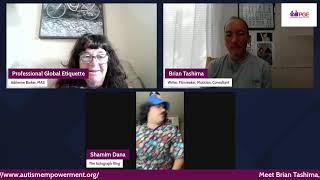
Brian Tashima, treasurer and editor of Spectrum Life Magazine, discusses his late autism diagnosis and creative projects centered on autistic characters, including the film Hold My Beer and the seven-book Joe Suzuki series. He shares resources for diagnosis and invites story submissions to the magazine.
Chapters
Oops, I'm smiling because I'm having a threesome.
I love it.
So, Shamim and Brian, so we are live. Shamim is, uh, I have known Shamim for, oh, it feels like maybe 4 or 5 years. He had reached out to me regarding something with the gallery. Anyways, we had a friendship. His father, amazing attorney, Uh, helped with SCORE a few times, and Shamim will say, Adrian, I have a friend, someone you need to interview. So today that's what we're doing, and Shamim's going to introduce our guest. So take it away, Shamim.
So everyone, um, today we'll be, um, talking to my friend, a really fast friend, um, Brian Toshiyama. He is the editor And Secretary and Treasurer of the Spectrum Life Magazine, which I am in right here, which is, um, here we are.
Yep, there you are.
Wait, let me see again. Oh, I love it.
And then here is— yeah, so we did this, and here I am, and then here's Brian.
That's awesome.
So how this came about was my mom and I were at Little P's, um, speech therapy here in, um, Portland, Oregon, um My mom was trying to get me active in the community with film and all that stuff. So we were reading in the previous issue of Special Life magazine, this article about Brian and his film Hold My Beer, which is a story about a young adult with autism who finds a way a new passion in life by creating Craft Beer. And they, they go on this adventure, and, and it's a short film. And Brian's also an author of a 7-volume set of books. It's called, um, Joe Suzuki, and it's all about an autism boy, um, with this love of music takes him on this journey and finds his true calling with music. And, and how— yeah, so pretty much this friendship started in, um, I found out Brian on April 26th, and then now— and then I met Brian at the autism walk on that— at the autism walk at the Oaks Park On August— when, when was it, Brian?
April.
April of this year. And then we did the interview on May 17th, and then Brian came to my party and did some photos, and, and the article came— is, is out now, which me and Brian did with Scott. And that's the story on how me and Brian met, and now We are right now trying to get Brian's series greenlit. So that's where we are right now. So that's why we're here with you, Adrian, with that help.
So, Brian— so, Shamim, I want you to introduce Brian to everyone.
All right. So, Brian, this is Brian Toshiyama, and he is a musician. A father of two kids with autism. He's also a musician, and he's also the, the treasurer and editor, co-editor of Spectrum Life Magazine.
Nice. And where would I find that magazine?
Uh, you can find it, um, online at spectrumlifemagazine.com.
It's actually spectrumlife.org.
Spectrumlife.org. So I'm just going to put that in my thing so we have it. Shamim, before we're going to go into, uh, right now talk to Brian, but spectrumlife.org, you said? Brian?
Yeah, what? I'm sorry.
Oh, spectrumlife.org, you said?
Yes.
Okay, so now what we're going to do is we're going to have Brian is going to fill in any of the gaps. We're going to go through the website, and then before we end, Shamim, you're gonna do a pitch on your movie. The audience— yes, excited to hear. So Brian, yes, shared some with you, but tell us, tell the audience who you are too.
Okay, yeah, so I am Brian Tashima. Um, I do a whole bunch of different things, as you may have, uh, I think you've gotten the idea from what Shamim has been talking about. I think the underlying theme or the common thread that everything that I do has is support for the autism and neurodivergent community. All my creative projects feature autistic characters or in the case of the film that I made, not only are the characters autistic, but we also tried to employ as many autistic people, talent behind the camera as well. The actors were actually autistic. We had autistic crew members, you know, like my book has an autistic character. And like Shamim said, I also serve on the board of directors for Autism Empowerment, which is a nonprofit organization dedicated to supporting the autism community. So, and Spectrum Life Magazine is one of our, one of our programs. So it's a program of Autism Empowerment. So that's kind of what I do.
So is Autism Empowerment, so it's not your bism, it's a program that you serve on the board for?
Correct. It's a nonprofit organization based here in Vancouver, Washington. I was personal friends with the founders, like our kids went to the same school together, so I knew them before they even started the organization. Then once they started to— once they decided to get it started, I wanted to be involved, so I got involved. And then, you know, after a little while they invited me to join the board of directors, and I've been with them ever since. So I think it's been about like maybe 13, 14 years. It's been a while.
So that's a huge amount of time. I love it. Okay. And then so they have Spectrum Life Magazine, Zoom Autism Magazine, the Autism Empowerment Podcast.
Ooh.
And a broader reach of the West Coast. I'm saying ooh, because just so you know, so my friend Sheila just created a program where you could take your podcast to a book. So just a thought. And it's, it's amazing, amazing price, and you could do 15 episodes and have a book. So, wow. All right, now we have— okay, so then I— so do you have your own website, Brian?
I do. Well, I have like websites for my various different projects. Um, for myself personally, I have like a blog. It's at the brian-tashima.blogspot.com. Com.
Okay, and then what, do you have one that kind of incorporates everything, or is everything kind of like a little bit, you know, one site for this, one site for this? Do you have a, a holding site that has everything?
Um, well, my, my blog kind of talks about everything, and it mentions in my bio like the different individual sites that I have. Like, I have one for the movie.
Oh, let me go in there then. Okay, can you put it in the chat? Would you mind?
Yeah, no, sure.
All right, and then I'll get that pulled up so we can kind of show everyone what you do. And so the beer, um, Hold My Beer, is that your first film?
Yes, correct.
Awesome. And you are the director, producer?
Yeah, director, writer, producer, basically everything.
Nice, nice. I, I want to share with you both— I, I think Shamim, I had talked about— so I'm on Chatter Social And there are a lot of film actors and actresses, film, film producers, directors. You may get a kick out of it. It is a really cool program called Chattersocial.io where you have the ability to— the real people, but real conversations. And you can actually be like, I'm like talking so people can see your face and know who you are. So it's really an amazing space. And also a great way you can get rockets, which is actually money when you run a room. So I think that you would be perfect for ChatterSocial. So if you go to ChatterSocial, ChatterSocial.io, and I'm going to put it in the comments too. I'm going to grab yours.
Okay.
And then, okay, the private chat. Let me go like this. Let me grab what you said to me. And I'm also going to put this in the comments, connect with Brian. Boom. And then I'm going to open it up and I can't wait to see what you have. Ah, ready guys? All right, we're going to share our screen and then we're going to go right here. There we go. There's Brian's blog spot. Wait, so do you own this or what? What happens, Brian, if something happens to Blogspot?
I— then I guess it goes away. I don't actually own it.
I know, that's always something to think about though, right? So, um, now, so you have both children, so you have two children and both were diagnosed with autism?
Yes, correct.
And how old are they?
They are now 26 and 22. Wow.
So there was a 4-year difference. Is that— is autism then, is that hereditary?
It's largely hereditary. In fact, the funny thing is that if we have time for a little story here, when I was doing my promotion press for Hold My Beer, the film, we were doing an interview with the Columbian, which is the newspaper here in Vancouver, Washington, and One of my actors, she was telling the reporter, she was like, "Oh yeah, I've worked with a lot of directors who are autistic and I think it really helps them in directing films because they're so focused on details and blah, blah, blah." And I'm thinking, "Wait a minute, does she think I'm autistic?" Because I never said I was. And then so that sort of set off this chain of events where I knew my kids, they had been officially diagnosed when they were young. And even my dad, he's not formally diagnosed, but he's very obviously autistic as well. We kind of came to this conclusion. And so but then what her words kind of set this thought in my mind of like, maybe I am also autistic because it is mostly hereditary. So I ended up, I talked to the founders of Autism Empowerment. And they were like, yeah, Brian, you know, we've always kind of thought you were, but we didn't know what to say, because we didn't know how you would take it. So I'm like, okay, so from there, I got like a formal assessment. And sure enough, I have like what they call Level 1 autism, which I guess used to be called Asperger's syndrome, but it's kind of like a mild form of autism. But I was like, wow, so I'm, you know, I'm part of the community. And when I told my kids this, like, my oldest, he was like, oh yeah, I kind of knew for years now. Yeah, he told me, welcome, welcome to the community. Thank you.
I think of it as a spectrum. I didn't even know that there's levels. And then can I ask, if you don't mind, how you went about, like, what is— what did that look like, that the testing or what you had to go through for an official diagnosis?
I guess there's different ways to go about it, but the doctor that I work with, he gives you a bunch of— they're like these standardized tests that a lot of people use. And so I took those just at home online. And so he would get those results, but then I had to go in and meet with them several times for an hour or two at a time where he would actually interview me and ask me questions. And He himself is also autistic as well, so it was kind of neat. But so, you know, after a few of these sessions, then you just, you know, he answered some questions, you know, he makes some notes, he compares that to the online test that I took, and, you know, he comes up with a diagnosis based on, based on that information.
How important— why do you need a diagnosis when you're an adult?
I mean, you know, you don't really, but I mean, like, to me it was kind of Once I suspected that maybe I was on the spectrum, I thought, well, it'd be kind of cool just because I've been involved in the community for so long and I've just been a very avid supporter and advocate for the autism and neurodivergent community, including my kids. Everything I do up until this point, like I said, has been kind of in support of the autism community. So I thought, well, "It'd be kind of cool if I were actually an official member of that community." So now, my voice is now part of this greater whole. I'm not just an outsider kind of helping, but I am actually part of the community myself now. So it was kind of important for me to do that. I thought it'd be a good way to kind of stand with my kids, have solidarity with them as well. So yeah, it was something that I, really, I think I wanted to do, I guess. And so it kind of makes a lot of things make sense. I think you'll hear this from a lot of people who get diagnosed as adults where they say, yeah, now these things that, it just, it answers so many questions and it makes things make a lot of sense retroactively where it's like, okay, that's why I react to things in this certain way. And now you can kind of like, because I think as adults we learn how to mask, they say, we learn how to try to fit in with society and you'll follow certain scripts when you're talking to people. We learn how to make eye contact even if it's not comfortable. But now when you have that official diagnosis, it kind of gives you the freedom to feel like, okay, well, I can be more myself now and I can give myself the grace to to understand that, hey, I don't want to go to that party. It's okay. It's fine. We can stay home. It's cool. You don't have to pressure yourself to feel like, okay, I need to do these things that make me feel uncomfortable just to fit in. Sometimes knowing your neurology now gives you kind of a reason to be, okay, well, I can be more accepting of myself as well.
So how would someone actually go about finding— is it a doctor or can someone else— how do you go about finding someone who can help you identify? So it's not for money or any services or anything like that, but just so that you can kind of switch your mind and your mind, um, like a mind shift. I just had a great guy yesterday, Mitch Weisberg. But you know, just so like once I know who I am, I love what you just said, some of those steps, but Where do I even go to get help?
Well, it depends on where you're located. I think like if you go to the autismempowerment.org website, there are lists of resources there. Basically you would just go to like, I guess any kind of like a therapist who specializes kind of in, you know, like maybe who knows, who's knowledgeable about like developmental disorders. Like the doctor I went to, for example, is actually on the board of Autism Empowerment along with me. So I kind of knew him already from there. So if you're in the Vancouver, Washington or Portland, Oregon area, like, you know, I would highly recommend him. Like I said, he's neurodivergent himself. So he, you know, he has an understanding just, you know, from his own neurology. So, but I think you can just kind of look up, you know, like, you know, providers who do, you know, start with therapists and then kind of, you know, do a deeper dive from there and see what their specialties are.
Okay. And is a savant still a term that's used?
Used?
It is.
I mean, the community, we don't like it too much because it evokes these images of like Rain Man and kind of these stereotypes where, because like, you know, not all, like you said, it's a spectrum. So, you know, not all autistic people are savants. I mean, you know, you have those. There are certainly like people who are very, very talented and, you know, their neurology allows them to like hyper-focused on certain things, or they have a talent for certain things. But, you know, not everybody, you know, not everybody in the community is like that. You know, like you said, it's a spectrum. So it's kind of a stereotype that we try to avoid.
Got it. Everybody's different. Nobody's perfect. Every brain is different. No one's perfect. All right. So then when your children were 22 years ago, 24 years ago, or 26 years ago, I think you said 22 and 26.
Yeah, 26 and 22. Yes.
So I know at one point there was a— where it was, there was a conversation to the doctors, the pediatricians, to say, okay, we want you at the age of 2, I think it is, to start testing, to start looking, having that discussion. Was that taking place with your children? Were they diagnosed at a young age from the pediatrician, or was it more school age?
Well, I guess, you know, when they were young and, you know, autism research and knowledge and awareness has come a long way, I think, in a relatively short period of time. Like when my kids were young, like we didn't actually know, like I, you know, like when my son was, you know, 1 or 2, I actually didn't know what really what autism even was at the time. I think at the time, you know, they were calling, they weren't even calling it Asperger's yet. They were calling it like Einstein syndrome or things like this. And there wasn't a whole lot of information there. It's come a long way. But like, so for my kids, you know, we kind of noticed in the beginning, like when they were young, like when my son was 2 or 3, he could barely talk, you know, as compared to other kids his age. But, you know, he taught himself how to use a computer, you know, like when he was 2, and he was already doing things on the computer that like I didn't know how, you know, how do you do that? Like I didn't know. And, you know, he couldn't explain to us how he figured it out, but I mean, he just did. And here he was just just doing things that just blew my mind. And so, and with my younger kid, we didn't actually know for kind of a long time because autism presents itself differently in people, like we just said, right? I mean, every brain is different, it's a spectrum. So for the longest time, we didn't actually think that they were on the spectrum. It only came about later on probably like in high school or, you know, around that time when they were older. So it's, you know, I think everybody's journey is kind of unique and kind of different. I think now there's a lot more knowledge and resources. So, you know, it's possible to kind of identify it early on, which is good because then, you know, then the kids can get the support that they need. Like with my son, with like all the support that he got from the schools that he was in, I mean, that I think really made a big difference and really kind of helped him. You know, today he's, you know, he has a job, you know, he's driving and he's pretty independent.
So I love that. I love that. Let's look at your blog. So I'm going to go to your blog and okay, so this is interesting. So music, writing, parenthood, and other random thoughts. They've got that together. You just wrote last Thursday, Overcoming Writer's Block. Love it. Love it.
Love it.
Love it. Start writing your book with math. What? No, I can't. I don't even know math. I love this. Not because I'm Asian, mind you. I actually didn't like math as a subject in school. I think it might have more to do with my neurology. Me too, by the way. I haven't been tested, but I definitely have some kind of math issue. And I'm pretty sure my daughter has dyscalculia. Oh, so you really have some really great blogs that you're writing here. I love it. Is your video Uh, like on YouTube, where would your video be?
Yeah, you can go actually to youtube.com. You go there too. Yep.
Oh, or what were you gonna say?
Uh, well, we have a direct link on YouTube. It's the YouTube slash at, uh, Hold My Beer Film.
What is it?
Slash, uh, at Hold My Beer Film.
I-D-E-A? Sorry, it's @home and what's the other word?
Uh, @holdmybeerfilm. Oh, I'll put the link in the chat. Hold on.
Okay, yeah, let's do that. I'm thinking I'm gonna try— I'm searching. Okay, yeah, I need your help. All right, let's take a look, you guys. Let's do it. Let's, let's— I love it. You mind if we do it now? Let's see, Brian.
Yeah, no, go ahead.
Private chat. Hold My Beer film. Okay, and how long? Oh, it's 38 minutes. Can we, can we just kind of look at it for a second?
Yeah, there's also a trailer if you go down.
Oh, I'll go to the trailer. Let's— oh, I'm so excited. Okay, here's the trailer, guys. 38-second teaser coming up.
Go to the Go to the trailer. Oh well, that's okay.
Oh, this is a teaser. Okay, hold on. The teaser, the trailer. I like all the behind the scenes. Okay, ready? Okay, get your popcorn. Okay, we're gonna do it.
I got this car and look how much I was paying for insurance.
I'm excited about this, right?
I use this website and now look at it. You need direction in your life, Val. You've seen a little downly And we think it'd be in your own best self-interest if you picked yourself up and started doing something. You know, anything. There's nothing I'm interested in.
I always thought autistic people always had some kind of special interest. It's a stereotype.
I thought this is what I was meant to do. The brew beer. Uh, there's supposed to be music on this. I don't know why it's not playing.
I hear the music. Okay, you hear the— you hear it?
Oh, sorry, I just wanted to double check.
Hold on, hold on. I'm I love this. So he needed to find his passion.
Do you know the—
any of these people you know, like the actors? I'm sorry.
Oh man, that is in first place, winner of a $100 gift certificate to my store and champions of this year's contest is—
really? You're gonna do that to us? You really did that to us. I don't even know what to say. I, I literally don't even know what to say. Okay, let me— two things. Let me just take— hold on for one second. That was Amazeballs. And, um, okay, so I want to take this, the Hold My Beer film, and I want to put it from our studio chat. I'm going to throw it in the comments. Everyone watch it, like it, share it. It's really great. I can't wait to show it to my daughter and her son. I wonder how many people watched it and thought to themselves, oh, let's try beer. I haven't found anything that I really enjoy doing, but I always— I think anyways with our children, Brian, we should expose them to as many things as they can. You know, yes, you got to play the flute, just see if you like it. Yes, you got to play the violin, see if you like it. Yes, you got to write, see if you like it, right? Like one of those things.
Yeah, no, I agree.
You don't like soccer? Fine. Let's go to tennis. Anyways, so I love that. Is there anything else that you would like us to know?
Well, let's see. Well, I have a bunch of other things. Well, Spectrum Life Magazine, I am one of the contributing editors to that. And so I did the interview with, with Shamim about his film. And it came out in the most recent issue. So, um, yeah, I guess we could maybe segue to a plug for The Autograph King.
Just let me just take 2 seconds to just do this for a second. Hold on one second. So everyone, because I just want everyone to be all on page as we are, I'm pretty sure You see it? Oh yeah, yes, yeah, yep. Okay, so there's the magazine. And then, so you are a, a writer for the magazine. So if someone feels that they have a great story, A, they wanted to donate and support, B, they— this is great, it's got providers, all the stories, Warriors Hold My Beer film. Oh, look at all these, this is great. The Zoom Autism Magazine, The Spectrum Life. So wait, so if they have a story, should they reach out to you?
Sure. Yeah.
Okay. All right, we'll have that information. In the meantime, everyone enjoy, uh, you know, make sure you just take a look at this. I'm not familiar with this, so I am excited to see that. We are going to go back to the studio. Okay, so thank you, Brian. That was a great interview. I loved it. I love the film. I can't wait to go and watch it. It is— I mean, the film is there. We only had, you know, I mean, I guess I could stream it next time. It's 38 minutes, so everyone watch it. Please, and leave, like, share, follow, all that good stuff. Shamim, what's going on? The Autograph King, when is it coming?
Okay, so according to the interview that me and, um, Brian did with Scott— so according to the interview, it says Scott is hoping to get it released by the end of the— of this year or early next year. So we're right now in the process of trying to get The, um, so we did the interview with Ryan as something people can actually, uh, physically read about the film so we can actually get people knowing about the film. And then now me and Scott are trying to, uh, look into distribution right now, um, and then we're trying to, um, reach out to local, um autism organizations, uh, to see if they want to get on board. And then that's pretty much it. So, so the— and then Brian's book. Yeah, so Brian and I are trying also on the Flipnote, uh, trying to get the series greenlit. So right now, um, we have, um, a And then so pretty much we have, um, the— some people who are interested. What Brian is actually looking for right now is connections, either if you know anything, Adriani, about maybe talking to the people you know to see if we can start the whole MyBio series. And then from there Brian has other ideas, like for example, Home might be a video game, um, a whole— a, um, Neurodivergent, the actual pub from the movie in real life. And then he also has a comic book out, um, that he's looking for artists to, um, uh, finish up the issues. So I, I've been working with Brian for the, um, like networking and getting contact information for Brian to see who might be interested in actually doing the series of them. So originally the movie was supposed to be a, a pilot episode for episode 1. So Brian then decided to make it into a short film as a teaser for the series. And the beer is like Zelda meets beer. It's like kind of like— I would say it's like tapa, if you would say, right, Brian?
Uh, kind of, yeah. Talking about the video game, but yeah.
I love— Shamim, can I play the, um— because I do have to run soon. I want to play the trailer. Do you mind if I play the trailer for everyone?
Yeah, go, go ahead.
Let's do it, let's do it. Okay, this is update, The Autograph King trailer, March 19th, from Scott Zakarian. Okay, beautiful. Oh wait, I gotta subscribe. Okay, there we go.
Let's go. But I can't wait to see The Autograph King movie. I want to learn more about this side of you.
My original idea was to get everybody who worked on the film.
Tusha meme, happy 20th anniversary comic book, the movie.
He's the autograph king. When I think of autographs, I know who to resort to.
He was probably barely able to walk and talk. That's when he got exposed to autographs.
It's not about the autograph, it's all about the connection.
His eyes, his ears, his hair.
Eye surgery. His one leg was very tiny. Yay, good point, Shenny! Grab, grab, grab! He can't see through that.
He doesn't have depth perception. He only sees with one eye, not both eyes.
It's so incredible. He just has all these difficulties and he's still He still makes it about other people.
He's everybody's best friend and he's everybody's biggest fan.
He's overcompensated everything that somebody with cerebral palsy would be able to do.
Hello, my darling.
I came up to you and said, "Hey cutie, you got a nice haircut today." He includes everyone and he's not overthinking every single thing like I am. It's all about just collecting what you love. Stan Lee is right here.
Nice.
1,117.
1,118.
One of the baseball players I met was Willie Mays, Hall of Famer, at his house. Antonio Banderas.
Caro Spinni.
Big Bird. This is my Weird Al collage I made.
You make my day very happy and very positive.
Make some noise for my friend Shabin, the autograph king.
How many autographs did you sign today?
Oh, that's making me cry. Shemim, that is so beautiful. Even though I've seen it, it just makes me cry. I know, it's touching. It's really touching. Listen, if you are, uh, if you're listening to this podcast, you got to go to Adrienne Barker Speaks, no prep needed, and just find the, find the video so you have the YouTube. Oh, I think Shemim's going to sing us out. Shamim, I don't— you know what, I, I didn't tell you, Shamim. So I, I do true crime, so I host a true crime podcast with Joseph Tuesdays and Thursdays, and I could talk about like true crime and not cry, but stories like this with humanity just hits our heart all the time. So I'm gonna mic because I feel teary, and you take it away with the music. Wait, I can't hear the music.
Hold on, let me get my hearing aid out. Uh, one sec, let's see, one sec, uh, one second. There we go.
Okay. Shabim, whose guitar— who autographed that guitar?
Uh, nobody.
Oh, what the heck, nobody? I'm assuming everything is, uh, is autographed.
Like, yeah, uh, here is the other. So I've got the other guitar, which is— this is a guitar that my friend gave me, which I— is signed by Thomas, right? There, uh, Sandy from, uh, Dan from Blockbuster and Sandy right around—
oh, the last Blockbuster.
Yeah, Sandy Harding, uh, Sandy from Blockbuster's here. And then this is the guitar that I helped Sandy with, uh, with, um, so last year, April 7th of 2024, me and, uh, Sandy created this event with Thomas and Nicholas for Last Blockbuster to like promote Last Blockbuster, and, and that was a fun event.
I love it, Shamim. We're gonna, we're gonna be closing out right now, but, um, I think we need to go back and do another interview, uh, where you could show off your— oh, I see a tabby too, because I have a tabby too.
Nice.
Yeah, they're so cute, aren't they?
We just got this done.
Oh, look at that autograph king. Oh, oh, and then put it— ah, Shamim, I'm so excited for the movie. Shamim, everyone, is incredible. He brings me some of the amazing— Shamim, remember when I interviewed, uh, what is it, C. Andrew Nelson? I introduced his friend. I had no idea. I never seen a Star Wars movie. I never even knew. I never even knew that, uh, I had to ask him if Darth Vader was a good guy or a bad guy.
Here you go, the last thing that I should have to show for you.
It's a good interview though.
All right.
Oh, you are so cute. I love you, Shamin. That's from Barker Animation Art Gallery. That's how it all started. You know what, guys? That's how I tell people all the time— say yes to opportunity. Someone reaches out to you and makes a connection like Shamin did via Facebook, don't ignore it. You never know where it leads. That is awesome, Shamin, the certificate of authenticity. Oh my God, I absolutely— this was empowering, Brian. You gave us insights on autism. You want to check this out?
My, my first ever Frank and Ollie from the Frank and Ollie, um, film.
That was one of my favorites too. I'm so glad you have that.
So I decided I needed a, um Frank and Ollie autograph to my collection. I was looking for an autograph that's not expensive, so I decided— I was just looking, I stumbled upon Adrian's, um, father's museum, and look at that, the autograph from your dad.
You're gonna make me cry.
Don't make me










