Meet Coach Willie Blak
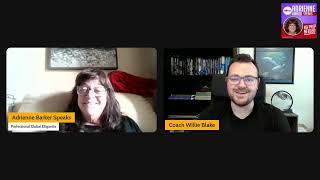
Coach Willie Blake, diagnosed with dyslexia in first grade, now coaches dyslexic entrepreneurs. He explains how dyslexia affects processing and communication, outlines the strengths it brings like creativity and big-picture thinking, and shares practical tools: multisensory lessons for learners, voice-to-text and audiobooks for adults, and a coaching framework built on small daily actions.
Chapters
We are, we are back on Adrienne Barker Speaks, No Prep Needed. Coach Willie Blake, did you know that?
I—
because I didn't ask any questions about who you are. You do know that I don't prep. I have no clue who you are. Well, just a little bit from your bio.
Yeah, thought we just jump in and do it. I love it.
I look at it like we just met for a cup of coffee and You say, I'm Coach Willie Blake, and I'm like, oh my God, let's get a cup of coffee together. You treat me and, and I'm learning from there.
I love it.
So I can't wait. I did see a little bit because I did put the bio in. So tell us, so introduce yourself, please, please, please.
Yes. So I'm Coach Willie Blake. I help dyslexic entrepreneurs and professionals to get clarity, confidence, and make more income with their dyslexic edge. I've seen that throughout my life. I wish I had a resource as an adult for my dyslexia. I was diagnosed in the first grade. And so I want to be that for other people, helping bring light to their life. And as a girl dad of 4 who just loves adventure and curiosity, just trying to make the world a little bit, a little bit better, one person at a time.
Oh, I love that. I absolutely love that. So I was telling Coach Willie Blake— don't you like that? CWB, Coach Willie Blake— that my daughter has dyscalculia and her superpower is her— she's so organized and so process-driven, and I am not like that. So I'm like, wow, is that so? Let's go over— let's talk about the, the, the superpower because I want to jump right in. Like, how can that be someone's superpower? I'm really curious.
Yeah, so dyslexia or dyscalculia, for those who don't know, it's basically the dys- before just means difficult. So calcula, math, lexia, reading. There's like graphia, writing. There's a bunch of -ias that go with it, but it all comes down to how you process information and then how you communicate it outwards. So it's just like our brains are wired differently And because of that, the way that we intake information through how we see, how we hear, how we internalize it in our head, and then how we communicate it outwards. Sometimes there's that gap.
I want Alani to hear that. Hold on for one second. Hold on. Let me see if I get my daughter. This is like crucial information.
Yeah.
Okay, Alana's coming. Just sit here and relax, Alana. Take a few deep breaths. This is Coach Willie Blake. You know, if you want to come over here, if you want to do the interview together, or if you want to just listen. So we started. So first of all, I didn't even know that. Did you know? Can you talk about the DISC before? Because start all over because I want Alana to hear this because I think we both can learn.
Yeah. So the DISC for either dyslexia or dyscalculia, the dys part, I believe it's either Greek and Latin. I'll go on the edge and say the Latin, but the Latin meaning of it is difficult. So with dyslexia, it's difficulty, lexia being reading. For dyscalculia, it's the dys, so difficult with math, which is the calculia part. And so it just comes down to how we process, how we process it, of how we take in information through the way that we see, the way that we hear, how we internalize it and interpret it in our own heads, and then how we communicate it outwards through whatever language and body language, nonverbal that we use. And so all that together, people who are neurotypical or like the average person who doesn't have it might see things one way. And when we try to explain it or try to understand it, there's just like this little disconnect. But it's not bad. It just means that the way that we think of things is just in a different wired way.
So, Alana, when Coach Willie Blake started introducing, he said, but it's also his superpower. And I love that. And he helps entrepreneurs. So we're having this conversation. As Alana knows, I don't know who's coming on. So it just so happens when I saw this and we— what do you mean by graphic? What?
What?
Because you said something about this. Something for that— someone that has graphic or—
yeah, just dysgraphia. So the graphia is writing, so the ability to write.
So what does that mean? What do you mean, the difficulty writing, like handwriting, or—
yeah, so writing, messy handwriting? Yeah, just anything that has to do with just writing, cursive, anything writing in general. Um, goodness, it's been a half second since I've had to explain dysgraphia, but it just— yeah, it's just the symbol of writing. It's just—
I'll look it up—
ability to write words that are clear. If you think of like the doctor's notes that are like the chicken scratches, that's kind of like dysgraphia at times, where it's just hard to create the letters, the symbols that we use that we call the alphabet.
I, I think I may have that. I, I really have. Oh my gosh, that's crazy. Nobody can read my handwriting, weirdly enough, including myself, which is really the worst. But Alana, everything is so clear and, and amazing. So what are your superpowers, Coach Willie Blake?
Yeah, my superpowers. Dyslexia is a big one. That's like the big overview of it. But because of that, I'm great when it comes to creativity. I think outside of the box. It's very easy for me to take a back step and see the whole picture rather than just like this problem has to be done this way. I'm like, it can be done that way. And there's also this way, this way, this way, and this way. So I'm able to think of out-of-the-box solutions as well as when it comes to sympathy and empathy. I can relate to a lot more people just because I've had to go through so much. And so there's a lot of different just superpowers of perspective, patterns, creativity, emotions, empathy that come with this awesome superpower that I call dyslexia.
Wow.
Okay. So you're—
you—
what did you say? You were 6 or so when, when you realized it? Yeah.
So I was diagnosed in the first grade, which is about 6 years old.
Okay.
So you diagnosed That's so interesting. And so you're diagnosed in the first grade because they started realizing as they were asking you questions, or because that's early to me. I wouldn't even think that you could be diagnosed that young.
Yeah, so when— so we went to like, we went to a different classroom. It was a random day in first grade. Teacher led us there, and it's just the program that they did. They had us each read a piece of paper that had a lot of words on it, no pictures. And when I read through it, I stumbled over the words. It was very hard to complete the sentences, and especially the big words. And by the end, they're just like, oh, thank you, you can go back to your classroom. Little did I know that was like the first indication in my school that they did for whatever program they did, that I was dyslexic. So from there, they they talked with my parents and lo and behold, I had this thing called dyslexia.
That is interesting. Okay, so now you're— so now once they told you, was there some, you know, like, how did they help you? What was some of the things that they could do to support you during your school year?
Yeah, elementary school. It was a lot of— it was the last Friday of each week for an hour, I'd go to a separate classroom. And I think with other dyslexics, because we were practicing reading and writing, had, we had a lot of fun. There's a lot of games, the rewards to help us think in a good way about it. So through elementary school, that's what that did. Because we found out so early, my parents were able to get more involved. And they helped me with this. I guess you can call her a tutor. Um, but it was just like I went to a random building that had this person in it who helps kids with reading struggles. And so we went over flashcards, we played little word games on the computer, and just, yeah, just those interventions. Uh, one thing I didn't mention, one of the bigger ones when I was in middle school and high school was before school even started I would go and meet with all of my teachers and have a meeting that said, okay, Willie has this dyslexia, and because of his— I believe it's 504 plan. I keep mixing 504.
Oh, are you mean that like IEP or an IEP and something else? The individual education?
Like, yeah, yeah, kind of like that. It's called— in where we're at, it was I believe the 504 plan, which basically was like giving extra time during tests.
Yeah.
Okay.
Sharing the notes, getting the presentations to send home, sitting in front of the classroom, those different things. So those are some of the things that helped me when I was growing up.
So I actually thought that if you had dyslexia, like you just— it was with you your whole life, you really couldn't. You know, you maybe— I thought that you really don't even— if you tested or tried or practiced, that you would still have the problem. But is it something that could be changed, that you can work with your brain to make sure and kind of do a twist on it? I don't even know the wording of it. I just, I just saw Jim Quick from Limitless this weekend, and he made me realize, wait a second, there's so much you can do with your brain. So, like, where are you now with it? Does it— is it still an issue? Have you?
Yeah.
I don't even know the words.
Yeah, still an issue. Like, just, I'm gonna have dyslexia the rest of my life. It's not a curable thing. And I don't think I want it to be curable. Because, of course, I have a hard time with reading. It takes me longer to read. But I'm able to listen better because of it. I've been able to observe a lot more. From people, body language, world events. I've been able to make connections that other people aren't able to connect. And so just like all these different things— I'm going to have dyslexia for the rest of my life. And now that I see it in a different way, I'm like, yeah, I still have a really hard time with writing. And when it comes to processing information, people have to not just give it to me in like a textbook format, but if they can do some type of visual with it or a video or audio, then I can— that's just the way that I learn a lot better. So it's, it's not something that I can overcome necessarily, but you can manage it and live with it and see it in a different way that you can actually use as an advantage.
So I wanted— I want to talk about the entrepreneurs. And hey, AR, let me bring you up if you'd like to come up. So if you had to give advice to teachers that are, have children in their class that are dyslexia, what advice would you give them? Because all the work that you've been doing, I mean, the goal is to graduate the student, right, and to expand. But if everything hinges on being able to do something, I'm trying to understand, like, how does that work for the teachers? Because are, and I'll ask one question at a time to make your life easier. So what advice would you give to a teacher that you feel from your perspective as a student and now an adult?
I would tell the teacher, and they're kind of in a hard place because they have their system that they have to follow. They have their, the curriculum that they need to apply to and make sure they cover. But I would say each person learns differently. And so you can make each of your lessons be attractive to everybody who learns in different ways. Let me give an example. A way that one person learns is through reading a book, and that's awesome. Another way people learn is through when they have music in the background, that when something is applied to music, they remember it better. That's, that's the reason why I— that's one of mine. And it's the reason why I still remember back in the 4th or 5th grade when we did the all 50 states in alphabetical order. I can still remember that to this day simply because it was put to music. So music's another one. And you can also put visuals, pictures. You can also do hands-on experience. So if you're teaching the subject of, let's just throw one out there, a history lesson on Columbus coming over to America, you can do like a little role play type thing with all the students of Columbus going over the ocean blues in 1492 and like going in the classroom, showing them crossing the river to the other side, meeting up with the Indians, and what they teach in school. So there's different ways that you can do it. Some are visual, some are text, others are audio. But being able to really engage as many senses as you can will help you to hit at least most of the students, if not all of them, in their learning.
Oh my gosh, I love the AR. And Nuala, I'm trying to bring you up if you want to raise your hand again. I don't know what's going on with the app.
I—
we're live on Chatter Social. If you're just wondering, who's she talking to? She's interviewing Coach Willie Blake, and then she's mentioning AR, and I want to get AR up here. So hold on, let's see what we got here. Sometimes things get glitchy, right? So let me go here, invite to speak, and Nula— I don't know what is going on. AR, someone— I'm like, okay, make moderator. I can't bring you up. It's the craziest thing. Um, if you have questions, put them in the chat, but I did want Coach Willie Blake to, um, hear your voices. I have to say, that's how I learn. And Jim Quick, so this weekend, did like a thing where like avocado and I don't remember the rest, but like, uh, olive oil, like for memory. But I definitely learned better when a teacher, when they did skits and if they had us be part of the skit. So that story that you were telling, that, that kind of, that would do great. But a lot of teachers, it's hard for them, right, to, I mean, in the first place, they have neurodivergent brains. Everyone learns differently. So I want to get back into the workplace now because I do work in the workplace. And there's some times where things are sent to me, like, I'll get videos and I'm like, videos are so hard for me. I'm more of like a step-by-step. So for me, watching a video, so I need the transcript of it. So I have to transcribe it because I can't just listen to a video and do it. I gotta transcribe it. I have to try it and then watch the video and then I do it. I really wish the world would understand that we all have different brains and that we just learn differently. What do you think that teachers, that a lot of students that have dyslexia are also pushed through the school system?
What do you mean by pushed through the school system?
Like they're, you know, they're graduated, they, they, they every year they're going up a year, but they're not. Let me, let me see if I can bring up now, Nuala. Every year they're advancing, right? And they're, and they're going from 5th grade to 6th grade, or maybe they're not. Like, do teachers, um, leave you behind? Do you fail a class? Have you seen any of that? I'm just trying to get a feeling so we can kind of help others.
Yeah, um, it really—
I—
it's not my expertise in like how it goes through the school system. I know at least for myself that I— for me personally, I love math, so that was easy for me to be in like an honors class with. But others like history and English, I was behind. And so I just continued to go through the school system and had to figure out my own ways to really learn and grow. I was at least reaching the barest of minimums in some subjects so I can go to the next grade.
But I know, right?
Yeah. Oh yeah, absolutely. Like friends would be hanging out and I'd just have to stick back and read my notes and try to memorize things, which took forever to do. But yeah, a lot of extra time to do it.
Sorry, Nuala, I'm really trying. I'm like, I keep— you can see my eyes are on my phone. I just— I'm having troubles. I wonder where Leah is, if she can come in and help us. So, all right. So the cool thing about Coach Willie Blake is that he actually is a coach for entrepreneurs. So I love this. So why does an entrepreneur even have to share it with anyone? Do they have to tell anyone they have dyslexia, or they're just getting the private coaching from you?
Oh, so coaching specific. I, I'd say in general, like, most people either aren't, either aren't diagnosed with it or are diagnosed and don't want to talk about it. Because it's just one of those really taboo topics. It's not like you talk to your friend and just like, hey, do you got dyslexia? It's not something you talk about, right? So it's like, it's really a lonely type road unless it comes up somehow in some conversation. That's why I love focusing in a bunch of areas, some with my YouTube channel that I have, others with the podcast that I have. And others with like LinkedIn articles that I write. So I'm hitting all the different areas so that when people are scrolling through social media, they come across and say, hey, who's this dude named Willie? They look at my stuff and they're like, oh, he's dyslexic, I'm dyslexic, I wonder what he's talking about. And my whole thing is to really normalize the mindset of, cool, you got dyslexia, like That's a really cool thing. Nothing to hide about. It's not a 1,000-pound gorilla that's sitting in the room. It's just something that happened to you that you didn't want. And really, how many times in our life have we been given things that we don't want, but we just push through? We just keep going. We do what works for us. So when it comes to entrepreneurs and they come across my content and want to work with me, A lot of what we go down into is, one, what's your learning style and what works for you? And then two, just do something each day. Do something, a small action each day that'll get you to the result that you want. Because it—
that's—
it's one brick at a time. It's one step at a time. We don't drive a car by throwing our teenagers into the car, driving on the freeway, and be like, you got this. Don't hit the other ones. No, we jump into a parking lot, right? We're sitting, we, the parents sitting in the driver's, the passenger seat. We're like, okay, this is how you turn the steering wheel. Your, your brake is on the left, your gas is on the right, your clutch is here if that's what you're driving. And then you just drive slow and hopefully avoid the lamp post that always seems to be in the middle of wherever you're practicing driving. So it's just one step at a time.
I love that. Okay, but I know it can't be that easy. AR, if you want to come up, you could raise your hand. I forgot I could use the, um, the little burger on the right side and, and lift you up that way. I live— oh, there we go. And then, okay, beautiful. That should work.
I'd actually go to what you just said of it can't be that easy. I'll throw it back to you. Why can't it?
Wait, why can't it be so easy? Oh, to, to, to make sure I understand exactly.
No.
Yeah. So I was talking about how it's just like one simple step. You just do one thing each day.
Oh, I love that idea. I think that's great.
And then you mentioned that it can't be, can't be that easy. And so I was just throwing it back and just saying, why can't it be that easy?
No, you're right. You're right. I think I was thinking of the, um, the app, but No, you're right. I think that one simple step for all of us actually does make sense. And I know with Alana's dyslexia, one of the things is it's too much, right? There's one problem after another problem. That's what she has to do. She has to break it down into this step and then this step. But as an entrepreneur, so, so they're listening to you and they're getting the advice. But what are their daily challenges? What does that look like?
Daily challenges is hundreds of emails in their inbox that they're trying to go through. It's managing their team, that whether it's in-house or third parties that you contract with. It's really, it's the phone calls, it's the organization, it's putting everything together and making sure that we just don't forget it. Because of our— because of a lot of people's dyslexic minds, um, that I work with, it's the way that we're wired to be able to think more creative. And that's why a lot of entrepreneurs, architects, actors, musicians, the ones who like are in creative fields, that's why there's more dyslexics there, because we're more prone to creativity rather than just the organization of here's what you do and this is what you need to get done. Now, does that apply to all dyslexics? No, I know several dyslexics who are very organized and do their thing. And there's always the thing of I have this issue, this plus the hundred of other issues that are on my to-do list, which one do I start with first? And so those are some of the problems you'll see with entrepreneurs.
I love it. I love it. I want to ask you, and then, um, Nola and AR, I'll open up to you guys if you would like to speak. What, um, so working with someone, what does that actually look like?
Yeah, so we'll jump on, and the first thing we figure out is what they actually want, because if you don't have a desire, then why would you ever want to change? If you love your life right now, then I'm I'm not the person to be able to work with. Because I'm, I'm the person who, after you get diagnosed, or if you aren't diagnosed, I don't care either way. I care about what happens after. I'm just like, what do you want? What do you not have in your life that you're just craving? You're like this, I would really enjoy being able to add this PhD or MBA to my label. My name. Or, I would just love to be able to go out and socialize without the pressure of having to hold this appearance. Or, man, I want to start a podcast. I want to be able to share my voice and message. Whatever it is, I want to do it. And so I figure out first what you want, and that helps to get the direction you need to go. And then we go into reverse engineering it backwards. In simple terms, if you ever been to like IHOP or a restaurant and they have like the kids menus and they have the little mazes on there, anytime I do it with my girls, I always like visualize from back to front the perfect way to go. So when I finally put crayon to paper, I can do it flawlessly. And that's what we got to do with our goals going forward. There are so many different directions, but if we start in the back and find the milestones, then we create a nice plan to then be able to start working on. And so that's what we do is the very first call, we talk about what they want and break down the game plan so that they know what they need to do the next 30 days, what they want to do over the next 90 days, which is usually like the length of time that we work with, and then the immediate action they can do today to start?
You know, I, I, I keep going back in my mind to the dysgraphia, and if I said it correctly, and the fact, you know, I have, I have some different books, and when people say, well, you sign it, it's embarrassing for me because I, I don't write very nicely. Uh, and, you know, someone said, well, slow down in writing. And even when I slow down, it just is so happy to me. So it is affecting me. I guess I would call you and say, you know, how can I sign books? How, you know, what, what can I do? Also, I'm a little more messier in my computer. You know, I'm not like— I see Ilana's organization and it blows me away. Is that some of the things that you see too?
Yeah, but do— like, why not do things messy? Why not just try it out? Perfection is so overrated. So overrated. Progress.
Perfection is so overrated.
Progress over perfection. Like, if it's messy, if it's messy, let it be messy. It's all right. Who, who's, who's gonna look at it? My— your mother-in-law might look at it, or the friend across the street might look at it and say something, but are you really wanting to impress them? Like, if you're wanting something Who cares what other people think? And so like with dysgraphia, I think it's actually really cool that you have a really, really messy signature. I think those are some of the coolest signatures from authors because I open the book and I see the big signature and I'm like, wow, I don't even see your name in that. But that is the coolest thing I've seen. And I'm going to treasure that because it's from you. So I hope that you can see that I love those big signatures. Messy because they just show that it's you. The book is from you. Wow.
Um, Nuala, do you have any questions or thoughts? And then go to AR if you have any thoughts or questions. Yeah.
I like what you say about being messy. I, I know where everything, every scrap of paper of something that I've learned or noted down. Um, I know where it is exactly in amongst my mess. So I'm quite happy with that. I'm just wondering, from my point of view, and I was, you know, going through school, you know, going through, like, right up till my early 20s, I had to have, when I was learning or reading, loud music and, you know, vibrant music or the radio on, that kind of thing. And yet when that, and it happened quite suddenly in my early 30s, I just now, until now, I can't, if I'm reading a book, I have to be reading the book. And if I'm learning something, I have to have silence. Is there a difference in age groups in terms of how they learn and how their brain works? Is there a change, or is it all according to the individual? Not that I don't have dyslexia.
Yeah, great question. And first off, with the papers all being around and messy, I got a box— I moved it— I got a box on my chair over here that's literally all my documents and papers and bills that I got from just this last year, and I go through it once a year. Tax season. That's the only time I go through it because I just, I don't like papers. I just put them in a laundry basket or a box and leave them until just one time I can do it. And that's, that's as messy as it gets. And that's just what works for me. So I totally get it with your, with your question. I haven't seen I haven't seen too much of a difference between the age gap. Obviously there's the generic, like, as you get older, sometimes because of the electrons and things that are going in your mind that you might forget some things. And that, of course, when it comes to like dementia and that, that you start losing memory. But I would say that when it comes to, to learning and stuff, it always comes back to what's working for you. What's working for you as the individual. If it's reading a book in a quiet room to be able to learn, well then that's the way that you learn. I know for myself, uh, back in 2018 when I was first starting this whole what is business, what is, what is even this entrepreneur word that I keep hearing, I came across this statistic that said 95% of CEOs read 50 or more books a year. And I'm like, that's really cool. Ain't no way I'm reading 50 books, especially since maybe I read an average of 1 before. But 12 didn't seem too, too impossible. A book a month. So I got a little card and wrote 1 through 12 on it. And then I went to my bookshelf, grabbed, grabbed literally the smallest self-help book I had. Which was a purple book called Rich Dad Poor Dad, opened it to chapter 1 and started reading. And from there I read the 12 books and I set the goal for 40 books after that to do in a year. And I learned, uh, as I was talking about it, all these books I was reading, my friend said, hey, did you— do you know this thing called Audible? And I'm like, no, what is it? He's like, all these books that you are reading are in audio form and you can listen to them. And I'm like, cool. So I then I turned my car into a library. I was always listening to books. And I could listen a lot faster than I can read. So while I was reading very slow on page, I'd read a few pages each night, I was listening to books to be able to then get to that 40. And a lot of people along— well, not a lot, There were some people along the way that were just like, well, you have to read the 50 books. They have to be paper form. And I say, nah, they don't. Because what's the goal with it? The goal is to be able to take away the lesson that you're reading. So whether it's actual reading the text or listening to the words or watching the video summary on YouTube, You're getting the lesson. So I took away that judgment of I have to read 50 books, and now I just am absorbing 50 books. And that, that 40 books which led to 50, and now I read 60 or more books a year. So it's just like, what works for you, do that. And so with the age, I don't see much of an age, um, when it comes to learning. It just really comes down to to what works for you. I hope that answered your question.
Yeah, Nuala, I think just got like— she'll be right back. She sometimes— the app glitches, but she can hear this later. I'm blown away because you're saying things to me— I'm 63 and I'm like, how did I— like, yeah, why not be messy? Why am I not so worried about my, my signature? What? I'm— you're— I'm like literally speechless. Not like I don't have any questions for you, but I— you're bringing up something that I did not— another way of looking at things. And you're right, the whole reading thing. Um, Nuala, you have to, uh, you're gonna have to listen to the podcast or, uh, go on the live to listen to, um, the rest of it because I know you probably got like, um, a little issue with the app or stopped hearing. But I, I'm just so blown away by this because I've almost not reading books because— and I have Audible, but it's like, well, wait, you're supposed to read the book. And then sometimes, though, even listening, I'll fall asleep and then I'll forget what chapter I'm on. I wish that they would know when snoring begins, turn off Audible automatically.
Agreed.
Yes.
But even concentrating sometimes is harder. I find that's maybe a little harder. As you get older, right? So, so I love this. So can you share like a challenge that you had with, with a client and like how it made a difference in their career and their business?
Yeah, of course. The client that comes to my mind, they wanted to be a speaker, a professional speaker, and be paid on stage and get that paycheck and be able to sustain. Themselves and then their future family with it. And so we went into, okay, what, what do you actually want? Well, they said, I want to be a public speaker. And I said, cool, what does that mean? Because a lot of times we are so vague with our goals that if I were to ask the question, so how do you know when you actually get there? A lot of people can't answer it. Because it's so vague. I want to be successful. I want to be a speaker. I want to be the next Tony Robbins. That was mine. I was just like, I want to be the next Tony Robbins. It's like, what the heck does that even mean? Because it's like, does that mean being an author? Does that mean being on stage with a bunch of Zoom calls around you? Is that going and doing the firewalk? Like, what does that mean? And so with her, we broke it down into 1,001 stages. She says, to be— I want to hit 1,001 stages. I said, awesome, let's break it down. First thing is, how do you get 1,001 stages? Well, you got to get on your first stage. What is that first stage? Well, you can go the virtual route, podcast, webinars, or you can go the physical route, which could be your own stages or other people's stages. And she chose to go the podcasting and the virtual route. And I said, cool, so let's break you down even further. What is— what stages are we looking for? Podcast was one of them, and the other one was going on Facebook Live. And so as we broke it down, we finally set the standard of, okay, so Facebook Live, you're going to go on each day, messy as all get out. You're going to literally— I don't know where my phone is. Literally grab your phone, hold it up, and just record yourself. You don't need the perfect lighting, no microphone. The background could be indoors, outdoors, whatever. You're just gonna go live cuz it's just about starting. And then you're gonna start applying to podcasts through PodMatch, through, uh, the different lists out there for podcasts. You're gonna start applying to be on podcasts. And so just from that 1,001 stages, we were able to break it down. She was able to get clear of, okay, now it's not just a professional speaker, but I want to get 1,001 stages. Because if I get all of those, there is very little doubt in anyone's mind that you're going to get paid to be a speaker because that's a lot of experience and a lot of practice with it. And it went down to then to the two action items: go live on Facebook every single day, and then start applying to be on podcasts. And just by focusing on those two things will over time get you to the 1001 stages.
I absolutely love that. Nuala, did you want to ask another question or follow up or AR?
I have a question, but I want to wait to see if Nuala had a follow up.
AR suite.
No, I couldn't press my— I was pressing the button, but it wasn't coming up. Yeah, no, the other thing I wanted to ask is people who want to be— who want to write books. I know it's slightly easier just now with AI, but You know, to me, writing in your own words, um, is there a difference between writing and typing in terms of having dyslexia? I don't know anything about it. That's why— this is why this is so fascinating to me.
Yeah. Well, uh, the speed at which you do it, it just depends on your practice on a computer. Versus your practice with handwriting, that would just be the speed in which you're able to write or type all the words. But when it comes to it— Oh, go ahead.
Yeah, when you see your words on screen or on paper, as someone who has dyslexia, is there a difference in and how do you overcome the words you have inside you and getting them out onto a page?
Yeah, great question. So I think if I'm understanding it right, it comes from when most people think about dyslexia, they think about seeing words backwards or seeing them in different ways. Like the B looks like the lowercase b looks like the lowercase d and it's kind of flip-flopped. That wasn't— that specifically for me wasn't a struggle with dyslexia, because it just depends. Like anyone with ADHD, with autism, it just— everyone's on a different spectrum and the severity of it. But the way that I was able to write the books that I've done was there's this cool button that literally had let me record my voice. And then it was able to transcribe the words that I used. So instead of having to type all my words, I was able to just say it into— it was, I think, like Microsoft Word was what I used. I was able to say it to Microsoft Word, it typed it out. I had to go in and figure out like the periods and the commas and all that, but it worked well for me because typing Again, just like reading was very slow. So I used the tool that I use a lot, which is my voice, and it helped to be able to create those books that I wanted.
Mhmm. So, so, so I can just ask one more follow-up.
Of course.
So in these times, are we seeing a lot more creative people and academics with dyslexia because of the huge advances in technology?
I think so, yeah, because now the limiter from before of not being able to write correctly or reading something out loud the right way, well, now AI is helping out a lot with that, and technology advances are really making it so that the things that we struggled with before are now things that we can just delegate. So now we're able to focus on our strengths. And when you focus on your strengths, it multiplies the results that you get. So absolutely, the new technology is creating the bandwidth for more people who are neurodivergent to come out and It's helping to—
sorry, I keep interrupting you, there's a latency here. It's helping to normalize, would you say, the whole line of, as you say, there's a whole spectrum of dyslexia and—
Yeah, it's helping to normalize Yeah, it's helping to normalize it to where people don't have to hide behind their challenges anymore. It's not that 1,000-pound gorilla in the room, but they can actually just be the human being that they were meant to be, and everyone gets to see it.
You make that sound so lovely. Welcome to Consuelo, by the way. If you want to come up, Consuelo, just raise your hand and I can bring you up. Those are great questions, Doula. I was enjoying that conversation. Uh, let's go to AR. Welcome, AR.
Hey, thank you for the welcome. Um, so I, uh, I've never been diagnosed with, uh, um, dyslexia, but I have been recently diagnosed with ADHD. And I heard you make reference to that a minute ago. And also, like, sometimes, like, even like just now, just knowing that I was going to speak next, I had like feelings of anxiety before speaking. I know sometimes that when it comes to reading, sometimes I read fluently, like there's no problem, and then sometimes I sound like a complete idiot. And I wanted to know. Well, I'm pretty sure I have dyslexia, right? But I just wanted to know how much— is it common that anxiety ties into it? And things of that nature?
Yeah, thank you.
Great question.
Great, great question. AR. Yeah, it 100%, 100%. It goes with it. And I'm also— I have a little ADHD myself. And it's the— and you get that feeling of you're about to speak, or off of this, it's like you're about to give a presentation. Or, man, specifically for me, you're about to make that phone call to either insurance or the person who you just don't know. And that unknown factor of I can't fully prepare for what's going to happen, what's going to be asked. I can't prepare for it. So my anxiety, my heart starts pumping, adrenaline starts going, I might start sweating a little bit. And a lot of times for me, to the point it's just, I tell my wife, I'm like, hey, can you please make this phone call for me? I'll do, I'll do laundry today, or I'll do the dishes, because I'd rather do that rather than having to make that phone call or do that thing. So it's very, very common with really any area of neurodivergence, from dyslexia, as well as ADHD, because it's, it's not specifically that, but it's about the experiences that we've had in the past. For me, in the past, anytime that I didn't have the answer, I felt stupid in the room. And so of course, over the decades and decades of when I was in school to where I'm at work, to where I'm just with my friends and family, of course there's this habit and a triculation of, well, now I have to have the perfect answer or else I'm going to look dumb. And if I look dumb, well, then the whole world's over. And I thought, like, if I look dumb, then I am dumb. And we start labeling ourselves of like, I am lazy, I am dumb, where that's not it at all. It's just our reaction to past experiences and traumas that we have. That's why when the clients that I work with, that's why we break it down so small to where it's just what is the next natural step to go for the goal you're working on. Because anxiety is real, stress is real, it happens. But just pick one thing you can do today. And that's enough. Everything else can be a bonus. But just like one thing to go after what you're working towards. I know that was a long answer to what you said.
Hopefully, I really appreciate it. Yeah, I really, really, really appreciate your answer. I just wanted to say one more thing, just, just to Adrienne. I love the advice he gave to you regarding, uh, your signature, and I'm hoping from this point, this point forward, not only do you do your signature but make it even bigger than you used to.
I love that. I love that.
A.R., you, you brought up something though, and so, so, you know, I'm 63. I, I, you know, when I was going through school, I don't remember any conversation of dyslexia. And so I'm thinking to myself, Coach Willie Blake, are there a lot of adults that, you know, we're not diagnosed, how would we even know? But yet we are going through it. So, you know, so when you're working with an entrepreneur, they may just like AR and kind of like myself say, you know what, I do. I mean, I have Debate the News True Crime, and I deliver the news at 9:00 PM on Debate the News, which I really love. But sometimes, like, I'll have trouble reading something. And now I just like, you know, I mean, what can I do, right? I either just continue on, but is that part of dyslexia? Like, I myself am not even sure.
I'm not sure if I understood the question with the things.
Certain words are hard for me to read out loud. Like, I'll like, I just, certain words I'll just have trouble like with the pronunciation of it. Is that just normal? Is that age? Was I always like that?
Yeah, I guess for sure.
I'm not even asking my questions straight today.
Cool. I don't talk the way that I think I should professionally talk either. So it's just like, we just have a good old conversation, right? We're talking like we're having coffee at a coffee house.
It—
yeah, it's part of dyslexia, because it's the way that we process information. Because our brain is wired just a little bit differently, that means that the way that we interpret what's being read or what we're reading, sometimes it gets mixed up. And so of course when we say words, they come out wrong, or if we're trying to form sentences that might be flipped than what we mean, or that we try to explain things so much that we start to over-explain because we want to make sure that we get the point, but we're just like circling the plane in the air when we just really need to land it and be fine with how messy it is. Of course, yeah, that's a lot of aspects that come with dyslexia and a lot of different, uh, divergence.
You just confirmed I have dyslexia. That's the big one for me right there.
You know, which one?
The over-explaining part?
Yes, the not knowing when to land and trying to make it a perfect landing, but, but it's so cluttered in my head that I, you know, it becomes like a, a gibberish landing. And I'm trying not to do that, and trying not to do that makes it worse.
Yeah, yeah, yeah. It goes and keeps going in circles, and then finally when we land it, it feels like it's just like a crash, and we're like, oh goodness. What's going on? Yeah, it's, it's a real, it's a real thing. And the one of the best things that have helped me to at least attempt to start overcoming it, just practice. Just keep talking, keep trying to make your words more concise, use different vocabulary. I've started looking at different words that I can learn each day, and it's just like, just Through practice. Again, progress over perfection. Always.
You know, welcome to the stage, Consuela. If you have any questions or whatever, just let me know if you want to talk with Coach Willie Blake. Coach Willie Blake, AR— oh, you know what? You know what I didn't do? And I apologize. Won't take long. But AR, then Nuala, then Consuela, would you mind introducing yourself so that— because you know who Coach Willie Blake is, but He doesn't know who you are. So, AR, you go first. Yes.
Oh, okay. So, um, I'm a graphic designer, as you said. You know, uh, we're kind of known to be creatives. I'm just, I'm just wearing the hat at this point. Like, I wasn't diagnosed, but the hat is on. Um, but yeah, um, I'm a graphic designer and I have, um, um, I'm currently most focused on like, um, brand design. And clothing. So my most current project is Harlem Homage, is a website that I have. It's in my— oh, he can't see my bio, right?
Yeah.
Okay.
Yeah.
But it's called Harlem Homage, and it's a shop that basically does that, pays homage to Harlem. Yeah.
So it's awesome. It's a great site. I saw it. Me too.
Me too.
Nuala? Oh, hi.
My background is 30 years in journalism and Coach Willie. And nowadays I represent a few people, but I mostly coach people on how to get free publicity. And I like what you're saying about, you know, reading out loud, because I also do a little bit of voiceover. And the difference between reading something and reading it out loud It's amazing. And you have to practice it. I have to practice. I practice 15 minutes a day just reading anything out loud. It could be a newspaper. It makes a huge difference.
It does. That's really cool.
I love that, Nuala. Yeah, we're so lucky to have her. And then Consuela, do you have a— are you able to come off mic?
I'm not sure if you can hear me. I'm driving. But yeah, my name is Consuela. Thank you so much. I'm from Canada, um, and I host the show here also on Sunday nights at 7 PM Eastern. You're welcome to come and join us on Chatter, and welcome to Chatter, by the way.
Um, thanks.
And yeah, I just, uh, I'm an art, um, I'm an actor and a travel consultant and a talent agent for social media influencers and creators. So that's what I do, but Adrian, love you so much. And hi, Nula. Hi, AR.
Oh, you know, so, so the three of them understand. So this is— so one of the things with being a social audio app, okay, so we're social audio with the ability to stream. So again, just in case someone walked in and they're looking, this is actually the app. It's ChatterSocial. It's free. You could download it off your App Store. If you're cool, you have an iPhone. If you're not cool, you have an Android. But so either way, you could download it. You come into a room, you could run a room. I'm doing my podcast live. And so, but we do see this, and you guys tell me if I'm wrong. We see all the different brains, right? Some people are very judgmental. I mean, I've been judged on just like, if I just like just saying 5 words and all of a sudden there's like this whole judgment going on. And I'm like, it's like literally 5 words. Like, what are you talking about? But You guys agree with me that, that a lot of us, you know, we're— I don't— I think one thing with chatter socials that we don't understand, like, we have to remind each other, we all have different brains, and to be respectful of that and to understand. I think in the workplace, I think for entrepreneurs, I think for clients working with someone, salespeople, all of that, to understand that when you're working with someone and that it's okay to say how best for you to learn. Like, that's what I've had to say to my clients, like, I work better this way. Right? So if you're sending me something, help me by sending it to me in a way that I can learn. Do you guys agree with me?
100%. Because everybody has a different way of learning. I'm more hands-on than— and visual than just listening to audio training, education, whatever. But, you know, this topic was actually really cool. I caught the end of it, but with the dyslexia, I— because of condition I was diagnosed, I developed dyslexia for some reason. And so I had to really work on my cognitive thinking. And really the process of the brain, it was really It was really a big step back for me, having to deal with clients on a regular basis, and actually having to think about the words I needed to say. And also the reading part of it, what you're talking about, Adrian, it's a little bit, it's not as easy when I'm actually reading something to read out loud. So I do it purposely to practice, and that's like something I've had to do and manage.
I love that, Consuela. Hi, Doctor, you are, if you wanna come up, just raise your hand, I can bring you up. If you raise your hand. A.R., any thoughts on what I said?
Uh, no, not really.
I mean, I've seen people be hard on someone because of, you know, their— how they've said something, or maybe they didn't understand something. But I just, I just think for the whole world, we have to be kinder and more understanding that every brain is different and not expect that everyone is the same way. And that— oh, I love it. Ella Green, the daughter of Rebecca Green, who has the Winey Palooza podcast— I do produce it and love it— says, treat other— treat people like they want to be treated. And I love that because we all grew up with treat people how you want to be treated. But no, how do they want to be treated? So Ella Green, that's just an amazing, amazing way of thinking. And I don't want to keep you too long. We've already been talking for almost an hour. So is there anything that I did not ask you or you have not shared that you would like to before we close?
Yeah, we've talked about a lot of good stuff today. The one thing I would say that probably we didn't touch as much on is, is really like, be okay with who you are. And more specifically, whatever that is that you want, just pick one, pick one thing that you can do each day to go towards it. Don't overanalyze it. Don't get into analysis paralysis, because I've been there and a lot of my clients get there as well. We overanalyze everything, just like if we were to go to a buffet table, halfway down our plate's full and it's just like, man, we still got those cookies and brownies still at the end, but I ain't gonna fit on my plate. So do I get a second plate and look fat to everybody, or do I go back and hope they're there for when I go for seconds? It's just like we got to start to unload. And the best way to unload, just like everyone was sharing, is by the— is by just doing little practices. 15 minutes, 10 minutes, 5 minutes of whatever it is, just every single day. Doing one call, one 5-minute meditation, one podcast episode. And that's going to lead you to where you are going to get to go. 'Cause ultimately, when it comes down to it, hard work beats lazy talent. So we don't need to be talented. We just need to start doing the work. And not that we haven't been doing it, but there's a power when we come and are able to focus on the desire that we have. So whether you're dyslexic, have ADHD, autism, whether you're neurotypical or any of anything out there, You have a way that works for you when it comes to learning. And you have a way that works for you with the tools that you have to be able to help you actually do the thing, to knock things off a to-do list, to be able to create something that was in your mind in the physical world. So just pick a single thing that you can do each day. And that's what I'd love to leave with you guys.
Wow. And I just want to say you— oh, Dr. Let me just bring Dr. You up. You, you know, you really— nobody's ever said to me, what's wrong with being messy, Adrienne? What's wrong with being maybe not so organized? You know, growing up in the family business, it was like that. This was what it was, you know. Yes, I may have a bit— my, my mom, my mom had a pretty clean desk. My 2 brothers and my dad all had messy desks, but we all said the same thing. We could find whatever we need, and we could. We— I, I knew where something was. It was just in some kind of pile. And so I— you just gave me like a, like, it's okay, Adrian, you— it's okay, why, what's the problem with it? And I really appreciate that. And just hold tight, let's just see if Dr. UR— it's so lovely to have you— do you have any thoughts or questions? The app's glitching a little bit, so maybe hard to, um, come off mic. Oh, okay, that's okay. I— so thank you so much. We are, we are at the end, but thank you so much, Coach Willie Blake. Wow, thank you for your patience. Thank you for the full hour. Thank you to AR. Thank you, Dr. UR, from coming in. Consuela, Rebecca was here earlier. I'm okay to be messy, and I'm okay to have like my signature. I was saying, AR, that I was this weekend— oh, go ahead. Who was that voice? I heard a voice.
Oh, sorry, that was me just saying yeah. Okay, make it big. Make that— make it bigger.
Adrian and AR and Consuela, and peace to you. I can't see, um, the coach's name.
Is it Coach Willie Blake? Yep, Coach Willie.
Yes, Coach Willie, peace to you as well. Um, I didn't see the link for the material that was in the post, but I'm so upset that I missed this space. I have created pathways for myself with dyslexia. My parents were white coat syndrome folks, so it was no going to the doctor to get help, or the dentist, or the— you name it, anything. It didn't matter. You had to figure it out, put some Vaseline on it, or put some Windex on it, like the administration would say. But there was so many other alternatives except for going and actually figuring out what the core issue was. So me being the oldest girl of 9 children, having people dependent on me, I just had to figure it out. And I'm grateful because in that figuring it out, kind of dispelled a lot of the feeling that goes with having what we consider to be disabilities or anything like that. It diminished that because I didn't come up with that type of understanding or outlook with it, right? So one, I didn't have a name for it. So I didn't even know that to call it a medical condition or anything. So I didn't grow up with some of the premise that I know some folks do. It was just something I had to figure out. And one of the methods that I used mostly was word searches, crossword puzzles, and I timed myself. I was very big on that. I would speed read. I had to go slow first and I would read the same thing over and over until I could read it fast. See it. And I worked in numbers too. I did medical billing and coding at one point, and I work with numbers now. I'm insurance and annuity and estate planning. So I'm always dealing with someone's numbers, social security numbers, IDs, you name it, you know. So this was something I had to conquer. It wasn't something that, you know, and I'm a believer. So I read scripture and scripture told me that, hey, I'm healed by stripes and all these things. And I believed it enough to do the work that I needed to do and trust God the rest of the way. And I do encourage people to see it as a superpower and to not carry the emotional projection that people put on it when it comes to some of these things. I just wanted to share that. I'm upset again that I missed the room, and you guys are awesome for having this space.
Oh my God. It is a podcast. It will be turned into a podcast. So we're live on LinkedIn, Facebook. And YouTube, and then it'll be a podcast. Oh, I'm so glad you joined. Wow, you said some amazing things right there, and I love that. So, so I guess it's, it's encouraging for anyone, especially like my daughter and those that are, um, you know, a little younger, that it's not, it's not a, it's not a sentence that's a, you know, like a life sentence. It's something that you can work on. It is a superpower. I love that you said that because that's the first thing that Coach Willie Blake said right? The superpower. So did you want to respond to, uh, beautiful, uh, Dr. UR?
Amen to everything you said. And you are, you are a superhero in your own respects for taking care of your— I think you said oldest of 9, so taking care of your 8 siblings and just being the powerhouse of individual you are. Way to go. Thank you for looking at this world, going through the pain to be able to come out on the other side of the light. So just, just way to be. Thank you for being just an example to all of us.
We want you on ChatterSocial to run some rooms for us. ChatterSocial.io. Thank you so much. Wow, Dr., you are— wow, wow, wow, wow. Oh, thank you, Consuela, A.R., Nuala, Rebecca, for being here. We'll end it now. I could do another hour with you. You really helped me. So just so you know, so I'm going to be creating— this is going to become a book and I'm going to send you the manuscript so you can take a look at it. And though there's a cost, I would be willing to barter because I would love like an hour of your time to just kind of like talk about me and be selfish. Because this is really— you just helped me so much. I just, I don't even know where to go with this. But Coach Willie Blake, thank you so much for being here. Thank you, everyone. I'm going to end it now, but have a great day. This was fantastic. You're a great guest, Coach Willie Blake. I love it.
Gonna—
thank you. My pleasure.
Thank you.
Ah, got a great smile too, by the way.










