Meet Matthiew Mehuys
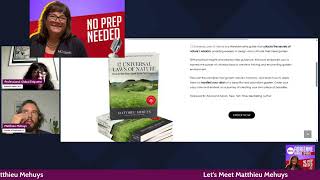
Adrienne Barker interviews landscape architect Matthiew Mehuys about his path from a Belgian farm to regenerative agriculture. He discusses his award-winning book 12 Universal Laws of Nature, a dengue illness during his Amazon trip, and how industrial farming degrades soil. Mehuys now runs Palonia Landscape Architects and teaches his Garden of Your Dreams Masterclass.
Chapters
We're back, we're live, everyone. Matthew, everyone right now is going, who's that handsome guy with Adrienne? So let me introduce you, it's Matthew Mahews. I think I said it right, Mahews, but he's going to say it better because it's his name and he knows it. So a couple things we could say about Matthew, right? He's brave, comes on live, doesn't know what to expect. Because you know me, he's brave, bold, beautiful. Sorry, but I have to say that you're just a beautiful looking human. And he's got two M's in his name. And if everyone knows me, they know I love M&M's. So anything with two M's makes me happy. So Matthew, introduce yourself.
Hey, thank you for having me on the show. So I'll give you my quick backstory. So I grew up on a family farm. And both my brother and farmers are still active farmers today. And when I was about somewhere between the age of 3 to 5 years old, I, I was really excited, excited and fascinated about plants, how plants can grow. How on earth is it possible that you have a tiny little seed and you put it in the soil, it can grow into a, into a crop that you can harvest, or even an age-old oak tree, for example? How on earth is that possible? Like, these were like some of my early questions around that age. And then I, I, we had a teacher at school, she was amazing. She was already a bit of age, but she had a lot of wisdom about plants and how to propagate and how to do a vegetable garden. So we learned all those stuff in our classroom, and our classroom was full of plants, and I, I still remember that, and I loved it. And so after that, I came home and I told my parents, like, hey, I want to start my own vegetable garden. So on our farm, it was mostly cash crops and cattle, so there was not much vegetable growing going on. And so they said, like, no, we don't have time, because they had super busy lives as a farmer. And but I persisted, and eventually they said, okay, there's this corner in the back of the yard, go and do your stuff there. And so I prepared my soil, I did everything, and I started growing with— I started growing radishes. And radishes are one of the easiest crops you could ever grow. If you're thinking of starting your vegetable gardening journey, start out with radishes. It's so easy. You just put them in the soil, wait a couple weeks, 6 weeks later you have something to eat, maybe shorter in some climates. So I started with that. And I succeeded, and I was like, wow, this is so cool. I remember having a salad with my mother and my parents, like, and I had produced these radishes. Like, this was one of the most fulfilling things that I experienced at that time. And still today, I remember it clearly. And so I thought like, hey, this gardening thing is quite easy. I'm just going to continue doing more. So I got more seeds, tomatoes, lettuces, and I just put everything in the soil. I had no clue what I was doing. And I came back a few weeks later to my yard to think like, oh, it's going to be full of beautiful vegetables and I'm going to harvest everything. It's going to be amazing because I was also doing all kinds of other projects on the farm. I had this kind of entrepreneurial hunger already from a very young age because I had 20 chickens from age 6 to 12 and I got my eggs every day and I sold them to friends of my parents. And by the time I was 12 years old, I had actually made a few thousand, uh, dollars, uh, which I then invested in the stock market, but that's another story. But so I did that and I came back to my yard and it was completely overgrown by weeds because obviously I, I had no clue what I was doing. So, and then I was devastated, like this was my first failure. And I'm like asking other questions like, why didn't nature help me? Why is nature trying to kill my project here? And it was only later in life because I'm telling you this because later in life I decided to— I did like economics and modern languages I studied, and then I said I want to go back to my roots and I'm going to study garden design because that's kind of like the obvious thing that I thought would make sense. Because I loved creating things. And so I, I studied that, but it was a formal training and I didn't feel like I knew enough. I went on to do a master's degree in engineering for, for big-scale projects in landscape architecture in Germany. And then I, I did what most people expected me to do, was to get a 9-to-5 job. And I did that for 2 and a half years in, in Germany, in one of the highest-ranking companies in, in landscape architecture in the world, because it's like Germany is really good at creating public spaces, green spaces. It's very important for them. And so I did that, but I became quite depressed doing that because I wanted to have an impact. I was young and I was thinking we have to do something about the environment, our beautiful planet. If you look outside, the climate is going crazy. We need to reverse that. It's partially made by humans, so we have the capacity to reverse that. And I'm like in an office job doing all kinds of paperwork in Germany, and I'm like, this is not what I was— why I was put on this planet. So I decided, okay, I'm going to quit my job. I had some money saved up, and I'm going to travel the world and go to places all over the world that are— that where people are doing things around actual eco projects that are making a difference in the world. So I visited a lot of regenerative farms, sustainable farms. I volunteered, I went to eco-resorts, I looked into developments that are like even how to build houses. I did a permaculture training in India. So I pretty much seen the whole world and got really inspired and got all this knowledge. And then Adrian, I did something that I don't regret, but it was kind of a twist plot twist in my own story is that I went to the Amazon rainforest because I wanted to see in Ecuador, I wanted to see and experience like everybody talks about the Amazon rainforest, it's the green lungs of our planet, but I really wanted to see and experience it with my own eyes. So I traveled for like, it was from Quito, the capital in Ecuador, I took a 12-hour bus ride, then I went on a boat for another 20 hours and then another 5 hours on a small boat. And I was like in the depth of the Amazon rainforest with an indigenous tour guide who had worked with National Geographic that you couldn't find him on the internet. It was some synchronicities that lined up for me to meet with him. And I spent several days in the Amazon rainforest. I saw so many beautiful things like trees big as skyscrapers. I saw dolphins 'cause it's full of dolphins there as well in the Amazon rainforest. I saw crocodiles, I saw parrots, monkeys, and even the guide, he's an indigenous guy, he said like, I've never experienced that in a trip. I've been guiding people for 30 years and I've never seen that much animals and biodiversity. Like, you're really lucky this time. We even saw a tapir, or the guide saw it, I heard it, which is a small elephant there's— and if you go on the internet, there's very few pictures of them. They're very rare to spot because they're very sensitive animals. But we saw them, so it was a crazy experience. But then the plot twist came that I, after that trip, I became really sick because I got stung by a mosquito that had a tropical disease called dengue, which is kind of like malaria.
You didn't get the dengue? You didn't get the shot?
You can't. I think today you could do some dengue shot, but at that time it wasn't— it didn't exist.
Oh my gosh.
Okay, so I got really sick and painful, right?
Too. Is it really painful?
Yeah, I was sick for several weeks. I lost 10 kilos, which I don't know how much that is in pounds, but I was like, yeah, really skinny. I couldn't eat for days. But, and at that moment is really one of the toughest periods in my life, but also my life from that moment, it went really downwards. Like I, I, uh, my girlfriend dumped me. I, there was a lot of, uh, I had to move in back with my parents because I didn't, yeah, I didn't have any more money yet. Uh, so I had to like go back and, and why am I telling you this is because, because for me it was kind of a blessing in disguise because I started to ask myself some deeper questions. Like, why am I here? What am I doing here? And I started to realize that, that God has gifted me to see things into the future, that we have to regenerate our planet, we have to take care of our planet. And so it was kind of a second chance for me to start actually doing something with it because I studied, I grew up on a farm, I had all the information, and I was actually wanting to continue to do more research because I loved it. I had like a small remote job, I love surfing. But Mother Nature or God, whatever you— or the universe, whatever you believe in, um, had a different plan for me. So from that really deep experience of, of those difficult moments, I decided, okay, you know what, I want to have impact in the world. How can I do it? It looks like I have to start my own business because it's business owners that change the world. So I said, okay, what can I do? I know garden design, so I started out with garden designs and doing designs for homeowners that are open to do it in a different way that is in harmony with nature. And actually, oftentimes I don't really advertise that. I tell them just I create beautiful, lush gardens that don't require a lot of maintenance. Because the beauty of the work that I do is when you work with nature and you understand how nature works, you can use that to your advantage and you create beautiful, lush gardens that almost self-maintain them. It's like you still have to do some care, but you can get that outsourced by a a gardener or you do it yourself. And so I started working with people one-on-one. And then from the experience, I had one client who told me like, hey, it's like we had done a big portion of their property and they said, I really love the work you've done. It's so beautiful. Everything looks amazing. But you know what? I'm sick and tired of having a landscape architect. I want to make my hands dirty myself and I want to do it myself. I want to learn. How to do it. And I said, you know what, I'm going to teach you everything that I know that I've gathered over the last 10 years, and I'm going to create a course, a crash course in 9 weeks. And that's where the Garden of Your Dreams Masterclass was born, where I now teach people online from all over the world how you can actually design, create, maintain, and your own garden. Even if you think that— I hear people saying I have a black thumb, I don't have a green thumb, but I think that's a total lie. You can totally learn it. So I do that online. And then now recently we're also getting into bigger development projects. So looking—
do you want to— you want us to walk through your website?
Yeah, sure.
I have a question for you. You ever think to yourself, what if you— what if you were born in the middle of New York City? Would you, would you still be gravitating towards plants, or is it because you were living on a farm that you were— like, I'm so curious, right? Like, are there, are there kids out there right now in the middle of the cities that would just absolutely so interested in plants but don't have the— but I guess you could do plants anywhere. But I find that fascinating.
That's a very interesting question. Nobody's ever asked me that, but I think I believe that God has kind of a plan for you before he or she puts you on this planet. So it's kind of predestined, I think, that I was born on a farm. And I also saw the dark side of farming, which is a lot of chemicals. And we're also working with farmers to change to regenerative farming because my father started. He was 17. He bought his first chemical sprayer when he was 21. And farming changed so fast to become a very complex system with a lot of chemistry and a lot of things that are not good for our environment. So there was also no mistake that I was put on such a farm, and we are currently transforming it to a regenerative farm because my brother stepped into the business about 10 years ago as well. And together, even with my father, who is changing his mindset because he had to do it in that way, the government was forcing him. If he wouldn't have done it industrially, he would have gone bankrupt like many of his colleagues.
Oh, the government— wait, so where, where were you? I don't even know where this farm was located when you were—
it's in Belgium.
Oh, oh, interesting. So is the— and then the government said you have to start using pesticides?
Well, I don't think they said it in such a way, but if, if you want, I can explain why we currently have one of the biggest challenges in the world, which is that we have overfertilized and completely destroyed the soils of our planet, which is creating one of the biggest challenges of our modern days, I believe, is climate change. It's not the wars and the social unrest. I even believe that it's a consequence of, or many of the conflicts happening today are a consequence of climate change. We might not know it, but like there's a lot of wars being fought for water. Water scarcity, people are moving from different parts of the world because it becomes like Florida is even becoming difficult to live because of all the storms that are happening more frequently. No insurance companies don't want to cover your house insurance anymore because it's just a matter of time before there's a destruction. So all of these elements are having a huge impact and it all, it has to do with industrial revolution, but also with farming that became devastating for our environment, but also for our personal health. Like a lot of the modern diseases are because of the processed food and all the chemicals. But so you might want to now start blaming people, right? It's very easy to say, oh, it's the fault of the farmers, it's the fault of pharmaceuticals, there's some evil forces, whatever. But I think that's really not helpful and even irrelevant. We have to look at the solutions. But just to give you a quick rundown of the history of modern farming, it all started after the Second World War. So the Second World War was over, and during the First and Second World War, there was a lot of chemical warfare. So chemicals that were being used for warfare and a lot of products that were used for the war. And the war was over. So all these products that were made to do big-scale warfare were becoming useless. And then they knew, or they started to experiment with these chemicals like nitrogen, which is used for bombs already. It was already experimented before the First World War, but they said, okay, now we have all these chemicals that we produced. What can we do with it? Oh, we can actually solve another big problem that we have in the world. After the Second World War, the biggest problem was hunger. A lot of countries didn't have enough food. Europe was a complete disaster. It was completely destructed. No infrastructure, not enough food. You might remember the Irish hunger that was more in 1800, but like food security was a big problem after the Second World War. So we had that problem and we had all these chemicals. So some smart people The government said, hey, why don't we solve that problem by using those chemicals into food production? Because when you use nitrogen, your food production goes up very fast. So at the beginning, it was kind of an ingenious system where we add a lot of chemicals to the soil, we do a bunch of chemical things, and that boosts the yields of farms. And so it was a brilliant solution. What they didn't realize, I mean, some early people were warning for it, but what we didn't realize is that as we were using all those chemicals, we are also destroying the health of the soil and the minerals. We are depleting. We now have erosion problems all over the world. All the soil is running into the ocean with the rain. So we have a bunch of problems that came with this big-scale mass production. Not to talk about even the animal cruelty around how meat is produced. That's a whole other topic. But so we have this industrial complex situation which is killing our planet. It's killing our personal health. At the same time, we have resolved world hunger because we have too much food on the planet for the amount of people there are. So some people say like, oh, there's too many people on the planet. We cannot grow anymore, but there's more than enough food on the planet. The only problem is the distribution, and if there's people that are in hunger, it's because of climate or warfare. But in theory, there's more than enough food on the planet, so we've pretty much resolved the hunger issue on our planet. But now we have other risks that came with solving that problem. We created a bunch of other problems that are having an impact on our, on our lives. So that's kind of a short history of farming.
And if that makes sense, it may sound a little complex, but no, no, no, it's not. It's— I mean, I didn't expect a lesson this morning, but I absolutely love it. And I could see farming, and you're so right here in, um, here in where I live, Daytona Beach, the community of Port Orange. Oh my gosh, everyone's in an uproar. One storm. But the funny thing is, is they're remembering that this never happened 10 years ago. It's with all the development. So what you're saying makes sense. Let's go through your website too, guys, because I, I, I'm— I like what you're doing is so interesting and so unique. So I love it. Just share with us the name. Where did you come up with your name?
So yeah, good. Palonia Landscape Architects is the, the company where we do we do like a done-for-you approach. We come to your property, we look at it, and we make a beautiful lush design. And then we take care of everything so that you just have to lean back and you enjoy a beautiful garden. And so the way we do it is that we do it in harmony with nature, because as it turns out, is when we start to understand how nature works. And that's what I covered in my book that has won an award that I launched last year, which is the 12 Universal Laws of Nature, is that when you understand how nature works, you can use that to your own advantage, and you can create beautiful lush gardens with whatever you want. If it's flowers, edible things, like obviously you have to look at the, the conditions of your soil and the country you're in and the climate, etc. But that's everything that we take care of. And then once you this, that want to create that garden, our goal is to make it as low in maintenance as possible because people don't have time to be working in their garden all the time, or most people don't have time for that. And it's not necessary. Like, I see a lot of maintenance that is being done all over the world in gardening is kind of increasing the maintenance. Like, I joke about it with a friend in Canada who's living in a community like a homeowner association community, and I saw them doing like maintenance for their properties. And I joked like, look, they're doing maintenance to increase the maintenance because they have no clue how to do it properly, how to do it in harmony with nature. And so that's what I create. That's the type of gardens that I make for people.
Beautiful. Hold on, I just want to write, get the book. Order the book. Let me— sorry. So, oh my gosh, beautiful. I like going through, listening to you speak and sharing your vision, and then looking at your website is lovely. So Matthew, I can't, I can't leave you without sharing with you, I think you should go on if you want more clients too and community that really agrees with you. Um, I'm gonna put it in the chat. Hold on, I'm gonna put the chat for you. Um, chattersocial.io, one of my favorite places to be. And this, this app is incredible. So it's all from people from all over. So you mentioned Honduras, and I said, oh, there's people from Honduras, Ecuador, all through the globe. They're all business professionals. We've got chefs that cook. Um, there's like, you know, there's a video. It's, it's really cool. I kind of just show you really quickly, but you could really show people and teach, and this is what it's made from. So actually, right now, I'm just going to show you this.
And what is the website again?
Oh, I put it in the chat. Yeah, chatter.io. And then they're running a room that opens it up and lets you choose. So right now, you see how Jonathan and Leah are talking? These are the people that are in the room right now. Okay, she's teaching about the app. You're gonna It works as like a social media platform. You can run rooms, you can monetize immediately, and you could share the value and what you feel because nobody is doing that right now. There's some celebrities on here that very well known that people in the United States know and love. They're celebrities from all over. If you love Afrobeats, some of the most amazing singers. So like, it's very diverse. You could go on and learn how to play the guitar, and you could talk politics about the news. Like, you can learn about marketing, branding, or you can learn about how to make fettuccine. So I think you should try to come on. There's no cost, so there's no charge. So come on and check it out because I think that you would absolutely— let me leave the room— you would love it because the audience is already built in. You already have a built-in audience and you have plenty of people that really care.
You're so knowledgeable about all these social media, uh, ways and online platforms.
You're so knowledgeable about our Earth, and I don't think that we can get enough lessons. So even though I don't, you know, I live in a, um, like an apartment resort style living, I don't have access to a garden. But my daughter, like radishes, do you mean you, you just take the whole radish and throw it in?
Take the seeds. You have to buy some seeds.
Oh, the seed. Oh, I thought you meant the whole radish, because what, um, they are like, I, I cannot even taste a little. I hate the taste of radishes, but what, what are like avocados you could plop in, right? So there's certain seeds that you don't even— you just have to plop it in.
Yeah, most of the seeds of the world you can, you can just plop them in, depending only if they're hybrids. You have hybrids made by, by farm and pharmaceutical companies that they, they make them sterile so you can't reuse the seeds, which is a kind of tricky way of tricking farmers and gardeners to buy seeds that you can't reproduce.
Well, we just definitely need to support our farmers. We know that the news here is, you know, it can be very scary when you start hearing what's happening with the inflation and the farmers, but you are a treasure trove. So, so you guys buy the book, look at the course, go on the website, and let me— I just want to grab that website one more time to put it in here. So I'm gonna put it in the chat so you guys can grab it. And if you have a podcast, if you're a podcast host, consider having Matthew on as a guest because he's fantastic. I love my time with you. I really appreciate it. So thank you so much. We are live, and then this is going to be turned into a podcast And I love— I want to add you in my next book because your content will turn out beautifully in a book. So very excited. I'm going to, I'm going to try a preview chapter to show you when my podcast, when this hits the launch. But for now, everyone who sees you will have your link in the information and you are amazing. Are you on LinkedIn?
Yes.
Okay, I'll reach out to you and connect with you if that's okay so that we can connect, so I could tag you. And boy, brave, bold, handsome, and the two M's, the— my favorite candy, and now my favorite— what, wait, what is your title? What, what, um, not like— so you, not your CEO, but what do you call yourself? Like a landscape architect? Is that your title?
Yes, and then consultants we also do.
I love that you followed your dreams. I love your story, and you started as a— as how, like, you know, you can picture that young kid all of a sudden coming home and understanding and loving. There's so much beauty and joy in your story. I can't wait to get your book. I want to share your story for you. Come on Chatter so we can meet, and I can introduce you to some amazing people. And there's some amazing developers in the United States. So I definitely— you need to be in ChatterSocial. And thank you so much for your time today. Thank you for being patient because we had the hour before. So I'm so glad that you said, let's do it. Let's do it in an hour. That was brilliant of you too. That's why you're successful. You don't take— you do it now, not later. So I love you for that. So thank you, Matthew. Anything else that I missed that you want to share?
No, I think you said it brilliantly, and I love what you said about the dream. And I feel like it's— you have to follow your dream, otherwise you'll have a miserable life. Don't chase other people's dreams or what other people think you should do, or dreams about only focusing on money. That's, that's not gonna help. Like, it's good to, to— I'm now listening a lot to Jim Rohn's audio tapes. I don't know if you know Jim Rohn. I think he was the mentor of Tony Robbins.
Oh, I know who you're talking about.
And he says, yeah, you should go and make a million dollars and you shouldn't just go make a million dollars and that's it. In fact, when you make that million dollars, you could give it away immediately because it's useless. The very reason why you make a million dollars is more about the person you will become when you make that million dollars. That's what's more valuable than the million dollars.
Oh, I love that. And imagine a world where we didn't have to choose between organic and the lower price because all of our food is grown organically. Wouldn't that be amazing?
Exactly.
I got it.
All right.
Yeah, scary. And I'm glad, honestly, my youngest is 19. She came back, she's safe now, but she's 19 and I have a granddaughter and it's scary because they have to watch everything that they put in her mouth. And that's so— I— yeah, it's crazy. All right, I can't wait to learn from you. Come on Chatter Social so I can, I can introduce you. Um, and send me a message that you're there so I can immediately— oh, my dog is going crazy.
Okay, bye. All right. Bye-bye. Thank you.










