Meet Rachel Allen
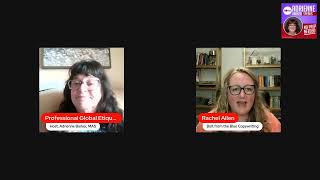
Rachel Allen, founder of Bolt from the Blue Copywriting, moved to Hong Kong with $200 and worked her way up from content mills to running an agency built entirely on referrals. She uses AI for research and drafting but warns against publishing it unedited, saying the human element is the only sustainable advantage in marketing.
Chapters
So I'm like, I'm gonna wait now. We're live. And I don't know who— I don't know who this is. I know it's Rachel Allen, and I think she loves words, so she'll let us know. And Rachel, okay, so we know 3 things, right? We know because— sorry, I'm gonna show you this. My book, Unscripted Brilliance. So Rachel, here's the deal. I am doing for PodMatch, which I love, and how we're met. We're here on PodMatch. Thank you, Alex. All the speakers that I am speaking with are going to be featured in this book. And so this is my first book. And then I think I'll pick another color like green. And so very excited. So thank you. So we're doing this on Chatter Social live and streaming live. Who knows where? And my bangs look good today, though. So that's a good thing, Rachel. So, Rachel, we don't know who you are, but the goal is everyone will find out who you are and you're going to be in a book and it's going to be published by Podfest. Oh, cool. And it will be also in the book. We will interview Alex and it's a beautiful book. See, it's 15 chapters, though. This is 16 because the first chapter is on chatter socials. Okay. It doesn't read like an interview. It reads like a real nice narrative.
Oh, I love that.
Introduce yourself. I have no idea who you are.
Hi, I'm Rachel. So I run Bolt from the Blue Copywriting. And as Adrian said, I do love words. It's what I've done all of my life and it's the only job I've ever had. So in my incarnation as the owner of Bolt from the Blue Copywriting, I do marketing, which basically means I make words make money.
I love that. Now, Of course I got to ask that question. The elephant in the room. Yeah, I'll say it's— yeah. Okay. So you know those two, those two words or no, two, two letters. No, two, two letters. I'm not feeling good today. So two letters and I won't say the first. I'll just say the last one goes with I.
Right, right. Yes. What would you— would Shelley just spiel about it? People ask me a lot about this.
I can imagine because we hear copywriting and then the first thought is, well, do I really need a copywriter? What's the difference? I can use ChatGPT and it will write up everything, including telling me why I feel sick today.
Right. I mean, you are welcome to do that. And if it works for you, like, my very congratulations. But my take on it, as someone who's been doing this for 17 years, is that it makes a fantastic marketing intern. But you definitely don't want to publish the end product of whatever it gives you. And if you're doing something that requires any degree of nuance or irony or sarcasm or personality like marketing, you probably don't want to rely on it because it's not going to present you in the best light.
I love that. Rebecca, I'll bring you up, honey, if you want to come up. It doesn't. It doesn't. It's funny. So this is actually— this is actually— a marriage with a secret sauce I can never share that does work. But if you do try to take like the podcast interviews and use, like you said, an AI, you'll like maybe you'll get one chapter and then boom, it goes down. And you're right. And all the— and then the dashes, you could say all the time, make it not look like AI. And again, so our— so 17 years ago when you started.
Yeah.
Did you even think that you would have to worry about people questioning you about AI?
I mean, 17 years ago when I started, I didn't even really know what marketing was. I had no plans to do this. I didn't know what copywriting was until the day I started doing it. I fell into it completely backwards. And so, no, I would have never thought if somebody would ask me about a robot intern taking my job.
That's funny. How did you— what was backwards like for you? How did you fall backwards?
Well, I had gone to school for journalism, um, and I graduated in 2008, which, you know, was a super fantastic time for everyone, uh, and I— the only job I could get was, uh, unpacking boxes in at the Old Navy warehouse on the 5 AM shift. And I was like, I don't want to do this with the rest of my life. So I thought, like, what's the furthest away I can get from Tennessee? And the answer to that is Hong Kong. So I bought a plane ticket and I went, and I did not get a work visa. So I landed there with like $200 in my bank account, and I had to rent. And so I started Googling like how to make money online, which is like slightly less ridiculous then than it was now, but still pretty, pretty silly. Uh, but I found this job that came up and they were like, okay, we're gonna pay you $3.25 to write 600 words. And I was like, done. So, uh, I did it and I loved it and they paid me the money and it was so addictive that the thought that anybody would pay me to write, I, I just had to do more.
Wait, $3.25 for 600 words? Was that a good deal back then?
Oh no, it was terrible. It was awful money even back then.
And then what were you writing about?
It was, uh, an advertisement for— you know, they, uh, this might have been before Airbnb, but like, you know, they do those like Airbnb experiences you can buy. This was an experience, uh, to get a flight in a World War II biplane, like a Red Baron plane.
Oh wait, so were you— was this a company out of Hong Kong or the United States?
I think it was out of the United States. I'm pretty sure it was a content mill.
Wow, that is so interesting. So they— so you're there, and then did you enjoy the writing about the experience? Like, did they— how did you experience the experience to write about it?
I mean, I didn't get anywhere near the actual experience. I just researched it and kind of like imagined what it must be like and, um, wrote something based off of that. And like, I love the research part of it. I thought that was super fun. That's one of my favorite things to do anyway. So I was like, someone will pay me to read about things and then write? Okay, sure.
So then, okay, so now you've got the job, you're working, you're in Hong Kong. Are you staying in Hong Kong or do you go back to the United States?
I stayed in Hong Kong for about 2 years and then over the next 10 years I moved pretty much every 6 months across Asia and Europe.
Wow. Yeah. Wow. So you're young and, and kind of like doing so. You weren't teaching English as a second language?
No, no. I looked at it, but I never ended up going that route.
My son went to Shanghai and taught English as a second language and stayed there for almost 10 years. That's why I'm asking you. That's interesting. Yeah. So at what point did you realize, okay, I'm going to make this not only a business, but a business I'm going to actually create a company?
Well, I got about like 3 years in, and I remember it really clearly because on the outside I was like, living the entrepreneur dream. I was living on this beautiful island in Greece, and I would work in the mornings and sunbathe all afternoon, and strapping young Greek men are delivering me hand-pressed orange juice every morning. And I was so anxious all the time because I knew that I was about to work myself out of the W-2 job market because I'd been out for so long. And I was like, but that's not the plan. I can't run a business. What do I know about doing all of this? And after this entire summer of grinding anxiety, I decided that I was going to give myself one more year and I was going to do a master's degree. So I did my master's degree in London. And at the end of that year, the choice was do a PhD or make this into a real business. And I decided to make it into a real business.
Sure. Sorry, you're cutting in and out. What country are you in right now?
Uh, I'm in Tennessee, so the United—
okay, where are you now? Oh, oh, okay. I'm thinking because you're coming in and out, I'm like, maybe you are in—
sorry about that.
Like, uh, you know, what, at what point did you— I get the W-2 part of it and like feeling kind of work your way out. But were you secure knowing that you knew where your next jobs were coming from as a freelancer?
Oh, absolutely not. It was like a total, like, month by month. I had no idea whether I was going to be able to pay my rent for month to month because I wasn't really trying to run it as a business. And so I didn't do a very good job at it the first couple of years. I thought it was just like freelance. Yeah.
Oh man. All right, hold on. I'm going to— I'm going to fix this a little bit so that we show up a little better. Let me just do the stream. Okay.
Thank you for that.
This is so interesting. This is so fascinating. Were you receiving— were you living off the income you were making by writing, or was there family income that was coming in? Something else? It was just me, just writing and being able to travel like that.
Yeah, you wouldn't be able to do that now, would you, with the cost? Yeah. And I mean, it was also like, it sounds very glamorous from the outside, but it's, you know, staying in the cheapest places I can find or looking for really good flight deals or going to a country just because it was cheaper, you know? So like, it was awesome. And the like, hashtag luxury entrepreneur life was, it's not exactly how it cracks up to be.
Okay. Kind of like an influencer. You're showing us some way that what, how it looks. Welcome Curtis to the room. How—
I got Diana.
We have Diana and Curtis in the room. That is lovely. We are streaming live, just to be clear, not just on Chatter. We're streaming live on LinkedIn, 3 places on Facebook, YouTube, and X. So, all right, so what I want to switch for a second— Bolt from the Blue Copywriting, is that the name of your full, full company name? Bolt?
Yeah.
OK, where did that come from?
Well, funny enough, it literally sort of struck me like a bolt from the blue when I was living in this really awful town outside of London. And I had decided to rebrand from just, you know, my name. And I went through several really silly iterations and names that no one understood. And I was trying to think about what really good marketing copy does. And it really does hit you like a lightning bolt. You know, it hits you and you can never see something the same again. And so I was like, yeah, that's exactly the feeling that I want people to have.
I love it. It's a long name, Bolt from the Blue Copywriting.
Yeah. Every time I have to give somebody my email, it's a real pain. But I have tried.
What is your email? Give it to us. Let's hear. Yeah.
It's hello@boltfromthebluecopywriting.com.
No, you didn't do that, did you?
I mean, Bolt from the Blue was taken. All the Bolts from the Blues were taken. So I was like, well, I guess this is, you know, at least it's memorable.
That is so funny. Okay. So now, all right. So then you, you come back to the United States. When did you go from a freelancer to actually opening up your business?
So after I did my master's degree in London, I decided to open up a business there. And so my first company was actually in the UK, like it was still me, but officially in the UK. And I did that for a couple more years, and then I moved to DC and moved the company to the United States.
Okay. And then what— so that was what year was that?
2016.
Okay. So 2016. Okay. And then you have your— you open up the business and now how are you getting the business? What are you doing to, to start to get clients and get the work again? Are you using Upwork or any other program or just head down and looking for clients?
Well, I've always been referral-based. Even now we're about 80 to 85% referral-based marketing. So when I was in London, I had sort of transitioned from the content mills into working with one-to-one clients. And I was really fortunate to be able to work with someone who was kind of a big name in the London world. And she was very generous in introducing me to people. And I ended up having a 6-month waiting list. And so I was able, luckily, to take that with me. And then sort of leveraged that. And when I got back to DC, let's shout her out.
Who is it?
Shaw Wasmond. Yeah, she's— yeah, she's—
I heard that name before.
You probably have. She's written a book called Do Less, Get More, Do Less, Earn More, something like that. It's been a couple of years since I've seen it, but yeah, she's a brilliant business development strategist and coach.
I love that. Okay, let's go back to the AI now. Now that we have an idea. So what point did you— were you like, oh crap, what is this AI? What's it going to look like? Is it going to be a concern for me? And how can I make sure that it doesn't? So how can I get people to realize that the regular brain to hand is maybe better than AI to— I don't even know where to go— to digital. So yes, I want to hear that.
So I was actually really lucky in that like about 6 months before LLMs became really widespread and popular, an AI company hired me to write a dictionary of AI terms for their users. And so that meant that I had to get into like the super granular understanding of like how these things work. And it was tremendously boring, but also really fascinating to understand like, oh, okay, I under— like I get what this thing is. So when it really blew up and there was so much hype around it and also so much fear around it, I was like, no, like, I know what this is. I know exactly what it can do. I know exactly what it can't do. And I know how to work with it to leverage both of our strengths. So I've never really been worried about it. In fact, I wrote an essay a couple of years ago when it first became like a big thing because so many of my clients were really worried about their jobs and there were so many, you know, online dude bros being like, you're going to be out of work in a year. And I'm like, dude, this is like my 5th internet apocalypse. Nothing is going to happen. It's fine. But what my reminder to people was is like, you are not a machine. There are things that it does that you cannot do, and that's fine. But there are things that you can do that it can't do. And of course, that's where you have to focus and leverage.
I love this. By the way, we're live on Chatter Social along with other platforms. Thank you, Diana. Diana and Curtis, if you have any questions, please unmike and just let us know. So glad that you're here. This is so fascinating to me because I was— I wrote a book. It's not my secret to share, just a book I would have wrote to myself about all the times I gave away so many secrets or the burden and consequences of secrets. Not like a big secret that was happening to me, just to be clear. But I used AI and I thought like, this is crazy. So like, I learned about it and then I spent a weekend And it— and then I published it, but it wasn't really what I wanted. And I noticed every time I went back to it, I kept getting different copy. And so it literally is— I don't know if I have it here. It's a short— it's a short book because that's all I could, like, squeeze out of it. And I use AI every day. But what I refuse to do is let AI tell me, like, what topics or where to go. Like, I don't want to be like, oh my God, I don't know what I'm doing. Like show me the way. I'm more like, here's everything I think. Is this a good thing? Like, so like, I don't want to get to the point where it's, it's like taking over my brain. Is that kind of how some other people feel the same way? That—
Yeah, absolutely. I mean, there's an old saying about fire, that fire is a good servant but a bad master. And it's like, yeah, absolutely. It's the same thing for AI. Like where I sort of warn my clients is if they start to feel insecure or like the robot knows more than them or can make a better decision than them. I'm like, absolutely not. This, this can make a better decision than any kind of program. But it's really useful for, say, thought partnership or first drafts or trying to like help you bring your ideas together. But where, yeah, if you start to feel like, oh, you know, I'm not good enough, the AI knows better than me, I'm like, absolutely not. You're human. You have things that you can do that it will never be able to do simply by virtue of how our brains are wired.
Yeah, that's— I really— it's interesting. I'm going to share your website because I'm curious and I haven't been on it yet. So, okay. So right now we see the website pretty clear. Okay. This— it looks good. I don't know what— let me see what you see. Yeah. See that? That looks good.
Okay.
So now I'm on your website right here. All right. Nice and clean. I like that. Bolt from the blue copywriting, data-driven. So you are, you're clearly saying we're data-driven, human-centered marketing for good people doing hard. I like that. It's funny, I do. I have a LinkedIn, like, lead generation, and I'm like, it is AI, but human-centric. Like, I touch everything. I look at everything. Nothing is, like, sent out. Like, I'm not sending a weird message to, um, a cannabis dealer regarding a CPA, right? Like, where they call in. All right, so now we got Let's Light It Up. Let me look this up. Fun for your theme.
Thank you.
So, okay, so, and then you talk about writing, marketing, the power. So what makes it different? Like, where are you going that's different than AI? And why would that help me for my business when let me just finish using AI? What's, what's a few words? What sticks and stones will break my bones, but names will never hurt me. Words don't even matter anymore. Well, I don't think that way, but yeah.
And I think you really called it out when you were talking about, you know, we all get those LinkedIn messages where it's like, hello, person I have never met, would you like to meet for a virtual coffee? I hope you're full of entrepreneurial enthusiasm. You know, it's the reason why we're all so jaded with the internet now is because everything sounds the same. It's impossible to stand out if you use the standard stuff. And so where I differ is that I bring the human and their voice. Into every single thing I do. So everything I write sounds completely different and it doesn't sound like me. It sounds like you, or it sounds like Sha, or it sounds like Christie, or it sounds like whoever, you know. And that is the only way that you can actually stand out in the face of such a massive increase in content marketing. So something I've said forever is that human is the only move left because people ask me every time we hit one of these internet apocalypses and they're like, oh, you can't make money on the internet anymore. Go home, it's done. And I'm like, absolutely not. It just means that they The hacks aren't working anymore, but the thing that reliably works is being human.
Okay, but I had ChatGPT interview me.
Mm-hmm.
And I spent like 3 days. I asked it all the questions. I said, interview me, and then it asked me all the questions and I answered, and I answered above and beyond. Now I say, give me my tone, and I get this really witty kind of tone, and I'm like, oh, okay, it knows who I am. Wait, isn't that enough?
I mean, that's up to you. If you're getting the results you want, then sure, maybe it is. But what I find for most people is that it's, it's enough for a surface-level pass, and as soon as anything goes weird, or as soon as anything pokes it with just the lightest of sticks, it just collapses. It doesn't sound like you. It feels odd. It feels off-putting to people. And something I've heard a lot of people say is like, why would I bother to read something somebody didn't take the time to write? And I think that a lot of people are feeling like that, which is why we're seeing such a swing back to analog and non-scalable marketing.
Yeah, that makes so much sense, Rachel. Let's just take a second to shout out who you're working with. Good Life, Point North. Some of these names are fantastic.
Oh yeah, good for you. Thank you. I love my clients. I have been so fortunate to work with just amazing people all over the world.
OK, so you— and welcome, Leah. Thank you for being here.
Hey, Leah.
You got Leah, Diana, and Curtis. And Leah, I gave you an emoji, a smile one. I love what you just said because you're right. It is going back. We can tell. And so I know that a lot of content that's AI, like with your books, you have to say it's AI. And sometimes the videos, you have to let it know AI generated. I haven't seen yet that I have to every time I do LinkedIn and let it know that it's AI generated. And then honestly, well, but LinkedIn has its own AI in there. So what's the difference? I'm even on Upwork and I'm thinking, okay, everyone's getting the same responses, but I make sure that I will really work it. Okay, so let's talk about the points, the differences, the SEO. What does it really— the difference in having you write something and AI, and have you ever tried both to see what it looks like? Like you write an article, then you ask AI, and then you try to— I don't know if you could deliver both or some way so you could look at the results.
Yeah, so I've definitely compared them, and the best I can say is that it does a really good first or second draft. But it just doesn't quite ever catch the irony or the nuance or the tone. Or you might see something like it makes come up with something that's surprising because it's just bashing a bunch of probabilities together, but it's never going to come up with something truly creative. And I think that's the difference. So somebody actually asked me on a different interview earlier today about one of my favorite headlines that I ever wrote, and it was 15 years ago, I nearly found myself face down in an open abdomen. And it was something I wrote for a client of mine. She had been a surgeon and burned out and then became a coach. But that's the kind of thing where AI doesn't get the— like, it can't do the weird stuff, it can't do the human stuff. So it might be like, I was so exhausted and burned out as a surgeon, which is fine. Like, but it doesn't have the like, what type factor. That is what really makes things stand out.
That is so interesting. So I love that question that they asked you regarding the headline. So when you're using AI— so you don't use AI at all? Like, are you having a little bit like writer's block? And like, what does that look like? Are you getting up every day and then you're literally— are you writing on the computer? Do you handwrite? What does that even mean, like writing?
Well, I don't handwrite because my handwriting is awful and nobody else could read it other than me. So I do that for notes to myself, but nothing else. But as far as using it, I'll use it occasionally as a thought partner. I use it when clients ask me to. And for me it's like, yeah, sure, I'll manage your robot intern. I manage human interns. I don't, I don't care. But you know, a friend of mine, Sonny Simone, who was the co-founder of Problogger, she said something a couple months back in a LinkedIn thing, which was like, AI wishes it could do what I do. And it's true. We've both written so many millions of words that thus far, like, I'm just faster and better. And the day that's not true, of course I will bring it in. And in situations where it's not true, like research, I love using it for research and like digging through papers and stuff like that. But as far as like creative work, as far as marketing strategy, I, I'm just better right now.
I love that. I saw a marketing strategy the other day. It was a lot of pages and it really, it looked all AI. Before we go on, what about the dashes? What is it with the dash thing going on with AI? Such as I like beg it. I'm like, please, please, dear God, never give me a dash. And then they're like, I won't give you a dash, dash.
Right, right, right. I dash won't give you. Yeah. Yeah. So I mean, the way they work, it depends on what it's trained on, right? So of course it depends on the different model. But since people use dashes a lot, I myself wildly overuse dashes in my own writing. It's my own little, like, punctuation tick. That's— it thinks that's how writing is. Like, it's looking for something that, that fits the approximation of what it thinks writing is supposed to be like. And since a lot of people use dashes, it just crams them in there.
You know what I do think? Now I'm thinking for marketing, it really does make sense to have a team of humans. That's so weird to say. To double-check everything before it goes out, because that way you can catch if things really do. So what does that look like when you're editing? So should people that— not because you're not using it, but should people that are using it and doing the marketing, or you're doing the marketing for them, is that part of what you're saying is, look, we're going to not only make sure it's not AI and we're going to like double-check everything, and then do you actually do posting and like what does your marketing look like beyond doing the copywriting?
Yeah. Well, so as far as to answer your first question, yeah, read everything that AI puts out. Just as sort of a cautionary tale, I was on a different podcast and they turned it into a blog post and the person who was interviewing me was a breast cancer survivor and I have never had cancer. But the AI got mixed up and said like, Rachel tells the story of her cancer survival. And I was like, whoa, we need to like, no, like edit that. That is just not true. So you want to make sure that you're fact-checking it. You want to make sure that you're ideally punching it up to be in your tone. And if you look at it and it sounds like just generic LinkedIn drivel, change it, edit it, like make it sound like you make it weird. And as far as what I do, like the actual mechanics of it, I do everything from the really big thinking like, hey, I have an idea, but I don't know how to message it. So like marketing strategy, all the way through to like launch support, copywriting, content creation, course creation, post on Instagram for me because I don't want to type stuff.
I love that. I did have an idea. I watched— River is here. Hi. I thank you. And let me just see, does anyone have any questions in the room? We've got Leah, Curtis, Diana. Hi, River. Hello, everyone. We're talking with Rachel Allen and she's a hand— she writes I mean, she types, but she does not use AI. She actually is— I love what you said. What did you say again when you said that, you know, more than AI?
AI wishes it could do what I do. Yeah. For writing, that is great. Like, it can research much better than I can. It can create other things that I can't. But when it comes to marketing writing right now, I'm better.
I do love, like, so I had an idea. I was watching TNT Animal Kingdom. I'm not talking about animals and like the raw. I'm talking about The Cody Family. I don't know if you guys ever watched it. Oh my God, I loved it. And so as I'm watching it and I'm looking at Smurf, who's the mother, and the sons, I'm like, this is a business. There's a lot of lessons. So I'm like, okay. So then once I had that in my head, I did say to AI, okay, Barry, because I call Barry Barry. And I've had Barry for 4 years. I'm like, Barry, yo, want to do Animal Kingdom and the leadership. And it did write a great article. And then I was able to promote it and put it in some of the groups. And then I was on— I love Chatter Social. I just love Chatter Social. And so I do the morning chatter. And I was talking to the morning chatter. And then I'm like, oh, after I talked, everyone loved that room. I'm like, I should do leadership lessons from I Love Lucy. So I'll pick every decade. And so I did need AI, but it was really like, my, my going in, because then I, what I did differently, I love this idea because I teach LinkedIn. I said, well, tell me, what would Lucy's LinkedIn headline look like? What would her banner look like? And then I'm like, what would her pitch look like? How would Lucy pitch herself to us? So that's been a lot of fun. I've been making an A, so M*A*S*H got a lot of, a lot of looks to it. AI draws the artwork, even like using Canva. I just never been great with art. I don't have that kind of talent. So I think that the, the AI will help me. So it's created like the real M*A*S*H scene and it was good. I'm getting a lot of— but that's because— but it came from here.
Yeah.
And that's the important part. Can you give me ideas?
Right. And that's the important part because like it would never have come up with something like that. And you're like, I don't know, what are these like super weird ideas that I can combine? That's real creativity.
But then I wonder, Rachel, that's so exciting. But then Welcome, Sky. But then I think to myself, if someone else has the idea, they could actually— like, because once I put my information in AI, is that— it's open, right?
Right. So that's the issue with that. And that's another reason, um, why unless I'm specifically asked, I don't use it in my client's copy. Because right now— and laws are changing— but right now the way it stands is that you cannot own intellectual property to something that you created with AI. So if you publish that book or whatever that's primarily written with AI, if you put out, say, a course that you've created with AI, you— and someone steals it, you have no trademark or copyright rights over that, which is, you know, a real bummer.
Wow. So, okay, so that makes sense. So if I had a larger company— it's just me— but if I had a bigger company, I want to protect them, I absolutely would not want to have the writing in AI. I may even ask you, right, Rachel, do not use AI. I don't want someone to take this idea or steal it.
Right. And I get that a lot.
That is really interesting.
Yeah. So I have a lot of clients in finance and law and architecture and stuff where there's confidential information. And so they will specifically say, do not use this at all because they'll put us in breach of contract.
And then editing, are you putting it through Grammarly or are you editing everything yourself?
I mean, I generally edit it myself and then I run it through a spell check. So I'll run it through like Jspell or something like that.
And Grammarly actually has an AI feature too.
It does, which is why you have to be a little bit careful depending on what you're using it for.
Yeah, it's funny. We have a lot of workshops on Chatter Social. It's interesting that when you think about it, they're all talking about, you know, how to use AI. But I would love— I'm just calling this out, Leah and Curtis and Diana River. I would love to have some rooms where talking about really like the dos and don'ts, like the real truth, right?
Totally.
Like, let's get down. Let's get down and dirty when it comes to AI, because I think there is a lot of things I just know enough to be like, okay, maybe I shouldn't do this. But I've had some clients too where I'll do a newsletter, but I don't know their industry enough to really come up with topics. But once I do, then it works really well. So, wow. So I love it. So your business is growing. You are in Tennessee. Where are you? Are you in Nashville?
Uh, no, I'm actually in Chattanooga.
Oh, how nice. Yeah, I wish I was in Nashville because then I would, um, hang out with, uh, Jelly Roll. Yeah, well, his wife Bunny more than Jelly Roll. I love it. Is there anything I didn't ask you that I should be asking you?
Oh gosh, I feel like we've covered so much. I mean, I think I'm just gonna sort of bring back the, the one piece of advice that I give people all the time, and the thing that I've been saying on the internet for, I don't know, 10 years or something, is human really is the only move left. So the next time we hit one of these big bumps in the industry, and the next time that everyone's saying that the internet's done, it's not. You're fine. Just take a breath and remember that the more human you can show up, the better your business will do.
Oh, oh, that is really good. I love that. And before we close out, do any— Leah, Curtis, Diana, River, fire! Thank you, Curtis. Do you have any questions? Thank you, River, for the heart. Hi, no questions, but I love how she said keep the human element into everything. Exactly, River. Thank you. Diana?
I also don't have any questions. I just wanted to say thank you for sharing that story about when you went to Hong Kong and how you kind of just—
I don't know.
You know what? Maybe that's a question. So What was it that you felt that gave you the confidence to just say, okay, I'm going to jump on a plane, go to Hong Kong with, I think you said, $200 or $300 in your pocket?
What—
where were you pulling that from?
I mean, part of it I think is just the hubris. I was like 22, you know, so it's like, I don't know what's gonna happen. But I think the other part of it is, you know, I grew up in an extremely rural, very small community, and I could see like the trajectory of how my life would unfold there. And I knew that that's not what I wanted. And so having this challenge in this unknown was the less scary of the two options for me.
Great question, Rachel. Let me just tell you, Diana is such a lovely human being. I miss you, Diane. I don't see you enough. Amazing, amazing woman. I have to have Diane on the show so people can meet. Amazing. And River is so supportive. And Leah is here, and Leah is actually the first chapter of the book Unscripted Brilliance, um, because Leah is the community manager for Chatter Social. You can download it, um, and come in. Yeah, it's, um, it is addicting. Sorry. To say. But I do. I do. Sometimes I'm like, it's just great because it's company. Right. And in the mornings and the evenings, there's just always something people are doing, these rooms. So right now, just to give you an idea again, so there you can see who's in the room. I have the bot in the studio in here. So that's great. So, well, Rachel, you've been wonderful. I thank you for watching, too, by the way, if you've been watching. We've been Rachel Allen with the longest name company and the longest email in the whole world.
Exactly.
So that's your proof. If AI came up with it, it would have been like drinkchill.com, right? Right. But Bold from the Blue copywriting. And let's— what is your tagline? Let's hear your tagline.
I make words make money.
I love that. I make words make money. That is a great tagline.
Thank you.
And so use it. And wait, so you did some research. So if we were doing like Facebook ads, these kind of ads, real words compared to AI words make a difference?
Yeah, they actually do. So I mean, with ads, there's so many other factors that go into it that it is not usually the deciding factor. It's more of like how much money you want to pour into it. But it does, you know, and we know, we know how this feels because there's so many ads you just scroll by and you don't even think about it. But the ones that catch your eye, you're like, I feel like a person wrote that.
I love that. And do words still matter when it comes to blogs? Is it content still king when it comes to words? And does that matter if the AI content, real content, what is like, can you like redefine that quote about content is king?
So I, I mean, for me, content has never been king. I think that was an excuse. I think relationships are king. Um, what the, the reason to still do blogs is for SEO. And so in that case, it doesn't especially matter if you use like AI or if you write them yourself, with the caveat that if you want someone to actually read it and if you want it to actually be valuable, then you need to either edit it yourself or write it yourself. And in that case, I recommend doing a platform like Substack or sending your blog through a really engaged email list.
I love that. Well, how can we help you to get more business? Like what, what does that look like? Who would we recommend? What would we hear? That we would be like, oh my God, we know Rachel from the longest company name, which is Bold from the Blue Copywriting. How would that work?
Oh, thank you so much. So I work with founders usually in the $1 to $10 million range, and they have some, some impossible dream or unsolvable problem. So they've reached a state in their business where they're like, hey, I want to grow it. I want to do this, but my team can't quite get it. I need someone to come in and like help us move the marketing in that direction. Or they're like, hey, I've been found this business because I've left, say, big law or big medicine or whatever. And I don't know what I'm doing, but I need a marketer who can keep up. That's what I hear a lot. People are like, I need a marketer who can keep up. And I am that marketer.
Awesome. Awesome. And so you guys, I'm really excited. When I started, I was saying that I have been working with PodMatch. So PodMatch is unbelievable. Don't you love it? There's this whole system where you get like— so Rachel booked But I said match for Rachel, and then she like, I don't have to send her my link. She gets a link. She signs on the form that I can, you know, that I have the right to do this and then publish it. And then afterwards, when it's done, then we can do it. So Rachel, here's the thing. This is the craziest thing. So I, I was like 15 podcasts like ahead, like where I would be doing it in January. And I thought, let me do something different. So I asked my friend Barry, what would it look like if I did a sprint? If I did, like, you need 15 interviews in order to do the book that creates a really good book. So I'm like, okay, what if, you know, what if I just, like, release my podcast every day for 10 or 15 days in a row? And it's like, yeah, you'll, like, flip the algorithm, which it has. Oh my gosh. I don't know why more people are doing it.
Yeah. No, a friend of mine, Liz Scully, runs the Biz Book Broadcast, and she posted every day last December. She did a daily last December, um, up from a weekly, and she's gone from zero to I think like 17 million downloads, um, in a year. So yeah, it definitely works.
I love that. And then this way we're ready for Podfest in Orlando because, and then this book is really going to be powered by Pod to Book but also, you know, soldiered by podmatch.com. So very excited about that. So you probably If you don't know the people in the book, you will. And you all have something in common, which will be PodMatch, being on the show, and being live on Chatter Social. So I like to make things in a circle. Round is my favorite shape. And just in case anyone knows, donuts are my favorite food because they're round.
Noted.
Thank you. I like it. I like it. All right. Well, have a great rest of the day. Thank you so much. I said all of that to say it was just funny because I hear that all the time. Sometimes we hear words from Chatter, our friends on Chatter Social, and start to repeat it, which is kind of scary. February. If I start sounding like Curtis, um, I'm in trouble. I'll give you Curtis, I love you. So, but Rachel, uh, so actually, so I, I could, instead of saying to you, is it okay, it's probably going to be like next February. No, we will have you probably in the next like 8 or 9 days because this is just strictly pod match guests that are going into my next, um, next book. So, so grateful that I get these bolts of ideas and I just, you know what I do do with AI is I use it for a note taker because in the middle of the night, I can just go to the app. I'll say what it wants, and then when I wake up, it'll remind me what I need to do for this. Yes. But I do try to not be so AI. So for those of you, you know what? We got to use this nagging or we're going to lose it. That's going to be scary. We'll all be walking around like, I don't know, like AI robots. All right. Have a great rest of the day and have a great Halloween. And I will be back in touch with you. And I really appreciate it. Hope you enjoyed this interview. And I loved it. It was fun. Yeah. Thank you, everyone on Chatter Social.
Thanks.
Oh, you are welcome. Awesome. I'm gonna end the stream right now. And perfect.










