Super Guest Jeff Standridge
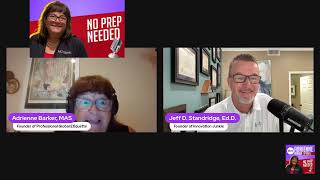
In this interview on the No Prep Needed show, Jeff Standridge, Managing Director of Innovation Junkie, discusses his Arkansas roots and the evolution of his entrepreneurial support ecosystem. He explains how Innovation Junkie grew out of Startup Junkie and the Conductor, differentiating the paid strategic‑growth consultancy (Innovation Junkie) from the free incubator/co‑working and accelerator services (Startup Junkie/Conductor). He details the organization’s funding streams—including SBA regional innovation cluster grants, USDA programs, Arkansas Economic Development Commission contracts, and SBIR awards—and offers practical warnings about grant scams and overpriced business‑plan services. The conversation covers the application and onboarding processes for both arms, the history and size of the Arnold Innovation Center, the membership model (150 members paying $25/month for coworking and event access), and the volunteer subject‑matter‑expert network (Conductor Connect) with guidelines to keep free coaching separate from paid consulting. Standridge also describes his effort to unite accelerators, incubators, and entrepreneurial support organizations (ESOs) into a national membership community via monthly calls and an annual ESO Summit. He shares common startup pitfalls, emphasizing the need for market validation before investing significant resources. Finally, he provides contact information (LinkedIn, email, personal website) and a brief personal note about his family and motivations.
Chapters
Great. Perfect. What day is it?
It's Friday. Yeah, it's live Friday.
All day.
I just met Jeff. All day long. I just— I, I don't know anything about Jeff. Do you know anything about yourself, Jeff?
I know a little about myself, but probably not as much as my wife knows about me.
I want to guess where you're from. So welcome back to No Prep Needed. I've done zero work. Nothing's being done. I can hide behind my name right here if I want to. Nobody can see me. But I just want to say I'm very excited. So I, because I love, look, read underneath, founder of Innovative, did I write it right? Innovation Junkie. So I'm ready. I'm going to mute up and I'm going to have you introduce yourself.
Very good. My name is Jeff Standridge. I am the managing director of Innovation Junkie, and I'm glad to be with you today.
I can't wait to learn more about Innovation Junkie. But where is your accent? I want to guess the South.
It is. I am from Arkansas, so I live in, in right in the heart of America. Actually, it's kind of more the stomach, probably, if you think about anatomically where it is. So just outside of Little Rock, Arkansas, which is our capital city, in a little community called Conway.
Oh, wow. I did get to spend a little time at Hot Springs, Arkansas. I did a 4-month road trip with my daughter. And we were in Hope, Arkansas, and the cute girls at the restaurant were like, you need to go to Hot Springs. And wow.
So, so I am from a small town 30 miles outside of Hot Springs, about 50 miles from Hope. So I'm, I'm, I'm from, from a little town that's between a place called Hope and a place called Hot Springs. And my wife actually graduated Hot Springs High School. And she's on her way down there right now to see a friend.
Ironically, it is the coolest place to have half of the street be a state park and the other half to be all the, the stores. It's amazing. And I did have a ghostly happening in the hotel, the Arlington Hotel. Very creepy. So not for today's discussion because I don't want to scare everyone on Friday. But what a— what— so, oh, and if you don't— like, I tell people all the time, go to Arkansas for vacation because it's amazing. And And okay, before we continue, how many homes does Bill Clinton have in Arkansas that's like a museum?
Yeah, you know, there's one in Hope. Of course, he had the governor's mansion here for a long time, but it's actually occupied by our governor since. But I believe he has an apartment in the presidential library that is in Little Rock.
Wow. Okay, so that's the only thing I missed. I did want to see his place. All right. So tell, tell us about you. So we now we know where you're from. What is Innovation Junkie?
Yeah. So Innovation Junkie is a strategic growth consultancy, an innovation and strategic growth consultancy. It started because it started because of another company that we have called Startup Junkie and Conductor. So they're two different brands, but a single team in two different locations. Startup Junkies up in Northwest Arkansas, where the Bentonville Walmart headquarters, J.B. Hunt Tyson Foods headquarters is located. And I started a division of that here in Conway, about 2 hours south. And the local community is kind of origins as a train town. So they wanted to call it the Conductor. But it's a— the Startup Junkie Conductor is an entrepreneurial support organization. That really secures third-party sources of funding so that we can provide sponsored consulting, coaching, mentoring, training, startup assistance, technical assistance to entrepreneurs, aspiring entrepreneurs, and small business owners in Arkansas. And so it's kind of a social enterprise, a for-profit company, but a social enterprise. But we use third-party sources of funding to fund the work that we do on behalf of entrepreneurs. We started having, after doing that for about 7 or 8 years, we started having a number of larger companies around the world coming to us and saying, look, we need the same kind of help. We need to, we need to go back to our days as a startup and think like a startup, learning how to innovate, thinking about strategic growth. And but they, they realized that they didn't qualify for those funded or sponsored services. So they said, look, just, you know, we'll pay you for it. Come, come work with us. And so, so that we could keep those business models pure, in 2021, we launched Innovation Junkie as a billable consulting firm. And since that time, we have worked with some of the world's largest companies and, and we've worked with a lot of mid-sized companies as well.
I love it. So would I be correct in saying, is this similar to like an incubator?
So the Conductor Startup Junkie was, was similar to an incubator, a co-working space with the incubator capabilities. And we run a couple of accelerators. Innovation Junkie is really more of taking that same kinds of content and applying it to larger companies. And so it's more of a management consultancy. We do a lot of executive coaching, strategic growth planning, innovation sprints, and what have you.
I love it. Are you— so I, I was chairwoman of SCORE. I've been involved with SCORE for 8 years, just finally stepped down to become a guardian ad litem. But, you know, had very familiar with the incubator system working with here in our county. There's— they have a really great program where in essence are able to share resources, give information, and everyone comes together at the table, including the chambers, to talk about how to help businesses. So do you have support of your local government, your local county?
We do. We actually, we actually have an MOU with our local chamber where we are their entrepreneurial support arm. So they're focused on really existing businesses. They're focused on recruiting economic development, recruiting industry in. And any, any small business owner that comes in to work with them, they say, look, you need to go meet with Jeff down at The Conductor. We also have a contract with the state of Arkansas as the statewide technology commercialization center in Arkansas.
Amazing. Amazing. We have actually something similar here too. I'm in Daytona Beach, so we have the Embry-Riddle.
Yeah. Yes.
And they have the Microplex. So I loved all of that when I was involved in it. I love seeing businesses grow. And yes, we actually have that. Second set growth. So when they reach a certain point, they're almost given to another group of people that will take them and scale their business to that next growth so that you really can follow them. No, it's such a great program. So, but when you said you got a call from someone, so you're in Arkansas, but are you saying that these companies could be from all over when it comes to Innovation Junkie? So you took that—
for Innovation Junkie, yes. Yeah. So, so the billable consulting firm, it, it goes beyond Arkansas to wherever around the world. So, um, Yeah, we've worked with, we've worked with Fortune 100 companies. We've worked with Fortune 5000 companies. And so, but to work with us on the conductor Startup Junkie side of the house, they are Arkansas-based companies for sure.
And then do you have like an application process? How do you review and approve companies for Innovation Junkie?
Well, so it's a traditional selling process, quite frankly. I mean, if they work with Innovation Junkie, then, then they come to us and we do some marketing as well. And they have a problem, we pitch them a proposal and a cost basis for that. And they either accept us or they don't, right? So it's the— on the Innovation Junkie side of the house, it's more of a traditional selling proposal process. On the Conductor Startup Junkie side of the house, yeah, they come to us, they fill out an application, we do an onboarding, we do an initial onboarding call with them, and then we begin to refer them to resources that we have based upon whatever their need is.
Amazing. And what were you doing before this? What, how, first of all, how long has Conductor Junkie been around? And then what did you do to like start your own?
Yeah, so Conductor and Startup Junkie has been around since 2000— Startup Junkie has been around since 2007, 2008. I started the Conductor in 2016. In partnership with Startup Junkie. So that's why it's kind of the same organization. I was working for a publicly traded company at the time, a technology company based here in Conway, and I was chair of the local chamber. And I started asking the question in about 2013, why is it that we don't have more startup activity occurring in our community? We have, you know, 3 institutions of higher education located here in Conway. We have at that time, two very large technology employers, but we didn't have a lot of startup activity. So I put together a steering team. We started studying the problem, studying the challenges, and learned about this concept called entrepreneurial ecosystem building. We stumbled onto Startup Junkie. We brokered a relationship between Startup Junkie and the state university here called the University of Central Arkansas, and UCA retained Startup Junkie to do a feasibility study. And so over the course of that 2013 to 2016, a concept for the conductor kind of emerged as a real concrete, crystallized concept. And the University of Central Arkansas basically said, a very forward-thinking president said, I want to be the flagship funder to help get that off the ground. So they entered into a 3-year contract, at which time I ended up stepping away from the publicly traded company to kind of be the founder of that. And since that time, we've secured funding from the U.S. Small Business Administration, a 5-year regional innovation cluster program, the U.S. Department of Agriculture, the Arkansas Economic Development Commission, and, and most recently, 2 years ago last week, we moved into a 12,000-square-foot facility just up the road that our local utility company acquired on our behalf, renovated it to our specifications, and I raised the money to fit out that space with furnishings. And so we have an 11,000 and change, 12,000 square foot coworking space with conference rooms, a big training room, and then we have some rentable office space upstairs for small startup companies that really can't afford their own space yet, but need to be together teams of 3 to 5 to 7 and still need the services, the free services of the conductor.
So, so wait, so the space you're talking about is this Innovation Junkie space?
This is startup junkie.
Okay. I was kind of curious how many square feet. So thank you for answering that without me even asking.
Yeah. It's called the Arnold Innovation Center.
So, so obviously this is needed in many communities and I'm glad that in our community we're, we're, we have a lot of startups and Also a lot of like the SBDC, you're right, there's a small business. There's a lot of companies coming together. Actually, our local city of Ormond Beach actually got involved with a fast-track program, and myself and a few people were trained to deliver the fast-track program for about 4 times. I think that we've been able to do that, but reaching out and at like for these grants, and I have a kind of a side, but you see a lot of people saying, oh, you got a company, I could get you a grant. But can you explain that it's not— first of all, to be very careful who really gives the grants. And since you really have been doing this, maybe some tips on what to look for to make sure that you are— you're not getting scammed.
Yeah, nobody's going to give you money to line your pockets as an entrepreneur. Now, if you are If you are formally certified as a disadvantaged business, either a woman-owned business, a veteran-owned business, a minority-owned business, the biggest benefit of some of those certifications is that if you intend to do business with state and federal governments, then there are some carve-outs that are available there that they have to carve out a certain dollar amount of their contracts to award to these disadvantaged businesses. You know, the grants and contracts that we go after are to produce specific outcomes for those agencies. So for instance, if, you know, the regional innovation cluster grant or contract was specifically to drive innovation in 12 counties, rural counties in Arkansas, And so we were able to go and competitively apply and compete for that funding. And then we had to deliver metrics, performance metrics every quarter back to the U.S. Small Business Administration in exchange for that continued funding. Same thing with the state of Arkansas. Now, there are some grant programs like the Small Business Innovation Research Awards, which are SBIRs. They're usually sponsored by federal agencies. But you have to have a product or a service or some research that specifically solves a need that that industry is looking to solve. For instance, the Department of Defense is doing a lot of work around traumatic brain, traumatic brain injuries or, or limb amputations. And how can we improve the lives of veterans in that regard? And there's some research out there. Coming from some of the academic health sciences centers. And as a result of that, you might qualify for an SBIR. But I will start off by saying is if— or continue by saying is if it sounds too good to be true, it most definitely is in 99% of the cases. And if someone tells you that they can write a business plan for you for a mere $1,500 to help you secure a lot of federal funding, as my granddad used to say, run like a scalded dog.
Yep. And go ahead.
I've had, um, I've had people come to me before with their business idea, and I say, do you have a business plan? And they say, oh yeah, right here. And they, they plop down a beautifully comb-bound, spiral-bound document that's beautifully paginated and, and graphically designed, and, and they plop it down on the table and say, there's my business plan. And I say, tell me what's in it. And they go, they don't know what's in it because they didn't write it. And they paid $1,200, $1,100, $1,200, $1,500. And so I say, do the work as an entrepreneur. Do the work. You can't outsource. You can't outsource the creation of your business to someone else.
But you can get a free SCORE mentor that I've worked with so many because I found what I'm really good at is going to like kind of that SWOT part or the Lean Canva to really ask the questions because I'd be like, what's the risk? What? Let's talk about your risk. I don't have a risk. And I'm like, oh, okay, we're going to talk about risk even more now because you think you don't have risk.
Who's your ideal client? Oh, everybody is. Well, if everybody's your ideal client, you're going to go broke before you sell anything. Or how many? Who are your competitors? Oh, there aren't really any competitors. Well, at the very least, status quo is your competitor.
So true. Or, um, even questions like, so what are you thinking for your business? Do you have an exit strategy?
For sure.
Yeah, it's gonna be sold. And so we see that all the time. But you're right, we have the SPD. We always kind of think with SCORE, we get them prepared, get their business plan so that they could go forward to look at any kind of funding. Though, let's be honest with each other. The grants make sense. It's very hard to go to a bank if you've only been in business for like a year and ask for a loan, but you can ask for a personal loan. You can guarantee it. But like, I think that it is really important. What makes me sad is businesses that want to start and they have a great idea, but then everyone that they reach out to is asking them for money. And so before they can even kick off their business. So it sounds like you are the innovator. I love the name Innovation Junkie. I think that's great. Conductor Junkie. That you have to pay something. I think that that's okay, but that you're not like— they're getting the service for what they are, because $1,500 to pay for a business plan that you would— that you've not actually done yourself. I totally agree with you. I didn't even realize that people would charge that much money.
It's crazy.
It is crazy. So how could we— like, so when my daughter and I did the 4-month road trip, which ended us in Arkansas, but we were driving through so many small communities and I'm like, oh, I wonder if they have anything like this. So like in the United States, do you have an idea of how many incubators or these kind of the— like how many are there?
Well, I can— I don't know in the United States. I can tell you about Arkansas, you know, and in fact, one of the initiatives I'm focused on is to try to organize these accelerators, incubators, ESOs, entrepreneurial support organizations, into a membership type of organization. We actually have a summit we call the ESO Summit every year, and we have a call that's orchestrated every month. And, and there's, you know, there's anywhere from, um, 75 people, 45 to 75 people on the call every month. And when we have our ESO Summit, uh, we end up having a couple hundred people there, um, but they're loosely organized. And, and so, you know, we're in the process of trying to create that membership organization for them so we can provide ongoing professional development and what have you. In terms of, you know, accelerators, there's several hundred of those around the country. Incubators, there's probably a few, not as many as there are accelerators. And then entrepreneurial support organizations are people who, who see as part of their mission doing entrepreneurial support. Probably several, several thousand of those.
And you're, in your Conductor Junkie and your Innovation Junkie, when you hold courses, let's say how to write a business plan or a boot camp, whatever that may look like, is that open to the public or just for your members?
No, no, no, no. It's open to the public. So if so, in it for Conductor and Startup Junkie, everything we do is free and open. Everything we do. Wow. For Innovation Junkie, that's more traditional consulting engagements, one client at a time, right? But on the Conductor Startup Junkie side, you know, it's open, open to anybody. Now, we do have a membership program for our coworking space over at the Arnold Innovation Center. So basically, we have about 150 members that pay $25 a month And for that $25 a month, they have unlimited coworking space. They have access to about 5 hours a month of conference room time, free coffee, free snacks, monthly luncheon. Of course, it's more convenient for them to go to a lot of our events because they're right there. But people can come that aren't members of the Arnold Innovation Center can come in and go to those events as well.
You know, I love the whole idea of it. I think of like, You're like, if you had your arm was broken, but you had kidney problems and you had a heart, and now you have to go to every single office. But here you've got everything all at once so that if you get accepted, it's a big deal because now you have access to all these resources and you don't even have to really travel and you can get them right in your backyard. I mean, that's amazing. And you have boundaries. Like, is there like a certain amount of time? Like, is there like Okay, I'm, I'm a new member now of Innovation Junkie. I've got my office, I move in, and I'd like to have 10 hours of free consulting. Is there a limit?
No, no, no.
So, and then what about marketing?
Well, we coach them on marketing. They do their own marketing.
Okay, so you kind of give that. So you bring in other speakers to talk about the different.
So we have what we call the Conductor Connect, which is a group of subject matter experts that that are business people in the community who, who volunteer anywhere from 2 to 4 hours a month. And they come and hold office hours and, and people can book 30-minute meetings with them. We have a couple of digital marketing experts. We have a software development, couple of software development experts. We have a managed services technology person. We have an attorney, a couple of CPAs, several bank loan officers, and they're part of our subject matter expert network.
Are they able to— so like the one thing with SCORE, and just to be honest, I mean, after SCORE, after 8 years, 400 hours of volunteering a year, I needed to step down because I'm still— I always said to SCORE, our local office, I am your risk. You know, I am the threat because I still work. So at any time, I'm not retired, so I may leave. And that's exactly what I had to do so I could build my own business. But is there— Do the people that are volunteering coaching and consulting, they're paid for it, or are they coming in to donate that time? But can they also turn it into business, or are they like a conflict of interest? What does that look like?
Yeah. So, so basically they are donating their time for the conductor. And, and we tell them that, look, it is highly likely that some of these clients that you coach with free might end up being paid clients of yours. But here's the only thing that we ask. We ask that you don't have that conversation in your free coaching engagement, right? And you decide up front how many hours can any one person consume from you. Is it, is it 2 hours? Is it 1 hour? Is it 3 hours? What is it? And if they say, hey, I really want to hire you to do this for me, we ask you to respond in some of a similar fashion where you say, hey, you know what, I'd be happy to do that. Let me get back to my office and I'll send you an email and we can follow up on that outside of here because this is funded by the conductor and want you to know that this service is free. So we ask them to just draw a big thick black line. Number 1, decide upfront how many hours are you willing to spend with any one client? And number 2, if you want to follow up with them or they ask you about doing it for them or you want to follow up with them about that, You do that from your office, not ours.
So what if they have a workshop, they're teaching digital marketing, there's 50 attendees. Are they able to get the name of the attendees and reach out and market to them? I love that. I love that. That I think that's really great.
The way we normally do that, though, the way we normally do that is we ask them and what they usually do is they say, here's my contact information. I'm available for free 30-minute consultations. And so they offer that 30-minute consultation. People reach out to them and that starts from there.
I really enjoy talking to you. I didn't know what Innovation Junkie is, but I think it's great. What can listeners do that maybe are not in the area? What if there's someone here that absolutely 100% knows branded merchandise? Like I grew up in the promotional products industry, so I know logo merchandise. Is there a way that I could say to you, Jeff, I could do it, or someone else locally in Arkansas to teach about marketing and branding solutions? Yeah.
So if they're located in Arkansas, obviously reach out. We have those kinds of conversations all the time. If they're outside the state of Arkansas and they want to talk with me about Innovation Junkie, I can be reached in one of 2 or 3 different ways. One, I'm very active on LinkedIn. Number 2, JeffS@InnovationJunkie.com. Jeff S as in Jeff Standridge at InnovationJunkie.com. And then jeffstandards.com is my own personal website.
I love it. Thank you. I'll put those on the notes too. And I had one last question, but it went in my ear and out the other. Shoot, hold on for one second. I'm so sorry. I was— I wanted to ask you. OK, forget it. Oh, so before we go, what is the one big challenge that you are actually like seeing startups come into? They have the idea, they have their they're working towards it, they have the family that says yes, they even got the money. But what's that biggest challenge?
The biggest challenge I see is that they haven't really vetted whether or not the business problem they're trying to solve is one that people will pay to have solved. So in other words, they come up with an idea and they haven't really tested that idea with potential customers. They, they make a lot of assumptions and they don't validate or attempt to invalidate those assumptions before they mortgage their house or throw a bunch of money at it or quit their jobs or whatever. And they run out of money before they figure out that they were only about 60% right in their assumptions.
We're going to end on that note because that is excellent advice. I think that, that when you watch that happen to someone, it can really hurt because you just had some some more thought and get rid of that idea, guys, of, um, everyone's my client, I can work with everyone. So I always say to people, you know, they say, well, we talk about LinkedIn, I always say you can't find me on LinkedIn as far as if you were looking for a 62-year-old overweight chunky woman. Yeah, I didn't define me. So like, if that— if I am the person you want to market to, you have to find another source because we're not fine. So like, you have to know where to find your clients. I love it. I love talking to you, Jeff. Thank you so much for spending your Friday. Thank you for understanding. I'm a guardian ad litem, so I volunteered. What is your purpose? What is— well, I feel like what you're doing is actually part of your passion project, too. Is there something else more personal that you donate your time to?
My calling is to create new insights that lead people to better ways of living and working. And so I have two grandbabies, one that will be two this weekend and one that just turned two months. I have two daughters, both of whom are nurses. One's a neonatal nurse practitioner and one's a pediatric oncology nurse. My favorite thing to do is to spend time with my family, either at the lake or we just got back from vacation together. And so that's what I contribute my time to outside of what I do here.
Wow. So you had— you got to go on vacation with your two daughters and your grandchildren. Oh, that is a gift. That's a gift. Thank you so much for your time. I really enjoyed speaking with you, and any way I can help you, I'm happy to share any posts. And you out there, you out there, share posts, get on Jeff's LinkedIn. I'll put it in the show notes. Thank you so much, Jeff. Have a great rest of the day.
You too.
Bye-bye. Thank you. Perfect. Thank you so










