Superstar Guest Bimal Shah, “The One Year Breakthrough” system. http://www.bizactioncoach.com/
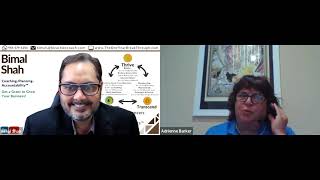
In this interview recorded on Martin Luther King Day (January 18, 2021), host Adrienne Barker, MAS, speaks with entrepreneur and business coach Bimal Shah about his personal background, coaching philosophy, and the "One Year Breakthrough" system. Shah recounts growing up in India after his parents’ divorce, funding his own out‑of‑state college education through multiple jobs, and launching a financial‑sector business straight out of college. He explains his three‑pillar framework—Thrive, Transform, Transcend—designed to help entrepreneurs achieve a three‑year vision in a single year. Central to the system is a comprehensive business scorecard that evaluates ten core functions (marketing, operations, sales, training, hiring, technology, customer service, finance, leadership, etc.), identifies gaps, and translates findings into 90‑day "leaps" and 15‑day "sprints" with weekly touchpoints. Shah emphasizes the use of state and training grants to fund growth for for‑profit businesses, describing how he writes grants, secures funding based on company size, and integrates the grant money into the coaching program. He shares a case study of a Florida solar‑panel company whose production cycle was cut from 260 days to 51 days, turning the business from red to black within a month. Shah also details how he builds future‑state organization charts from P&L statements to reveal role overload and streamline staffing. The conversation moves to his three books—The Daily Happiness Multiplier, The Breakthrough Experience, and the Breakthrough Accelerator series—each focusing on cultivating joy, providing step‑by‑step frameworks, and delivering rapid‑action workbooks. Shah mentions his involvement in high‑level mastermind groups (CEO Boardroom, 90‑Day Leap, Million Dollar Roundtable), his upcoming weekly podcast "Laws of Business Breakthroughs," and his plans to engage on platforms like Clubhouse. He also promotes a live Zoom event helping businesses apply for PPP loans under the CARES Act, offering a 30‑minute walkthrough. Throughout, Shah offers advice to students on leveraging extracurriculars, internships, and scholarships to fund education. The interview concludes with mutual appreciation and plans to share the recording.
Chapters
Awesome, awesome, awesome. Hi, so hello everyone, it's Adrienne Barker from Adrienne Barker Speaks having a candid conversation today, Martin Luther King Day, so very important day for all of us, January 18th, 2021. I've got Bimal Shah, and Bimal, this is so interesting because you have— I love your background, so this is beautiful. So you have— not only are you a coach and you are really a financial coach, but I love the fact that you did your book a few years ago, and I want to make sure that we talk about your book, which I find is very exciting because having a positive mindset is, is huge, and it's— everyone's talking about it. But tell us your story because I like reading about it, so I want to hear it from your mouth exactly what happened when you left your home.
And I added two other books, um, to the last one as well, so I have three books now. And, and my story began, you know, like, and I was 2 years old, my parents got divorced. I was born in Dayton, Ohio, and then went back to India, grew up there, came back here with empty pockets, funded my own out-of-state tuition, working 5 jobs, graduated with a lot of savings, and started in the financial sector, started my own business. I had numerous opportunities to work even at a very good salary, starting out of college, but I denied those and started my own business straight out of college and have been helping entrepreneurs ever since. I have 3 principles that my whole business is founded upon: Thrive, Transform, and Transcend. So Thrive is like, okay, first you need to learn how to grow and scale and, you know, maintain that scalability. Then you transform your business, you go to the next level leaps, and then you transcend into a third level. So this is, um, these are the principles that I have founded, uh, business, and I also do business coaching, consulting. I do grant writing. My whole thing is I want to take entrepreneurs and help them achieve their 3-year goal in 1 year. Am I— I want to make pioneers out of entrepreneurs. I believe God sent every entrepreneur on this planet to be unique and different and be a pioneer. So that's my whole mission, and I want to help them by taking their 25-year goal, connecting it to a 3-year goal, helping them get there in one year.
I love that. I love business too. I am a SCORE certified mentor here in Volusia Flagler, vice president, and also I do workshop development. So maybe you and I could talk about doing a workshop for SCORE on, um, on what you offer. But I want to ask you a question. So you're a young guy, but I know the times are different now when you're trying to get into school. So how easy was it for having empty pockets, but yet able to get an education? And how could someone, how could the, the young adult today do what you were able to accomplish? Maybe what was it, 10 years ago?
20 years.
OK.
So today there's a lot more opportunity, it's a lot more easier. I would say it was much harder back then. And today the resources are plenty. So one of the resources, students, if they work hard, study hard, and take advantage of opportunities. And you're specifically, your question was students, right? Like how do students when they're going to college accomplish the same feat? One of the ways is thinking outside of school and taking employment or jobs or, you know, things that they can as, you know, there are opportunities everywhere and every experience counts. And including volunteering hours and all of that. In today's environment, one of the things that really, really helps college admissions and give you grants, scholarships, and work-study and aid is looking at extracurricular activities, volunteering, and internships besides your college education and, you know, and school education or high school education. So while you're in the second or third, you know, junior or senior year of your high school, Ramp up on as many things as you can do outside of your high school.
That is really great advice. I love that. You know, I'm a daughter of two entrepreneurs, but my parents, so they were definitely traditionalists. So they started their business in 1955, but they would have said to me, it's hard work, Adrian. It's hard work and pay your suppliers first. And watch your money. So things have really changed. Like, I wonder how my parents would have thought about the idea of growing your business and getting a grant or what it looks like to thrive. They just worked so hard. They don't want anything else to come and play with anything, but that's a big deal. That's a big difference too, right? The traditionalists who started their business back in the '50s and '60s compared to today, Can you talk a little bit about that?
Sure, so absolutely. So things have improved and there are some fundamentals that still stay. So looking at, you know, 1950s when your father said that, you know, pay your suppliers, work hard, those things really apply even today, but you have to work hard on smart things. If you just work hard, you may be working harder in the wrong direction and you can put in a lot of time, energy, resources, money, and even your sanity, you know, and getting, you know, working hard in the wrong direction. So you have to work hard on smart things. Now you can learn through the school of hard knocks, but you can learn by people who have done it. So I've done it, I've helped many entrepreneurs, and I can shorten your time span of maybe 10 to 20, 25 years into 1 year. So you don't mistake, make the same mistakes that, you know, others are making, or you don't go the journey so hard because the road becomes much easier for you. And one of the things I would say entrepreneurs today, if they want to grow their business, the very first thing they have to do, one thing is know who they want to serve more than what they want to do. Is who do you want to help? Who do you want to serve? And then you have to have a very unique offering in your product and service. You know, you can't do the same thing as everyone else. So one of the things I do uniquely different than everybody else is I help entrepreneurs achieve the 3-year goal in 1 year and have the government pay for it through grants. So there are grants that allow businesses to grow, and that's what I get for them. So that's very unique. So now when they try to shop me around, they don't know where to go because there's nobody else.
It's so unusual because you think of grants, we think of a nonprofit. That's you, but you're— and all I, all Only with COVID-19 did I think that the average person or the average business person thought, wait a second, I can get a grant for my business and not be a nonprofit. But you're not talking about COVID grants. So really explain what that means to get a grant to grow your business.
So there are state grants, there are training grants that are available that allow businesses to grow their business. And I can walk you through. Actually, I can show you on the screen, you know, how the whole process works.
Really? Of course. Oh my gosh, yes, please.
Okay, give me one. So while I'm pulling it up, you know, it's, uh, basically you take your— I've developed a very unique system which looks at every single function of the business, and then within each function, I provide training, um, to the businesses and help them achieve their 3-year goal in 1 year. And, um, I do a scorecard on the business. I look at, um, so I'm a big believer in scores. I have more than 200 thinking tools and, um, thinking tools has helped you think in the right direction. And then I walk them through and fill in the gaps and achieve that through 90-day leaps, 15-day sprints, and weekly touchpoints.
Oh, you put a little sports into it, which I love. Really makes the word coach play. I love that. I love it.
Okay. So give me one second. Okay. So what I, so this is, you know, once I have a 25-year vision, a 5-year moonshot, we hone it down to a 3-year goal. So this is an actual sample of a client, you know, their 3-year vision. And then once I get to their 3-year vision, then I do a scorecard on their business, you know, on marketing, operations, sales, training, you know, hiring, technology, customer service, financial, and leadership. So these are the essential functions of a business, whether you like it or not. I mean, as soon as you say to God that I want to be an entrepreneur, God says, great, here's your responsibilities.
I love this.
So, so we take a score, we do the gap analysis, and once we do the gap analysis, we find out the dangers, the opportunities, the threats, the weaknesses. And then I build the strategies and executions, the financial impact, and then we convert this into 90-day leaps. 15-day sprints and weekly touchpoints.
So what— okay, so I love this. I think it makes sense. I grew up in a family business. Why would a company not want to do this? Would they be scared of the cost to it without understanding that the whole idea is that you actually can look, that you actually see your business, like take the blinders off, see your business, really focus on it, and put the energy in where you need it to be, even if it's costing you a little money?
So the one thing is businesses don't know, right? So one reason they couldn't do this because lack of knowledge or they don't know something about that this exists. So once they know that this exists, I have— I mean, out of, I would say 99.9% would go forward. You know, very few would not go forward because of some timing issues, some other personal issues, or some other challenges that they have to resolve first, but that becomes a priority than trying to utilize on business growth, you know, and scalability. So there are some other challenges that businesses and entrepreneurs face, whether it's partner issues, personal issues, things that they have to fix those first before, you know, they go in any, take any step forward. So that, that is primarily the only reason that, you know, I have seen across, come across.
I actually, so how many times have you done this where you've realized, oh, this business is underwater and they really need to make some significant changes or shut it down?
So I'll tell you a true story. So one was a solar panel company where, right here in Florida, where they were in the red. And what was happening is their production cycle was so extremely long. And what was costing the financing companies who backed the pro— you know, who financed the project to back down and say, we're not no longer financing this project because it's taking way too long to complete it. And number two, the customers were asking for rebates or like for discounts or money back. So they were getting pulled at both ends. You know, one is, you know, here companies saying, okay, we can't finance this. And here they say, give me my money back. So they had to really, the main problem was the production cycle. Okay. If they can shorten the production cycle and their production cycle was over 260 days long. So, wow. So we shortened it to 51 days.
And wow.
So that put them in the black in just 30 to 45 days, literally from red to the black. And that was a transformation. So, so that is, you know, so many times, you know, the problems are in operations, problems could be in customer service. This is why I developed a functional training, which takes into account every single function of the business and make sure that things are taken care of.
This is, to me, this is so important because I have seen it where the owner, the president can actually have a blind eye areas, just, you know, never want to hear all the things that are wrong, just want to concentrate on everything that is right. So there's a blind eye on all the other issues that are going on because they just don't want to face the reality. So I kind of call it limping along, where you're just like, you know, you're walking with a cane, you're kind of limping a little bit, and you're not really back standing tall and ready to take on the world. So working— so is it an expensive program? I don't like to ask that question a lot, but I'm just curious. You don't have to give me a dollar —amount, but is it different?
It's different for different businesses. That's what I mean about it. So the smaller the companies, the— again, it's through the grant, so it's funded through the grant, right? Really? Okay. So, so the larger the business, the, the larger the grant. So number of— depending on the number of employees. So, you know, and I get them— I'm the only one who gets the maximum grant for business. Processes. So, you know, each company, depending on the size of the company, they can get a grant that I can get them approved. I do the grant writing. So I wear all the hats that I need to wear to make sure entrepreneurs achieve their 3-year goal in 1 year. So whether it's working on marketing, working on operations, working on sales, training, hiring, recruiting, whatever it takes.
Are they opening the books and the door for you and you're able to go in and speak with the staff and How open does the business have to be?
So I fundamentally, first thing I ask is for numbers. The business is driven by numbers. So, you know, listen, if you can't show me— and one of the things I say, we can build your future org chart, your future organization chart from your P&L statement. So, so we actually build their future first.
Oh, I really love what you're doing here. OK. All right. And then how— so tell me about the org chart. How would that be? Because that sounds interesting that you have a little trick with that.
Yeah. So we take their P&L statement and then we build their future dream come true P&L statement. And now let's build an organization chart and compare it to your current organization and see what's missing, who's missing. Are we— have one person sitting in 10 different seats? I did one company, you know, when I developed their future organization chart, There was one individual who was sitting in 13 different seats and he was getting burned out. And the owner felt like, well, you're at the top, you can handle everything. So you're the managing director. You should be able to do everything. And when we prepared the orchard, the owner realized how deeply he was burning. Wow. Wow.
I really love what you do. I'm hoping personally that I can use it as a— with my my, my brothers and sisters if they listen, because we have a family business. My parents passed away, so they left behind an art gallery and, and a museum. And, and really, I'm very excited. I think that there's a lot of future, but we need something like this.
Yeah, I'd love to connect and see how we can assist.
I appreciate that. Now tell me about— let's switch gears for a minute. Tell me about your books, and tell me about your first book, The Positive.
Kind of what I just started, I wanted to write I didn't know what I was going to write about, so I just kept on writing. So I started about that, you know, you should do what you, you know, you have the saying that love what you do or do what you love. People get confused, and you know, there's a lot of things, follow your passions and the money will follow. The reality is you should, you know, basically love everything that you do, and if you find happiness in everything that you do, the progress will follow.
Oh, I love that. The progress will follow if you find ever— and you're not just talking about waking up and work, you're talking about like what, the joy of cooking, the joy of taking care of your children, your spouse, any of that.
Any of that, absolutely. So whatever work it is, do it with joy, do it with, you know, love, and you will find progress and you will find cooperation, you will find communication, you will find connection. and you, you will see growth. And a lot of people, sometimes they spend years and years, you know, trying to discover what their passion is. But if you just love everything that you do, you will find what you're skilled at, you know, what you're talented at, and then you'll be able to leverage that to another level to make more money.
Can, can everyone do that? Like, in all honesty, Bimal, like, I, I do find joy in everything. I just I just do. I just do. And you know what, even in people, you gotta just find something positive in everything. And actually, it kinda worked out a little negative for me too. I find magic in everything I eat. So I work for American Cancer Society, and I would naturally go out and say, "Oh, I had the best meal, this place." And finally one day they said, "Adrienne, you like everything. You're gonna have an event in a couple months, and we don't trust you to tie the food because you like everything." We don't want you to actually pick out the food because we know that you're just going to like everything, and then that may not be the best thing for us because it may not actually taste good. You just are going to say it tastes good. And I'm like, no, I think I really do have good taste. But the funny thing is, one day I walked in, I said, I had the worst French toast this morning, and it was like, they were like, I got clapped, like, yay, Adrienne didn't like something. But it reminded me that I have to be careful because sometimes you actually can get a reputation for always like being too positive and people, you know, they stop trusting in you.
It's not like being too positive. What it is doing— there's a difference between joy and, you know, liking everything. Joy means you don't take anything negatively. I mean, joy doesn't mean that you're funny and laughing and everything. It's just you're doing it with your heart, you know. So that's one emotion that many times is misunderstood. So joy, joy just means that you're doing it with a good energy, you're doing it with good positive emotions. And then if you do that and you find your place. Now the second thing, you know, realize that people need mechanics, people need science, people need scientific steps on what to do. You know, you can, you can have joy, but if you don't know what to do, again, you will fall through the cracks. So you need systems, you need processes, you need steps, you need stages, you know, you need to know what to do. I mean, there's a saying, I don't know who said it, but you don't, you don't need the reflexes of Dan Patrick, you don't need the muscles of Hercules, and you don't need the brain of Einstein, you just need to know what to do. So that's where I wrote my second and third books, is laying out steps and, you know, step-by-step and stages. Do this, do that, do that. Step 1, step 2, step 3 stages.
Oh, so it would be good for someone like me who just kind of has a wide cast net around everything but would like to reel it in a little bit more. It sounds like you wrote the book for me. Yeah, it does.
It's the Breakthrough Accelerator. Therefore, it's a series that I'm building. So right now I'm in part 2 and part 3. But the part 1 is all about just resolving your biggest challenge in 4 weeks. So the goal is taking your biggest challenge and breaking it down and going over a 4-week timeframe.
Do you have yourself— do you have like a podcast? Do you speak weekly? What, what do you do to market yourself?
So I have, you know, I have connections and strategic alliance client referrals. Masterminds is one of one of the things that has helped me do that. And I have a weekly podcast that is going to be launched. There are 10 episodes that are being recorded. It's Laws of Business Breakthroughs. Every Monday you can join in. I can send you the link later on. But it's, it's in the process of, you know, I have a team recording, putting the show notes and all that. So the episodes have been recorded. But it should be, it should be posted very soon.
Very nice. Have you heard of Clubhouse?
Every Monday at 9 AM. I love that.
Have you heard of Clubhouse, the new app for iPhones?
Yeah, so I think one of the people told me, Blanca, Blanca Pepper Greenfield, she told me about it, so I'm gonna look into it.
You would be great on there because it's all audio, but everyone on there is doing more marketing and branding and not necessarily talking about coaching, planning, accountability, and what you're doing. I could see that being really great for you. So you got— so your first book you wrote was— was that— I may be incorrect, but was it 2015? Yeah. Okay. And then you have— so I found the first book. So you have the second and third book that— what's the second book, the name?
So I'll get all three. Breakthrough. The first book is The Daily Happiness Multiplier. The second book is The Breakthrough Experience. Accelerator, and it's part 1 of 13, part 2 of 13. So those are the two.
Wow, you're gonna be busy. Do you have a family? Yes. Wow, do you have children? Yes, teenagers. Oh, you do? How old are they?
14 and 16. I have a 14-year-old too.
Girl or boy? Two girls. Oh wow, I have one and she keeps me on my toes. I have three older boys, but my daughter is definitely— I'm 58 with a 14-year-old year old. So I got pregnant at 44, so she is keeping this face young as much as I can be when I— it's something else, isn't it? I just got my daughter the green light card. How are you? So what— so with your daughter, first of all, does she want to go into business? Does she have any interest in what you're doing?
So she is right now like in high school, so she's, you know, learning, and she's interested in law. And the older one is in the process of going to college. So the ages were 16 and 18.
Oh, 16, 18. I was thinking 14 to 16. Oh, 16 and 18 are lovely ages. Oh, that is really fantastic. I really enjoyed talking with you today. I'm gonna make sure that everyone has a copy of the— where to get your book, because you're on Amazon, right? Yes. Is your book more of a workbook? Like, so you people—
one is a read book where you have a you know, a lot of things to read on. The second one and the third one are more like workbooks. Nice.
Okay, all right, I really need something like this. Oh, and then tell me about the— like, I know you are in some really strong mastermind groups, and there was one around the table— Mind the Table—
what was that one that you're part of? CEO Boardroom Mastermind.
CEO Boardroom. Okay, that's a big one. And then there's two other ones that you're involved in.
Yeah, The biggest 90-day leap and the roundtable. So top of the table and, you know, the Million Dollar Roundtable. I was part of it before.
Wow. Wow. Very nice. So I love this. Oh, I have it. We have all of your information up there too. Biz Action Coach. That's a nice looking website, by the way. That is chock with a lot of information. I definitely would tell people to go on that because I'm impressed. I did not go on to the oneyearbreakthrough.com, so I'm going to go check that one out too. And is there anything else that you want to add or how we help you?
So, so right now there's a big opportunity. I mean, the CARES Act, they passed the PPP. So if any business owners and listeners are listening to that, we help them process the PPP. And then we can get them the funding. I have a live event on Thursday where you can join in and We help people go on there and submit their entire application along with documents in 30 minutes. So anybody who joins, we're going to walk them through screen by screen what to do and submit it and get it in the system in 30 minutes.
Okay, where do we find that? Where do I get that information to share?
Um, it's on Zoom, and I'm doing in partnership with the Riviera Beach, um, you know, City Association, RBCA, and they are putting it together and writing it, but I could send you the Zoom link.
Yes, please. Yeah, if that's okay with you, and then we'll share that with our SCORE clients too. That would be great.
Yeah, and then it's also on bit.ly/pppin30minutes. Very—
okay, very— yeah, that's— this is so important. Everyone should be taking care of this. The other thing I would do— do most people understand that that that information though is public and that people could see how much PPP loan that they did take out?
So even though the PPP, they put out the chart of businesses and, you know, how much loans that were funded, which company got what is not necessarily public. You know, like every single company, they— what they do put out is the number of loans funded by each state. So like how, how much, how many loans did each state fund, how many businesses got the money. But I can tell you that this round of money is not going to last beyond a week because it's only $284 billion and that's not a lot of money. If you do the math, you know, it's only $40 grand per county. Right. You're really right.
But I did know, I was able to look up and see what other businesses were able to get in the first round. And actually see the name. OK.
I don't believe— and what I was saying is they don't give every single data. I mean, there must be some companies they put out the name, but I don't know if I have to still see if they put out every single company that received funding.
OK, if you get that information, I'm curious about that because I looked up a few and I was like, oh, that is interesting information that's available that I just didn't know if people sign up, if they knew when they were signing up that it would be public information.
No, I mean, you know, with the government, if you get the money, they, they, they make it public.
Yeah. Very interesting. All right. I love that. Thank you so much for all your information. It was lovely speaking with you today. Thank you for taking on the role of host.
Once you're done, I will send you the link of the recording and then you can, you know, do what you like with it and post it.
Okay. Sounds great. You're a great guy. Thank you so much for your time. Very excited. I learned something new. All right. Have a great rest of the day. Bye-bye.










