Superstar Guest Nir Bashan, a world-renowned creativity expert.
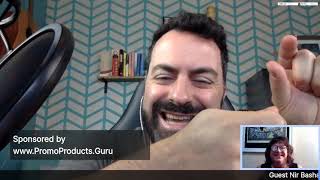
Nir Bashan, a creativity expert, argues everyone is born creative but loses it through school and analytical pressure. He presents a Concept-Idea-Execution framework and 92 tools for structured solo creativity using pen and paper, rejecting traditional brainstorming. His techniques include journaling and writing ideas down to manage self-doubt and activate different brain regions.
Chapters
Hi everyone, happy Monday! Okay, I know I'm all excited again. Look who I have that we're just going to jump into this. I have Nir Bashan, who is— he just wrote a book, he's going to tell us about it. I like to think I'm creative, but actually, Nir, I went to your book and I read about the self-doubt. This is such an interest, this is like dear to not only my heart But as a promotional products executive, someone that's been in the branding industry for years, this is, I think, all of our hearts. So tell us about who you are, where you are, and the book, please.
Definitely. Yeah, for sure. So thanks for having me. This is really exciting. I am a creativity expert and I talk to people all over the world about how to become more creative at work. It started for me at a very young age. I was 9 years old in Los Angeles in the early '80s, going door to door, trying to get, you know, people to let me wash their cars. And I discovered that nobody gave me the keys to their car because they had their precious, you know, 1981 Ford Taurus, you know, that they love that car and they wouldn't give some 9-year-old the keys to the car. And so I discovered that I had to get creative in order to make money. And I did all kinds of other things instead of selling cars. I did, you know, other things. I cleaned out trash cans and I, you know, cleared out front porches and all of this stuff. And it set up a lifetime of understanding that you need to be creative in order to do well in business.
That makes sense. I love that. My parents got married in 1955, and my mom's father gave my parents blinds that were imprinted and said, this is going to be an important business, you know, logo merchandise. And I think that he knew that my— both my parents were very creative to get into this industry. So tell me more about— because we think in our minds that we are creative, but is it part of like who we are, or Or can you actually manifest creativity?
Yeah, so we're all born creative, and then somewhere along the line we lose it, whether it's school or whether it's, you know, society or whatever. We get less and less creative as we get older, just at the time where we need it more and more. Um, we tend to overdo the analytical side, which is numbers and spreadsheet logic and all of this stuff, and we underdo the creative side. And we wonder why we can't get to the next level, why we can't sort of, you know, reach a new level of business and doing well in business. And we're always kind of limited by that fact. So we need to add creativity to our analytical thinking in order to do really, really well in business.
That's really interesting. It's easy to— I, you know, I'm a SCORE-certified mentor, so I love it. So I will work with a lot of different clients and helping them, and often they're like, oh, well, that— I didn't think of that. And, but some of the things too in creativity is what you think of what you know, and then of course what you don't know. So how do you go out and make sure that you can be creative and also be quick to be creative? Like sometimes you have to feel like you have to be creative on the spot.
Totally. So there's a process for it. Um, I worked in Hollywood and in music for many years in Los Angeles. And what I discovered was some of the most famous musicians in the world and some of the best actors and most impressive actors in the world are not just whatever, I'm creative. They have a process for it. They get a pen and a paper and they write down different ideas and stuff like that. I talk about it in the book, how to do those things so that you can draw out creativity whenever you want it. And so, through working with musicians and people that are typically we see as creative, all the way to working with business owners and people in manufacturing and medicine and different types of fields, retail even, I learned different tips and tricks from all of these different fields. And I kind of put it together in a book that is a doing book. It's an action book. It's not about theory or like thinking about it and that sort of thing. It's about doing it. And so I give a lot of tips and tricks inside the book of things that people can do to become more creative. One of them is the concept idea and the execution. I ask people to write down what their concept is. That's the biggest level of their, of their job or their business. The idea is like the middle range and the execution is like the exact delivery of their product or service. So if it's a pizza joint, the execution is the meat lover, double cheese, stuffed crust, medium, with cheesy bread. That's the execution. The idea is a higher level thought. Maybe it's food or Italian food. And the concept at the highest level Which is maybe sustenance or comfort or something like that, that you tend to think of when you think about a type of product like that. And I've done this in workshops of, you know, one person and a board of directors, and I've done it for 1,500 people. And I have people write all this stuff down. And what ends up happening when you write something down and circle it, you get a different sort of part of the brain that activates. I talk about it in the book and we cite a bunch of research about it. But basically, I've seen this. It's amazing. It's like an awakening. And people sort of do this exercise and they go, wait a second, if my idea is Italian food and my execution is pizza, why don't I do an idea of healthy Italian food? And then take all of the products or services therein that might be under that, that could be new offering, that could be a spin-off, it could be all these wonderful creative ideas. The, the truth is that we're all born creative, and we need a technique as adults to help reawaken that creativity so that we can use it in our products and services. That's easy to do. It takes 5 minutes to learn but a lifetime to master, and it's something you can get started on today. Even just doing those 3 tiers right now, thinking about your business, will help you become more creative.
That's so interesting. I always thought that it was brainstorming around the table. And that was to me like, okay, so you— everyone gets around the table and everyone starts coming up with ideas. And then one person kind of seems to take control. Actually, I was saying earlier, this was no rehearsal, by the way, no script, just to remind people, we just hop right on. But I was saying that I— Nir is in Orlando, and I'm a graduate of the Orlando leadership. But right now I'm in the Daytona leadership. And it's interesting because we have some really amazing Alphas and they were great. And I found that my voice was a little quieter because I was watching the, the other, the rest of the team and some of them were just so creative and it was neat. We were given a project and then we have to execute the project via Zoom with like 24 of us and try to divide it all. And in seeing that, I'm thinking, okay, it really was like the brainstorming and then the ideas. So, but if I'm all by myself and I'm trying to do it for my own business, is, or is it for both? Would I give everyone around the table a copy of the book and then say, okay, in 2 weeks, let's meet? How would you do that?
Yeah. So the, the concept, idea, and execution, that is the catalyst of creative sort of thought. It's just one of the tricks and tools and things that you can use. But yeah, you could definitely do it by yourself and you can do it with a group. People think that brainstorming is kind of like the thing that they should do, but I don't advocate for brainstorming. You have egos getting involved. You have different personalities getting involved. You have Barbara from, you know, HR who doesn't like Teddy from operations. You have Sam who never really talked to the, you know, anybody in IT. And you have, you know, I don't know, Jane who doesn't, you know, even want to be here today, right? And so you get people in the room and it's like, really, we're doing this? So what I advocate is for creativity that can be generated one-on-one. You and you sitting down with a pen and doing it. And then that creativity, once it starts to get going, can be done in a group too. But it's structured. It's structured. It's not like a free-for-all. People think that creativity comes from just people being free. Oh, let's give them freedom. Freedom to come up with ideas. That's not where ideas come from. Ideas come from structure. Believe it or not, creativity comes from a defined box, a defined sort of idea so that you can— you can't think outside the box if you don't define what the box is in the first place. So what I work on with people is an actionable type of creativity that they can use by themselves or with a group. But it gives them structure to build on, not just, "Hey, we're going to get a whiteboard. What's your idea? What's your idea?" doesn't work.
I love that. Thank you. Also, I really, as someone who's kind of an extrovert with like a little bit of percentage of introvert, and then also I could be very shy as much as I can be very loud. So for me, when I was in that situation, often if I'm not leading it, if I'm not in charge to lead a session, I get very silent. Like, so nobody's going to even hear my voice because there's— I'm just not an alpha, like I'm not that person. So for me, and then so for me, I really kind of need to take a day to like do it myself so I can actually have ideas because otherwise I am that person that always said I'll sleep on it at night. Let me think about it. Yeah.
And, and so because creativity is in our DNA, it literally is part and parcel to who we are. The way that it manifests is going to be different for you than it is for me. And having the pressure of having to get it right in 5 minutes in a workshop sort of brainstorming, whatever session you want to call it, is a little bit unfair to the participants, right? So I believe that creativity is something that started within human beings about 50,000, 60,000, 70,000 years ago. I write about in the book the first creative person on Earth was a woman named Harriet. She was a, you know, a cavewoman, and she saw a stick and like a little berry picker and was the first person to have the creative idea to put the berry picker on the end of the stick so that she can, you know, fight off some beasts. Um, I mean, people lived to like 20 back then. You were like a grandma, whatever, at 20. And, um, so largely in part to the beast and, and all of the things on Earth that were way more powerful and smarter and, you know, all of the thing, but they didn't have creativity and we did. And so today that manifests itself in who we are as people and the way that we practice it and the way that you would practice it, or some of the listeners or some of the people watching right now, uh, practice it is going to be completely different. And that's the beauty of it. It's not about, oh, let's, let's get everyone in a room and We have to leave with an idea. I don't know. I think it's okay to sleep on it.
I love that. All right. So I'm sure that you had many people tell you that they get their best ideas in the shower or on the potty, right?
Let's be honest.
Some of my best posts are when I'm like doing my thing. So I just have to say, like, is that because your mind gets quieted down when you walk, like go in the shower?
Yeah, you know, so there, there's a thing that people think that creativity is about those moments, right? It's about waiting for those moments to strike. And sometimes you have to wait a really long time for those moments to strike. You have to wait, you know, a month and you might get one idea in the shower. But there's a way to expedite that process. You just need the tools in order to do it. Don't have to wait until you're on the, you know, potty, or if you're, you know, in the shower to come up with those types of ideas, that's— the ideas are gonna get out, right? They're, they're part and parcel to who we are. Our minds are literally split into two hemispheres. There is some crossover between the creative and the analytical, but that's just who we are as people. There's no doubt that you'll get an idea, or I'll get an idea, or lightning might strike. But for me, this is not about waiting for lightning to strike. I'm not a very patient person. I don't like to wait for much of anything. I like to do things and get, you know, uh, things going quicker. So for me, it's not about waiting for those moments, it's about actively participating in doing creativity through all of these tips and tricks and tools and methodologies that I have that will help people not have to wait for those moments in the shower, but something that they can do today.
Now, I love it, your book. Um, so thank you for sending the PDF. I'm actually going to order the, the whole book because it looks like it's got a journal, right? And so when you open it, you have pages, right, that you could write— you write in that book?
Yeah, totally. You, you write, you write in the margin of the book, and you kind of like, you know, fill in the, the, the parts of it that— this is meant to be kind of a battle guide. It's not really something you put on your shelf and, you know, you admire from a distance. And you brag to friends about reading. This is real-world type stuff. It's a field manual on how to become more creative. It's about harnessing the power of humor. I talk a lot in the book about humor and courage and empathy and what those three things together can do for creativity. I talk about the little victory, and I have people do an exercise where they list a few of their little victories. Of times people tell me, "Nair, I don't have a little victory." And I tell them, "Well, you're not looking hard enough." So, you list sort of what those little increments that you've had in your business and let them sort of guide you on a path. I talk in the book about complacency and how to deal with that. I talk about comfort, how to slightly take yourself out of a comfort zone in order to become more creative. And pretty soon these things start to add up, right? And you start to go, 'Ah, okay, I don't have to wait for the shower moment or for that walk that I take every Tuesday to get an idea. I can come up with an idea now on the spot, and I just have to sit here, grab a pen, do a few of these exercises, and boom, I can now figure out why, you know, the payroll wasn't made for the last 3, you know, pay periods, and who screwed up, and how to creatively attack that. I can now figure figure out why, you know, the merch is piling up in the warehouse and why we can't move a box out of here. Like, what's going on, right? I'm done yelling at people. I'm done with that stuff. So you can just sort of grab a pen and sort of come up with it. Or you can grab, you know, a few of the leadership teams or some of your employees together and say, okay guys, here's the structure. This is what I want to work on. Let's do it. Because when you have structure and you have a goal, generally people can meet those things. So It really is about doing.
I love that. I love solving. Like when a problem arises, I actually enjoy it. I'm like, oh yes, because now you have to figure out the ways to solve it. And for some reason, for me, I tend to like, oh, calm down. And all of a sudden I just love that. So when there is a problem, and I also try to remind people around me how severe that problem is. For instance, I was with a few people, we were doing an event and we lost all the receipts. Well, it wasn't the end of the world, we have ways that we could fix it. So when someone else is actually going crazy over that problem, I like to, um, come up with the solutions. There really is a great feeling. But I have a question. So the other day I was walking down the stairs and all of a sudden it hit me: it's not who you know, it's who you don't know. And then I thought to myself, well, I wonder if that's a saying. And then I wonder how much of the creativity or what your mind thinks Like my solving problems is just from 35 years being in an industry and helping my parents, working with my amazing mom and dad. And that really gave me an ability to have so many problems always happen that there was always solutions. But creativity, thinking for myself now as I'm older and I'm thinking that, and then I actually Googled it. Is that a saying? Well, there's a saying, it's not, it's not what you know, it's who you know, but there's no saying. It's not who you know, it's who you don't know. And then I'm like, wait a second, did I just come up with the most amazing creative line, or is it just not there? Like, I don't see it on the Google or whatever. How does that work in the brain? Like, how do you know that you really have a creative idea?
You know, that, that's a— I mean, it's a brilliant thing to come up with that sort of idea. Um, sometimes it really doesn't matter what anybody else thinks about your idea, it's what you think about it. And how you move it forward in your product or your service means the world. It's not really all about what, you know, somebody else thinks and that sort of thing. There's a long line of, you know, in history, there's a long line of products or services that emerged from, you know, people saying, oh, this is the worst idea ever. Why would anybody dot, dot, dot? And then an entrepreneur or business owner would go out and execute that and, you know, it would become a best-selling product. There is an intangible that people have that analytics cannot and will never be able to touch. Look at what you have in your Amazon cart. I mean, I love Amazon and they're great, but, you know, they've spent millions on this AI algorithm that's supposed to tell you based on what your order is, you know, some other comparable product. And for me at least, every time it's so wrong, it's like it's not even close, you know. Like I'll order something and something will pop up there, it's like, what? Where did that come from? And you know, it's just one of those things that there is a certain degree of creativity that we have that can never be replicated by a machine. It can never be replicated by someone else. And Part of it is having the courage and my empathy, humor, and courage part. It's having the courage to carry that idea forward. So if you think that's a great idea, I think it's a great idea. But if you think it's a great idea and you think that you can monetize that by putting it on one of your products or something like that and getting it out there, who am I to say that that's not a good idea? If you can resonate with your audience and your customers, whether you're B2B or business to consumer, whatever it is, if it works for you, then who am I? Who is anybody to take that idea away from you? That is the power of creativity.
Okay, so then just before I let you go, then, then the next step is that after I had that thought in my mind, I went to your self-doubt chapter because it's— so can you just talk a little bit about that? Because I feel like I have that a lot, the self-doubt part.
So you, me, everyone else. So self-doubt is a monster that lives inside of, of us that is more powerful than any army. Or like, you know, you tend to think of like a bomb being really powerful, but in every human experience, there exists a far more powerful force than anything that can be compared to, uh, in nature, and that is the power of self-doubt. We are constantly editing the ideas that we have because we don't think that they're good enough or they're smart enough or that they're, you know, anybody will like it and so on and so forth. But that's just the thing. We need to learn how to control self-doubt so that ideas like the one that you had or the ones that your customers, clients will have, will be able to get out there and be really successful in the marketplace. So I talk about a method of water to help people deal with self-doubt. Water just flows. All the atoms are connected, and it doesn't care which atom comes before it or after it. It just is. And so I talk about allowing yourself to understand that not only is self-doubt there, but that you just gotta kind of, you know, let it go and understand that it will— it is something that is in your power to control, and it's something that is in your power to sort of visualize as as something that doesn't care what it is. It's neither here nor there. It is what it is. The second thing I tell people to do is write stuff down. When you write stuff down, you activate a different portion of the mind like we talked about earlier. And when you write stuff down, you are less particular about a precious idea. Listen, you and I have been entrepreneurs for our entire lives, right? And I'm sure some of your listeners and people watching us right now are of the same mindset. And I have, and maybe you have, In the past, had an idea and I was like, this is the best idea ever and I'm gonna keep it close to me and not let anybody— and I'm just gonna guide it, you know, to fruition with, you know, everything I've got and nobody will ever see it and blah blah blah and oh, somebody will steal it from me, you know. Now I have more ideas than I know what to do with, more creativity than ever because I write stuff down and when you write it down, you you're less precious about, you know, oh, this is the one precious idea. And what happens is self-doubt, that monster that grips you, starts to let go. 'Cause if someone steals your idea about, if not, you know, what you know or who you don't know or whatever, then you can come up with another 10 ideas. And then if somebody takes those away, you come up with another 10, another 20. Don't worry, it's not about, letting self-doubt crush you. You got to let it go. And you've got to have a preparation of having some other ideas so that you can allow yourself to let go. It's about, you know, just taking a deep breath from, you know, once in a while and shaking off that incredible grip of having to get it right all the time and having to do it perfectly all the time. And creativity, for me, the channel that I can teach other people to do, which will allow them to get there.
Okay, I could listen to you for hours, so I'm going to post your website again, and I'm going to follow you and your events and, and learn more. And I'm going to share you with the industry, so I'm going to share this on the promotional products, uh, special page that we have with 10,000 members, because you really are a nice connection with all of us in the promotional products industry. Can we see your book one more time before I let you go?
Yeah, definitely. It's called The Creator Mindset It's got 92 tools to unlock the secrets of innovation, growth, and sustainability. It's a McGraw-Hill Business release, which I love them, really nice people at McGraw-Hill. You can get it at Amazon. It's for sale now. Prime, it's Prime, so it'll go to— it'll get to your house tomorrow. Barnes Noble has it, a bunch of bookstores, the local indies have it. It's around the world. And I would love to hear what you all think about it. And I would love to get feedback on it at my website, nirbhashan.com. And thanks for having me. This has been really fun.
Oh, thank you so much. I will see you again soon. Thank you so much. Really wonderful. Have a great rest of the day. This was great. Thank you.










