Volusia Hispanic Chamber Presents Servant Leadership Workshop
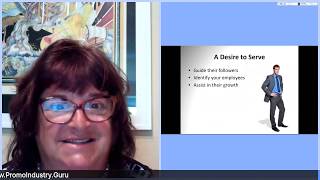
In this pre‑recorded 45‑minute workshop, Adrienne Barker (PromoProducts.Guru) introduces and models servant leadership for members of the Volusia Hispanic Chamber of Commerce. She explains why the session is pre‑recorded (her involvement in a COVID‑19 contact‑tracing assignment), shares personal stories from her family‑run art gallery and other work experiences, and defines servant leadership as a philosophy that puts employee growth, empathy, and empowerment before short‑term sales goals. Throughout the talk she covers self‑reflection, democratic leadership, delegation, feedback, coaching, the difference between empathy and sympathy, the pitfalls of micromanagement, and how to build employee passion through community‑service programs (the “Spirit of Caring”). She also outlines practical tools—active listening, persuasive communication, performance evaluations, and delegation as a trust‑building gift. The session ends with a preview of a follow‑up roundtable on barriers to servant leadership scheduled for July 13, inviting participants to share their experiences and questions.
Chapters
Hello, I am Adrienne Barker, PromoProducts.Guru, a very proud member of the Volusia Hispanic Chamber of Commerce. Very excited to be here today. It is Monday, June 29th. Now I'm not coming live and there is a reason why I'm not coming live. And part of it is because of my servant leadership qualities that I have. I look forward to our talking about servant leadership today. But I want to share with you two stories. One is the reason why I'm not here today is because once COVID-19 hit and we were all learning about it and we needed the time to stop so that we could stay home. For me, I'm not talking about for anyone else, for me, I watched a lot of news, I read a lot, wanted to learn a lot. And during this time of learning, I learned about contact tracing. And I thought, ooh, this is really interesting. We've been doing this for years, I wanna learn more. And so I decided to take a free course from Coursera, the Johns Hopkins Institute, and I took a contact tracing course. It was 8 hours, it's free, it's on the web, you can find it. And as I took it, I realized, oh my gosh, this is me. I actually love to listen. I actively listen. I love to help. I want to help. I get along with people. Geez, the one skill I have is people like me and I'm likable and I like people. So, and I genuinely care. So I decided after I took the whole course, that I would love to just go on an assignment. I'd love to learn more. I want to do it. I want to do it. It's exciting. And so I did apply and I got a contract. So I'm actually recording this Sunday, June 28th, and I'm recording it so that you could play it on Monday. And then in 2 weeks I'll be back and we're gonna have a conversation about this. But in the meantime, I feel bad that I'm not able to be here live, but I'm hoping that you still enjoy or watch the presentation and then send me some messages. I want to hear more about being a servant leader for you, what that feels like, what that means. When you grow up in a family business, you kind of know sometimes I'm a little different, but you're not sure, especially when you're old like me. Today's my birthday, so I'm 58. But when you're a little older like me, we didn't have the internet. Our answers that we needed to find were not readily available. There were no coaches in the system, coaches available for me. And so the way my brain thought was quite different from a lot of other people. So when I would look at an employee, I would want them to grow. Everything to me was to make sure that this employee could be the best that they could be and make sure that they're in the right position. So we're going to talk about that. But I had something that happened about a year ago that I wanted to share. So I moved to Daytona to open up my father's fifth art gallery, family art gallery. In the meantime, my father has passed away, but I was very excited to open the gallery. I knew enough about it to start the business, needed some help obviously, because a lot of it— suppliers, QuickBooks, all of that was new to me. Excited to learn. And I had hired a woman right away before I even came up here. I was on the phone met her before I opened the gallery and hired her. Things were going great. In March— that was September of 2018— in March of 2019, we need to hire more staff. And so we found a young man who is a graduate of the University of Florida, art degree, fantastic. Didn't interview very well at all, really. And I needed a couple days to think about it. When I finally made the decision, let's hire him, I had a conversation with this woman and I said to her, this is exciting, let's mentor him, let's help him. This is really like a second job at an art gallery. We're going to make a difference. He's only, you know, he's in his mid-30s. We can move him forward. That's how my brain thinks, right? I'm always thinking, how can we help anyone else? What can we do? Because when you're in work, you are going to make a difference. You are effectively changing your employee's life and hopefully for the better. As I'm telling this to her and I'm thinking, I'm excited and wouldn't everyone want to help an employee? She said to me, Adrienne, he works for us. I will be his manager. I will train him, but I will definitely not be mentoring him, nor do I care to mentor him. And what is wrong with you that you want to mentor him and thinking about his future when don't you think you should just worry about right now and sales today? What is wrong with you? And I actually thought, what is wrong with me? Part of being a servant leader, which we'll talk about, is self-reflecting. So when you go to bed at night and think about all the things, it was, what is wrong with me? I kept thinking to myself, there's got to be something wrong with me. Why is it? I mean, really, almost for— that was last year. It was only really a couple of months ago that servant leadership popped up again and I realized, oh my gosh, inherently this is who I am. It's not easy to be. Let's get right into it. I'm very excited. I do have to pop off and on the screen. I'm using a program that I use for my candid conversations, which by the way, anybody would like to have a candid conversation with me, to talk servant leadership. I would love to do that. I'm leaving today, which is June 28th, to do the 2-week contact tracing course, and then I'll be back in 2 weeks. I look forward to hosting the next, and I'm pretty sure it's the 13th of July for the next workshop roundtable, which is going to be a lot of fun. Anyway, I have to go ahead and go back and forth to do my PowerPoint, so excuse me as I move it forward. As we're talking about servant leadership. I don't want to read this all to you. We all can understand that servant leadership is, and it can be seen as a contradictory term. We can figure that out. That makes sense. But it's very popular and it's gaining traction right now. The idea is that fixing solutions come right with the employee and focusing on their success. I don't know about you, But I know in certain fields it's very, very difficult when you're working and you're an employee and your manager is not caring enough to train you. Things are being said to you that really show a lack of empathy and caring. And maybe even you have a leader that is consistently making sure that you're not trained, talking behind your back. Setting you up not for any kind of success. That is a problem. And we probably have family and friends that are telling us about this. And that is why in order for us to have our next generation come into the workforce and really enjoy it, we want to make sure— and as leaders out there, you want to find out what leaders that you have that are actually natural servant leaders and put them in the correct position. Take another second to read what this says on the screen. Because it's all about building a better professional relationship, and that really in turn will help your company not only be successful, but your customer service is going to be successful too. Part of our objectives today is to define what servant leadership means. Learn how to be a mentor and a moderator, and practice self-reflection. Servant leadership is really giving of yourself to your employees. We're not talking about boards and committees, though that would be a place for servant leadership. But if you are a servant leader in your business, what does that look like? How are you helping to get the best out of your employees? Because a servant leader is not necessarily going to worry, focus so much on the sales, and the dollars because they know that that will come. That'll come naturally if you put your employees in the right position. Self-reflection. I wish I could ask you to raise your hand. Self-reflection is actually really just waking up. Actually, I use my self-reflection before I go to bed, but waking up, going to bed, it's just thinking about how your day had gone, what you could do better, what you will do better tomorrow. It's thinking of yourself and your actions and not being upset with yourself, but understanding how you can do things better. And so growing up, I used to say, I used to ask people, do you self-reflect? Do you look in the mirror? But not do you look in the mirror and see all, you know, what do you see? It's more like, are you looking in the mirror and thinking of how you can improve the quality of life for your employees? So again, it's a business philosophy that emphasizes the act of a leader, such as a manager or a supervisor, and focusing on the growth and development of their employees and ensuring their success. Take a second to eat that, right? Okay, good. So again, comes from inside. I knew myself I had a desire to serve. I wanted to— I want to guide people. I want to make sure that no matter where you are in your stage of employment, because let's be honest, if you're filing for your company, that is a huge responsibility. Let's just take a restaurant. You're a restaurant manager. Every step of every employee is important. So the employee that opens the door, now the employee that sanitizes, The employee that's greeting your guests, every part of that business, to the chef that's cooking the meal, to the server bringing it out, they all need to have a desire to serve. And as a leader, you want to assist them in their growth. If you have someone that says, "I'm just working for a paycheck," that's okay. But maybe if you're a servant leader, you would help them to understand that it's a career path for them. And that this will help to shape them. Do we all remember our first jobs? I wish I was in a room with everyone. I could hear your story. This is very one-sided for me because I love to hear people's stories. I had a job. I worked at Wendy's in college, okay? And the donuts, my love for donuts came from the whole donut. But Wendy's was an interesting story. I enjoyed working for Wendy's. It was great. I loved the food. I was in college. And when we had our spring fling, you would have thought that the manager who has worked with me now for 9 months would have said, Adrian, absolutely, we'll make sure you're a college student, we'll make sure that you can go enjoy your Spring Fling. But for some reason, he boxed me in as an, like, not have— not in college, and told me no, I couldn't go to college, I couldn't go to the Spring Fling, which was crazy because I wasn't going to miss my Spring Fling. So what did I do? I left. And they were surprised that I said, well, I'm choosing my spring fling over you because, A, I knew that I could get another job. And I knew that this was something that would last. And then inherently, I knew what an odd employer that wouldn't work around my schedule on something that's so important to a college student. And that was the first time I realized, oh, there's something— issue with someone that's not necessarily really thinking about others. So I worked in a place in Tucson where the receptionist and secretary was very good at Photoshop and I was not. And I'd ask her, you know, I'd have a project to do and she would offer to do it. But when I asked her to show me so I can make changes and do it myself, she said, no, if I show you, Adrian, how to do this, then I can lose my job. Because right now I'm the only one in this office that knows Photoshop. So if I teach you Photoshop, then I'm not valuable anymore. And so she was the opposite of sharing. She was taking power back to her and not even willing to give it up. Completely not any kind of servant leader at all. And honestly, kind of the first time I really met someone that was so blatant in saying it. I mean, I know I've met people that believe that they want to know everything and not share it, but she said it verbally. That was really what surprised me and had me thinking. So when you read this, asking employees' opinions, how important is that? And working together on challenges, you could read this and be like, oh, that's me. I'm definitely all that. But are you really? Are you sitting down and listening to your employees and asking them what their opinions are? Do you have a suggestion box in your office? Are you open? Is your first hour of the day committed to a town hall appearance so that you can find out what your employees' struggles are? That's all important in a servant leader. Are you putting others first? This is a big one too. As a servant leader, if your employee needs to leave, they have their birthday or whatever it may be off and you were planning that day, are you putting their needs first? Are you saying, okay, you go and I'll stay? That's totally understandable. It's important to make sure that you're putting their growth and their success first too. Are you delivering feedback? Feedback is so important. People want feedback. You know, if you do, let's just say you're sending out your sales numbers every day. Do you want someone to say great every single— great, great. Like, at what point does great become a nothing? At what point does that mean nothing? Sometimes you really want to make sure that you're delivering feedback that is essential. Actually ask questions. Look like you've really made the choice to really review what they're doing. Because sometimes leaders will come back and they'll write something and you're like, "Oh, they didn't even look at what I was doing." That's a problem. Develop your relationships. That's really important too. There's a difference. You don't need to know what your employee is doing in the middle of the night or all of their family problems. That's not what we mean with empathy and servant leadership. It's focused on the work that they're doing and they're bringing. If some of their issues outside the work are coming in, then yes, you want to manage that too in such a way that you can help them to come back and bring back their productivity. You cannot be their social worker either. So you want to be careful of that. Helping employees grow, encourage their goals. What does that look like? So you have an employee and they did $250,000 in sales their first year. And do you say to them, okay, 2020, you did $250,000. 2021, we got you at half a million. You can do it. That is not managing their goals. Sitting down and finding out what the majority of the sales were. Are any— if there's, let's just say there's 3 sales that were over $25,000, working with them to make sure that they are able to get the repeat business back, or will they not? Or how can they make up if they're— if that was a one-time client? Taking the time to sit down, just don't send out a blanket, here's your goals. That may sound like, well, I don't do that. But you know what? A lot of leaders do do that. They don't take time to really sit down and make sure that your goals match that employee and that it makes sense. Give feedback when possible. We talk about constructive criticism, but that is so important to make sure that someone knows where they are. And I worked for Muscular Dystrophy Association for over 10 years, and they always said, you know, nobody's 100% perfect, right? So you got to leave room for getting there. So, you know, get them over here and, and then let them know that this is where they're going to achieve. So that's important. Listen, listen to the questions, listen to the requests. Don't be focused in other ways. It's very important. We know there are many different types of leadership and oh boy, there's plenty of workshops available to look at the different leadership styles. Oh my gosh, I love that. I love that we're all learning, so that's important too. Servant leadership is not for everyone. But if you wanted to know about servant leadership and if you're thinking this is a path, then I'm excited that you're here so we could talk about it. As you can see, different types of leaders and each one has a different method and approach to handling conflict and success. However, many leaders often blend their different styles together and that way they could do the best for their employee. Now, I just happen to have a democratic leadership style. I like voting. I'll tell you a story. We had an office in Celebration, Florida, And I came down and I naturally just love committee work and board work. So I've served on many, many different committees and boards in the various areas where I lived, always from the beginning to the end. I've always fulfilled my— inside my mind, my contract for the time. So whatever that time was, I've served the time that I needed to. And I've served on boards with the Children's Advocacy Center, and give kids safe shelter and Celebration Area Council and different board members of different chambers. I was on the Kissimmee Osceola Chamber, the Hollywood Chamber of Commerce. I was on the board of directors for the Hallandale Chamber of Commerce. I was on the board of directors for the GLBT Tucson Chamber of Commerce. I mean, I've been involved in a lot, industry boards, all of that. And I noticed my leadership style is definitely democratic. I want everyone to be able to chime in and say what they want to do. So when I was in Celebration, I created a program called the Spirit of Caring because I realized I'm on all these boards and committees, but my staff is not. So first, it was defining to them what it feels like to serve and how great it is. And when you find your passion and what their passion is at now, and a few of the staff really didn't have any passion. So I said, okay, let's all take a couple of weeks and let's look in the community of what you feel like your passion would be. Reach out to that nonprofit, invite them to come in and talk with us if needed. And as a team, let's vote and let's do 4 a year. And 4 times a year, we'll, we'll help whoever the employee is for that time achieve the value and the experience and the excitement and fulfilling your passion for working with a nonprofit that you love. So we did Give Kids Safe We did— excuse me— Give Kids the World, which I loved. We did Base Camp, which was great. The Sunshine Foundation. There was a lot. And I started to watch our employees grow and see that they were really enjoying donating their time and dedicating their time. And then, of course, we were doing it together as a team, which really— we know that teamwork just builds each other up. So it's a great way to build your relationships. Up. Our employees felt more valued too. That kind of experience is something that is so important to each of us. But remember, someone younger may not know how to serve. If you're a servant leader and you have a company, think about doing something like that. The logo is very simple. It was just a chain of people all holding hands and in a nice spirit of caring way. I would love to work with your company if you'd like to create one. And the idea is that the employees themselves pick exactly what it is that they would love to do. Now, we know that we have some leaders that have that laissez-faire style. They worry about micromanaging. I don't want to micromanage an employee. That's not the way to do it. Well, you know what? We need to talk about that. So, you know, giving freedom among employees, that's nice. And, you know, not having to have them, you know, say what they want to do. But here's my problem with this is that I've been an employee and I've been an employer. I think that really makes a difference too. If you have, if you were born in a business, you own your, and you haven't had that chance to know what it feels like to be an employee, or it's been many, many years decades, then that's probably not going to make you the best. Because micromanaging, that's a term that doesn't really even make sense to me. What does that mean? So your employee gets in and you're going to micromanage? Okay, now walk over to the computer and turn it on. No, but micromanaging to me, to be successful, is know that people want to share what they've done during the day. They want to tell, they want to tell you how exciting it is. So that's good. So you want to leave an open door. You don't want to micromanage them so that they And they feel like they can't, you know, all of a sudden everything is so like managed. But you want to be able to make sure that they know it's not micromanaging someone to, to ask them questions and to make sure that they're happy with what they're doing. And how was their success that day? And what is the success tomorrow look like? And how, what does the success like look like next week? And how to get them to complete the success and making sure no matter how great a sales day they had, let's say they had a crazy amazing $5,000 sales day, helping them to figure out why it was successful that day and how to do it. All of that is not micromanaging. It's helping to build your employee to be the best that they can be. And I know I say leading by example. And I will tell you that we could see right now on social media, a lot of people are leading by not example. And they're getting called out and they're getting removed from their position in their company. Many of them are CEOs because We see visually on video, on social media, they're not leading by example. But what about just right there in front of you? Lead by example. If you are during COVID-19 right now and you're a manager and you need to wear a mask because it's mandatory where you live, where you are, where you work, wear the mask. I was out in Orlando And I couldn't believe that we were in a resort area. So there's like a little kitchen area where you could eat by the pool. Really fun. Love that. And the manager was not wearing a mask. So were the other staff wearing a mask? Of course not, because the manager felt that he didn't need to wear a mask. I asked so I could find out what was going on. You are the example. Be that example. Servant leader understands that. They know that the employees look up to them. They look up to their employees too. They inspire and motivate employees, but they also know that their employees can motivate and inspire them. Giving feedback is so important too. I'm going to talk— that's really important. There's a path-goal theory, the supported leadership. Making sure you have a job that you need your employee to do, you give them the path to do it, you stay available for them so that in case they have any questions and helping them to grow, and you participate in their path so that at the end of the day, nobody fails. Because to me, if you have an employee that was unable to do their job successfully, but still good at it, but unable to do it successfully, Maybe that's when you really need to get involved. You don't want anyone to have the feeling of a failure. So don't put a staff member as a national accounts director if they don't have the ability to be a national accounts director. And don't give someone a title that doesn't mean anything. It's on the business card, it's on the website, but you've given them no responsibilities on that title. That is another problem too. That is not the path-goal theory that you want to do. That's taking it the other way. Sharing the power is so important. And as a servant leader, you do that naturally because you don't need the spotlight. You don't have that kind of narcissistic personality where, oh my God, everything is me. You hear this all the time, right? We all had an idea together, but when Joe got up to speak about the idea, it became Joe's idea. Is that really how you want to be? Is that really how you want people to think of you? Is that, oh, Joe, he steals people's ideas. Oh, we spent 3 weeks working on this project with Joe. I worked 20 nights in a row for 4 extra hours and Joe took all the credit. So no Joe, right? No Joe. No Joe means no joking around. So for some leaders, learning to share the power can be one of the hardest obstacles. That they've ever had to deal with. So after all, leaders are supposed to have a feeling of power and use it when they can, or should they? Being empathetic is very important. We're not talking sympathetic, we're talking empathetic. Giving someone sympathy, feeling bad for where they are, Oh, I'm so sorry that you're going through that at home. That's got to be so difficult. We're not asking you to be sympathetic. We're being empathetic, being compassionate. I understand what you're going through at home. Let's make sure during the day when you're working that we keep your stress at a minimal and that you're really enjoying work. What can we do to do that together? That's really important. So looking at the challenges and obstacles, helping them to focus on that, not focusing on your weakness, Oh, I know your mother's sick in the hospital, so maybe you shouldn't be here today. Maybe you shouldn't do that project today. Listen, be empathetic, and help work on the obstacles that they may have. Oh, another show of hands, please. I would love to see a show of hands. Who doesn't know how to delegate? I learned how to delegate when I went to a presentation that explained to me that delegation is a gift that you give to an employee. It's a gift of trust. It's a gift of faith. It's a gift of confidence. And it's a gift of skill. And it's a gift of helping them to learn. So what does that all mean? That means that if you have a project, don't think to yourself, I'm the only one that could do it. And don't be the one that says, Oh, I'm the only one that can do this, so I'm gonna have to do it. Don't be the martyr. Oh, and it's me. I've got— I had to work all weekend last weekend to do this project, and, you know, nobody else wants to do it. Is that true? Delegation means you're saying to someone, here's this project, and I know you're going to do a great job with it, and I have an open door. So if you need any questions, I have any— have any questions or need any help, I'm here to help you. Who likes to delegate? Please make a message and send it to me because I want to hear your delegation stories. So my secretary has my lunch dates all planned and I am excited to work on this because it's my project. Now I'm not doing a great, really representative of this, but stop using I. Years ago, I started thinking it's all in we. We is a great word. We'd love to talk with you. We'll be right back to you. Our Chamber of Commerce. Stop using the my and I because it's gonna get in your way. It becomes a habit. So my biggest advice to guiding you right now is to remember that. Yeah, the old, there's no I in team. That's sweet. And I love that saying, but in reality, just make sure that you don't— it's— we all don't own people. None of us own the chambers or the businesses. So try to keep yourself— try to use the we and us. It'll help you. Talk about micromanaging and the importance of knowing what your employee is doing. But you have to remember, know when to step in, know when to step back. That's really important. As a servant leader, you want to step back from your employees and you want to know when to step in. The good thing is that you're there to watch them so you can offer them the help and the guidance. So when you see that they're falling, you don't want to say, oh my God, this is so crappy. You haven't done anything. You have to say, how can I help you? Being a servant leader is a different kind of leadership style. It's not, we need to make $5,000 today. I'm not really— honestly, I don't care how you're going to do it. You're going to do it. Get on the phone. And do you know how many people I know that actually deal with managers like that? And they're not successful. And the employee ends up leaving anyways. And the cycle goes around again. How many of you have had a job in your life or currently in place where this is going on with you? Where you are given a job with responsibilities and no help at all. And then sometimes even told by the leader, well, I don't want to micromanage you. You handle it all. Call me if you have any questions, but you do it all. And then they're not even around. So micromanaging is not calling at the end of the day to say, hey, "Tell me about your day today. Give me a little 15-minute recap. Let's talk about any struggles that you had. And I want to hear your accomplishments too." So a little case study because it's fun. Okay, so Tim is speaking with his co-manager Dorothy. And David, one of the employees, just lost a family member and he's unable to come in. And Tim is playing the hero and saying, "Oh my God, I have so much work to do, Dorothy. This is crazy." I have to do all of Dave's job because he's not here. And Dorothy says to Tim, but wait a second, why aren't you delegating? And Tim says, well, if I delegate, what difference does it make? Nobody's going to do it right anyways. Is Tim right? No. And it's important for Dorothy to step in and say, Tim, let's look what's on your plate. When you delegate something, you are helping that person grow. You are giving them the gift of growth, of a mindset of learning, and you're showing them that you're not only compassionate, but you understand that they can do it, that you believe in them. So they should believe in themselves. So is Tim helping anyone in his business by doing Dave's work and then complaining about it? Absolutely not. I like questions. So take a second to look at these questions right here. I can't really see the screen to read them to you, and I don't remember every one of them, but it's important. I just want to have you just take this second to just read it, and then I could give you the slide too, so that's totally fine. You got a feeling for the leadership, what's taking place, what you need. So trust, trust, trust, trust. Work with your employee. Take a second to review these questions. You think you got it? Good. There'll be a test a little later. We all know about coaching. A lot of leaders really understand their need to be a coach, and I'm excited to see so many leaders that are consistently taking classes about leadership coaching styles. Add in servant leadership style too, and you can have a really well-rounded leader that's really helping to bring our employees up. So very excited. I say our employees because to me, your employee is part of like my life. So it's our employees. We have kids right now that are working in high school. They're going to be graduating college. What better gift than to give them the ability to work for a company and to have a leader that is a servant leader and that will they— and In turn, by modeling that behavior, that employee is going to be a servant leader. So it's great. So again, if you haven't had a chance to review all the questions, that's okay. We'll get the list to you. Notice if your employee is not progressing. Keep an eye on your employee. If you're already doing the feedback and you're working with them, this will come naturally for you. This one I'm going to kind of go quickly. Take a quick— I'll give you like 10 seconds. Okay, it's 6 seconds, but if you haven't read it, that's okay. I'm gonna send it to you. Many qualities and characteristics of the servant leader. We're just learning about a little bit now as a beginning. We're already at 35 minutes in, so I only have about another 10 minutes. But I want you to just get that feeling of what the characteristics are. Having the empathy, having the power of persuasion, and having great communication skills. Very important. I talk about listening skills because focusing is so important. Being able to be in a room when we go back to being together, Focus. You don't want to be the squirrel that's looking around, or don't get on your phone and try to— the new iPhone 11, 3, by the way, love it. But don't get on the phone because you're distracting other people. Actively listening, paying attention. So when your employee comes into your room and wants to— comes into your office, not your room— and wants to talk with you, put down all of your electronics and focus. Now, if now's not time, by the way, some people are like, I don't want to say no. It's OK to say, I definitely would like to speak with you. Can I get 10 minutes? Don't try to rush it so that you're— and I've had leaders like this before where you say yes and let the person sit down, but you're doing anything but listening to them. Actively listening. Active is the key word. And I repeat this. It seems so common sense. Of course, we're all actively listening. Again, I'd have a show of hands. How many people know that they've gone to see their leader and there's been no active listening? A lot of interruption and nonverbal communication, like this, like that. Watch it. Make sure you just keep everything— listen. Do you know the difference between coercion and persuasive? Because coercion is like intimidation, manipulation. You need to get the $5,000. If you don't make those sales today and accomplish that goal, well, you probably won't be here tomorrow. That's probably going to be what's happening. That is coercion. If you're persuasion, you're going to say, hey, let's come up with some ideas of how you can make that $5,000 goal. Let's sit down together and talk about that. And I know you could do it. And so you're showing them with persuasion, helping them to figure out the route, cutting through the clutter so you can help them to find out how they can in turn meet their goals or whatever it may be. So if you're persuasive, you're gonna know all the facts, you're gonna help them to achieve their goals, and you're gonna know when to listen. Ears. Always, as a leader, recognize opportunities. You know, observe your employee, keep an open communication, perform evaluations— so important. I worked in an office one time where the employer, our senior director, he had his own hours. So he got there, maybe he got in the office around 7:00 AM, but we didn't open and start till 9:00. So for 2 hours, yeah, he got the work done that he needed to get done, but was he a leader for us? And then he left at 2:00 PM. So really, We had 3, 5 hours with him out of an 8-hour day. How was he observing us? Often we maybe would only come in towards the afternoon when we got done with all of our early morning meetings. I couldn't believe that this leader was really doing the opposite because he was so concentrating on the work that he was doing, he forgot that he was a leader. In order to lead and observe us and keeping open communication, and performing evaluations, wouldn't he have to kind of be there? That makes sense. Performing evaluations is so important too. I can't believe, you know, growing up in the family business, evaluations were tough. I really had to convince my parents why it made sense and how important it was and that people want the feedback. They want to know where they are. They want to know where they can grow. They want to know how far they can go, right? Most people say they want to know where that glass ceiling is and how to get there. And they want to be, you know, if you got some, look at your employees, you may want to have one employee that says, I'm happy just being a secretary. This is my job. I love it. I don't want to take my work home. I want to go home. I want to leave the office, enjoy what I did during the day and go home. And then you have someone like me. I want to do more than just, you know, be a secretary. I want to do more. I want to learn. I want to help formulate and change and mold someone's life. And I was ridiculed by it. But I can look back now at 58 and say, I'm proud that I understand what a servant leader is now and that I was doing exactly what I'm teaching you. So I'm not just reading this as, oh, this is a workshop. I wish I had this knowledge. It would have been amazing for me to have been able to be a little more proud of the way my brain was thinking. But I want you to be proud. Proud of being a servant leader. Servant leaders relate to employees, emotional involvement, sense of need, working on their confidence level. Don't we all love to do that? See, this is something I love to do. Now, if you don't have the time to do this, or if you want to have me come in and help you, I'm happy to do this for you. That is really what makes me thrilled to sit down with you and talk to you about how we can help you to become more of a servant leader. A few more of these review questions just so you can see them. I could talk my way through it, but I'm not going to right now. I'm going to give you just a couple of seconds to see what it is so that you can get a feeling. And my computer is a little hard to read anyways, but look at the questions. The answers are right there, so they make sense, right? Please take a second to read that, the difference between persuasion and coercion. It really is important to understand the difference because coercion is is not fun, and it's— it can become a threat. It's intimidating and manipulating. Build your confidence of your employee. This is so important. I know these questions seem fairly simple, but I think that all of us not only need a reminder of doing this, but we're all in it together for the growth of our employees. I feel like this is something that will make the world a greater place. This will help when we go into the store. Is just to see people really loving the positions that they're in. I think we see it often in retail and grocery stores for some reason, especially if you have the teller and the bagger and they're chatting. And some of them aren't even taught to focus on the client. The other day I was in a well-known shopping grocery store and they were talking throughout the whole thing, which was weird to me because I had to really keep an eye on making sure she wasn't making a mistake because I know if I'm not focused, If I'm having a conversation and doing something else, usually I screw up. So I'm trying to see if she's messing up somewhere, what's going on. I don't want to be rude and say— I've stopped being, I stopped trying to consistently school people. I did have that a little bit of that, you know, excuse me, do you know that I'm standing in front of you and you should really be concentrating on me? That's called good customer service. It's not up to me to do that. It's up to the managers of the store. So that's why it's important. So if you work in a grocery store, what do you want to do? You want to be on the floor and you want to look and see what your employees are doing, how they're interacting. That only makes sense, right? To make sure and then to give the feedback. That is growth. Don't give the feedback in such a way that they're angry. If you're good as a servant leader, you're going to give the feedback and they're going to say, oh my gosh, I definitely can do this. And oh, if I do this for like 3 months straight, I could actually go into a little bit better position, which I would love, you know. So if you're a bagger, work hard to show if you want to be— remember, it's okay to be a bagger. There's no position in any work that's not important. And one of the things I love about China is that there's a position for everyone. So when you go to China— and I can't wait till doors open again because I really love the country— that, you know, so clean, you can eat off the floors of the train stations. There's a job for everyone. Everyone loves their job that they have. They've worked hard in their life and schooling to make sure. I'm not sure what servant leadership looks like in China. So if you know, please let me know. We didn't talk about Barry. So it's 44 minutes in. Next time we talk, we're going to talk about the barriers to servant leadership. So my plan is I will be back Monday, I'm pretty sure it's the 13th of July, I will come back and I'm going to have a special guest with me. We're going to talk about the barriers to servant leadership. We're going to talk. I'd like to do a roundtable, so we'll have a program. Pat will help me to have everyone on Zoom so we could do a chat and we could all talk together. We'll move forward on the barriers and some of the other things to discuss about servant leadership. I hope you like this. I think it's important to discuss. I know if you were like me and someone may be saying to you, what do you care about the employee? Care about the business. All our servant leaders, give us a whoop, whoop, whoop, whoop. I look forward to seeing everyone in 2 weeks. Thank you so much for your time. Enjoy the rest of your day. Enjoy the beautiful weather we have here in Volusia County. Thank you all so much.










