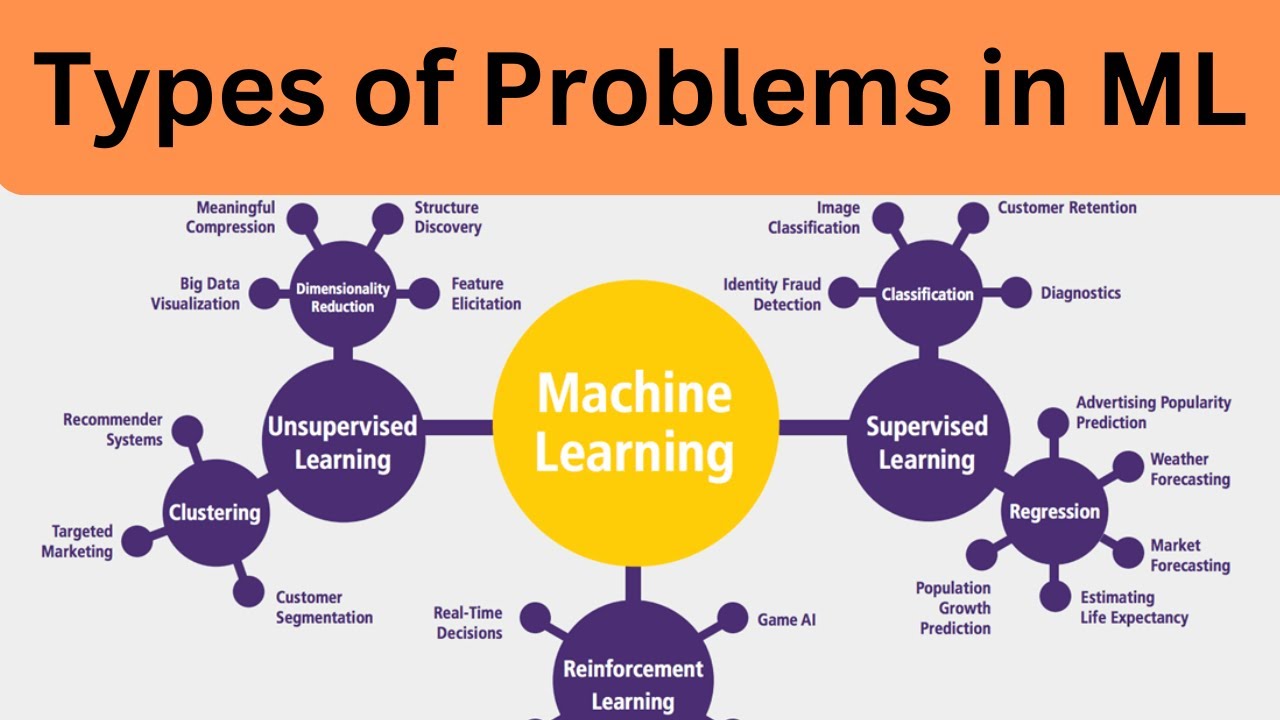
In this beginner‑focused tutorial, Akansha Yadav explains that the very first step in any machine‑learning project is to identify the nature of the problem before diving into data cleaning, feature engineering, or model selection. She walks through eight common problem categories—classification, regression, clustering, anomaly detection, association‑rule learning, natural‑language processing (sentiment analysis), reinforcement learning, and time‑series forecasting—providing clear, real‑world examples for each (e.g., email categorisation for classification, house‑price prediction for regression, customer segmentation for clustering, fraud detection for anomaly detection, product recommendation for association rules, review sentiment analysis for NLP, chess‑playing agents for reinforcement learning, and stock‑price prediction for time‑series). For every category she describes what the output looks like (labels, continuous values, groups, rare events, rule‑based recommendations, generated text, sequential decisions, future values) and advises beginners on which type of model to pursue. The video ends with a call‑to‑action encouraging viewers to rewatch and apply the concepts.
Chapters
Ladies and gentlemen, hello everyone, welcome back to my YouTube channel. And today we are going to discuss that how we can choose that what is the nature of the problem. If you are given a data, how you are going to work on it, what are the things that you have to do as a beginner onto that project. So let's get back on the screen and start our journey that how we can do this, how we can basically choose the nature of the problem, how we can decide the nature of the problem, what it is trying to do. All right, so nature of the problem is the first parameter that you have to select before choosing any machine learning model for your project. You don't have to worry about data cleaning, data processing, or any other, like what model you have to choose, how you have to train it, how you have to divide it. No, the very first thing that you should do is decide what is the nature of the problem, what the problem is trying to do, what should be the solution of this, what is exactly the problem. So let's see, there are multiple examples that I can give for the nature of the problem, but I have listed few of them on your screen. The first is the classification. Classification is something when you are going to do a classify something. If I talk about the mail, in mail what do we get is there are different categories, that there are updates, promotions, social. So what our email is doing is— what our Gmail is doing is Gmail is trying to classify the things on the basis of the data that the persons are sending to us. Suppose I'm getting some, uh, notification from LinkedIn. So LinkedIn is something which is social, it will come under the category of social. So that is how machine learning algorithm is working on the backend of the Gmail or Outlook, whichever you are using. So classification is assigning a label to that particular data point. Okay, this This is the data, and this is for this label. This is for spam, this is for non-spam, this is for update, this is for social, or this is for promotion. So that's how classification things— if you are— you have the problem where you have to classify the things. For example, classifying tweets as likely to get retweets or not. They're given multiple tweets and you have to classify them as retweets or not. Very simple. Regression. Regression is something where you have to predict the continuous numerical value. It is going to be numerical, yes. So first thing is numerical. Whenever numerical is coming up and you are predicting the next numerical value, then it means that is a part of a regression. So that's a regression task. Go with something which is a regression model. For example, you have to predict the house prices. You are given 100 years of data where the particular locality is given to you, where the area of that particular house, the number of bedrooms in that house, the kitchen is attached or not— everything is given in to you in that data. What you have to do is you have to predict the price of the house, that what should be the price, what should be the relevant price as per the data which is from 100 years. Second example could be temperature. This is the 10 years of data that this— on this particular day, as per the weather, that was the temperature of Delhi. So temperature, it means I am predicting a value. It means I am predicting a value. Value is like temperature value. It is in Celsius or in Fahrenheit, that doesn't matter, but that is a value, numerical value. Predicting the house prices based on the speech. Third one is the clustering. Clustering is the nature of the problem where you are going to group some similar data. Suppose let's take an example of social media. On social media, there are multiple categories. The people are posting, uh, videos content on it. So machine learning is trying to do what? Machine learning is trying to cluster it out. Suppose I am the user and I am more into, uh, technical, whether it is gadget or it's programming or it's something related to the jobs like that. So what I will do, what my machine learning algorithm will work on is machine learning algorithm will try to filter out some, uh, things. The multiple data, it will divide it into multiple clusters that this is of education, this is of gym, this is of home, this is of gadgets. Like this it will cluster the things. There is not only single value or single, uh, content or single post, it's gonna cluster it. The multiple thing will be there. So clustering is something where you have to group something, group similar data together without predefined labels. There won't be any labels, but you have to cluster the things that, okay, these are the similar points, these are the similar points, these are similar. It can be on the basis of the area, or it can be basis of the any parameter. For example, segmenting customers into distance group based on it, based on their behavior. We, uh, we can even take an example of e-com. Suppose I am a buyer on Amazon and I am looking forward to buy something on only on EMI. I'm not a person I'm going to pay at the site, at the at the same time. So how my— what Amazon will do is Amazon will keep me in the category where I am just paying through EMI. If I am paying through credit card, it will keep me under the category of credit card, that this is the user who likes to pay more with the credit card. Give, give her that option frequently. The option will pop up for me that, okay, pay with credit card, like this. So that is how clustering works. So those problems where you have to group something, go with the clustering models. Another is anomaly detection. It can be disease, like suppose it can be something related to where you are predicting the disease, that these are the parameters, these are the current status, or the current status of the patient's health, and you have to predict whether this person has that particular disease or not. This is anomaly detection. It is going to be unusual because prediction might change. Same way, it's like detecting frauds, fraud credit card detection. That is anomaly detection. There are multiple projects on Kaggle where there are— where there is a dataset given to you that it is of credit card, this is a bank data, and you have to check whether it is the fraud credit card transaction or it's the safest one. So what you to do is you have to check, identify rare or unusual instances in the dataset. Basically unusual or rare thing which you have to find out in, in the data. So anomaly detection is something that, and you have to choose the model accordingly. So these are the 4 problems. Let's move on to the next one, association rule learning. Discovering interesting relationship between the variables. There are 15 columns. You have to first check the, in, uh, the dependency that how they are dependent on other. For example, recommending products based on the user's purchase history. This is association rule learning. Suppose right now I want, I'm, I wanted to buy a watch, digital watch. So what I will do is I will search for that project. Maybe I will buy it, or there are chances that I won't buy it. So what I will do is, uh, after a week I am not into like digital watch, I bought it from the market, local market, let's suppose. And then in the next week I'm looking forward to buy something like a refrigerator, or I wanted to buy something, a home decor item. So what Amazon or what e-com brand will be doing is e-com brand will be recommending a product for me on the basis of the purchases. I'm looking for something, it will suggest me, okay, have you bought this or not? If not, bought this right now. So these are the things that is done under association rule learning. We can go with that word. Another is the natural language processing that is done on ChatGPT or other multiple tools are there available in the market that are working on the natural language processing, which is basically to analyze and generate human language text. It is a sentiment analysis of the customer review. There are n number of reviews posted on the product on Amazon and you have to do the sentiment analysis whether that review was good, bad, poor, or worst. So that is the sentiment analysis of the customer review. Another model is the reinforcement learning model. Reinforcement learning model is where you are training the agent to make the sequential decisions. Suppose it's a chess game and the computer is playing the chess game and I am one of the player who is playing along with the computer. So computer is gonna make the next move as per me. So while I'm playing, playing with the computer, computer will learn while I am playing. And on the basis of that training that I am giving to the agent, and although the model has been trained, but it will learn from the particular decisions as well based on the reward. Suppose Computer is making a good move. Computer was able to defeat in that game. So what will be done is, in the back end of the model, a model will be getting the rewards. Okay, you got 100 points, you got 200 points, like that. So reinforcement learning works on training the agent to make sequential decisions based on the rewards. It can be either in points or other parameters, like teaching an AI to play chess or navigate in a maze. Another model is a time series forecasting. Time series forecasting is when you are predicting the future value based on the historical data. The difference between time series and the numerical value is like big difference because in the numerical value you will be getting the features, you will be getting some parameters on the basis of which you have to predict the next numerical value. It's going to be numerical value. But in case of time series forecasting, you have to predict the stock price. It's all about stock market. If you are a kind of a person who are more into making money through stocks, you should go with the time series forecasting. So there are— these are like 8 natures of problem which we have discussed today. I hope it helped you. So we'll meet in the next video. Till then, you can rewatch this video, implement the things which I told you in this video. Bye-bye!