ABC's of Money with Alan Akina - Lesson 5: How to Start Your Own Business
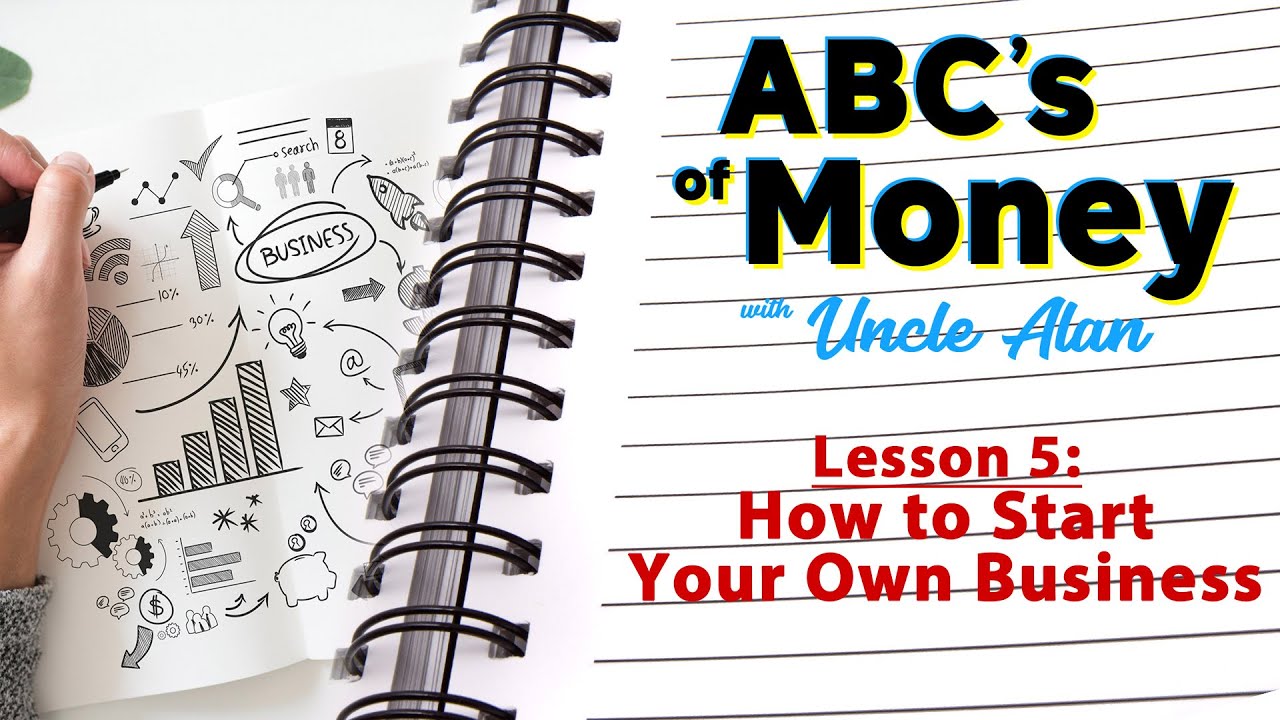
In this 30‑minute livestream, Alan Akina teaches kids (and their parents) the fundamentals of starting a business. He begins by defining a business in simple terms and sharing quirky examples (broken‑doll hospital, anger‑room, pooper‑scooper) alongside mega‑companies like Amazon and Walmart. He explains why entrepreneurship is a fast path to wealth, citing Forbes 400 data and the statistic that owning a business is the most proven way to become a millionaire. Alan introduces his son Keanu’s real‑world youth venture—buying and flipping high‑priced basketball socks and shoes—to illustrate the "see a need, fill a need" principle. He then walks through a step‑by‑step framework: four ideation questions, choosing product vs. service, basic market research, a one‑page business‑plan template (problem, solution, market, financials, team), making the business come alive (name, domain, legal structure, registration, bank account), bootstrapping with sweat equity, developing a Minimum Viable Product (MVP), selling, and iterating based on customer feedback. Alan assigns three homework tasks: generate a business idea, draft a one‑page plan, and create a logo via Fiverr, with a chance to win a gift‑card. The session ends with a Q&A on handling failure and basic stock‑holding advice, and a preview of the next lesson on real‑estate investing.
Questions this video answers
Treat it as a learning lesson, close it down, and move on to the next idea; failure is a valuable experience.
Hold the stock long‑term; if it’s a good company it should keep growing, so keep it and let it appreciate.
Chapters
Good morning or good afternoon, everyone. Welcome to another edition of the ABCs of Money with Uncle Alan. Welcome back, kids. Good to have you. Parents, welcome back. Last or this past Tuesday, lesson four was investing in stocks, and I was so excited to see your post and different comments and. Getting messages from people saying they bought their first stock. Like, to me, that, that really made my day to see people buying their first stock ever. And then for all of you kids, to be able to see you doing these things at an early, early age when you have the number one wealth builder on your side, which is time, right? Letting that grow over time. And unfortunately, we can't pick everybody for the winner of our gift cards today. So we got Stockpile gift cards that That we are giving away, and the winner today for our Facebook group is Mr. Stephen Teripaya. Congratulations! I saw you had some really good stocks. I think do we have a picture of that? Let's see here. So Mr. Stephen has some really really good companies: Amazon and Facebook. So congratulations, Stephen. We'll be. My assistant will be contacting your parents to get in touch with you to get this to you. Anyway, we are going to move on to lesson five. Okay, lesson five is how to start your own business. So I want to see before we get going, do any of you if you have a business that you've already started kids give me the thumbs up if you already have an existing business. I want to see how many of you have have started a business and we got ten things to cover. Okay, so I pre wrote down some. Some of the things we're going to cover. There's a lot because what I'm really doing is I'm teaching you a year's worth of business in 30 minutes, and that's kind of hard to do. So we— I just cut out everything that you don't need to know and just started with the basics. Okay, so again, this is a lot of information. I'm going to try to cover it in 30 minutes, so take good notes. And we're going to start out with what is a business? What is a business? Kind of simple, right? So I came up with a simple answer for that. Okay, so a business is a person or an organization or an entity that produces a product or service and they sell that in exchange for money. So it's really simple. It's, it's creating something that other people want and you sell that in exchange for money. It's a very simple term. Business is, and and to be honest, there's all kinds of businesses. I'm like there's literally millions of businesses. So I I went on last night to look at like one of the craziest businesses that are out there in existence. I I found three really crazy ones. Okay, so so write this down and I'm gonna get your feedback. So the craziest idea that I've seen is what we call a broken doll hospital. So, so if you have a broken doll like your Barbie doll, you can send it to a hospital and they'll fix it up for you. I did not know that existed. The second crazy business that I saw, and this might be for adults, maybe your parents have used this business before, but it's called the Anger Room. Okay. The Anger Room. So what people do is they rent out these rooms so you can take out your frustration and all your anger and you can rent this room and you can break stuff. And it's not yours. Like, crazy idea. Who would have thought of that? And then the third crazy idea is pooper scooper. So people actually have— you pay them to come over to your house to pick up your dog poop. Wow. Crazy. Now, here's a couple of examples of some really, really big, successful businesses. These are 2 of the largest companies In the world, the first that comes to mind is a company that hit about a trillion dollars in value: Amazon. And Amazon is growing like crazy now. Amazon started in a garage. The owner's name is Jeff Bezos, one of the richest men in the world. He started in his garage. The second biggest company that that I know of is Walmart. All of you are familiar with Walmart. Now Walmart started in Arkansas. Not sure if we have any— if any of you are from Arkansas, give me a thumbs up or whatever you do. Howdy in Arkansas. In Arkansas, it started out as a five-and-dime store. So this was a nickel and a dime store where you can buy stuff for— you know how we have a dollar store now? That was like the dollar store back then. And now they're worldwide. They are just massive. Okay, so those are examples of businesses. And there's, like I said, there's millions of businesses. Okay, so that was number one. What is a business? Second thing, write this down, kids. Why should you start a business? Okay, why start a business? I have several key things that I want you to take down as, as notes. Out of the 3 asset categories we talked about— paper, real estate, and business— business is the fastest to revenue. What that means is that is the fastest way to make money or put money into your pocket is starting your own business. I have several things. And I have a guest today that I'm going to feature on our, our show today. But here's one for you. Write this down, kids. Why start a business? Because if you can't see yourself working for someone else, you will be a horrible employee, but you will probably be a great business owner. So if you can't see yourself working for someone, then what we call entrepreneurship Would be the thing for you. Okay, now entrepreneurs and entrepreneurship is growing rapidly all over our world. In fact, more and more colleges are introducing entrepreneurship programs and degrees, and it's growing. Like in 1990, here's a statistic. So in 1990, there was only 180 colleges that offered some sort of some entrepreneurship program. By 2004, that grew to over 2,000 schools, and today there's probably double that. Now I'm going to introduce you to my son, my oldest son. His name is Keanu, and Keanu is going into entrepreneurship at BYU in Utah. And he's a, he's a great entrepreneur and he's always been that way. So I'm going to introduce you to him. He's going to tell you about his first business that he started as a 12-year-old. In the, I think, seventh grade. So Keanu, this meet Keanu everybody. How you doing, buddy? Thanks for talking to the kids.
Okay, so my dad asked me just talk a little bit about the business that me and my brother kind of had when we were younger. So growing up, we played basketball, and back then the cool thing was to have some crazy socks, some basketball socks, and. We we kind of noticed that these socks that they were selling were really expensive. We were looking on sites like eBay, and they're going upwards of like eighty dollars for one pair of socks. And so who who who has eighty bucks to pay for socks, right? So me and my brother tried to figure out another way to have cool socks to play with, and we found a couple websites that actually sell the socks directly, and people. What they were doing was they were getting them from these people who were making them and selling them on eBay for a higher price. And so what we did was we started to buy the socks directly from these sites that would sell out instantly. So we had to know, we had to do a little bit of research to figure out when they were going to release the socks, and we needed to figure out which ones that we were actually going to get. So I brought these socks to show you guys today. They're like some Captain America Nike socks. So these were the kind of socks that we were buying and selling on eBay. And it eventually led to us getting into shoes, buying and selling shoes. So I brought my favorite pair of shoes with me today. These are the Wethicoby 8s. And from buying and selling, I was able to afford these shoes that I wouldn't have normally been able to afford. And so basically, the point of starting this business was to create some kind of value for people to be able to get shoes that they weren't able to get normally. And something else that my brother kind of did more than I did was he would buy used shoes that were kind of old and beaten up and take them and fix them up, clean them, repaint them, and make them look nice and sell those to people. So you kind of add that value of refurbishing the shoes. And so whatever your business is, it just has to be something that you're interested in, something that you like, and be able to create value for your customers.
Very good. Thanks, Cam. Let me grab that mic from you. Yeah, very proud of them. So the way that it started was these shoes started getting really expensive, right? And they played basketball. So They wanted these nice shoes. And once the shoes started going over $100, I'm like, guys, I'm buying you one pair of shoes a year and that's it. Okay? If you want more shoes, figure out a way to make money. You got to figure out a way to make money to buy those shoes. I'm not, I'm not buying any more than one a year. And so, so they got together and they convinced me that they're going to sell $80 socks on eBay. And I was like, you guys are crazy. There's no one in their right mind that's going to buy a pair of socks for $80. I won't even buy a pair of socks for $8. And so I had them prove it to me, and they, they did. They showed me all the sales that were going on. So I was their first investor. I bought them 2 pairs of socks and they flipped it, made some money, took that money, bought more socks, kept flipping it for a few months, and then they got into shoes. And then the shoes, they started flipping and making $100, $50, $80, $150. And eventually over years— now they started when they're in the 5th and and 7th grade. My son Kavika was 5th grade and Kiana was 7th grade. And they would flip these shoes and they made enough to cover the majority of their church mission. They both went on church missions, which is about— it costs about $10,000 to go. And that was their goal, to make $10,000. And they did a lot of that by flipping shoes. And they still have some shoes left over that they kept. And I'm very proud of them. Why? Because it was a start of getting into the business mindset. Why? Because later on in life, they'll now, instead of flipping shoes, they'll flip houses or they'll flip businesses. Okay. And it just leads to bigger things. So I appreciate kind of sharing that. Now, the other statistic that I want you to write down is owning a business is the, the most proven way To become a millionaire if if that's your goal. So if you really want to build up your wealth, owning a business and operating a business is the fastest, most proven way to being a millionaire. And I think the second is like being an engineer. I think they have a 7% chance of becoming a millionaire. Now, if you I don't know if you ever heard of the magazine called Forbes. So so there's a magazine called Forbes, and you can probably Google it later. It's called the Forbes 400. So every year they publish the 400 richest people in the world. And if you look at last year's list, this past year's list, 7 of the top 10 billionaires all owned and operated their own business. So that kind of gives you an idea of why entrepreneurship is such a big thing. Okay. Now, the next thing, number 3, How do I start a business? Okay, how do I start a business? Well, you remember that movie Robots came out a while ago, and if you haven't, go look at Robots. Really cool movie. And in that movie, I can't remember which robot said it, but they were talking about business, and a very simple term came out of this movie. Write this down: see a need, fill a need. And from Robots, see a need, Fill a need. So that's the start to your business. You know, my kids saw that people were buying $80 socks, so they found a cheaper way to get it and they flipped it. And so I have four questions that I'm gonna I'm gonna pose to you that I want you to write down. Okay, that will help you to start the process of owning your own business. Okay, so number one. What can you do to fix a problem that is bugging you? Okay. What irritates you with a certain product or service? Right. If you don't like the way this, this bottle works or you don't like the way that the computer works, what bugs you? And instead of being frustrated about it and complaining about it, think about ways that you can fix that problem. For me, in my life, what bugged me was I wanted to learn about money. I wanted to learn how to take care of money, how to make money, how to grow it, and all aspects of money. But I could not find anywhere that would, would teach me the things that I wanted to know. So I ended up creating my own company. Second question I have for you is, can you take a new way of doing things And apply it to an older product or service. So if there's new ways of, of making toast, how can you apply that to the old way of making toast and make it better and create a product or service out of that? Okay. The third is, do you see something coming in the future A trend happening, a movement, a new direction that people will be going in, especially kids your age? You see something different that I don't. You're in a whole different world. You're in this, this, this cloud, right? The wireless world and technology. What do you see as a kid coming up that you think could be the future? And could you capitalize on that? Capitalize is Take advantage of the opportunity and make money from that. I mean, you kids have such a bright future. All of you are so smart and so sharp, and you see things differently. Use that to your advantage. That's not a bad thing, kids. Being young and being innovative is is a great trait to have. Okay, and then the fourth question. So write this down: Can you improve something? Which means, can you make it? Better? Can you make it faster? Can you make it cheaper? Okay, something that's out there, and there's so many different opportunities. So this will kind of get your, your juices flowing as far as how to start a business. Okay, now I want to go into choosing a product or service. Okay, once you go through this list of how do I start a business, you're going to pick Okay, am I going to— am I going to build a product-based business or a service-based business? And the thing that I want you to do is once you start to figure out if it's a product or service, I want you to do research on it. So the easiest way to research is just Google, right? Google it and see if there is a product or a service out there already. And even if there is, it doesn't matter because you can always do it better. And competition is a is a good thing and it'll challenge you and push you. So if you see other things that are out there like it, don't worry. Execution and having something different always helps. The other thing that I want you to research is what will it take to develop your product or service? What will it take to develop this new product or new service? Next, how much will it cost? How much will it cost? So you figure out, okay, I'm going to make this, this new water bottle, right? Remember, I mean, they never had these flasks until just a few years ago and they, they figure out a way to make a flask and to make it better. So how, how can you make a water bottle better? Right. And so how much is it going to cost for you to develop it? And then the next thing is, is there a market for it? Okay. Is there a market for it? Write that down. Market, kids, is potential customers. Who's going to buy that? Who's going to buy your water bottle, your flask? Is there people out there wanting that? I mean, or are you building— is your product a toothbrush for dairy cows. I mean, is there a market for a toothbrush for dairy cows? Probably not. So it's a cool idea, but is there a market that you can sell into? So those are the questions that you need to ask yourself. Okay. Now, like I said, Uncle has a lot to cover, so write things down quick. Now, next, we're going to go to number 5. Write a simple business plan. Okay, now this is a simple business plan is going to be like your guide. This is like your roadmap to starting a business, and you're going to you're doing your business actually on paper. So this is a great exercise that I'm going to take you through, and I went through business plans. I've done them all before. I've done my my own before. I paid companies to do these big. business plans for me that was just a complete waste of money. So I'm going to give you the simple one-page business plan outline that you can start, and this is going to help you before you invest any money. All it is is a pen and a piece of paper. That's all the investment that you need to create this business plan. So write these things down, okay? Okay. There's 5 steps that I want you to cover in writing a business plan. Number 1, the problem. What is the problem that your potential customers have? Write that down. What is the problem that you identified, right? So you identified with the bottle again, people's drinks get warm really fast. That's a problem. People like cold drinks. So I'm going to create a flask that keeps the drinks cold for 24 hours, no matter if it's in the sun or not. Okay. The second thing I want you to write down: the solution. The solution. What is the solution? So write that down: the solution. And under it, you're going to write a paragraph on what the solution is. Okay, how your product or service will fix the problem. Okay, so for each of these, you're going to write a paragraph. Okay, the solution. How is your product or service going to fix our problem that we've identified? With number one, okay. Now let's go to number three. Who will buy your product or service? This is called the market, okay. So you can write it down: the market for number three. The market—that means your customers, potential customers—who will buy your product or service. So you might think that that the guys are going to be buying your water water bottle are. The 25 to 35-year-olds, right? These guys are very active. They're not at home. They're always on the run, and their drinks are left in the car. So you got to identify who your who your market who would be most likely to buy your product. Number four, your financials. Okay, your financials. What this is is how will you make money? With your business, because I'm talking about for-profit businesses here. Okay. How will you make money? Very, very important. And you're going to write a paragraph on this as well. How will you make money? How much are you going to charge? What is your bottle going to cost? Is that— is it going to cost you this much to make and you're going to charge this much? And, and how much are people willing to pay? Okay, so your financials. How will you make money? And number five, the team. The team. Who will you need on your team to make this go? Can you do it all by yourself? Great. If you can, great. I started my company with me and a couple guys. Just and I filled in the rest over time. So. One of my companies was just me and my wife. We started a long, long time ago, like 19 years ago. Another company. I promise you that if you just go through this exercise, it'll make you think more clearly about your business. Okay, now let's move on to number 6, called Make It Come Alive. Okay, Make It Come Alive. Again, there's 5 steps to this. This one's a little more complex, so I'm not going to spend a lot of time on it. Because you probably don't need to do this right away, but I just want to get it out there. Number one, to make it come alive, find a business name. So you're going to pick a business name for your new company. My company is obviously 101 Financial. It says what we are. It's the big— 101 is the basics. Financial is money. So you want to come up with something innovative and something cool, easy to remember, and you probably don't want a long name, something that your customers or the market will remember. Number 2, domain name. Secure a domain name. So once you get your business name, you want to make sure that the web address, the URL, the domain name is available. So once I picked 101 Financial, I wanted to make sure that I can get 101financial.com. You always want to be able to get the .com. If not, it makes it hard when you start to, you know, build up your business and people are searching for someone else's company. Okay, so URL or domain. Number 3, structure. How are you going to structure your business? This is a little complex. I'm just going to give you the simple answer. Most people just started out as what we call a sole Proprietor. Okay. A sole proprietor means it's just under your name. The company is registered under your name and you use your Social Security number for tax purposes. Okay. That's the easiest, simplest way. You don't really need to spend a lot of money on creating anything. The second step up in structure is what we call an LLC, a limited liability company. So that's starting a corporation now. That's a whole nother lesson we can get into. But I don't think any of you need that right now. You know, none of you need to start an LLC today, but write that down. LLC stands for Limited Liability Corporation or Limited Liability Company. And then the third most popular is what we call an S corp. So just write down S corp. And those are the, those are the, the 3 3 different ways. Okay, so sole proprietor, LLC, and S corp. Okay, now none of you have to do that right now. Okay, 4th step is once you have your official business up, you need to register it with The state and the federal government for taxes, right? The government's going to want to take money from you, and that's a whole other lesson we'll cover at another time where you got to pay taxes on the profit you make, and the government likes to take a big chunk of it. And then the last thing is the fifth thing is your bank accounts. And once you have all that, you can set up a bank account, and they can write checks to let's say you have. Water Bottles LLC. People can buy it in, in that instead of your, your name. Okay, so those are 5 things to make it come alive. Next, we're gonna talk about number 7, bootstrap. We're gonna bootstrap. So now we got all this in place. How do we pay for all this? My number 1 recommendation is called bootstrapping. What is bootstrapping? It simply is using the least amount of money possible, which means the way you make it work is through sweat equity. You use things that are free, free tools, right? You might not have money to build a website. Well, then use Instagram and Facebook for your website. You might not have money for, you know, phone services. Use email and free services that are online. There's a bunch of apps out there for free. You, you know, there's so many different things. And then bootstrapping also is using your network, people that you know. Maybe you have an uncle that's an attorney. He can do the LLC for you. Maybe you have a cousin that's an accountant. They can help you with bookkeeping and with your financials. But use what's around you and use your skills and a lot of sweat equity. Sweat equity is your own work, your own blood, sweat, and tears going into your business. And I did, I did that with my company. I bootstrapped the entire thing and I built it up into a multi, multimillion dollar company with my own money. And I did it straight. I just did everything as low cost as possible. And I've carried that on till today. So you ask a lot of my employees or people work for us like, Alan's so cheap, he doesn't want to spend money on this and that because I know how hard it was to build it up to where it is. So every dollar we make, we take very, very good care of it. We don't We don't waste anything. Okay, so that's bootstrapping. Next, number 8. This is where you start to get into developing your product. Now you can go, go make it, develop your product or develop your service. So if it's a, if it's a widget, if it's a water bottle, you're going to start figuring it out. How do I make this? You know, can I make it in my own garage? Can I, can I go to this factory and ask them to help me develop this? If it's a service, how do we do it? Can we do the service online? And offer online programs or whatever it is that you want to offer to lower your cost. Okay, so look at the different business. You're either a product or service, and then you start to develop that. Okay, you start to make it. Now once you get it made, so let me talk about, um, let me talk about, uh, developing your product or service. I want you to write down these letters. Okay, it's called MVP. Okay, now MVP doesn't stand for most valuable player in the business world. MVP stands for minimum viable product. So write that down, kids. MVP stands for minimum viable product. So can you get your product or service to just work? Just get it enough where customers can use it, test it out, try it, and give you feedback. Now, when you develop your product or service, I want you to know it does not need to be perfect. Does not need to be perfect. If you're striving for perfection, you will never get there and your business will never get off the ground. We want to get to MVP, minimum viable product, to start testing it, getting feedback from customers. And that's what I did. One-on-One was not perfect 18 years ago. It wasn't even that good, but over time we got better, so we became the best over time. So write that down: MVP, minimum viable product, to get it going. And then lastly, number 9, is you can start selling. Once you have your product or your service, let's start selling it. Let's start getting it out there into people's hands so they can use it. And that is the best way to figure out your business is will people buy it? Is this a business that people actually are going to support? Are they going to buy my product and service? And I want you to remember this. Okay? So we're going to write this down. Um, when you start selling, listen to your customers. Okay? Listen to what your customers are saying about your product, about your service. And take the good and the bad. In fact, I like the bad better. It does hurt. It does hurt me a little bit to hear people say bad things like, well, I don't like this or that or this about your company. And it happens all the time. People say stuff about my company all the time, but I don't want you or I to take that personal. We use that as feedback to now go back to the drawing boards and we tweak it. We tweak the product or service. We start to fix it. We make these little changes to continually make it better. Okay, so that's the formulas. So keywords that I want you to remember from today. Okay. Business. What is a business? Right. It's a person or an entity that develops a product or service and sells it in exchange for money. Very simple term. Okay. The second word is bootstrap. What is bootstrap? Starting your business with as little money as possible. Okay, don't borrow money or or or get investors. Start it with as little money as possible. You can do that. But today, all the tools that are available to you right on your phone is a hundred times better, maybe a thousand times better than I had when I started eighteen years ago. Okay, the the next key phrase is MVP. MVP, minimum viable product, minimum viable product. The next is business plan. What is a business plan? Well, that's your outline of how your, your business is going to operate. It's, it's your business on a piece of paper, one sheet of paper. If you can get on one sheet, great. Okay. And then the last word keyword that I have for you is market. What does market mean? Market means your potential customers who would be willing to buy your product or service. Okay, now I know this is a lot to cover, but I also want you to know that to start a business, you don't need a lot of money. You don't even need a degree. When I started One on One Financial, I, I Wasn't a graduate of college yet. I don't have a business degree. My degree— I started one-on-one, but I later graduated like 5, 6 years after I started one-on-one with a biology degree. So I'm a biology major. So, you know, you don't need a lot of money. You don't need a degree, although a degree is helpful. I'm not saying don't go to college. I highly encourage you to go to the best school that you can. I think it's helpful, but it's not needed. And And you don't even need, you know, real-life experience with a business. There's kids that are developing products or services that are just absolutely taking off— apps and services and things in there, in your world, that do very, very well. Old people like those companies, so they buy it for a lot of money. So ultimately, folks, kids, write this down: your business, like my son said earlier, is ultimately about adding value to other people. If your business doesn't add value, your product or your service doesn't add value to people, it's, it's going to be a business that doesn't last long. It'll, it'll eventually go away. Okay. The other thing is I want you to write that, write this down is hopefully choose something that you love to do. You love to do that still has a market, right? You might love to brush dairy cows' teeth, okay? But there's no market for it. So hopefully you find something that you love to do that has a big enough market where you can build a successful company. And if you find those things and you're passionate about it and you work hard, you will never work another day in your life. You will never work. Having your business is going to be like, like nothing else you've ever seen. You will never feel like you're working. That's how I feel with my company, like doing these things, like doing these things for you today. I'm not charging. We're not making money on this, but I love it and I get excited every Tuesday and Thursday to teach you. And the night before, I'm working on reviewing this and planning. Last night I was up to 3:00 AM going over this plan for you today because I love it. And I never will have to work another day in my life. Okay, you ready for the homework, guys? Okay, this is kind of fun. So your financial assignments, write this down. I got 3 things for you. Okay. Number 1, see a need, fill a need. So number 1 is I want you to create a business. Come up with an idea, even if it's a crazy idea, just, just to start. This may not be a business that works, Or last long, and it may. But I want you to go through the exercise this weekend before next week's class on Tuesday. Come up with a business idea. Okay, that's number 1. Number 2 is start your 1-page business plan. Okay, so that's, you know, write a simple business plan. Again, do it on 1 page. If it goes more than 1 page, you might be thinking it through too much. Okay. Very, very simple. And then the third exercise is your financial project is to create a logo. Okay? So I want you to create a logo for your new business. Now, if you come up with the business, so let's say you have Water Bottles in Paradise, okay? And you have that name, or for some reason by next week throughout the weekend, you can't come up with A name for your business. Just call it your name. Alan Akina Incorporated. Akina Company. Just something. I want you to go through the exercise and, and again, this is all voluntary, but here's what I'm going to suggest. You create a logo. Now you may be graphically inclined. If you are, design your own, or you might have a cousin or a sister or a friend that can do graphics, great, use them. But for everyone else that's not, I want you to use a service that I've used in the past. It's called Fiverr, fiverr.com, fiverr.com, and you can get a logo made for $5. So this, this class is actually going to cost you money. It's going to cost you $5 and you go on Fiverr and you hire one of their, their freelance logo designers. Okay, have your parents help you with this. There's, there's a bunch of them that will do a logo for you for $5, and then there's others that you'll see that charge $10, $20, up to $600 for a logo. We, we don't want that. We want a very simple $5 logo. I just want you to go through the process of creating that and then going back and forth with them to iterate that new logo and come up with something that you absolutely love. Okay, so I created my logo many years ago. And we just came out with this new logo earlier at the end of last year. So come up with it, fiber.com. Okay. And then I want you to post that logo on social media, your parents' social media, yours, and then tag me. Okay. Tag me in it and then use the hashtags Money ABCs and One-on-One Financial. And then we'll have a Another winner next week Tuesday for more gift cards. Come up here, Kiani, and let's hear these questions.
Somebody said, what if your company is unsuccessful?
What if your company is unsuccessful? You just say, hey, this was a great learning lesson. Close it down and move on to the next idea. Learn from it. Everyone's had failed business ventures, so it's not a bad thing. It's a great learning lesson.
Heather asks, she says, I recently bought a stock, but I don't know what to do.
Okay, you bought a stock, Heather. Now you just keep it forever. Keep it till your old life meeting. And if it's a good company that you bought, that company should keep going up and getting bigger and bigger. So you see all companies; their goal is to grow and grow and grow. They have to grow. They're going to hire smart people. They're going to innovate their products. They're going to do all the things that we talked about today to build their company into a success. So keep it. Next week Tuesday. We're going to be going into lesson number six: how to invest in real estate. This is going to be another fun one. We're doing a lot, guys. We're doing a lot of good stuff. And parents, I hope you enjoy this as well. If you are enjoying this, and this is something that is adding value to you, please share this with your classmates or share this with other family or friends. And adults are welcome to join us. We're not trying to block adults. Many adults are on. That don't have kids, we welcome you too and hope you learn from this. And and then let's share the love for April. This is Financial Literacy Month. It's our job to go help other people that are looking for things to do like this. So thank you so much, everyone. God bless you. Be safe. Be well. Listen to your parents. Do your homework. I'll see you next week.
More from Alan




MBS622- Secrets of #Fail: Unlocking Financial Freedom: A Journey with Visionary Alan Akina
