Beyond Hype Where Are NFT's Headed Matt Medved; gmoney; Swan Sit; Alex Atallah OpenSea, Alex Saln
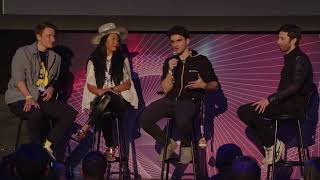
NFT experts including OpenSea's Alex Atallah and collector G-Money discuss what comes after profile-picture collectibles. They highlight emerging uses: NFTs as access keys, real-world asset records like land titles, and 3D avatar standards. The biggest hurdles to mainstream adoption are usability, security, and better onboarding for regular users.
Chapters
Hi everyone, I am Matt Medved, co-founder and CEO of NFT Now, the premier publication for NFT coverage and curation. And we have an amazing panel now. We have Gmoney up here.
I'm right here behind you.
Oh, good. Okay, we're waiting for a chair. Hold on, hold a second.
No, I mean, I'm going to be off stage because of the camera, because of the feed.
Got it. Got it. Cool. Anyway, we have got the panel Beyond the Hype: Where Are NFTs Headed? And we have incredible panelists to discuss this. So some forward-looking questions as we look towards the future. So I'm going to begin with a question on use cases because we have all seen an incredible rise in market volume and mainstream attention around popular use cases like digital art, digital collectibles, now photography, music NFTs. What are, for each of you, the most interesting emerging use cases that you're excited about and you could see making a market impact in the near future? I can start.
Yeah. Do you want me to do the mic? Yeah, I'm Alex Atallah, the co-founder of OpenSea, and I— should we just go around and introduce ourselves first? Maybe I'll pass it.
Hi, I'm Swan Sit. I'm an advisor to a lot of NFT and Web3 companies.
Hi, I'm Alex Atallah, co-founder, head of product at Rarible. Super excited to be here.
And I'm G Money, a collector of NFTs and all-around NFT advocate.
Thanks for having us here. I think it's been pretty surprising how many NFTs are these 10,000 profile picture collectibles. And they're important. They're giving people identity in the Web3 space. But I think what we need going forward is NFTs that give people access or unique abilities in the internet that they wouldn't have otherwise. Like, NFTs really provide a brand new way for platforms to share users without having to worry about an API that might go down, or access that might expire, or assets that might not exist in 5 years or 10 years. So like really, really cool applications of NFTs that I'm seeing now get going that couldn't get enough funding 2 years ago or didn't have the right team 2 years ago are doing things like real-world items. Fabrica is doing land titles. There are some things are doing truly unlockable content that you cannot unlock unless you own the NFT. I just ran into a company called Lit Protocol that's doing this, where you can have actually, like, images that cannot be seen unless you own the NFT, or a Zoom meeting that you cannot enter unless you match some on-chain condition. And then other types of visual NFTs that haven't been explored yet. So far we have these static and sometimes animated images, but What we're missing is much richer visual and auditory experiences. One project that I found that I really, really liked is called Mona, where you explore these 3D rooms. And it's kind of like Virtual Land, but it's a room, and it's the coolest room ever. It just feels like an art experience that could not exist in the real world, and it's truly unique to the digital realm. So I think we'll see a lot more experimentation along those lines, and I'm— that's partly why I'm here at ETH Denver. I'm really, really excited to see them develop.
Those are great ideas, and I want to piggyback on that. You mentioned land deeds. Anything that requires authentication or has data silos in Web2 is super primed for how this will work in Web3. So birth records, membership loyalty, verification of your education or employment history. All those things can be universally done. So my background, I was in Web 2.0. I was the head of digital marketing at companies like Nike and Revlon. Massive data silos. And if you buy through a retail partner, we have no idea who you are. So if I think through not just the collectible parts of NFT, but if I were still at Nike, what I would do is the shoe coming off the supply chain, I'd put an NFC chip in it, into the rubber embedded, so you can't get to it. Now I know exactly where my products are flowing through the supply chain. Something falls off the back of the truck, ends up on the gray market, I know which factory, which truck distributor it came from. Then as it sells through, maybe it's sold through Foot Locker, maybe it's sold through Nike. If it went through Foot Locker, I have no idea who that customer is, but if it's chipped and the customer wants to opt in and scan that, I know exactly who they are. Think about secondary resale markets. We don't need GOAT or StockX anymore. The primary manufacturer can have that information. Information. And then all the way down to the consumer, you know, when Nike used to, um, Nike does these drops, the sneakers app, every Saturday morning, 7 AM Pacific, right? And most people get an L because those shoes are hot drops. If you have wealth, you're not getting up at 7 AM on a Saturday morning to try to hit refresh 30 times and get an L. You're probably buying that shoe for 10x on the secondary market. Nike has no idea who those consumers are. So imagine being able to see in a wallet they have 30 pairs of rare Jordans, airdrop something, start building a relationship. So I think it's the new advent of not only D2C, true D2C relationships, but ownership of consumer data by the consumer. Your wallet is the biggest representation of who you are, and while it's universally accessible and viewable, they don't know who you are. So if brands do the work of creating enough value for you to want to share your wallet, now it's a much more holistic view of consumer data and a much better value exchange because the brands now have to pony up what customers would actually want in order to share that.
Thank you. That's a great answer. I wanted to get back to Alex. You mentioned that NFTs are often used as 10,000-item supply PFP. And I actually have a thesis about that, that what it allows us to have is to have the digital scarcity that 2020 was a lot about NFT art. And then almost none of the NFT art went up in price, sadly. And the PFP trend, one of the foundation of the PFP trend is, OK, we should have only 10,000 items. And I think that community is the only scarce thing that we have in the metaverse, that we can have all sorts of land, all sorts of games, all sorts of— everything, but the people who are doing like job, who are pushing something, who are advocating, who are proposing, well, doing really something useful, these are the really scarce supply. And NFTs and PFPs, they became this like social consensus that we will create this artificial scarcity that will like belong to us. And then we collectively, 10,000 people, will go and push this to the other world. Like we see World of Women being like signed up with Hollywood. We see CloneX as interoperable 3D avatar that you can use in multiple games. And it all represents cultural artifacts that metaverse consists of, and that's why they're valuable. And so I'm super bullish on 3D avatars that will be interoperable across multiple environments and not exactly 3D. And I think the Twitter move by enabling you to put NFT on avatar is a huge one. Now, like all the other guys will catch up and we will have interoperable digital identity and then interoperable gaming items, interoperable 3D chair that you can move from one game to another. I'm excited about all sorts of digital-only metaverse native access keys as well, but like digital-only metaverse-native cultural artifacts for NFTs.
Yeah. And to add to what everybody said, I think everybody brought up very valid points. I've always had the thesis that NFTs are the thing that take crypto mainstream, which is why I very much have been pushing for mainstream adoption as much as possible. So, you know, The more people we can educate about the space, you get more creativity coming to the space, right? And so to build on what Swann said, I very much think that over the next year or two, we're going to see a lot of play between the digital space and the physical space. And that to me is probably one of the most exciting things because we're not going to be fully digital tomorrow. And I think that's a transition that happens over the next 10 to 20 years. Maybe faster, but I very much think that it happens as a gradient over time. And because of that, you just need to be looking out for these applications and crypto coming into your everyday life in the real world.
Absolutely. Absolutely. The next topic I wanted to discuss is around usability. One of the biggest mainstream, you know, hurdles to mainstream adoption that exists is there's no frictionless way to get into this ecosystem. How are you thinking about usability and security from a platform perspective? I'd love to hear from both the Alexes.
Yeah, it is no small secret that usability is tough for NFTs. I mean, for just kind of a comparison, there's less than 10 million NFT users, probably more like around 6 million to 8 million monthly. And that's compared to 1.8 billion monthly gamers in the world. So there's a really long way to go. Gaming is just, you know, video games are way more usable in the centralized world. For one, we need, we need better games in, in the NFT space. I think we need game studios that are willing to try, make errors, throw it, throw most of it away, try again, make some errors, throw most of it away, and continue to iterate. And we're seeing some games make a lot of progress in that direction. Those applications will bring a lot of mass adoption themselves. It won't necessarily be the marketplaces. But the marketplaces have a lot of work to do too. For one, keeping users safe is super important and huge shout out to our community for reporting content and for being vigilant. We have a lot of great users doing a lot of good work along with our, our support team. But what we— what I think we need is better prioritization of NFTs that have a lot of skin in the game. You know, if you, if you decentralize your metadata sufficiently and if If your contracts have all the metadata on-chain and they cost a lot to deploy, then they should be more visible than NFTs that cost, that were just made programmatically and without paying anything. There are a lot of ways to make NFTs more, like better NFTs, more discoverable. And on the wallet and fiat flow, I think we'll see a lot of really cool developments there this year and next year now that banks and card companies like Mastercard and Visa are getting involved.
Thank you for the question. So I think the usability and security are one of the most important things in this space for everybody who is entering the NFT space. And security is actually even more important. The whole 2020 we've been talking about, okay, NFTs are hard to use. We need on-ramp, buy with credit card, login with email and password type of usability experience for NFTs. And then all of a sudden, I know 10 million people learn how to use MetaMask pretty easily and enjoy their Bored Apes and they put hardware wallets into their computers and enjoy all that stuff. I think from the usability standpoint, we are more or less OK now. From the security, it's a little bit worse. We don't want to have the ICO moment for NFTs, for NFTs to become this obscene word. And that's why we should self-regulate as a community. We should call out projects that are doing a bad job. Alex Atallah, great suggestion to just elevate those who are committed, who always have skin in the game because those will be—
Right?
Yeah, this one is working. So, right now the security lays on the marketplace's shoulders a lot. So there is no fundamental way to understand which NFT collection is legit and which is not if you're looking only at the on-chain data. You can have exact on-chain copy with another contract. And that's why marketplaces have blue checks, blue ticks, yellow ticks for, OK, this is the legitimate collection. We probably need something better than this for the whole community to organize around collections that should be verified, that are known to be legitimate. Maybe like token curated registry or something decentralized there. And security of metadata, super important. There was several conversations. I think there should be almost like NFT preserve metadata project that will have only one task to make sure that IPFS links that are stored inside blockchain as metadata storages are preserved. And if anyone in, in, in in town wants to help with that, we should coordinate. So a lot of needs to be done on the security. Rug pulls are probably the biggest threat for the mainstream adoption. I have a lot of friends that are doing cool with NFTs, and I have a lot of friends who just entered the space and they said, oh, I bought something hypey and then it went down, or it was rug pull, and now I hate NFTs. Gamers hate NFTs because they think that may be another way of big companies to to like claim, like put big companies to basically take their money. So yeah, I think I'm a little lost there, but I throw a bunch of data points.
Thank you. Next, next topic I want to talk about is the opportunity that we have when building Web3 and a Web3 future. And what a shame it would be if we just simply rebuilt the same hierarchies and inequities that have existed in Web2. So how are each of, each of you thinking about building and fostering gender and racial diversity and representation? In the NFT space?
Well, for us, it starts with our team. We have a very strong focus on diversity for our hiring practices in all different parts of OpenSea. And then, you know, we don't, we don't really look at that when making decisions about collections. We want diverse content. And I think the— we really want to encourage new groups of people to create NFTs. But we, you know, we want, we want NFTs to like exist, right, for what they're showing and for the communities that they're fostering. The great thing about diversity is that it means there's new communities for NFTs that have not been developed yet, and every new community if it's 10, even if it's just 10,000 NFTs, is just more growth for the whole space. It's like, there's nothing, diversity is purely good for the NFT space. And it's a self-fulfilling prophecy where it's just gonna keep growing and new groups of people who've never had a community on centralized social media before are gonna find it way easier to do with NFTs. Because they don't have to worry about visibility on Facebook or Twitter or getting some kind of non-preferential treatment. Their NFTs just speak for themselves. And every new community, it's kind of a tribe that has specific interests that are accelerated now with shared incentives. Diversity is, it's one of the most beautiful parts of the NFT space in comparison to all other types of social media, I think.
It's early, but competition's good. And we don't like the FAANG companies of Web2 'cause they own all of our data. But in Web3, while the data is more accessible and universal, we still have very concentrated centers of power in our oligopolies. I'm not gonna fault these guys, they built incredible platforms that are easy to use, but if we want to expand and diversify, we have to challenge ourselves to not always go to the easiest, simplest solution, or to take part in building the future that we wanna be a part of. Beyond that, just like any new technology or movement, you're brought in generally by someone who looks or sounds like you, right? The information's available, we could Google it, but you start getting interested when someone you trust brings you in. So we have to develop different pockets and avenues of bringing people who don't look like us into this area. So I'm one of the founding members of BFFs. Brit Moran, Jamie Schmidt, Tyra Banks, Gwyneth Paltrow, Mila Kunis, Kat Cole, a bunch of women from all walks of life. There's 70 of us. And it's an organization dedicated towards bringing in women and gender non-binary people for access and education. We're all kind of doing it every day, but when you have a movement with big names willing to donate their platform, their time, their wealth to it, then you start actually making a difference. So having organizations and groups, not all so official, 'cause Web2, we tend to be really slow in making sure everything's perfect. Throw something up, start reaching out, and tell people, even if the conversation's really difficult. I mean, how many of us have heard, "But I can't touch it," when you're talking about an NFT, right? Like, we have to have those hard conversations, and that's the only way we diversify. Woo!
I probably won't be able to get the same reaction from you guys. So just yesterday, we had an amazing conversation with the NEAR team about Web3 and about what is actually Web3, what is the definition of Web3. And one thing that we had in common is that Web3 is a lot about ownership. That in Web2, the ownership of everything was very, very much concentrated, like big companies, monopolies. And the Web3, we have tokens, we have communities, we have NFTs, and the ownership level is much, much more distributed than this. And I think this is an amazing opportunity to just rebuild something from scratch and redistribute it in a more healthy way than it was done before. And I'm actually pretty excited about the diversity of the NFT space that is already there. A lot of creators in the NFT space are super diverse, coming from different backgrounds, countries. It is so accessible. It is much more diverse than DeFi, let's say, these days, which is— I'm super excited about. Well, of course we are making like necessary steps to, to help that, starting from hiring, from endorsing who we put on the homepage, communities. We were super honored to feature the Women Rise project empowering female creators, and I personally, I think I own probably only female PFP. I might be wrong, but it's most of the time that I've been putting like my money into lately because like I support this. So let's redo stuff from scratch in the proper way. That's my call. Yeah! Oh, it was.
And to add to what everybody on stage said, you know, I agree like there's a lot that can be done, right? I'm a person of color. I live in Puerto Rico. One of the things I've been doing is, you know, how can I empower people locally? Which is why, you know, I started my Metaverso conference last year. And, you know, like, how can I see this technology that I have seen firsthand change creators' lives and do it in my backyard and do it with people that might not have access to this technology? And I agree. Everything that was on stage, that everybody on stage said, you know, these are all things that we have to do. And as leaders, we're in that position, you know, to help make it happen. And I'm trying to do what I can because I think that diversity in, in anything, right, like whether in not just Web3 or NFTs, is super important, right? Because everybody has their own personal experience, right? And that is what leads to that creativity of a new use case for NFTs or a new type of NFT utility that maybe somebody else hadn't thought of. And I just want to say, like, as much work that needs to be done, I kind of want to just like, you know, between yesterday and today, looking in the crowd and walking around the conference yesterday, just compared to like 7, 8 months ago when I was going to crypto conferences, the amount of diversity that I see in the crowds, I think has been really good and like a really good testament to how far we've come in such a short period of time. And I'm not saying that like our work is done because there's definitely still a lot more work to be done. But like yesterday, like, you know, crypto ETH is what, 30, 40% off highs. You know, there's a line around the block to get into the castle. And you know, there's a lot of women in the line. There's a lot of women walking around that are networking, working on projects, developing stuff. And so like that, like, makes me super bullish on the industry and like makes me like really happy to kind of be part of this movement right now.
We've got about, we've got about 5 minutes left. So in closing question, as we look to the future, what does the metaverse mean for each of you and how are you preparing for it both personally and professionally?
Okay. Yeah, let's start with G. Oh, all right.
So, so personally, like, I think I believe that we're already in the, in the metaverse. It's just a 2D metaverse, right? 'Cause what is the metaverse? It's just a community of people in a digital environment. And I think over time that will become more immersive and it will be a more 3D experience where all of our senses get integrated. Whereas right now it's mostly just us typing in front of the computer. And I just think that over time as it becomes more frictionless and much easier, that leads to more adoption. And, you know, I think we're all here right now, and by each of us doing what we're doing, everyone in this room, we're all generally preparing for it, right? Because we all see that digital future, we want to be a part of it, and we want to help increase that adoption. So I guess when I think about this question, you know, like, one of my goals is to, you know, my main goals are to disrupt and to increase adoption. Right. And so, like, what can I do to help onboard as many people as possible to get to that scale where crypto becomes an everyday part of life? And, you know, I think a free and open metaverse is like the key, the key component to that.
I've had a lot of conversations with friends about what is the metaverse, especially people outside of the NFT space. Ask me. And, you know, there's questions like, does Clubhouse or Twitter Spaces count as the metaverse? Do they have to be like economic transactions for it to count? Is the metaverse only virtual reality? I don't really know the answer to the question of what doesn't count as the metaverse. I feel like roughly when people talk about it, it's a new type of networking that humanity is doing where your physical location doesn't matter as a very general description of it. And what it— and the internet was just the first step forward. What Web3 is doing is kind of rebuilding economies onto the internet in a way where we don't have to worry about physical location anymore. And there are just tons of things that society just depends upon for physical location. You can imagine like trading all kinds of collectibles and then redeeming your NFTs for the real-world item when you want to, but trading purely in the metaverse and purely virtual goods until you do that. And there's all kinds of things this unlocks and all kinds of parts of the internet that are still centralized on computers here and there when they'd be much more powerful if they were broken up and if they could last tens of years, decades, even centuries. So, personally, I try to think about— I try to decouple my assumptions about how the internet works from just the way it has worked in the past. And it's really hard to do. Every once in a while you think of something and then you realize, "Oh, wait. It doesn't need to be the case where we, you know, we host this ourselves." Or it doesn't need to be the case that us at OpenSea just close source this part of the project. It doesn't need to be the case that this algorithm needs to be secret. It's actually a lot better when it's shared with other companies and it's a much better user experience and it's gonna last longer. Building things that last longer than the internet companies of the '90s and the 2000s is really what we have to do and the best way to take advantage of Web3. Um, so that's pretty much what I'm— or how I respond to it personally too.
I'll take a different angle and focus on metaverse as defined by spaces like Decentraland or Sandbox. I spent my entire career at companies like Nike and Revlon doing marketing and building community, and That's the, that's the focus of what a lot of this stuff is. And I help Web2 companies like those enter Web3. I also help a lot of the blue chips you guys know and love grow up from a project into a company. So the contrarian thing I'm about to say is, as you guys think about sandbox land and you're shopping around, location doesn't matter. Physical location doesn't matter, but metaverse, I don't think matters either because the first time your avatar goes in and you're walking around, wandering around, maybe it's cool. Cool that your plot of land is next to Adidas, but how many times are you going to walk across town with your metaverse? No, you're just going to click and go to the experience that matters. So we all talk about community. Community for me is the intersection of two things: commonality of purpose meets frequency of touch. You have to believe in the same thing, and you have to communicate enough with your tribe to feel included. So the experiences that are in the metaverse that are built, I don't think are going to be proximity. Don't go pay 3x for that piece of land next to someone cool if the apes have a party on the edge of the swamp, are you not gonna go because it's too far for your avatar to walk? No, you'll fly on your hoverboard or you'll one-click and go because that community is dope and you wanna be a part of it. So metaverse is for me like what Web 2.5 is right now. We're not gonna have goggles on all day, every day. We'll still wanna participate in a 2D kind of way. But think about the affinities and the tribes you wanna be a part of, 'cause that's what from the ground up is Web 3. Not where your physical spatial location is.
Thank you guys for amazing these answers. And I want to piggyback on what you said. The location doesn't matter. This is the most important things in the metaverse. There is a simple reality check. Metaverse is already here. I take to tend the most broad definition of metaverse as just like the digital universe that we all live in. You open your iPhone, you go to the screen time, and you check like how many hours have you spent in this interface to the metaverse every day. For me, it's more like 7 hours usually, combined with my computer would be probably 10. And I can say that I probably live in the metaverse since the 5th year of my like school. I was born in a city where it was like 8,000 people, and there was just literally nothing else except for metaverse for me there. And how am I preparing to the metaverse? Well, I already live in it, so for me it's mostly about making it better, building things that will make the architecture of metaverse better from my perspective. And it all goes in the understanding of it— the metaverse should be open, it should, it should be accessible, open, it should be built and principles of decentralization, open web, and ownership, open ownership, of course. So we are building the liquidity layer for the metaverse that is open. That's my mission. I want to make the metaverse better, more open, and I'm building liquidity layer for that. That's my take.
And that's a wrap. Thank you everyone. Let's give it up for our panelists.
More from Alex
Are YOU getting enough out of your LLM experience? feat. Alex Atallah of OpenRouter
Fun stories from building OpenRouter and where all this is going - Alex Atallah, OpenRouter
Will Open Source AI Overtake Closed Models? Ft. Olama, Fireworks and Open Router
From OpenSea to OpenRouter: Alex Atallah’s Masterplan for LLMs | Data Driven NYC