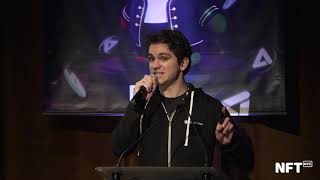
Interview with Alex Atallah, CTO and co founder of OpenSea

Alex Atallah, CTO and co-founder of OpenSea, describes pivoting from a Wi-Fi Coin idea to building an eBay-style NFT marketplace after being inspired by CryptoPunks and CryptoKitties in 2017. Early growth relied heavily on single projects, but OpenSea diversified after 2022 and now supports five blockchains including Polygon, where it covers gas fees for users.
Chapters
the blockchain network itself, come up to me and I'll be delighted to talk to you.
All right, all right, all right. Thanks a lot, and, uh, um, you know, kind of one of the founders, big backers of Casper Labs is Brock Pierce. You know, a super interesting guy, a real crypto OG, um, who actually I quote quite often because he said, uh, you know, I heard from Cliff Sarkisian, the COO, kind of at the DEX in 2019 Cliff is a super talented guy, Harvard Law School, left everything to go into crypto and to do Casper Labs. And at the bottom of '19, he was wondering, he asked Brock, Brock, did I make a mistake? And Brock looked at him and said, hey, he said, you know, bull markets are bullshit and bear markets bear fruit. And, you know, for the people who stuck it out during there, you know, this is bearing fruit, and that's why we're here, right? Because OpenSea was a company, obviously, you know, you saw, you know, you started and you've been here before. This isn't your first time, uh, as a guest at Crypto Mondays, but this is the first time, uh, with the market cap. I don't think your market cap was over a billion the last time. So, um, you know, I think I'm all super interested. Tell us the genesis story.
Sure, thanks for Can everybody hear me?
That's good.
Thanks for inviting me, Lou. Last time it was in East Village. It was like a year— that was almost a year and a half ago. It feels like 5 years ago. OpenSea, we started it in 2017 at the very, very end. Devin, my co-founder, and I were exploring crypto as a potential new frontier for tech. I'd always been a bit, uh, sad and kind of nostalgic for missing out on all the other big tech revolutions, like birth of computing, the birth of internet.
Did you think that was it? There was no more innovation to come?
I was wondering when it would come, and crypto looked pretty interesting. It was a bit— it was very noisy at the time, a lot of crazy stuff going on, a lot of—
what year?
In 2017. Um, that was the ICO discovery of ICOs, uh, and, and there were a lot of communities that were just incredibly fired up. I'd never seen the energy, and a lot of them was just obvious. Everyone was incentivized for the wrong reasons. Nobody was actually caring what the tokens could do. And then we saw a couple communities that were very different than all of these 2017 communities. They were focused on utility. Some— one project, the tokens gave the owners a piece of art that was attached to them. And the founders were also very humble. In contrast to all the other ICO communities, they gave away all the tokens for free, and there were 10,000 of them. This is CryptoPunks in the middle of the year, and this community just grew up around them. Organically. It wasn't like they tried to monetize an existing community. So that was another inversion that was different from everything else that we'd seen before. And it was really exciting to just explore them, meet these pseudonymous users. A lot of them were really talented developers.
How did you do that?
We, uh, all these projects, they either had Discord servers that were powering the community and letting people talk to each other, letting owners talk to each other, so they were just pretty easy to join. Some of them had subreddits, but Discord played a pretty big role. And then there was Decentraland after that, and CryptoKitties after that. And CryptoKitties, again, very humble project. It was a hackathon project, and it turned out to be way big.
At what hackathon?
From ETH Waterloo.
Hackathon?
Waterloo? At the end of 2017.
Wow. Canada has played a role.
Yeah, um, and, uh, and that was by the Dapper Labs team. They, like, they helped discover something incredibly new and important, and it was not a— it seemed like something brand new for the web that existed on a fundamental level. It was a new primitive for the internet. You have web pages, which are a primitive, and you have cryptocurrencies, which are a primitive. And then you have these things, NFTs, which are really different from web pages discoverable by Google and from cryptocurrencies discovered on an exchange. So we wanted to build— they exist somewhere in between, but we wanted to build a marketplace or a way of discovering this new type of primitive.
And who's we?
Uh, just Devin, my co-founder.
And how did you meet Devin?
I met Devin through a mutual friend that I had in college that he went to high school program with.
And you met him like, oh, just as a friend? And then, or did you meet—
met him as a friend through tech things in San Francisco. We worked on this crypto project that let you mine or earn a cryptocurrency from your router when it's not using any bandwidth, when you're not at home. And how did that go? Yeah, well, early, very early. We, um, we got into Y Combinator with that idea, but that was right at the end of the year when we were noticing that NFTs were more than just—
at the end of '16?
At the end of '17. We, um, we pivoted like first day of the program in 2019. Wow, she joined.
But hey, actually we're a different company. I'm sure Y Combinator had no problem with that. They were—
I don't really know what their reaction was. We kind of— they were introducing everybody, we, we just stood up and, and they introduced us as Wi-Fi Coin, and we're like, oh wait, wait, hold on, we're actually completely different. Um, we thought You know, like, we thought this new primitive would be best discoverable on something that looked more like eBay than Coinbase or Google, so we, we called it EtherBay, and it had obviously a lot of nautical-themed assets as a result. And then, you know, we realized, okay, that's not a great name for this, uh, because we figured we keep the nautical assets, the nautical theme, all the art, some of the art that we've made, and the logo, and just focus on the openness of it. And that's where OpenSea came in.
And so you start the company and lots of challengers early on.
Who was the first money in, uh, besides Y Combinator? It was—
and just quickly, how would you describe the Y Combinator experience?
I thought it was very helpful and pretty phenomenal group of people. Learned a lot from other people in our cohort and the rest of the group. The partners were— are very focused on building something people want and talking to users aggressively. So that— and I think that became a big part of our DNA early on as a result. And so you graduate, then first money in, uh, after them, um, we started talking to Kevin Hartz, who was a partner at Founders Fund at the time. He was one of the Eventbrite co-founders. And Nick Tomaino at One Confirmation. And, uh, we talked about—
I met Nick when he He was at Coinbase.
Yeah, yeah, Nick is great. Um, and then we did our seed round with a bunch of others, but—
and so you start the company, you're going along, uh, what was there a point where you thought you weren't going to make it?
There were definitely slow months, many, many slow months. We thought it was— we didn't know if we were really, really early. Turns out we were. Or wrong. Or wrong, yeah. It was quite a long— you know, there were some months of just no growth, some months of decline.
It was very dependent.
Yeah, it was great.
You extrapolate out, it's not pretty.
Yeah, it all looks really small when you're like I shift the axis further and further to the left. Um, it's also very dependent on projects. Like, there were, there were some months where we, we did see a lot of volume and a lot of excitement around NFTs on the marketplace, and it was all just one project. So it was very— it wasn't very diversified. It was a little bit—
yeah.
Um, and then it just became more and more diversified, especially in in this year after February.
Was there like, was there a moment where you said, oh my God, or was it just gradually?
Uh, after February this year, we saw, we saw some projects do really, really well, especially projects that blended art with technology in novel ways and that built communities.
Name any specific ones?
Hashmasks was an early one from February that did really well, and they built a really strong community. They, they had it.
Can you extrapolate on that? Like, because obviously this is community, right? So when you say community, what do you mean?
Well, in the Web2 context, a community is a group of people with a shared interest, and in Web3, we're taking it one step further and adding shared And with NFTs, we can add another element of fixed supply. So a community of, of NFT holders, there's fixed supply, or, or at least predictable supply, around who can be really in the community and who can prove that they're a member. And this means that the creator can just generate all this interest and and all this excitement without— and all they have to do is just make what they make and do what they do. And people in the community will do the marketing for them and will build products that interact, that are interoperable with the NFTs, that add value to them and, um, and just provide benefits to everyone else in the community. So it becomes a, like, a zero or negative marginal cost situation to set up an NFT for a community.
Can you talk about how your thoughts of NFTs have evolved over time, about what they are and what they can become?
Well, we've really just scratched the surface. For context, like, there's just a few million users in the space. Gaming— there's over a billion digital gamers in the world, and Just the number of users is really— is a lot smaller than it could be, in part because crypto is still hard to access. And improving the on-ramp for lots of audiences around the world to access NFTs is a major goal for us at OpenSea. On the content side—
and what— so what are you doing to further that?
We have a couple projects coming that will make it a lot easier for you to buy NFTs directly on whatever blockchain they're backed by. We have OpenSea, we support Ethereum where most of the volume is, but also some sidechains and some layer ones that are proof of stake, but that are pretty low gas costs. And that's actually where most of the NFTs that we see being created are being created on Polygon. Polygon is the biggest example.
What do you think— what does Polygon do right?
Polygon was really, really active with companies, with gaming companies and with NFT companies in crypto and also with the DeFi community. They had really good developer documentation and tutorials. They, they had tech that just worked.
Um, you know, you say that like you're surprised.
There's always, always stuff that doesn't work. Like Ethereum doesn't really work. It's, it's a really, it's a really new space with all tech, you know. Yeah, there's kind constant forks that happen for Ethereum that improve it, and miners adopt it, and like the standard behavior for the chain will shift in good ways. Polygon moved really, really quickly, and they focus on like speed of iteration, getting feedback from all their partners and their users, building, and then iterating again. And I think that's the main thing.
Yeah, I just I came back from Lisbon from the Solana conference. Any thoughts on Solana?
Solana is fantastic and we're following it really, really closely. There's a lot of new technology. They're also similar to Polygon, very, very actively engaged with projects built on top of it.
And so I assume you track across chains who's actually driving volume in NFTs. Is there anybody that we haven't talked about that you go after and they're actually doing something?
Uh, Tezos has volume.
Uh, what do you think? Because actually, it's funny you would say that. That is actually the only other chain.
Flow also.
Yeah, yeah.
Okay, Flow has NBA Top Shot.
Yeah, no, I mean a couple new projects that are popping up. Yeah, they, um, but I, I'm intrigued trajectory? Yeah, I don't know. Who do you see like that has that trajectory? Okay, they found some product market fit other than Ethereum.
I think Polygon and Solana both have good trajectories and also a lot of organic adoption. It's not just a single— and this is it, all the chains but some chains have more than others. Lots of developers building unique smart contracts and addressing completely different audiences in different parts of the world. Those are exciting to see.
Okay, so, uh, I, I try and keep— I think Bob's going to go over a little bit only because he's so interesting. Uh, this week's half hour, I try to keep my questions 20 minutes. I think I went over again because it's so interesting. I'd like to spend the last 10 minutes if anybody has questions in the audience for— yeah, anybody out? Yeah.
How do you see competition from Coinbase since they're looking to launch their own marketplace for NFT next quarter? The question was, how do we see competition from Coinbase since they're looking at launching an NFT marketplace next quarter? Uh, we're really excited that they're getting deeper into the space, it'll be, I think, a very good thing for all NFT creators. And the cool thing— we talk to Coinbase a lot, we work with them closely on their wallet, like previously on their wallet, which uses the OpenSea API to show you collectibles that you've bought. And what we've noticed is that it's a bit cliché, but the phrase rising tide lifts all boats especially applies to Web3 because all of these companies are building on the same underlying infrastructure, those blockchains. They can collaborate a lot more easily and users can choose much more easily which product they want and they'll just pick the one that best suits their use cases. So what we've often seen is that new competitors will onboard a group of users that we weren't properly addressing, that we weren't doing a great job of onboarding ourselves. And then they'll come in and get interested in NFTs and wonder what else there is. And, and that's where OpenSea comes in.
You mentioned, uh, Capstar over there.
Yeah, I'm an artist. Even, even I sold several hundreds of NFTs, but I'm suffering from the high gas fee. I use suggest us to move to Polygon.
So the question was, as an NFT artist who sold hundreds of NFTs, I pay few thousand US dollars, there's no fees, just for gas fees, suffering from gas fees on Ethereum. So am I suggesting moving to Polygon. Polygon, I think, or at least until Ethereum, until we see it like Ethereum 2 come along, Polygon and chains like it are gonna have a better user experience and save you a lot of money because OpenSea actually pays all the gas on Polygon. Polygon is not a gasless chain, but you still have to— it still has a lot of in common with Ethereum. It's just the gas is so cheap that OpenSea can afford to pay it all for you and for your users and for your buyers. So you will save a lot and you get the same user experience, and it'll get a lot better soon.
So I'm sorry, just, uh, just, I, I was told that I should like once again come back here and tell people to shut the fuck up.
Hey! Hey!
There are people here trying to learn!
Okay? You're not gonna stop these fucking learning—
Jesus! Thank you. That's it.
Hey hey!
So the microphone is done.
Because it's actually because of a lot of people, they still don't have a MATIC. So my problem is I still cannot accept offer because people, they, a lot of my collaborators, they keep asking me that I only have Ethereum, now I have to buy MATIC, and then that's the gas fee.
So that's the problem. So there's some misconception there. For Polygon, you still use Ethereum. What's required is bridging it to the Polygon network. And we let you— we detect when a user has Ethereum on the Ethereum network and we help them bridge it to Polygon so that they don't have to worry about it. You actually never have to go out and buy MATIC to use OpenSea.
Yeah, but somehow, because especially because we are in the US, if they get it from exchange place and it's also It takes for decades. Like, I have some transaction that it took me like one week to get it. It is— and I have to tell them I have no clue because I don't know what's going on.
Okay, we'll have to figure out what the details are there. There's something strange.
Okay, so, so, okay, so, so people are talking over here. And so first, let's give Alex a big fucking hand. You know, these guys built a massive community, and I'm gonna just finish real quick. So I sent an email, I said, through via Meetup, you know, I've been running this for, uh, since our first one was January 2018. And I am ready to hand off the reins, right? I think communities, right? I think communities function best if they turn over the leadership, right? You know, I mean, it's supposed to be decentralized, but there's still— I'm turning Crypto Mondays into a DAO. If anybody wants to come and help and, you know, be a co-host for Crypto Mondays, let me know. Look at Alex Atallah over there. She's helping me now set it up. Looking forward. And You know, at the end of the day, I'm pretty sure fucking wag me. Thanks.
More from Alex
Are YOU getting enough out of your LLM experience? feat. Alex Atallah of OpenRouter
Fun stories from building OpenRouter and where all this is going - Alex Atallah, OpenRouter
Will Open Source AI Overtake Closed Models? Ft. Olama, Fireworks and Open Router
From OpenSea to OpenRouter: Alex Atallah’s Masterplan for LLMs | Data Driven NYC
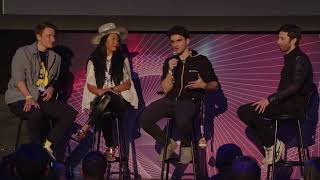
Beyond Hype Where Are NFT's Headed Matt Medved; gmoney; Swan Sit; Alex Atallah OpenSea, Alex Saln