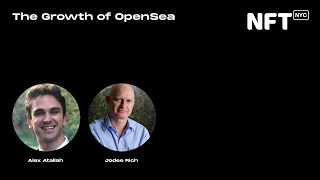
OpenSea: Alex Atallah - Jodee Rich and Alex Atallah at NFT.NYC 2023
In a fireside chat at NFT.NYC 2023, Jodee Rich and OpenSea co‑founder Alex Atallah reflect on OpenSea’s origins, product philosophy, and current challenges. They recount how OpenSea deliberately built a horizontal, neutral marketplace and an open API to attract developers before a clear "killer app" existed, defying early Y Combinator advice. The conversation moves to two pressing industry issues: royalty enforcement and security. Atallah explains the historical split between on‑chain and off‑chain royalty models, introduces OpenSea’s Operator Filter that lets creators choose which marketplaces can trade their NFTs, and describes collaboration with MetaMask (and Blockade) on a transaction‑level phishing‑detection API. They then explore the nascent intersection of AI and NFTs, noting how generative AI can act as a co‑pilot for art creation and smart‑contract coding, and how AI‑driven tools could democratize NFT production. Finally, they discuss NFT.NYC’s experimental digital‑twin ticketing system that blends traditional event‑ticket features with NFT ownership, enabling community‑driven artwork and niche interest NFTs (e.g., "crispy bacon" or kite‑boarding tokens). The chat ends with a vision of NFTs fostering instant, interest‑based communities and tribal networks.
Chapters
For me, I'm here because of the community, and, you know, I think that there are few people who have done more for the NFT community than our next two guests. So let's give a big hand to Jody Rich and Alex Atallah. Come on, guys. Thank you very much, Lou. So this is tradition. Every NFT NYC, Alex and I sit down and we have a little fireside chat. For those of you who don't know, when Cam and I were thinking about whether we should do this or not in 2018, we came to Alex and Devin and we said, oh guys, we wanna do an event, bring people together, And they said, who would we bring together? And Devin said, oh, I've never done an event before. And I said, well, let's just give it a shot. And Alex and Devin have been incredible supporters of NFT NYC since the beginning. In fact, I'll tell you a secret. The first two events, we lost quite a lot of money and we paid half and OpenSea paid half. Do you remember that? I sent you an email. Yeah, I said, this is how much we lost, Alex. And Alex was great. In fact, Alex has put his hand in his pocket again today. I'm going to embarrass you. We gave away 100 complimentary tickets this morning to students and job seekers, and Alex made a personal donation to help pay for those tickets. So, big thank you. So, we're going to sit down. We're going to— we have lots to talk about. And we're going to start with, hmm, we're going to start a little bit with history, we're going to move on to industry, and then we're going to talk about what you're doing now. So backstage we were chatting about the old days, and I remember for a long time we both felt that we were out in the desert and that no one really cared or loved about NFTs. What was the most successful single thing that OpenSea did in the first few years to create traction?
Well, in those days, it was really the biggest question was whether NFTs were going to be a thing or not. And most people didn't think they were going to be a thing. So we built a marketplace. We didn't know what type of NFT would really bring the industry forward or be the killer app. So we built a horizontal marketplace. And to make sure that it was— it felt open and unbiased and neutral and welcoming to everyone, we did a lot of work to really make it easy to access for developers, for anyone who is trying to be creative, for creators, and for all— for whatever business could potentially be a killer app for NFTs and could make NFTs work for the world. 'Cause all we knew at the time was that it was a fundamentally superior form of digital good than everything that we were used to.
We would believe it.
Yeah, so the, you know, this was definitely a case, most people say, you know, don't build a solution in search of a problem. Find a problem first and then build a solution. We were definitely doing it the other way around. Like, this was a solution in search of a problem for sure.
But you went to Y Combinator, and that's where they said, "Don't do that." But you left Y Combinator, and you did exactly the opposite of what they told you, right?
I don't know if they say, "Don't do that," exactly, because there are many cases where a new technology emerges, and obviously it doesn't solve any immediate problems, but it's a bet on a future where problems will emerge. And those are the types of problems that I'm most excited about personally, not the ones that people see right now, but the ones that we predict will become really big issues down the road. So we spent a lot of time just making the platform open.
You made an API that every developer who also was dreaming about NFTs could use. That was the key honeypot, wasn't it?
Right. We made an API. We allowed you to create smart contracts that get automatically discovered OpenSea, we basically made it easy for you to create businesses and apps and experiments and just have them work without necessarily getting our permission or getting special API integrations built by us.
And, and moving forward now to where we're at right now, you've, um, you're still on the board of OpenSea. You're now dreaming about the next things. Before we talk about the future, let's talk about right now. What do you think are the two biggest issues for our industry and marketplaces? Is one of them royalties?
Yeah, I would say like royalties is one, and maybe security is another one. With royalties, in the early days, a lot of the, the I think that the problems that we see with creator fees and royalties today kind of stem from the way NFTs evolved from the very beginning. We didn't, you know, in the beginning, we weren't sure if marketplaces were gonna be embedded inside of NFT contracts, or if marketplaces were going to be a separate program, a separate smart contract, and NFT contracts were going to be a separate program, separate smart contract. And in the early days, it wasn't clear which model was going to work. We looked at both. Unbundling marketplace logic from NFT logic allows NFTs to really access more types of liquidity. And that was the way the ecosystem moved. But it came at the consequence of not being able to enforce creator fees, which is—
It's the conversation about what do you do on-chain and what do you do off-chain?
Yeah, well, enforcing creator fees could have been done on-chain if the marketplace had been embedded in the smart contract in some way. And I think there's still lots of ways of making that happen. One step in that direction is the operator filter that OpenSea introduced in November, which allows NFT creators to specify which marketplaces they want to allow the NFT to be traded on.
The interesting sort of development over the last few months is you really introduced royalties on resale, and then another marketplace didn't support those royalties, and they were able to undercut OpenSea, which I would have thought would be very annoying both for you and for the artists. And now you're bringing back a new solution, aren't you, so that the artists can choose what they want to do? That's what you're referring to.
Yeah, yeah. A personal belief I just have is that user choice wins in the long run. And that includes creators, giving creators the choice to decide what their business model is going to be, and giving them the choice to decide even which marketplace they want to direct users to.
And you want to talk about security?
Yeah, I mean, security has always been a big issue for NFTs. And for the crypto space as a whole. Everybody's heard of issues of people's wallets getting hacked and people being tricked by a phishing website. So I think we'll start to see very cool initiatives develop. One interesting one that just emerged is MetaMask is now doing some work with OpenSea to figure out if you're about to sign a suspicious transaction. And it's a lot more intelligent than just looking at what website you're on and seeing if it's on a block list or something. Because these websites, they just change so rapidly. You can't, you can't catch up to the number of iterations that a scammer will try to make. So it looks at lots of things, the addresses involved, like the kind of data that you're actually doing, the actual transaction that you're going to submit. And Blockade is also incorporating their data into it too. So we're getting to a point where we have enough data and we're working with enough companies and it's like a cross-cutting effort that we might see a much safer world. Web3 experiences all.
So is this an API that a wallet could call to check whether the transaction that's about to occur is possibly scamming or fraudulent? Is that how it works?
For details, I think, you know, if you're a company that's interested in working with OpenSea on something like this, should reach out to our security team on the OpenSea website. I know that an API is involved and like, we're definitely like giving access to MetaMask or helping MetaMask like see that data and use it to make decisions.
Because earlier this morning, who saw Crypto Novo's story? Yeah. So Crypto Novo told a story about how he was hacked and it would be super interesting to sort of do a little reverse check to see if that API would have sorted out the problem that CryptoNovo had.
Hmm. Yeah, yeah, yeah. I'm not sure. But yeah, regardless, it, it is like a, I think, a really important step for us to solve in the bear market because bear market I think has more power user activity than activity from new users who are— don't really like know how to stay safe in Web3 yet. If we can get really good at doing this now while we're in a bear market, then the bull market will be significantly easier. Otherwise, when the bull market happens, we'll get a flood of new users coming in who could be in a really precarious position if we're not careful about safety. And the internet faces this too. Like, you know, Chrome and like browsers and search engines all had to work together to keep the internet safe.
So let's talk about that flood of new users that we expect. And one of those new users could be artificial. You are doing some really interesting things on AI now. I just came from a really interesting panel where we were talking about how— I'm not sure if you all know this, but sometimes lawmakers are very, very insightful. And I heard the story on this panel this morning that in 1988, UK lawmakers decided that AI-created art actually would be subject to copyright. In 1988. And apparently the story was that those lawmakers in the UK were motivated by the movie Terminator. So I think Arnold Schwarzenegger would be very pleased to hear that, that he back in 1984 inspired lawmakers who are now giving AI copyright. That was an interesting twist. You didn't know that, did you? No, no, no, I didn't either. So, um, you told me earlier today that you, you're dreaming about AI. Tell us a little bit about AI and NFTs.
Well, I've just been exploring it for the past couple of months, particularly the intersection of AI and decentralization. It's really thin. They're like, most of the AI community does not love crypto, and most of the crypto community is not really playing with AI.
So the guys in Silicon Valley, the AI guys, don't like to talk to the New York guys who are dreaming about NFTs.
Yeah, and I mean, the communities seem to have kind of different cultures, different interests, and, you know, I'm making sweeping generalizations here, which you have to always be careful about. But let's bring them together.
Yeah, let's bring them all together.
Yeah, I think there's a cool intersection here because if you go around on Twitter and just look at the types of things people are making in AI, they're all locked to APIs. Like, they're all just making these hard dependencies on projects that might deprecate their APIs in the future or might, you know, do something that users don't want. Every— and, you know, we've learned that basically every company makes mistakes if you extend the timeline far enough. And building these hard dependencies on APIs that are all, like, paid APIs, first, It sort of stifles innovation a little bit because some people don't really want to pay anything. They want to shift that cost to users, kind of like what crypto does really well. And second, it also just prevents users from having all the choice that I think they're going to want to have. These models are fundamental building blocks for the internet of the future. And right now, users have no choice about them.
So what about AI interests you? How does that intersection work?
Mainly the way I described, but also I'd like— I think the, the, uh, they're just much better ways of doing information retrieval. Like, I, the number of times I use Google for things has just dropped really, really low, and I've just shifted a lot of just my searches to ChatGPT.
It's just Amazing. And I think that's a takeaway. Alex Atallah doesn't use Google as much and uses ChatGPT. Do you use ChatGPT more? Do you use ChatGPT actually more than Google now?
Maybe.
That's a big statement.
It really, like, there's a trade-off because there's a small chance that you'll get some hallucination from the AI, but there's also a chance that you'll get fake news from Google.
So I say in AI, fake news is called hallucination, but on Google it's called fake news. That's cool. I mean, I really like that. That's a takeaway too.
I think the— I think it's incredibly exciting. I also think AI is really great for NFTs because first, think about how much effort it takes to make a one-of-one NFT. But at the end of the day, you just have a one-of-one. What if you could create 10,000, like, NFTs based on a ton of effort put into just one? Then suddenly you have a community.
So, so let's drill down on that. So you create one NFT and it has characteristics, attributes, and then you say to your AI, unpack those attributes and make another 10,000 and they're all a little bit different. Is that your point?
And it wouldn't be just a one-step process. You would work. It's kind of like a copilot, like an NFT artist generative art copilot where you're saying, let's see, Let's see what happens if we put hats on everything. And let's, like, make some of the hats, like, really wacky and some of the hats really serious. And, you know, if it's fast enough and if you can do enough, like, if you can get a feedback loop going, a really, really good feedback loop, then I think we'll just have much better projects and much more interesting— you know, the fact that, like, a lot of the art is de-risked and a lot of the effort to put in. Means that the effort shifts elsewhere. It shifts towards like making cool community experiences, making interesting programmable smart contracts. It's now— I've used ChatGPT to write like 4 smart contracts and it's incredible. It really, like some of them compile on the first try. It's really amazing.
Wow.
So it's just, and I just use natural language. Anyone can make smart contracts now. It's like, I think it's gonna be really big. It just, hasn't quite— people haven't quite seen what it can do yet.
I was talking to Garib, who is the founder of Comic-Con, earlier in the week, and he loves the way AI is empowering people to be better writers. And you're really saying AI is empowering us to be better NFT creators.
I think it will, yeah, for sure. I'm curious what NFT— like, what else NFT NYC is doing in terms of of technology that you guys have— every year you guys have done something new using something cutting edge that has just come out. And it's been every year pretty exciting to see what you guys try next. It's kind of like a conference lab or a tech conference lab that's putting on a conference. What are you up to this year?
Oh, I love that. It actually brings back memories. Do you remember? Devin wrote that blog post about the first NFT tickets that we created together a few years ago. Yep. If you want to search Devin Finzer NFT tickets, it was like 4 years ago that we, that we did some tickets with you. So, um, I think everyone knows, I've said this many times over the last few days, I'm not an event guy, I'm a tech guy. And you're right, this event for us is a way of testing new tech. And this year we've created a digital twin ticket so that we end up with the benefits of both an Eventbrite ticket, you know, email addresses and surveys and being able to send out emails, with the benefits of a digital NFT ticket. So that digital twin is fun. And what's really cool about it is we had thousands of NFT artists submit artwork that we then put on the tickets. So there's user-generated content, the artists are part of the, the whole narrative, and then our attendees get to see the beautiful artwork. And those attendees who don't like to use NFTs to check in can use Eventbrite and vice versa. So that's one thing. The one that I'm most excited about that still has a way to go is my crispy bacon story, which some of you know. I like crispy bacon. I think next event I might create a crispy bacon NFT that gives you crispy bacon access for breakfast. And those of you who like crispy bacon, we can share crispy bacon stories together if you actually own that NFT. In other words, we're going to use an NFT to create common interest. I'm a kiteboarder. Those of you who want to use, want to grab the kiteboarding NFT, we will then have a CRM and we've revealed it now to this audience. There's a CRM where you can go, okay, show me everyone who has claimed that crispy bacon NFT. And we can have a little crispy bacon party at the next event.
Nice. So it sounds like it builds on the like instant community.
Exactly.
Feeling that you can get from NFTs, because it's kind of like a good way of like finding true fans of something.
And I think that's going to be the future. That's going to be the future of networks is that instant community from common interest and that tribalness. We are way out of time. It is always a joy to talk to you, Alex, and we always will wish you— we— I know you're still a director of OpenSea, you're still involved, but you're now thinking about other things, and we all wish you so much success in the future.
So thank you, guys.
More from Alex
Are YOU getting enough out of your LLM experience? feat. Alex Atallah of OpenRouter
Fun stories from building OpenRouter and where all this is going - Alex Atallah, OpenRouter
Will Open Source AI Overtake Closed Models? Ft. Olama, Fireworks and Open Router
From OpenSea to OpenRouter: Alex Atallah’s Masterplan for LLMs | Data Driven NYC
Beyond Hype Where Are NFT's Headed Matt Medved; gmoney; Swan Sit; Alex Atallah OpenSea, Alex Saln