A New Middle East Order?
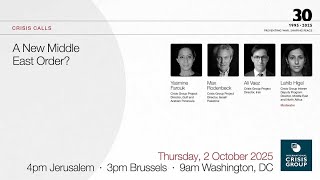
The Crisis Group webinar, moderated by Lahib Higel, convened three regional experts—Max Rodenbeck (Israel/Palestine), Ali Vaez (Iran), and Yasmin Farouk (Gulf/Arabian Peninsula)—to assess how the 7 October 2023 war and its two‑year aftermath have reshaped the Middle‑East power balance. Israel has emerged as a de‑facto regional military hegemon, fighting on nine fronts (Gaza, West Bank, Lebanon, Syria, Iraq, Iran, Yemen, Tunisia, Qatar) and projecting long‑range strike capability. Its deterrence doctrine has shifted forward, restoring fear among neighbours, but the war has cost Israel international legitimacy, deepened its reliance on U.S. aid (≈ $40 bn) and exposed demographic and political constraints. Iran’s strategic posture is in flux. Two internal camps debate whether the 12‑day war (June 2024) shattered Iran’s “axis of resistance,” ballistic‑missile arsenal, and nuclear program (estimates: 50 % of missiles, 60 % of proxy support, 80 % of nuclear capacity lost) or whether a pathway to a nuclear weapon remains viable. Options range from limited proportional retaliation to a “go‑big” nuclear‑or‑missile strike to reset the balance. Domestic pressures, leadership turnover, and economic hardship further complicate decision‑making. Gulf Arab states, long‑standing “shielded” actors, now face direct attacks on Qatar and heightened security anxiety. They remain heavily dependent on U.S. power projection, are deepening bilateral security deals (e.g., Saudi‑Pakistan military agreement) and reassessing their stance toward Israel and Iran. The Abraham Accords are under strain; the UAE and Bahrain have benefited, but Israeli actions in Qatar and potential annexation raise red lines. Gulf states are balancing collective GCC interests against individual security guarantees from the United States, whose reliability they view as increasingly unpredictable. The panel discussed the likelihood of a revived Axis of Resistance and anti‑U.S. sentiment, concluding that Israel’s overwhelming strike capacity and war fatigue in Lebanon, Syria, and Iraq make a rapid resurgence unlikely, though low‑level proxy activity could persist. Regarding Israel’s endgame, the experts noted a lack of consensus within Israeli leadership, unresolved costs of the Iran war, ambiguous objectives in Syria and the Gulf, and demographic challenges that prevent a decisive resolution of the Palestinian issue. Audience questions touched on the durability of Iran’s “rally‑around‑the‑flag” effect, the feasibility of the Trump‑backed Gaza plan, and the Arab states’ willingness to fund reconstruction or enforce a two‑state solution. Responses highlighted the fragility of Iranian popular support, the opaque sequencing of the Trump plan, and the Gulf’s limited leverage without U.S. backing. Overall, the discussion painted a picture of a new, unstable Middle‑East order where Israel’s military dominance, Iran’s strategic uncertainty, and Gulf states’ security‑dependency intersect, creating multiple flashpoints and a high risk of further escalation.
Chapters
Hello and welcome everyone to this Crisis Group webinar where we will discuss the question of a new Middle East order. My name is Lahib Higel. I'm the interim deputy director for the Middle East and North Africa program at Crisis Group. We have with us today three of our experts, Max Rodenbeck, who is the project director for Israel and Palestine, Ali Vaez, project director for Iran, And Yasmin Farouk, Project Director for the Gulf and Arabian Peninsula. This is a moderated discussion. We will go about for 45 to 50 minutes. I will pose two rounds of questions to the speakers. And meanwhile, you will have the opportunity to put your— pose your questions in the live chat box. Please state your affiliation when you do so, and we will get to the questions in the last segment of the webinar today. Um, so since 7 October, um, the balance of power in the Middle East has shifted in ways that it appears to have been irreversible. Two years on, Israel's war on Gaza following Hamas's attacks is still raging with devastating effects on the civilian population. And meanwhile, Israel has emerged as a military hegemon following the regional escalation that its war in Gaza unleashed. With the degradation of Hezbollah in Lebanon, the Houthis in Yemen, Israel has not only undermined Iran's decades-long forward defense strategy, it has also entered a war directly with Iran, as we saw in June this year. And it hasn't stopped there. In September, Israel struck Hamas leaders in Qatar, sending shockwaves through the Gulf Arab states. So where does all of this leave the region? Our experts here today are going to help us make sense of this new order that is emerging, how regional countries are positioning themselves, whether we are heading towards further escalations, and what might be the way forward. Max, I'm going to start with you. So Israel appears to be virtually unrestrained in the region. The US has done little to limit its military ventures. And it may have military dominance in the region, but global public opinion has turned against it. So what does this changing dynamic mean for Israel? You're on mute, Mats.
The mute button loves me. Thanks, Lahib. That was a great introduction. And thanks everyone for joining us. Yes, indeed. I mean, the last 2 years, we are not at the end of this horrible war in Gaza, but we seem to be getting close to the end. So it is a good moment to pause and reflect. And for Israel, the last 2 years have been really transformative, and they've been transformative in a regional sense in a way that perhaps no event in Israel's history, certainly since the 1967 war, has been transformative. And just to remind people of what happened in the 1967 War, Israel defeated 3 Arab armies and it conquered the Sinai from Egypt, the Golan Heights from Syria, and of course, the West Bank along with Jerusalem from Jordan. And this was a sort of announcement of this sort of strength and power of Israel relative to its much larger Arab neighbors in a way that was, you know, really shook up the region and, you know, redrew the map literally of the Middle East for quite a long time to come and set up, you know, the next several decades of Israel's relations with the region, pretty turbulent relations. But I mean, it was all because of that war. And that was, so that was an army, as I said, that was a war against 3 armies. In the current conflict, Israelis have declared, Netanyahu himself, you know, that Israel is fighting on 7 fronts. So they said. And the 7 fronts that it's been fighting on in this war so far, aside from Gaza, of course, against Hamas, but in the West Bank to, you know, pacify the West Bank, in Lebanon against Hezbollah, in Syria, Israel's intervention to get, you know, to crush Hezbollah had a huge impact on Syria. And Israel is still involved in Syria. In Iraq, there hasn't been that much action, but it's been in Israel's sights, shall we say. And Iran, of course, with that 12-day war in the summer. And then Yemen, where Israel has been striking the Houthis. And in fact, we can actually add two more to that. Israel also struck Tunisia a couple of weeks ago. Drones struck some of this flotilla, the Samud flotilla, which was heading with aid towards Gaza. Some of those boats were struck in harbor outside of Tunis. And so Tunisia is another place. And then, of course, Qatar, even more recently, with the bombing in Qatar of Hamas agents. So that's 9 different countries that Israel has been engaged with. And in a sense, this is the good news for Israel. I'm going to give you first the good news, then the bad news. The good news for Israel is that It has kind of won all these wars, you know, and put that in, you know, quotation marks. And, you know, the most definitive way that it's won is it's really gotten rid of what was its biggest bogey, which was the axis of resistance that Iran had built up over a long time with all of its proxy fighters, such as Hezbollah is the most obvious one. And that has really been put out of action pretty much for the time being. Iran is unlikely to be able to rebuild this network of kind of of proxies. But Israel has also, you know, sort of won, so to speak, in Iran by studying back its nuclear program, we think, and its missile program. It's on the verge of winning in Gaza, as we can see with the latest Trump plan, which is basically a surrender document, to be frank. And Israel has actually achieved this at quite low cost. If you look at the numbers of, you know, how many soldiers were killed, you know, the number of soldiers Israel has lost in 2 years is about 1,000. This is painful to Israelis. I don't underestimate this, but that is a surprisingly small number of soldiers when you're fighting on 9 fronts for 2 years and fairly successful. You know, and Israel has also won in the sense that it has restored its deterrence. The attack on October 7th, 2023, from the Israeli perspective, Aside from the shock, horror, and shame, and sorrow, and so on, the worst part of that was the shock to Israel's deterrence strategy. People were not afraid to march right in and kill people in Israeli towns. This was a shock to the system. The need to reestablish, the desire to reestablish that deterrence was a big part behind all of these wars. And Israel has actually changed its doctrine, its military doctrine. It's now pushed its deterrence forward. So its deterrence now happens further away from Israel, and it happens before your enemy even begins to build the capacity to do stuff. This is the sort of new Israeli doctrine. And so this has reestablished deterrence. It's also established fear. I mean, Israel's neighbors are all living now in fear of the regional bully. And Israel has shown this extraordinary strike capacity that just so outclasses everyone else in the region with the strikes on Iran and on Qatar recently and on Yemen. These show a kind of a long-distance capacity that wasn't there a few years ago. And it's pretty terrifying if Israel can use stealth aircraft to go and aerial refueling to go long distances and and then use air-launched ballistic hypersonic missiles to strike targets very far away with very little capacity by anyone to fight back. This is pretty terrifying. So yeah, deterrence. Now I'll talk a bit about the downside. I mean, the downside for Israel is that, you know, as in 1967, 1967 was an extraordinary victory, but it led to many more wars. There was another war in 1973. Because of 1967, it set off a wave of terrorism around the world because Palestinians were suddenly under occupation. They had no way to fight back. And, you know, so it launched a very turbulent period for the Middle East, much more turbulent than the previous 20 years, say. So 1967 was a huge victory, but it was hardly a decisive war. And this is the trouble with the current situation. These wars are victories, yes, but are they decisive? That's less clear in many ways. And of course, the biggest trouble with 1967 is it created in Israel itself a demographic problem, which was that having captured the West Bank and Gaza, Israel had millions of Palestinians that were suddenly ruling over. And that demographic problem has just not gone away. It's gotten more severe. And it continues. And the new wars have not solved that problem. So the core problem that Israel faces has not been resolved by this. And then, you know, this war with Iran has not resolved the Iranian nuclear problem either. It's set it back perhaps, and Ali will have much more to say about this, but it's certainly not, it's far from resolved, the Iran problem. And then there's been a cost to all this. Israel has not paid a big cost in soldiers. And I should have mentioned also its economy is doing okay, despite all of these wars. So Israel has not paid a very high cost in those terms, but it has paid a huge cost in terms of its international legitimacy, whether that's important or not. Well, you know, I will not judge right now, but I mean, it is a cost. You know, there are many, many countries in the world, many people in the world now just consider Israel to be the perpetrator of a genocide. And Israel is seen as a regional, not a force for stability, but a force for instability. It's seen as the regional bully. This is something Israel has to live with. And that's a result of this current war. And so there's this kind of isolation that Israel faces internationally, which is, it's faced similar isolation in the past, but never to this degree, never this degree of sort of moral sort of outrage. And the corollary of that is that Israel's dependence on the United States as its one sort of steadfast ally through thick and thin has really mounted. Israel is now a very rather rich country, very strong country, but it really needs the United States. And this war with Gaza, the war with Iran, none of this could have happened without full US backing to the tune of Estimates go up to about $40 billion have been transferred to Israel in the last couple of years in various forms of aid from the United States, including vital things like aerial refueling to strike Iran. So Israel is more isolated and also more dependent. So I'll stop there. That's my roundup and happy to pass the mic.
Thank you very much, Max. We'll come back to Think Forward a little bit more as well, but I'll turn to Ali for now. Ali, Iran appears to be significantly weakened, and as Max mentioned, it has lost its main allies in the region. It suffered losses in its military leadership. Nuclear program has been set back. So how does it view the region at this point?
Thank you very much, Lahib. It's great to be on, and thank you everyone for joining. So the 12-day war really created an overly charged debate in Iran about what happened exactly and where do we go from here.
Here.
Let's start with the what happened interpretations on the Iranian side. I think Max did a great job in explaining the sense of euphoria that exists in Israel to a great extent, but also the nuance of not everything was achieved. There was a very similar sense in Washington, and there is a debate between two different camps in Tehran. One camp argues that the foundations of Iran's strategic doctrine over the past 400 days, 4 decades' worth of Iran's national security doctrine was completely shaken as a result of this conflict. The triad of Iran's deterrence, its ballistic missiles, which are its conventional deterrence, its axis of resistance, which was its strategic depth, asymmetrical deterrence, and its nuclear program, which was its hedging towards the ultimate deterrent. All of them suffered significantly over the course of the— since October 7th, basically. They all peaked, I would argue, on October 8th, and then from that point on, it was a downward spiral. This group argues that if we want to be fair and look at the outcome, about 50% of Iran's ballistic missile arsenal is gone. About 60% of the Axis of Resistance assistance is gone, and about 80% of Iran's nuclear program is gone. These are all rough estimates, but it just demonstrates how much of a setback Iran suffered in this war. They argue, this group argues, that when Iran had to be bold, it wasn't. It was cautious. And when it had to be cautious, it was too bold in April of 2024 by deciding that it wanted to open a direct conflict with Israel by retaliating on Israeli soil for an attack on its consulate in Damascus, it basically opened itself up to a confrontation with a superior military power. And when it had to respond in a way to deter the US or Israel from escalating further, post-Soleimani killing in 2020, for instance, or even the Iranian symbolic attack on on Al Udeid and Qatar. In all of these cases, no American has ever been killed. They argue that it was too little, too late. And the argument really boils down to one reality, which is that it's just too late to do anything that would fix this. Iran is too vulnerable, especially given the fact that its air defenses were significantly degraded even before the June conflict and the October 2024 exchange with Israel. And anything too provocative or too risky would not bring about high rewards for Iran. I have to say this group is in a minority from what I can see. There's another camp who argues almost the exact opposite, that two nuclear superpowers, one regional, one global, went after Iran and Israel just by the choice of targets. If you look at the opening salvo, which targeted Revolutionary Guards top brass, or the attack on— which was apparently aimed at decapitating Iran politically, in which Iranian president was injured, or attacking prison systems or other sites. It did appear that it was a regime change policy that this group argues they didn't achieve. The nuclear program, there is still a pathway to weaponization. Iran has 400 kilograms of highly enriched uranium, that is currently unaccounted for. It has a stockpile of advanced centrifuges. It has the knowledge. It has the manpower. In the course of a few days, it can still achieve what it could achieve before the conflict, which is enough highly enriched uranium for a single nuclear weapon. Now, I'm not saying it would do it or the path to it is easy. I'm saying that this group is arguing that that option is still available. And Iran still had at the last day of the war 1,500 ballistic missiles and 200 launchers. And it could continue in an attritional conflict with Israel for a few more weeks that will be extremely costly for Israel. As a senior Iranian official recently told me, the transition from unconditional surrender that President Trump asked for in the middle of the first week of the war and the unconditional ceasefire in the second week of the war Something happened in between, and the Iranians see that as their victory. And finally, their argument is that the Axis of Resistance, yes, it has suffered, but the ammunition for reviving it is plenty because that ammunition is not money, is not even necessarily arms, is the degree of hatred that currently exists in the region. And Iranians have always been able in the past 4 decades to cultivate that in order to create new groups. Now, there's one thing that I would argue these 2 groups agree on, and that's the almost inevitability of another round of conflict with Israel. And then the question is, how do you manage that? By definition, everybody believes that the current ceasefire, which is not written, its terms are not clear, is shaky, and they believe that Israel thinks that the job was not done and Iran remains vulnerable. And so there is a window of opportunity for Israel to resume conflict. And then there are questions of how to deal with that scenario, which I can talk about. But it really boils down to an analogy that I think might be of interest to you as well, Lahid, because the question is really if Iran is going to be Iran in the 1990s or Iraq in the 1990s, in the sense that Iran in the 1990s was emerging from a ruinous war with Iraq and was pretty weak, was pretty vulnerable. Its economy was in trouble, and it decided to focus internally, rebuild, recover, and invest, double down in its ballistic missiles program and in its regional network. Hezbollah in the 1990s was not Hezbollah in 2006 or in 2024, 2025. It might now— the clock has gone back to the 1990s in a way. But, but again, all the material to work with is still there. And if they could get back on their feet in the 1990s, why can't they do it again? So that's one argument. The other argument is that Iran is actually playing into the hands of Israel and it's isolating itself now, especially after the UN sanctions were snapped back last week. It's becoming another Iraq, which is engaged in an attritional campaign of pressure that would weaken it further and further over time and would tore apart the fabric of the society. So that's kind of the dilemma that Iran is facing. But in the next round, I can talk more about what are the options moving forward.
Sounds good. Thank you very much, Ali Vaez, for explaining the dynamics at play here within Iran. Yasmin, I'll turn to you now. So the Gulf Arab states have for a very long time had a sort of shielded sense of security in the region, but over the last 2 years, this regional escalation has really affected them, and even directly, Qatar has been struck by both Iran and more recently Israel. So what are their perceptions when it comes to the region and where it might be heading?
Thank you very much, Lahib, and thanks to colleagues and to everybody who is watching. Well, I mean, I, To think about the point where we are right now, I will start with, you know, the past 2 years, what happened until they were directly targeted by first Iran and then by Israel. Before the attacks on Qatar over the past 2 years, the Gulf countries were actually overall say, and some might even say they were winning without really fighting. They were winning in terms of strategic importance and stability without the cost that it would've taken them to roll back Iran in Lebanon, in Syria, in Yemen, and in Palestine itself. And so, so far as before Qatar was targeted, they were incurring risks, but risks that are not comparable with the cost that they would've paid to see this regional configuration happen. It was also remarkable that even in the exchanges between Israel and the Houthis, the United States and the Houthis, or with Iran, a country like Saudi Arabia that was targeted by both the Houthis and Iran in the past, even though Iran denied it, was not entangled in those conflict. But the attack on Qatar, whether first by Iran, but especially after the Israeli attack on Qatar, it was a turning point because this was a point where they started feeling that there might actually be a cost for this new regional configuration that is happening around them. And no matter how hard some Gulf countries try to act individually and to have an individual identity and an autonomous and independent foreign policy from the rest of them, they are still perceived as a group. They are talking about the GCC countries as the Gulf countries. And so an attack against them and an instability in one of them does affect the others in the eyes of the rest of the world and in the eyes of the external actors. It raises the stakes for security and stability and even for sovereignty, as Qatar kept insisting. I also have to say that these two attacks in the two times risked, or at least targeted at some point, the Gulf unity between and the reconciliation that has been going on since 2021. Both attacks, singled out Qatar for the first time for its relationship and the facility that it gives to the United States through Al Udeid and the presence of CENTCOM. And some even in Iran tried to say that it is fair game because CENTCOM does participate in, in a way or another, especially on the intel side, in the Israeli or the US attacks on Iran. And then you had Israel singling out Qatar for its relationship with Hamas, and they were progressively kind of pushed into taking sides, whereas for 2 years they have managed to have relations with all sides, with Iran, with Israel, and with the United States without getting entangled in this war. And this is why in our last piece on that issue at ICG, we call this litmus test for the Gulf countries. The second element I would highlight in this regional configuration that the Gulf countries are dealing with today is that, and I'm glad Ali mentioned Iraq, Because I feel that we're living in a moment that looks like post-Iraq War, but in 1991, when you saw the balance of threat in the region being overhauled through a war. And we saw a moment of unity of the Gulf countries and actually of the Arab countries in a configuration that looks a lot like now, the Gulf countries with Egypt, with Syria, And but then only to give way to a doubling down by individual Gulf countries on the security and defense relationships with the United States. And this is exactly what we're seeing right now, starting with Qatar when it comes to the US and other individual arrangements such as the Saudi agreement with Pakistan. But this, this seems more complicated and being more complex than just about the Israeli attack on Qatar. But in all sense, one of the main outcomes that are seen here in the Gulf is that the United States remains the only international power that is, first of all, able and capable to project power in this region in the speed that is needed and in conflicts. And but, and this has, of course, a consequence on everything that we've been talking about over almost the past decade about how Gulf countries have been diversifying their strategic relationships, they're diversifying their international relations, building their own national capacities. We're really seeing a doubling down and the confirmation on the role that the Gulf countries want the United States to play in their security and in their defense. And this is something they agree on with Israel. Both parties want the United States to be that security guarantor, to continue its presence in this region. Now, the dilemma for the Gulf countries is that the US projection of power is not something that they can predict at this time. It is not the old US that functions in the way that they knew that they have been dealing with. It's an unpredictable US. So although they still believe that their number one security guarantor that they are doing everything to make more committed is the United States, there is a realization that this might backfire, this might cost them at some points. The final element I would highlight for Gulf countries in this new regional configuration is that we still haven't seen them want to seize the moment collectively to reshape or at least weigh in on this reshaping of the Middle East that Israel had started, that we're still waiting to see Like Ali said, whether Iran is going to react to it, they have been and they are until now in a kind of crisis management mode. They're trying to manage the crisis, as I said, by having individual security arrangements, by getting the US to double down, by sending collective messages to President Trump. But at the end of the day, the way forward for all those arrangements and even for this collective messaging or unified messaging to President Trump that this is becoming costly for them, that this is becoming risky for them, it is not clear what's the way forward for it. Because for example, as we saw with the Trump plan, although they acted collectively, and by acted I say had meeting to send the same message to President Trump, they couldn't really control and weigh in when the plan changed after they agreed on it with President Trump. And what we are seeing is that there is still, thinking that individual agreements or individual arrangements would make them immune of the consequences of Israel's action by either keeping a relationship with Israel itself or keeping the dialogue open with Iran or keeping the dialogue open with the United States. But in all cases, they are not presenting and they're not weighing in with an alternative to either the Israeli vision of the region or the Iranian vision of the region. Vision, despite the fact that they have been putting in either an Arab League declarations or GCC declarations that they have an alternative vision for the region. But we haven't really seen them weigh in through influence and using their tools and leverages to enact it on the ground.
Thank you very much for that, Yasmin. Maybe we can come back a little bit more to tease out what it could look like instead. But I'll come back to Ali because you were also touching on the question of Iran's vision going forward. And if I if I understood you correctly, there are two camps that are at odds with each other. So which type of foreign policy is going to win here going forward?
As always in Iran, very hard to predict. But also, as always, probably the system will try to find a middle ground solution between, between the two camps. But there seems to be also a degree of indecisiveness right now, which could be attributed to different factors. One, I think, is the still-lingering shock of the opening act of this war, which is interlinked to another factor, which is the fact that a lot of the current 3-star and 4-star generals who are running the show are new to their jobs. And in contrast to their predecessors whose formative collective experience was the Iran-Iraq War in the 1980s, a World War I type of conflict. This new crowd, their experience is the Syria War, and it's a very different experience, and therefore, they have a very different worldview. But interlinked is the fact that the reason so many Iranian generals were killed on on day one was because of Iran's deep penetration of the Iranian system by Israeli intelligence. And those loopholes create a lot of questions and paranoia within the system. The Supreme Leader is not as visible, for instance, as he was before the war. And I think there is a degree of undecisiveness also because the options are really not attractive. So let's start with what the Iranians believe is an inevitable conflict with Israel. There are two options. One is to do what they've done before, which is to respond in a proportionate manner. Now, a lot of Israelis say the conflict next round will start from where it was left off on the 12th day, which was, if you remember, a campaign of massive bombardment that Israel was planning and President Trump pulled the plug on. It was supposed to target a lot of the infrastructure, which Israel didn't target, really the energy infrastructure, just targeted one gas facility, which is actually shared with Qatar. And in response, the Iranians targeted a refinery in Haifa. So the idea is that they would respond in the same way. And the reason, if you ask the Iranians why, for instance, towards the end they were doing very targeted 1, 2 missiles per day, is that because they say their threat perception, this was proportional to their threat perception, that this was not posing an existential threat to them. Whereas if the US was dragged into the conflict, then that would actually pose an existential threat. Threatened them. And the response in Doha was the same thing, that they didn't want to kill Americans. They provided advance warning because, again, they didn't want to bring the US in. But the second camp, which actually has the upper hand, is the camp that is saying we have become too predictable for our enemies. We have been too restrained, and we have to turn the table. We have to go big or go home, basically. And we have to put some of the most massive warheads that we have and target 500 missiles at Dimona, Israel's nuclear facilities, and basically create so much devastation and chaos at the beginning of the war that we create a new equilibrium. Here, the thinking is, again, to use one of Max's analogies, is to use the 1973 example of Egypt losing the war in 1967, but then reaching a new equilibrium, not winning, but reaching a new equilibrium in 1973, which then allowed it to negotiate from a better position. Now, Sadat took it all the way in 1979 to normalization. I don't think the current Iranian leadership wants to go there. When Ayatollah Khamenei is not there anymore, the next generation might consider. But in trying to reach a position of relative strength and restore a degree of deterrence, I think there is a broad consensus within the system. I'll also say a few words very quickly about what options they're thinking about when it gets to the nuclear issue. Because that's kind of really interlinked with where we will go next. And as I said, because the red lines in the current ceasefire are not clear, Israel has said, for instance, if the Iranians try to dig out the highly enriched uranium stockpile, we will strike them. President Trump has said if Iran tries to restore its nuclear program, reconstitute it, he would strike them. So if there is some degree of digging, if there is a guy with with a mechanical digger in front of one of these facilities, is that the beginning of the war? Or, you know, we have to see more. If Iran starts installation of, you know, air conditioning in a facility that is supposed to become a nuclear facility, is that the beginning of the war? Or when they actually install centrifuges and start enriching? So these are, these are some serious concerns and serious space for miscalculation. And I think I think the fact that Iran has overlearned the lessons of the 12-day war and maybe Israel is too high on the euphoria of it creates plenty of space, I think, for miscalculation. Now, there's a huge demand even at the popular level now for a nuclear weapon. I don't think that path is easily available to the Iranians simply because of the security loopholes that I talked about. I think if Iran tries to do so, it would try to do so when Israel is distracted with something else, when the US is distracted with something else. If you look at Iran's victories in the region, it has always been in the past 4 decades as a result of the mistakes of whether it's Saudi invasion of Yemen, whether it's US invasion of Iraq, whether it was Israeli invasion of Lebanon. It was never based on their own initiatives. They're good at exploiting others' mistakes. And so they might be waiting for a moment like that, but there is huge demand for it. And also because there is a degree, as I said, among some at least, hopelessness about the other options of how quickly they can restore the conventional deterrence or the regional deterrence. But there are also those who say, you know, we have to put the nuclear issue on the table and buy time because we need to recover. The problem is President Trump appears uninterested in diplomacy right now. I think he believes that he has bombed the problem into the back burner. And so he's resolved the issue. And those who are still interested in the Iran question is basically the camp of Secretary Rubio. And he is now increasingly talking about conditions that are similar to Pompeo, Pompeo's 12 demands. This is almost the same thing, that Iran has to talk to us directly, zero enrichment, agreement. It has to put limits on its ballistic missiles, and it has to stop funding resistance groups in the region. All of those things together is, from an Iranian perspective, appears as surrender. And of course, with all the bad blood already there of the US withdrawing from a negotiated agreement and bombing them in the middle of another negotiation, it's very hard to be optimistic that a diplomatic solution is on the But again, there is also the option of muddling through, of not getting a deal or maybe getting some smaller deals and not doing anything that is too provocative. For instance, the Iranians had said after Snapback they would withdraw from the Nonproliferation Treaty, which is what North Korea did before it tested its first nuclear weapon. The Iranians have not done so. And I think the reason is because they don't want to alienate China and Russia, who are now trying to neutralize the effect of UN sanctions snapback. But again, the option of muddling through is the option of Iraq in '91, and in a way is not even as stable as that option was because of the elements that I mentioned and the fact there is tremendous amount of domestic economic pressure also on the Iranian population. There was a moment of rallying around the country. I don't want to even say the flag, because the flag and of course the support for the regime are all subjects of debate. But the sense of nationalism in Iran was awakened. Weakened during the 12-day war, and the regime initially benefited from that. But all the problems have returned, and the Iranian system is really struggling to keep the lights on. There are severe shortages of energy, water scarcity. And so with all of these problems, there is a risk of internal turmoil as well. And again, in the paranoia of the Iranian system, that's all part of Israel's design. So, you know, in the bottom line is that this is a system that is increasingly in a corner and systems that are put in a corner and increasingly have less to lose sometimes become pretty reckless. So those are the risks I think moving forward.
Thank you, Ali. Max, I'll turn back to you. So Ali painted a very dim picture and the likelihood of another round of escalation between Israel and Iran.
Is there.
So where do you think Israel is going from here? They're going after Iran again. What is their endgame here?
Thanks, Lahib. Yeah, the question of Israel's endgame is one of the interesting things about Israel is that it's always had an open-ended endgame. What is the endgame? I think you ask 100 Israelis, you get 100 different answers to what is the endgame. But Israel has a whole bunch of open questions, of which Iran is just one. You know, having emerged as the regional hegemon, it has a whole bunch now of unfinished business and things to wrap up and things to tidy up and make clear. And a lot of these decisions haven't been made in Israel. And there's a lot of debate about them. So, I mean, you know, obviously, Iran is really rising to the top of the unfinished business question. There hasn't even been proper accounting in Israel of the cost of the war with Iran, for example. I mean, you know, Israel has been quite clever about hiding the extent of damage, but not just hiding the extent of damage, but hiding the extent of the cost. How much did it cost to shoot down all those Iranian missiles? How much did the Americans spend shooting down all those missiles? Can Israel afford this again? How often can it afford this? You know, these are questions that really haven't been clarified to the Israeli public or in general But so, and will Israel strike Iran again? I think it's pretty clear, as Ali was saying, you know, everyone is convinced that this will happen. And it is a kind of question of like, of when, what is the window of opportunity? This summer's strikes on Iran, the 12-day war, there was a kind of convergence of factors that made it a moment of supreme opportunity. Is that going to come together again? And of course, a very key element in this is where is the Trump administration on this? You know, Trump having declared absolute victory over Iran back in July, is he going to go back to war again? Because Israel certainly needs the US on board again. And so that we'll have to wait and see. You know, other unfinished business in the region, sort of immediate, on top of the Israeli agenda, one of the questions is Syria. You know, the fall of the Assad regime is a mixed blessing for Israel. Israel actually had quite quietly, you know, a modus vivendi with the Assad regime that lasted, you know, 25, 30 years. They were not, they were sort of frenemies in a very odd way. And so it's been difficult for Israel to come to terms with this new setup in Damascus. And of course, the US has been very key to sort of calming Israeli nerves on this At the same time, though, Israel has pushed into Syria in ways that are very destabilizing to the new regime in Syria, occupying Syrian land, you know, supporting factions in Syria, particularly the Druze. And it's not quite clear where is Israel going with this. I mean, you get contradictory statements coming out of Jerusalem. You know, Israel poses as the protector of the Druzes in Syria. But I mean, playing this kind of sectarian game in Syria or Lebanon or Iraq or anywhere else in the Middle East is a recipe for disaster. Unclear. So does Israel want the new Syrian regime to fail? Or what does it want exactly? It's really very unclear. So that is a kind of unfinished business that needs to be tidied up. And same thing with, I mean, in a very different way with all the Gulf countries. You know, this Israeli attack on Qatar was so high-handed and was done with so little regard to what the response would be in the Gulf. It's aside from the kind of, you know, sort of military side of things, you know, Israel's capacity just to sort of zap the center of any neighboring capital with total impunity at any time. It's a really disturbing thing. But also Israel's lack of caring what happens, you know, what do you think, is really disturbing. What kind of actor is this? Then Israel has a lot of diplomacy to do to clear up this question. And there's a kind of schizophrenia there in Israel's attitude to its Gulf neighbors. On the one hand, it desperately wants these Abraham Accords to spread and peace in the region and so on. Declaration. But at the same time, Qatar, for example, is demonized every day in the Israeli press as this locus of terrible stuff because Qatar has sort of acted as a mediator and acted as a channel to Hamas and at the request of the Americans and of the Israelis. But for the Israeli public, it's been held up as this dreadful place. So there's schizophrenia there that Israel needs to to iron out these questions. And of course, then there's, as we mentioned before, the central problem in Israeli is this demographic reality that you have 7.5 million Israeli Jews who rule over essentially, let's just be direct and say, call it what it is, rule over 7.5 million Palestinians. That has to be figured out. This seems further further than ever from a resolution, to tell the truth, despite this new peace prospect in Gaza that has very little to do with the rest of the Palestinians. The West Bank doesn't fix that. So that is a problem. And then there's another question in terms of Israel's relation with the region, which bears on all of these things. And it's about Israeli domestic policy and how, you know, how there's— and this question of Qatar, for example, is a good example. That's a good example of how this plays out. Is the kind of schizophrenia confusion between what goes down in domestic policy and how Israel behaves in the region. Israel, as a sort of new hegemon in the region, it can choose different ways to behave, but it would be in Israel's own interest, I would say, for Israel to behave responsibly in the region and to take into account its neighbors to a much higher degree than than it has. And part of the trouble with this is that the demographic trend in Israel and in Israeli politics is towards a more inward-looking type of Israel. That's where things are going. The kind of domination of Israel for decades by this kind of Ashkenazi group with links to the outside world often speaking foreign languages, with one foot in Israel and one foot elsewhere. The new Israel isn't like that so much anymore. A lot of people speak only Hebrew. They've grown up inside the Israeli information bubble, which has gotten increasingly strong and impenetrable. And they're not attuned to the rest of the world in the way that earlier generations of Israelis were, which doesn't bode well for Israel as a sort of dominant player in the region, So that's a question. And then another trend, as I mentioned earlier, Israel has become more reliant than ever on the United States, and the demographic and political trends in the US don't necessarily look favorable to Israel either. So those are difficult questions that will have to be dealt with. Now, of course, one response among Israelis, and this is, again, has to do with domestic politics, the way people look at things in domestic politics, is to say, we don't care. We don't care about the rest of the world. We will relish our isolation and so on. And Netanyahu himself recently, in a recent speech, controversial speech, which he kind of tried to walk back, but he said it, and it did raise the question in a useful way. He described Israel's future Israel as being potentially a sort of new Sparta, you know, an isolated little martial state that would not have to rely on anyone else. You know, it would be an inward-looking economy, inward-looking society. And, you know, it was interesting for him to raise this. And, you know, perhaps for some of his political base, that sounds great. But the reality for Israel is very different. I mean, you know, Israel is deeply embedded in the world trading system. It relies very heavily on foreign trade. It's a huge part of its economy. It relies even more heavily on the international financial system, international investment. Nearly all the financing for Israel's very successful high-tech sector has come from outside Israel. And an Israel that is subject to sanctions, that is subject to boycotts, that is subject— it doesn't doesn't look so great in that sense. So it's not really realistic to speak of Israel being a kind of isolated new Sparta. Thank you, Mats. Yeah, I will stop there.
Yeah, thanks a lot. Okay, so I wanted to encourage those that are following the livestream to continue to pose your questions in the Q&A chat box. We will get to them very soon. I just wanted to quickly turn back to Yasmine regarding the Gulf. So We've seen a few tangible steps being taken recently. One example is, of course, Saudi Arabia's agreement with Pakistan, for instance, or Qatar's security relationship with the US. Could you elaborate a little bit more on what these countries might do going forward in this environment? And maybe also one word on, on the Abrahamic Accords and what the prospects looks like for that, given what Max just said on the developments in Israel.
So maybe I'll start with the last one and then turn to Saudi Arabia, Pakistan. The relationship with Israel to Gulf countries is not only about Israel, it's also about the United States, which makes their calculation more complicated than the Israelis when looking at the Gulf countries. Israel might think in this moment where, like one Gulf official called it, drunk with power, that the Gulf countries will always come around because the United States will always convince them to come around. And if you look at the different accords and the different agreements that Israel had with other Arab countries, there was always a US bonus to those agreements, right? Whether to Egypt, whether to Jordan or to Morocco, to Sudan, or even to the UAE itself. So Gulf countries, when they look at the relationship with Israel and looking forward, whether this completely excludes any kind of relationship with Israel, if it continues with its current plans and if the United States doesn't stop it, they also have to factor in the kind of let's say, access and the kind of benefits that they may get from the United States in addition to those to Israel, especially if they don't see a change in the Iranian thinking about the region. As Ali explained, it is not like Iran has abandoned its vision for that. It has a right to be recognized as a regional hegemon in the Gulf region, that it's not like Iran currently does not see with great sensitivity what Saudi Arabia and other Gulf countries are doing in Syria, what they are doing in Lebanon. So these all are factored into the calculations of the Gulf countries that Israel doesn't think about. And it links to a question that I saw in the chat on whether the Gulf countries will eventually accept to refund basically the reconstruction and support the Trump plan in Gaza. Gaza. So far, the Gulf countries have been withholding this. I mean, again, they have always stopped short of action. And by action, I mean any kind of coercive leverage they have against Israel or even against the states that support Israel and allow it to continue what it's doing either in Gaza or in the West Bank. But it doesn't mean that this, the only leverage that they have that is actually a carrot that they're going to give give it away easily. So as far as we hear from Gulf countries until today, unless there are basic conditions on which they could agree, because also they don't agree on every component of the day after, right? They agree on basic things such as no occupation of Gaza, such as no mass displacement of Gaza, such as the need to stop the war. But will they, for example, fund reconstruction if Israel remains in Gaza? I highly doubt Will some of the Arab countries send troops to Gaza if Israel is still there or if it's not under a UN mandate, for example? That's also different between, you know, from one Gulf country to the other. So the relationship to me remains a triangular relationship. It is not just about Israel and the UAE and Israel and Saudi Arabia. It is also about the United States. And quite frankly, I mean, the country that, the two countries that have advanced the most their relationships with Israel since the Abraham Accords were concluded are the UAE and Bahrain. We have seen them benefit, have tangible benefits from this relationship, whether in terms of defense relationships, military relationships, relationships, critical technology relationships, or in terms of investments. But all this has been under risk and a lot of it was frozen because of Israel's actions, because Israel didn't take enough the interest positions and posture and security of those countries. Even annexation, which was, remains actually the, again, since Max is here, it'd be more accurate, legal annexation, which is a UAE red line, is something that Israel is with. So it is making— the calculation is becoming more difficult for the Gulf countries. But do they exclude that down the line, if Israel changes its behavior and if there is some kind of acceptable agreement and arrangement in Palestine, there will be a relation with Israel? The answer is yes, because even during this war, you We had statements coming out of the Gulf saying the regional order that we envision is a regional order that includes both Iran and Israel. So if Israel decides to change its behavior, those countries, again, mainly because also of a US component, will slowly go back to that track of normalization and relations with Israel, especially if Iran remains a threat. Threat. Now to the question about Pakistan and Saudi Arabia. So the military relationship between Pakistan and Saudi Arabia goes back decades. Pakistani military experts, officers, soldiers have been deployed in Saudi Arabia for decades. In the 1980s, there was already a protocol of military cooperation between Saudi Arabia and Pakistan. Saudi Arabia has invested in the Pakistani army, whether directly or indirectly. So this is really a relationship that is a known currency to both sides. The agreement that was announced recently is one that has been in the works and being negotiated for, I mean, I mean, there are different estimations, but it's either the past years or at least the past months. It is not something that was decided or something that was thought of because of the attack on Qatar. The timing made it look like such, but the feeling in the Gulf that over, especially over the past 2 years, that any outcome of this war or this conflict, belligerence between Iran and Israel is not going to protect them enough is a feeling that has been there, whether Iran wins this fight or Israel wins this fight. Because even if the Gulf countries are making use of the retreat of Iran in Syria, we see it very clearly in Lebanon as well, in Yemen as well, Well, as Ali said, there is a very vivid concern that if Iran finds itself too cornered, it will lash out against them. Qatar was the easiest target for Iran, but it doesn't mean— and maybe some of the Gulf countries still feel that they are immune, that Iran is going to think many times before targeting them because of shared interests. But it doesn't mean that they exclude it. And this was why they, at the beginning of the war and especially towards the end of the war when Israel started talking about regime change in Iran, they felt that the risk is becoming too real to them. And so the kind of security agreement that Saudi Arabia has with Pakistan is really not targeting Iran or targeting Israel. It is also against the consequences of their actions where both them still see the Gulf countries as collateral damage. It doesn't also mean that, because that is linked to another question, that Saudi Arabia or the other Gulf countries were stopped looking east. But looking east to them was mainly and primarily in terms of technology, in terms of economy, and in terms of getting additional layers of security, a backup of the security guarantees, a backup of for the technology that they cannot get from the United States. But the Gulf countries have always been very clear that their number one strategic and defense partner and their number one partner even in technology is the United States. And we have proof of this that when the United States asked the UAE or asked Saudi Arabia, Saudi Arabia was just a statement, but when it asked the UAE that in return of cooperation on AI and on microchips, the UAE needs to interrupt some of the cooperation in those fields with China. It was obliged. We had a statement a couple of years ago from a Saudi official on AI stating the same, that if the United States is willing to offer Saudi Arabia in terms of technology and AI the access that it needs, Saudi Arabia will not be looking elsewhere. But because, as I said in my presentation, the relationship with the United States has become so unpredictable, because the United States has shown that not only it will not intervene when Iran attacks, but it will also not protect those countries against its own ally, Israel, that the Gulf countries are complementing with additional layers that not only include defense agreements, agreement, but also include keeping the channels open with Iran, keeping the channels open with Israel itself. So this agreement with Pakistan comes within this context. It was announced, and so the context, the timing of its announcement made it seem as Saudi Arabia sending a warning to Israel, but also to the when it states that it might respond in case of attack, that it is not alone. There is a dimension in it of that, but the main point is to offer additional layers and closer and easier access to deterrence, especially.
Thank you very much for that, Yasmin. So we have a few minutes now, 10 to 15, to continue with some of the questions that that the audience have sent. Thank you very much for that. Max, I'll start with you, and let's group two of these questions. One of them is from Karim in Brazil, and it regards the Axis of Resistance. So in light of the genocide in Gaza, could there be a strengthening of anti-American sentiment in the Middle East and consequently a reinforcement of the Axis of Resistance, not only in the military sphere but also politically and diplomatically. And Ali, I might let you answer that as well after Max. But also, one more question here, which is on the end of the war. And Dibrod Novik is saying that this is dependent on the Arab players shouldering responsibility for the Gaza day after. Do you see them going for it now that their three conditions for doing so were rendered uncertain? At best? And he's referring to the 20-point plan here. So the 3 points being complete Israeli withdrawal, involvement of the Palestinian Authority from the outset, and a credible path to a two-state solution.
Thanks, Lili. Yeah, there's a couple of excellent questions. So I'll answer the question from Karim in Brazil and also from Nimrod Novik as well. The question from Karim is about the Axis of Resistance. Can it be— will it revive? As a result of this sort of general, you know, anger against Israel. And, you know, I think the answer is maybe, but not very soon. And I think the, you know, right now in terms of, in military terms, and military and political are linked here, the fact is quite straightforward and simple that Israel has shown in the last couple of years that it has both the capacity, but perhaps even more crucially, the immunity, apparent immunity to strike anywhere in the region and to strike ruthlessly and effectively. I mean, if you look at some of these, some of the strikes that Israel has done in the last 2 years, I mean, just not so long ago, Israel struck Sana'a in Yemen and wiped out wiped out virtually the entire cabinet of Yemen, you know, which is pretty shocking. When was the last time another country did that? And not so long ago, it wiped out almost, or took out of action, some, several thousand of the top commanders of Hezbollah. So, you know, that's a, this is the kind of capacity that Israel is showing that it has. And of course, in Iran as well, took out a lot of the top command of Iran in a single like. So I think that just because of that, there is not going to be rebuilding very soon. But I think there's another factor, which is that much as people are, of course, people are appalled at what many consider to be a genocide in Gaza. There's extreme distress and anger in the region particularly, but worldwide, there's no question. But there's also exhaustion, and there's exhaustion in the countries where the axis used to exist. In Lebanon, much of The Lebanese public is just fed up with too many years of war and want to get back to their lives. Syria, even more so in many ways, you know, after more than 10 years of civil war, it's exhausted. They want to get on with building their lives. And Iraq, same, you know, there's, you know, so it's just, it's not quite, it's not easy to see how this would be constructed. So the simple answer is no. So that's that question, really. Then the other question is from Nimrod Novik, which is about the Arab response to the Trump plan, this new Trump plan that was announced earlier this week. And will the Arabs take responsibility, rise to this role that is implied that they'll play? I think it's a little bit, it's possible, but not very willingly. Frankly, and I say why. I mean, on the one hand, the Arabs are likely to sign on to this deal ultimately. And one of the reasons is that this deal gives each of the main Arab players in the region something of what they want. You know, each one gets the one thing that they really considered important. You know, Jordan and Israel in this Trump plan, they're assured that Palestinians are not about to be pushed out and become refugees in their countries. That's the biggest, their biggest ask is they don't We don't want refugees. So they're getting that. Other countries are being paid off in other ways. You know, the UAE, its particular call was no legal annexation of the West Bank. And so Israel seems to have been, you know, would be cajoled not to declare annexation. Annexation proceeds in other ways, but legally speaking, they're not going to declare it. So that's a win for the UAE. And Qatar, for example, Another country that plays an important role in persuading Hamas what to do. Qatar has just been given by President Trump a much tighter military alliance. So that's a payoff to Qatar. So Arab countries have been paid off. And also Arab countries, none of them are unhappy to see Hamas go, which is what this new deal with Trump would involve, getting rid of Hamas. So on those points, that's all great. But I think there's so much obscurity in this deal deal to do with the sequencing, timing of, and who's supposed to do what, who's supposed to negotiate what with whom. It is really quite obscure. So, you know, there's so much room for failure in this. And in parts of it, you know, are not actually realistic. And, you know, I have some sympathy, of course, many of the Arab countries have let it be known that they were upset that certain parts of this were changed at the last minute and adjusted to Netanyahu's of the document. And the parts that were changed have to do with the Palestinian Authority and its role, for example. Of course, Netanyahu can't stand them, doesn't want them to have any role, and certainly absolutely doesn't want ever any Palestinian state. That's a lifetime goal of Netanyahu. But I don't think the Arabs are wrong to wonder then, what are you going to get instead? I mean, the Palestinian Authority is regarded by most Palestinians as basically a Vichy regime that is almost collaborationist with Israel, that is bent over backwards to do everything that international community and the Israelis have asked it to do. And even that isn't good enough for Israel. It's hard to see what sort of Palestinian representation there can be. And without any Palestinian representation, what sort of situation do you have in Gaza, West Bank going forward? So I think the Arabs are not wrong.
I just wanted to pose as well this question to Yasmin to see if she has the same take here on on the Arab states' positions?
Again, as I said, behind all this, you always have not the shadow, but you have the US mediator now. You have the US in all this. So the calculation of the Arab countries is not just against Israel that is isolated, that is a bully, but there is also what the United What's the space of action that the United States is allowing them to do? But again, to talk in very concrete ways, Saudi Arabia has been very clear, unless the very few remaining components that would allow in the future for a two-state solution are there, it will not pay for the reconstruction, it will not pay, it will not support the process. But is it going to come out against the Trump plan now? The answer is no. I don't know, but there is this way of handling the United States across the Gulf and in the Arab countries, and especially with President Trump, you do not oppose him in public. You do not say no in public. But I believe that the reconstruction remains a card in their hand that they are still willing to play. The normalization when it comes with Saudi Arabia is still a card that they're willing to play. But I also have to say something. What Max has described, I mean, in his own words, that each country gets something for the compromise on its position that it is willing to do on Palestine is also Israel's craft, right? That if today when discussing the end and the ceasefire, you also have to discuss the safety and security of Qatar, that's part of the Israeli strategy that to get concessions on what is most important to it, which is Gaza, which is the West Bank, it is going to have very concrete and very serious leverage on all those countries. And this is why, you know, there is that need to step up the action because Israel has raised the bar too high for them.
Great. Thank you for that, Yasmin. Ali, I will turn to you last here. So could you please— there's a A question from Paul Arts, and he's asking if you can speculate on the durability of the so-called rally around the flag effect in Iran, and then if you have any different take on the potential of the Axis of Resistance coming back.
Sure. Let me start with that, because when Max was thinking, I was thinking, yes, Axis of Resistance is very unlikely to be reconstituted anytime soon. Anytime soon. But resistance without Axis is quite possible. And it takes actually very little to recreate resistance groups who do the old tactic of fighting little fights here and there or resorting to terrorism. And those things could buck down Israel for a long time. And again, a lot of these of these groups started not as the expansive bureaucracy and machinery that Hezbollah had before it was degraded by Israel, or even Hamas as a ruling establishment in Gaza. But a lot of these groups started as small resistance groups operating with very little. And we know how groups like Al-Qaeda and others They have been able to achieve a lot with very little. And that's, I think, the model that many people in Iran have in mind right now. And that, by the way, if you want to deprive them of the financial tools to pursue that kind of policy, it really amounts to reducing the Iranian economy to zero, which is just not on the cards, especially when you don't have China and Russia on board. With dialing up economic pressure on Iran. On the rally around the flag effect, look, I think the mistake that the Islamic Republic has committed is that it basically conflated nationalism with support for itself. And as a result of it, it has not done what it has said it would do, which is to strengthen a sense of national unity. It has in fact doubled down on policies that have alienated the Iranian population for a long time. It has arrested hundreds of people. It has executed several people on espionage charges. It is becoming more of a police state, more of a repressive state, and it cannot deliver what a lot of authoritarian countries in the region and beyond have delivered to their people. It's either prosperity like China has or the Gulf countries have, or security. There is this deep, deep sense of insecurity that there is a regime in Iran who cannot even protect its own airspace and the country's skies. And that is deeply problematic for a huge part of the Iranian population. So you put all of that together, you already, I think the effect has dissipated and already you have enough ingredients for more frequent and more violent confrontations between the state and the society that we have seen occur again and again over the course of the past few years.
Excellent. Thank you very much, Ali. And unfortunately, I will have to wrap up this very rich discussion. I really want to thank our three speakers, Max, Yasmin, and Ali. And thanks to all of you who attended this, who posed your questions. I do apologize for the questions that we were not able to answer within the timeframe. But I hope that you will join us again for future events. This one has been livestreamed. It will also be up on our YouTube channel where you can watch it again if you missed any part of it. Thank you very much.
More from Ali







Israel and the U.S. at war with Iran: what comes next & what implications for the region and beyond?



Trump ‘Is Living in a Fantasy Version of His Own Presidency’ | The Ezra Klein Show
