Avoiding All-out War in the Middle East
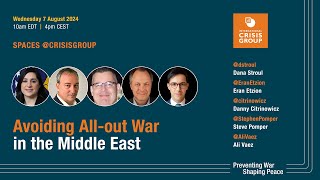
Senior analysts debate how to prevent regional war after Hamas leader Ismail Haniyeh's assassination in Tehran. Iran faces pressure to retaliate, Netanyahu may want to broaden the conflict, and the U.S. has limited diplomatic leverage as the election approaches. A wider war could collapse nuclear negotiations and drag in Hezbollah, Iraqi militias, and other actors.
Chapters
All right, I think we're good to go. Thanks for joining everybody this morning. My name is Steve Pomper. I'm the chief of policy here at International Crisis Group, and today we're going to be talking in this space about avoiding all-out regional war in the Middle East. I'll just say a few words to frame the conversation. I'll introduce our experts, and we'll be off to the races. So I think, folks, if you're on the call, you know that since Since the 7th of October, when Hamas attacked Israel, took hostages, killed about 1,200 people, and Israel responded with a military campaign in Gaza, one of the big concerns for observers of the region, for officials of countries in the region and with stakes in the region, and for groups like us, Crisis Group, a conflict prevention organization, has been a worry not just about the immediate humanitarian implications of the conflict in Gaza, but also the implications for regional stability and the possibility that the conflict would expand into a truly regional war. The contours of that, of that war, of that scenario are already visible. You know, we've seen clashes at the northern— Israel's northern border with Lebanon, with Hezbollah. We've seen tit-for-tat attacks between US troops and Iran-aligned groups in— sorry, US forces and Iran-aligned groups in Syria and Iraq. And of course, we've seen hostilities in, in the Red Sea, where Yemen-based Houthi militants have launched dozens of attacks against commercial shipping. But even so, I think what we've seen in the last week or so, maybe the last few weeks, has been an uptick in those different fronts that makes it seem like we could be on the brink of something that has been successfully contained up to this point. This despite the fact that, as Secretary of State Tony Blinken put it, it appeared that talks to reach a ceasefire at Gaza, at least until recently, were somewhere close to inside the 10-yard line. His words. But rather than sort of closing those 10 yards, what we've seen instead, a Houthi strike in Tel Aviv and Israeli retaliation against the port of Hodeida, a dozen kids killed in the Golan, and Israel attributing that to Hezbollah and taking out a senior Hezbollah official in Beirut. And then, of course, the assassination in Tehran of Ismail Haniyeh, a senior Hamas official, which has now put the region on edge as Iran threatens to retaliate and Israel to respond in kind. So quite a lot happening. To help us understand the stakes, what is indeed happening and what might lie ahead, we have just an amazing panel here. I'm joined by Ali Vaez, Dana Struhl, Eran Etzion, and Danny Citronwitz. So Ali is my colleague at Crisis Group, where he directs the Iran Project and has for years been one of the foremost analysts on Iran's nuclear program and regional policy. Dana is director of research at the Washington Institute for Near East Policy, She served in the Biden administration as Deputy Secretary of Defense for the Middle East. Eran Etzion is a veteran Israeli diplomat and strategist whose career included senior roles in Israel's Foreign Ministry and the National Security Council. And finally, Danny Sitrinowitz is a research fellow at the Institute for National Security Studies in Israel. He previously served in Israel's military intelligence, including as head of its Iran branch. So we really couldn't ask for a better lineup of experts to unpack this moment. I'll pose some opening questions to our participants. And then for those who are listening in, please ping your questions to @CrisisGroup, all one word, and we will do our best after this to put them to our panel. Okay, I'll take a breath and now start with Aaron. Aaron, I'd love to get your sense of what's happening in Israel right now, in particular what you think Prime Minister Netanyahu's calculus was in the sort of closely paired attacks in Beirut and Tehran, taking out two senior leaders of Hezbollah and Hamas respectively. And, you know, basically creating what could be the sort of next step up an escalatory spiral. What's your sense of how Israel might respond if there is an attack from Iran and Hezbollah combined with potentially operations from still other of Iran's partners. What's your feel about what Netanyahu had in mind and what could come next?
All right. Great to be here. Thanks for inviting me and thanks everyone for tuning in. I'm actually near Jerusalem in my home and the short answer to the question of how does it feel or, you know, where is Israel or where are Israelis right now? There's a lot of anxiety and everybody's anxious. Everybody's kind of anticipating the upcoming Iranian Hezbollah, Houthi, whatever stripe. So kind of a strange sense, not unfamiliar by now, but nevertheless not something that you easily get used to. So, um, to your question about Netanyahu's calculus, I'm going to be, um, I don't know, maybe some people would find it somewhat harsh or blunt, but I'm gonna As I always do, I'm going to say exactly what I think. I'm not going to beat around the bush. And to me, it's very clear what Netanyahu's calculus was. His strategy is very clear. He wants to extend and enlarge the scope of the war all the way to a full-fledged regional war with his own particular political personal interest in mind, which is to survive as Israel's Prime Minister. It's as simple and brutal as that. And he knew full well that by authorizing these two acts, even though of course one of them, for one of them, Israel did not take responsibility, but everybody assumes it was executed by Israel, that he knew full well that it would mean, if not total elimination of the possibility of a hostage and ceasefire deal, at least a serious blow to this kind of deal. And that was clearly his intention. If that's not serious enough, I believe that he also was looking and is actively looking into dragging not only Iran but also the US into the regional war. That has been an age-old ambition of his. Of course, he never stated it. You know, he stated it once, for those of you who have good memory or with deep kind of knowledge, way back when in the '80s when he appeared in the US Congress and actually kind of urged the Americans to take over Iraq and depose Saddam, something he said would create enormous positive reverberations throughout the Middle East. So that was the the last known time where he openly called for American involvement in the regional war. From then on, he was more careful, but it was always kind of a secret ambition of his. And now he's very close to actually making it happen. Also, of course, he was interested in the morale boost in Israel. Israelis are, you know, the morale here is low. People are depressed according to various professional scientific studies. On October 8th, some 43% of Israelis were clinically depressed and 33% were clinically PTSD. And the numbers have since declined, but they're still extremely high. So morale is low. Today we commemorate 10 months to the day for a war which is the longest in our history. And everybody realizes that we're not winning. So these are all the reasons that he had. And one very important point that we learned just yesterday And I think is very critical and goes kind of to the core of the severity of the situation here in Israel is a letter that the Attorney General in Israel sent to Netanyahu yesterday, where she basically says that he's an outlaw. Some of you may recall the headline in the New York Times a few days ago, Netanyahu went rogue. This is essentially what his own Attorney General, the Israeli National Attorney General, essentially is saying in writing. And she's kind of detailing a new normal, which is the cabinet is not being convened, due processes are being thrown out the window. Netanyahu is making decisions as if he is a dictator in an undemocratic, non-democratic regime. And she specifically refers to a certain highly secretive decision that she cannot, that she says in writing, she cannot refer more explicitly to, that was taken on a certain date. And this date is the date in which Haniya was taken out. And she says specifically that this action was taken without authority and without due process. So this is where we are. Israel is on the verge of regional war after a decision that was made essentially outside the scope of Israeli law by a rogue prime minister. So that's the first part of your question. To the second part, would Israel react? I'll be consistent here. Netanyahu will continue to look for escalation and he lacks any internal checks and balances. So, you know, absent any other major developments, I think the only real possible check on serious retaliation, which will in turn probably also create an Iranian counter-reaction and so on and so forth, is the American administration that so far has failed or failed to either succeed or even try to actually curtail Netanyahu's escalation strategy. And we know that this time around, as opposed to the last time in April, there is no coordination, synchronization, choreography that the US and others were able to create between essentially Iran, Israel, and others. So this time, all bets are off, essentially. And it's very possible that there will be a much more serious Iranian, Hezbollah, Houthi, Hamas, whatever, coordinated or not between the various actors, but with direct Iranian involvement that will be more serious. And will create a much more serious dilemma for the Israeli government. And I submit that we are headed essentially by a rogue prime minister whose judgment is completely impaired. And it's very difficult to foresee what kind of retaliation he will authorize and who, if at all, from Israel proper will stand against it. And what exactly will the Americans do to prevent kind of this whole situation getting out of control. It's already out of control, but, you know, getting even worse. That's it. Thanks.
Okay, Aaron, thank you very much. I think we're going to go to Ali next to try and give us a little bit about the view from Tehran. So look, the rhetoric, Ali, coming out of the Iranian government has been pretty menacing in terms of the response that they're planning to Ania's killing. And that's, I suppose, at some level, not all that surprising, given that he was killed, you know, in the heart of the Capitol during the inauguration of Iran's new president. But still, it would be helpful if you could, for our benefit, if you could frame for us what it is that, you know, has really set off— if you could really— sorry, just give us one sec. Technical issue here. Um, sorry about that. Um, just if you could, if you just lay out for us a little bit what the, you know, the reason for, for that really strong reaction is, and also how they're thinking about what seems like a bit of a bind for them, because all the analysis that I've read about this up to this point suggests that the war that Aaron was talking about that Netanyahu may want is not necessarily something that the Iranians want. And yet I think there's a feeling, if I understand your own analysis correctly, that they can't, you know, they can't easily shrug off this situation without sending a very strong message to the Israelis, at least in their own minds. So how are they going to thread that needle?
Thank you very much, Steve, for moderating this discussion. And from my part, I want to thank Dana, Danny, and Aaron for joining our discussion today. Look, this— the Iranian very harsh reaction and the fact that the Supreme Leader has already put himself in a rhetorical corner that Iran would have to take action, I think it's because of two main elements. One is that the nature of this attack was highly embarrassing for the Iranians. The place, the fact that it was not just in Tehran, but in one of the most secure compounds of the Revolutionary Guards. The personality who was targeted, not a junior commander officer, but a man who had just met with all of the senior leadership in Iran a few hours before he was killed, Esmail Haniyeh. And also the timing, which was hours after the new Iranian president, President Pesejkiyan, who came to office on the promise of de-escalating tensions between Iran and the West, was inaugurated. And also, it was once again a reminder and exposure of deep vulnerabilities that the Iranian intelligence system has. So, so all of that, of course, is very hard for the Iranians to swallow. But, but at a bigger strategic level, I think it's the question of deterrence. They in April took a major gambit by firing for the first time in the history of Iran-Israel relations, more than 350 drones, missiles towards Israel with the aim of restoring deterrence or getting back to the previous rules of the game, more or less, that dictated Iran-Israel rivalry in the gray zone that they had been fighting over, over the past few decades. I think the thinking in Iran was that they might end up in a darker area of that gray zone conflict, but clearly they have, I think, now come to the conclusion that because that attack was— did not cause significant pain for Israel, especially in terms of damage and casualties, it didn't have the kind of gains that the Iranians had in mind. And in that sense, I think looking back at April, it was probably the beginning of the end. And it wasn't the beginning of the end of this, this dynamic, but the end of the beginning. And we're really in a new phase that could be much more dangerous. Now, in terms of what Iranians are going to do, it's very hard to say. It does appear that timing is dictated by several elements. Nasrallah yesterday teased that making the enemy wait is in and of itself psychological warfare, which is a viewpoint that probably Iranians agree with. As they say, vengeance is more satisfying when exacted sometime after the harm has been inflicted. There, it could be the result of an internal debate in Iran. There is a new government, much more moderate, pragmatic, although the cabinet is not yet in place. So President Pahlavi is basically sitting in these meetings at the Supreme National Security Council presiding over his predecessor's appointees, which is a very bizarre situation. But that might have reduced the efficiency of the system to be able to go through options and make decisions. If indeed this is going to be a multi-frontal retaliation, then there is a need for coordination with regional partners and allies. And given the degree of intelligence vulnerabilities that I mentioned already, I think they have to resort to very traditional means of face-to-face communication, which takes time. And finally, you know, Israel's response after Iran's April 14th attack was a good reminder to Iran of its own defensive vulnerabilities. And there was some news of testing missile defense systems near Esfahan the other day, which might mean that the Iranians are trying to also put their own house in order in anticipation to an Israeli response. And the nature of the response is also, again, hard to say. I feel there are several options here. One is an April Redux, which I don't think is likely because, as I said, I don't think they believe that it delivered the results that they had in mind. Another option is April Plus, which would be a much stronger Iranian response, not as well telegraphed as in April, with the aim of causing more damage and death. And this time, maybe over multiple days, not just one episode. There's also the possibility of April Plus Plus, which would then bring in Hezbollah to help overwhelm Israeli anti-missile defense systems. And then final option is April plus plus plus, which is to bring in everyone, have proxies and partners in Iraq and Syria also fire at US bases so that instead of US having enough bandwidth to shoot down missiles that are flying overhead to basically be forced to defend themselves, the Houthis also coming in targeting ports in Israel and Hezbollah again helping Iranian missiles get through. So all of them, of course, very scary scenarios. And I should say the difference here, I think, between now and April is that 3 elements helped contain tensions in April. One was the fact that the US surged defensive capabilities to Israel. Second was that Iran telegraphed well in advance what it was going to do. And third was that Israel also limited its counterstrike after Iranian retaliation. The first element here is still true. But the latter two options of Iran trying to coordinate in advance seemingly does not exist. And I have a hard time imagining, and I stand to be corrected by our Israeli colleagues, but I have a hard time imagining that if indeed there are casualties in Israel, that Israel will be limiting its counterstrike.
Thanks, Ali. And maybe I'll go to Dana before we go back to one of our Israeli colleagues. But so, Dana, I have to imagine that if if the way that the US government is looking at this, it's probably trying to guide things as closely back to April without any of Ali's pluses as it can manage, but facing some of the challenges that he noted. I wonder if that's your perception of this, and maybe more broadly, you know, what do you think they're trying right now in terms of diplomatic and military moves to, you know, keep this situation from exploding into exactly the sort of full-out regional war scenario that they've been trying to avoid since October? Over to you.
Well, thanks so much for having me. I'm a huge admirer of the work of the Inner Crisis Group, and special thanks to Ali, who coached me through joining my first Twitter Space discussion, which required a lot of coaching. Let me, just to answer that question, start with, where, what the lessons are for administration starting on October 7th and October 8th. So first of all, the president's policy has been, I think, very consistent actually from the beginning, which is he wants to de-escalate and he wants to prevent full-scale regional war. And the team has done that through a combination of diplomacy, both front channel and a lot of private messaging. There's been lots of leaks and disclosures about some of that private messaging, and then using partners across the region to pass messages to Tehran. There's been work to signal willingness to use military force to both stabilize the region and also from a deterrence manner. And you can see that in the very rapid increase in military posture that happened after October 7th, but also what's a very clear narrative in using military force before October 7th in things like exercising, bilaterally with Israel, multilaterally with multiple Arab partners in the region. All of this is actually intended in many ways to signal both to partners and to adversaries a desire to use military forces as a stabilizing effect across the region. And then, of course, part of the post-October 7th— so this increase in military posture, the very clear diplomatic messaging President Biden goes to Israel and of course uses the very famous contraction "don't," which he messages to Iran and then non-state actors. If you're thinking about escalating this conflict, I have one word for you: don't. Okay, so what I want to do is just briefly touch on how the administration's approached different crises within the big crisis since October 7th. So in addition to working to both support Israel's right to defend itself and militarily dismantle Hamas in Gaza, all being quite clear on the need to improve humanitarian access for Palestinian civilians and minimize collateral damage and civilian casualties. There was then Iran-backed militias in Iraq and Syria who escalated against U.S. forces seeking to force tension between the U.S. and Israel and also impose costs on the United States for its support for Israel. And of course, there were over 180 attacks against U.S. forces, ultimately leading, culminating in the death of 3 U.S. soldiers deployed in Jordan, which then leads to a pretty serious escalation in unilateral military strikes against these Iran-backed militias in Iraq and Syria. Point there is that some of what's happened post-October 7th is costs posed directly on the United States, and the approach of the administration was to use presidentially authorized unilateral U.S. military force to address it. Then, of course, we have the crisis coming out of the Houthis in Yemen, which is a group, while explaining its cause as solidarity with and support for Palestinians in Gaza, has essentially managed to reroute international shipping out of the Red Sea area using increasingly sophisticated capabilities. There, the administration selects a multilateral approach. So both in a multi-organized Operation Prosperity Guardian, which is a defensive monitoring and presence mission in the Red Sea to demonstrate that there's international consensus that the Houthis should not get to disrupt freedom of navigation, but then also a separate coalition that's multinational strikes in Yemen intending to degrade Houthi capabilities. And that broadly holds until last month when we saw the Houthis launch a drone all the way into downtown Tel Aviv, which prompts the Israelis to respond with unilateral strikes on the Hodeida port in Yemen. So again, they're not unilateral U.S. strikes, but multinational, and really attempting to show international consensus on that set of issues. And then, of course, we have Lebanon and Hezbollah, and there, largely, this has been one that the Israelis have handled. And fair to say, up until now, in the past couple weeks, that both sides, both on the Israeli side and what we've we've heard from Nasrallah messaging in Hezbollah, is incremental escalation, but general commitment to maintaining action below the threshold of full-scale conventional conflict. And of course, I think at this point in time, that's very much in question. The point of all of this is that there's been different approaches to each of these different subcrises. The risk of where we are now is that all of those different contexts converge. Let me speak a little bit about April. April for the Pentagon black swan event, because up until that point, there had been an assumption that the regime in Tehran would exercise its force and its presence asymmetrically through proxies and militias and not a direct state-on-state attack. So the fact that the regime directed a state-on-state attack and one of such complexity, ballistic missiles, cruise missiles, drones, all at the same time, also that they did, as Ali said, telegraph what they were going to do in advance. And then they actually articulated why they were launching that attack. And it was that if the Israelis continued to target Iranian officials anywhere, they would risk another state-on-state response from Iran. What is notable, I think, about the lessons from April 13th: one, that the Iranians escalated and attempted to move the goalposts for use of military force in the region, that it was a direct attack, that they linked it to Israeli targeting. Of an Iranian official anywhere. Heretofore, there had been a sense that Iranian use of force was proportional, military target to military target, certain facilities to certain facilities. Here you again see the Iranians attempt to move the goalposts for military force. And ultimately, Israel obviously responds by denying Iran the final say in moving those goalposts. So the Israeli attack work response targeted air defense around a nuclear site deep inside Iran in Esfahan, but intentionally avoids collateral damage and civilian casualties. So communication through military force. The other real noteworthy development from that April experience is that Israel's defense was enhanced by multinational security cooperation and that the U.S. played an indispensable role here. So organizing partners, to both share intelligence, share early warning, and collectively defend the sovereign area of the region. I think some of this was viewed and messaged at the time as a pro-Israel defensive coalition. Certainly this helped Israel, but it was also about the region sending a signal to Iran that you will not get to violate our airspace without meeting coordinated action, and also demonstrating that actually the U.S. can organize its partners. Partners and allies to successfully intercept an Iranian conventional attack, which had always been tremendously, I think, invoking fear across the region. Now that the Iranians are again contemplating direct military force, it's worthy that Haniyeh is not an Iranian official. So again, I think there's a question about the movement of goalposts or thresholds for use of military force and what it means for how this administration seeks to promote stability across the Middle East going forward. And finally, I think there's an assumption that now needs to be questioned. Since October 7th until now, I think a lot of the work that the Biden administration has done has rested on the assumption that all actors are calculating their uses of military force to demonstrate willingness to climb up the escalation ladder, but avoid escalation to the full conventional conflict or the full war. I think that's an open question today. And as there's such confusion coming out of so many different locations across the region at once, The administration is probably looking at those lessons learned where unilateral force was effective in Iraq, Syria. Was multinational use of force actually effective in Yemen? Has the support for Israel as it has sought to manage that escalation with Hezbollah been successful to date? But there's open questions about the motives and desires and end states of each of those actors, which again, just makes the situation so ripe for miscalculation.
Thanks, Dana. That's sobering. We're going to go to Danny next, but before we do that, just a reminder, folks should feel free to send their questions to @CrisisGroup, and we'll come to those after we hear from Danny. So, Danny, if I could ask you to share your sense of how Iran and the threat from Iran is viewed within the Israeli security establishment, particularly curious if you think the perception there matches the way in which we heard from Aaron Netanyahu's views were portrayed. Is it close to that level of threat perception in the sense that a war is inevitable or even desirable, or is it more nuanced than that? And a separate question, but what do you think they're cooking up in terms of potential retaliation, you know, in following what seems like it's an inevitable next Iranian strike? Is it going to be similar to the April response, which was a subtle but revealing strike near one of Iran's nuclear facilities, or do you think they too will sort of come up the escalation ladder a bit?
Well, thank you for having me. I can say I'll be more optimistic than the previous speakers. I'll say a couple of things first. I just want to say that we have to highlight the fact that we are as close as we've ever been to a regional war. I think it goes without saying, but this is not the April 14th. And unfortunately, even if we manage to avoid the regional war, the steady state is so problematic. And we just saw yesterday back-and-forth clashes between us and Hezbollah that Even if by miraculous way we manage to dodge the bullet in terms of calming the situation, the steady state is very problematic. So it is important to say that without the ceasefire in Gaza, we'll find ourselves— eventually we'll find ourselves in a war, whether it's going to be in the next couple of days or weeks. It's, I think, the sad truth of the situation. I think that Nasrallah highlighted that in his speech yesterday. Without the ceasefire, we'll continue his activity against Israel, terror activity, because of the fact that at the end of the day, for him, it's like the, the domino theory. He cannot lose Hamas in Gaza Strip. So again, even if like we managed to dodge a bullet, situation is very bad. That's one thing. The other thing is also connected, and I really agree with everything that Ali said about the Iranian calculus. It's a breach of sovereignty, breach of Everything related to the reputation of the Islamic Republic, and they have to retaliate. There are a lot of reports today about what Ignatius wrote regarding the fact that the administration managed to persuade the Iranians not to retaliate in a way. I highly doubt it. They may have, of course, a lot of discussion behind the scenes in terms of calming the situation or limiting, containing the Iranian response. But I don't think, unless something dramatic will happen, something dramatic that will be given to the Iranians that they will forego a retaliation. For them, they climbed the ladder, the Supreme Leader climbed the ladder, and I don't see any other choice than retaliating. Of course, there is the issue of Hezbollah retaliating, and I don't know how they're going to synchronize that, or whether Iran is waiting to see what will happen with Hezbollah, then deciding on its retaliation. That's in general. The problem is, and also connected to the Israeli response, that unlike the April 14th, the Iranians need to shift the gear in terms of not launching attack against secluded military sites, but probably military sites that are close to civilian population. And there, the error is, of course, high in terms of the capability of them hitting civilians. But even if they will hit a military site, I think that Israel will not retaliate in the same manner that it was after the April 14th. It will have to retaliate much harder. I think a lot of criticism in Israel about how Israel reacted last time, criticism for the political system. And I think that it would be very hard to not see Israel raising up its retaliation. I think that the U.S. administration has an important role in pressuring Israel, ending it. Again, a lot will depend on how the Iran attack will occur and whether there are going to be casualties. But assuming it will be large in terms of scope, but even in terms of the targets, then we will have to retaliate. And the administration will have to play a significant role in that regard. But unfortunately, the Iranian response, I think, is not the most problematic one. I think the problematic one is Hezbollah. I think the administration is really focusing on Iran, but Hezbollah has much more capabilities in terms of causing real damage to the State of Israel, whether it's its use of accurate missiles or drones. So I think in that regard, even if Iran will attack and will manage to foil the attack by the help of CENTCOM and other moderate Sunni countries in the region, Well, it will be very hard to foil Hezbollah attack. That is why I think that we're not in the April 14th event because of the Hezbollah aspect. The Houthis are important, but I think their ability to threaten Israel is very limited despite the drone that unfortunately crashed in Tel Aviv. I think the issue is Hezbollah in that regard. So having said that, looking at the Israeli response and also relating to what Defense Minister Gallant said yesterday, today, I think in one of his statements. I think, again, none of the sides really wants war. I think it's also important to say. But we are entering— it's like a tangle. Even if the administration will manage to persuade Iran to have a limited response, then of course, also connected to the Israeli response. Same thing goes to Hezbollah. So I think that it would be very hard to create a situation, especially when there is no closure mechanism. You know, at the end of the day, you ask yourself, who is the element that actually will prevent war? And I'm not sure that there is. Even the administration has its limitations, not only in terms of influencing Iran, but also especially for the Lebanese government, that its ability to influence Hezbollah is none in that regard. So I'm very pessimistic in that regard. And if you're adding the fact that there will be harsh response from Iran, adding with the response from Hezbollah that we have never seen until today in terms of the sheer volume, the length, the use of ammunition. And the fact that Israel will retaliate harder than, or different than it was on the 14th of April after the frontal attack, and with no closure mechanism, I think that it will be very hard to contain the situation. And we are getting to the final stretch of before maybe a regional escalation that might end with a regional war. That is why I think, again, the recession has an important role in deterrence, but also in conveying the messages. But it will take, I won't say a miracle, but it will take very delicate and subtle political steps in order to prevent, after the retaliation, to prevent things from further escalating. And I wish I were more optimistic in that regard, but again, I think we are in a very problematic situation right now. We find ourselves, and adding to what Iran said together with the Iranian policy, and then Australia obligated to retaliate the assassination of al-Shukur. The bottom line is, closer than ever to our original war.
Thanks, Danny. Okay, we have a couple of questions, and but before we get to those, I wanted to invite Laura Rosen, who has, I think, now speaker rights. Laura, did you want to put a question to the group? Okay, another tech— sorry, we'll come back to that in one sec. I'm going to ask a question first to Ali and Dana, then we'll come back to Laura. So here's a question from the Twitter audience. Do you think Iran will be backed by China and Russia if war breaks out between Israel and Iran? I wonder if we could go to Ali first and Dana second to take a crack at that.
It's a good question. I don't think we can put Russia and China in the same basket here in the sense that I think Russia is one of the actors that would actually benefit from further conflagration in the region because it's a distraction from the war in Ukraine. It would result in the increase, increasing the oil prices, energy prices globally, which Russia would benefit from. But all of that is with one caveat, and that caveat is Russia's gains in Syria. As long as those gains are not endangered, and this I think is one of the main topics of discussion that National Security Adviser Shoigu had in his visit to Iran the other day, I think Russia is, is not unhappy with these escalations in tension. And, and let me add that after Israeli retaliation in April, which led to an S-300 battery missile defense system in Isfahan, the Iranians desperately went to the Russians and asked for the S-400 system that the Russians have promised to the Iranians and are yet to deliver. And of course, 4 months later, that hasn't happened yet. And it's very unlikely that it would happen in the coming days and it will be fully operational. And so Iran clearly is quite vulnerable on that front. These, I think overall, because they get about a third of their energy from this region, they do not want a major escalation and they don't share the Russian appetite for chaos here. But there's also a question of how much they can actually do to try to prevent this. And here I'm not very optimistic that they have enough leverage to be able to do what the US can. Which is to extinguish the source of these tensions, as Danny said, which is the war in Gaza. And the only way to do it, of course, is to get much tougher on Israel and maybe even do some of the things that the administration has so far been reluctant to do, including a binding UN Security Council resolution requesting an immediate ceasefire. and for details of, uh, detainee, uh, uh, hostage swaps and, uh, and other, uh, details to be negotiated later on, as well as, um, uh, implementation of that border deal between, um, Hezbollah and, uh, uh, Israel that, uh, Amos Hoystein has been, uh, negotiating over the past, uh, few months. Um, uh, which, uh, again, is, is something that, uh, Iran could also, uh, help with, uh, and would provide it with a face-saving way out. But again, I think the US has much more leverage here to try to contain these tensions if it is willing to use it and pay the political price for it than China or even Russia.
So I'm going to put that question now to Dana about China and Russia and tack on to it a question that just came in, which dovetails with what Ali was just saying, which is, beyond the level of influence that China and Russia might have if things escalate. What do you think influence the United States might still have to try and prevent an escalation? What sources of influence might it have that it's not using right now? Do you agree with Ali that it could be doing quite a lot more, both on the diplomatic front in terms of conditioning arms sales, et cetera, if it were willing to pay the political price for it?
Thanks for that. Let me, okay, let me start with China. So I would, the discussions about China and Russia, Iran and us tend to leave out the rest of the region, who I think very much has a say here. So first of all, for China, in terms of where oil purchases, trade, the exciting part of the Middle East for China is not Iran. It's the region. So for China to unequivocally side with Iran in a conflict where it would either resupply Iran, providing intelligence, et cetera, the whole region is gonna lose out in a full-scale war. The extent of the collateral damage, civilian casualties across the entire Arab world, it wouldn't just be Israel. China benefits from stability and they've largely appeared to be quite content to focus on commercial and economic ties on a backbone of the United States serving as the security guarantor in the region. So it strikes me that it's not really in China's benefit to support Iran in a full-scale regional war. It is, I think, very clear that what the Chinese are attempting to do is at every opportunity to erode U.S. standing in the region, it's taking those opportunities. The U.S., obviously, it's part partners across the Middle East are deeply frustrated with Washington's commitment to Israel's security and its support for Israel's campaign in Gaza. So anything where it can expose the United States as having double standards, for example, the approach to supporting Ukraine in the European theater versus Israel in the Middle East theater, benefits China to strengthen its own position here. Putin just yesterday urged Iran to minimize civilian casualties in any kind of response that it may be contemplating. And I think that's quite interesting, just this idea that, first of all, when we think about Iran and Russia, because of Russian reliance on Iranian weapons for its war in Ukraine, leverage has shifted. There's been reports of the Russians sending in cargo planes full of equipment for Iran. And I think there will be some amount of lip service paid to paint Israel as the aggressor here and the United States supporting Israel. But here, I just— the difference is, I think the Russians have lost some leverage to Iran. The Chinese do not benefit from full-scale regional war. With respect to what the United States could be doing here more, I just want to be very clear. The United— first of all, President Biden has made calls, for example, to King Abdullah. Secretary Blinken has convened the Seven. For those of you who get State Department alerts, there are a lot of phone calls happening, and those phone calls are not designed to get the Iranians to minimize their response. They are to signal to the Iranians— the diplomacy is being used to signal to the Iranians, do not respond. Nobody wants a regional war. So I do not think that the Arab Gulf states are trying to signal to Iran to pick the lesser end of the escalation ladder. Everyone is tired after 10 months of war, and everyone wants to get back to the business of locking in an agreement that ceasefire in Gaza and a real process. So the diplomacy is not to minimize Iranian use of force in this context. It's to get it to stop. And I would guess that the Iranians are not going to receive enthusiastic reception today in Jeddah with this meeting of the Organization of Islamic Cooperation with some sort of statement endorsing a very strong military response across the region. So there's other things that are happening here. This idea that conditioning of arms sales to Israel, there's, I think, a narrative taking hold in parts of Washington, D.C., that if only the United States could exert more leverage on Israel, we could get to this ceasefire. I would really caution us to rigorously question that. It's quite clear that Yahya Sinwar, hiding in the tunnels under Gaza, believes that there are still more for himself and Hamas to benefit from the war continuing as well here. They're negotiating with a terrorist organization. There have been, for example, reports from the Wall Street Journal that Sinwar seems to not care at all about the loss of Palestinian civilian lives in Gaza and thinks it actually benefits his cause in the long term here. So this isn't a situation of two equal stakeholders here negotiating on a ceasefire. And then in terms of— so, and then I would finally say on the conditioning arm sales, I think that more conditioning of arms deals would show such daylight, the risk is such daylight between Israel and the United States, that it actually emboldens adversaries and non-state actors to escalate at that particular moment in time. And so this is the very delicate balance that this administration is walking, is how to ensure that there's not signaling that they're not going to support Israel's defense, but also make clear that the goal is preventing the regional war, is de-escalation, and returning to the really important work of getting hostages still held by Hamas in Gaza released and getting to a ceasefire in Gaza so that the focus can shift to Palestinian civilians.
Thanks, Dana.
Actually, if I could maybe take this back to Aaron and Dani too, I'm interested in— let's start with Aaron— in their perspectives about whether or not there is more that the U.S. could be doing to try and achieve de-escalation using the different sources of leverage it has in the region, taking into account Dana's very fair point that, you know, when you're trying to end a war, you have to have willingness on both sides. And certainly Hamas has at different points in this negotiation been an obstacle to that. But the Israelis have been too at different points, if reporting is to be believed. So I guess the question is whether you think the United States has optimally used its influence or or if there's more that it could be doing. Eran, first to you.
Yes, thanks. First of all, I would say that even though a lot of people are saying it, I disagree with the phrase that none of the actors actually wants a regional war. I actually identify two actors that are interested in a regional war. One, obviously, is Sinwar. The whole October 7th scheme was actually about that, about igniting a regional war. And I would submit that even though we don't have proof yet, I would certainly not rule out the possibility that it was coordinated by Iran, with Hezbollah, with the Houthis, and with others. So the regional war was there from very early on. It's a very clear interest of Sinwar, and that's definitely one actor that is clearly interested in that. And as I said before, I think the other actor is clearly interested in that is Netanyahu. Regarding what the US can and cannot do, again, I'd put it as simply and brutally as I can. Any American president can curtail any Israeli prime minister with one phone call. That's all it takes. All that Biden needs to do, if he really wants to avoid the regional war, is pick up the phone and say the right sentences to Netanyahu, and the regional war the war will be averted. It's as simple as that. I know it's not simple, obviously, but, you know, that's— I want the message to be very clear. And the distance between what the US can do to prevent a regional war and what it has done so far is pretty wide. Now, why is that? I think there are two main explanations. One is I think there is underestimation of the shall we say, the probability and the severity of the scenario, even though admittedly, and it was said many times during this conversation and everybody understands it, that from day one the US tried to do everything or a lot to prevent the occurrence of regional war. For a variety of reasons, we are where we are, and I think all of us agree that we're very close to it. And I think there is an underestimation of how bad and how quickly it can get. And I think that's probably one reason why not more has been done. The second obviously has to do with the political space where the Biden administration has a problem, as I think Dana was alluding to, to pressure Israel. That's true about any administration at any point in time, but certainly this administration 3 months before elections and with everything that went on in the last 10 months. But again, if I was in a position to advise the American administration, I would tell them, guys, go back to the drawing boards, reassess how damaging a regional war would be for the US. And when I, when the scenario I have in mind, and with this, I think I'm relating to some of the things that Danny said. This is not something, you know, people imagine, okay, we have a regional conflagration, it takes a few days, maybe even a couple of weeks, and then it's over. No, no, no, no, no. We might very well be in a situation, we don't have time to elaborate, but I think I can defend that thesis that this is going to go on for months and months, if not more. And then what? And when I say this, I mean, you know, heavy damages to Israel, damages to Iran, obviously a tremendous amount of damage to Lebanon, and in other arenas as well. It can get to nightmare scenarios in Gaza and in the West Bank, the collapse of the PA, and with zealots in the Israeli government seeing this as a historic opportunity to create the second Nakba for the Palestinians and mass deportations from the West Bank to draw them and from Gaza to Egypt. And for some of you, it may sound, you know, nightmarish, maybe implausible. I would submit it is probable. I don't want to quantify it, but I would argue it's in the cards, how bad it can get. Now, you try to convince me that it's not worth the right kind of phone call with the right kind of messages and the right kind of threats from an American president to a rogue Israeli prime minister. And last but not least, I want to say a word about Russia. Here too, I beg to differ with some things that were said. And I'm reminded of the Syrian civil war. I was head of policy planning at the time in the Israeli MFA, and I obviously was in touch with a lot of my counterparts around the world, including in Washington, in London, and elsewhere. Nobody foresaw the genius Russian move that actually brought them Syria as a ripe fruit within, you know, essentially a moment in historical terms and with minimal use of force. It was a strategic opportunity for them that they saw, identified, and grasped, and nobody else understood it. So I would urge everybody to try and assess what kind of strategic opportunities would be open to Russia in a case of a regional war now. and what would they do to seize that opportunity? I have some ideas, but I'll save it for some other time.
Thank you.
Thanks a lot, Danny. I think we're going to give you the last word. If you could, you know, share any reflections you have on this question of US influence and whether it would be better and more usefully exerted, particularly at this fragile moment, that would be great. But also, if I could ask you just to say a few words about the implications of this crisis moment for nuclear diplomacy? I think Secretary Blinken said recently that breakout time is down to a week or two, and obviously that's its own set of issues. So how do we think about nuclear diplomacy against the backdrop of this crisis? Over to you.
Well, I'll say a couple of things. I'll try to be short. As far as regarding nuclear diplomacy, I think I'm going to highlight, I think, what Ali said about the position, and I think that we have to pay close attention to what's happening these days in Iran. Now, like Ali said, the situation for Prizeshkan is very strange. He's head of the cabinet, but the cabinet is not his. So he's still waiting. He has process to make in order to approve his cabinet. But I think that for him, of course, regional war can be a nightmare in terms of its main task, that's reaching some sort of political solution in the nuclear, regarding the Iran nuclear program and then lifting sanctions. That was his main obligation to the Iranian public during his campaign. So I think in that regard, again, Raisi is not Rouhani. He's weaker. He has no cabinet. But I think the fact that he's the head of the SCNS in these troubling times, I think it's important. I'm not saying it, of course, will prevent Iranian retaliation. I think the Supreme Leader obligated to that from day one, bringing the SCNS to his home and declaring everything he needs to declare in that regard. So I really, really think that President Erdogan won't prevent a retaliation. But if push comes to shove and France goes for deterioration, I think the fact that we have President Erdogan as president can be influential in that regard. And also it relates to the nuclear diplomacy in that regard. I think that at the end of the day, we're getting close to decisive moments in terms of the Iranian nuclear program, 2025 in terms of the possibility of snapback. I think there'll be a lot of discussion whether they're going to be reaching a deal or maybe at the end of the day employing the snapback. And I think those decisions will be monumental for the future of Iran nuclear program. So in that regard, I think that, again, we have a mountain to climb in terms of our own problems right now. But I think this is something that also needs to pay attention because at the end of the day, after the presidential election in the U.S., that there will be another big try in order to return back to some sort of political solution on nuclear side. No JCPOA, of course, but something else in that regard. And I think that for Przesiecki, it is the most important thing right now, and any escalation can harm his ability to reach that. And I think he understands that. That is why you need to pay attention to him, to Zarif, and how they are trying to challenge the IRGC, the army, the Hashdesh, in terms of escalation with Israel. That is one. The second thing related to the possibility of the US pressure on Israel, I think at the end of the day, like I mentioned, the key is ceasefire in Gaza. It's also the moral obligation of the State of Israel to return back the hostages. But I think even more than that, if we don't want to find ourselves in a war of attrition with the Axis, a war that I don't think we're able to win, we need to reach that— already said yesterday that the Axis will stop if there'll be a ceasefire in Gaza. Maybe it will allow Austin to implement his understanding regarding pushing back Hezbollah from the Israeli border. And maybe it will allow us to return back the people living up north to their homes. I think those are crucial. And then from there on, I think it will be able to a little bit stabilize the situation. But besides that, nothing will happen. And if, like I mentioned yesterday, previously, if you're going to avoid, even if you're going to avoid escalation right now, at the end of the day, we find ourselves in a regional war with no ceasefire in Gaza. So the key is ceasefire in Gaza, and the administration needs to do the utmost in order to pressure the parties, whether it's Hamas through Qatar, whether Israel, in order to reach that goal. The main problem is that we know the administration is in the final stretch of its term. We are entering the, of course, the election campaign from Republicans and Democrats, and I think it would be very very hard for the administration, even President Biden, to take, let's say, harsh decision in terms of relations with Israel during this campaign. And I'm hoping that unlike what people said in Israel, that Netanyahu is not capitalizing on that. Because if he is, I think it will have enormous effect for the relations, not only today but also for the future. Of course, the key is Netanyahu, like Ron mentioned, and I think that Everything in the administration's power in order to pressure Netanyahu to change his policy, I think, would be crucial. Because if Netanyahu will agree to that ceasefire proposal, the cabinet will approve it. And if not, then the cabinet won't have any say in that regard. So everything depends on him, if we like it or we don't. And the administration, despite the fact that they don't want to take dramatic decisions in terms of pressuring Israel, I think that Without doing something out of the ordinary, I don't see, unfortunately, any change in that regard, and we'll find ourselves in a regional war in the end. But push comes to shove, first and foremost, let's, I hope that we'll be able to dodge the bullet in terms of the current escalation right now. We're entering, like Eran said, we're entering a very, very sensitive era now in a period in Israel. Besides the fact that nobody knows what will happen, I think it's safe to say that we are into escalation that we haven't seen even since October 8th or 7th in that regard. And nobody knows how things will develop, unfortunately. And I think that the administration in that regard needs to be 24/7 dealing with that in terms of transferring the right messages to Iran. By the way, not only threat messages, but maybe something in terms of Pesechian or other elements, or Zarif, that will ensure them some sort of negotiation or more bright future in terms of the relations. So they will maybe can be used that in order to depressurize the situation between Iran and Israel. That is one. And second, of course, is the issue, hopefully, that operationally there will be an ability to foil the attack that happened on April 14th. And I think that maybe will allow Israel to decrease the response. Again, I think it will be a response that will be harsher than the 14th or after the 14th. But hopefully not more than that. And besides that, we have the mounting problem of Hezbollah. And there I feel that even if we were to contain the Iranian event, Hezbollah is a different situation, much more dangerous in that regard, given Hezbollah's ability to harm Israel. And here is again, I'm not that optimistic. And the next couple of days would be crucial in terms of our ability to avoid regional Thanks, Danny.
I actually, I'm going to extend this a little bit longer because I see that Dana and Ali both want to weigh in on this nuclear diplomacy question. So first Dana, then Ali, then we'll wrap this up. And apologies to those if I didn't, whose questions I didn't get to, but we are sort of at the limit of time. Okay, over to you, Dana, for a quick two-finger on the nuclear diplomacy issue.
Thanks so much. I feel compelled to offer the pessimist's perspective, especially because if you've worked in any Ministry of Defense or Department of Defense, you have to be prepared for the worst-case scenario. So one of the biggest risks here, I think, especially when you look at the April 13th response, is that the Iranians decided to launch a direct attack on Israel. And until April 13th, there was tremendous concern. One of the reasons to not go to war with Iran or launch a preemptive strike is because of the great expansion of its missile arsenal and attack drone capability. And we've seen just how destructive those drones can be in the manner that Russia has employed them in Ukraine. So the biggest risk, I think, if you're a leader sitting in Tehran and you look at how easily the United States and Israel were able to assemble a multinational coalition to intercept and defeat the majority of that attack, is that you need some kind of insurance policy. And all U.S. officials now talk about Iran being within only a 1 or 2 week decision space to decide to go to cross the nuclear threshold. So we lost visibility, we lost any constraints, we lost IAEA access during the withdrawal, the U.S. unilateral withdrawal from the Iran nuclear agreement. And one decision could get them very close to having that nuclear weapon, at which case so many response options are taken off the table. For the United States, for Israel, and for the world. So there's a lot of casual talk right now in Washington, D.C. about contemplating a preemptive strike now in order to forestall some sort of Iranian counter-response to Israeli actions over the past couple weeks. And I think that very much discounts what that would likely prompt Iranian senior leaders to do in terms of their nuclear weapons program, because that is the way to ensure that other actors no longer attack you. Number 2, the lesson of April 13th is that Israel cannot defend itself by itself any longer. Israel was able to engage the cruise missiles and the ballistic missiles because the United States and other partners took on the drones. Israel needs the United States, and its security is significantly enhanced by cooperating and operationally integrating with Arab partners across the region. The longer the Gaza war goes on, the more frustrated and reticent these partners are going to be to support collective defense that includes Israel. And finally, a core element of Israel's security for many decades now has been that Israel is a bipartisan issue here in the United States. One of the most, and should be, very terrifying element for the Israeli people and Israeli decision makers is that Israel is now a political wedge issue in the U.S. election. Regardless of who wins the U.S. election, the fact that security assistance to Israel, weapon sales to Israel, military transfers, whether or not the United States should be increasing its military posture to support Israel are issues of open public partisan debate is not in Israel's interest. The idea, and I would finally note, I think it's quite clear that President Biden is getting very frustrated with Prime Minister Netanyahu. Now, leaders can have tensions and leaders can disagree. So far, this administration's consistent policy has been to support Israel's ability to exist, and it's going to continue to do that. Like we heard from Aaron earlier, I think the decisions of Prime Minister Netanyahu and the fact that much of Israeli society seems to be no longer supportive of his policies is a huge issue for Israel, but the longer Israel appears to directly contradict or have tension with the United States, and I should also note here, there are over 30,000 U.S. in the region. Those forces are being targeted in Iraq and Syria by Iran-backed militias. Israel has an interest in making sure that U.S. forces are able to stay in the region to do the critical work that we're doing. It's important that this relationship remains solid, and the longer we go on in this high risk of miscalculation, the greater the risk is for everything the United States is able to do in the Middle East, and it opens space for others like China and Russia. Thanks.
Okay, thank you very much, Dana. And Ali, we're going to give you the last word.
Thank you.
Just in the spirit of crisis group work, let me just end with another very cynical note of doom and gloom, which is that one has to really consider in terms of planning the next steps and what comes in terms of Iranian response and risk of further escalation, how it will impact Iran's nuclear doctrine. Already there is a lot of skepticism in Iran about the ability to get effective and sustainable sanctions relief, about the reliability of the United States as a negotiating partner— not just the Trump administration, but even a Democratic administration. And if you add to that any effect of this tit-for-tat between Iran and Israel and their respective allies that would diminish Iran's regional deterrence and a heightened threat perception by the Iranians as a result of it, it makes for a really dangerous mix that could push the Iranians to weaponize their capacity. And so in that sense, I think the more Prime Minister Netanyahu succeeds in weakening and diminishing Iran's regional deterrence, or he fails on the nuclear side.
Okay. That is a, as you say, an appropriately grim note to end this conversation on. I just want to say thank you, Aaron, Ali Vaez, Dana Goldstein, and Danny Goldstein, for a really incisive, if sobering, conversation. Thanks for giving us your time this morning. And to all of our guests on this Twitter Space, or X Space, I guess it's now called, thanks to you as well. Please do follow our experts and look to Crisis Group's Iran Project for the cutting edge of analysis in this difficult moment. Thank you so much.
Thank you.
More from Ali







Israel and the U.S. at war with Iran: what comes next & what implications for the region and beyond?



Trump ‘Is Living in a Fantasy Version of His Own Presidency’ | The Ezra Klein Show
