How Sanctions Work: Iran and the Impact of Economic Warfare
Economists and social scientists who studied U.S. sanctions on Iran argue they've devastated the middle class and doubled poverty, yet failed to stop Iran's nuclear program or regional expansion. The authors call for credible relief mechanisms and treating sanctions as a calibrated tool, not a default one.
Chapters
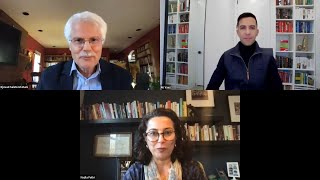
Hello everyone, welcome. My name is Kambiz Ranavardi, Treasurer for Columbia DC and a graduate of the School of Engineering and Applied Science. First, I would like to thank our partners for this evening, Harvard Club of Washington DC and their members for joining us. We have a very exciting talk about How Sanctions Work: Iran and the Impact of Economic Warfare, which is the title of the most recent and exciting book by Professor Javad Salehi-Esfahani and Professor Ali Vaez on the issue of sanctions, and particularly the case study on Iran. And this would be in a conversation with Nazila Fathi, author and former NYT correspondent. I would just say quick housekeeping. We would record this event. I would share the link within the 24 hours of the event, and I would encourage everyone to check our website for the full bio of our panelists. But for a quick introduction, Jawad Saleh Isfahani received his PhD in economics from Harvard He has taught at the University of Pennsylvania and Virginia Tech, where he is currently professor of economics. He is a research affiliate at the Middle East Initiative at Harvard's Belfer Center and also a research fellow at the Economic Research Forum in Cairo. His current research is on economic inequality and economics of the family in the Middle East. Ali Vaez is Crisis Group's Iran Project Director and Senior Advisor to the President. He led Crisis Group's effort in helping to bridge the gaps between involved countries that led to the landmark JCPOA in 2015. Previously served as a Senior Political Affairs Officer at the UN's Department of Political and Peace Building Affairs and was Iran's project director at the Federation of American Scientists. He's an adjunct professor at Georgetown University's Edmund A. Walsh School of Foreign Service and also a fellow at the Foreign Policy Institute of the Johns Hopkins School of Advanced International Studies. And our host, Nazila Fathi, is a journalist and commentator on Iran, And also the author of The Lonely War: One Woman's Account of the Struggle for Modern Iran. She reported out of Iran for New York Times for nearly two decades until, due to government crackdown and threats, forced to leave the country in 2009. Among many awards she has received, a name, a Roald Wallenberg Fellowship, at Lund University, Nieman Fellowship for Journalism at Harvard, Shorenstein Fellowship at Harvard Kennedy School, and an association at Harvard's Belfer Center. Without further ado, Nazila, sending it to you.
Kambiz, thank you. Ali Javad, welcome. Thank you so much for spending this evening with us. The book is amazing, impressive. I want to start, Ali, with you. There's a part in the book that talks about the methodology that used in this book. Can you elaborate?
Thank you very much, Nazila, for moderating, and thank you, Combees, for the invitation. It's great to be here. Of course, we miss the other two co-authors of this book, Professor Naguib Bajjohli and Professor Badi Nasser. The story of the book is that in 2019, at the peak of the Trump administration's maximum pressure policy, I was very frustrated by the fact that in conversations with US policymakers or in the general debate about US policy towards Iran, I couldn't see anything that was really substantive in terms of looking at the impact that the sanctions were having on Iran. And of course, sanctions have been a key feature of US policy towards Iran for decades. But in 2019, at the pinnacle of maximum pressure, of course, this was really the talk of the town. But mostly people would focus on superficial criteria like foreign currency exchange rate or inflation rate and unemployment rate. Which was really scratching the surface in terms of impact of sanctions. And I couldn't find anything comprehensive, neither on Iran nor on, by the way, any other country that had been the target of US or multilateral or international sanctions. And so I had a conversation with Javad and Vali at the time was the Dean of SAIS Johns Hopkins and Narges was and is a professor there. So We took the project to size and we gathered a team of economists and social scientists to start, each of them looking at one aspect of the impact of sanctions on Iran. I believe we had around 6 economists looking at macroeconomic impacts, microeconomic impacts, how this impacts social welfare in Iran. And so on, and also social scientists who looked at the impact on Iranian society, on culture, on the medical sector in Iran, even on environmental implications of sanctions. And we produced these reports under the rubric of Iran Under Sanctions at SAIS Johns Hopkins under Rethinking Iran. And once the reports were finalized and they were publicly available, we thought to ourselves that this is great. It's really adding a lot of nuance and depth, but it's still not putting it all together and is not painting a big picture. And so we decided to bring it together as part of the book, which you now have in front of yourself.
Well, it's very interesting. Javad, if at any point you want to step in and have comments, please do. I would like to keep this conversation and avoid giving you a long time to talk about it, but I'm really curious what led you to get involved in this book. You have written about Iran's economy since, I don't know, I can remember since at least the late 1990s. Why now? Why this book?
Well, that's a very good question. You know, I think the first article I wrote on sanctions goes back 2010 when I was visiting Harvard, and it was in the context of Iranian youth, which was the topic I had worked on before. And I described there then how sanctions are most likely to affect the youth because their behavior when you are in college, even before that in high school, is to prepare for a future. So what you think is going to happen in the future affects your decisions now, and therefore your decision now affects what happens in the future. So it has long-term consequences. And I am sad that I proved right. I speculated that young people will have difficulty getting set up in having jobs, being able to get married, buy houses, and that was going to eliminate hope, eliminate hope for the future. When you are young— I was young, everybody, all of us have been young at some point— if you look back at that time, what really kept us going was hope that if we do X, Y, and Z, study, work hard, and choose the right topic, that in 10, 20 years we'll be better off. And sanctions have made those kinds of dreams very difficult for young people. And just like Ali said, we were reading a lot about sanctions. It was oftentimes focused on small things and sometimes on big things like devaluation, but they interpreted it the wrong way, you know, devaluation is a sign of an incoming economic shock, but it's actually a good response to it. It's the correct response to devalue your currency so you can economize on imports and maybe even produce more for exports. And some of these websites in Washington were using devaluations as signs of economic collapse, which was not correct. And there were other artificial metrics like how much cash the government had. I remember an article that said Iran has only $4 billion left in the bank, which turned out not to be true. But even then, these are small events relative to the bigger impact of sanctions reducing the size of the middle class, impoverishing the lower middle class, and things like that. We thought a book could have a bigger impact than individual articles. In fact, the articles we wrote were comprehensive, the ones for Rethinking Iran. But having a book at least gives you excuse to have a book talk like these where we can look at various topics. And I'm hoping that the narrative will be changed a little bit as a result of doing this interdisciplinary work, looking at sanctions not just from the economic point of view, but looking at anthropological approach, like what happens to people. We have anecdotes from some 80 people that I guess contacted and they bring to life the metrics that we have, like rising poverty rates or the smaller size of the middle class. And also, you know, we had Ali Vaez, who is a specialist in the nuclear aspects of sanctions as well as the international politics of it. Vali Nasr understands sociology of the Middle East, political science. I think the book is much better than a dozen articles that we had before in terms of putting the story together. And we can talk a little bit more about what we learned from the book, but there it is. I think the motivation was to affect the narrative.
So We have 4 distinguished authors looking at sanctions on Iran from various perspectives, a very comprehensive look. You mentioned youth being impacted by the sanctions. Iran has been under some kind of sanctions since the 1979 revolution. That's more than 40 years ago. And the sanctions were supposed to force Iran to change its behavior. And now you're saying that the impact has been mostly on the youth. Ajabat, can you delve a little bit deeper into that? What does that mean?
Yeah, certainly. But let me first preface my remarks by saying, when we say sanctions, we don't distinguish between different kinds of sanctions. I'd like to make a distinction between comprehensive sanctions, which is really what the book is about. And specific sanctions, targeted sanctions, sometimes targeting a specific industry, sometimes targeting specific individuals. The difference between the two is very significant. In fact, when you look at Iran's economy, you're correct, Iran has been under sanctions since 1979. But for most of that period, it has been these specific sanctions. Which do not have this sense of collective punishment, right? So collective punishment is what's wrong with war and is what's wrong with comprehensive sanctions. Specific targeted sanctions exclude ordinary people who perhaps have nothing to do with the dispute between Iran and the US. And the other characteristic of those targeted sanctions is that they're easier to remove. As our book argues, comprehensive sanctions are difficult to remove, and it has been an obstacle in getting Iran to change its behavior because they don't really have much hope of sanctions disappearing if they do things differently.
So, Ali, have sanctions been enforced against any other country for such a long time, and have they worked?
So, some people have told us that maybe a better title for the book would have been, instead of saying how sanctions work, do sanctions work? And the reality is that the book really tries to delve deep in answering that question, because depending on what you mean by effectiveness of sanctions, you can come up with different answers. Of course, sanctions have an effect, but especially an economic impact that Javad can talk about. But are they effective in advancing US policy objectives? And there, I think the answer is mixed and mostly leaning towards negative. As you know, Nazila, there are other countries that have been target of US sanctions for a long time, like Cuba, for instance. And of course, Cuba remains as much of a thorn in the US's side as as has been the case for decades. And so Iran is not unique in the sense that the US has not been able to achieve its policy objectives. But in the case of Iran, you have two criteria that I think are different. Number one is just the sheer quantity and quality of sanctions. Iran, until Russia invaded Ukraine, was the most sanctioned country in the world. And even today, by some measure, Iran is the most sanctioned country in the world because despite all the designations against Russia, and a lot of it is designations against individuals and entities, Russia is still primarily targeted by primary sanctions and not secondary sanctions. Secondary sanctions are so much more toxic. Secondary sanctions are basically measures that the US puts in place by regulating its own market. Basically saying to companies, you have a choice, either you do business with Iran or you do business with the United States. And given the size of US economy and the dominance of US dollar, it's a very clear and easy choice for a lot of countries and companies. We still don't have a lot of secondary sanctions on Russia, despite the fact that Russia has invaded a neighboring country, something that Iran has not done for nearly 400 years. But so Iran remains one of the most sanctioned countries in the world, and the quality of sanctions against Iran, I would say, are incomparable almost to any other country. The second difference, if you look at a country like Cuba, for instance, or Venezuela or Syria, and this puts Iran in the same category as North Korea, is that as a result of sanctions, in fact, the threats that Iran opposes the US interest or interest of US allies in the region, not only has not diminished, it has been augmented over the years. So take the nuclear program, for instance. When the US started imposing sanctions on Iran, Iran had 164 centrifuges in the mid-2000s, when you were doing fantastic reporting on this. Today, the US has way more sanctions on Iran than it did in the 2000s, but Iran is so much closer to the verge of nuclear weapons. It is literally a threshold nuclear weapons state. If you look at Iran's support for its partners and proxies in the region, in the 1980s, when the US started imposing sanctions because of Iran's support of terrorism, Iran only had one key regional ally, which was Hezbollah. Today, Iran has a network of at least a dozen of these non-state actors around the region with the ability to project power all the way from the Indian Ocean to the Mediterranean through the Red Sea. And you see how Iran has been able to activate this network since October 7th. If you look at the human rights situation in Iran, obviously the regime has become much more aggressive at home despite all of the sanctions that have been imposed. Same applies to Iran's missile program, which not only has— today Iran has the most advanced and sophisticated arsenal of ballistic missiles in the region, it is proliferating missiles and drones to state and non-state actors around the world. So by every measure, the threats that Iran poses to US interests, or the reasons for which the US imposed sanctions on Iran, have gone from bad to worse. And in that sense, I think Iran is kind of in a category of its own in terms of demonstrating how sanctions not only fail to deliver on US policy objectives, but to a large extent are counterproductive.
So the sanctions were supposed to stop Iran from going into the direction that you just explained, and it has achieved exactly the opposite purpose. I mean, when you think about it, sanctions are supposed to have this deterrent role. So the countries are threatened by sanctions so that they wouldn't want to be sanctioned. Javad, do you think Iran would've acted differently under a different scenario if Iran had engagement with the outside, economic engagement with the outside world? If it saw the benefits of a much better revenue flow instead of being under tight economic sanctions for over 4 decades and learning how to cope with them?
That's a good question, but also a very difficult question because it involves a counterfactual. What would have happened? Is anybody's guess. We do know from having examined the data, detailed data that's available in the case of Iran, of what has happened to people's living standards, not just average person, but also people in the middle class, in the lower middle class, and the poor. And there is no question that there's been the harshest Impact is on the poor. Poverty rates have doubled. There are 4 million more people poor today than they were before sanctions. And then there's the exit from the ranks of the middle class. The middle class in Iran has had a moderating role on politics. Now, one might argue that Iranian leaders have their mindset in having military strength. They have their allies in the region. They oppose Israel. And those objectives have not changed. But the brief history of the Islamic Republic shows that they're also very pragmatic, that depending on what they feel is the political situation inside the country, they behave differently. So with the same objectives, they may have behaved in a more moderate way had the middle class had been increasing all these years. I take your attention back to 2013, when just after a few years after big demonstrations that were heavily repressed, In 2009, following the controversial reelection of Ahmadinejad, Iran behaved in a very pragmatic, moderate way, allowed a moderate president, Rouhani, to be elected, and then allowed him to negotiate and sign into the JCPOA in 2015, which was in effect for 2 years. And in those two years, Iran's economy grew by 20%. And a lot of that came as benefits to the middle class and to the poor.
And that is much, that's much higher than like the average economic growth anywhere else in the world, right?
Yes. But of course, it is nothing to be terribly proud of because when the economy is repressed, And you let it go, it grows just by itself, right? Most of the time I think of the Iranian economy as this jack-in-the-box where it's kept low by force. In normal economic development, we need force to make the economies grow. But in the case of Iran, it is repressed. As soon as there is some more oil money available or even the government changes its behavior, And people rush out to invest, to make improvements in their homes, and so on. So, to go back to your question, Iranians probably would have put more pressure on the government to allow better elections after 2017. Well, it's very important, by the way, 2017, Rouhani was reelected with a bigger margin. Areas of Tehran that are known as middle class, upper middle class, they increased their vote for Rouhani tremendously. In Shemiran, which is the richest part of Tehran, Rouhani had 49% of the vote in 2013. His share of votes in 2017 was 79%. So there was a momentum of hopes and aspirations of the middle class that could have continued. When Trump left the deal in 2018, just a year after this Rouhani victory, it dealt a huge blow to that process of moderation and modernization and economic growth. And then, in a way, all bets are off after that. And the regime decided that the avenue of rapprochement with Europe, with the West, wasn't really going to happen. It had its pitfalls. It felt it had— the conservatives felt they had been deceived by the moderates. Jawad Zarif came under a lot of pressure for not having been careful enough or having lied to the conservatives about what was going on in the negotiations in Vienna. All that proved false because now that the facts are out, Iranians did negotiate a good agreement. The agreement had just one big flaw, and that was Trump. That could not have been predicted. So, you know, I tell people that Iran would've been quite different had Trump not withdrawn from the JCPOA. Perhaps the same pragmatic forces that allowed Zarif and Rouhani to negotiate JCPOA would have allowed it to do more. You know, there was a lot of tolerance of private foreign investment in Iran. Tehran was buzzing with foreign investors. They had built an international hotel that had a direct link to the airport on the other side of the highway. So they didn't have to come to Tehran really. They could just come to the airport, go to a hotel and exit. A lot of things were happening and all that ended in 2018, in May 2018. So yes, the short answer is that, although I don't have proof, is that Iran would have been a more moderate country now because its politics is— Iran is not North Korea. There is politics inside. There's give and take, you know, actions and reactions. So if you look at Iran in that way and you understand its politics, I don't claim to know that, but I do believe there is pragmatism. The country wants to move forward, and nobody in Iran, including the leadership, looks to North Korea as a model for where Iran should go.
That's interesting. I want to read a few lines from the book because it just resonates with what you said. Maximum pressure and comprehensive US sanctions in general have resulted in political hardening and increased military control over political culture. And worst of all, they have done so while suffocating the voices for engagement and change. So I mean, you have both argued that the sanctions have failed to change the Islamic Republic's behavior and policies. You also argued that it has sort of silenced voices for democratic change. Ali, I wanna ask you about this, especially because of the violent crackdown that occurred in Iran in 2018 and again last year. What do you think of this?
Very good question, Nazila. Look, the reality is, of course, dynamics in Iran are complicated, and we in the book, we're not trying to reduce developments in Iran to just the impact of sanctions. Everything that is happening in Iran is multifactorial. Sanctions play a role, but they're not the only factor. Yet it's really important to understand the impact that they're having on the Iranian society. The logic that the Obama administration was pursuing in 2015 when it finalized the nuclear deal with Iran was that at that time, the middle class in Iran, despite years of sanctions and corruption and mismanagement, was about 65% of the society. And of course, the Iranian middle class, for anybody who's been in touch with them or know them, is extremely open-minded, pragmatic, likes to be connected to the outside world, and even to a large extent, pro-Western, a force of moderation, a force of agents of change, if we want to be honest. And so the logic was that 10 years of economic growth under disagreement, even if it's around 5% yearly, would grow that middle class to around 85% around now, around 10 years from this time that the agreement was signed. And this coincides with the time that the ruling elites, the Jacobins of the 1979 revolution, who are in their 70s and 80s, would be dying out by the force of nature. and the country would be overall in a better place to transition to something better. Now, this was, not necessarily an exact science, but the general trajectory of travel, that, the administration at the time was thinking about. Now, look at what the Trump administration did. It completely reversed these dynamics. It pushed huge swaths of Iranian society under the poverty line. Now, 1 in every 3 Iranians is under the poverty line. Again, Javad can give you the economic data much better than I can. Without any doubt, the middle class has suffered tremendously. A lot of bright young Iranians are continuing to leave the country. And in the process, the elements of the Islamic Republic were best connected and best placed who benefit from sanctions, the so-called merchants of sanctions in Iran, those who control the black market, the smuggling networks, launder money, given the lack of transparency that comes when this country is under sanctions. Those people who are usually the most hard men in the Islamic Republic, the ones who have guns, have been empowered and enriched. And this, I think, overall does not put the country on a better footing to transition to anything better. In fact, it might result in transitioning to something worse, a military dictatorship over an impoverished population, quite similar to what we have in other countries like Egypt, for instance. So that's one element that one has to take into account. Now, of course, the Islamic Republic has always been repressive. With or without sanctions. But when a country is under sanction, there is also an element of securitization that comes as part of this package. The US has to securitize Iran, has to vilify Iran, has to demonize Iran and turn it into a pariah state in order for sanctions to become more effective, to create a chilling effect around sanctions. That in turn deepens the regime's threat perception because they see this policy not aimed at behavior change, but aimed at regime change. And that basically pushed the regime to become even more repressive at home because even normal grievances of the population that are completely legitimate because of economic discontent, for instance, are seen as part of the broader package of US policy aimed at undermining the regime. And so the Islamic Republic becomes even more aggressive and repressive at home. As we saw, for instance, in 2019, in a matter of a few days, they cracked down when there was an economic-related uprising. And the numbers of fatalities ranges between 300 to 1,500 in just a matter of a few days. And so this is also something that one has to take into account. People have this, I would argue, simplistic and even naive expectation that a bad country, a bad regime, you put sanctions on them and they turn into a democracy. That example, I would argue, does not exist anywhere in the world. You often hear people talking about South Africa, but South Africa is really a unique case in the sense that in South Africa you had a ruling elite who had realized that it was at a dead end and was seeking a way out, an exit ramp. And that exit ramp was provided in the form of an opposition with a positive vision for the future of the country in the form of Nelson Mandela. Who has no equivalence in Iran today, unfortunately. And South Africa was completely dependent on the West for its economic functioning, and therefore the West had a lot of leverage to put pressure on South Africa. As a result of sanctions over many decades now, Iran has shifted its economy towards the East, is no longer dependent on the West, the West has overused and exhausted its sanctions leverage. And so we're not really in a similar situation to South Africa. And Jacob often makes this really good point that the South African population also at large agreed with the logic of sanctions. Whereas in the case of Iran, I think it's a much more mixed picture of those who are so frustrated with the regime who might want more sanctions, especially those who are sitting outside of Iran and are not affected by it on a daily basis. But a lot of people also see the US's fault, for instance, in reneging on its obligations under the nuclear deal and exiting from the agreement when it was completely unwarranted and Iran was in full compliance with its obligations. So again, to go back to the main theme of the book, It really boils down to the fact that none of these questions have easy answers. It's complicated, and I hope people would read the book and will come to the same conclusion.
I do hope that people read the book. I just want to add to something that you said, that the protests, even though the protests have become bigger, the regime has become more violent too. And like every time it's been faced with a protest, political, social, economic, no no matter what, it has gone to extreme lengths to use violence and end the protest. So here we go. I mean, even if the sanctions were aimed at bringing people to the streets and like forcing some kind of change, that has failed too. Javad, I want to go back to your economic evaluation. Do you think Iran can recover from these sanctions if they are lifted? What does it take for Iran to recover from this scale of economic pressure?
It would take a while. The most important thing to notice is that Loss of oil revenues is one thing. Oil revenues are about half of exports and maybe about half of government revenues. So when they disappear or when they shrink, there is no way that you're going to avoid an economic decline. And that has happened and the decline has found its way to the budgets of average households average Iranian household is at the level of living standard they were 20 years ago. But Iran has found a way to increase its oil revenues, and it has apparently, I read in the press, it has a way of getting more money or sending more oil out by fine-tuning its responses to the nuclear watchdog IAEA. And that could probably continue into the future because the US doesn't have an easy way to stop Iran from enriching uranium beyond 60%. So it will negotiate with it. You know, the Korean money will go to Qatar and you could use it this way, that way. Or maybe they look the other way when Chinese buy oil from Iran. The one thing that is hurting Iran in the long term is the financial sanctions. They're very different from oil sanctions, and the government has no easy way of getting around those. What financial sanctions do is prevent Iran from finding its way out of this recession. Iran has been good in allowing the currency to depreciate, as I mentioned earlier. It's the right response. What that does is let Iranian wages in dollar terms to go down quite a bit. Iranian workers outside Iran are cheaper now than the Chinese workers. So if they can equalize technology, they should be able to beat China in Iran's neighborhood, at least, you know, Turkmenistan, Afghanistan, Iraq, maybe even Turkey. The reason why they cannot do that is because of financial sanctions. If somebody buys something in Turkmenistan from a small producer in Iran, they would have no way of sending them the money. Small producers cannot send someone in a jet plane to collect gold and/or suitcases of dollars to bring back the way large enterprises in Iran like IRGC does. They sell oil on the open seas, and they bring gold or actual dollar notes to Iran. This is the only way Iran has found to get around the financial sanctions. The other is the age-old barter, where you go to Sri Lanka and you say, you know, here's oil, what do you have? Oh, okay, tea, we need tea, they bring tea. They do a lot of that with China, but we don't know of any country that has gotten into a path of sustained growth doing barter with a number of countries. You need to allow small producers, by small producers meaning those who employ maybe 10 to 50 workers. They don't have the means to set up international trading institutions. If you want Iran to get around financial sanctions, you need another bloc composed of countries that can buy oil and sell commodities that Iran needs. That bloc is still in the making. There is some very weak good news, like Iran joining BRICS. I'm optimistic that if US overuses its sanctions, it will persuade these other countries to find a kind of a trading area. And maybe even a currency will emerge in that trading bloc that will do what the dollar does. Until that happens, it's very hard to imagine Iran growing from its 3-4% per year. To 7-8%, that it has grown in the past under the Islamic Republic in the 2000s, a bit of help from oil market, Iran was growing at 9% per year. And that's what you need given the youth bulge that has now entered in their 30s. And they're still kind of not having decent jobs. They're doing work here and there. So employment grows, but Iran is not able to create good jobs for the children of the revolution, the ones who were born in the 1980s. And that requires the classic arrangements for international trade. Again, I emphasize, no country has been able to develop in the last 100 years without international trade. So I hope Iranians will understand that selling oil on the open seas and bringing the cash back to the country is not getting around the sanctions. It is allowing a small producer to freely export what they want and bring the money back to the country.
Well, this is a great segue to one of the questions that we got in the audience. So the question is whether UN sanctions, whether the sanctions on oil and gas are UN sanctions or sanctions imposed by the United States, and also which countries are respecting these sanctions. So you, you pointed to a group of countries that are helping Iran sell its oil, and also the financial sanctions that have been very devastating. So can you answer this question and elaborate on that?
Sure, I'll try. Ali can help me with a lot of the details.
Ali, please step in.
First of all, no country can fully defy the United States. Even China is in some kind of agreement with the US that it can Iranian oil. In any case, they are in dispute. So this is a good time for Iran to sell some oil to China while the Chinese are confronting US on multiple fronts. But in principle, China's economy depends very much on trade with the United States. Its companies are integrated. And this is going to be the case for several years until US and China have a fallout and then China would bear no cost if it defied the secondary sanctions and buy oil from Iran. Ali, can you add to this first part of the question?
There are no UN sanctions on Iran. In fact, all UN sanctions were lifted in 2015 when the Security Council unanimously approved the nuclear deal with Iran. There were only some restrictive measures that remained in place on Iran's ability to buy or sell conventional weapons, and that came off in October of 2020, and also some restrictions on Iran's missile program, and that also came off in October of last year. So, there are currently no more UN sanctions on Iran, but exists is only and purely unilateral US sanctions, which of course, some people tend to forget, it's not international law. The US basically is enforcing its own local law on open seas by, for instance, seizing Iranian oil tankers, which, you know, even a former Trump administration official used to call it piracy, you know, because again, it's enforcing U.S. law internationally, which from many countries' perspectives is seen as illegal. Now, China in early 2010s used to cooperate with the United States because it had the same nonproliferation objective of preventing Iran them from moving towards nuclear weapons, but also was on much better terms with the US. Now, given the degree of tensions between China and the US, I would say Beijing is much less interested in helping out the United States. And this really puts a limit on how far the US can go in enforcing its sanctions on Iran's key and some people would even say sole oil customer, which is China. Iran also sells oil to Syria or to Venezuela, but that seems to be more a policy to support allies rather than a policy for which Iran gains financially. So China is key here. But if the US is now to, and you hear this in a policy based in Washington quite a bit, that the Biden administration has been too weak in enforcing US sanctions against Iran. Well, that basically boils down to enforcing sanctions against China. And the banks that China is using for its oil trade with Iran have no US nexus. So you have to go to the next level and start sanctioning Chinese state institutions. And given the degree of US debt that these institutions have thought, this is really a global economic warfare that would have devastating impact for the US economy as well. So we have kind of really reached the limit of how far the US can go in putting pressure on Iranian economy. Now, you can definitely create a dent in Iranian oil exports to China by, for instance, targeting the way stations that Iran uses to send its oil to China. We know in Oman or in Indonesia or in Malaysia, some of Iranian oil gets mixed up with other oils and then gets imported into China, or you can seize tankers. So there are some ways of putting pressure, but I would argue that at best would create a 300,000 to 400,000 barrel dent in Iran's almost 1.2 million barrels oil export to China. Now, at best, that would get the dial of sanctions, which I would argue is currently 8 out of 10, to 9 out of 10. And, you know, if Iran has survived 8 out of 10 degrees of sanction, that one extra level is not going to be a game changer, but it also comes at a cost. Iran is staying, it's very close to weapons-grade uranium. It's enriching to 60%, which is almost 90% of the effort that it gets to get to weapons-grade uranium, but it's not yet really enriching to 90%, which is weapons-grade. Well, if we enforce sanctions and Iran starts enriching to weapons-grade, then what? Then the same people who are arguing for enforcing sanctions will say the US would have to take military action. And this again goes to one of the core messages in the book, which is that sanctions are often a path of least resistance, because they're attractive to both hawks and doves in Washington. They're attractive to hawks because they see it as a way of penalizing an adversary and weakening it in the hope that it would either surrender or it would be toppled by its own population. And they're attractive to the doves in US politics, because they see it as an alternative to war. The problem is when sanctions fail, then you're left with no option other than resorting to conflict. And this is, this is a big risk.
That's interesting. And we have another follow-up question to that. I think Jawad mentioned a little bit, but the question is that, is there any way to provide Iran with some kind of relief from financial sanctions, but to make sure that the revenue is going toward benign internal uses? I'm assuming by that the question means that not toward military or nuclear weapons. Is there any way? There have been some suggestions, I think. So that the money from the transactions go toward medicine and food?
Well, the restrictions that limit, say, Iranian exports to food and others is not going to guarantee that the money is not going to, say, the IRGC, to sanctioned institutions, because those institutions can produce, you know, fruit juice and export it. The difficulty is the information you need to monitor the system may very much scuttle the trade until we have better information, the technological improvement where you could easily determine where the money is going I doubt very much that that can happen. The other thing you have to notice is that in the US, there is no sympathy for Iran not growing. So there is— the sanctioning agencies are not going to find a way to allow some small producer in a small city to find customers outside. They're not losing sleep over that. And the reason why they're not losing sleep over that, because this other alternative to sanctions and war, which we haven't talked about, and the book doesn't talk a whole lot about, which is diplomacy, getting to know each other and trying to do trade, that hasn't proven itself. We don't have many examples. We don't know what would've happened if Cubans had been trading with the US all these 70 years. Would it still be a communist country? We don't know. There are people who argue this way and that way. And just as you were talking a minute ago about where the money might go, Producing things for exports is risky enough. You're not going to get people to invest in Iran with all the difficulties Iran has. Iran is not a good place to be a producer. There is arbitrary power, rules change all the time, the exchange rate changes all the time. So, Even when you have the ability to trade, people may want to take their money outside. It's big firms from outside that can afford to spend, to invest in Iran, but local producers may prefer to go somewhere else. I don't know when that business climate is going to improve, but if you have any inkling that US will interfere with that trade, you either get people to go after rent-seeking, which is a great path to success. You get close to the government, you know, close to the bonyards, the foundations, you get their business and you make money. To come up with new ideas and invest on them, very risky business, and then have to tolerate this other added risk that no producer in any other country has to face, which is they may produce something, they may invest in something, and the US may come and say, no, no, that's dual use, you can't do that. So I would say that is not going to work. I think what needs to happen, the possibilities are one, Iran begins to negotiate, with the West and come to an agreement that is deeper understanding. What would've happened if Trump had not exited? That's my view. I think having had another 5, 6 years of JCPOA, things would've changed. The easing of sanctions may have still been slow, not to the liking of Iranians, but we would be in a much better place then in that case than we are. We are now.
Do you think Iran has irreversibly moved beyond West's influence now?
I think so. I think, you know, the way I look at Iran, everything is moving in one direction, from BRICS and investment in work with Chinese, and then selling drones to Russia, people emigrating, I don't see this geopolitical story changing. Of course, the US and Israel have also gone their own way, making it much harder for Iran to work with them. In the last several months, the Middle East has become more polarized because of what is happening in Gaza. So I'm pessimistic about the relationship with the West improving. I would put my hope on improving internal relations in Iran. You know, Iran is itself polarized, and not over geopolitics, over women's attire, over a lot of social restrictions, over economic policy. If Iran moves to fix those divisions, which are completely unrelated to sanctions and other things, then it may have a chance to go outside and try to mend those relationships. As long as you have this polarization inside Iran, these are people, social forces that pull the country in opposite directions, it is very hard to have a sensible long-term foreign policy.
Of course, you know, nothing is forever. And I have to say that I think in terms of Iran's foreign policy, if you look at not just decades, but almost 3 centuries of recent contemporary Iranian foreign policy history, where Iran finds its comfort zone is really in negative balancing between great powers. It has never been comfortable fully being in one camp. Even under the Shah, who was very pro-Western, he had good relations with the Soviet Union as well, out of necessity, of course, and normalized relations with Communist China. And so, we're not yet at a point that this cannot be reversed or or balanced, which again, I think is where Iranians are most comfortable. But the longer this situation lasts, the deeper the rupture becomes and the more difficult it will be to repair relations. But still to this day, most Iranian officials or Iranian elites would prefer to send their children to live in the West and to study English rather than Chinese or or Russian. But again, these patterns are changing, and one has to be pretty conscious of the long-term implications of the realities that sanctions create.
And, you know, there's a question that I think is for you, Ali. If Russia can continue to sell oil to India, other countries, how can the US continue with sanctions as a plausible policy?
Yeah, so look, one effect of the overuse of sanctions is that after a while, countries will start negotiating with the US to get specific exemptions. In the case of Iran, for instance, today you have Iraq, which is a a key neighbor of Iran and is completely dependent on Iranian exports of electricity and natural gas, negotiating with the US to get waivers from US sanctions. Even the Trump administration, which was much tougher in enforcement of sanctions, I think that's beyond questioning, could not cut off Iraq's dependence on Iranian energy sources because a third of the lights in Iraq would go off if they were to cut off Iraq from importing Iranian electricity. Same applies to Iran's trade relations with Dubai, for instance. In all these years, decades of ups and downs of US sanctions, that relationship has been something that the US has not been able to cut off. It has fluctuated, but it has never been cut off. And even today, the UAE is second largest trading partner of Iran. And India and other countries are doing the same thing. Now, in the case of Russia, of course, the stakes are much higher for India, and therefore India can manage to negotiate with the US and try to get away with not complying with US sanctions on Russia. And that applies to a lot of other countries in the Global South as well. But let's also remember that India got an exemption from the Trump administration to continue its investment in the Chabahar port in Iran, which also India saw as strategic and to its interest. And again, this is one of the side effects of the overuse of sanctions. When you start targeting a little island like Cuba or hermit kingdom like North Korea. It has different stakes. And when you start sanctioning a major exporter of oil like Iran or a major exporter of natural gas like Russia, the stakes start becoming quite different. And again, this is one of the reasons that in the long run, I think the US will start weakening the dominance of the dollar in the global financial system. We already see countries moving in the direction of trying to de-dollarize their bilateral trade. I don't think this is an immediate threat, but if we continue on this trajectory, then in the medium term, it is very likely to create alternative financial systems to the one that we have today.
Uh, Javad, what happened to the handouts that the government was giving to people, especially people who were on lower income levels, and subsidies? Uh, there were lots of subsidized items of food, uh, also energy. What has happened to those?
Well, the energy subsidies persist. It was an attempt, a good attempt in my view, to eliminate them. Their value is very sizable, perhaps 20% of Iran's GDP. So if you look back in 2010, when a law was passed to remove energy subsidies and use the proceeds to deposit cash in people's accounts. That experiment was successful in the sense that it was done. Very few countries have doubled, trebled energy prices without riots or government change. Iran was able to do that. And the only reason why it was able to do that was because it was depositing money in people's bank accounts. That's what you meant by handout. The cash transfers, they were actually not so much as handouts. I think the correct interpretation is that is Iran's income from its oil wealth, which instead of giving it to the government to build roads and schools and so on, which rarely does in a just manner, more roads and schools, money spent in richer areas like Tehran than in Sistan and Baluchestan or rural areas. The alternative to letting government to spend the money is to give it the cash directly to people and they decide what they want to spend it on. You know, I have preference for giving the money to the government because investment is more likely to take place that way. But when that money is not properly or equitably spent, the alternative becomes valuable, at least for part of that money. Now, that program became victim of political differences inside Iran between the moderates and the conservatives. Oddly, conservatives were in favor of liberalizing the energy prices, and they're the ones who had the requisite mechanism to do that, which was the cash transfer. Rouhani, when he came to power, he expressly expressed his disdain for cash transfers. His economists echoed that, and so they didn't do anything about that. Raisi hasn't touched energy prices himself, but he did something similar to what Ahmadinejad did by removing subsidy for food and medicine, especially food. Some of the food items like red meat are also inequitably distributed, the subsidy for them, because the consumption of red meat by the top decile is 2.5 times that of the lowest decile. In energy or in gasoline is 10 times. So that's much less equitably divided. But he removed that energy, which that subsidy was substantial. You know, They were selling each dollar for $4,200. 2 months, they raised the price to $2,800 and $5,500. So almost 6, 7 times. And the money was again distributed through the same mechanism. They have people's bank account numbers. They just press a button and the money flows to people with some modification. They re— revived the cash transfer program. The problem with these transfer programs is that they are one-time shots. They come, maybe they are making a big difference first when they are distributed, but then there's— when you have 50% inflation, a year later, the value of the cash transfers drop by 50%. And in 3, 4 years, it's become negligible. But on the whole, I should say Iran has done relatively well with social protection. It has other mechanisms for social protection. It has the Committee Emdad, which covers about 8 million people. They are not given cash. They're given help one way or the other. It's a very elaborate system that has become very effective for the last 40 years. Like people are identified by neighbors instead of people applying or filling a form. They're recommended that this person who maybe is an old woman whose husband has died, and then the committee goes and tries to find out what they can do for them. So the social protection is part of the reason, as we argue in the book, why the harsh sanctions have not resulted in mass uprisings.
Ali, we have a question whether the US can unilaterally seize Iranian assets outside international waters, perhaps rules like oil tankers.
Well, it has done so, and the only mechanism that the Iranians came up with to deter the US from continuing down this path has been to retaliate in kind and in a disproportionate manner. So for every one tanker that the US has seized, the Iranians have seized two. And of course, that is a very risky gamble as well because And now you'll have two maritime coalitions in the Persian Gulf region to try to secure the area, especially in the aftermath of the tensions that sanctions that were enforced by the Trump administration in 2019 resulted in attacks on shipping lanes, on tankers, on ports, on energy infrastructure in Saudi Arabia. And you also now have two maritime coalitions in the Red Sea. So there's a lot of friction, a lot of warships, and a single incident that results in casualties can actually result in a military confrontation. And the effort that goes into seizing these tankers, you know, the intelligence required, the military operation to seize them, the transfer of these tankers to the US, the selling of the oil, and then deciding what to do with the revenue is just so complicated. It's so time-consuming that it's one of the least efficient ways of enforcing sanctions. And again, the risk of it is that then every time you achieve this, you then spur Iran to retaliate in kind, which does the exact opposite of what the US is trying to achieve, which is to try to pivot away from this region and focus on much bigger strategic questions like great power competition with China.
So we also have a question here whether in your research or in the book you offer recommendations, and I want to conclude with that question for both of you. You know, this has been going on, this policy of putting pressure on Iran for over 4 decades. It hasn't worked. It has changed Iranian society in ways that, you know, it was not intended to. I want both of you to, I mean, answer the question whether the book offers any recommendations. And for yourself, I mean, if you were going to advise policymakers here in the US, what would you tell them?
If I can take a stab at that. So there are multiple recommendations that one can put forward. I would say the key one, which is something we haven't really discussed tonight at length, is the question of sanctions relief. Because sanctions are only as effective as the prospect of removing them if the target country actually does what you want, which is to change its behavior. And we have a clear example of this, again, with Iran agreeing to a nuclear deal that rolled back its nuclear program, put it in a box, and under the most rigorous international monitoring ever implemented anywhere in the world. And yet, even under the Obama administration in 2016, when the deal was being fully implemented and John Kerry was going around the world encouraging international banks to do business with Iran, the US was unable to deliver effective sanctions relief because that chilling effect of sanctions that I mentioned at the beginning outlives often the impact of sanctions themselves, and it's not easy to dissipate. And so what happened was that the Iranians were very disappointed with sanctions relief under the Obama administration. And then the bigger problem occurred, which was that the US proved that it's unable to provide sustainable sanctions relief. So Iran basically dismantled infrastructure on the ground to facts on the ground, right? It destroyed its heavy water reactor, an irreversible, or at least not reversible in the short run, reality on the ground. Whereas the US overnight was able to reimpose all of its sanctions when President Trump withdrew from the nuclear deal. And that left a very bad taste for the Iranians. And then we had another exact experience last year when the Biden administration reached a prisoner/humanitarian deal with Iran in which it did a swap of 5 hostages in Iran and also agreed to transfer $6 billion of Iranian frozen assets in South Korea. To banks in Doha to be used for humanitarian trade. Now, remember that humanitarian trade is exempt under U.S. sanctions. So Iran should have been able to tap into those funds all along anyways. But it wasn't because the chilling effect of sanctions had deterred South Korean banks to allow Iran to convert currency that was frozen in that country and use it for buying food and medicine. The US moved that money to Doha, created the humanitarian channel over which it had oversight and control. It could even veto Iranian purchases of vaccines, for instance. And yet, after October 7th happened, and as soon as Hamas fighters paraglided into Israel and committed those atrocities, the US restricted Iran's access to those assets. The humanitarian deal had nothing to do with Iranian regional policy or support for Hamas. And this wasn't the Trump administration cheating on the commitments of its predecessor. This was the Biden administration reneging on its own commitments that it had finalized just a few weeks earlier. And so that I think is extremely devastating, not just in the case of Iran, but in any other case. Because if the sanctioned country comes to the conclusion that the US is not going to provide effective and sustainable sanctions relief, then this becomes a one-way ratchet. And countries will come to the conclusion that the change of behavior is not going to have any impact, and they should rather focus on circumventing and skirting US sanctions. So our number one, I would say, suggestion to policymakers would be that they have to figure out a way to be able to use sanctions as a tool of statecraft in a manner that it actually provides effective and sustainable sanctions relief. And, you know, in the title of the book, the reason we call it warfare is that sanctions actually kill people. Sanctions have devastating impacts for Iran, for any economy that is targeted by them. But yet, unlike in wars where you come to a clean-cut decision to cease hostilities, get a ceasefire, end the war, the president in the US cannot unilaterally decide on ending sanctions. You need to negotiate with Congress, and you need to also get states to end their own divestment and sanctions against the targeted country. And that is only done if you get a treaty, which of course is extremely difficult in polarized environments in Washington to do on a toxic subject like Iran. And even if you get a treaty, the president can still withdraw from it with a stroke of a pen. And so these are really extremely big problems that are structural and would have to be addressed in a serious manner if this tool is to remain a serious part of US foreign policy. And last point, and I'll end on this, is that another point that the book argues for is that there is a need for a constant assessment and reassessment of the impact of sanctions. You cannot have just the quantity, the sheer quantity of sanctions as the main criteria of their effectiveness. You have to see if they're working, what are their side effects, what are their unintended consequences. You have to look at not just the economic implications, but also again, social, cultural, generational at times implications of sanctions. And adjust your policy accordingly. If you're not meeting your objectives, you should follow a different course, not just to add on sanctions and layer them in order to feel good about imposing sanctions and doing something about policies of a country that you don't like. Nazila, in the past 20 years, the US has increased its sanctions by 900%, not just on Iran, on any country that it's sanctioned. And it was only last year that the Biden administration hired economists at the Treasury Department at OFAC, which is responsible for enforcing sanctions, to start looking at economic implications of sanctions. It was only last year after 20 years, a 900% increase in the use of sanctions. I think that's just inadequate. Not only OPAC needs more economists, but it also needs social scientists, anthropologists, sociologists, psychologists to try to better understand the implications of sanctions. And then the US needs to have the nimbleness that is required to use this tool as a tool that advances diplomacy, not a tool that makes diplomacy impossible.
And I want to remind our audience that you are an advisor to the current administration.
Not in any official capacity.
But it's important that you do talk about these recommendations and have been in a position to also give them to the administration. Can we conclude this with your comments, Javad? This has been an amazing conversation, and I do want to hear— our audience wants to hear about your thoughts and what recommendations you have.
Well, I was going to add to what Ali was saying. Which is essentially, if you're in a hole, stop digging. Sanctions have become a hole. It's very difficult to get out of it. They didn't expect Iran to become more belligerent. They didn't expect Iranians to become stronger vis-à-vis the civil society in Iran. But those things have happened. What needs to happen now is first a realization that something went wrong. And I'm not very optimistic on that. I was listening to a conversation between Tarek Masoud of Harvard's Middle East Initiative and Jared Kushner. And Jared's big plan for if Trump comes to power is, first of all, to strangle Iran. And his idea is that we need to remove Iran's cash from their disposal. His argument is that we were almost there. Had Biden not come to power, Iran would've surrendered by now. That's a total misunderstanding of the data and what has happened. And to reduce economic impact to cash in Iran's or government's coffers is also pretty simplistic. What we need is a better understanding of Iran, that the fact that it has politics. It's not just France and England and European countries that have political factions and they have legitimate— each faction has its own legitimate needs. Iran is very similar to that. And I am reminded that one-third of Iranians have consistently voted for conservatives. So it's not like all Iranians want one thing. Iranians are very divided. Iran has an unequal distribution of income. The revolution has not quite fixed that. It has poverty, and they disagree on how to fix that. The moderates Pro-Western politicians in Iran have argued for years that if we go reattach ourselves to Europe, everybody will benefit. That's not what the lower half of Iranians have experienced. They know when oil prices go up, the money first goes to Tehran. It improves lives in Tehran, and then slowly, slowly, if ever, gets to poorer areas of Iran. And the Iranian politicians have been very slow in recognizing that income inequality makes it very hard to get everyone on board to have a unified policy externally. If the US understood that and understood that if Iranians— this is advice, by the way, they would easily give to Mexico, fix your income distribution, or to Brazil. But in the case of Iran, there is nothing that Iranians can do that US would recommend that would improve the situation for the US and for everybody. I think making Iran and all Iranians look like evil, an evil nation, you know, I've heard Biden says you don't negotiate with evil. And that's a kind of a phrase that we hear a lot from US politicians. So recognize that those Iranians who oppose the US and who support the government right now, the 18 million who voted even in the last election, for the parliament, which most of whom are conservative. They need to come on board. They are citizens of Iran. And US cannot just deal with the so-called good Muslims, good Iranians, and hope that the good Muslims will side with the US against their own government and will deliver policy change at the external level for the US. That will not happen. It's true that many Iranians oppose their government, but that doesn't mean that they prefer US interference to their own government. You know, the history of US and Iran has been very tragic since the 1950s, you know, the coup and then support for the Shah and so on. So I think International conflicts are very difficult to solve, especially when they get so deep and set. I don't know if US is going to solve this problem with Russia now that Ukraine war has been going on. But stopping coal from going further and trying to understand What went wrong? It's good that they have two economists now working on Iran at the Treasury Department because maybe they can dissuade Jared Kushner if he comes to power with Trump again, that Iran, Iranian economy is not a bank account with a pot of money and you take the money out of the pot and everything collapses. That there are people who are very productive, they work, they sell stuff, Iranians have almost every app that you can imagine in this country, from Uber to cooking and ordering food. They have made that for Iran, and they're working. Did we predict this when we said you cannot buy US computer chips or equipment? No, we didn't. So I think it's better to be more humble about the new Iran, the new global economy as well, and recognize that the US needs to get along with Iran rather than come with a heavy hand and say, "Do as I say," the way Mike Pompeo said in 2018, and it really backfired.
Well, thank you so much. This was Great, Ali Vaez. Thank you so much. Thanks to our audience for their wonderful questions, and thanks to, uh, people who organized this, uh, event. And I hope that you all have a great evening.
Thank you, Nazila. Thank you for, uh, the, uh, Columbia DC, uh, to put this together. I really enjoyed the conversation and learned a lot.
Absolutely. Take care, everyone.
Thank you. Bye-bye.
More from Ali







Israel and the U.S. at war with Iran: what comes next & what implications for the region and beyond?



Trump ‘Is Living in a Fantasy Version of His Own Presidency’ | The Ezra Klein Show
