Israel and Iran at War: How Does This End?
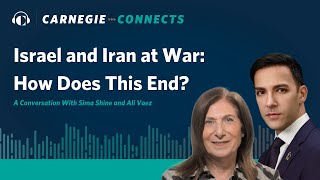
In a 45‑minute Carnegie Connects conversation hosted by Aaron David Miller, former Israeli intelligence researcher Sima Shine and International Crisis Group Iran Project Director Ali Vaez examine the unfolding conflict between Israel and Iran following Israel’s "Rising Lion" air campaign. The panel discusses why Israel chose to strike now, the distinction between pre‑emptive and preventive action, and the limited ability of Israel to dismantle Iran’s nuclear program, especially given the remaining capabilities at the Fordow site and undisclosed centrifuge facilities. Both guests assess Tehran’s view of the strikes as a regime‑destabilization effort rather than a pure non‑proliferation move, and they explore the prospects for regime change, the role of Iranian minorities, and the potential for internal dissent. The conversation then turns to possible U.S. involvement, contrasting a limited surgical strike on nuclear sites with a broader “shock‑and‑awe” campaign, and evaluates how Iran’s Supreme Leader might respond, including threats of regional escalation, attacks on Gulf infrastructure, and the use of proxy forces. The panel also considers longer‑term trajectories: whether Iran might exit the Non‑Proliferation Treaty to gain bargaining leverage, the likelihood of a negotiated settlement, and the broader strategic calculations of Israel, the United States, and Iran as the conflict evolves.
Chapters
Good morning, good afternoon, good evening, wherever you are in this world of ours. I truly hope you're safe and taking good care. I'm Aaron David Miller, and welcome to Carnegie Connects, a series of conversations about issues of critical importance to America. And to the world. I think in the 105 Carnegie Connects we've done since March of 2020, there has not been one that is more tied immediately and more timely. And what we've witnessed over the course of the past week and how it plays out in the next— in the days and weeks ahead will have critically important consequences for the region. I don't often use the words game changer. I hate that word. Transformational. I hate that word. Sea change, inflection points. It's these— these phrases are used and deployed far too often. I'm reminded of something that Vladimir Lenin said, his famous quip. He said, quote, there are decades where nothing happens, and there are weeks where decades happen. So I'm not persuaded yet. But I think we may be on the cusp of one of those weeks or decades. And yet, I wonder if there are— if, if where we're going doesn't face severe limitations and constraints on the part of each of the three key actors here. The Israelis by themselves cannot destroy Iran's nuclear program. Question is, how do they rationalize and process accomplishment and success if that program survives with significant capacity? Iran's invested— I think Ali used this figure once before— $5 trillion in this nuclear program, and they have to, for reasons of domestic and regional prestige, respond, and they have responded, but they're responding in a way it seems that is somewhat constrained, and if the U.S. strikes, the question is, will they respond with constraint, or are we talking about a full-out comprehensive response? And finally, the Trump administration. Clearly, the president wanted to avoid intervention, but could not or would not try to figure out a way of how to do that. And now he's on the cusp of joining a war that he probably did not want to join. And then the question becomes, can the US, even with all of its power, destroy Iran's nuclear program? The 45 minutes we have will go fast. We have many questions, but we have the right analysts to answer them. Sima Shine is a senior researcher and former director of the research program at the Institute for National Security Studies, INSS. For most of her career, Ms. Shine served in the Israeli intelligence community. Her last position was head of the research and evaluation division of the Mossad, 2003 to '07. And in that capacity, fascinating, she was in charge of the production of both daily and periodical evaluations on Middle Eastern and international leaders. So Simo was doing intelligence assessments for the Israeli political establishment, which puts her in a unique role today. Ali Vaez is the International Crisis Group's Iran Project Director and Senior Advisor to the President. He led the Crisis Group's efforts in helping to bridge the gaps between Iran and the P5+1 that led to the landmark 2015 nuclear deal. Previously, he served as a Senior Political Affairs Officer at the UN Department of Political and Peacebuilding. He's also an adjunct professor at Georgetown University's Edmund A. Walsh School of Foreign Service and a fellow at the Foreign Policy Institute of Johns Hopkins SAIS. So, Sibel, let me start with you and the Israeli operation Rising Lion. Why now? And how would you describe right now, 4 days in, it'll be basically 5 tomorrow night, what the Israelis have accomplished?
So why now? What actually, what was the trigger for the decision? I would say that it's a combination of several 3 to 4 reasons. The first one I will mention is the— in the last year, we saw a large talking in Iran on the issue of rethinking the policy, the nuclear policy of Iran. Since the war in the Middle East with Gaza and Israel, and then Hezbollah and all other proxies joined. There was a continuing dialogue within the Iranian parliament, journalists, you name it, people that were in past high-ranking positions, as to the issue of changing the nuclear policy, and in the last, as a deterrence, as the major deterrence for Iran, and much more— it became much more after the attacks, the Iranian decision to attack Israel and the retaliation on the side of Israel. And in the last, in the last several months, that was mentioned by the prime minister as well, there were indications, small indications, that the Iranian scientists on the weaponization program were doing small steps that I I don't know exactly what they are. So this was, this was the major background for the decision. To that I will add also the growing understanding in Israel that the dialogue between the, between the U.S. and Iran doesn't go anywhere, and the gap between what the administration is asking and what Iran is willing to do is a huge one. And actually there was a, there was a thinking that perhaps Iran is just using the talks in order to waste time and to use this time on their nuclear program. And I will also add to that another one more reason, and that is the window of opportunity. No question that in Israel there is a feeling that there is a unique window of opportunity that wasn't before the war. And that is the fact that most of, not most, but all of Iran's proxies in the region are weaker. Some of them are not relevant, as we saw Hezbollah. I think also the militias in Iraq, Hamas. So the deterrence that Iran has built for two decades in order to prevent an attack on Iran was not there anymore. And of course, there are also the the lessons learned from the two rounds of mutual attacks between Iran and Israel. All this together, I think, brought the Israeli government to the decision that it's the proper time to do it.
Right. You know, I listened very carefully to the security cabinet's delineation of their objectives. The word preemptive was used. Now, there's a big debate between preemption and prevention, but I wanted to ask you to follow up, Sima. Preemption suggests an imminent threat. I know the Israelis have been moved at times by the so-called Begin Doctrine, right? Eliminating the reactor in, I guess, July of '81 and again in 2007, the Syrian nuclear reactor. Explain for me the difference. And maybe, you know, former Prime Minister Ehud Barak had this notion of the zone of immunity, that at some point Iran's nuclear program would enter a zone of immunity beyond which Israel could not shape and affect it militarily. Was this preemptive? In response to an immediate threat, or did the opportunity arise to deal with a threat that might be inevitable at some point?
It's a difficult question, I must say, and especially since my English is not my language, so the preemptive and preemption, I'm not sure I know exactly the difference.
Your English is wonderful, Zima. Go ahead.
But But I think that it's a combination, as always in life, it's a combination of reasons. It's not one, one reason. And I think I didn't mention, of course, because I think it's, it's, it's quite known, the element of Prime Minister Netanyahu, his agenda for so many years. So it's a combination of things. But no question that Iran has reached a point in time from the technological point of view, that it was only a question of a decision, political decision. And the political decision, once it would have been taken, Iran could have—only from the 60% enriched uranium—could have enough fissile material for 10 devices. And that is according to open sources. So I think there is a—it's all together. And as always, as I said, no one reason for that. Right.
Ali, let's go to you on two issues, if you would. Number one, Iran's assessment, your assessment of Iran's assessment of Israeli objectives. And then number two, these reports, The Economist over the last week was filled with reports that the Iranians have been working on trigger mechanisms. Small, small devices, which would suggest a degree of weaponization. So, first of all, what is Tehran's view of what the Israelis have done or what they hope to do? And then maybe you could speak to this issue of weaponization or non-weaponization. Where are the Iranians on that question?
Aaron, first of all, thank you very much for the invitation. It's great to be with you and see that is safe and sound. Look, the reality is that what the Iranians see here is more a strategy aimed at regime destabilization rather than at defanging their nuclear program. And if you look at the number of targets, the majority are non-nuclear so far. And of course, Israel, at the end of the day, is both responsible for how advanced Iran's nuclear program is today. And simultaneously incapable of removing the threat entirely, because the one site that is still relatively intact, Fordow, is where Iran has the two elements that it needs, the two ingredients that it needs for a dash towards nuclear weapons: advanced centrifuges and a stockpile of 60% enriched uranium. And as a result of the situation that we're in, the IAEA has not been able to access Fordo in the past few days. So we have no idea if the material is still there or not. Yeah. So if your objective was to prevent or preempt, it doesn't matter. This, I don't think, would have been achieved other than Israel thinking that it would start this war and it would impress President Trump by its initial achievements and then would drag the United States in to finish the job. So that's, I think, probably how the Iranians are perceiving this. You know, the targeting of the top brass of the military, targeting of state institutions, not just IRGC sites and, and launchers, missile launchers or air defense systems. All of this suggests that this is more aimed at regime destabilization. And if there was any doubt, Prime Minister Netanyahu's statements in the past few days, you know, encouraging the Iranian people to rise up against the regime, I think has further consolidated that view in Tehran that this is a war aimed at toppling the regime or destabilizing it.
Yeah, I mean, go ahead. Sorry, go ahead.
In terms of the nuclear trigger, look, we of course knew that Iran had accelerated 60% production. We also knew that they were looking at possibilities of some sort of a shortcut to a nuclear test, maybe by, you know, not an advanced kind of nuclear weapon that you can put in the cone of a missile, but more sort of a dirty bomb or a more rudimentary design like the one that was dropped on Hiroshima. But the reality is that at the end of the day, they still had all of their nuclear material under monitoring from the IAEA. And the one risk that, again, Israel has created as a result of this attack is that, you know, even if we imagine that Iran had done some prior work for weaponization and so the timeline for weaponization had shrunk from what we thought initially would be 6 to 18 months, let's say to 3 months or shorter. Now there is the risk that Iran, given the fact that in the past 4 years it has produced hundreds of advanced centrifuges, And because of US withdrawal from the JCPOA, we no longer know where those centrifuges are. There is a possibility that there are clandestine secret facilities with machines that are already ready to be fired up. All they need is the material. And again, we no longer have supervision over the material. So I don't think this approach, at this stage at least, has served the nonproliferation purpose of a preemptive strike on Iran.
Right. So you're saying two things that both of you are saying, that right now, if the Israelis stopped and there was no American intervention, they would have to some degree set the program back a matter of months. But with Fordo still functional and undeclared sites where there might be advanced centrifuges working, you actually might incentivize Iran. I mean, is that the argument? We'll get to the issue of U.S. intervention, whether— how that's likely, if it comes, when it comes, is my view, whether or not that's affected Iran's calculations. But, Yahweh, you raised the issue of regime change. So, I want to go back to Seema on this. Seema, you were quoted, I think, in Reuters as saying, when they asked you about regime change, I think you said it was a quote, and I love this word because it implies so much, aspiration. It was an aspirational goal. Now, an aspirational goal means that it is something to be aspired to, but perhaps not actively calculated that it would work. But I want to ask both of you on the issue of regime change because it's a term, and Ali, you use a fascinating phrase, which is regime destabilization. Which in fact could go any number of ways without regime change. But just let me posit the following circumstance. In the last 20 years, regime change in the Middle East has occurred through 3 sorts of processes. In Egypt and Tunisia, it occurred when hundreds of thousands, millions of citizens of those states went out into the streets. The military security establishment refused to defend the regime. Ben Ali and Mubarak departed. That's one example. Mass demonstrations with security elite that failed to respond. The second is what you watched in December. You have an organized, coherent military group, a former al-Qaeda derivative backed by the Turks, which had governing experience in Idlib, surge, probably much to their surprise, in a matter of two, within two weeks, they're in Damascus and the Assad regime is gone. So that's a, that's an alternative to the Assad regime. And then, of course, you have George Bush 43. You have the invasion of Afghanistan and Iraq and the forced removal, at least temporarily in the Afghan case, of the Taliban in an effort to pursue al-Qaeda. Do any of these circumstances apply in either of your judgments to the current situation in Iran? And what might Israeli military activity and a possible US military intervention, does it change anything?
You ask me or Ali?
Sima, let's start with you since I tagged the question to your quote. Okay.
So I, first of all, you are very correct in describing what changed regimes in the region. One element that I think is very important in the two examples of Syria and Egypt Because Syria, I didn't mention, but in 2011 started a war in Syria, and the regime stayed for a long time. So in both cases of the change, I think what is very crucial is the support of the army. In the case of Egypt, as you say, there was no support. In the case of Syria, first time it was the support, second time no support. So this is a very crucial element. Now, I don't think that we can compare Egypt, Syria to Iran, it's completely different. But I think still, when we are talking about a regime change, first of all, I don't believe in a regime change that will come as a result of a military attack on a country. So that's one thing. The other one is no question that in Iran there are components of a this support to the regime that could raise in a situation where they feel that the regime is weak. And no question that what happened for the regime in the last 6 days is a very, the show of a very weak state. This is a state that for years was building on death to America and death to Israel. And what happened? In 1 or 2 days, most of the security higher echelon people were killed, the scientists, sites there. 40% of the ballistic missiles are not there anymore. I mean, that is, that is something that when the people in Iran look at that, they see a weak regime. And that is, of course, part of the posture of the regime vis-à-vis the population that for years, well, was killing people on the streets. So was— and people were afraid of it. So on one hand, you could say there are a elements that could support those who want a change of regime. But, and I think this is more important, two things. One, there are millions of people that support the regime. And two, I think the regime is still strong enough inside to deter people from going to the street and using. And third, I think there are those that even though they hate the regime, they might think that bombing Tehran and other places is not something that they want to support.
Yeah. Ali Vaez, you on this question.
I agree with a lot of what Sima just said, and I'll add to it that, you know, a revolutionary kind of regime change is quite unlikely for two reasons. One is the nationalistic reaction to the use of air power against civilian centers, given the number of casualties in Iran, I think the more likely reaction is more of an anger and patriotic reaction rather than, you know, and rally around the flag kind of reaction rather than a revolutionary sentiment. And by the way, one has to also admit that Prime Minister Netanyahu, given, you know, his own track record in undermining democracy in Israel and the amount of bloodshed that he's responsible for in the region in the past few years, I don't think really is seen as a credible figure or a liberator for Iranians. Then there is also the fact that there is no organized, unified, disciplined alternative inside or outside of the country that could march into Tehran and do what Ahmad al-Sharif did in Syria. So the way, Aaron, I feel this will end is to draw on your historical historical regional analogies, is either something similar to the 33-day war with Lebanon in 2006, in the sense that both sides would reach a balance of devastation that would, you know, would be sufficient from their perspective, and they would prefer not to go any further than that. And the regime will survive and will try to recover. This is even in a scenario of US intervention, but in a scenario that the US goes really for the jugular and launches not just a surgical attack on Fordo, but a much more massive bombing of the country. I think the more apt analogy is probably Iraq, 1991, in the sense that, again, you would have a shadow of the current regime that would survive. It might even lose control over the entirety of its territory. But, you know, what it controls, it would do so even more with more— with a heavier hand than it used to do in the past. And it will be well entrenched. Now, what happens after that is, is either it would get into the decay that we saw the Assad regime went through from 2011 to 2024, or that then there would be a need for another military intervention. To topple it. But the reason I say also, you know, destabilization is because, as you know, the Islamic Republic has mistreated Iranian minorities more than other segments of the Iranian society. And so there's a lot of anger and frustration among Iranian Kurds, Arabs, Baluchis, and so on. And I'm afraid Israel arming these separatist groups might be part of the plan of trying to plunge Iran into civil strife, which would then basically neutralize it as a regional adversary because Iran would be bogged down in internal infighting and would not be able to project power beyond its borders. Right.
I mean, it's a fascinating insight, Ali, that, that in response to a more massive American strike, parts of the country could somehow slip beyond the capacity of central government to control. I mean, that is a— that's not a minor change. That's the beginning, you could argue, of a dysfunctional state that can't control its own territory. And add to that minorities, which would be open to external manipulation by outside parties. and you have the question of real destabilization of Iran as a country. And that would be a transformation for sure. Fascinating insight. Sima, any thought on that?
First of all, I really think it's very interesting, and I think The possibility is there. I personally believe that, but that's just a guess, nothing that I can count now on it, is that the first option that you mentioned, Ali Vaez, that both sides will, will feel fatigued enough after several, 2, 3 weeks, I don't know, something like that. And if the US doesn't, doesn't get in, that both sides will decide that the time has come to stop. The Iranians have said, I don't know if it will be within 3 weeks also, but at the beginning they said, if Israel stops, we stop. So it might be, they might change their position, but that was at the beginning, after 2 days, I think. And it might happen. It might happen. Yeah, I do think that what, this is something that I am saying also in Israel, that there might be a ceasefire in the war. But the problem of the nuclear will not be solved. And on the contrary, it will encourage Iran more to go on a secret project somewhere. Iran is big enough. And as you said, we don't know about the advanced centrifuge. There was no inspection. I'm sure they have 500 somewhere. I'm sure about that. Now, This is a completely possible option. Another option that I want to raise, which is partially connected to the two others, is that the parliament will decide to go to encourage the government to leave the NPT. And that is a step in order to start different negotiations, because from what I understand, there is no reason to go back to a six the next round if the demand is zero enrichment, and the Iranians say no, the legitimacy to enrich. So there is no bridge between the two positions. But if Iran decides to leave the NPT, and as a bargaining position, not as a decision to go for a bomb, but as a bargaining position, they can of course believe that they have 90 days to negotiate with someone. I don't know if they can count on Trump on that. To negotiate in order to improve their position. All the options are bad. I don't see any good option, because if there was a good option, the Iranians would have come to Trump and say, okay, give us billions of dollars and invest in our, in our oil and gas infrastructure, and we, for 10 years, we stop enriching. If they wanted the good solution. This is not what they want. They want, for many reasons, and I, I agree what Ali Vaez said, there are many reasons why they want it. Not only— I agree, I understand it, but when they have to calculate, I think that would be a better way to handle the situation. Of course, at that time that they negotiated, they didn't believe neither that Israel is going to attack and not that the US is going to attack. So everything has changed dramatically. And I think we have to have one full day of dialogue among ourselves in order, in order to try and understand how we got to this point in time.
Yeah. I mean, it seems to me after a week or so, the sort of limitations of Israel and Iran are being made clear. The waves of missiles have diminished. The Israelis have destroyed, according to their estimates, a third of the launchers. You could have 10,000 ballistic missiles. If you can't launch them, they're useless. The Israelis may well, if this keeps up for several weeks, begin to run short of interceptors. There's— there is that problem. So there's a new vector. Building, right? I mean, my own assessment is based on the fact that Donald Trump feels angry and frustrated at and with the Iranians. He believes that he is somehow perceived now to be weak based on an inconsistent policy over the course of the last week. And he was clearly unwilling or unable to say no to Benjamin Netanyahu when he came to him on Monday and again on Thursday, even though he seems to have played along with the ruse that there would still be a negotiation on Sunday, which was critically important for the Israelis, the first phase of the Israeli operation, for the Iranians to believe that there would be absolutely no, no strike until after that succession. So you have a new vector that's building. You have refueling capacity. You've got statements by the supreme leaders, "We will not surrender." You have the President of the United States calling for the evacuation of Iranians from Tehran, and unconditional surrender is what he wants. It could well be in the next 48 hours that the Americans will strike. So, this is first a question for Ali, you, you distinguish between a more surgical strike at Fordo and other nuclear sites and a more shock and awe response. Although what the Americans could do that the Israelis already have, hasn't, haven't done. I mean, I'm sure there are, there's, there are different target sets. But here's my question to you, Ali, because it will determine the next phase. What is the Supreme Leader's response going to be to any American military strike, whether it's surgical or whether it's more comprehensive? What are the options?
Look, so there are two main categories of options, right? One is to threaten devastating response and actually not do anything. There is precedent for this in 1988, towards the end of the Iran-Iraq War, when Iran was exhausted after that war and The US intervened and destroyed half of Iran's navy in half a day, and Iran didn't even, you know, shot a single, single bullet in response. But this is not the same Iran and this is not the same supreme leader. I see this more as— and, you know, Aaron, in D.C., we have this tendency of always thinking that if we amass 150,000 troops on the border with Iraq, Saddam Hussein would magically surrender. You know, or if we fly B-52s or B-2s to Diego Garcia, you know, the Houthis would all of a sudden surrender. You know, for these people, surrender is just not an option. Surrender and capitulation means death. And therefore, you know, I don't see that as a realistic option. So he has to respond. And again, in the West, we are, I think, primarily our source of information is dominated by narratives that, you know, often tend to overlook the Iranian perspective on a lot of these things. You know, and if we want to be honest, we have to take a step back and look at the fact that Iran experienced its own version of, you know, Pearl Harbor last, last week. And yet managed to recover in less than 12 hours and push back against Israel in ways that, you know, which other country has been able to inflict so much harm on Israel in the past few decades? And they're not done yet. They're still able to keep this up. And to the extent that I understand, there are also some of Iran's strategic assets that they're probably keeping in their back pockets, including hypersonic missiles with heavy warheads. Right, that they can launch at US bases in and around the region. And if they are, they see that this is an existential one final battle, then I think they might try to bring down the whole region with them, you know, to create the kind of global economic shockwave that would force Trump to blink first. Right. So in that scenario, we might have attacks on energy infrastructure in the region, on shipping lanes, and, you know, Hezbollah might join, the Hashd al-Shaabi in Iraq might join, the Houthis might join. So we really might end up with a regional conflagration option. I think that is a much more preferable outcome for Ayatollah Khamenei and the way he sees his own legacy to go down fighting. Rather than to be the one who would capitulate after several decades of sticking to a resistance narrative.
Yeah, Sima, I agree. I was going to ask you the same question. So if faced— see, I was about to quote my inestimable colleague at Carnegie, Karim Sadjadpour, very wise on Iran, who basically says the most extreme revolutionary, the day after the revolution, becomes a conservative. Because the whole point of the revolution, its success and its endurance, depends on preserving and conserving the revolution. So Supreme Leader, I guess, would have to— the conversation, internal conversation, would be, yes, I'm in my mid-80s, I'm not well, I've tried to preserve the revolution, I'm not going to succumb, and I'm going to respond even if it means a response that would surely court a massive response on the part of the United States. And that brings us to the thing the Middle East has never witnessed before, not even through the last 18 months and 4 strikes, 2 on Iran by Israel and 2 on Israel by Iran, a regional war in which the Iranians use their thousands of short-range ballistic missiles to attack US forces in the Gulf and Saudi oil installations. I don't know about Hezbollah. Maybe they— it's an end of times moment for them too. The pro-Iranian Iraqi militias. Closing the Straits of Hormuz is not such an easy thing to do. The Americans could open it, but in the meantime, you're ending up with oil over $100 a barrel. You could see asymmetrical warfare. Terror attacks by Iran against American-Israeli interests in the region and out of Jewish interests as well. If I were to ask you in the few minutes remain, you think that scenario in relation to any American attack is possible? You can't predict the future. Yeah, of course. But I asked it anyway because you—
We have to think about it even if we cannot predict. I want to say two things. One is that the dilemma that the leader is now facing is existential. No question about that. The question is whether it's going— first of all, I think if the US attacks only Qom and immediately says we are not going to attack any other places, only the nuclear, and we suggest to you to come to the table and negotiate the ceasefire and the future, it's difficult for me to think that the leader will prefer to attack the American facilities in the Gulf and to bring the US all major capabilities to the war, to attack all the Gulf states that it took so many years to improve relations with them, and sacrificing the future of the Islamic Republic. Um, I think— but here I have to say in brackets I didn't understand the decision. I mean, I have explanations, as always, but I didn't understand completely the decision of the leader on the, on the 13th of April to attack Israel. I mean, what, what reason was it to do it? He didn't do it when they, when they probably, according to foreign reports, Israel assassinated Fakhrizadeh in Iran, not in Syria. So I, I, I must say there is a Therefore, I'm not so confident in my evaluation because this leader, from my point of view, was always perceived to be a very cautious one and not one that rushes to war. And what happened on the 7th of April, it was really, you know, it was half a year after what Hamas has done. Israel was already recovering and attacking dramatically. What did he think? That they— what was the— when he made the decision, did he think that Israel will not retaliate? Did he think that Israel is so weak that it will not? So therefore, I say I have a big question mark whether he and the people surrounding him, the IRGC and all others, whether they will be able to say, okay, we suffered, but we can We can reconstruct ourselves. We have the Islamic Republic to save. And this is something that they— I don't know, because I have a huge question mark on the decision-making process, especially today that part of the people are not there anymore. Might be better because Salemi was not someone that discouraged the leader from going to attack Israel. But in Bakhmut as well. So it's a big question, but I would recommend them if it's only calm, swallow the situation and look for the future and not the, you know, go for a full-scale war that nothing good will come up of that.
Right. Ali, explain for our audience the significance of of its only comm? And what about the— is this a decision of one man?
Well, we don't know what has happened to the decision-making structure, Aaron, after these attacks. But it does appear from Khamenei's messaging, even as recently as today, that he is still in charge. And, and yes, I think it would really boil down to his decision. The problem with that kind of approach is, you know, that if you basically say to the Americans, fine, you can come bomb one of the most strategic sites and we will do nothing, in Khamenei's head, that sets a precedent that could be repeated over the years again and again and again over all other, you know, strategic sites. So he has to respond. Now, he can play it in the way that he played in the aftermath of Soleimani's killing in a way that wouldn't result in American casualties, so that both sides can say that they contained the repercussions of this kind of tit-for-tat. The main issue, I think, is would he be willing then to negotiate with a president that, as you said, they now perceive complicit in Israeli aggression against them, withdrew from the previous agreement. Killed General Soleimani, you know, would they see him as a reliable negotiating partner? Would they really believe that President Trump, after all of this, is willing to make Iran prosperous again, as he has said? Right. I have serious doubts. And I do agree with one very important point that, that Sima made, which, which is that Iran, if it is to return to the negotiating table at any point, It needs more leverage because its current leverage, nuclear leverage, has been severely degraded. Now, if it survives and it comes to a draw with Israel, I don't think it can gain the upper hand. But if it's at least more or less at equal footing, this is what happened at the end of Iran-Iraq War. Iran only agreed to a ceasefire when it was at equal footing with Iraq. I can imagine that they would, they would be willing to negotiate, but they need to generate leverage. And the one way of generating leverage is to withdraw from, from the Non-Proliferation Treaty. However, I don't think they would do it before the war ends because that would provide justification for US entering into the conflict.
Right. Well, a final and final question to both of you. It's an unfair one, but I'm going to ask it anyway. If you had to make a prediction on a US strike, Sima, first to you, yes or no?
Hmm. Now I cannot say yes or no because it's, because it's really, I'm following every word that President Trump is saying and he says yes and no. You don't. And I cannot predict.
Maybe, maybe not, as he says. Right. But, but I would put it, Aaron, at 60% now because I think Trump is when he sees an opportunity, he's very tempted to grab it. His killing of Soleimani was very— a good example of that. And now I think he does believe that Israel has done the heavy lifting. He can come finish the job and take the credit for it. That's often very attractive for him. And of course, he doesn't think about medium to long-term consequences. There is no plan for the day after. Those are all typical of General Washington. I mean, in general, in Washington thinking, but also particularly applies to this administration. I mean, I think you're right.
Last comment by me. He has a very transactional situational view of matters. In Russia-Ukraine, he wants to end the fighting but not the war. In Israel-Hamas, he wants to get the hostages out but has no interest in a day after broader Israeli-Palestinian negotiation. And if left to his own druthers on Iran, he would have found a way to negotiate a JPOA, maybe. Which would have parked the Iranian issue for the remainder of his term. Highly transactional, very risk-averse when it comes to the use of military force. We'll see this time around, though, won't we? Sima Shahin, Ali Vaez, thank you so much. I mean, I can't tell you, 45 minutes, I mean, bottled your analysis in 45 minutes. It's got to be the best anywhere. And I want to thank you for your wisdom, your authority, and for coming on Carnegie Connects. Thank you for having us. Both of you, thank you and take good care. Thank you.
Thank you very much.
More from Ali







Israel and the U.S. at war with Iran: what comes next & what implications for the region and beyond?



Trump ‘Is Living in a Fantasy Version of His Own Presidency’ | The Ezra Klein Show
