Israel and Iran at war: toward a broader regional conflict?
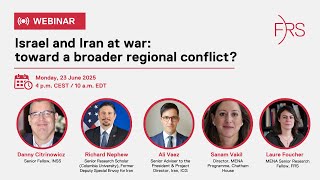
Four experts analyze the escalation after U.S. and Israeli strikes on Iran's nuclear facilities. Richard Nephew details uncertainty about 400 kg of enriched uranium and centrifuge components. Ali Vaez argues Iran's regime is more resilient than planners assume, citing historical miscalculations like Saddam Hussein and Khomeini's miscues.
Chapters
Hello everyone. Thank you for joining us for this really timely webinar hosted by the Foundation for Strategic Research. I'm Laure Fouché. I'm in charge of the Middle East at the Foundation. Today we're going to be talking about the very rapid and significant developments regarding Israel-Iran war. Trump's decision to strike the three main nuclear sites without the authorization of the Congress certainly opened a new phase of the war. This US decision of a direct military involvement reshuffles all the cards, not only regarding the Iranian nuclear program, but also regarding the geopolitical balance in the Middle East. So where are we heading at with this new phase of war? How the actors are adjusting their strategy and how this war can end? In order to unpack all of this, we have an excellent panel today with four prominent experts and former officials. We are really lucky to have with us Dani Citrinovitz, Senior Fellow at the Institute for National Security Studies, INSS, in Tel Aviv, Richard Nephew, Senior Research Scholar at Columbia University, former Deputy Special Envoy for Iran, and former coordinator on global anti-corruption at the State Department. Ali Vaez, senior advisor to the president of International Crisis Group and Iran project director. And Sanam Vakil, director of the MENA program at Chatham House. So thank you, the four of you, to agree to share your analysis with us today. I know your time is extremely precious, so thank you again. Just a few remarks before we start. We will have 1 hour of discussion. I would like to ask you to, if you have any question, please type in the Q&A box with your name and affiliation, and I will do my best to integrate your questions in the discussion. This event is an open event, so it's on the record. So let me start with you, Richard. Trump declared Iran's nuclear capacity totally obliterated. We heard different assessments since then. What do we know so far about the effectiveness of the US strikes, and what does that mean from a nuclear perspective? What could be the US response to the critical issue of the highly enriched uranium stocks that we don't know really where they are at, at that stage? And how all of these tactical military successes support the goal of nonproliferation objectives. Also, regarding the US intention from now on, they are all but clear. Several senior Trump officials suggested that it was a one-off military operation, that it's not about regime change, but nuclear capabilities. President Trump, on the contrary, suggested that regime survival requires a deal. So what will be, according to you, the main triggers for the US to pursue their military involvement? And if Iran decides not to strike back the US directly, can the US step aside from the war?
Great. Well, thank you very much. Thanks so much for having us and appreciate the opportunity to to share some thoughts. You know, as I try and think about the nuclear issue, I think you can divide up the types of targets, the types of activities, if you will, or interests that Iran has in the nuclear program into 3 buckets. You know, first you've got the fuel cycle, then you've got personnel, and then you have weaponization. And so the strikes that have been undertaken thus far over the course of the last but now we're on the 12th day or something like that, have been intending to deal with all three of those different pieces. But it's unclear really at this point how effective the strikes have been in addressing all three of those pieces. So the Israeli strikes up until Saturday had dealt significant blows to Iran's ability to enrich uranium at Fordow, or at Natanz rather, to convert uranium at Esfahan, uh, as well as, uh, you know, potentially to, to take uranium that is enriched and turn it into metal, which is how you would produce weapons. That's what the Israeli strike package had done. The US strike package, uh, added to those by attacking both Fordow, Natanz, and Esfahan again. The strikes at Fordow, uh, appear to have hit what they were intending to hit. So they, they were able to get into the spaces inside of Fordo where centrifuges are held and to destroy it. That is at least as best as we can say right now based on the information we have, the information we have about the, uh, the munition was used, the massive ordnance penetrator, and what its capabilities are. Um, what we don't know is, uh, what happened with some of the material that was there, potentially some of the equipment was there, uh, as well as, you know, certainly any of the, the personnel that were there. The Iranians had ample time and warning to know that Fordow was going to be attacked. There was a possibility of it being as long as 2 weeks, but they also knew from the start of the crisis that Fordow had a pretty significant cross-eye on it. So I think from the standpoint of what the Iranian expectation was, they had to believe that Fordow was going to be targeted at some point in time. And that's why there are so many reports about material having moved. And that really is the kind of lingering issue that you spoke to of what happened to the material, what happened to the highly enriched uranium. The bottom line is we don't know, and neither does the International Atomic Energy Agency. I just saw a moment ago Rafael Grossi was giving a statement to a meeting of the IAEA board in which I only saw before this started that his kind of introductory presentation was noting the fact that we don't know where 400 kilograms of 60% highly enriched uranium is. —so going from the 60% level it is today up to 90%—and to being able to then eventually turn it into material for bombs. That is a piece that we don't know. We don't know where Iran could have been doing it. We don't know where the material is now. We do know that the Iranians have had a stockpile of centrifuge components they've been producing since 2021, when they stopped allowing IAEA access to them. They stopped doing this both because that they were in a process of withdrawing from the JCPOA after the US withdrew from the JCPOA, and because, uh, they had had centrifuge component workshops attacked. And so they were making the argument they need to move this, this kind of activity underground to a safer location. So from a fuel cycle perspective, we have a number of different facilities that were attacked, uh, we have a number of different enrichment-related capacities that were destroyed, but we don't have eyes on highly enriched uranium. We don't know whether or not Iran has additional centrifuges, and importantly, we don't know whether or not they still have the ability to produce, uh, uranium metal, either using salvaged equipment from Esfahan, equipment that they procured separately, or potentially equipment from the previous nuclear weapons exercise that has never been found. So it's entirely plausible to me, and until we get IAEA or other outside eyes on it, that the Iranians have an independent capacity to do this. On the expertise side, you know, in the first days of this, of the conflict, we saw that the Iranians were in fact attacking, or rather the Israelis were attacking a large number of Iranian sites. You know, the numbers have varied, but essentially there is an allegation that the Israelis have killed more than 10 Iranian scientists who potentially would be able to help produce an Iranian nuclear weapon. The problem is, is that Iran has a very significant and proficient technician class that has been working on uranium enrichment and non-uranium conversion and all these other technologies for a long time. They've also been working towards having some of the knowledge you would need for weapons for a while as well. So this allusion that some people keep making to Robert Oppenheimer, what would happen if you had killed Oppenheimer before the Trinity test in 1945, I actually think is a pretty interesting way of phrasing it. If you had killed Robert Oppenheimer a couple of days before the Trinity test, Trinity test would have happened no matter what. It wasn't going to affect things. And that is the open question we have about the personnel side of whether or not there are still people who are more than capable of enriching uranium to 90%, fashioning the metal, and then producing into weapons components. The big open question— this is the last category— is the weaponization side of how far the Iranian weaponization effort had gotten before it was halted, whether or not the Iranians have a weapons design that they feel comfortable with, whether or not that design is something that's useful for missiles, probably not, or something that is useful for a cruder device, a test device, or something that's a little bit larger that couldn't be, uh, attached to a missile. Those are all open questions. We have some information from the nuclear archive that Mossad acquired back in 2018, uh, but not even the Israelis have a complete picture of what the weaponization program looks like. United States doesn't either. It's an open sort of question, which when you add all these things up in my opinion, means we have not actually fundamentally addressed the nuclear issue at this point, that the Iranians still possess the capacity to move quickly towards nuclear weapons if they choose to do so. And obviously they have strategic reasons to want to do so. You had asked a little bit about U.S. intentions, and I'll talk about that briefly and then I'll be quiet. Look, I think one can read what the administration was saying yesterday very literally. That the US doesn't have an intention of making this a long-term campaign. There's no real intention at regime change, you know, coming from most of the system, potentially even the president, one-off strike, those sorts of things. One could also reasonably argue, and the president certainly was indicating this last night, that regime change is still on the table. And I think this all connects back to a question of what is necessary to address the nuclear issue. I think if you read a lot of what the Israelis have been saying, and Danny and others, I'm looking forward to what you have to say about this. You know, I think one can see that regime change is not being presented as an either/or, but actually as a package to how you permanently address the Iranian nuclear threat that's perceived. And in part, this is because of guys like me and others who've been making the argument it's really hard to take the nuclear out of Iran outside of an agreement because it's been part of the last 20-odd years of Iranian politics and Iranian strategic thinking to some extent as well. And so the argument might be, well, yeah, that's the reason why we need to try and change the regime or at least put the regime under so much pressure that the regime is fearful and it can't recommit to the nuclear program. What this adds up to my mind is a huge amount of ambiguity as to how far the United States would go. I do not believe that this is a one-off strike if there is still a possibility that Iran is able to produce nuclear weapons and if there's no confirmation as to what has happened to the material, and there's no way to try and prevent nuclear weapons without that. I also would say that if Iran continues to refuse to negotiate, and I see every reason to believe that they will refuse to negotiate, that you won't see the United States contemplating additional strikes to try and deal with either nuclear capabilities or to contribute to the Israeli regime rattling, you know, campaign that they've got on right now. And I think that creates a real political problem for the president. I think he's been able to quiet some of his base by saying this is a one-off thing. There are even some prominent voices in his party that are very concerned about this becoming any longer a campaign. And those voices will get stronger if instead of being a one-off, it's a two-off or a three-off or a four-off, or it's a never-ending saga, especially if you're not able to, to get international inspectors to go look at parts of the program. So I'll stop there.
Thank you so much, Richard, for this impressive point you just raised. Dani, please help us to have a better understanding about the Israeli perspective and a bit to address what, what Richard just said. At the end of the day, Prime Minister Netanyahu finally obtained from the U.S. what he has deeply wanted for many, many years. But as Richard mentioned, we are not sure yet at all about the end of the game. So how will Israel act now and what does Netanyahu hope he will get from the US from now on? And also, and it's all linked, it's difficult to have a clear idea about when Israel decision makers might consider that they have an interest to stop the military campaign and to declare the mission is accomplished. So what are the terms of the debate in Israel today over continued military involvement and over how to conclude the war?
Well, I thank you very much for inviting me to such esteemed panel of members that I watch closely every word that they are writing about the situation. And finding— I'm trying to use them to find more clarity to the situation, of course, that's developing. I will say that my luck is I was requested during my professional life to analyze the Iranians and not the Israelis. So because it's harder to analyze Israelis, but definitely I will try to give some more clarity in what we're seeing right now, although we have to say there are elements that we don't know what happened behind the scenes. So it's very hard to complete the picture. But I'll start by saying that we have to understand why Israel initiated this attack. And I think it's combined for two main reasons. First and foremost is the operational opportunity that it identified. Hezbollah is weak. The 26th of October attack, 2024, destroyed the Iranian strategic air defense. And with the approval of President Trump, that is using Netanyahu, used Netanyahu in order to weaken Iran by thinking that Iran would turn back to negotiation tables, surrendering to all US conditions. Netanyahu understood that it's a once-in-a-lifetime opportunity for him. Adding to that, of course, we had the issue of the force buildup and what happened that we don't know regarding weaponization. Probably the scientists did something, but we don't know how much they were close to nuclear bomb. But definitely we know that Khamenei didn't instructed the buildup of a bomb. Scientists did something behind closed doors. There is a debate between the American and the Israeli intel community about how close they were to a bomb. But definitely, we have to remember it's not an imminent threat to the State of Israel, because the fact that Iran never intended to build a bomb and put it on a missile and launch it to Israel, although this is the perception in Israel, unfortunately. I'm not saying that having, of course, nuclear bomb in the hands of Iran, it's a good development. It's a negative one, but it never was in the eyes of the regime destruction of Israel by nuclear force. So, but the things that Netanyahu presented actually made a lot of people think, and that is why there is a lot of support for this activity in Israel, that what we are doing, we are saving Israel from second Holocaust. Now, so the main two reasons of this attack for the Israeli perspective was, of course, the first is to redraw, eliminate the nuclear threat on the state of Israel. And second, of course, minimize as much as they can the issue regarding the missile threat. Although we have to remember that Israel never went to war against one of its neighbors because of force buildup. It never happened in the past. But this combination created the assumption that we have to do something. Now, of course, Israel had major successes at the beginning of the war. It caught Iran by surprise. And I think that, I don't know if it was, I assume that it was some sort of understanding of Netanyahu that he wants a regime change based on the fact that he thinks that a regime change, he's going to something that will change the Middle East completely. I think he sees that as a once in a lifetime opportunity. But I don't know if he couldn't or didn't want to say that from the start. He wanted to see how things would develop. But definitely now we all know. This is the aim of the state of Israel. We see from the declaration coming from Netanyahu and Defense Minister Katz, we see what Israel attacking even these days, you know, if in prison, what the connection to have been imprisoned to what's happening regarding the nuclear site. So I think that in that regard, Israel is hoping to topple this regime, but it's a lot depend on what, on the relations between Israel and the US. And Netanyahu worked closely with Trump, that obvious, goes without saying. I don't know what happened between him and Trump and Dermer and Whitkopf. But definitely, I think there was a pre-plan in terms of what Israel is doing and also what the US has done regarding Fordo. The one thing I don't think that they have some sort of understanding is regarding regime change in Iran. But I think that Netanyahu really hopes that during this campaign, he's able to allure the US side in order to join hands and topple the regime. We all know it will be a problematic situation. But I think that Netanyahu set his mind, he really thinks that toppling the Islamic Revolution, Islamic regime in Iran, will change the face of the Middle East, will allow us to do maybe to advance the nuclear, the hostages deal with Hamas, and normalization with Saudi Arabia, and so forth and so forth. He really thinks that. I don't think he intends to something limited regarding the nuclear or the missile. That's of course, it's an important development. But I think you think about higher things that you want to achieve. Now, the problem that we are facing right now is the fact that we are facing against Iran. It's not Hamas and not Hezbollah. And why it's so important? Because at the end of the day, when Israel launched the attack, it has an amazing operational program, but zero understanding how, what is the exit strategy from this event. Netanyahu had hope about involvement of the US. Netanyahu, I think, was hoping maybe for rapid collapse of the Islamic regime. But the problem is that how things developing right now, that Israel have very bad option in front of her. Yes, the Iranians probably will, Ali Vaez speak about the Iranian worst scenario developed that they have options. But Israel also, they don't have, we don't have good options there right now because of the fact that, okay, we had major achievements. Our ability to topple the regime is limited to nothing. You're using only air force without the US help. This is one aspect. The other aspect is that the Iranians, despite the Israeli achievements in limiting the launches of missiles towards Israel, Iran still has— I saw the assessment today— around 1,300 missiles, more or less, and still hundreds of launchers. That means At the end of the day, they can launch 20, 30 missiles every day for a longer period of time and put Israel in some sort of attrition war that we find it very hard to exit. So in order to prevent that, we need some sort of political agreement. We know that even if Israel will stop the war or stop attacking Iran and Iran will come back to the negotiating table, I don't see Iran giving the US any compromises regarding the enrichment, let alone regarding the forced buildup of the missiles. That is why I don't see an agreement that will suffice, that even Israel will find it sufficient. Now, Israel can stop the war tomorrow saying, okay, we're stopping, we achieved our objective. But then what will happen if Iran is trying to rebuild its capabilities? I'm not even talking about the nuclear side. I'm talking about everything related to their defense or the missiles. What will happen if we see launchers moving from place to place? Are we going to attack that again? Risking the fact that you have to close the airport again, putting a lot of economic pressure on Israel again. And I think that Iran, this is what they're striving to do. So I think that we are in a, in a polar situation because we got into the war, we knew what we want to do in terms of operationally, but practically on the ground, we are finding it's very hard to find a way to get out of the war while preserving our achievements if Trump won't join hands with Netanyahu and start or try to topple this regime. So amazing operational success, but actually strategically I'm not sure where we are right now. Definitely connecting what Richard said about the fact that if we discovered that the other day the Iranians would enrich to 90%, let alone went to some sort of nuclear device, we actually— everything that we did actually pushed the Iranians over the threshold and not protected them. And of course, the fact that the IAEA, with all of the criticism that we have, also Israel and other countries, of course, use the certainty that they're creating regarding what's happening in Fordow, in Natanz, certainty that we don't have now. And despite all what we can think about Israeli intelligence, that it's a wonderful intelligence, there's no 100% understanding of what's happening, especially in a country like Iran. So we are, so we find ourselves in a way trying to figure out where this material is using our intel. Sometimes the intel is right and sometimes the intel is wrong. So we, I think that at the end of the day, and I have to say something also on a personal level, it's very hard to fight the euphoria in Israel. Because Israel went to this war thinking that there'll be 5,000 casualties in day one, more or less. And of course, we have only 23. Each and every one of them is, of course, important. But for Israel, I don't think it's negligible. It's something they can accept. The problem is that, and that's important to say, the home front command on the home front in general never encountered devastating effect like the Iranian missiles. So I'm not sure, and it's like a roulette every night. So I'm not sure how much in terms of resilience Israel with the price of your pain economically in terms of what's happening with our civilians, can you sustain that for a longer period of time? So, and this is my final stretch of my statement. I think we are coming into a junction when Israel needs to decide whether US is with them on toppling the regime. If yes, wonderful. Netanyahu will think it will be the best thing that ever happened. If no, then Israel have to decide how to end it, and there are no good options here. And I think that if we're trying to, let's say, increase the bet, maybe killing Khamenei, I think it would just make things worse regarding Israel. It transformed the war to a war of religion between the Judas and the Shia. Maybe we'll see, then we'll see Hezbollah and Iraqi militias attacking Israel. So what we are doing right now will be, of course, enormous importance in terms of how this war will develop. The last thing I want to say, that, well, really we are in uncharted territory. It's very hard to predict what will happen, even regarding decision-making process in Israel and Iran and elsewhere. And I think it's a challenge for all of us. So this is why I think this webinar is extremely important. But again, in terms of Israel, and there is a constant back and forth between me and the Israeli analyst dealing with Iran, I think And this is my personal assessment. I think that despite all of the achievement that we had, I think we might try to climb a mountain that is too high for us, not because we don't have achievements, but I think that attacking a country that is 25 years in reaching uranium and actually a country that was willing to give some compromises in terms of negotiation with the US, we know that this is something that I think we are increasing the chances of the negative development than a positive one. Despite all our operational achievement that we had. So we have to wait to see how things will develop. But until the war won't end, we not know exactly who is actually achieving more, more gains in this problematic situation. And one last thing about that, the chances of escalation are still there. Of course, we don't know how Iran is going to retaliate. I think Israel is hoping that Iran will retaliate against the US forces and the US will see that as a breach and join Israel. In continuing attacking the Iranian regime. Bottom line of things, Netanyahu wants regime change. He thinks it's a historical moment in time. He's in Churchill against the Hitler of Iran. And I don't think he meant only the nuclear and the missile. It remains to be seen, but this is the way I think Israel thinks. And the last attacks on Avim and other places of the Basij and others actually highlight the fact that Israel is hoping for some sort of uprising that will occur in Iran.
Thank you so much, Dani, for your insight. It was extremely clear and really interesting. Ali, I'm going to turn to you. Dani just explained why Israel don't have good option. Can you tell us about Iran's option, which as well appear really limited? Can Iran absorb the US attacks hoping that Trump will not have interest to go further than this? How can Iran try to preserve or even build leverage for the next stages? And maybe as well a question about the stability of the Iranian regime, because all eyes are focusing on this issue. Can you tell us how much cohesion is there today within the regime and how resilient can it be? And especially, maybe more importantly, what are the alternative scenarios? Can you please unpack all of this for us. Thank you.
Thank you very much, Flor, for organizing this. And it's great to be on this panel with dear friends and colleagues. And I'm particularly happy to see that Danny is safe and sound, even, even though he looks a little sleep deprived. But otherwise in good spirits and sharp analysis as always. Look, of course, the Iranians were taken by surprise. You know, they did not expect that Israel would start a military strike as long as President Trump has not declared or concluded that the diplomatic option was exhausted. They also felt duped because of the fact that the 6th round of negotiations was already scheduled and there was no signal whatsoever that, you know, if they would not show flexibility ahead of that round of negotiations, that Israel would take action. But this is what's, I think, interesting to understand. I agree with Danny that Israel's opening salvo of this conflict was extremely impressive, ingenious, in fact, of taking out almost the entire top brass of IRGC's leadership. But, you know, the two men who started a war of aggression against Iran in the past four decades, Saddam Hussein and Benjamin Netanyahu, had one thing in common, and that was that they underestimated the resilience of the Iranian system. In the 1980s, of course, I think Iraq's impression was this is a newly established revolutionary system. It doesn't have deep roots and could be easily toppled. Now, I think Netanyahu's calculation was that this is a deeply unpopular and delegitimized regime and could be pushed over the edge very easily. And in both cases, the calculation turned out to be inaccurate. You know, Iran recovered from its equivalent of Pearl Harbor moment very quickly and started punching back. And, and yes, of course, from a military perspective, Israel is a first-tier power backed by the world's only military superpower, nothing to compare with a weakened and third-level military power like Iran. But they have, as Danny was saying, been able to punch back and inflict harm in a way that they believe that although they don't have escalation domination, They have a much higher threshold for pain than Israel does. And so if this turns into an attritional conflict, the odds of Israel blinking is higher from the Iranian perspective. Now, the problem, and again, going to the 1980s and the Iran-Iraq War analogy, is that that was precisely the calculation that prolonged the Iran-Iraq War for an unnecessary 6 very bloody traumatizing years because the Iranians were seeking the ever elusive upper hand, and they didn't achieve it. And at the end, they had to agree to a ceasefire when they were at the equal, at least at an equal footing with Iraq. That is what Ayatollah Khomeini called at the time, drinking the poison chalice. And, you know, I get It really gets under my skin every time I hear in Washington people talking about drinking the poison chalice. Drinking the poison chalice was not something that killed the Iranian regime. It actually saved the Iranian regime. So if you're anti-regime and you're advocating for Khamenei doing the same thing, I don't fully understand what the objective is. But in any case, you know, Iranian, I think, plan for now is to use what they have very cautiously, the stockpile of their missiles, in a way that it paralyzes life in Israel and basically starts exhausting the population in a way that generates pressure on Israel to pull the plug on further escalation. And then on the other side is that they have to respond to the US. They have to retaliate because otherwise they would set a precedent that the US can come in at will and bomb strategic sites in Iran with no consequences whatsoever. And that they cannot let stand. And so, they have to respond. The question is, do they do something similar to 2020 retaliation after Soleimani? Cautious manner and maybe with telegraphing it in advance in order to minimize casualties, or whether they would do, you know, something more significant or in a different form. It doesn't come necessarily in the form of, let's say, missile strikes, but cyber operations, covert operations, even acts of terrorism, who knows? But I do believe that there is definitely the itching within the Iranian leadership that they would have to respond. But I think they're seeing it sequentially now, that they would deal with Israel first. And when they get to some balance of devastation in which Israel decides that it has to step back, or at least we're in a sort of a 2006 this Hezbollah-Israel fight, that the war ends without really any clear victors, that would be the time that they would turn their attention to the United States, because I don't think they want to help Israel by bringing the US further into this conflict at this point. Now, regime stability, you know, for now, there is no sign of defections at the top. There is no sign of pressures from below. We haven't seen any protests inside the country against the regime. And of course, you know, the reason I think Netanyahu's desires for regime change are very problematic is that I don't believe serious people in Israel are unaware of the fact that, you know, there is really no viable, united, disciplined, organized alternative available to the Islamic Republic. I don't believe for a second that someone like Netanyahu, you know, Danny knows this better than I do, Israeli intelligence that has so deeply penetrated into the Iranian system and knows the Iranian society, really believes that the son of the Shah could be teletransported, you know, on the peacock throne again and just start, you know, taking Iran back to pre-1979 status quo ante. I refuse to believe that. You know, even in the case of the Iraq War in 2003, I think the United States at least had some, you know, constructive vision of what could come next, and a degree of organized Iraqi exile community who could step in. None of that exists in the case of Iran. So my fear is that what Netanyahu really wants is regime destabilization in a way that it would result in internal chaos and civil strife, so that Iran becomes one of these failed states in the region who really cannot challenge Israel in any way, in the same way that historic rivals like Syria or Iraq, etc., they were all neutralized because they were fragmented along sectarian and ethnic ethnic fault lines and were forced to focus internally. But again, so far it does appear that the regime is still keeping a tight grip on power internally. I have seen some signaling of maybe the Kurdish minority considering picking up arms, but not any other minority group at this point. There is in fact more of a rally around the flag effect rather than the other way around. So, we'll have to see. But, you know, and I'll end with this, that my biggest concern is, you know, the Iranians have now put a huge part of the blame for what has happened on the IAEA and on Director General Grossi specifically. And I think that is going to make it very difficult to go back even to the bad situation that we were in on June 12th, that the IAEA had still oversight of the fissile material, but a lot of issues with Iran. And that's why the Board of Governors designated Iran as being non-compliant with its safeguards obligations. But even going back to that, I think, is going to be difficult. I think because the Iranian physical nuclear leverage has been degraded, They will likely try to generate political leverage in the form of signaling that they might withdraw from NPT or even take legal action in that direction, or changing their nuclear doctrine and things of that political nature to give them more leverage. But the question that nobody really has been able to come up with a viable answer to is how do we get out of here? You know, what's the exit ramp? What if the United States is still seeking zero enrichment? Would the Iranians trust a president who has constantly moved the goalposts, started from no weaponization to no enrichment, to we're not seeking regime change, to maybe we are seeking regime change, you know, to taking military action against Iran? I have a very hard time imagining that the Iranians would be willing to go back to the negotiating table and really trust that President Trump would deliver and will not move the goalposts, ask for concessions on missiles and other things, and would actually deliver on sanctions relief, which would be a lifeline to the Iranian regime.
Thank you so much, Ali, to raise all these really important points. Sanam, let me turn to you now, please. For now, Iran has been really cautious not to harm its neighbors, as all have been calling for de-escalation. I would like to ask you, how do the Gulf Arab states perceive today the US joining the military campaign can impact their own interests? And also, if at this stage there is a room of maneuver for the Gulf Arab states to push actually for de-escalation? Because it seems that if there are some players that are maybe able to push for this or to offer some alternatives, maybe the Gulf Arab states are these players. Please, the floor is yours, Salam.
Thank you very much, Laure, and it's a pleasure to be with you and also among people that I follow and greatly respect. So thank you for the question. I think it's an important one to break apart. I think the Gulf states are in a particularly difficult moment, really, because it's important to remember just 12 days ago, the Gulf states were supporting and helping to facilitate the Trump-Iran talks that were scheduled to take place on June 15th in Muscat, Oman. The Gulf states had been very supportive of these talks broadly. Each GCC country, while distinct, had played a role either in as carrying Trump's initial outreach letter, playing a facilitation role, passing messages back and forth, So, the Gulf states, unlike the last time negotiations began with Iran prior to the JPOA, the Gulf states were endorsing and underwriting this process, seeing direct de-escalation between Tehran and Washington as very important for their broader regional agenda. And to further sort of solidify their approach, the Gulf states and Iran were in regular communication. Foreign Minister Arakchi was on the phone after each round of meetings in Muscat. There was a lot of engagement and investment on all sides. This by no means suggests that the Gulf states individually and collectively have overcome their deep historical and regional frustrations with Iran. That's not quite the case. But Iran and the GCC, particularly the UAE and Saudi Arabia that have most recently restored ties with Tehran, have doubled down and invested in the relationships, recognizing that in the context of geopolitical shifts, uncertainty coming from the United States, the direct dialogue with Tehran was a better Iran management strategy. And ultimately, I think their vision was that they would incentivize through investment and diplomacy, a changed behavior with Iran, and perhaps also over time be able to influence the broader regional landscape as well. And so that's important to remember as a backdrop. And secondly, let's not forget that President Trump was in Riyadh, Saudi Arabia, gosh, just a few weeks ago, where he was celebrating his strong relationships with not just Mohammed bin Salman, the Crown Prince of Saudi Arabia, but also visiting Abu Dhabi and Doha and Riyadh. He repudiated past American regime change endeavors in the Middle East. He called for peace and partnership. He endorsed their economic development agendas of focusing on technology, not terrorism, celebrated their investment in commerce, not chaos. And the Gulf states themselves felt very positive and confident after that trip that President Trump was doubling down in these relationships. So they were very taken aback obviously given a heads up, but taken aback by this campaign on Iran. And the region, I think, today is whole scale trying to find pathways to support de-escalation. This is a 2003 moment for the Middle East, and they feel like they're in some sort of Groundhog Day moment where, you know, just over 20 years ago, they were appealing to Washington not to disturb the balance of power, the ecosystem, and the US went ahead with its ambitions. And this is another dangerous moment for them. They've certainly been trying to work the phones, working all channels. The Omanis continue to play a role between Witkoff, the Omani Foreign Ministry, and the Iranian Foreign Ministry. The Qataris also have an important line to all countries. But, you know, beyond that, I think the Gulf states on their own unfortunately don't have the ability to bring down the temperature. Yes, the UAE and Bahrain have the ability to talk to the Iranians and the Israelis, but the UAE, while concerned by Israel's activities in Iran, particularly regime change ones, isn't going to play a bridge-making role right now. So, what the Gulf states are doing is investing more broadly with Turkey. They had an Organization of Islamic Conference over the weekend in Istanbul. And I think much of the work going forward is going to be coming through Turkey to build a de-escalation channel. But to say very directly, the Gulf states are worried about the emergence of the United States in the war. They're worried that the war will spill over and impact their security, their economy. But, you know, more broadly, any sort of strikes on facilities that release radiation, have impact, humanitarian consequences for the Gulf. People are not just bystanders in the Gulf to this war in the way that they were to Gaza. You see photos emerging from people in Kuwait or, you know, in other parts of the Gulf where they're watching missiles flying overhead. And this feels very real and very reminiscent of the Iran-Iraq War for Gulf leaders, if not the 2003 war. And this, just to go a bit deeper into what Iran's calculations are here, there have been a lot of scenarios and suggestions laid out as to how Iran might respond going forward. And I concur with Ali that I think Iran will be focused on some sort of perhaps 2020-like scenario. Of a response perhaps. And I think I've read recently that the Israeli system seems to concur. So I don't know if we're all in groupthink or not, but nevertheless, for Iran, if you're looking at Iran's options and people sort of oftentimes throw around that Iran could strike the Gulf states similar to what it did in 2019 when there were attacks on ships or attacks on Saudi oil facilities in Abqaiq. I don't think that that's going to be the arena of Iran's immediate response. And of course, there are a lot of suggestions that Iran could close the Straits of Hormuz. I still don't understand exactly how the Iranians would go about doing that. Yes, it could certainly alarm a president that's worried about oil prices, and he's tweeting about it right now. But that would also harm Iran's carefully built ties with its neighbors. And if we look at the Islamic Republic of Iran today, it is a very isolated state. It has long dealt with its own foreign policy and psychology, which is that of strategic loneliness, but it has built back these ties with its neighbors. It's more integrated in the Middle East, ironically, than I think it's ever been over the past two decades. And I don't think it would harm those relationships unless it is deeply desperate to do so. So I think, you know, an Iranian response wouldn't be directed to the countries that can play the role of facilitator, back channel, and potentially over a longer period of time, be very important for what comes next, whether it is a stalemate or a protracted conflict. The Gulf states, I think, have a stabilization role to play. They don't want to see the disintegration of Iran. They fear the consequences of a fragmentation in Iran, and they know and remember the history of post- 1990, '91, Iraq. So they're very invested in this conflict. And last point, let me mention something that we're not talking about in the context of this war. The Gulf states are worried about the longer-term consequence of an aggressive Israel at the end of this war, a militarized, very overconfident Israel they fear is then going to turn to them on some of these key issues. Of regional stability, but more broadly, the issue of Palestine and Palestinian statehood. And remember, before this war began, there was growing momentum internationally in Europe and of course in the Gulf to pressure on this issue of statehood. There was a possibility that France and the UK would recognize Palestinian statehood, and that has fallen off of the agenda while people in Gaza continue to die at higher rates with nobody paying attention. And Gulf states do not want to be pressured into normalization and want to remain steadfast on this issue of Palestinian, a pathway for irrevocable Palestinian statehood. And that looks very hard to see with a militarized Israel at the end of this war.
Thank you. Thank you so much, Sanam. It was extremely important points you raised as well. And it's impressive hearing you and Danny, how the gap between Israel perceptions when it comes to the Gulf Arab states and the actual Gulf Arab state perception of Israel, which is clearly more and more perceived as escalatory power, et cetera, et cetera, in the region. We have 10 minutes left. I'm going to try to pick up as much as possible the question of the audience. And there is one bit coming back, which is Regarding, again, the regime change and to what extent does Israel consider the fact that the regime change in Iran is unrealistic? And what does the US support would change or not? And maybe I will add something to this, to Richard. Do you think that If we are in a scenario 2020 that you all a bit mentioned, do you think that the US would go so far or does it make any sense to you? So maybe Dani first and then Richard, please.
Thank you. Yeah, sure. So I'll try to be quick. First, Israel didn't enter this war campaign with some sort of a plan to overthrow the top of the regime. There is no like a secret plan, as we see right now, that enables Israel to use, I don't know, minorities or people on the ground in Tehran to take over the regime itself. I totally agree with what Ali said previously, that first and foremost, Israel wants to topple this regime. What will happen after? Well, they're hoping again, I'm sure that they're not building on the son of the Shah, I hope so. But Definitely, although there are some politicians in Israel that are, unfortunately, but definitely Israel wants to see the top of the regime. And also connected to what Salam said, Israel have different perception about what will happen in the day after. In Israel, Netanyahu's dream was always using what we call the third circle that will influence positively the first circle, meaning that we'll have normalization with Saudi Arabia and that will force the Palestinians to forego their political ambitions. So I think that he really thinks, again, I'm a poor Netanyahu analyst, but I think that in terms of what he's trying to do now, toppling the regime will actually stabilize the Middle East, will increase the Israel virtue in terms of how the Gulf states see it as a superpower, positive one. And then they will work together to stabilize the region and force, of course, the release of hostages. And force Abu Mazen to surrender to Israeli wishes, whatever. So, this is what Israel is trying to do. This is the way I think Netanyahu wants to use that and try to allure Trump in order to implement this thought, because I think he understands that Israel's ability to do that alone is minimal. So, this is where we're coming from. There is no, like, a plan that will say, "Let's do this, and let's do that." Let's topple the regime, and then what will happen next, even if the most important thing And again, drive from what Ali said, I totally agree. The most important thing that Iran will be weak, Iran will be fragmented and won't pose any further threat to Israel. Because really, for Netanyahu, this is like Nazi Germany. We can laugh at it, but this is how we think, this is the ideology, and this is why we're trying to do so. That's, I think, in general terms, how we see a situation and where we go from here.
Yeah, and I'll just add on top, you asked a good direct question, would the United States go for regime change? Look, I very much agree with everyone. I think that there is no master plan for changing the regime, which implies an outcome, but instead potential support for regime collapse. I can see the Trump administration and the president supporting that, but I think our fundamental frame for Trump on this ought to be opportunism as opposed to strategy. I think if he saw that that the, you know, the way were clear for a deal with the current government, he would take that, right? If he thought that there was a deal that could still be reached even with Khamenei in charge, I think he'd be okay with that. It really comes down— and frankly, he would also provide a lot of sanctions relief and other such things. You know, I don't think that these are inconsistent thoughts in his mind, that he would both attack Bordeaux and, you know, potentially bring the United States even deeper into a conflict and potentially still be willing to do a deal. I think the real question for him is going to be what is the thing that allows him to declare a win most successfully? If he can declare that we've killed the nuclear program forever and collapsed the Khamenei regime, fine, good, excellent. If he thinks that he can do a deal and get his Nobel Prize, fine, good, excellent. There's no vision thing that is attached to what he's attempting to do here. It's much more what are the opportunities that are potentially available within certain bold lines? And I think from that standpoint, the possibilities really are pretty broad. And it's part of what must be going through Iranian calculus now, though I'm incredibly interested in Ali Vaez's thoughts on this, is, you know, do they still think that they could survive doing a deal with Trump? Because Trump absolutely believes he could survive doing a deal with this government.
Thank you very much, Richard. Apropos the opportunity to do a deal, what could be— and this question is to Sanam and Ali, what could the I3 do? What could be their role? I mean, they have been aligning themselves with the US and Israel's position regarding what is required from Tehran regarding a potential deal. And now they find themselves totally marginalized, if it's not humiliated. So what could be the role of the I3? We have 5 minutes left. If you can both answer this question, that will be fantastic. Thank you.
Do you want to go first? Do you want to go first or should I?
Oh no, you please go.
Please go, Andy. Okay. So basically, let me just be very frank and say that I think the E3 so far has played a rather negative role, I would say. I mean, the E3 were not consulted by the United States before the US entered into this conflict, even though a country like France had voluntarily adopted President Trump's zero enrichment position after years of arguing for a limited and rigorously monitored Iranian enrichment program as a position, meaning that France capitulated to President Trump before Iran capitulated to President Trump, seemingly in return for nothing. Right. And it wasn't even consulted at the beginning of this war and has failed to condemn what is a violation of international law, which in a way, I'm afraid, you know, the E3 are thinking so short-term that they don't understand how this will come back to haunt them for years to come. Already they've lost all credibility when it gets to upholding human rights standards. Their voice, especially with regards to what was happening in Iran, was very important. But after Gaza, they're no longer credible. And now even upholding the international law, they're not credible to Europe for. So their role has been disastrous, I think. And at this stage, I would say the only way that they could help was to come up with some kind of a realistic, achievable set of measures for a nuclear deal that will be face-saving for both sides, and then very rigorously and proactively try to go in between Iran and the United States and try to advocate for that. But I don't see that, and I don't believe that the Europeans are able to now finally get their heads together and find the right path. So I'm afraid they're going to further damage their relationship with Iran, which is going to unfortunately be a generational thing.
Probably.
Let me just pile in to Ali's strong words on the E3. I think that they've rendered themselves unfortunately irrelevant. They've— their collective frustration with the broad Iran portfolio issues that they bear, including state threats, has just played out very negatively. They've moved away from diplomacy, whole scale. Supported the war and very quickly entered into regime change scenario planning, which is a reflection of their collective frustration and policy limitations in this space. I don't— and on top of it, of course, Mark Rutte just also said that the war, he wouldn't condemn the illegal nature of the war on June 13th. So this altogether has broader-term consequences for Europe's role as a diplomatic player going forward. It puts much more pressure on the Gulf and the Middle East, which I've long suggested should be the center of gravity for any sort of dialogue and de-escalation. But it is the E3 that has the history and the technical expertise to bring this down. But they, as Ali said, would have to move extraordinarily quickly. I think Iran has already calculated that the E3 is snapping back sanctions and that space is already closed. So they're operating with a very narrower, narrower off-ramp that doesn't include Europe, unfortunately.
Thank you so much, Sanam. So unfortunately, we're going to have to end this webinar. Thank you so much again to the four of you. You raised all really important points, and I'm sure it's really, really useful insights for the audience and for the decision makers among this audience. So thank you very much again. Bye-bye. Thank you. Thank you. Bye. Bye.
More from Ali







Israel and the U.S. at war with Iran: what comes next & what implications for the region and beyond?



Trump ‘Is Living in a Fantasy Version of His Own Presidency’ | The Ezra Klein Show
