J Street Policy Center: The Latest Between Israel and Iran
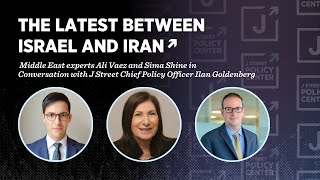
In a live J Street Policy Center webcast hosted by Ilan Goldenberg, senior policy officials Sima Schein (INSS, Israel) and Ali Vaez (International Crisis Group) dissect the unfolding Israeli strike campaign against Iran. The discussion covers: (1) Israeli public opinion—high poll support for the war—and the government’s evolving objectives, from curbing Iran’s nuclear program to degrading its proxy network, with a peripheral but debated notion of regime change. (2) Iranian leadership’s surprise at the strike, its perception of U.S. diplomatic dead‑ends, and internal Iranian public sentiment ranging from nationalist anger to regime‑loyalist resolve. (3) U.S. calculations, especially President Trump’s ambiguous signals, the strategic importance of the Fordow enrichment site, and the risk of U.S. escalation or disengagement. (4) Regional dynamics, including the Gulf states’ uneasy position, Russia’s limited mediating role, and the potential for proxy escalation involving Hezbollah, the Houthis, and Iraqi militias. (5) Competing narratives about the relative weight of the Iranian threat versus the Palestinian/Hamas issue, and how these shape Israel’s security calculus. (6) Possible conflict trajectories—quick de‑escalation, prolonged low‑level war, or a weakened but surviving Iranian regime—and the broader implications for regional normalization, the Abraham Accords, and long‑term stability. The panel ends with a sober assessment that while short‑term military gains are possible, the path to a sustainable strategic victory remains uncertain and fraught with historical analogues to post‑Gulf‑War Iraq and post‑2003 Syria.
Chapters
Hi, everybody. This is Ilan Goldenberg. I'm the Senior Vice President and Chief Policy Officer at J Street. And thank you all for joining us for this update and discussion on what we are seeing with the current conflict between Israel and Iran, which was launched last Thursday evening and has since been full of just very fast and furious developments. I'm not really going to do much in the way of background, because I think people are reading so much and seeing so much, I'm just going to start by turning to our two experts that we are joined with today. And we're really lucky to have two people who I've known for a long time and really counted on for their analysis of these issues. The first is Sima Schein. Sima is with INSS in Israel, but has a long career, you know, working in the Israeli government, including, you with the Mossad, with the Ministry of Strategic Affairs, and with the Israeli National Security Council. And is just like one of the people I always go to when I'm in Israel to understand and talk about what is happening in Iran and how the Israelis are perceiving Iran. And Ali Vaez, who is with the International Crisis Group and has just been like writing and working, you know, and commenting on Iran for years. And really is like as good as anybody in Washington, maybe the best person I know in Washington who like understands Iranian thinking and Iranian government thinking on these issues, and has also just been very carefully tracking the nuclear issue for, you know, really for as long as— again, for as long as I've been working on these issues, and maybe slightly, slightly less, like, you know, because I think I might be slightly older and have like less hair, but, um, you know, um, but But really just lucky to have both of you here. And I think I'm going to start just by asking very simple questions. And Sima, I'll go to you first. Sima, how does this all look from the Israeli side right now? What are, what are people thinking?
So it's a good question because the institute, the INSS, has just completed the poll and there is a high, very high support for the for the Israeli attack on Iran. There is a growing confidence in the— because it's a— we compare it to other polls that we are doing all along the war. So there is also a growing confidence in the military capabilities, which is not a surprise. And there is— the concern is that— the concern according to the polls is that Iran will sustain some of its nuclear capabilities and the main target of the war will not be achieved. So I think this is the results of the poll are very similar to what I hear, what I see. There is a very high appreciation to the, first of all, there is a growing understanding that that Iran is the problem, not only the nuclear one, which is of course the main problem, but also what we have seen in the last year and a half or 20 last months since the attack of Hamas. Everything of that would not have been able to happen without Iran. Iran is the one who supported the Hezbollah, who supported Hamas, who supported the Houthis in Yemen. So Without this Iranian factor as a destabilizing factor in the region by weaponizing its proxies and financing them and training them, all these events that we are suffering in the last 20 months would not happen. So there is a very, very deep concern in Israel from Iran for many years. It has been highlighted been much stronger since the beginning of the war. And I think this is the reason why we see such high numbers of support to the decision of Israel to start the war with Iran.
Now, Sima, I'm also wondering, in addition to how Israelis are thinking about it, like, how is the leadership thinking about it right now? How is it, you know, like, in terms of just, you know, experts and how they're seeing the situation right now?
So the Israeli government, first of all, the Israeli government has published the aims of the war. It is evolving. The more successful the tech is, the more targets for why should we go for Iran? It started with the nuclear program, then with the ballistic missiles. And now we are also hearing about terror, its terror activity, which means that it's a support to the proxies in the region. And there are those that think that the hidden agenda is regime change. I'm sure that not only in Israel, people would love to wake up in the morning and see a different, a better regime in Iran. But I don't think this is one of the targets of the war because Israel doesn't know how to do it and no one Nobody from the outside knows how to do it. But there is a strong commitment and belief that we can do a lot. But there is still an understanding that we cannot completely destroy the nuclear project without the support of the US. Support more than it is supporting now us in defense, but also in offense. And this is, I think, one of the big questions. For the coming days.
So we'll come back on a bunch of those things because I have a lot more questions. But Ali, turning to you. Yeah. How are things looking from Tehran as far as you can tell and talking to Iranians? I mean, you're based here in D.C., but how, you know, how are they— how do you think people are viewing it in Iran?
So, look, the Iranian leadership, Ilan, I think they're taken by surprise because from their perspective, the diplomatic track between Iran and the U.S. had not reached a dead end. As you know, Steve Witkoff was supposed to go to Muscat on Sunday, last Sunday, to have the sixth round of negotiations with the Iranian foreign minister. And the Iranians did not believe that before President Trump comes to the conclusion that the diplomatic track is exhausted, that the military option would be deployed either by the U.S. or by Israel. This is why the opening salvo of Israeli strike in Iran was so effective, because Iranians really did not expect it. Now, in the aftermath of the attack, I think, and everything President Trump has said since then, including his increasingly threatening tone as of today, signals to the Iranians that the The entire negotiation process was a ruse, that Trump was basically trying to provide time for Israel to prepare a surprise attack, and now is looking to ride this wave. And the objective of this campaign, from the Iranian leadership's perspective, and given the type of targets that Israel has opted for, which, by the way, the majority have been non-nuclear, so the targeting of state institutions and economic infrastructure, etc., it signals to the Iranian leadership that the objective here is primarily regime destabilization. And this is why I would argue that because they don't see the U.S. as a neutral actor here, they see the U.S. as basically playing good cop, bad cop with Israel, and because they believe that the objective is not just to destroy and defang their nuclear program. I don't see a scenario in which they would be willing to accept President Trump's terms to dismantle their nuclear program and give up on the right to enrichment. In fact, they are more likely to double down. Their calculation right now— I've talked to a few Iranian officials in the past 48 hours, and it appears that their calculation is that although Israel and the United States have escalation domination, but they have much lower threshold for pain, whereas Iran is the other way around. It doesn't have the same kind of military capabilities and endless resources, but it has a much higher threshold for pain. And so they believe that the more this goes on and expands and it further rattles international energy markets, And that would be the one thing that would create backlash, political backlash on President Trump and would force him to pull the plug on further escalation. As it gets to the population's views on this, of course, unlike, you know, we're not as lucky as INSS to be able to conduct the poll, so we don't know really. But anecdotal evidence, I've seen some people, including members of my own family, who hated the Islamic Republic are now primarily driven by a sense of nationalism and patriotism, and are very angry at the fact that, you know, someone who was trying to undermine democracy in Israel and has so much blood on his hands is pretending to be the liberator of the Iranians from this regime. Now, of course, there are segments of the society who hate the Islamic Republic so much that they are willing to burn down the entire country to get rid of the regime. And then there are its core constituents and supporters who feel that, you know, that there is no life for them after the collapse of this regime, so they have to fight to the last blood for its survival. So it's a divided society. And we really don't know which one of these three trends that I described to you is more dominant.
So I want to go back to Sima. But Sima, can you hear us? Because I know you're—
Yeah, I hear you.
Yes. All right. And we'll just ask you to speak up a little bit because I know you're in a cab, you're doing TV all day. Things are a little crazy right now for everyone. And I want to ask you, it's really a question for both of you. Where do you see this going over the next, let's say, week? And what are some of the biggest decisions that are coming, you know, and we might expect over the next few days? So, Sima, I'll start with you.
Okay. First of all, from what I hear from Israelis, from the Israeli side, I understand I understand that Israel doesn't want to stop the war now. They have enough plans for several days. I don't know for how long, or a week or something like that. And of course, there is a huge, huge hope for President Trump to decide to join in order specifically for one reason, and that's the Fort Duresset site. Of course, now everybody who knows the program knows that Fordow was from the beginning built to be a secret site. Then it was revealed by intelligence communities in the West, and it's part of the program in Iran. And the fact that they are enriching to 60% in Fordow, if If this stays untouched, that means that Iran can break out to a bomb in a very, very short time. So there is a hope, I understand in Israel, that President Trump will, this one way or the other. One way is to bomb Fordooh, the other way is to bring Iran, as he just now wrote on the truce, to surrender, complete surrender. That's the words of President Trump. So if Iran will be willing to come to the negotiation with the promise to stop enrichment anywhere, I think President Trump will not join the war. Otherwise, it becomes more and more plausible that he will. Just following what he's saying and what he's writing. I think this is the point in time where we stand. There is still plans in Israel. There is an eagerness to see for do destroy it completely as a secure for the future. There is the option that Iran will decide because there Actually, I will be happy to hear from Ali Vaez how he sees it, but the way I see the Iranian side, it looks to me that they don't have too many good options, and there is the way to believe that the way to preserve their regime is difficult if they don't agree to surrender, as Trump said, and it's difficult if they agree to surrender. So in both cases, it's a very difficult situation. And one day when there will be no wars, we'll be sitting and talking, the three of us, of the wrong decisions that Iran has taken along the last years. But this is the situation as I see it from Israel.
Ali, you want to respond to that? Because I think—
Yeah, I largely agree with what Sima said. I think the odds of President Trump joining the conflict are higher than him ending it. I think he has probably been given the impression that this is a job almost done and he can come and basically deliver the coup de grâce at the Iranian nuclear program. And also claim credit for being the person who destroyed Fordow and therefore destroyed whatever remains of Iran's nuclear program. And I also agree with Sima that the Iranian leadership really does not have any good options in front of it. But I would argue that suffering from Israeli and American bombs is a better option from the perspective of the Iranian leadership than surrendering to American terms, because the regime would hardly be able to survive if it does capitulate. It doesn't trust that President Trump would limit American demands to just zero enrichment. It would believe that Trump would also move the goalposts and would basically go for full disarmament of the regime. And would not deliver any economic incentives. And so they are much better off hunkering down and fighting this and go down fighting, basically. Because otherwise, in addition to all the losses, they would lose the support of their core constituents, which is a small minority in the country. And without that, this regime would not be able to survive. However, from the air, there is very limited possibilities for affecting regime change. Right? Even in scenarios that there are troops on the ground and there's land invasion, regime change has not always worked in the way that the US has hoped for in that part of the world. So their view is that in the absence of a land invasion, Whatever happens from the air is going to result in the regime suffering and being severely damaged but surviving. And there is no alternative that would be able and ready to march into Tehran and take over power. So eventually, at the end of the day, it would still be the Islamic Republic. My own view is, you know, in a scenario of a massive U.S. intervention, What we are likely to see is a version of Iraq post-1991 or Assad post-2011, not Iraq post-2003 or Assad in 2024, in the sense that you would have a weakened central government that might even lose control over the entirety of its territory, but still is pretty entrenched and repressive and remains in place. And would still try to pursue weapons of mass destruction with whatever means it still has at its possession.
Yeah.
And I got to say, actually, I really appreciate the analogy to, like, you know, post-Gulf War Iran. That feels like a very real and plausible scenario. You know, I do see— I want to go back to one question I have about all this that's just really boggled my mind from the start. And what it says about the US-Israel relationship, if Israel launched this operation without a plan for Fordo and without assurance that the US would do Fordo, I mean, isn't there a risk there of either drawing the US in or, you know, or kind of an assumption of drawing the US in? And then if things go badly, that's a huge risk for Israel or, you know, of being stuck in a situation where you've We've poked Iran, but you haven't gotten rid of the single most important piece, at least of the nuclear program.
In this moment of time, you are correct. And it's a risk that Israel has taken. But the question that I ask myself whether they had a good enough reason to believe that at the end, if everything goes smoothly and only Faudot will be the last problem, they will have the American support. So that's one thing. The other one, I would say that going for such a war without having the assurance that the US will support on the case of Faudot is quite a high risk. But I assume that it was important enough in the eyes of the government in order to do it. And also, probably they believe they can harm Faudou in a way that it will not be destroyed completely, but will be difficult will take time to rebuild these parts of it and to make the electricity and other things. So probably they believe they can make some damage. But I agree with you that even my question each time that I'm talking to someone is, how do you make sure that Iran doesn't break out to a nuclear after this war? Because if they have enough material, if they have for two, if they have— I assume that they have centrifuges in some secret place, advanced centrifuges, because the IAEA did not inspect them in the last years. So I think we are at the beginning of the event and not at the end. And there are question marks and there might be different scenarios for the exit strategy.
Yeah. And that may be like, that actually is a good natural link to the next question because this is always a really important question. I'll ask both of you. I'll go to Ali first, but like, you know, and frankly, it's a question we've seen Israel really struggle with in Gaza. Which is, you know, how does this actually end?
Right.
I mean, I think Israelis have shown an incredible track record of being very operationally effective, especially like jumping out early in wars and conflicts and being, you know, really impressing people with some of the things that they accomplished last week. And I think really set the Iranians back. But like, what are you like trying to tie this to and what's the long-term play here? So Ali, like, how do you see this potentially ending? What are the, you know, I'm interested in both your views on scenarios, and Ali, I'll start with you.
Look, this might be too cynical of an interpretation, but I'd love to hear Sima's views on it. But what I think is, I doubt that the Israeli government, given the degree of its intelligence penetration in Iran, which has allowed it to conduct these really stunningly impressive covert operations, is naive enough to believe that, you know, it is possible to magically replace the Islamic Republic with, you know, the pre-1979 status quo ante of a pro-Israeli political order. I don't think there are— maybe some people believe in it, but the Israeli government as a whole, I would be shocked if they really believe that that's possible. So, my view is that, you know, what Israel is seeking is to turn Iran into basically another Syria, another Iraq, another Libya, another Lebanon, another Yemen, in the sense that it is a diminished regime that is bogged down in internal civil strife and chaos. In a way that it is no longer able to project power beyond its borders and challenge Israel in the region. You know what, I don't necessarily think here the idea is to let, you know, figure out a way of having a soft landing here or how to put the pieces of the puzzle back together. I don't think that's really the game, the name of the game. It is to create, you know, another failed state in the region, which would then neutralize a long-term adversary for Israel. Now, in the short run, I can definitely see how this would benefit Israel. The question is whether it would also benefit it in the long run. You know, obviously, in the long, storied history of Persians and Jews, there has never been deep-rooted animosity. And even this period under the Islamic Republic, which is exceptional, wasn't really at the popular level. It was really government to government. I'm afraid that depending on how this war ends and the degree of bloodshed that it might cause and the consequences for the Iranian nation, it is quite possible and likely that it would have generational effects that would live with us for years to come. I mean, Ilan, this is like, again, to go to the 1991 analogy, of course, the first Gulf War was an impressive military victory for the United States and objectives were achieved. But it is also that war that eventually led to 9/11. And so that's the kind of thing that I worry about, that, you know, Israel and the United States might be running high on, you know, this impression that victory is around the corner and, you know, tactical achievements are already in the pocket. But that doesn't mean that it would translate into a sustainable strategic win for Israel and the United States unless, again, there is some sort of a reasonable strategy behind it. But from what I see now, Everybody's thinking short term. Everybody is riding high on this wave of hubris.
Yeah. And look, I should say, like, part of the analogy for, like, you know, like, in part of one of my old jobs, I worked at the Pentagon specifically on all these scenarios like this was, you know, and we talked actually, you know, specifically the Iraq '91 scenario was, was one that you could see as an end state for this kind of fight. The challenge with it is always that, like, You know, in the aftermath of the war in 1991, like the US had to keep a lot of forces in the Middle East for, you know, a generation to contain Saddam Hussein for the next 12 years at a pretty high cost. And there's a world where you have a very antagonized, like, you know, permanently seeking like much weakened but also like very like you know, antagonize Iran that requires a different level of like long-term military engagement. I don't know. It's possible unless they're so degraded and they've been there already that it doesn't matter. That's the counterargument. But Sima, over to you in terms of just how you see like scenarios for how this ends.
Well, it's, we are, we are asking ourselves and we are trying to have tomorrow, I think, a meeting on that in the institute. But this, it's difficult now to see There are different scenarios of how it will end, and it will be very much dependent on whether the US is involved or not involved, whether suddenly we see an agreement around the table on the nuclear issue that changes the whole situation where we see it today. Today, I don't know. It's difficult. I agree with Ali. I was saying it also before the war when we talk about this issue that the resilience of the Iranians, of the state, I don't know of the people, of the state is much more than the Israeli one. We are a small country after 20 months of war, but there is a huge gap between the support of the— There is a huge gap between the Support, very high support in Israel to the war, very high support. One has to understand Iran is perceived to be the problem of Israel with the proxies in the region, with the nuclear project, with ballistic missiles. Iran is the problem of Israel and there is no question mark on that in the Israeli society. So there is a lot of support and therefore I think it gives the government much more more room for continuing. Yeah, it can happen. I saw the foreign minister of Iran saying if Israel stops, the war will stop. I don't know if it's correct today after 5 days, but it was correct after 2 days. It might end without any agreement, without any solution to the problems, unfortunately. Many of Israel's different clashes with our neighbors were finished in this way without any agreement. But I have to say that there are so many options and it's very difficult to put the finger on which one is more probable. I also think that in Iran itself, Things might be changed. It's not that I think that because of the bombing, the regime will fall, but I think there is an insecure feeling in Iran between, among the people, among the people themselves, that they don't know where to live. And when Trump says that the Tehran population should evacuate the city, I mean, that's a That's a situation that they have never suffered before, never experienced before. So I think it's difficult to be sure about which of the scenarios will work better, and we have to see some more days in order to perhaps to be more clever on the options.
Yeah. I mean, I would just throw in, I just put up a piece that I've spent some time thinking about the way this ends, and I do look, there is a world, I think, where Iran agrees to some kind of a deal. There is a world where— and I think that's what— that'd probably be the best outcome. Like, you know, I think there is a world where, you know, we have some kind of collapse. There's a world Ali is describing of like the kind of, you know, you know, post— like just a very weakened Iran still in— and the fighting stops. I mean, there's also just a world, and I got to tell you, especially when you don't have clarity about how it's going to end when it comes to wars, where this just drags, like, for a long time with continued— and then the question is, how much capacity does Israel have and how much, like, to shoot down missiles? And how many missiles does Iran have? And then, like, how much tolerance is there in the Iranian system, like, in the Iranian country? Because, you know, if Gaza and Ukraine and, you know, like, all these wars have taught us anything, thing, um, it's that, you know, if there's no plan for how to end them, like, and people are miscalculating, um, it could just kind of just continue at some level of fighting perpetually. Um, and to me, I mean, this is the thing that worries me, frankly. It's like that, that option is, um, you know, that's a bad outcome for, you know, the Iranian people and for Iran. It's a bad outcome for Israel and the Israeli people. It's like a bad outcome for for everyone in the region, you know, and so, and I think we have to like look at that as a very realistic outcome of all this as well. You know, I want to like a few additional questions and things have started coming in the chat. So maybe I'll start to throw some of those out and actually see my— we'll come back to you first just on the outcome.
Yeah, because I have to go home because there are some information that might be a lot, so I prefer to have a question and to leave this. Will there be a recording of the conversation?
Yes, yes. So we will put this up.
You'll send me?
Yes, yes.
Okay, great.
But I guess my question is, you know, one of the questions we had come in, like, why this timing? Like, why Why now? Why did Israel choose to go when it did choose to go?
Why now? There is the formal position of the government that was said by Netanyahu that Iran started to do some steps on the weaponization. There is, of course, the end of the 60 days that Trump gave to Iran to negotiate. There was a great feeling in Israel that Iran is just talking in order to waste time. And when you combine it together with some steps in the weaponization, group, you could also think that this was the strategy. Let's talk with the Americans. The more we talk, the more we achieve on our— And was the report of the IAEA that they have so much accumulated, so much 60% material actually increased in the last 3 months, the output of 60%. I think it's all together and I assume it's also political decisions, always. There is also a political dimension to every decision. And probably with Netanyahu, there is more political angle to any decision. But it's a combination. It's never one reason.
Okay, so Sima, since you have to physically go, I'm going to ask you one more question if you have time, and then I'm going to just— and then if you need to leave because you need to get inside and potential, like, you know, I know you're concerned about—
I just want to get to my apartment and then I can also continue there because I have a, I have a place to be there if there is a siren.
If there is, okay, in that case, why don't I go to Ali and then why don't you go to your apartment and, and get back to us in a couple of minutes.
Great idea.
All right, so for everybody who's understanding, Sima's making sure she's near a shelter in Tel Aviv. Yeah, so Ali, I'm going to continue to go through some of the questions from the audience. Um, you know, like You know, I think, you know, there has been at least some reporting of Iran wanting to de-escalate, reaching out for potential dialogue with the United States. Is any of that stuff— I mean, you're pretty skeptical on that, but how do you respond to that reporting? Or do you think there's any way out of this from that perspective?
Look, I think one of the— to go to your question to Sima about the timing, I think One of the probable reasoning that I don't know who, but somebody has put to President Trump that he seems to truly believe in is that, you know, Iranians would become much more amenable to a compromise if their nose is bloodied and if they are beaten, you know, severely. And so I do believe that at some point after initial maybe disappointments of the Trump administration or President Trump's negotiating team, that this is not an easy issue to resolve in 60 days. He became probably a little bit more open to that concept. And so that is the concept that I think resulted in him if not green-lighting, at least providing a yellow light for Israel to take unilateral action. And so, I see these kind of deliberate leaks as part of the psychological warfare aimed at demonstrating to President Trump that the policy is working and the Iranians are crawling back to the table and begging to agree to his terms. But again, you know, this is really not, shouldn't be difficult for for ordinary people to understand. If somebody with a big stick is beating you to accept terms that you were not willing to accept before and you agree, then you're basically demonstrating that that stick works and beating you works. And then basically you're setting a precedent that has no end from the Iranian perspective. So this is why I don't buy into this argument that the Iranians would now agree to capitulate or demonstrate more flexibility. And if you look at what they have said publicly, is that they have said if the war stops, then we will come back to the negotiating table, not that we would come back to the negotiating table and surrender. So I don't, I just see these as potential, again, deliberate messaging aimed at influencing the man who matters the most here, which is President Trump. And, Ilan, I add one more thing on this, which I think is really important to understand. In the Iran-Iraq War, Iran refused to negotiate and prolonged the war, which was extremely traumatizing and costly, for an additional 6 years in order to try to gain the upper hand at the negotiating table, and only agreed to a ceasefire in 1988 when it was completely exhausted and really couldn't continue the conflict anymore, but was at a position of equal footing with Iraq. It had not gained an inch of Iraqi territory. It had not lost an inch of its own territory. It did not negotiate from a position of weakness. The current leader was in charge also back then. He was president in 1988. And so that mentality, I think, is still dominant in Iran, that you never give in in the face of pressure because it will not alleviate pressure. It will only invite more.
Yeah, that is— yeah, and that very much goes to like the scenario I was talking about, which I still have to assume is the base case. Like, it's a lot easier to to start wars than to end them. And like, once they start, you're just— there's a world where you're on the pathway. I mean, I think thankfully, I don't think you'll see this go the way of Iran-Iraq, because this— that was a massive land war, and that's not what this is, which comes at much higher cost for both sides. But, um, but yeah, there's a world where this just keeps going. Um, Ali Vaez, another question for you, um, and then maybe I'll— if Seema's back, we can go back to her, or I'll opine on a couple of things myself, too. But, you know, the Russian role in all this, given that, you know, Russia's relations with Iran have strengthened over the past few years, especially over Iranian support for Russia's war in Ukraine. Is there a role for the Russians either in supporting the Iranians, de-escalating, like, you know, especially given Trump's seemingly positive relationship with Putin?
Look, so the Russians offered to President Trump to to mediate the issue with Iran back in February. It was the Iranians who decided not to choose the Russians and chose the Omanis, because they don't trust the Russians. And there is a reason they don't trust the Russians. In Syria, for years, the Russians looked the other way when Israel was bombing Iranian assets and interests and personnel. In Syria. And they've always overpromised to deliver conventional weapons to Iran but underdelivered. And so I don't think that the Iranians can really count on the Russians here. They had provided them with some electronic warfare technology, which helped to a certain degree back in October. When Iran and Israel had another round of confrontation. But since then, we haven't really seen any major delivery of weapons or, you know, aerial defense systems from Russia. And I do not think that Russia will take sides in this conflict or, again, in the eyes of the Iranian leadership, has the credibility and is seen as a neutral intermediary to be able to come in and end the conflict.
And Ali, while we're— while I'm popping questions off to you, another one is we've gotten is about, you know, Iran's relations with the Gulf states, how they're all viewing this. And also you'd had, you know, over the last few years, some kind of improved relations between Iran and the Gulf states and a move away from supporting military action. How do you think the Gulf states are seeing all all this?
Well, look, when the president was in the region, every Gulf state leader that he met asked him not to attack Iran and to do a deal with Iran. Instead, the president has allowed this war to begin and is now considering joining it. This is a very uncomfortable spot for the Gulf countries because they are afraid of any of these two scenarios. One is a scenario of an Iranian defeat, right? Because that would turn Israel into the absolute hegemon, unchallenged hegemon of the region. And that's a very uncomfortable position for countries like Turkey and Saudi Arabia. And then there is the other scenario of this war expanding and getting prolonged, which would then undermine their lofty economic development ambitions for years to come. Because again, if it expands, imagine a scenario in which Israel in the next few days starts targeting Iranian oil export facilities, then it is quite possible that we see a reduction of the hot summer of 2019 that Iran would start attacking tankers in the Persian Gulf and the Strait of Hormuz. The Houthis would join in. The Iraqi militias might join in. Iran might target U.S. bases in Bahrain and Qatar. And, you know, eventually you might even have maybe in initial phases covert operations, cyberattacks against energy installations in the region. Then maybe even if things get really bad, overt operations. This could get very ugly very quickly. The Gulf states are aware of it and they know it will be very difficult to shield themselves off of these tensions for a long period of time. We might be able to do it for a week or so, but again, if it expands and escalates, becomes uncontrollable, then it will be very difficult. I think the Gulf countries are very unhappy about it. They are urging President Trump to pull the plug on further escalation. But I don't think they are getting the kind of impact that they hope they would have on his thinking.
Yeah, I mean, I do think on this point, it's important to point out because there is like, been a lot out there about how the Gulf states support military action and support— like, I don't think there's much love for inside the Gulf for the Iranian regime. But there's definitely been a shift from about 10 years ago where there was kind of at moments quite encouragement of the US lean in, the very famous like cut the head off the snake, which is now 15 years ago. But I agree with you, Ali, like when you talk to the Gulf states these days, you know, like there's really been a fundamental shift in approach where like our primary focus is the economic development, getting away from oil and a major war in the region with all these missiles flying bombs flying over our heads, even if they're not directed at us right now, is very uncomfortable and could endanger the entire project, especially if the US gets in and you have the Iranians starting to like take shots at American bases or Gulf bases in the region. I'm going to just test quickly. Sima, are you back with us, or are you still, still moving around to your apartment? Sima? Hi, Sima, can you hear us?
I don't know why I don't see you.
It's okay, we can hear you. There you go. Okay. Well, here, okay, so let me go back to you, Sima, both on anything you've been listening to, you heard from Ali, but I also had another question for you, and I think this is And for me, this is an important one because maybe I disagree with this. This is something where I disagree with the Israeli assessment on in particular is that like Iran is the source of all of Israel's challenges. Like, so, right. Like, I still personally tend to believe that, like, you know, you have millions of Palestinians living between the Jordan River and the Mediterranean Sea in Gaza and the West Bank. And yes, Iran has supported Hamas. However, Hamas is fundamentally a Palestinian organization and pulled off, frankly, a much more horrific outcome and a terrible outcome on October 7th without very high levels of technology, without huge amounts of money, but they were able to cause huge damage to Israel. And so my question is, is the focus just off of Gaza and everything with the Palestinians gone? And like, how strategically important is the Palestinian issue versus the, versus the Iranian issue? I mean, both in your own assessment, but also how it's viewed in Israel, because I really do think, you know, this is— I agree completely. Like, Hezbollah is absolutely like a product of a lot of support from Iran, and the Houthis and their ability to threaten Israel comes from Iran and Iraqi Shia militias. But I view Hamas as something like quite different than that. Um, even if there is some Iran— there is meaningful Iranian support, it's still at the end of the day like a very fundamentally different thing that requires different answers. But I'm interested in your take on that, to say that Hamas is different.
Uh, it's different in, in some aspects, uh, but— and here a big but— one that was This, I understood it before, but there are also documents that show—
We hear you and then we don't hear you for a second.
The position, perhaps in another place will be better.
Yes, now I hear you much better. Yeah.
Oh, okay.
So what I say is that Iran is, of course, Palestinian Hamas is different.
But Hamas would not dare to go on the 7th of October without the understanding and the, uh, and the, uh, and it is also, uh, was found in documents that, uh, that they felt that they have the back of the, of Iran. And I have to remind you that in the last 3 years since 2021, Iran has established this war room in Beirut. All the proxies were meeting there with the Revolutionary Guard. They have been talking about attacking Israel from all fronts and making the war that will finish with Israel. That doesn't mean that they thought that it will happen on the 7th of October. Doesn't mean that they wanted. Perhaps they just wanted to prepare everyone in order to deter Israel. All the answers could be right. But from Hamas' point of view, he has— you know that there were in Hamas some people that, especially Hamas outside of Gaza, that were against the close relations with Iran. And then Sinwar was the one who saw that he will get from Iran everything that he needs in order to attack Israel.
And you see what happened.
It's not that Nasrallah didn't enter the war. It's not that the militias in Iraq didn't enter the war, or the Houthis. All of them have entered the war. They didn't do it in the maximum capabilities that they had, but all of them joined the war because that's what they were planning before. To be together in order to beat Israel. So I have to tell you, even you know me for so many years, I was always for the solution of the Palestinian state. I'm for two-state solution. I'm still for that. But I don't think you estimate enough the trauma of the Israeli people after what happened with Hamas on the 7th of October. And there is And let's admit, started in order to put the two-state solution on the table. Hamas never accepted the two-state solution. So it is a completely different story. And it's something that I'm asking myself every second day, how to evaluate the current situation. So I still think that Palestinians deserve self-determination. I still think it's not for the interest of Israel that they will be part of Israel. I think the separation is important. But I have to tell you that it's very difficult to, even for me, to think of how you do it with such a support to Hamas also in the West Bank, with such a high support. I have to admit this. The thinking of of Gaza, which is not our subject now, but the thinking that Hamas will stay in Gaza is something that is very difficult to accept. And I know people that were living in the south, they will not go back to their homes if Hamas stays in Gaza. It's a completely— no war in the history of Israel has made such a trauma to the Israeli people as this, the list. And you have to understand, it's not the question if they had— they didn't have a nuclear bomb, but they came into the houses of the people and killed them and their children in their beds. So, this is something that you cannot live in a state that you don't have the minimum security for your life. This is something that I think most of the people in the world don't understand. They think it's continuation of the conflict between Israel and the Palestinians. Now to Iran, which is our subject. Even I cannot ignore the fact that Iran is the— Why the Houthis were attacking Saudi Arabia for such a long time? Why did Iran attack Saudi Arabia in 2019? So we have to, we have, you know, it's difficult to say, but we have to admit that Iran is conducting for years a very malign policy. Why are they killing opposition people in Europe, opposition Iranian people in Europe? Why are they killing people, their own people on the streets? Because they want a not to wear hijab. So, you know, we cannot isolate the issue, only one issue, and talk about it. We have, at the end of the day, we are facing— I don't know if I would support the— nobody asked me, and I don't know if I would support the attack now on Iran, but since we are there already, I must say that this regime is a very terrible regime to everyone. And You know, that's a— I'm trying, I'm trying. It's not a, you know, a scientific evaluation, but I'm trying to tell you, to express how people in Israel that supported a two-state solution, people that saw that we can get to— that the JCPOA was a good agreement. It was not the best agreement, but it was something that we could live with. For some time and then improve it and then prolong it and others. And today I must say that this regime, you know, is the only one that could make Israel suffer the way we have been suffering. And I don't have to elaborate on that. Most of the details, you know, both of you. It's a state that was sending arms to Sudan with airplanes to Sudan and from Sudan with vehicles through Egypt, through Sinai to get to Hamas. It's not a state that they— Where do you see such things anywhere in the world?
Yeah, no, no, no. And I don't disagree with the very deeply problematic nature. And I wasn't even like, I mean, look, obviously at J Street, we continue to say, well, what we've been arguing for really, And maybe this will take us to a question I can finish with both of you on. What we've been arguing for, what we were arguing for before the strike started on Iran, was, you know, a deal that ultimately gets the hostages out, ends the war in Gaza, but actually has a real plan for the post-conflict that over time marginalizes and gets rid of Hamas, something I spent basically like a year and a half in the Biden administration trying to push for, you know, and with very little support from this Israeli government. Right. With a security and political plan, and then leveraging that to try to get what we call the 23-state solution, right? Like, you know, peace between Israel and all of the Arab neighbors, you know, and as part of that, a demilitarized Palestinian state, right? You know, obviously, Iran stood in the way of a lot of those things. But I guess my question for maybe both of you all now in this last moments of this discussion is like, Is that vision of normalization and that different kind of region, is that still dead? Or is that dead because of this? Or is there still there? Or is there an opportunity that potentially comes out of this depending on how it ends to actually move the region in a more positive direction across the board? So maybe I can go to both of you actually. Ali, maybe to you first, just on whether there's anything positive that can come out of this or if we can still get back to some of those visions or or like not for a long time at this point? And then back to Simut, of course.
It's very hard to say, Ilan, because we don't know how this ends. And once the dust settles, we'll have to see. Again, even in the case of an Iranian military defeat, it doesn't mean the end of the Iranian regime. It doesn't mean the end of its ability to create destabilization beyond its borders. And the Arab street sentiment is also a factor that we would have to consider, especially in a scenario that there are, you know, significant civilian casualties in Iran, as well as what we have seen in Gaza and Lebanon and Syria and so on. I have a hard time imagining that the Arab states would be rushing to normalize relations with Israel, at least not immediately. Immediately after this. And again, because there is no balance of power that would be in their interest either. So I'm quite pessimistic about the prospect of the region landing in a better place. But again, let me just end with this, that I agree with a lot of things that Sima said. But let's remember that the Iranian regime, I think, harmed its own people. More than anybody else. And so no doubt that, you know, getting rid of this regime could be a good thing. But it is a bit like, you know, downsizing the government in the US or, you know, trying to improve trade relations with other countries. There's a wrong way of doing it, then there's a right way of doing it. And the way that as it is being done now through violence and through seeking full capitulation, could really make a bad situation worse. And of course, you know, the US broke countries like Afghanistan and Iraq and was not able to put it back together. I don't think Israel even for a second thinks about putting Iran back together after this. And so I'm not very optimistic that this would be a 1945 moment in which the Iranian regime is defeated, and in the aftermath, the U.S. and Israel help build a much more moderate state in Iran and would not see it as a zero-sum dynamic. So again, I see it as yet another Libya, another Syria, which would create negative repercussions for years to come. You know, remember al-Qaeda, remember ISIS, remember, you know, all the tragedies that happened in Iraq in the aftermath of US's impressive victory. I'm afraid we're on a similar trajectory.
Sima, closing word to you.
I think there is the idea ideal scenario, which— up, and this regime is not there, but there is another regime that takes control of this— again to another place. Sorry, next time we'll do it on the laptop in a better way.
Next time we won't be hopefully in the middle of a war where everything's a little crazy.
So let's hope so. It's, uh, yeah. And you, all the time that we are talking, you, you cannot imagine how many calls are getting in, and the, and the, and 50% of them are from outside of Israel. Okay, I, I, I, I agree with the, with the way that Ali has described the situation. I hope that we are wrong and something good will happen. But I don't think that— I'm not talking about normalization, widening, you know, Trump is talking about Lebanon and Syria being involved, joining the Abraham Accords. I don't think all these optimistic scenarios are there. I don't think so. All of this, and you don't go for a relation, for such decisions when you are not stable. But that's too, too much to think about it. I think what is important now is to see how, how can the US and Iran and Israel close this event. If it, in a way, there is no nuclear program, or there is something— of course there is Bushehr and others, etc., but not in a way that they have the capability to break out to a bomb. This is one thing.
And the other one is that the international community and to I think you've broken up a little bit again, but I think we're kind of over time anyway.
Yeah. Yeah.
So I think we'll probably wrap it with that. But thank you both for doing this and taking the time. I know everything is quite crazy right now. And thank you for everybody who joined us. And, you know, and especially, you know, wishing both to your friends, families, loved ones, like, for everybody to stay safe. And Sima, also you to stay safe. I know Um, but take care, everyone.
Take care.
More from Ali







Israel and the U.S. at war with Iran: what comes next & what implications for the region and beyond?



Trump ‘Is Living in a Fantasy Version of His Own Presidency’ | The Ezra Klein Show
