MESF 2021: Pathways to Manage Non-Proliferation in the Middle East
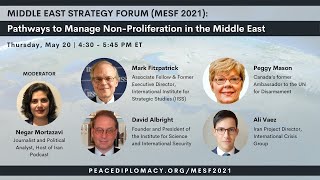
The panel, moderated by Negar and featuring Peggy Mason, Ali Vaez, David Albright, and Mark Fitzpatrick, examined the complex landscape of nuclear and broader weapons‑of‑mass‑destruction (WMD) non‑proliferation in the Middle East. Peggy outlined the historic multilateral push for a regional WMD‑free zone under the NPT, noting the 1974 Egypt‑Iran proposal, the 1995 UN resolution, and the stalled 2015 and 2020 conference attempts. Ali provided a detailed update on the Vienna negotiations to revive the 2015 JCPOA, describing the four negotiation rounds, remaining brackets, the looming expiration of Iran’s temporary Additional Protocol agreement, upcoming IAEA Board meetings, and the influence of Iran’s presidential election on the talks. David highlighted the U.S. non‑proliferation policy legacy, Iran’s “hedging” strategy—three pillars of weapon‑grade uranium capability, weaponization, and delivery—and the limitations of the JCPOA’s verification regime, especially at military sites. He also warned that the JCPOA alone cannot prevent regional proliferation, citing Saudi ambitions and the broader risk of a domino effect. Mark expanded the discussion to include missile and chemical‑weapon proliferation, the challenges of Israel’s undeclared nuclear arsenal, and the feasibility of a Middle‑East WMD‑free zone. He argued that realistic steps involve extending JCPOA‑style restrictions to Gulf states, universalizing the Chemical Weapons Convention, and improving IAEA verification, while acknowledging that a full nuclear‑free zone is unlikely in the near term. The panel then fielded audience questions on making any future Iran deal more durable, the role of international organizations (especially the IAEA and Canada) in strengthening the non‑proliferation regime, and the prospects for a regional weapons‑free treaty. Consensus emerged that a stable follow‑on agreement would need a stringent withdrawal clause, broader regional de‑escalation, and incentives for all parties, but that no single “silver bullet” exists. The discussion concluded with calls for incremental, pragmatic measures rather than idealistic, zero‑sum solutions.
Chapters
Thank you, thank you so much, Eunice, and the Institute for Peace and Diplomacy for holding this very important and timely panel with an excellent group of experts from various locations joining us, including Mark, who's joining us from his car. Thank you for being here. Let me just introduce this distinguished panel who need no introduction, but I'll try to be brief. We have Peggy Mason with us from Canada. She's currently President of the Rideau Institute in Canada. Her career highlights diplomatic and specialist expertise in the field of international peace and security, with a particular emphasis on the United Nations, where she served as Canada's Ambassador for Disarmament from 1989 to 1995. Since 1996, Ms. Mason has been involved in many aspects of UN peacekeeping training, including development of US principles on disarmament, demobilization, and reintegration of former fighters, and the reform of UN arms embargoes, and the dramatic evolution of UN peacekeeping in the 21st century. And in October of 2019, she was elected vice president of the prestigious Canadian Pugwash Group. Ms. Mason is also on the advisory board of the Institute for Peace and Diplomacy. We also have Ali Vaez with us. He's Crisis Group's Iran Project Director and Senior Advisor to the President of the Crisis Group. He led Crisis Group's efforts in helping to bridge the gaps between Iran and the P5+1 that led to the landmark 2015 nuclear deal. And previously, Mr. Vaez served as a Senior Political Affairs Officer at the United Nations Department of Political and Peacebuilding Affairs, and he was the Iran Project Director at the Federation of American Scientists. Ali is an adjunct professor at Georgetown University and is a fellow at the Johns Hopkins School of Advanced International Studies. We also have David Albright with us, a physicist. He's a founder and president of the nonprofit Institute for Science Science and International Security in Washington, D.C. David directs the project work of the institute, heads its fundraising efforts, and chairs its board of directors. In addition, he regularly publishes and conducts scientific research. He's written numerous assessments on secret nuclear weapons programs throughout the world and has published assessments in numerous technical and policy journals, including the Bulletin of Atomic Scientists, Scientific American, Science and Global Security, Washington Quarterly, and Arms Control Today. And last but not least, we have Mark Fitzpatrick, an associate fellow at the International Institute for Strategic Studies. Until 2019, Mark was the executive director of the IISS American office and head of the Nonproliferation and Nuclear Policy program. He's the author or co-author of 4 books about Iran's nuclear and missile capabilities, and he produced a strategic dossier about nuclear programs in the Middle East. He has lectured throughout the world and is a frequent media commentator. He joined IISS in October 2005 after a 26-year career in the U.S. Department of State, including as Deputy Assistant Secretary for Nonproliferation. He received a master's degree from Harvard University. Welcome to all the panelists, and I'd like to first ask you each to give your opening remarks, and then after your opening remarks, we'll do a period of Q&A. I'll ask you some questions and some follow-ups, and then we'll open it up to the audience for questions. The panelists. So if we can start with Peggy Mason, the floor is yours.
Thank you, thank you very much, and thank you for the organizers for inviting me to speak on the— on this last panel of what has been a stimulating and productive two days of discussion on the Middle East against a dramatic and disturbing backdrop. I thought it would be useful to use my brief opening comments to to consider, recall, recount the longstanding ongoing multilateral effort in the context of the NPT, the linchpin of global nuclear nonproliferation efforts, and in the UN General Assembly to achieve a weapons of mass destruction-free zone in the Middle East. The NPT in Article VI explicitly refers to the right of any group of states to conclude regional treaties to assure the total absence of nuclear weapons in their respective territories. There are currently 5 such denuclearization agreements covering the entire Southern Hemisphere below the equator. In terms of new nuclear weapons-free zones, the Middle East remains an old unfulfilled aspiration. First jointly proposed by Egypt and Iran in 1974, through a General Assembly resolution. The concept was broadened in 1990 to cover all weapons of mass destruction. From the outset, two different approaches have been evident. On the one side, the Arab states in the Middle East and Iran have called for the establishment of a nuclear weapon-free zone in the Middle East and the dismantlement of Israel's clandestine nuclear weapon program. On the other side, Israel, some supported by the EU member states, Canada, and the United States maintain that regional peace and security is a precondition for any negotiations on such a zone. So the classic chicken and egg. The 1995 NPT Review and Extension Conference adopted a resolution co-sponsored by the three NPT depository states US, UK, and United States on establishing a zone free of nuclear and other weapons of mass destruction, as well as delivery systems in the region. There was very hard negotiations, of course, to ensure that the treaty was indefinitely extended, and that was one of the agreements that was reached. This resolution called on all states in the Middle East to take practical steps to achieve the zone and called on all NPT states States parties, and in particular the nuclear weapons states, to cooperate and to exert their utmost efforts to this end. The 2000 NPT review conference reiterated the importance of the 1995 resolution, and the 2010 review conference mandated that a conference be held on such a zone by 2012. It was not held due to US and Israeli objections, and this in turn contributed— well, basically was the cause of the failure of the 2015 NPT review conference over disagreements on how to make further progress on the zone, including the holding of the conference. So I raise this in the context of nonproliferation because, of course, the impact, the negative impact on the outcome, the potential outcome of review conferences. Egypt, the traditional lead in this issue, in 2018 introduced a resolution in the UN First Committee mandating the conference to be held. So in other words, instead of continuing with consensus efforts, they have— a vote was held which was overwhelmingly in favor of holding the conference, but with U.S. and Israel voting no and a large number of abstentions. The resolution called on the Secretary-General to convene annual sessions of the conference until it concludes a legally binding treaty. The mandated first session of the conference was held in November 2019. The second session was to have been held in November 2020, but was postponed due to the pandemic. Of the original co-sponsors of the NPT resolution on the zone, the UK and Russia attended the conference, but the USA and Israel did not. I would say that most Arab states of the region, the Middle East, considered that the UN General Assembly decision and the holding of the conference was a breakthrough despite the non-attendance of two key states. Proponents of this effort argue that it is complementary to and parallel to the NPT process and could alleviate pressure over this issue at the next review conference if parties attend in good faith. My final point here in closing: since the United States and Israel did not participate, it is now an open question as to how this issue will manifest itself at the upcoming, upcoming NPT review conference currently scheduled for August 2021, having been postponed due to COVID from May 2020. I mean, two successive failed conferences for the NPT would, you know, would not bode well for the strength of the entire regime. I'll stop there. Thank you.
Thank you so much, Peggy. Next, we go to Ali Vaez.
Thank you very much, Negar, and I would like to start by thanking IPD for the invitation. It's a great pleasure to be here and on this panel with Peggy, David, and Mark. Peggy talked about one complicated multilateral negotiation. I'll give you an update on another one, which are the talks that are happening in Vienna to revive the 2015 nuclear deal with Iran, or the JCPOA. The fourth round of negotiations just wrapped up this week, and now finally there is a joint text that both sides are working on. In the first round, they basically talked about generalities. In the second round, the U.S. provided more detail. The third round was a bit of a deadlock. And now, according to U.S. officials, meaningful progress has been made in the fourth round. But the joint text still has a lot of brackets in it, and some serious disagreements remain, including on some sanctions that the U.S. is seeking to keep in place, especially terrorism-related sanctions and some nuclear measures that the Iranians are a bit reluctant to undertake to go back into full compliance with the JCPOA, given the fact that they have made some irreversible progress, especially when it gets to research and development on more advanced centrifuges. But I think at the end of the day, because both sides realize that status quo ante is not entirely revivable, they would be willing to demonstrate flexibility. But of course, there are serious milestones coming up that could affect this process. One is the deadline of a temporary agreement between Iran and the IAEA on maintaining some aspects of the agency's monitoring of Iran's nuclear facilities. Because Iran stopped its voluntary implementation of the Additional Protocol 3 months ago, and that agreement expires tomorrow. I think it is likely that it would be extended, that the parties would agree, Iran and the agency would agree to put a bit more time on the clock, but we'll have to see what happens tomorrow. Then 2 weeks after that, there is an IAEA Board of Governors meeting, in which the Iran case is likely to come up again because of Iran's reluctance to cooperate with the agency and respond to some of the outstanding questions related to the Comprehensive Safeguards Agreement. The agency has been able to find nuclear material in several sites in Iran and needs to know what's the story behind this, which is often thought that it goes back to Iran's nuclear activities prior to 2003. And then 2 weeks after that, there's another milestone, which is the Iranian presidential elections. And there's been a lot of debate whether a deal to restore the JCPOA is possible before the presidential elections, or it could only happen after the elections because the deep state in Iran does not want to deal with the electoral implications of a major diplomatic breakthrough. Again, I think next week when the negotiations in Vienna resume, we'll have an answer to some of these questions. But the point in giving you this quick overview of the status of negotiations in Vienna is to say that a lot of the things that we will discuss in this session about the future of nonproliferation in the region depends on what happens with the JCPOA. I look forward to the discussion.
Thank you so much, Ali. Let me just, before we go to David, let me remind our audience that if you have questions for the panelists for the duration of this panel, you can drop them in the Q&A section below. And also, I think you can submit questions through the social media and email channels of the IDP. So with that, I'll hand it over to David Albright. David, you're on mute.
Yeah, sorry about that.
Thank you.
Thank you very much for the invitation to speak, and I'm very happy to be here. I want to take a little more of a, I don't want to say argumentative position, but I'd like to give a different view on looking at the issues, nonproliferation issues in the Middle East. I'd like to go back to what used to be US nonproliferation policy. I mean, as essentially the policy in the Reagan administration that sought to keep uranium enrichment and reprocessing out of regions of tension. And I do this because there's an imbalance going on in the region. And so, U.S. policy is being pursued quite aggressively on one side of the Gulf. The UAE signed up to a no reprocessing, no enrichment pledge, and it's a nuclear cooperation agreement with the United States. The United States for years has been pushing Saudi Arabia to do the same. Saudi Arabia is resisting, looking across the Gulf at Iran, which, which is an exception to this policy, and And that it's a— and to make matters more complicated, the JCPOA, and I assume it will come back. I mean, I'm going to, in my talk, I'm just going to assume it's going to come back. It's legitimized enrichment in Iran in contraposition to this traditional US nonproliferation policy. And in some ways worse, it's created a pathway toward a very large uranium enrichment program in Iran. I mean, that's, if you look at Iran's enrichment plan that was submitted as part of the JCPOA, they want to have tens of thousands of advanced centrifuges sort of ready to go in 2030 when the sunsets really start to disappear on the nuclear limitations. And then you combine that with Iran's history of seeking nuclear weapons, I would argue, and again, I more than, I hope this just stimulates discussion. I find it hard to be optimistic about the prospects for nonproliferation and denuclearization in the Gulf region, or even more broadly in the Middle East. And I'd also, in a way to provoke discussion, is when I look at it, and my institute and I have been studying Iran since the late 1980s, early 1990s, is that pressure and a fear of the consequences, particularly military ones, has dissuaded Iran from crossing the line and building nuclear weapons. However, Iran has not ended its nuclear weapons ambitions. And what do I mean by that? I mean, in a book we've just published called Iran's Perilous Pursuit of Nuclear Weapons, we do, we look very deeply into the, what's called the Amad Plan. And we use the nuclear archive that was seized or stolen by Israel in Tehran, which senior, at least one senior Iranian official has admitted was theirs. These are not forged documents. And what you see in this and what we describe in the book is Iran having a crash nuclear weapons program in the early 2000s. And half of its locations were not known by Western intelligence until the seizure of the archive in 2018. Now, we all know, you know, U.S. invaded Afghanistan, U.S. invaded Iraq. In the summer of 2003, it looked pretty grim to the Iranians. The Iraqi army had been crushed in a matter of days, an army that Iran couldn't defeat in 8 years. So they went through a process of reconsideration, and the archive contains their discussions. About the future of the nuclear weapons program and what they planned to do. And they decided not to build nuclear weapons. And that stands as a great nonproliferation accomplishment that occurred at a— when we didn't even know it happened. But it didn't stop its nuclear weapons program. And in our book, we go through this, and I don't want to bore people with the details, but we lay out how our assessment of what happened after 2003, using a lot of information that the IAEA had acquired, and basically end up with an assessment that the program today is a program to be ready to build nuclear weapons if the leaders decide to do so. And that's not a threshold state. This is a different category. It's not a Japan with separated plutonium. This is a country that has taken many more steps beyond that to be prepared to build nuclear weapons. And we call it be prepared to build nuclear weapons on demand. There are three pillars to Iran's nuclear weapons program: the capability to make weapon-grade uranium, weaponization of that weapon-grade uranium, and missiles, the ability to deliver it. And Iran is doing well in all three. Unfortunately, the JCPOA has not eliminated any one pillar. It's certainly taken big chips out of the fissile material or the weapon-grade uranium pillar, but it has a promise to put a bigger pillar in place in the future. Another thing, and Ali referred to it, is there's been a real problem in dealing with Iran's past nuclear weapons programs and concerns about present-day nuclear weapons-related activities. The deal is wonderful on the verification of declared fuel cycle facilities. I worked on inspections in Iraq in the 1990s, and the JCPOA is really good on that side, but it's not so good on delivering on the— to know what's going on at military sites. What is going on on the nuclear weapons side? which, based on the Amad Plan, really does happen at military sites with, interestingly, interconnections with the Atomic Energy Organization. And so the IAEA, well aware of this, has been reporting every 3 months that it has an inability to verify, or whatever, however you want to put it, have confidence in the absence of undeclared nuclear materials activities or facilities. Facilities. And worse, since the discovery of the archives, which the IAEA has the complete set and has used, they found undeclared uranium at two former Amad sites and at Turquoise Abad, which is a site where equipment and material associated with the nuclear weapons program is alleged to have been stored. And at Turquoise Abad, the IAEA wrote recently that Iran's answers about the undeclared uranium were not technically credible. And this brings to 5 sites where the IAEA has established the presence of undeclared uranium. And Iran's lack of cooperation on access to military sites and known members of the Amad program and its successor organizations is, from a nonproliferation point of view, is a dangerous precedent for the region and the world. And I think we're heading to a dangerous future unless we do more than just reinstall the JCPOA and continue to live with the current inspection inadequacies. And it's a future that's unstable. I mean, I hope we talk about— Trump made it clear he wanted to leave the deal. I was personally involved in an effort to fix the deal, and under National Security Council advisor McMaster, he was more or less kicked out. That effort was abandoned, and John Bolton came in and Trump left the deal. And I would guess if a Republican came to the White House, there wouldn't be any effort to fix the deal the next time. And who knows if the House and Senate go Republican, what could happen in terms of imposition of additional sanctions. Violence, I think, is going to continue. And we use violence in a very broad term. I mean, often it's stated, you know, have a deal or have a war. Israel sculpted a third way where they're blowing up things, people are dying. I mean, it's no accident Mohsen Fakhrizadeh was killed late last year. I mean, he's seen as the Leslie Groves of the Iranian nuclear weapons program. Saudi Arabia is going to be hard to predict. I mean, we monitor it more and more that, you know, it's trying to make sense of their secret fuel cycle. Activities. We're very worried they may team up with Pakistan in some way. We don't think they would buy a bomb from Pakistan, but maybe they'd buy a safeguarded uranium enrichment plant. We don't know what Iran's going to do as they build up their capabilities. And I have to be pessimistic about a WMD-free zone in the Middle East. I mean, I worked on it. I haven't worked on it in decades, but in the '90s during the Anchors Process, Some of you will remember there was a real concerted effort to develop this regional dialogue that would move toward that, and what were the conditions and verification requirements? Now, I don't know if I'm over, but let me just say, I think—
Yes, I have some questions for you later on. We're going to have a chance to take them.
Okay. Let me just end with two quick things. One is, there are things that can be done and I'd be happy to talk about it, and the deal can be fixed. And it's been thought through in many ways. And it's important to focus more on the inspection effort. Let me end there.
Okay.
I'll definitely follow up on that with you, and I hope you've sparked some debate for later in the Q&A part. Now let me go over to Mark Fitzpatrick, and then afterwards we'll get to the Q&A section. Go ahead, Mark.
Thanks for inviting me, and apologies for speaking from a car. I'm going to return to the kind of the focus that Peggy started off on, looking at the Iran nuclear issue, but also more broadly other countries in the Middle East, and then more broadly beyond the nuclear. But I promise to do it in 4 minutes. I look at the issue in terms of a hedging strategy that Iran and some other states pursue. Hedging means building up capabilities that can be employed, expanded upon for a rainy day. And the aim of nonproliferation is to keep these capabilities latent, limited, and transparent. Now, the nonproliferation goal does not apply to Israel because it already is an unconfirmed nuclear power outside the NPT, intent on keeping its regional nuclear monopoly. So the goal in the case of Israel for other parties is disarmament. Not nonproliferation, even though disarmament is unlikely, it seems, for the time being. In theory, Israel would be willing to give up its nuclear weapons when it is at peace and when it has secure borders. Unfortunately, there's been no movement in that direction. It's all the opposite, it seems. Early on, Israel's nuclear capability sparked nuclear interest in other countries, particularly Egypt, Iraq, and Syria. Israel's nuclear program was not the reason Iran expanded, uh, went down the nuclear weapons capability route. You can thank Saddam Hussein for that. But Iran's confrontation with Israel and with the United States, I think, is increasingly a driver for what has become a very aggressive nuclear hedging strategy. As David said, it's much more than Japan. The more that Israel attacks Iran's nuclear facilities, the more determined Iran is to expand on them. Iran's advances spark Saudi interest in nuclear weapons, as we know. Now, I don't think it'll be so easy for the Saudis to buy or develop nuclear weapons, but where there's a will, maybe there's a way. So let's reduce the will by alleviating, to the extent we can, Saudi concerns about Iran. I believe that restoring the JCPOA would block Iran's pathways to nuclear weapons for at least a few years, buying time. And that time cannot be wasted. Iran needs to be persuaded to keep its worrisome capabilities latent, even after the JCPOA limits expire. If Iran and the Saudis can be kept from acquiring nuclear weapons, this would obviate Turkey's perceived need to keep up a power balance. I'm talking in terms of nuclear dominoes. That might not be a relevant analogy, but one can't rule it out either. So now, nonproliferation doesn't just apply to stopping the spread of nuclear weapons. It also means stopping the spread of chemical weapons, of biological weapons, and missiles. One of these is a foreseeable goal. The chemical weapons abolition is really conceivable given that 193 parties are— 193 states are party to the Chemical Weapons Convention. It's shameful, I think, that Israel and Egypt are not among the 193, though Israel at least did sign the convention, but they haven't ratified it. I think it's horrible that Syria, which did sign the convention, continued to use chemical weapons. And it's horrible that Russia protects Syria from suffering any consequences. You know, treaties are worthless if they're not implemented and enforced. Now, there's no treaty to stop the spread of ballistic missiles, only an arms control agreement, the Missile Technology Control Regime, voluntary. Once the Iran nuclear deal is restored, and I think it will be, The United States and European partners will seek to engage Iran in talks to limit its missile program. The most important objective in these talks, I believe, is to stop Iran's export of missiles and rockets to non-state actors like the ones that Hamas is raining down upon Israel. It's also important, I think, to stop Iran's— to limit the range of Iran's missiles. To lock in a self-declared limit of 2,000 kilometers. I think Iran is unlikely to do so unless regional rivals are similarly constrained. This means Israel and Saudi Arabia also accepting limits. Both of them have missiles that can travel farther than Iran's. And maybe this can best be done in the context of a Middle East nuclear weapons and WMD-free zone that Peggy addressed. I'm not very optimistic about that, so maybe a missile, uh, focus on the missiles alone. Thanks very much for inviting me.
Thank you, Mark. We have a few questions from the audience, and I encourage everyone to type your questions in the Q&A section. But let me first start by doing a round of questions and then maybe have some debate among the panelists. Let me start with Ali, since you gave us the latest on the JCPOA. One question that has been discussed and still remains is whether, after Iran and the U.S. agree on a full return to the JCPOA or to full compliance, can this renewed agreement be made more sustainable in any way, basically to prevent another withdrawal in the future, as we saw that we saw under the previous administration, President Trump, in case of, let's say, another Republican administration in the future? Because this is something that's been of concern, both when it comes to the experts who are watching this space and also mostly the Iranian side.
Thank you, Negar. That's a great question. Look, the reality is, I think we have to admit that, you know, there are two inconvenient truths about the JCPOA. Number one is that it had it has proven, given the record of implementation or non-implementation, that it's not really satisfactory to either side. Iran was unhappy with the amount of sanctions relief that in practice it received in 2016. And the U.S. has been unhappy about certain nuclear elements of the nuclear deal, to some of which David referred to. The second inconvenient truth is that the deal has proven to be unstable. Again, just look at the record of the past few years. And so without any doubt, there needs to be a follow-on agreement. And that's the best way I think of stabilizing a nuclear deal with Iran that would address not all, but some of the shortcomings of the original agreement based on the experience that we've had with its implementation. Now, you know, we can talk about elements of a follow-on agreement, but I think there is a very clear milestone in 2023 that both sides can use to, as sort of a deadline for negotiating a follow-on agreement. And that's one of the milestones that is basically in the JCPOA's own calendar, and that's the transition day. So by transition day in 2023, Iran is supposed to ratify the Additional Protocol And Congress is supposed to lift, not just suspend, but permanently lift the sanctions that the JCPOA had suspended. Well, we know Congress is not going to do that, and Iranian parliament is not going to therefore ratify the additional protocol. And so the deal will again be in trouble in 2 years from now. And that's, you know, one more reason that this deal is unstable. And I think Iranians will be unhappy with the prospect of another unstable deal right before the next round of presidential campaign in the U.S. starts, especially because, you know, the prospect of uncertainty in the economy is sometimes worse than the certainty of living under sanctions for the foreseeable future. So this revolving door of sanctions relief, you know, the doors of the Iranian economy opening and closing, every year and a half is not really something that the Iranians want. And I think President Biden would have a hard time seeing that under his tenure, the Iranian nuclear program starts growing exponentially. So there needs to be a follow-on agreement by that point in place. And I think if the JCPOA is restored, and with it, at least a modicum of trust between the two sides, if the deal, a follow-on agreement is framed as a better-for-better deal, then I'm pretty optimistic that it could be achieved in this timeframe. The second element that is necessary for making a follow-on agreement more stable is to address the regional context of enmity between Iran and the U.S. and their regional partners. I mean, remember that some of the critics of the JCPOA often refer to non-nuclear issues, for criticizing the JCPOA. And those non-nuclear issues, be it Iran's ballistic missile program or its regional activities, all happen in the context of the region. And so there is a need for regional de-escalation. And I think one of the mistakes of the Obama administration was that it tackled this issue in a sequential way. It prioritized the urgent at the expense of the important. Urgent was the nuclear issue, important are the regional issues. And I think that's why the Biden administration seems to be pursuing a simultaneous approach of trying to de-escalate regional tensions, be it in Yemen or Iran-Saudi negotiations that have happened in Baghdad, for instance, in parallel to try to revive the JCPOA and then build on it. But to address your question specifically, you know, unfortunately, there is no legal mechanism that would set a follow-on agreement in stone. Obviously, if the following agreement is negotiated as a treaty, you know, it would have political buy-in from both sides. But as we saw during the Trump presidency, you know, the treaties could also easily get reneged on. The treaties are very difficult to get in, very easy to get out of. Even if you get a congressional executive agreement that requires just a simple majority and not a supermajority, in the same way, again, any president can easily get out of it. And I think that's a major problem for U.S.'s credibility as a reliable negotiating partner. But that's a much more structural issue than just the issue of the JCPOA. I do believe that the follow-on agreement would have to have a withdrawal clause, which the JCPOA lacked. And the withdrawal clause would have to be pretty demanding and stringent on conditions. But I also think that the most important element again here is to change the incentive structure for both sides. If the U.S. has more insurance that Iranian nuclear program will remain civilian in the longer run, I think there will be less opposition to the agreement. And if the Iranians also benefit more from a JCPOA 2.0, I think there's a better chance that they would remain committed to it. Another element here that could potentially help and was lacking in the initial agreement is that if the follow-on agreement has some elements of U.S. primary sanctions as well, and there is an opportunity for more than just the Boeing deal, so the U.S. companies have more skin in the game, I think the cost-benefit calculus for the next U.S. administration to get out of an agreement with Iran could potentially change, or at least the political pressure in Washington against unilateral reneging on the agreement would increase. But again, there is no silver bullet solution that would guarantee that the next agreement will remain in place permanently.
Thanks, Ali. David, I want to ask you about the impact of the revival of the JCPOA. But let me combine this in two questions. Going back to your remarks, you talked about your efforts under National Security Advisor McMaster to make the deal better. I want to know what the ideal scenario— that didn't happen, but what the ideal scenario was that you had in mind as far as, you know, taking that effort and making the deal better. And then As a follow-up, I want to ask you what the impact, what you think would be the impact of the revival of the JCPOA, of going back to full compliance on other countries in the region, namely, for example, Saudi Arabia's nuclear program.
Yeah, I think, I mean, the short answer, it's complicated what was done, but the short answer was to create the momentum to negotiate a follow-on deal. I mean, that was the idea, was to first get the Europeans on board and then to go out to Russia and China. And it was going very well with the Europeans by the end. It needed more time, but it was really making progress, and there was papers had been— joint agreements had been, or multilateral agreements had been generated. And it But the bottom line was really to get to a better deal and broaden the negotiations to the regional and missile issues. And there was considerable support within the administration for that. On Saudi Arabia, I mean, well, on the JCPOA, the problem with the JCPOA is it doesn't— and Ali referred to it— it just doesn't— it's not very satisfactory from a U.S. national security point of view, and it's certainly not satisfactory from a an Israeli point of view. I mean, they view this, Iran's nuclear program, as an existential threat. They don't feel that it would take that many nuclear weapons to destroy their country. And, um, and so they're— they want to see no enrichment and no reprocessing. So they're going to be unhappy. Saudi Arabia is just very resistant to stopping with Iran having enrichment. It just doesn't want to do it. And US diplomats have pushed pretty hard on Saudi Arabia to accept the gold standard, the no enrichment, no reprocessing. So I just think it'll— the situation will slip away in terms of capabilities. Who knows? I mean, we'll work hard to stop Saudi Arabia, expose things, make it harder for them, you know, want IAEA much stronger in their presence in Saudi Arabia. It's always easier to stop them now than later. And I would certainly encourage the Biden administration to push them. I mean, at the same time, if the U.S. pushes away Saudi Arabia, I don't know what the status of that is, but there's a lot of forces in Washington that want to treat Saudi Arabia almost as a pariah country. I think that'll worsen the situation from a nonproliferation point of view. I don't want to talk about— I don't want to defend Saudi Arabia's human rights records, or— but just from a strictly nonproliferation point of view, is there a reason to hug Saudi Arabia? Which also brings in, it may be important for Israel to hug Saudi Arabia. Israel certainly doesn't want to see Saudi Arabia develop capabilities in this area because it doesn't know where it's going to be 10 years from now. So I think, but I think the bottom line is the JCPOA is not a stabilizing nonproliferation tool in the region if you're worried about the spreading of capabilities.
Thank you, David. Let me go to Mark. If I'm going to pose a question to you, but also if you want to respond, because I know you may have different views on the JCPOA, but Question is, how, in your opinion, how do you think the revival of the JCPOA will impact the international nonproliferation regime? And then as a follow-up, can this sort of agreement be replicated with other nuclear programs, be it in the Middle East or even beyond the region?
Thanks. Um, so clearly, the revival of the JCPOA is going to strengthen the international nonproliferation regime because the withdrawal from the deal, the unraveling of the deal, really was detrimental to global nonproliferation, starting with Iran's abandonment of its commitments, its building up of capabilities, getting so much closer to a nuclear weapon. And then the, you know, the way that this impinged on Saudi concerns. You know, Saudis really have a legitimate concern here, although they're actually more worried about some other aspects of Iran's policy. So if Iran's march toward nuclear weapons can at least be halted temporarily, that alleviates the pressure on the Saudis. It doesn't remove it entirely. It alleviates the pressure then that would also impinge on Turkey and possibly Egypt. And it strengthens multilateral diplomacy, which is the tool, not only tool, but a major tool of the nonproliferation regime. Can the deal be replicated? Well, it certainly cannot be replicated entirely because it's such a unique situation. Iran is such a unique country. No other country in the region as Iran's current history of violating the NPT and its aggressive nuclear hedging strategy. But there are elements of the deal that can be replicated, and not just in the region, but universally. Some very important aspects of the JCPOA, the ban on certain technologies that are useful to nuclear weapons development, that should be recognized as part of the NPT ban. The extra verification measures that go beyond any other verification measures should be replicated elsewhere. Now, there's one unfortunate thing about the JCPOA is that the ban on nuclear weapons-related development cannot be verified. Russia prevents the IAEA role in verifying it. So that has to be fixed for starters. And just You know, just one thing in response to David. He presents a good case, but I think, you know, all of us would agree that no enrichment in the region or anywhere would be better. No reprocessing would be better. But if a country is already so far down the road to that, you know, it's better to limit it than to not limit it. And the impact on Saudi Arabia is much worse if Iran's program were never limited by the JCPOA. So the alternative is not the JCPOA and then some ideal arrangement that could be imposed on Iran, and you think that Iran might accept. I mean, they didn't accept anything that was, you know, that the administration before Barack Obama tried to impose, and they didn't accept any of the 12 demands by Pompeo, but they were ready to negotiate some limits, and the key is how to expand upon those negotiated limits.
Could I say something?
Sure, sure, by all means. If anybody else also wants to jump in, I welcome it.
Okay, I think you could make the same statements before South Africa decided to give up its nuclear weapons program. And if a way can be found for Iran to demonstrate it's truly a civilian um, as a civilian program and had the benefits of that, uh, easy to import enriched uranium, I think the program may just disappear. I mean, that, that was the strategy in South Africa. Let them have enrichment on a civil side, and they kept a 200,000-300,000 SWU per year plant, and they shut down their, their military enrichment plant and ended their bomb program. And within 2 or 3 years, they shut down that plant too. Because they could just get enriched uranium so much cheaper through the international market. So I think Iran can be steered in that direction, but it just seems resistant. It just seems to be hanging on to it. It's a very poor centrifuge program. I mean, we know much more about it because of the JCPOA. It's a failed commercial program, and they hang on to it, and you have to worry that it's really just They need the weapon-grade uranium pillar there if they do decide to build the bomb.
Let me bring in Peggy here. She has more of an international perspective and also a more northern Canadian perspective when it comes to these issues. Peggy, I want to ask you about the role of the international organizations in strengthening or advancing nonproliferation in the region, also the role that Canada, you think, can play as one of the countries in the systems? And also, how, in your view, can the IAEA, basically as the world's nonproliferation monitoring agency, be strengthened and more empowered to sort of play a stronger role in pushing for this nonproliferation regime in the Middle East or even beyond?
Thank you. Thank you very much. Well, I might just start with the IAEA. And of course, I think the single, you know, the single most important thing that can be done is to ensure that the IAEA has the budget that it needs, and that attempts to politicize it are squashed. Canada, for example, provides voluntary funding in support of the JCPOA. But I think the additional protocol, trying to get as many countries as possible to sign on and to implement the additional protocol, I think those elements— I think the budget has to be satisfactory. On expanding the role of the IAEA, I mean, I'd be interested in the comments of Marc and David, but there's a conundrum which the negotiators of the Treaty on the Prohibition of Nuclear Weapons, the latest treaty in this area, faced when they were trying to identify an agency to verify disarmament, nuclear disarmament. And of course, all of the examples that we have, notably between Russia and the United States, the Soviet Union and then Russia and the United States, involve bilateral measures. Each side hammering out a deal where each side is satisfied that the dismantlement is really taking place. In this TPNW negotiation, the negotiators looked to the IAEA and they actually sought advice from from probably the best Canadian expert in this area, Terry Grauwe, former senior official at the IAEA, about the role that they could play. And he said, he cautioned greatly against the IAEA playing a role which would put them in possession of nuclear weapons proliferant knowledge, because that in itself is is nuclear proliferation. And that far better to have bilateral arrangements between, that satisfy each side. In this case, it was, as I said, Soviet Union and United States, and then have the material from dismantlement put under international safeguards. So a long way around to say that So there is a real issue about the IAEA going beyond the role that it has now. Now, having said that, so I answered the IAEA part first, but if I wanted to go back, you asked me about what role international organizations can play. I mean, I went through that long process with respect to efforts to achieve a zone free of weapons of mass destruction in the Middle East, which has a long, long way to go yet. But the single most important role that Canada can play in international organizations to advance nonproliferation in the region is really to work on ensuring, on strengthening the regime generally and working on strengthening the NPT. Review process. And, you know, in that regard, as I talked about earlier, you know, we had 2015 was an unsuccessful conference. The idea that we would have a fail— that means failure to agree on a final document after reviewing the state of the treaty, you know, in 2020, now 2021— does not bode well. And The reason why I've talked about the specific example of the nuclear weapons-free zone in the Middle East and how that can scupper the conference, but there's a broader problem. And Mark said, you know, it's not nonproliferation when you're talking about nuclear disarmament. Well, actually, under the NPT, there are two types of proliferation. There's horizontal proliferation, which is what we've been discussing, and then there's vertical. Proliferation. And of course, the NPT Article VI, there is a treaty obligation on the nuclear weapons states to engage in good faith negotiations to reduce and ultimately eliminate their nuclear weapons. And the problem we have in the lead-up, you know, to the 2021 review conference is that from the point of view of all those non-nuclear weapons states in good standing at the NPT, Nuclear disarmament has been there. Not only has there not been nuclear disarmament in some while, but we're going in the opposite direction with massive nuclear weapons modernization programs ongoing in all— there's programs ongoing in all of the 9 nuclear-armed states, and the biggest ones, the big— the single biggest, United States, is followed, you know, followed by Russia. And so not only is there not any movement towards nuclear disarmament, but we're going in the opposite direction. And under the Bush, under the Bush, under the Trump administration, we even saw increased reliance potentially on nuclear weapons, and we saw new roles for nuclear weapons. Now, happily, the Biden administration has made it very clear that they're not interested in new roles for nuclear weapons. And there's even the Nuclear Posture Review ongoing. There's at least some discussion of whether or not the United States might consider a sole use of nuclear weapons, that is, to deter their use and retaliate if there is a strike. So that's a positive element. But the other really important point with the Biden administration, and this came out in the G7 nuclear nonproliferation statement or nonproliferation statement in the G7 meetings that were just held, was the reaffirmation of the importance of past commitments that have been made. I mean, I described some of the past commitments in the review conference process and really important undertakings that the Nuclear Weapons the United States made in order to get all the other states parties to agree to an indefinite extension of the treaty. Now, the Trump administration had made it clear that they were disowning those past commitments. And the reference in the G7 statement indicates, reaffirms past commitments. So, you know, that's a very positive step. But, you know, to cut to the chase, it's going to take more than reaffirming past commitments. It's going to take some measure of tangible progress in reducing nuclear risks at a minimum if this conference is going to end in a success. And Canada, as a non-nuclear weapons state party to the NPT and a NATO member under, you know, a nuclear umbrella, has a role to play in dialogue with NATO on reducing nuclear risks. And reducing its reliance on nuclear weapons. And in fact, we've had, astonishingly for many of us, but we had a unanimous recommendation, all parties agreeing in Parliament, from our standing committee, our parliamentary standing committee on national defense, calling for Canada to undertake such a dialogue with NATO to reduce its reliance on nuclear weapons. I mean, as long as the big guys and those under the nuclear umbrella can continue to demonstrate in every way that they think nuclear weapons are fundamental and central, the NPT bargain is going to continue to be more and more wobbly with all of the focus on horizontal and no progress on the vertical. So Canada has played a role in the past in trying to strengthen the NPT. I wonder if folks aware that the NPT has no standing secretariat. It has no ability to call an emergency meeting in the face of some proliferation threat. So I would hope that Canada would take up again its efforts to strengthen the institutional framework of the NPT so that at least there's a standing secretariat and an ability to call urgent meetings when necessary outside the regular review process. I'll stop there. Thank you.
Thank you so much. Let me, before we go to the audience, let me pose a question to the panel and feel free to jump in any of you. I want to know if you think a nuclear-free Middle East eventually is ever possible, can be a reality, or countries in the region willing to sign sign under any conditions a weapons-free treaty for the region? And let's say, what role would international organizations, UN, IAEA, and various world powers be playing if such a scenario is a possibility in your view?
Who goes first? Maybe I should. I think it can be. I mean, Again, I haven't worked on it in a couple of decades, but the Acres process, which involved deep Israeli engagement, I think it's possible. Mark laid out, you know, and Peggy too, we have to deal with the regional issues and make the region safe, which has been a key in other nuclear weapons-free zone successes. I hope I'm not saying something secret, Peggy, the IAEA does look at nuclear weapons programs deeply. And I'm sorry you got that advice because I've been involved in Iraq, the nuclear weapons design information, all kinds of things were looked at in detail by the inspectors in South Africa, Taiwan, Iran. And the IAEA does it in a very disciplined manner. The ones who do it are from the nuclear weapons states. And in fact, I've always wondered why this approach isn't taken, and I would hope it would be taken in the WMD-free zone in the Middle East approach. The IAEA is very good at ferreting out secret activities and doing denuclearization in a very fair, honest, and and thorough way. And they've demonstrated that very successfully in South Africa. I mean, people don't like to bring up Iraq, but it was done there too. The effort was over by 2007. There had been some bumps. Iraq had hidden things. I'm sorry, 1997. Iraq had hidden some things, but after '95, there have been some changes and there was great clarity. And the nuclear weapons weaponization program was deeply understood by the inspectors, and the same as I mentioned in South Africa. So I think they could do it. And again, it's the nuclear weapons states providing the inspectors, creating curtains around that information, and then finding secure places to store it. Libyan weapons design information is in the U.S. State Department. They did a case, they had— Switzerland ended up with a great deal of nuclear weapons design information through the Khan network. That information was vetted by the IAEA, and then it was simply destroyed. Some was kept by the IAEA that was necessary for the legal verification, but most was actually in that case destroyed.
If I could just jump in, I thank you very much for that clarification. Of course, Of course, the key issue that you've identified is it's IAEA inspectors from nuclear weapons states that are doing this, and that removes that problem of the broader, potentially the broader dissemination of the information. But of course, in the context of the multilateral Treaty on the Prohibition of Nuclear Weapons, it would be highly problematic to try and build that approach in. So, but still, I think that's a very That's a useful clarification. And of course, yes, under special inspections, now the optional protocol— I mean, Canada was a proponent of special inspections way back before the United States was. The IAEA has become a past master at detecting diversion to undeclared activities. So yes, they have developed incredible expertise. Expertise in doing that. And we've seen that with respect to the JCPOA. And I might just note, going back to the JCPOA, that whatever subsequent concerns the IAEA had as the deal unraveled, they certified full compliance by Iran with the JCPOA up to the departure the withdrawal of the United States. And so I think I'd want to say, you know, I think I'd want to follow what Mark has said about identifying, and I guess I would say the best is really the enemy of the good here. And if you've got a program that does recognize, that does hem in hedging as much as possible and give the international community time sufficient time should there be a decision to break out, then I think that's what we need. I think that's what United States and Iran are looking at now in the context of the negotiation that they're engaged in. And I think that, as we've seen with the efforts also on the regional side, that really could unlock further progress. In both areas. I do have to say something about South Africa though. I don't think there's any, I don't think you can draw any lessons from South Africa for, I mean, in terms of motivation in the Middle East. I mean, it was such an entirely different situation. I mean, and it, you know, it really was a change, a massive change in the governance of the country. And, you know, there are some darker intimations as to why the outgoing government might have been so keen to end its program. So I think it's a really sui generis situation. But it's a good precedent in terms of giving up programs. But, you know, Argentina and Brazil had latent programs as well, too. So we have a few examples of countries starting down the road and giving them up. I'll stop. I see Mark's been Mark, you're on mute.
I thought I might address the question. You know, is there any possibility of a nuclear weapons-free zone, nuclear weapons-free zone in the Middle East? And the only possibility, frankly, realistic, is if that free zone does not encompass Israel. You know, that would be possible. But nobody wants that. None of the countries that are advocating it want that. They want Israel to get rid of its nuclear weapons. So the question is, what would it take to persuade Israel to give up its nuclear weapons? David has outlined, you know, theoretically one scenario, South African one, where it no longer felt a need for nuclear weapons. Frankly, its security environment changed to the— and its domestic environment changed to the point that they didn't feel any need. Conceivably, you know, that maybe could do it. Does Israel find other— some other way to satisfy its security needs? Another way you might think of it theoretically is So right now there's one nuclear weapons state, doesn't want to give them up. If there were two or three nuclear weapons states in the region, well, maybe Israel would feel better off if there were none. And then in those circumstances, maybe it'd give up. I'm not advocating this, but theoretically, you know, they might be more willing in those circumstances.
But can I make a suggestion between multiple nuclear power countries in the region and zero nuclear powers? I think honestly, it's not very realistic to expect a nuclear weapons-free zone in the region to happen anytime soon, given the geostrategic rivalries. And by the way, it's not just the problem of Israel. You look at other rivalries, including Turkey's relationship with the UAE, and it's just extremely complicated. But I think there is a way of bridging these two extreme scenarios. By actually trying to tie it into a JCPOA 2.0. Now, what David says in terms of South Africa model would happen if there is regime change in Iran, but absent of regime change, the other scenario is that the Iranians were reluctant to agree to permanent restrictions on their fuel cycle capabilities because they didn't want to be an exception to the rule in in the NPT, they didn't want to create a new category of nuclear weapons states in the NPT and non-nuclear weapons states and then Iran. So the idea was that after a while, they would be able to become a non-nuclear weapons state NPT member in good standing. Now, one way of bridging this gap, which goes along with the other scenario that I mentioned to you, which is a need for a regional de-escalation and regional dialogue, is to try to expand some of the restrictions or monitoring mechanisms in the JCPOA to the subregion, in the Persian Gulf region, because then if you have at least the 6 GCC countries and Iran and Iraq agree not to enrich uranium beyond 5%, for instance, or not enrich uranium at all, or not do reprocessing of plutonium, or to do joint venture uranium enrichment facilities, or have joint monitoring of each other's nuclear facilities. These are some of the solutions that I think are much more realistic and have a much better chance of being the first step towards a nuclear weapons-free zone, at least in the subregion.
Okay, so that was actually one of the questions from the audience. Matt had this question. Also about the Middle East free from nuclear weapons. Let me ask another question. I think we only have time for this one from Robert Antle, asking, how do you view the prospect of the results achieved in Vienna in light of the upcoming presidential elections in Iran? Do you think that the new president and his government will feel bound by the results of the negotiations in Vienna? I guess, Ali, if you want to take that.
Sure. I would say it appears that there is less of a tradition of reneging on a previous government's commitments in Iran than is the case in the United States with the framework agreement with North Korea and then the JCPOA. But, you know, the Iranians remained committed to NPT even when there was regime change post-1979. But there's one element that is key here, which is that the governments come and go, but there's a Supreme Leader that represents an element of continuity at the highest level of decision-making. So if a deal is reached, or if the JCPOA is restored, I think that, you know, it's a decision that needs the Supreme Leader's approval. And because the Supreme Leader is still going to be there, post-Rouhani's presidency, the chance of the next government remaining committed to it is still going to be there. But again, this is just the political part. I think the incentive side of it is also important that has and has to be taken into account. We have to make sure that sanctions relief this time around is effective and that what we're putting on the table as a follow-on agreement is not the ideal that we all want to see, but a win-win agreement that the Iranians also see benefits.
All right, we have less than 5 minutes, and I would like to ask each of you, if you wish, to make closing remarks. Less than a minute each we have, and then I'll hand it over back to Eunice. We can start with you, Peggy.
I'll just make one, I'll just make one brief comment on, you know, on this domino, the falling dominoes of should the deal fail and should Saudi Arabia increase its interest in others in the region and elsewhere. I would remind everyone, and I regret that in these discussions of the domino effect, it is rarely mentioned that in 1992, the first ever summit-level meeting of the UN Security Council was held, and a declaration was made that the proliferation— in this case, they were certainly talking horizontal— that the spread of nuclear weapons is a threat to international peace and security. They declared it as the standing threat upon which the Security Council would act. And so, you know, I think that's very, very important to remember. Quite aside from the fact that we're talking about countries that are non-nuclear weapons states parties to the NPT, there is this additional element of the Security Council and the role that it might play and could play if countries started to go further down that road. And I thank everyone for the discussion, and thank the organizers again for a wonderful conference.
Negar, you are muted.
Sorry. Final comment, David, you have 30 seconds.
Yeah, I think it— don't underestimate the power of what the IAEA could do to clarify the situation, to provide assurances that the program is peaceful, if allowed to do the work. And Iran should seriously think about, you know, nuclear weapons are not in its interest, and it should be willing to cooperate and open up to the level that several countries have done. South Africa is just one, and they know how to denuclearize, and they can keep their centrifuge program if they do that.
Mark, final comments.
Right.
Well, keeping this goal of a WMD-free zone in the Middle East, which we all realize is unrealistic now, aim for things that are realistic. Aim for taking the parts of the JCPOA that are really good and try to get them elsewhere, like this ban on nuclear weapons-related development. Universalize the Chemical Weapons Convention. It just takes 2 more states in the Middle East to get it, and we're almost there. Then North Korea, you know, do something. Regional ban on nuclear weapons testing. There's no nuclear weapons testing anyway, so it shouldn't be that hard. You know, so I just think that's what the Biden small-step diplomacy is probably going to do in the next 4 years. Home run's a great Singles and doubles get also you to score.
Thank you. And Ali, 30 seconds, final comment.
Yeah, just very briefly. Tomorrow is the 3rd anniversary of Pompeo's speech at the Heritage Foundation drawing 12 conditions to impose on Iran. And I think the lessons of the past 3 years are pretty clear that as a result of that kind of maximalist approach, Iran's nuclear program is now much closer to a breakout point than it was under the JCPOA. And I think the lesson in that is, as Mark said, we should pursue realistic objectives in a non-zero-sum matter. I always, you know, feel that the ideal that some people in this town are pursuing in getting a deal with Iran makes for an unfair deal. And unfair deals beget unfaithful dealmakers. And I don't think that's an outcome that anybody wants. Thank you.
Well, on that note, I want to thank you all, Peggy Mason, David Albright, Mark Fitzpatrick, and Ali Vaez for this great panel. And I'll hand it back to Younes Sangiabadi for final remarks. Thank you.
Thank you, Negar. I'll be quick in delivering my closing remarks so we all can go and enjoy our Thursday afternoon. After 2 days of panel discussions, keynote speeches, and one-on-one interviews, the first annual Middle East Strategy Forum is finally coming to an end. In the past 2 days, we hosted 46 renowned speakers and Middle East experts from 10 countries. It was a unique experience to be able to virtually bring together over 1,000 foreign policy and defense professionals to listen and engage in constructive discussions around current and emerging issues in the region. As a Canadian institute dedicated to the cause of peace, we strongly believe in prioritizing dialogue and constructive engagement, especially when we speak about the complex region of the Middle East. In a time as dynamic and transformative as ours, there is a critical need for proactive, unconventional, and independent voices in statecraft and foreign policy. With international events like the Middle East Strategy Forum, we aim to address this deficit by cultivating a network of experts, scholars, and practitioners who are ready to provide fresh and constructive ideas to resolve global security challenges through peaceful and diplomatic means. Ultimately, it's only through these discussions and active engagement that we can develop a more comprehensive understanding of each sides' perspective and help policymakers in adopting creative and open-minded approaches in managing the strategic challenges and geopolitical risks of the 21st century. With this forum, we have taken the first step toward rebuilding and strengthening such environment and policy discourse that is imperative for Canada, the US, and their international partners in crafting a nuanced and even-handed Middle East strategy. Before I end my closing remarks, I would like to acknowledge and thank the Hill Times, Al Monitor, the American Conservatives as the media sponsors, and the Quincy Institute and Toronto Finance International as our supporting organizations for the Middle East Strategy Forum 2021. On behalf of the Institute for Peace and Diplomacy, I'd like to Thank everyone who took the time to attend the forum in the past 2 days. The good news is that we've just got started and we'll continue to host more panel discussions and conferences as we firmly believe that sustainable peace is only achievable through dialogue, diplomacy, and constructive engagement. Thank you everyone, and hope to see you all next year at the 2nd Annual Middle East Strategy Forum, hopefully in Ottawa and in person. Thank you.
More from Ali







Israel and the U.S. at war with Iran: what comes next & what implications for the region and beyond?



Trump ‘Is Living in a Fantasy Version of His Own Presidency’ | The Ezra Klein Show
