Reality, Risk, and Potential: Managing Today's Conflicts
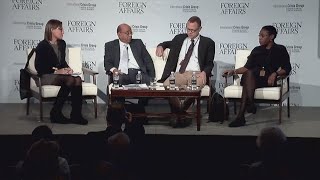
Policymakers and activists critique the global drug war, citing a leaked UNODC paper supporting decriminalization. They highlight how criminalization harms women disproportionately, how localized truces in Latin America work better than enforcement, and how Portugal, Switzerland, and Germany show that treating drug use as health, not crime, reduces harm.
Chapters
I wouldn't say perfect, but from the reunification of Germany until 2008, the situation was too good. And we believe that the situation will continue to be like that. The United States was the monopoly country. He practically had no objection from nobody. Even if there was no agreement, like could have been in Kosovo or something like that, it was resolved without major problems. But I think that the crisis of Georgia, the economic crisis, has been a really turning point. And we are living for a short period of time, because 2008 to today is a year, 9 years, it's not an eternity. This period of time which we don't know really how to handle things properly. And due to the economic crisis, in many of the problems of today. Are linked to that. For instance, in Europe, it's very clear that without the economic crisis, we would be in a completely different situation.
Rina Kionka, you're the only member of this panel who's actually serving in government at the moment and at the European Council. Thanks for that reminder. As though the pressure weren't enough. Do you— and I appreciate this may constrain your answer to my question, but I'm going to put you on the spot. About anyways. Do you feel that Europe is up to the challenges that it now faces? Does it even make sense, for example, to talk about Europe in a security context? And does the crises, the rolling crises within Europe that seem to be creating, if not splits, then attenuating tensions like we've never seen before, suggest that perhaps Europe went too far? The dream of a postmodern Europe is being confronted by a premodern reality, and that this postmodern institution is not capable of dealing with it?
Complex question. Well, the history of the European project is one of fits and starts, of moving a bit ahead and then pulling back a bit. And this is the situation that we see right now is exactly the same sort of thing. Since the Lisbon Treaty came into force in 2009, this was supposed to be a new era of foreign policy-making, unified foreign policy-making, with the External Action Service, with a permanent president of the European Council. But it seems like in the last 5 years, and even when the treaty was renegotiated the enthusiasm of the member states and also of the European Commission waned a bit from the first ideas back in 2005. So you had a project, it was accepted, it was ratified, but there was reluctance. And I think this is part of the problem right now. And there are all kinds of ideas about how to change the situation. I think we see another— there's another issue going on for Europe right now, and that is a political one. We are seeing what Stefan Lehne of Carnegie has called the prime ministerization of foreign policy. So on the really big questions, the emphasis has gone from the foreign ministers over to the prime ministers. And it's partly because of the rising popularity and strength strength of Germany and of Angela Merkel, but it's also widespread. And so this is why we see on the European Council a lot more foreign policy than ever was the case before, because a lot of the questions have been taken over by the leaders themselves. So those are two issues to keep an eye on. You asked before about what keeps me up at night, and it's migration to to be sure, migration and also its push and pull factors, which I assume we'll get into more in the next panel.
Go ahead.
Well, I have listened to you both talking about migration. And I think we have to talk about refugees. The problem today is a question of refugees. And the relationship with refugees have a very profound obligation. And the Europeans were the ones who really benefit after the First World War, etc., of having some normative vis-à-vis refugees. Now, the thing that can be understandable is why a group of countries who have suffered migration, always had refugees, now they are not open their minds to refugees. Which are coming from a war which is not far from their borders, in which you have some responsibility also about that war. So that's what I think is difficult to understand, and I say that forcefully, is that a group of countries which have benefited from all the benefits of the regulation, international regulation of migration, when it comes to their borders on migrants, I'm sorry, on refugees, we are not able to deal according to the law. And we have an obligation to take. And this is what I think is so important to really talk about refugees at this point in time. This is a different story than migrants. Economic migrants, we'd have to talk another time. But we are talking now about refugees. And refugees, we have obligations we have to take. That is what bothers me not having been able to have the the moral preposition. And it's a war that is not far away. It's a war which we have responsibility for.
Jean-Marie, you mentioned something earlier about how Western states are no longer status quo powers themselves, how it's not just Russia and China who are the revisionist countries, but we've all become revisionist countries. What do you mean by that?
Well, what I mean by that is that indeed we We don't want a world order that would be based on the power of coercion. That when we see people challenging their leaders for more democracy, we normally stand with them. But what is different from previous times, where one could say that there was also always that— I mean, that was the dignity of democratic countries. What is different today is that with social media, with access to information, that moral support becomes, in a way, a more effective support. So indeed, when President Putin says that— sort of says that color revolutions are cooked in Western countries, that is wrong. They are cooked by the people who make those revolutions. But when he says that there is support for those color revolutions and that support does help empower the people who do that, he is right. And we cannot concede on that because we don't think that the stability of the world can be based on ultraconservative regimes that repress their people. So I do think that this continuous movement of change is going to spread and develop.
Now, we're talking about institutional decay. At the same time, Next month, there's a global climate conference in Paris. And everyone now, somewhat surprisingly, expects a positive outcome. The question for all of you— and I'll see if I can get a volunteer to answer it— is, is this more of what we're likely to see in the future? That is, rather than relying on our traditional institutions, which are not working so well, an ad hoc process where on particularly pressing issues, we convene either a global conference or all the related parties, and through painstaking bilateral, multilateral negotiations on the sidelines, we get a consensus on a particular topic?
I think we will see all of the possibilities. You can have a global consent on something, particularly on principle. Then we will see the implementation, where we go. On environment, for instance, it's quite possible to reach a consensus on principle or target. But then the way up there will not be so smooth and without conflicting economic interests and so on and so forth. You can see regional agreement. On some other issue, hopefully. You can also see a growing of bilateral agreement on trade. So I think that we will see many of these possibilities, hopefully, because exactly the complexity of the threats and possibilities are such that cannot be all strained in global or only regional or only— so you will see many of this, hopefully, this possibility. And coming back, but the final point is that there is not a single issue today that can be really solved at simply national level. That is the real point. At least you need a regional something. And Europe, I think that a friend of mine is totally right. He said to me, you know, in Europe you have two different kind of states. The one who are small and the other who have not yet understood that they are small. And I think it's a perfect definition in the sense that Take the most powerful today, which is Germany for many reasons. On many issues, it's really very small. So it's not up to—
She's very polite. She doesn't mention France.
Well, because France is your domain. No, so that's why I worry that— and I'm sorry to be back to— my European obsession, that if Europe disintegrates or goes back to nationalism, back to square one, we moved out of the tragedy of nationalism exactly for some reason, and now we are going backwards on many, many issues. And that's why, for instance, the refugee one is for me one of the most important because it touches on values. It doesn't touch only on the portfolio or on the economic, as difficult as it was, is the economic crisis. But the question of refugees touches on value. Why do we stand together? Do we really have such a short memory by which we really forget simply what happened just a few decades ago? So we have short memory. And we have lost any sight. So when we look at the Mediterranean, I don't know why we presume that millions of refugees will stay there forever. Why we didn't even think that sooner or later these people losing hope will move. And history of the humanitarian crisis shows you that the immediate people prefer to stay near home in the hope to be back. But if time goes on and this hope is lost, people move. And we didn't get prepared for anything. So now today, the most discussed issues are wall, protecting the border, barbed wires, and so on. And there is no discussion on integration policy.
Right.
But that—
No, no.
Jean-Marie first.
At European level.
Javier first, and then Jean-Marie.
At European level. My country, I am Italian, we didn't do so badly on refugees. We tried to save people. We didn't do so badly. I'm proud of it. I think that you don't build anything on cadaveri, on corpses. But at European level, I see very little discussion on integration policy, which is exactly what what we need. That's why I'm so worried.
Well, isn't it the failure of European integration problems?
Sorry?
Isn't it the failure of European integration policies which is responsible for so much of the public opposition today?
No, no, no. First of all, Europe has common policy that are dictated by the treaty.
No.
I'm talking more about individual countries' immigration policy.
No, no, no.
Migration is not a common European mandate. Because member states didn't want it. In 1999, at Tampere, at the summit in Tampere, member states wrote that— head of states— that we, Europe, needed an integration policy. 1999. But then when the commissioner tried to put forward the scheme for an integration policy, it was just rejected. So now member states are, by the week, calling on Europe on something that Europe cannot deliver. And depends on the week. The first week is Italy, followed by Greece. The third week is another member state, and et cetera, et cetera. But the issue is that we need them. We need people. We need migrants or refugees. And by the way, Xavier, very difficult to make a clear difference between the refugees and migrants. How do you call for people fleeing Eritrea? Economic migrant or do you call it refugees?
That's what you have to—
Or you have to go on the case-by-case difficult basis?
Particularly when they're on a boat.
Sorry?
Particularly when they're on a boat, it's very difficult.
What do you do? You send them back to— They are already on the boat.
They're refugees.
So?
Listen, I need to open the floor to—
Oh, sorry.
But quickly. Javier and then Jean-Marie if you want.
If we were to look at the big problems that the world has, we have probably mentioned two. One is proliferation of nuclear weapons and the other is climate change. Now, in proliferation, the most important problem in proliferation has been resolved. It's resolved through negotiation. it resolved through negotiation with the European Union inside, because in fact it was the European Union who started that negotiation in 2003. And I was the one who started that negotiation. So it was a serious problem that really mobilized all the energy of the world to get it. And it's done. Now, I think that in Paris in a few months, we are going to see another very important achievement on a foreign fundamental problem. It is going to be achieved in a manner very intelligent, I think. Because finally, we have discovered that the transnational problems cannot be resolved top-down only, but you have to have some bottom-up. And the manner in which we are going to resolve the commitments on CO2 emissions is offered by the country. We put all the countries together, see how many that gives. And if it doesn't give enough, then we have to go to make another effort. But it's a manner of doing things which I think will be used for other global problems, international problems in the future. So I think that in these two big issues, we have to be optimistic because we are moving in the right direction. Now, the problem that we have is that for the first time, we have tensions between the big powers and the intermediate powers of the part of the world which has been always messy, we have no solutions. And let me tell you that the three things are interlinked. The United States pivots to Asia, and in a way, with the appearance that it wants to abandon the Middle East. The Middle East people think that maybe the Americans are not going to be so immersed in the classical parts of the Middle East. And then Russia takes advantage of that. And at the same time, believe it or not, China is following the Middle East situation with tremendous attention. I came from China, and I realized about one of the things that we were spoken more. Because China is going to get their gas, their oil from the Middle East because the United States are not going to buy it anymore. So we have these things which are interrelated at the same time that we have the big powers tensions. That is, I think if we don't look at it like that, we will not be able to resolve it.
Well, just one quick point. I think a world with multiple actors is more unpredictable, but it also offers more opportunities. But it offers more opportunities only if the various actors don't retreat in a kind of defensive nationalism. And that is the challenge today.
Reena, please.
Yeah, just two quick points. One on migration. I knew this was going to happen during this panel. But I think that the thing that surprised Europe is not that migration is happening and refugees are coming, but it's the scale.
Yeah.
You know, there are 10,000 people coming over the border every day. The population of Slovenia increased by 3% in over a weekend. It's just a capacity problem, really. And I think everybody should be worried when we have deployments of military on borders in Balkans. It's not been that long. We all remember what that meant. And the second was to answer your question, or to respond to your question, on the different kind of ad hoc alliances or groupings. That's already going on and has been for some time. E3+3 Iran negotiations that Dr. Solana started. We have 16+1, China's Chinese working with certain European countries. We have the Normandy 2, the Normandy 4, and 2 of them in Europe. So these are already groupings that are happening, and in many ways, they can be seen as the only political way to respond to certain crises that demand a quick, flexible response.
I see.
That they should be a complement to the rest of it. So there should always be a Javier Solana or an Ashton or a Mogherini as part of the process. I think that binds in also the European—
Especially Solana.
Yeah.
If we can choose.
Especially. Yeah.
That's the father of—
OK.
Questions from the floor, please raise your hands and then just wait for the microphone and identify yourself when I call on you. The lady in the third row here, please. Can we get her a microphone?
Giosetta Capriati, Foreign Policy Association. I admire and respect Emma Bonino, and I'm glad to see her here today, but I disagree with the assumption she made. First of all, you cannot compare migration that Europe is facing these days with migration to the United States of America that started almost two centuries ago. America was an open country that needed everybody, people of different creed, religion, skin, race, etc., etc., and still does. Europe has 2,000 years of history and is mainly a Christian continent divided in nations with different cultures that disagree among each other. I'll give you an example. I'm Italian. I'm very proud that my country so far has taken everybody, all the boat people arriving in Sicily. Many of them want to go to France because they speak French and they have relatives in France. They arrive at the border with France by train in Ventimiglia, they are stopped there, and they are stationed on the French— on the Italian Riviera for several months. Now, only Italy complained in Brussels, nobody paid attention. Only when the migrants threatened to walk to the Eurotunnel, all of a sudden UK and France woke up. They went to Brussels and somebody started paying attention. Merkel, at the end of August, declared she didn't want any more migrants, just to change her mind a week later. Why? Because she realized that the migrants from, the refugees from Syria were mainly doctors, architects, engineers that Germany needs. So that's why she changed her mind, only for them. So Europe needs a united policy about migrants And I agree with Mr. Solana that you have to differentiate between migrants and refugees, also because there is the fear that ISIS is infiltrating the so-called refugees.
Thank you.
And I would like just one more thing. I'm glad that during the opening of the General Assembly, there was a meeting of foreign ministers from all over the world to talk about the refugees problem. That is an international problem.
Thank you.
So I'm sure you all agree that Europe does need a common policy on migration. And on refugees.
Let me just comment.
Well, hold on.
Let me ask—
Oh, sorry.
Just finish my question. I'll give you a second to respond, but I also— I do want you to address the security issue and tell us whether— how much of a piece of the puzzle, how large a piece of this puzzle it is. And do you think that European countries are dealing with it adequately, exaggerating it, or what?
No, I just wanted to react to you because at the end, I think we— We agree. The point— no, the point is that we don't have a common integration policy for migration. You said America was an open country, needed everybody. Do you know how much is the demographic decline in Europe? We need 50 million new people by 2050 just to keep our social welfare in balance. Starting from Italy, going to Germany, Spain. Spain is moving from 46 million to 40. Bulgaria will lose 20% of the population by 2050. So the fact that we have been so blind not to understand that we really needed the integration policy head of states called for in 1999 and did not implement, I think it's our fault. So what we need is that, even if it is very late. Finally, when they are already on the boat, it's very difficult to choose in between a refugee and an economic migrant. And again, people coming from Chad, how do you— or from Eritrea or from Afghanistan, how would you call them, refugees or economic migrants? It's not on a case-by-case—
Emma, I'm sorry. Can I interrupt? I mean, we have been having migrants coming from I don't know how many years. We had in Spain boats coming in and we tried to adapt that in an organized fashion. When you have the refugees from a war is when you cannot have time to plan, et cetera. And that is what we have to mobilize it. Let's not confuse. I think that we are talking today about refugees, not about migrants, because this is the point.
Okay, let's think about migrants. In any case, the refugees, 90% of the profile of people are migrants. This debate is not going to get resolved today. I want to add one more element, which is the security element. The questioner asked, and I think it's important to address because it's an issue that opponents of immigration, whether in the United States or in Europe, are raising all the time.
Of migrants or refugees, they are missing one key point, is that a number of the terrorists or potential terrorists are actually homegrown terrorists. I look at France, and not necessarily from the Maghrebin immigration in France. You see a significant proportion of French people who are going to Syria who converted to Islam, who were this great French Christianity that is vaunted by the right. They were part of that, and they converted to extremist Islam because today Marxism is discredited. 30 years ago, they would have gone to the Red Brigades or to Baader-Meinhof or to Action Directe. Now, if you are a revolutionary, if you want to use violence, and you are a small-town thug who wants to have a bigger life than just attacking the local bank. The extremist Islam is the ideology. And so the problem is not about Islam. It's not about foreign Muslims. The problem is about the disenfranchisement of people in a number of dreadful suburb. That's a much deeper problem. And indeed, then the Islamic State provides the flag around which people can rally. That is, in my view, the real challenge. But politically, it's convenient to say it's all these foreigners that are going to infect our countries.
Thank you. Let's take another question, please. The gentleman in the aisle.
Don't go by boat. No.
On the thinking boat. Herbert Regenbogen, Professor of International Law and International Relations. Avion 1938. And question is, is there not really a confusion between the liberal world order of prosperity and the sanctity of human rights? Which we are missing under the concept of human security. And to touch upon that human security, isn't it that we are moving in a non-polar world, which was published in this journal 2008, as an additional perspective of what has been discussed? And is it not really the escalation of our liberal world order and the transformation into a stewardship economy where the property rights are changed into public goods such as clean air, water, soil, which is under the soil, and that this transformation and the human rights issues and all of the other human rights issues need to be quantified under human security.
Thank you.
Well, how do we bring human rights into the conversation at a time when Europe, the United States, countries around the world feel so threatened? Because of course, that's precisely the moment when countries tend to focus inward and to shove human rights concerns to the margins. Any takers?
Well, I like very much your presentation. I have been defender of that terminology, human security. That in fact, all the philosophy of the action of the European Union as such, outside our borders during the '80s, were based on, in the '90s, were based on that concept of human security. We have to defend not the security of the state, but defend of the people of Bosnia, or the people in, in the Sahel and the people. That is a concept I think was very beautiful on Chad. It's very, very, very beautifully presented. And I think this is still the basic philosophy of the European Union. We are not going to go to war as European Union, but we will go to places where problems of that nature have to be resolved of human security. And we have done a good number of operations of that nature.
Next question is standing on the side.
Thank you. Stefano Vaccara, I'm a journalist, La Voce di New York, Radio Radicale. Um, I have just last Friday at the United Nations, um, a special reporter for the migrants issue. His name is François Crepeau, I believe, and from McGill University. He really attacked, for example, the resolution, the Security Council resolution that just passed a few days ago about this, the, you know, the UK military ships can actually stop and arrest those traffickers. And my question is about the human rights issue here. If you stop these flows of immigrants from— migrants from Libya, for example, you condemn them to die in the sense they don't die on the sea, they die in Libya that is a no-man's land in this moment. So here there is a human rights factor How do you— I mean, how Europe, for example, European Union, can push for a resolution like this through the Security Council and not thinking to the consequence of something like this? And then another question, this is for everybody again. This is a problem. Yes, Solana is right. This is a problem that's been on for years. I believe in Sicily, at least we see Lampedusa arriving in the last 10, maybe 12 years. Why the world, especially here, everybody else, started to wake up on this issue only when— I mean, I feel very sorry for the child— only when was a Syrian child on a beach dead and not when there were so many African children dead? Thank you.
I think that the key issue is that Europe cannot be an island of stability, peace, and comfort in an ocean of turmoil. And so one has indeed to look at the immediate emergency measures, how you manage the flow of people coming into Europe, and that's not an easy question. But if the Europeans do not address the situation of underdevelopment in Africa— and there I'm talking about economic migrants— the fact that in the Sahel you have one of the highest growth rate of the population and that there is no way the countries of the Sahel are going to be able to accommodate that population growth. If you don't address that, if you don't address the conflict in Syria, if you let the whole Middle East descend into chaos, you can— you will not build walls that will stop people. And so it's really a call for Europe to look beyond its borders. And that requires leadership. And that is not so much in evidence today.
Well, not just leadership, but capacity. Do you think Europe has the ability to address these problems?
No, I don't think it's now a question of ability and capacity, because we waited too much, too much time to put in place But this being the problem that we have, the question remains, can Europe do it? That is why it is a problem. Because if we would have been prepared, it would have been more smoothly. I simply regret the fact that we slept on the dream that these people will stay forever in Lebanon or Jordan or whatsoever. So capacity is a problem. This I do understand. But again, it's a little bit our fault not to get prepared. And secondly, it's a problem, but stop thinking it's an invasion. That is really a hysteria that is not really, frankly, acceptable.
To go back to this refugees migration, I'm sorry to— I think it's very important. I mean, my own country, Spain, had an organized migration with the countries from the southern part of the Mediterranean. But it could be done in an orderly fashion. 'Cause you talk with the Kingdom of Morocco or the country, southern part of Santo Tomé or whatever country, and it was in a state with whom you can organize the flux of migrants. You can say, well, I will help you with X number of migrants. I give you aid for this year and you send me X number of migrants. Now, this is impossible to do today because the countries which are in war and therefore it's not a state with which you have an agreement of how do you handle the fluxes. The fluxes do come because it's a war. And therefore the way in which you have to tackle is much difficult. And when you have a situation of peace and you want migrants, You can deal with the country and get agreements, as Jean-Marie would say. When the state which is throwing the citizens as refugees is in a state which is failed, therefore you don't have anybody to talk to to get an agreement of quantities, fractions, et cetera. So that is why it's so important to get the difference between refugees, It might.
Rena.
I completely agree with Dr. Salama. You have to really— you have to know the difference between refugees and migrants. But it's very difficult, as we talked about, especially when you're in the sea, when you're in the sea. I think it's important also to understand that this is not an invasion that we're talking about of refugees. and there's a lot of good that can come of it to European economies. I spoke before of the capacity problem. I myself— this is for me personally quite an interesting and personal question because I myself am a child of refugees. And so, you know, this is something that comes quite close to home. There is a lot of welcoming of refugees in Europe. I think that the media has focused on a few statements, maybe not such statements that were not maybe politically that opportune. But you have to remember that all over Europe, there are people bringing refugees into their own homes as a personal gesture. And this is— the state question is one of coming to terms with the flow, with the scale, and the fact that at the same time as you're looking at the root causes in Syria, in Libya, then you also cannot have a kind of— you cannot have a Schengen, one of the four freedoms of movement within Europe, without having an external border that works.
Works.
And just on the Libya question, on the Security Council resolution, the whole point of that was to save lives. And the effort began when there was another huge ship went down and hundreds and hundreds of people lost their lives. So the whole point of that Security Council resolution— it's been a long time coming. It's gone in one phase, and now it's the second phase— is to beef up the search and rescue and look for the smugglers, disrupt their business model so that people do not drown in the Mediterranean.
We have about 5 more minutes. If I can take another 2 questions together, the gentleman at the back and then the woman sitting a few rows ahead of her, please. And please keep your remarks short.
Chandrakant Pancholi from Overseas India Weekly. Is there any discussion going on about income inequality in Europe, or whether such a problem doesn't exist there? And can you give some advice to United States about income inequality and how to deal with it?
Next question, please.
Thank you. Farah Khalidour, World Affairs Council of Houston. When speaking of migration and speaking of Europe and Europe's responsibility, what about the United States, who has been involved by action or omission in some of those wars that have led to the refugee crisis? Thank you.
Thank you for bringing the United States into the picture. So two questions potentially involving the United States. The latter one, what about the U.S. role in all of these crises? The questioner was asking about the US role in starting these crises, but I'm more interested in the US role in addressing these crises. And the second is income inequality in Europe. Does Europe have anything to teach the United States?
On the first question, I do believe that there has to be a more coherent vision between the United the Europeans on how to deal with the enormous challenges in the Middle East. And I don't think it's a very good thing that the only agreement is on a militarized response of bombing the Islamic State. I think that misses some fundamental issues of disenfranchisement of Sunni Arabs in Iraq, in Syria, and beyond. That's that feed into the success and the appeal of the Islamic State. And so I think when the Europeans and the Americans agree, they don't necessarily agree on the right strategy. And I think there has to be a much deeper discussion on the issues of the Middle East than there is at the moment.
Yeah, I think also that the fact is this alliance, very loose, of 43 countries, 60 countries, '63, I don't even remember. But at the end of the day, if you go really and see who is really fighting ISIS— Nobody.
That's—
It's the Kurds.
Let's say the number is becoming smaller and really smaller every day. And I think that the question that the US on the refugee crisis, I think you are quite right in putting the US on the— On the picture, I know that there has been pressure to Obama administration to get 100,000 or 200,000. But I let aside the numbers, which are already important. The point is exactly out of responsibility, out of the conventions, out of duty. In any case, I think this is a world problem. It's not only a European one. And it's very good to try to destroy the traffickers' business. Provided that it simply doesn't mean that you send people back wherever they come from. And that's why it's so difficult, because you have to go case by case. And most of these people come without documents. So you don't even know where you have to send them back. So, but that, the refoulement, let's say, that is another tricky issue that we have to be very careful in handling. I think you are totally right.
I think it's useful to bring the United States into the conversation for one other reason, which is the contrast between the response in the United States and in Europe disproves the argument that in Europe the stingy response to refugees is all about economics, because of course the United States is doing well economically at the moment. We're in the midst of a, what, a 5 or 6 year recovery, and yet the opposition is as strong, if not stronger here, than it is in Europe. So it's not sufficient to say, "Oh, if the economy were only stronger in Europe, then we would be opening our doors. We haven't solved all of the world's problems today, but I think we've made a lot of progress. We're out of time. Please join me in thanking this fabulous panel.
Thank you very much.
Thank you very much. Ah, wait, what? Yes, nice to meet you. Hi, nice to meet you. I thought that, I thought that maybe you're there. Yeah, I thought that you are here. Who is again in your vision at this point?
Good morning, everyone. Can you please take a seat so we can begin?
Thank you.
Good morning and welcome. My name is Suzanne DiMaggio. I'm a director and senior fellow at New America, New America's office here in New York. It's a great pleasure to be with you this morning. Foreign Affairs has assembled a stellar panel this morning to discuss the situation in the Middle East. It's a rather extensive agenda, so I will just get started. I think you have everyone's bio, but let me introduce each of our speakers very briefly. I'll first be turning to Ali Vaez. Ali is the senior Iran analyst at the International Crisis Group, and before joining Crisis Group, he was head of the Iran project at the Federation of American Scientists in Washington. He also has a background in journalism. Then I'll be turning to Ali al-Shihabi. Ali is the founder and former chairman of Rasmallah Investment Bank. He's also a prolific writer. His latest book, The Saudi Kingdom: Between the Jihadi Hammer and Iranian Anvil, has just been republished by Princeton University as part of their series on the Middle East. So I— please look for that book. Then I'll be turning to Joost Hilterman. He is the program director for Middle East and North Africa at the International Crisis Group, where he leads the organization's research advocacy policy prescription in and about the region. He previously was Crisis Group's Chief Operating Officer. And then finally, I'll turn to Denise Natali. She is a Senior Research Fellow at the Institute for National Strategic Studies. She joined INSS in January 2011 following more than 2 decades of researching and working in the Kurdish regions of Iraq, Iran, Turkey, and Syria. So the format of our discussion today, we have about an hour. So I will have a discussion with our speakers for about 35 or 40 minutes. And then open the rest of the time to you for your questions. So let's begin. So Ali, we witnessed the conclusion of a rather historic nuclear deal between Iran and the P5+1 very recently after some intense years of negotiations. So I wanted to ask you about the domestic implications for Iran, is it really a game changer? Is it a win for President Rouhani? Will it tip the balance in the favor of the moderates? Or has it just strengthened the tensions between hardliners and moderates in the country?
Susan, you know, we have a very clear pattern of previous major decisions in the Islamic Republic, be it the end of 1988 war with Iraq or the 2003 nuclear agreement with the European Troika. And consistently, the pattern has been that the system has tried to counterbalance opening to the outside world with internal retrenchment and internal readjustments to the balance of power. Without any doubt, the nuclear deal is considered a victory for President Rouhani. Any president who can deliver on something that he has promised during an electoral campaign will be bolstered if he can deliver on it, no doubt. And the president would like to be able to now use the dividends of the nuclear agreement and score a victory in the upcoming elections in 2016, the parliamentary elections and the elections of the Assembly of Experts, which is this body that is in charge of selecting the next supreme leader. So it can have a very important role in the fate of the system. And then 2017, there's a presidential election. So obviously President Rouhani's game plan is to cash in on this nuclear agreement win in the upcoming elections in 2016 and then get reelected in 2017. But obviously his rivals want to prevent him from doing exactly that. And this game has already started. We have already seen an exacerbation in domestic infighting in Iran. And that's why I think the political situation in Iran will get worse before it gets even worse. Because in February 2016, we have this election, so we have infighting that will get exacerbated, and then everybody will focus on the presidential elections next year. It's very interesting that the Supreme Leader, as the chief balancer of the system, has already started two major balancing acts. One is to make sure that the president and his pragmatist allies do not disprove proportionately gain from this agreement, and he has done that by basically putting the brakes on all fronts. President Rouhani did not want the nuclear agreement to be reviewed by the parliament. He wanted it to be reviewed by the Supreme National Security Council, which had already, now we know, approved the deal back in August, so even before Congress and before the Iranian parliament. But the Supreme Leader forced the agreement to be reviewed by the parliament, which provided President Rouhani's rivals with an opportunity to harshly criticize the deal. Again, in another example, now the Supreme Leader has conditioned Iran's implementation of the deal to first seeing the report that the IAEA is supposed to publish on December 15th to make sure that the dossier about Iran's past nuclear activities is indeed clear.
Closed.
And at that point, he has sanctioned Iran going forward with two major steps. One is shipping out the stockpile of low-enriched uranium, and the second is to take out the core of the heavy water reactor and destroy it. That basically means that the economic dividends of this deal, the sanctions relief, will not be triggered before the February 2016 elections so that it doesn't become an electoral issue and the president won't be able to benefit from it. And there are other examples as well. Most important in the foreign policy arena, Ayatollah Khamenei's banning of further negotiations, bilateral negotiations with the United States. And that's really the second balancing act. It appears that the Supreme Leader, again based on the pattern that we've seen again and again, does not want to see too too much change in the foreign policy of the country coming too fast. And last point I want to make is about the economic situation. The economic situation, ironically, is actually getting worse in the aftermath of the deal, and the reason is because of the low oil prices. Iran's budget this year is the lowest since 2008, since even the apex of the sanctions regime. They have $20 billion budget deficit this year, and the demand in the market is totally stagnant because of this expectation that once sanctions relief is triggered, the economic situation will improve. So now the demand is very low and the country risks actually sliding back into recession. But the economic situation will get better next year once sanctions relief is triggered. So I think for the foreseeable future, at least until the elections, it appears that the Supreme Leader and his camp have the upper hand, and we should temper our expectations about how much more President Rouhani can really deliver.
Now, prior to the conclusion of the deal, and certainly since, the opponents to the deal, have been quite concerned about how it will strengthen Iran and its activities in the region. Some believe that this will embolden Iran's activities, make it more aggressive, extend— it will be a windfall for Iran's proxies. And others say, no, this is not the case. In fact, I think there was a CIA analysis that was talked about recently in the LA Times that made the point Iran is going to use this windfall to revive its economy. What do you see happening? Is it realistic to think that whatever gains Iran makes economically will go back into the economy, or is this a moment where we do see Tehran strengthening its position in a very tumultuous region?
Look, there are two separate questions here, I think. One is the question of financial resources and what's the impact of additional resources on Iran's regional policy, and the second is the question of policy decisions about the path forward. On the financial resource question, you know, if you look at the pattern of the past few years, During 2011 to 2013, when sanctions were really hitting hard and the Iranian economy was under a lot of pressure, we didn't see any impact, any consequence on Iran's regional policy. It continued to support its allies in the region. It's continued to prop up the Syrian regime. It's continued to support its allies in Iraq. 2013 to 2014, when as a result of the interim agreement and the sanctions relief that came with it, about $15 billion came into the Iranian budget, we didn't see necessarily a significant escalation in the region, any tilt in the balance of power one way or another. Now, this year, 2015, we again see an escalation in the region, whereas Iran's budget, as I mentioned, is actually under a lot of stress. So there is not a direct correlation between the Iranian financial situation, necessarily, and its support of its allies. Those are based on strategic calculations. And that brings me to the second part of your question, which is the debate that is currently happening in Tehran. So there are two schools of thought. One school argues that now that we have resolved the nuclear issue, we actually have an opportunity to strengthen our economy as a major element of power. If you want to project power in the region, it's just not militarily. You know, you have to be able to do it by soft power, by economic power, et cetera. And now this is an opportunity. We have to be able to get foreign investment in the country, strengthen our economy, and that can only happen in a calm environment. We can't be involved in all of these wars and even provide the pretext for Congress, for example, to pass additional sanctions and again prolong the chilling effect of the sanctions regime. And the second school of thought says, but we have to be careful because in the region there might be countries who realize that we need to be cautious in the foreseeable future in order to benefit from sanctions relief, and they might use that opportunity to push for further gains in this zero-sum game that we see in the region. And there is a debate between these two schools of thought in Tehran, and I think the outcome will be determined by how other players in the region and beyond the region play their role.
Ali, I want to get your views on what you think this means for Iran. I think they may be a bit different from Ali's. But first, I want to ask you about Saudi Arabia internally. They have had a new king since January. Since that time, he's launched an air campaign in Yemen against the Houthis. He's also increased support for anti-government rebels in Syria. This is— this challenging Iran's expanding influence in the region is nothing new, but it does seem to me this is a more assertive, muscular Saudi Arabia than we've seen. Also, at the same time, we hear reports recently about the worsening economic situation in the country. Tell us, help us understand what's happening. Is it a is Saudi Arabia facing a crisis due to the transition, tensions within the royal family, and the economic strains, or is this being exaggerated?
Look, there is a transition in power taking place in Saudi Arabia. What everybody's been talking about for decades, which was a generational transition between the first generation of the sons of the founder of the kingdom and the grandsons has effectively taken place, at least the first stage of it has taken place. Like any political transition, there are a few winners and many losers, so that, that causes a lot of rumbling across the royal family. Also, there is a bit of a structural issue because a new position has been created, which is Deputy Crown Prince, which was created by the previous king with the idea of sort of obligating his successor to appoint a certain individual as crown prince. But his successor did not abide by that and appointed somebody else. So today that raises questions among people that the king has appointed a crown prince and a deputy crown prince, and is, is that going to stay, or is there another move coming? Is there a competition between those two people? Now, look, any political system has competition over power, and there may be some truth to that, there may not be some truth to that, but it certainly adds an element of concern and interest to outside observers. I think more important is that Saudi Arabia feels very threatened. I think that, you know, there are two schools of thought going back to Ali's approach on Iran. There are two schools of thought when thought when you look at Iran today. One says that Iran is a country that wants to get its economy in order, wants to be a respected member of the Westphalian order. It's going to use its— it has come in from the cold, and it's going to, you know, focus on building up its economy, and it has tremendous potential. This is a South Korea in the making. There's another school of thought, one which I lean towards, which says that Iran is a revolutionary government, It has matured in sense of its political tactics, but it has not matured in terms of its revolutionary objectives. Iran is ambitious in terms of wanting to increase its influence and elements of control across the Arab world. And we— and why does one conclude that? Because that's a minority opinion, particularly among Western elites that are excited about the nuclear agreement because they say, well, you know, Rouhani and moderates and this and that. And I say, look at— don't look at what the Iranians say, look at what they've done. Iran has been a very stressed country economically for the last 20 years. Yet despite that, they have prioritized their nuclear program, they've prioritized their ballistic missile program, They've prioritized helping Hezbollah, helping Bashar, and helping all their other allies in the region. So when you look at what they've done, you say, in terms of actions, I mean, you know, we've heard stories about, you know, cancer medicine not being available for children in the hospitals in Tehran. Yet, you know, Bashar and the allies in Iraq and the, you know, tremendously expensive nuclear program and the ballistic missile, for example, They just tested a ballistic missile a week ago. So I think if you're skeptical of Iran, of which I am, in terms of its revolutionary ambitions, you are very worried because they put a smiling face forward, they've succeeded in breaking the— they've come in from the cold, so to speak. And the West wants to believe that. You know, people want to believe that peace is at hand, that a major step has been taken forward. But I think that the concern that Saudi Arabia had and people on my side of the fence have is that the nuclear agreement was a one-topic, one-subject agreement. The agreement with Iran should have been a total one, which tied in its total behavior across the region.
We would have never gotten to an agreement if that was the case, I think.
Well, but then what have you gotten? You have gotten today revolutionary power with big ambitions in the region that has had a major restraint taken away from it. And if you lean towards the pessimistic sense, then Iran is one step closer to, you know, maybe potentially bringing down what remains of the Westphalian state order in the Arabian Peninsula, you see. And that's what people are scared about, and that's why Saudi Arabia reacted, overreacted if you want, in Yemen.
[Speaker:DEBORAH AMOS] My best guess.
So when we look around the region, at every turn, every serious conflict that we're witnessing, at the crux of it is a conflict between Saudi Arabia and Iran in one way or another. Now, the Iranians say, both publicly and privately, that they're making an effort to reach out to their Saudi counterparts and begin dialogue. President Rouhani, when he was first elected, I believe his first major foreign policy speech mainly focused on Saudi Arabia. Iranian Foreign Minister Javad Zarif attended the funeral of King Abdullah, and more recently has said publicly that he has been reaching out to try to begin dialogue to attempt to reduce this tension that's pervading the country. So far the Saudis are not responding.
Can I address that?
Yes.
You see, I think that's looking at it from a slightly skewed perspective because the Iranians say a lot of good things. But look at Yemen. Yemen has its own deep internal problems. And Yemen had a movement, you know, an anti-government movement called the Houthi movement, which was Shia but Shia-lite. If you know anything about the history, it was a very mild form of Shia Islam. There really was no sectarianism in Yemen. But suddenly the Iranians got involved in advising the Houthis. Now, they maybe didn't send them huge amounts of weapons, they didn't— the Revolutionary Guard didn't show up, but they have been involved and they have admitted they have been involved. That scared the daylights out of the Saudi government because they said, here we have a structurally weak Yemen anyway. It is in civil war anyway. And the Houthis are a problem anyway, and then if the Iranians come in and convert them into an ally, it becomes a huge problem. So I think, again, you react to what the Iranians do, not to what the Iranians say. You look at Iran's behavior in Iraq over the last 5 years. The government of Mr. Maliki, and even the government today, has bred sectarianism in Iraq. Iraq today is controlled by Shia militias that effectively are in arm to a degree or another, or at least heavily influenced by the Iranian government. And when people want to talk about ISIS, you know, this sectarianism in Iraq and the behavior of Bashar al-Assad, who has been supported totally by Iran, is what has bred ISIS, what has allowed ISIS to grow. So when you look at that, you know, Mr. Zarif attending a funeral, a few wise words, you tend to take them with a big grain of salt. I'll give you other examples. Kuwait discovered a huge cache of arms, weapons that were attributed to Lebanese Hezbollah in Kuwait just 3, 4 months ago, which is an arm of the Iranian regime. Bahrain has discovered a lot. Now, there are structural problems in the Gulf. There's a Sunni-Shia problem. The Shia have been disenfranchised. That is a weakness in the Gulf. But the Iranians are taking advantage of that, you see? So I think that the Iranians make some nice noises. As I said, tactically the feeling is that they have matured in their behavior, but strategically, their long-term strategic objectives are still revolutionary.
Okay, I'm going to move on to Yousf. So we've heard about the impact of the nuclear deal from Ali, particularly domestically and in the region. A more muscular approach by Saudi Arabia adds to the already heightened tensions, a growing tension now between the United States and Russia in the region. So heightened tensions between all the key players, and I should mention Turkey too. So we already have this volatile mix. Give us the big picture view. You were in, for example, you were in Iraq recently. When you see what we're witnessing now, how is it impacting the fight against ISIS there? And do you think the U.S. Current approach is working. I don't think we know anyone who would say that, but what is your view on it from the big picture?
You know, it all depends on what you see as the key objective of the players, and they are totally at odds, of course. Even when they say they're on the same page, for example, many can agree that they're fighting ISIS. In fact, they may not be fighting ISIS to the same extent as others, or they may have entirely different key objectives in mind even when they're fighting ISIS. So in Iraq, for example, if you look at the United States, it clearly is there, it came back in order to fight the Islamic State. It says that it has a military approach folded into a political strategy that seeks to encourage the government of Prime Minister Haider al-Abadi to be more inclusive in order to end the alienation of the Sunni community that we saw Mr. Maliki, with Iranian help, perpetrate when he was prime minister. But in fact, all we are seeing is a military approach without any implementation of a political strategy. And the problem is in Iraq and the problem is in Syria. And I think in the end, the question really has to be, we can understand why ISIS is seen as a threat because it has potentially a transnational agenda that crosses borders and that could affect Western interests and the West itself. And for example, the local regimes, whatever their degree of legitimacy, don't pose an external threat, only to their own people. And they've proven, you know, they have a very strong record in that regard. They will kill their people till the last person in order to stay in power. So the issue here is that in order to be effective, in fighting a group like the Islamic State, you have to deal with the local dynamics and you have to take into account the interests of the communities that feel marginalized and disenfranchised, be it in Iraq or in Syria. And if you seek to defeat the group that has stepped into the vacuum to nominally represent these alienated communities, you have to have a strategy for governance that follows on the heels of the defeat of that group ISIS. So who is going to run Syria? Who is going to run the Sunni areas in Iraq effectively, locally? It cannot be Shia militias. It cannot be some other outside party like a neighboring state. It's got to be local people. And I think the— what we're seeing is the political strategy to bring that about has been lacking.
Just this past week, there was a meeting between Secretary Kerry and the foreign ministers of Russia, Turkey, and Saudi Arabia to discuss Syria and getting to a political settlement. Iran was notably Iran has been omitted from that discussion. So my first question is, in order to solve the political puzzle in Syria, what are your thoughts on Iran's role? Does it have to be at the table? And secondly, what do you see now as the way forward? What is a formula for reaching that political settlement?
Well, you know, the nuclear deal with Iran has shown that you negotiate with the enemy if you want to reach, you know, make progress and preserve global peace. And so the notion that you could exclude Iran from negotiations over Syria where Iran clearly is a major stakeholder is ludicrous. It has to be included. The question is when do you bring it in? Possibly it's a matter of timing. There's a strong Saudi resistance to any inclusion of Iran on any of the issues in the region, be it Yemen or Syria or Iraq. But Iran has strategic interests and it has concerns. It feels in many ways encircled. I may depart a little bit from Ali's perspective here in the sense that I think that while Iran used to be revolutionary in outlook, it is essentially defensive in its moves in Iraq and Syria because it was supporting those regimes before these regimes were threatened. Then when the threat came, they stepped up their involvement in a military way, in a very unhealthy way, I have to add, but it is understandable if you see that a vacuum was created and they were sucked into it. The question is, what are they going to do with it? What's their exit strategy? Maybe they'll capitalize on it. Maybe they will use the revenue from the sanctions relief in order to extend their power, and that is, of course, a major concern. But if you go to Tehran today, you recognize that revolutionary fervor is not there. There's a regime there that is deeply disliked by many, many people in Iran and that is hanging by, you know, it's fairly strongly entrenched but it's deeply unpopular and we have to wonder about the longevity. Now, so Iran must be included and I think in order to bring that about we need to reduce tensions first of all between the United States and Russia and seek some kind of common ground between them in Syria, and then bring in the regional states: Turkey, Saudi Arabia, and Iran. In the end, what we need is some kind of process whereby you can rebuild a regional security cooperative framework. It used to exist in the past. It can exist again in the future. Right now, the imbalance is such that it would be very difficult, but I think if you can balance Iran with the combined efforts of Saudi Arabia and Turkey, both Sunni powers— unfortunately we now speak in sectarian terms— but then at least Saudi Arabia can be reassured somewhat that it's not isolated, because that is what it fears most. It is acting out of panic right now, so it needs guarantees, it needs to be reassured, it needs to be coddled a little bit, and with weapons I suppose, but also with the security guarantees. Not that I'm advocating necessarily to arm Saudi Arabia or any country in the region more than it already has. One of the problems, of course, is the proliferation of weapons. Everything should be de-escalated, but we're in a very grave situation at the moment. Russia and the United States, that is where we need to look now. There is potential common ground, but it's going to be very tricky. I think the Russians will soon find out that militarily they will not be able to prevail in Syria. No one can. In fact, there is no military solution. So all they have done so far is to assure themselves a seat at the table. Then let's move from that.
Okay.
Denise, let me turn to you. I want to ask you about the Kurdish situation in the region, the seeming ascendancy of the Kurds in the Middle East. What are the realities that you see on the ground regarding Kurdish statehood and autonomous regions? How likely and viable is this scenario, and what does it mean for regional politics, stability, and alliances?
Thanks, Suzanne. I'll start off with the fact that there's about 25 to 30 million Kurds in 4 geographically contiguous states in parts of Iraq, Turkey, Syria, and Iran. This fact, as well as the idea that we've got these deeply fragile or hyper-fragmented states in Iraq and Syria have led to this very popular idea that Sykes-Picot is unraveling and the next step forward is that Kurds now are going to have their own state because you have this state-like entity in northern Iraq. You've got groups now in Syria calling for their own autonomous region. And you've got mass mobilizations in Turkey. This is actually the first time in the trajectory of the Kurds over the last 100 years that these three major groupings divided by states are mobilizing at the same time. So it all looks like there's going to be a Kurdish state, and we see this often. And I couldn't disagree more. It's a very popular idea, and there are many people advocating for it. The fact of the matter is these are all landlocked entities. And let me start with one, the idea of a larger Kurdish region. You've often seen these map images. That just can't happen for the idea that Kurds themselves, after having been partitioned into four different states since the state formation period, they've been assimilated or they've integrated into different states in different ways while still asserting that they're distinctly Kurdish. But let's take northern Iraq or the Kurdish region of Iraq where it seemed like after 2005 with this very weak Iraqi government that the Kurds were well on their way to selling oil and becoming a state. These are landlocked entities. And in the Kurdish region of Iraq, again, its very survival is based on the idea of cutting deals with Tehran, with Ankara, with whatever entity now is in Damascus and as well as Baghdad. So you've got this idea that when you're landlocked, you need your borders open. And that means cutting deals. And there is not one state in the Middle East— and even as much as Turkey benefits from the Kurdish region in Iraq, from its oil or deals or commercial deals, no one's interested in a Kurdish state that would undermine their own territorial integrity or sovereignty. Secondly, you have to look at how How autonomous are these entities beyond the idea of saying we want self-rule? Again, I go back to the Kurdish region of Iraq. Up to about a week ago or a month ago, and even then, 95% of these entities' revenues come from the government in Baghdad. So if there is no self-sustaining independent revenue source, again, in northern Iraq, in the Kurdish regions, as well as— we'll get on to Syria— It's very difficult to imagine that an entity can become independent without becoming in some way a vassal state or a client state of another entity. And by that, I'll say Turkey. When you are a landlocked energy region with one transit route, normally, we've seen this in the Caspian, you become dependent on your transit route. And that would be if the Kurdish region in Iraq seeks to leave Baghdad or seeks to leave Iraq, it would by virtue become a client state, and if not already, of Turkey. But there's another reason, and we've heard this, it's very, I find very simplistic to talk about Iraq and Sunni region and Shia region and Kurd region, but these entities are not so clear-cut in fact. You have particularly since, particularly since Daesh took over Mosul, you have about 2 million refugees in the Kurdish region. 20% of the Sunni Arab population in Iraq is now living in the Kurdish areas in the north. Dividing where the borders would be of an independent Kurdish state in and of itself would lead, in my view, to grave conflict. We have an issue called the disputed territories. What would a Kurdish region mean? Does it mean this very contentious area called Kirkuk? Does it mean parts now of Mosul? Since the Daesh takeover of parts of Iraq, or large parts of Iraq, you've got again different opportunities where the Kurds are, I would say, engaged in territorial engineering, demographic engineering, and this has all been to the expense of Sunni Arab populations. So to go back to the idea of fragile states lead to independent Kurdish states, I think is faulty causality because of again this inability of these entities to be self-sustaining. So in fact, rather than assume that these entities are so autonomous that one day they're going to declare independence unilaterally and send ripple effects through the Middle East, I would argue it's Turkey, it's powerful states like Turkey and Iran and other regional sub-state actors like Sunni Arab groups that are going to determine the trajectory of the Kurdish regions and decide what deals will be made, what revenue sharing arrangements will be made, and situate this issue. Because if we over-determine the leverage of these entities, then we're going to get the policy wrong. And this is why, again, I do not see these entities existing. And quite frankly, I just came back again from the region. The only time I hear this discussion of Kurdish independence is when I come back to the United States. I keep saying, come on, guys. And they say, are you kidding me? And then— and I— excuse me, one more point. And there's another point we hardly ever talk about, and that is the deep, deep internal divisions inside the Kurdish region. So when everybody again in Washington is talking about— or that's where I'm from— independence, these guys are talking about, are we going to have— are we going to divide again? There was just deep armed conflict. That led to violence and deaths just about 2 weeks ago while everybody's still talking about a Kurdish state. So I'm a bit mesmerized about this conversation when the real concern is, is there going to be a civil war? Is there going to be more conflict? And how do you regulate these deep divisions between these groups within Iraq and as well as across borders?
A good dose of reality there. Can you talk a little bit about the Kurds and the fight against Daesh, ISIS. We were talking earlier about what you called important second and third order consequences that are laying the groundwork for future conflict. And I can't resist but ask about the US Special Forces operations with the Kurdish Peshmerga rescuing 70-plus hostages being held by ISIS. We've been told that the US does not have boots on the ground. But here we are. Are we going to see more operations of this kind?
Sure. I have to qualify. I do speak for myself, and I don't speak for the U.S. government or the Department of Defense on some of these issues, so I'll answer what I can answer. I'd like to pick up with some of the points that Joost made, though, about having this idea of localities gaining influence. When we're having these deep, hyper-fragmented states in Iraq and Syria, you've seen the emergence of these sub-state actors, whether they be militias, the Shia militias, or the good guys, our very important allies and partners on the ground in the fight against Daesh, which are the Kurds. So it's very easy to point to how important the Kurds have been in this fight against Daesh as partners on the ground. However, what's completely missing, or largely missing, I can always count on Yossi not to miss it, is the second and third order consequences. When you decide to subcontract your foreign policy out, when you decide to lead from behind, you also have to understand that the strategic priorities and threat perceptions of our allies and partners on the ground are not necessarily going to be those of the United States. So what is happening now after a year of fighting Daesh is that our partners on the ground are engaged in territorial and demographic engineering. When I talked about now, this is swaths of areas that have been ungoverned that has been provided a large opportunity for Kurds to go in and assume control. So this very important and sensitive issue of Kirkuk, Kurds have taken control of some of its oil. You have Sunni Arab populations that have not only been displaced by Daesh, not only been disfranchised by the Iraqi government under Nouri al-Maliki, But now they're also being, let's say, discriminated against. Their homes have been looted by some Kurdish groups, Peshmerga, when they have been forced out. So, you know, when we talk about ISIS gains, ISIS-free territories, defeating ISIS or Daesh, excuse me, has been translated into gains for the Kurds, which has been translated into more losses for Sunni Arab populations. This is the way I would look at it. When I look at a map and it said Daesh-free areas, You say Sunni Arab territories that they lost to Kurds. And this is the way we need to look at it. I'm not trying to take sides, but we're setting the groundwork for future conflict. There's also Turkmen populations. There are also other groups on the ground that largely— I can tell you I've spoken to dozens and dozens of different groups who say this is made in America. New states made in America, and the United States is leading this. So we need to be careful, in my view, of the perceptions We can't necessarily have our boots on the ground everywhere, but at least we need to go into these operations, these very localized, hyper-localized conflicts now. Because Daesh has been superimposed over different local conflicts and ask, what are the threat perceptions of our local allies and what are they planning to do? Right now, I would say that the priority is not necessarily defeating Daesh, and some— and many people are actually benefiting from its presence. It's consolidating territorial control. It's gaining resources and trying to establish as much autonomy as possible in these entities. The United States, in my view, needs to be aware of this. And the same thing is going on in Syria. And I'll make one point about Turkey. I know that there's— we've had long periods of ups and downs with Turkey, which is a very important strategic ally of the United States. But we should also understand that it's not so crazy from a Turkish perspective, because we have— we should stop mirror imaging, that when you see your borders being, let's say, under threat, or when the territorial integrity of your country is under threat, and now arms are going to groups that this ally of ours has been struggling against for years, you can certainly be assured that there would be great concern. Again, we need to be aware Are our strategic end states the same as our partners on the ground? We need to be clearer. So these are some of the very deep concerns I have right now because there are, without a doubt, important territorial and demographic changes going on at the expense of Sunni Arab groups, at the expense of other local groups on the ground. And my concern would be there will be a backlash against the Kurds, as well as other groups fighting to take back these territories that local groups see as was driven by the coalition in their fight against Daesh. Now, you asked about this commando. I can't really comment about this commando raid other than the fact that I would imagine, again, that the idea in general sense of— I'm going to pick up where you also went. There's an idea that we're going to defeat Daesh. And these are definitely my views, through just simply a military operation, we're going to go in and we're going to break into prisons. I quite frankly think they needed the prisoners to get information. I mean, there's very important, you know, we all must know at this point that the nexus between the former Saddam's former Ba'athist officers and some of the Daesh elements was very strong. And those groups or any groups that you can find at this point can provide very important intelligence. And how to move forward. So I imagine we're going to be there for a while, but again, we have to be careful about who we're sending arms with. Are there conditionalities to our arms? Are our arms fueling local conflicts on the ground? When I go back to the internal conflicts between the Kurds, these weapons, who are they going to? They're going to one group. One group is worried that they're not getting to another group. So, you know, arms without conditionalities, arms without monitoring, I think is a recipe for disaster as well.
Thank you. Well, we covered quite a bit of ground in a short period of time. I'd like to open now the floor to your questions. So please raise your hand and wait for a microphone. Any questions? Yes, this young lady here. Can you give her the mic? And the more concise you are, the more questions we can take. Please introduce yourself.
Sure.
Farah Khalidar, World Affairs Council of Houston. This is really more directed to Ali. You spoke of looking at Iran's actions rather than words. Would you not say the same about Saudi Arabia for the past few decades in terms of their actions directly or indirectly in funding extremist Islam?
I'll tell you, this issue of Saudi funding extremist Islam is worthy of of analysis because it's an accusation that has become very widespread. Saudi Arabia and America and the West looked upon fundamentalist Islam until 1980 as a benign force. You have to remember that that period was a period when communism and socialism and Arab nationalism, everything was spreading across the region. And everybody thought that fundamentalist Islam is a benign force, these people worry about women driving and women covering and alcohol and silly things like that. They don't worry about the hard stuff. They'll never be a threat to the established order. So yes, the governments did fund, you know, and in Saudi Arabia you can call it the Wahhabi establishment. Now, when Khomeini took over in Iran, it suddenly opened up a light bulb, not just with America and the status quo powers who realized that the Islamists can take power, but with Islamists themselves, the Sunni Islamists who said, hey, you know, we can take power like the Shia did. So that transformed the Islamists into a bit of a threat. At the same time, Saudi Arabia was grappling because it was threatened by the Iranian Revolution. There was a fundamentalist Islamic threat. And they continued giving the established Wahhabi establishment money. Now, people today extrapolate from that to Daesh, or to ISIS, or to al-Qaeda. ISIS and al-Qaeda, there is no evidence whatsoever that either the Saudi or Gulf governments supported them or wanted to support them. A lot of private capital went, yes. There are individuals in the Gulf who have contributed to these people. But in terms of, you know, Saudi Arabia understands that it is actually the number one target of ISIS eventually. If not ISIS, the son of ISIS. ISIS does not threaten Iran. When the Iranians say we're fighting ISIS, ISIS is a virus that goes into Sunni, in a Sunni body only. It has no traction, and we can see that on the ground. So in terms of Saudi Arabia funding fundamentalism, actually Saudi Arabia is fighting fundamentalism. Private Arab capital, yes, has helped ISIS, but if you look at it, and there's a more recent analysis of how ISIS has made money, ISIS has made money from oil and like the Bolsheviks did in the first 5 years of their power, by plundering everything in the areas that they control. So I think that Saudi Arabia is trying to fight, maybe not very successfully, maybe not very effectively, but it realizes that fundamentalist Islam, whether it's Qaeda, ISIS, or the son of ISIS, sees Saudi Arabia and the established order as a prime target. You cannot be a caliph in Islam if you don't control the holy places. So I really think there's a huge misconception that somehow Saudi Arabia is using ISIS or using Qaeda in its supposed competition with Iran, when it's exactly the opposite, actually.
Any other comments from the panelists on this?
No.
Question? Yes, you in the front.
Yeah, Matthew Plunkett.
Can you wait for the microphone and please introduce yourself?
Hi, Matthew Plunkett. Wanted to follow up on Dr. Natali's point of the US sowing the seeds for future conflict through our policies. She may not be able to speak to it, but I'm wondering if others on the group, if that's true, what our policy should be in response to that. The turmoil in the region.
I can make a couple— I can make some comments. They're my comments. Sure. Well, first of all, again, I go back to where we are now, and we're dealing with these hyper-fragmented states and hyper-localized conflicts, correct? So it's not that we have to, first of all, understand who our local partners are and not mirror image and not assume that their, again, their threat perceptions are our own. We've gone into this, in my view, without any conditionalities. At what point do we say, what are our local partners up to? We're going to now say, at a certain point when you stop killing people, using our weapons to do something, we pull out? But at this point, I see that we've lost a lot of leverage because we've— again, I use the word subcontracted out. But I would say at least if you're going to And we can't put full boots on the ground. We have to certainly know that there's going to be some red lines with our local partners. And I don't think that we've set any red lines. Secondly, be clear about our strategic end states. And I'm going to take Turkey and I'm going to take Syria because there's concern on the one hand the United States is, I'd say, arming a Syrian group where there's moderate Arab forces and Kurds. Let me say it that way. And whether arms fall into Kurds or not, We've got Turkey that is extremely, let's put it mildly, upset. At no point along this way am I hearing very loudly, the United States supports a unified Syria, whatever it's going, whoever's going to be in charge. We're not seeking to create a Kurdish state. And we have to certainly alleviate the concerns of our regional partners such as Turkey while we engage. I'm not saying don't engage militarily with local partners. Third, strengthen the state institutions. Let's not talk about Iraq. Arms do go through the Iraqi government, and we monitor them. But handing out weapons to different local groups because they happen to be, you know, on our side and they seem like the good guys is a little bit, in my view, let's say, short-sighted.
And specifically, I mean, in the case of the disputed territories, it would make sense to have joint security arrangements. And there's a lot of precedent for that. But there is no conditionality, as Denise rightly points out, and there ought to be. And it's workable arrangements that could be envisioned.
Can I just add one thing? Again, back— what's going on now in the north is— and I think you also referenced this— it's creating governance structures in Daesh-free territories. We're not doing that. So that we say that these areas are free of Daesh, But they're lawless. I mean, you have to have a system where internally displaced persons, and they're largely, largely Sunni Arab communities, need to be able to go back because you're not going to alleviate or build confidence that the future is going to be better when you can't go back to your homes. There are no joint governance structures or security structures right now in Daesh-free territories. We should right now, as we're fighting Daesh, be creating those governance structures on the ground. They are not happening. And so again, you're still getting yourself into this vicious cycle.
Next question. Yes, this gentleman right in the front in the middle. Please wait for the microphone. It's coming. And please let us know who you are.
Tom McCardle. Thank you for your time. Jimmy Carter's op-ed Sunday suggested that the various regions of the states together and force their clients to come to a peace deal. My question is, do the states have the—
are they—
do they have enough influence over their clients to force their clients into a peace deal?
Well, in the case of Syria, and, you know, Jimmy Carter was absolutely right, the only time that Bashar al-Assad gave in to any demand, it was on the chemical weapons issue, and it was after Russia and Iran persuaded him to give up his program. It was not about the US red line or anything else. And so by that logic, you could see that it is only by actions of Russia and Iran that you can bring Bashar al-Assad to the table or to come to a change in government that would eventually, I imagine, exclude Bashar al-Assad. The United States cannot do it by itself. The opposition clearly cannot do it. Turkey cannot do it. Saudi Arabia certainly cannot do it. So, but jointly you can come to an arrangement that works where all of these states' core interests can be preserved. Everybody will have to make very painful compromises, no doubt, but it's got to include Russia and Iran. Of course, the question is, do Iran and Russia have the same view? As to what should happen in Syria, and that is a problem. I mean, Putin talks about his 9 points, Iran has 4 points, there's already a difference. So we'll have to see how that moves forward, but there is no question that you have to have— and sorry, and directly to address that, it is because Bashar al-Assad is tremendously weak. He cannot do anything at this point without his paymasters and without his protectors. And so he's still alive politically and physically, I suppose, thanks to the support of Iran and Russia. And I don't think either country is particularly enamored of him. They've seen him make a mess of things. They're probably even, some of them might even be embarrassed about him, but they are very much concerned about how to preserve their own strategic interests in Syria with a successor regime. So that— and I think that's what we need to focus on. What would that look like? And how can the strategic interests of all the parties be preserved? What would the minimum requirements?
And if I may add, there are also additional cases of success in this field. For example, Turkey facilitated negotiations between Iran and Ahral-Usham, for ceasefires in two Shia villages versus Zabadani. And, you know, you can see this could be a first step or a foundation towards a bigger-scale ceasefire with the involvement of regional powers.
Another question? Yes, this gentleman right in the front. Microphone is coming.
I was born in Brooklyn. I lived my whole life in a secular country, and I constantly hear of Shiite-Sunni, Sunni-Shiite conflict, and I wonder whether there can ever be any resolution of issues in the Middle East unless there's a Sunni-Shiite accommodation of some sort. Is that possible?
Are you asking me? Look, these things are historical fault lines that have been around for 1,400 years. You had Irish— you had Catholic-Protestant in England until the last 10, 15 years. The Shiite-Sunni thing had gone quiet until the Iranian Revolution. When the Iranian Revolution took place, first of all, the revolutionaries were theocrats. And secondly, in looking to export the revolution to the region, they realized that there was a Persian-Arab divide. So they couldn't get traction in the region by being Persians. So they rolled up the Shiite flag and realized that there were disenfranchised Shiite communities in the Sunni world. The Sunnis then reacted trying to uphold their status and privileges, and that inflamed sectarianism. So I think that there's an effect, that there's an attempt to change the status quo in the Middle East, building on a fault line where the Shiites were a minority. Yes, they were disenfranchised in Iraq, in Saudi Arabia, in the Gulf, in Lebanon. Iran was able to empower these minorities The majority reacted, and it has inflamed sectarianism. And sectarianism, you know, you can transcend it if you're drinking espressos in New York among elites. But the masses are just impossible. Once you've lit that match, it has to burn out. And it's a very, very dangerous situation. And social media has exacerbated it because it has allowed people to, you know, sectarianism has given channels to everybody to feed on. And Paul, I think the Iranians are taking advantage of it. Probably my colleagues here or on the panel will disagree, but I think the Iranians are taking advantage of a structural weakness in the Sunni Arab order which has been deficient in incorporating its Shia minority as well. And the Iranians are taking advantage of that for their geopolitical ambitions.
Where I agree with Ali is that it is a political project, sectarianism, and so it cannot be addressed at a religious level. You're not going to convince Sunnis and Shias of each other's mistakes because it all goes back to the origin of Islam and the descendants of the Prophet. It's not a religious dispute, it's actually a political one. But sectarianism today which absolutely came out of the Iranian Revolution, is a political project that's being encouraged and fanned by political actors that seek benefit from it. And so in order to overcome it, we have to go back to reducing the political tensions, the geostrategic tensions in the Gulf and in the region as a political objective. And I think then you will, if that succeeds, and that's is a tall order, but then you will also see that some of the religious tensions will go down again as they have because they've existed for 1,400 years and they will continue to exist. They will only pop up again when they are being exploited for political purposes.
I just want to make one final point. I would also— and I obviously don't disagree about the sectarianism, but you should ask, you know, what about the dogs that don't bark? So let's look at Iraq. We've called it Sunni-Shia, oh, and Kurd. Oh, and by the way, 95% of Kurds are Sunni, but they're not identifying as part of that Sunni-Shia sectarian division. So there is a certain political component to all of this as well, and that there are, in certain localities, you'd ask, OK, then if that's the case, why are Sunni and Shia groups fighting alongside in this location, but they're not here? Why is a religion so salient as an identity in this area, but not among 30 million Kurds. Oh, okay, maybe 2 million. But the point is, it's to make a blanket statement that much of this or most of this is sectarian and Sunni and Shia, we also miss the fact that there's still these ethnic rivalries, that they're territorial, that it suits people's interests. And again, I am not trying to understate the importance of sectarianism, but what about the dogs that don't bark which makes us look at, okay, fine, what other identities or what other interests are being at play while these two groups go at it?
If I could just add that sectarianism, however, is fueling— it is going out of control. So even if the politicians have— on both sides have tried to use it, once the fire has gone out, it is going out of control. And it's reaching a fever pitch among people on both sides of the fence. That's why it's extremely worrying.
And I think we have to end on that note. We've come to the end of our time. I've been asked to make an announcement that there'll be a short break now, and then the next panel will be held in this room on Africa, growth, and conflict. So please step out and then come back in a few moments. And please join me in thanking this fabulous panel.
And thank you.
I'm not sure about that.
Yeah, it's fine. Everything is good.
It's great.
Okay.
So, good morning. And thank you all for coming today. This panel is about Africa, specifically its growth and its conflicts. I think everyone in this room is probably well-versed in the story of Africa rising and possibly equally well-versed in Africa's all gloom and doom. But I'm hoping that today's panel will take us beyond the headlines and really put positive and negative trends in perspective. So I'm delighted to introduce today's panelists. To my immediate left is Dr. Mo Ibrahim, founder and chairman of the Mo Ibrahim Foundation and founder and former chairman of Celtel International. Sitting next to Next to him is Howard French, Pulitzer Prize-nominated journalist and associate professor at Columbia University School of Journalism. And finally, Comfort Arrow, program director for Africa for the International Crisis Group. So Mo, I'd really like to start with you, if I may.
I draw the short stick, yeah, okay.
So the recent publication of the 2015 Ibrahim Index of African Governance has some interesting findings, and I think it would be really helpful for you to go through some of the highlights and give us an overview and set the stage for our discussion.
Yeah, thank you very much, Meredith. Maybe it is appropriate for us to start this discussion by just showing some data. We produce this annual index for Governance in Africa, because we want to move the conversation on Africa from really impressions, headlines, generalizations. We watch on the news today, Shabaab did that in Somalia, or those guys, and that becomes Africa. It frames 54 countries by a snippet of news on CNN or BBC. We think the discussion about Africa should be based on facts. And that's why we really think the index is a good basis to start any discussion. And a quick— where should I end this? They should move it. Yeah, we're gonna go back one. Yeah, okay, right. First, a brief word about the index. What is the index? We really measure, in summary, 44 categories. We have 14 subcategories under these categories with 93 indicators. So there's 93 points of measurements, and that's for every country in Africa, 44 countries. And we have been doing— we have the data for 15 years because we publish that every year. And that gives us a good picture of what's happening because it's not just important to have a snapshot where a country is at the moment, but where the country is coming from and where it is going. And that's really interesting to enable us to understand what is happening. We cannot do this alone. We have agreements with 33 institutions. Some are global institutions, some are African institutions. Anybody who collects credible data in any of the areas we're looking at, we have agreements to use raw data and produce this. So every point of data is referenced, and there's over 90,000 points of data we have in here. I must say that I have here memory sticks with all information about the index, and if nobody wants to— interested to have it, please, you can come and have that memory stick with all the data we have. These are the 4 categories, main categories which comes under the index. And the first one is the safety and rule of law. Second one is participation and human rights. Third one is sustainable economic opportunity. The fourth one is human development. These are the 4 pillars of governance. We define governance as that basket of public goods governments need to develop, need to deliver to their people. So we need to have the debate, the discussion about any country based on that. What has been delivered? Is there food on the table? Roads? We have power generation? Kids in schools? Place in hospital? Access to justice? Independent judiciary? Rule of law? All these issues matter, and this is what is governance in our view. This is a general picture of what is overall governance in Africa is doing over the last 15 years, and it's very interesting to notice here that There have been great improvements from the year 2000 up to the year 2010-11, and then things started to stall. And that's very interesting to see what's happening here. Why after 10-12 years of continuous improvement on governance, we appeared in the last 4 years or so to stall. We have not gone backward, but we are stalling, and that raised some flags, and we will need to look into that. Right, this is a general picture of what happened over the last 4 years. This is what you call the year of— years of stagnation, and what we see here is some of the major movements, what happened to some of the key indicators here. On the left-hand side are the improvements of the last 4 years, and the right-hand side is the really decline over the final 4 years. We notice things like participation is improving, regular elections, etc., space for political parties to participate, that is happening. Infrastructure, investment infrastructure is increasing in Africa continuously. So the infrastructure in Africa has been improving over the last 4 years. Health is a great improver in Africa. That's really wonderful. Education, more kids have access to schools. Gender issues, gender has been increasing year on year. You know, Africa scores very badly on the issue of gender. We are One of our main problems here, the way we treat our African women. And as a man, I'm very ashamed of that. But anyway, there is a lot of improvement over the last year on year, but it's improvement from a low base. So a lot of work still need to be done there. Personal safety, yes, some improvement. Welfare, a little bit of improvement. What is happening on the right-hand side? We see some problems there. The biggest problem really is in the business environment decline in Africa, which is mainly related to two major factors. One factor is the power generation. There is huge shortage of power in Africa and is a big issue. Because that's holding back the countries. Many business projects, factories, etc., are delaying their opening because of lack of power, and that is a problem for us. So this is one of the major problems. The second one problem also is the congestion and red tape at ports. How to get goods moving in and out really at a quicker pace, that's something really hurt business, and that is a problem. And these two problems are in our hands. We cannot blame the economic global outlooks or imperialism or colonialism. It is our problem. We need to deal with it. There's also some problems with national securities. You can see some rise in some conflict, etc. And a little bit of decline in accountability. So this is some of the things we notice, and I'm not going to go through all of that. Here is the general picture, and we looked at the various regions in Africa here— Southern Africa, West Africa, North Africa, East Africa. And Central Africa. And we notice that Southern Africa is the best governed part of Africa. Indeed, most of the top performing countries in the area of governance are in Southern Africa, which is quite interesting. West Africa is not doing bad. North Africa is fine, although it has some setbacks, especially and the countries which went through the springs and aftermath of the springs. There are some, uh, East Africa, a lot of issues there. The number of failed countries in East Africa is like Somalia, like South Sudan, really failed countries, and that's dragging this area around. However, the worst governed part of Africa is really Central Africa, and that's where really We can see the score is very low. So if we try just to have a general view about what's happening in the different regions in Africa. Now this is an important picture. It shows the performance of every single country in Africa over the past 15 years. There are 53 countries here who became 54 after the split of Sudan. Into north and south. And you have the performance of all these countries over the last 14 or 15 years. And what you see there is a huge spaghetti, is a huge diversion. And this slide has a very interesting title, which is Africa is not a one country. Please, if you want to talk about Africa, you need to understand that countries of Africa who is scoring almost 80%. Huge. Yeah, that's a big score. If you try to compare that with some of the— we have done internal analysis, uh, we're about, you know, same criteria we applied to Europe, to Asia, and various other countries. Many European countries cannot match some of the scores here actually on governance. So we have some wonderful countries scoring high, and we have some people in the 20s. And you see the divergence between those countries. So please, when we talk about Africa, we need to understand it is not one country, and that picture proves it for us. Very quickly, these are the top-ranking countries: Mauritius, Cape Verde, Botswana, South Africa, Namibia, Seychelles, Ghana, Tunisia, Senegal, and Lesotho. These are our top 10 performers in Africa. We noticed some of those countries have moved down a little bit, so it means even the well-performing countries really need to not to sleep on their laurels. And now, that's an interesting one. These are the top performing countries And we see countries like Senegal, Kenya, Togo, Morocco, Ethiopia, Rwanda, Madagascar, and Tunisia really moving forward, and maybe these are the potential rising powerhouses in Africa. So I hope just I gave a quick brush, sort of, view of the finding of the data concerning Africa. Thank you.
Thank you so much. So there's a spotlight on governance and elections at the moment. This year so far we've had 10 presidential elections. There's some tallies going on at the moment in Côte d'Ivoire and Tanzania. And Burkina Faso is left to go. Coming up, we've got some challenges to term limits. Can you speak a little bit about the correlation between these elections if you feel there is one, and the regression, particularly in the safety and rule of law and sustainable economic opportunities?
You're addressing that to Moai, I see.
To all of you, yeah.
OK, I'll pick it up. I mean, one of the interesting takeaways, Moise, from your statistics— I mean, one, it's drawn from the continent. We're not surprised that it is the center that is the most troubled. It is also the center where the issue of term limits has come up a lot. So I think that's quite interesting. So we've got the referendum that happened over the weekend in Congo-Brazzaville as well. And Central African Republic, the debate is whether it's premature to even consider elections in the midst of a real insecurity in the country. We saw already this year the warning that a number of of NGOs and international organizations gave soon after the Burundi elections in 2010 that what was going to happen this year did happen. So those who say that there's not enough early warning out there, this was a clear case where all the scenarios that ended up happening in 2015 were set out the day after in 2010. What's interesting about Burundi is that it set in motion what could potentially happen in the DRC. And then I know Howard wants to talk about Rwanda later. Burkina Faso? Burkina is an interesting one. And we shouldn't assume that what happens in one part of the continent will have a domino effect elsewhere. So the notions that the rise of the street in Burkina would have a rippling effect has actually had the reverse. Of effect. I mean, what's interesting, I think, about the keynote in this latest situation, again, one that was forecasted, that the Republican Guard were nervous about what the transitional government was doing, is the reaction also of the military, but also of the street, in reaction to what the authorities were trying to do there. What is concerning about What was the concern about Burkina was this notion that inclusiveness would not be an option. Was it a misstep by the transitional government to try to neutralize a lot of these key players and not to allow them to be part of the process? That may have been a mistake. Was it naive to assume that you could actually remove all these hard elements from Compaoré's days and assume that they could not play their role in the future. I think there are a number of question marks about that. So they're still going through quite a difficult, difficult balance. But I would say, Mo, that the outcome of your statistics solidifies much of the analysis that at least my organization has put out there in terms of the struggles around national security, security, safety, and accountability. And I would question a little bit on participation, but we can discuss that later.
I'd just like to add two very quick notes. One of them, which is something that the audience will hear me sort of invoke a few times in this conversation, is history. What's really remarkable in this discussion about democracy and elections and constitutional change, et cetera, et cetera, is— and gets forgotten in the discussion very often— is how quickly we have come from a situation when competitive elections were simply unknown in Africa to a situation where competitive elections are now almost taken for granted. And so now that they are the norm, we are preoccupied with other challenges that come along with competitive elections, such as monkey business by leaders who wish to change the rules on the fly so as to give themselves advantages. If you take the long-term view of this into account, we are left with a vast improvement the past, even with the big problems that persist today. The second thing I would like to—
please, thank you.
The second thing I'd like to say is, and this is really not meant to detract at all from your work, Mo, I have great respect for it. Thank you. But there's a structural issue involved in your presentation that, that's maybe unavoidable, but that structural issue is sort of embodied in the nation-state. We're counting little tiny countries as It's like American— the American Senate, right? So Montana has 2 senators, New York State has 2 senators, right? This is a peculiarity of constitutional law in the United States. We are counting nation-states in Africa as if they're the same thing, when in fact, if you take 4 or 5 of the most populous states in Africa— Nigeria, Ethiopia, Sudan, Congo, 1 or 2 others— that's pretty much 80% of all the Africans there are. And so if you're thinking about what's happening to Africa in terms of people's lives, there should be another way into some of this kind of analysis, which looks at actually, you know, breaks down the nation-state bias and begins to think in terms of the overall condition improvement or deterioration in the lives of Africans.
Yeah, if you might respond to this point. This is a very valid point, and we had to look debate actually within the foundation. And one of the things we try to do is to try and look in one analysis what we do, what happens if we weigh the results by population. So that Nigeria, for example, count like 20 times of what Botswana counts, or— and there is a problem. What we opted for, which people don't realize is available. We have a data portal actually, so all this data are available in a situation which enable any researcher— nothing stop you going into this data, pulling this data, changing the way the various countries are weighted, or any result is weighted. Because somebody thinks, for example, I don't care about human rights, I want to focus on health, education, food, etc. You can eliminate human rights and look at this. Some people saw—
I know what country you have in mind.
Don't put words in my mouth.
I won't say. I'm going to that country next week, so I don't want to be denied. Check it out.
A prize for anyone out there who guesses.
I want to jump in because there were two points that you 2 mentioned that are really interesting and one is the nation-state concept and the disparity in size and also really talking about an historical perspective. So, you know, I think it might be worth mentioning in DRC, for example, you've got various distinct economies that are side by side in a country of that size which will obviously impact greatly on assessing business opportunities. But also the historical perspective, because that's something that the average person who reads about Africa doesn't really have a sense of the history. I know one of the things that people are always asking about is China. Is China bad? Is China good? What is China's role in Africa? And I know that you have spent a whole lot of time writing about this and thinking about it. So I'd really love you to talk about China, particularly in the context of what's going on economically and and how that might weigh in.
Sure. Thank you. A lot of the discussion today around China and Africa is very short-term perspective in nature. And the most recent news from China is, of course, of an economic slowdown. And so people are thinking about, well, what does this mean in terms of Africa, a bunch of countries that are commodity producers essentially. By the way, that is something of a misperception. The extent to which African countries rely on commodities is in the popular imagination somewhat overblown, but this is the perception anyway, that these are a bunch of commodity producers and so if China is slowing down, then it's bad news for Africa. Again, I'd like to take the longer-term view of this. China begins to become really interested in Africa in the early 1990s. This is after a very long run of very robust growth for China in the immediate reform era beginning in the early '80s when China begins experimenting with special economic zones, attracting foreign investment, and manufacturing for export around the world. China takes off. In the late 1980s, the Chinese leadership begins to have a conversation about how far this model can carry them. And they come to a conclusion that it's very far-reaching in terms of their projections forward and their— I believe in their insight. And they say, you know, a model that's based on special economic zones can't really develop the vast hinterland of China. It can make pockets of wealth in the east of the country, but we have this immense population and this immense territory that we've got to develop. The only way that we can develop our country in a lasting way to lift all of those boats is to switch from simply being a recipient of globalization as exerted by others, inward globalization upon us, and becoming a globalizer, exerting our efforts and energies and capital outward, becoming a player in other parts of the world. China looks around starting in the late 1980s, studies the scene, sees that Western Europe has become really preoccupied with Eastern Europe and that the United States has become very very preoccupied with what will later become known as the greater war on terror and says there's this vast space called Africa that's simply being unattended to. At the time, that's 900 million people. The Chinese, who are very good for reasons you can intuit on demographics, say, "Ah, 900 million people. What might this mean in the future?" And they come to play with the numbers and understand that by the middle of this century, that's 2 billion people. By the end of this century, although projecting that far out, it creates a great margin of error, somewhere between 3 and 5 billion people. China is a country that wishes to export and sell things to people, and so they have an interest to know where the people are. The marginal people in the world are increasing, the numbers of people in the world in this century are almost entirely going to be in Africa. And so the Chinese set their minds on finding a way to connect their economy with the African economy. There's been a great misunderstanding of that in this country and generally in the West, which simply says this is a resource play, that China wants to gobble up African resources because it's an industrial power. China from the very beginning thought of this. Yes, it would source resources in Africa. By the way, Western Western investors still have the upper hand in resource production in Africa by a very large distance. But from the very beginning in the early 1990s when the Chinese leadership starting with what are known in Chinese political circles as small leading groups, these are policy discussion groups, they have in mind capturing the emergent African consumer class. And this is what the Chinese have done in a consistent long-winded approach since the 1990s, totally catching the world sort of asleep. The United States and this country, we— people who look at Africa still don't even really understand this. They think it's still only a commodity play and that there's really no such thing as an African consumer. Who would bother with an African consumer? The Chinese are taking a long-term view of this and they wish that down the road, starting from a low base with cheap knockoff cell phones and junky stuff, that over the long term that the default brand that an African will buy for their mattress in their bedroom will be a Chinese brand, that the default kitchen equipment will be Chinese equipment, that the default mobile phone will be a Chinese mobile phone, that the default automobile will be a Chinese automobile, and that in the long run this will pay off big for Africa— for Chinese. In the short run, we're gonna have lots lots of ups and downs, and we're in a cycle of that right now with the Chinese slowdown, but this long-term thing that I've just described is a secular trend which will not be upset by those cycles.
I think that's really interesting and kind of segues nicely into another question I wanted to open up to the panel. When you talk about the Chinese longer-term view on consumers to buy their products, you need people to be employed to have the money to buy things. And right now you have a huge population of young people who are, for the most part, pretty well educated and pretty unemployed. And that, again, feeds into a question of history because it's really been but a generation, if that, in a lot of countries that have ended protracted civil conflict where the lingua franca politically was violent protest. So how do you capture a group of young people who are essentially idle, they're under or unemployed, and teach them a new way to interact politically, but also get them employed? One of the things that we all read about the Chinese, and perhaps this is incorrect, is that their presence there hasn't created a lot of jobs. So somebody, needs to be addressing that. And I wonder if any of you can speak about the need to create jobs. Because the Chinese obviously see this coming down the path.
I'll just speak to the Chinese piece of it.
One thing I would say here is that this demographic feature of Africa— I think you all know that Africa really is a continent of young people. Half the population are below 19 years old. It's a very young continent. Every year, 15-20 million young people come to the job market seeking jobs. And the question is where the jobs will come from. This is a major challenge, in my view, facing Africa. Really, what we're going to do with our young people. And it's a double-edged sword. Usually young people is a huge, really, injection of energy into your economy. But if those people are trained really to deal with the sort of jobs which are going to require in the next 10 or 20 years. And so if we fail to educate and train our young people for gainful employment, we end up with a major, major problem. You end up with a huge bunch of young people, no jobs. No job means no hope. No hope means you're going to go into the Mediterranean, get killed or whatever, or you do all kinds of stupid things, or pick up a Kalashnikov and go and fight for Boko Haram. Or is it a real threat for African security, for African stability, not only for Africa, also for all the neighbors of Africa who unfortunately are very asleep or unaware of this problem on their borders? That's our friends in the European Union. Which is another story. But that is really a challenge really facing Africa and the African leaders. What we're going to do with the young people, that is a threat and an opportunity.
I mean, I want to respond but go back to what Howard said about history. I mean, I think history is relevant and it impacts our work. I'm going to bring it back to contemporary history and the history history that probably I would say that we've been trying to rewrite ourselves on the, on the continent. And let's look at the Ethiopian model because I think it's worth in terms of where Ethiopia aspires to be like some of its Asian counterparts. And if you see the way in which the Ethiopian developmental state has evolved, historically speaking, the project was an aspirational one in terms of rebuilding the nation-state, to go back to what you were saying, Howard. But it appears that the, the project itself is reaching some point of stagnation because it hasn't been able to match that developmental state to what its population desires, which is why you're having some young people exit the state. Which is why for so long so many people have abdicated from the state and have looked for alternative ways of survival. So the developmental state, and why your statistics are interesting, Mo, is that, and why Ethiopia appears to have achieved some of the MDGs, the bar was, the bar was already low. So the most basic needs were met in terms of hospitals, in terms of education, in terms of building local facilities. But what these developmental states didn't do, and it's not just Ethiopia, it's Sudan, it is to a certain extent Uganda as well. We'll leave Eritrea out of the equation. What they failed to do was to open that political space for some of the middle class and the urban dwellers. And because they knew themselves that they needed to reform, but they didn't know how to manage that reform, which is why you've seen some of the stagnation. Which is why you've seen the youth, our whole population in Ethiopia. Can you explain why there's a willingness by a number of youth in Ethiopia being prepared to go to Saudi Arabia to work instead? So there is migration that way. It's not just the European migration that we should talk about. We should talk about the migration that goes towards the Gulf States and even comes down to South Africa as well. So again, I want to point that because the, the— what is interesting about Mo's statistics, Howard, is that it is historical, but his history starts in 2001 with, with, um, the 9/11. And it has a history also that takes us to the financial crisis, and it brings us up today to the economic and other financial crisis. I would have started a little bit earlier. I would have started probably in 1990 or 1995. So there is history in that story, and in that history has been the project. And the big project was the developmental state by Ethiopia. And the question is, where is that developmental state now? What can it deliver to the youth? And how do you reverse some of that migration? Because yes, some of it is linked to stability, instability, to conflict, but a lot of it's also linked to the fact that the urban city dweller is not getting access to a lot of this rising, to a lot of this economic growth. There's a great deal of inequality that accompanies the growth that has been talked about today on the conference.
But Comfort, this is also related to the China question. Yeah, I'd like to speak to that. Yeah, because in our discussion with the African leaders, it's very commonly African leaders will say, okay, what model of development I have here? Shall I follow the Westminster type of democracy, liberal democracy kind of route, you know, another mini UK or mini US, or shall I follow the Chinese model? And they say, look, the Chinese—
They never stop to ask themselves about what model works for us.
Yeah, that's what they— okay, but I'm telling you what the people are saying. So say, look, China for the last 30 years achieved the double-digit growth, has really moved forward, took people, 400 million people out of poverty. Maybe I should follow this route. And unfortunately, you guys here in US don't help us. I mean, the kind of mess you have in Washington between, you know, it doesn't give a good name for democracy, you know. You know what I'm talking about.
Is that what we're talking about?
Because, look, I mean, you're going to be the United States, those guys cannot even approve a budget. Yeah, but look at the Chinese, get things done. Look at London Heathrow, completely congested for 15 years now. The government cannot make a decision. Do I do third runway here? Do I do that? And really, it is total paralysis in decision-making. Look at Chinese, they put airport here, they built airport here, in no time it's done. So we have this discussion. My pushback always has been, we said, okay, I mean, we don't tell people this is not an ideological thing. This is factual, just numbers. And we don't care if you are a socialist, if you are a capitalist, we don't care. What you deliver. If you deliver all these things, human rights included, and it's fine. And we mark people in that. So we say, okay, But I noticed on the Chinese experiment, if you really want to follow the Chinese experiment, really watch carefully. Because I remember the Chinese 30 years ago when they embarked on their development program, they were all wearing this brown pajamas, or, you know, everybody, the leaders were wearing that. They were going onto bicycles, yeah. And every year I noticed they line up 20 mayors, 5 ministers for corruption against the wall, and they shoot them. So we say, look, you take off your Brioni suit and, you know, your Cadillac or whatever you have, your wine bar, you know, and put on your pajama and act like a Chinese leader. Okay, just— that's how it was. And then, by the way, you have to shoot some of your friends every year.
On that note, we're gonna let Howard jump in and talk about the Chinese experiment.
Then you follow the Chinese experiment and you are welcome. So we are not taking any ideological position, but to say, fine, you just be true to your choice, and that's our position on this.
So I would say, I'd like to say a few things. First of all, that this level of analysis that you've heard from your the African leaders who say these things to you, is really sad because it is so superficial from them in terms of understanding the Chinese phenomenon. China, so they can build things, they build things quickly, wow, look at that, that's impressive. China has made some of its greatest errors, in fact some of humanity's greatest errors on the exact same basis. The Great Leap Forward, 40 million people died of famine. The one-child policy was just setting China up for what may prove to be the biggest human story of this century, where China ages faster than any other society ever has before, because they said, we're going to make everybody do one thing, and they were really good at that. So deciding that this expediency is wonderful isn't really the whole thing, right?
Yeah, but the double-digit growth is very attractive. And you need to combat that.
Of course.
So give me some arguments. I would love to hear some arguments. So I can use with my friends, you know.
Of course it's very attractive, but it's a one-off. China won't be doing this for very much longer.
It's done it for 30 years.
30 years in the span of time is very short. This brings me to what I wanted to say, right? So back to history, right? So in fact, although the headlines don't usually account for this, Africa has been on a pretty good run of growth too. Although the headlines don't really— for well over a decade now. The headlines don't usually account for this. Africa has been investing, generally speaking, African countries have been investing huge amounts in education of their people, right? So I'm talking about these large pools of people who are basically absorbed in what is euphemistically called the informal economy, who don't find regular salary jobs, right? You ask me what is, you know, so China's coming in, it wants to sell things to people. You know, the ambient growth rate of most African countries has been pretty healthy for the last, you know, good stretch of time. However, these people aren't being absorbed into formal jobs. I just want to put two things out there in response to this. One of them is China didn't come in with the project, to its credit, didn't come in and say, "Hey, we're going to fix everything for you guys. We're going to make Africa like China. We're going to give you the answers to all of your—" China has said nothing like that. China has been very clear about seeking China's interests. And so Africans need to be very clear about seeking their interests in the way they engage with China. One thing that has been happening, however, is that China has been investing massively for its own interest in infrastructure in Africa. This is creating lots of spinoff effects. For one thing, it is facilitating the, the acceleration of urbanization in Africa, which is now taking place on a pace faster than anywhere else on Earth. You don't see that very much in the headlines. Africa is urbanized— let me just finish, please. Africa is urbanizing faster than anywhere. This creates— all of this creates accelerated economic exchanges and patterns of trade and exchange, which are, even in the informal setting, are creating new opportunities for income for people. So this is one source of growth. However, the long-term solution for Africa is going to be a global solution. China was able to take off because in the 1980s the United States led a Western understanding, the emergence of a Western understanding with China which says we've still got this enemy called the Soviet Union. If we open up the global economy to the Chinese, China will grow wealthier. They'll come to admire our ways of doing things. They'll lean to our side It will help us see the Soviet Union into the graveyard and everyone will be better off, right? And so 800 million Chinese people entered the global economy. There's 1.1 billion Africans who by and large cannot enter the global economy for structural reasons. They can't sell their commodities easily in the global economy. Part of it is the ports we need, we know we need. Part of it is the electricity we know we need. But a big piece of it are structural inhibitions in the global economy that makes it very difficult for Africa to industrialize or even to sell commodities overseas. And so if Africa is going to emerge, it's— and if Europe doesn't want to be swamped with refugees or if we don't want to see this human tragedy become exponentially larger as the African population grows in the way that I said it's going to grow, There's going to have to be a political understanding just like the political understanding that happened with China in the 1980s. Well, that throws up an interesting question.
Mo, at a breakfast recently, you spoke about the mini states in Africa. And I know that, Comfort, one of the things that you've spoken about is regional cooperation. Some places it's not so bad. Some places it's nonexistent. But how do you reconcile the autonomy of sovereign states, their own interests, their own preoccupation at the moment with national security, and then speak to a collective voice that has purchasing power? You made a very good point, particularly about mobile phones. More are being used on the continent of Africa. You know more about that than anybody. But they're not being produced there. So how do you reconcile the autonomy of a sovereign state with the need to have collective purchasing power and that voice?
I mean, what I wanted to add to what you said, Howard, was that the two countries that do see themselves maybe as counterweights or counterbalancing China is South Africa. Very strong footprint, economic footprint. But also Nigeria as well. And to a certain extent, I think Ghana, but I think those are the two, the two countries. To her credit, one of the things that Madam Zuma, the chairperson for the African Union Commission, has consistently said that the way forward in terms of dealing with this global phenomenon that you're talking about was self-sufficiency but economic integration. That the way in which we're going to insert ourselves or begin to insert ourselves is to sort out ourselves in terms of regional cooperation, free movement of people in our regions. So she's been very clear on, on her project is about trade, her projects about economic integration, her project is about, about building that cooperation in the regions. Her big setback, or what she argues is a bit setback in some of the regions, of course, is around conflict and instability and why that hasn't been able to unfold. ECOWAS was the very first mover in this area. A long time ago. A very long time ago.
ECOWAS is wonderful.
I mean, it's very easy to cross over. I mean, what happened in Ivory Coast was a slight setback to that project, but ECOWAS has always believed in that. Southern Africa, SADC, has been complicated because of that political tension between Angola and South Africa that has compromised the ability for that free trade. And also with the economic community in East Africa as well. So I think, Howard, I mean, I agree with what you're saying. I would say the very first step on the continent is for the continent to begin to ask itself some serious questions about how it cooperates amongst itself, within itself. You know, where the impulse, the issue of sovereignty is not just about Africa vis-à-vis the North. It's also, at home as well. So there are a number of suspicions in the region. Yeah, you know, I'm back.
Yeah, I'm saying just for people to appreciate this, the regional economic integration of Africa is the most important and pressing project really for these at state level in Africa, because 54 countries, many of them are very small countries, really subscale. If you are an investor You go into a small country, you immediately see the glass ceiling because how are you going to grow a decent business, business with this company if you are really locked up within the border of a small country? It's much cheaper to import goods from China to West Africa than to get goods from East Africa to West Africa. It doesn't work. 14% is the trade within Africa. It doesn't work. But this project actually is well before even Madame Zuma, for 20, 25 years, the Africans all agreed they need to really— that we need a single market, frankly, single market. It was the project that came up with. But it has been very slow in implementation because a number of issues. We should not minimize the difficulties we're having that. The economic argument for this is overpowering. But the problem is also cultural xenophobia, misunderstandings by many business people. It's so strange. You talk to business people in Tanzania, they say, "Oh my God, those guys from Kenya are gonna come and really take my business away." I say, "Why didn't you think about you?" going and taking business and is always this negative. And then you can see how immigration is a problem, because if you have to have a really single market, we need the freedom of movement of goods, people, and capital. So you need to have that. Please let me finish, please. And you need to have these three, uh, components. The problem is how to overcome the senseless fears and this xenophobia. This is something we all know about. I mean, you look at yourselves here in US, I mean, how you paranoid about Mexicans and, you know, what— you look at Europe. I was so surprised, a headline in the front page of a Polish newspaper, 2,000 refugees, not migrants, refugees, arrived in Poland and my God, 60 million Polish citizens are going to be Islamized now because 2,000 arriving here. So the fear of Islamization of Poland— I mean, it's so crazy how xenophobia can take over and it happened. I mean, we've seen the problem in South Africa, how migrants were being attacked in South Africa. We see that problem. So that's something that needs to be faced down. We should not succumb to this xenophobia and foolishness, which is sometimes cheap politicians really propagate for whatever short-term gains they perceive or whatever.
Just really, really quickly.
Please, you go ahead now, it's yours.
It's on the same point.
I'm going to cut you off. I'm afraid, because I realize that we've really run out of time. And I think just on this business point, knowing that there are probably a lot of people in the room that have business interests or might look to have business— we hope look to have business interests in Africa— might be a good time to open up for a few questions, and then we can come back to your point. So, yes?
Douglas Graham from a company called Ideation. My question is for Dr. Ibrahim because of your clear love of data as a measure of development.
Have you looked at using state-sponsored cryptocurrencies for— in addition to state-sponsored cryptocurrencies? It's because in addition to the benefits of providing banking to the unbanked, being able to greatly reduce corruption and some of these issues, it produces a wealth of very granular data that can help in the use of data to answer these questions. A very quick answer, really. When we see Western regulators are struggling with dealing with this crypto, so we are very worried about already. We wait for the Western regulator to sort it out and then we— thank you.
Yes.
Hi, my name is James Ferrari, particularly Dr. Abraham. Where do you see the job, continent job issue and the role of internet, smartphone, by extension, that gentleman was referring to alternative currencies, but to play a tremendous role in the sector or on the continent for employment?
So, if you repeat the question.
The technology, how? How it's going to play a role in terms of empowering— Smartphones. Smartphones. Yeah, really mobile phones and modern communication data, social media, etc., really suits the environment in Africa. Because you appreciate, we don't have really retail banking in Africa. They don't address the population. The capital maybe are able to have an account. Outside the capital is very difficult. Addresses is a big problem in Africa. You try to send a letter to somebody at the— because Many streets haven't got even names or a proper civil sort of address system or postal service. So mobile phones really came in to fill a very important gap in that market. And I see mobile phone to be really the platform for a lot of these services. Banking definitely gone mobile. That is the future of banking in Africa. Actually, you can see more transactions now on mobile phones than any other traditional method in many African countries. So that suits us, and that I think what will prevail. So in many areas, actually, Africa can leapfrog what is happening in Europe or United States. Our adoption of mobile phones, as I said, is— we have more mobile phones than the United States. Not because we are richer, but because the need for that is more urgent than your need for it here. You have other alternative things to do to communicate with each other. So it is quite feasible for Africa really to leapfrog, and technology can be a great help.
There's a lot of innovation happening in that space in Africa as well. Well, you said that for the electronic money you wait for outsiders to figure it out, but in terms of cell phone-based solutions for banking and trade, Africans are figuring it out themselves.
They're only hampered by regulatory issues in like the Nigerian Central Bank or places like that. You had a question. Yeah, sorry.
Thanks. Hi, Jonathan Tepperman, Foreign Affairs. I take Howard's point about not overemphasizing emphasizing the role of commodities in African countries, but I'm curious how you feel about the coming hydrocarbon boom across Africa, which has the potential to turn many countries which are currently not major oil and gas countries or players at all into major exporters. You know, the most optimistic predictions— I don't have the numbers at hand— suggest that within 10 years, something like 13 countries which are not in the game at all, will be reaping enormous amounts of money in hydrocarbon exports. But as you know, this tends to be a very mixed blessing and can hurt countries much more than it helps them. The answer seems to be all about how well entrenched your institutions are. And given that this is precisely what you study in the report, I'm curious. What you, Mo, but what everyone on the panel has to say about that and whether you're just optimistic or pessimistic about it in general. I would say that, you know, in terms of timing, if you're in the rent collection business, which is what many African elites are in, the arrival of this boondoggle of hydrocarbons is— the timing is very unfortunate. It's taking place at a time when there's gigantic gas fields and other petroleum fields in Central Asia, shale and fracking development in North America, et cetera, et cetera. So it is unlikely that the price that they're going— even if they have vast new sources of revenue, that the price per unit of energy that they're going to reap from this is going to be, by historical standards, a very interesting price. That's unlikely. That's what I would say first. Secondly, I would say, that there is no bright future for any African country that consists of a future that is essentially as a natural resource producer and exporter. So if that's your whole game plan as an African elite or as a leadership, then your people don't have a future. There is no record of African community commodity-producing dependent countries producing good results for their peoples. And so to the extent that Elites here and there say, oh, we have Tanzania. Oh, we were not a gas producer before. We have one of the world's biggest fields coming on offshore. We can just rely on that. That's predictably horrible in terms of the result. And so I don't know how we get from this situation to a better result. But the implications of this windfall are entirely understood and will not be good.
Just one last question.
Hi, Minister Toskovich, former Minister for Foreign Investment of the Republic of Macedonia. My question is for Professor French and Dr.
Arrow. I'm interested to know, basically following on some comments Dr.
French a comment that Professor French made about these various indices, Ibrahim Index, Doing Business Report of the World Bank, Transparency International's report.
The objective behind these is to, of course, encourage countries to compete against each other and to improve their standing year on year.
And yet there are—
a comment you made earlier in the presentation suggested you didn't think those were working, that they weren't maybe valuable enough or they weren't I'm just wondering what you both think about, you know, how we can make the leaders of Africa care about competing with each other to improve the status of their countries.
I mean, it's not that they're not useful. I mean, I think they are useful. I mean, it certainly supports our analysis in a useful way. I think it's also a good way of assessing progress as well, to a certain degree. There are lots of ways of assessing progress, and it goes back to— it feeds in, I think, to a certain extent into what you were saying about evolution and watching how a certain country has evolved over time. And in a continent where getting hard data, raw data, is often difficult, when you're able to produce these kind of statistics, they provide weight to some of your own analysis that you're providing. I mean, my interest in the Mo Ibrahim one is more to do with the fact that it is produced partly from data from the continent by people from the continent. And it tells a story that is one of optimism, but one of stagnation as well. But it also gives you a sense of where the shortcomings are. Predictably. I think some of it is not surprising, and it just adds more weight to what we know already. I want to go back to the question that was asked here, and I think one of the stories, one of the things that we've noticed also in the last 5 years as we've seen more of these findings come on stream, is that the findings are on peripheries. And so the center of conflict is increasingly on those borders, not borders just between the center and the periphery, but borders that lock in other countries. So Somalia, Kenya, Uganda, Kenya, Ethiopia, Somalia, and Ghana, Côte d'Ivoire. So my, my, what, what gives me a headache going forward, since you're painting trends, is that the, the conflict trend is not essentially within the states, but it's going to be on those borders where those findings are. And the, the DRC, the continental struggle between the continental finding on oil between Angola and the DRC is the big worry some now. So if we're looking for regional cooperation, what's going to undercut it is that competition between the neighbors. And this is the one thing that the African Union has always espoused about, about good neighborliness. And I think it's going to be a real threat going forward. I would say that that is the one thing to keep an eye on going forward.
It's worth adding to that that interstate conflict has has been one of the great bright spots in African trends over the last generation. It used to be that there were common wars between states in Africa. They're almost unheard of now. And so if this drives conflict between states, then we could be back to the bad old days.
Well, I'd like to hear from all of you briefly just to wrap things up as a takeaway. I know, Howard, you've talked a lot about potential. And I think what would be really important is to leave with a perspective that takes us away from these sensational headlines, be they good or bad, and really talk about potential and give us something to think about when that's a little deeper than the headlines. So perhaps you could—
Sure. You know, I think we should take a leaf from the Chinese and learn to take a long-term view of the African continent. And this doesn't require us— it doesn't require that we become naive or put on rose-tinted glasses to understand that a great many long-term secular trends in Africa have been remarkably positive. That Africa started— where did Africa start from? Mo said earlier, and I understand why he said this, but he said a lot of these things can't really be blamed on imperialism. Actually, as unpopular a topic as it is, there's a whole lot that can be and should be blamed on imperialism. The fact that Africa is 54 countries is a result of imperialism. The fact that there are 17 landlocked countries in Africa is a result of imperialism. Having overcome many manifestations of these hard-baked-in realities to the extent that Africa has is actually quite an incredible achievement. And so the Chinese say, we Chinese in the space of our lifetimes have come from generalized uniform poverty to a case of sustained rapid economic growth. Therefore, we understand as Chinese poverty is not a fated condition. Underdevelopment is not a fated condition. We've come to take a view of Africa somehow in this culture as this fixed thing that's somehow fated. And we need to get away from that and understand that over time, just how much has changed and projecting forward, just how much more will be possible.
I can safely say that the Crisis Group doesn't have that stereotypical view of China. In fact, we think we see the potential of China in Africa. But mainly also because of the places that it is operating And so we've seen the careful way in which China's inserted itself in certain peace processes, South Sudan and Sudan as well. We've seen China also begin to dial back some of the high expectations that African countries have of it. So I think China has become increasingly disappointed with certain of its partners because they're not seeing from those partners an articulation of what their interests of what their own end goals are. So I think, so we have a slightly different nuanced perspective on China. But what I would say as a final point, Meredith, in terms of the long view on development on the continent is that yes, there's a great deal of optimism. I think what concerns us and what we need to keep attention on is that some of those deep-seated fundamental conflicts, there are some of them that still persist on the continent. And I think the extraordinary human cost of the conflict in South Sudan cannot be lost in the conversation. The extraordinary humanitarian crisis that has happened in the center. It's not surprising, Mo, that your statistics is in the center. And South Sudan is part of that center. We saw 15 years of progress, Howard, in the region that we started our business in. And unfortunately, there has been some backwards slide in that optimism. So while I don't want to end with a bleak note, I think that in telling the story, I think there are still some areas that we would say keep an eye on. And your statistics speaks to that in a very articulate way.
I'm going to give you the final word.
Oh, I'm very optimistic when it comes to Africa. Progress is not a straight line. We'll have hiccups every now and then because still we're part of the global economy, we're affected with all what happened around us. Africa growth this year expected to be around 4% or on average, or 4.5% on some countries, which is not bad. We hope for more than that. African governance has improved a lot, stalled a little bit in the last few few years, but we hope that we'll move forward from there. Personally, I invest my money in Africa, and I invite you, all of you, to invest in Africa, because according to the World Bank, the highest return on private equity in the world is in Africa, actually. So I don't know if you're aware of that or not, but this is my advice to the business people: don't be afraid of Africa. Actually, The largest trading partner of Africa is not China, it's Europe. So China is number 2, but America comes at a very distant, very distant number 3. And has been falling. And it is sad. I mean, don't see why this retreat from Africa. You know, you guys decided to pivot to Asia or somewhere like that, I don't know. But I think from just business point of view, Africa is an important place to watch out, and you should take a leaf of the Chinese sort of strategic approach to Africa. Those Chinese guys are not stupid, they are very smart. Don't underestimate them.
Thank you. Well, thank you.
Thank you very much. Thank you. Thank you.
I've been asked to remind everyone that you're all invited to lunch. I hope I got that right. Anyway, you're all invited to lunch.
Can I get one?
Yes.
So they want us to all sit on the bed. They want us to all sit 3 together.
You can't sit on my lap.
No, I need to do it for all my friends.
Do we get these too?
I give you my credit. Okay, okay, okay, right, okay, okay, right, okay, okay, okay, yeah, oh, I can go up here anyway. I'm running out, so I have to say goodbye. Okay. Yeah, International Italian Academy. Okay, all right. Yeah, okay, got it. Okay, thank you. All right, good, good. Just a thought was, uh, I teach, uh, college, uh, a lot of the morning classes. Um, I just wanted to see if I the idea of the cell phone internet, is that just a false promise? Is it just road infrastructure that most need it? Or is it pinning hopes falsely on it? It's just the latest thing and all that. The map. Well, I mean, you can pin too much hope on it.
But I don't think that it's a false hope. No, I think that this is a—
This is a way into the service economy for Africa that didn't exist before, and that's a huge change. Hi, how are you? How are you? Good. We're going to see you this evening, yeah? Yes, you're going to come, right? Okay, good. Okay, okay. Oh, hi, you're here again. You're a little sneaky bug. Okay, okay, no problem. Okay, no problem. Okay, no problem. See you later. See you later. Bye. Hi, hi, sorry, thank you. Sorry, I'm sorry. Nice to meet you. Oh, nice to meet you. Which part of— I'm actually only a year here. Okay, okay, okay, right, okay, okay, no problem. Thank you. Okay, nice to meet you. You're Facebook, right? Yeah, yeah, yeah, Facebook. That's right. Yeah, yeah, nice to meet you. Thank you. See you later. There you Here. Here. I'm looking for Oh, thank you. Thank you very much. Okay, I'm looking for the room mic if my patient would like to speak into the room. Oi! Why, like, take people down? We can hear you. Luckily no one can hear this.
Great, thank you.
Yeah, I can think back to when, um, I was living in Boston. My mother, about a year and a half ago, only been one year. Sure. Okay, now can you let me know when to start taking questions from the audience? After so many years in— Yeah. You're welcome anywhere in the world. Yes. And you? I'm Peruvian. You're Peruvian? Peruvian. I lived in Mexico for 10 years and right now Colombia, Belén, Peru. Right. No, I'm from the north of the country. In the north there's a province called Piura and I'm working with a pet farmer there. Yeah, yeah. Well, the best food comes from— So we need to decide, okay, now we're going to, you know, wrap up whatever's happening and now we're going to turn to the audience. 1990, I think. I think that's me. I've been your friend in— I've heard of Francis. Yes, I've been your friend. We used to talk every time in a while about the resemblance of discussions in Afghanistan and the American debate. They were not that different. There's been a lot of attempt to mirror them, that's why. Thank you. So he ended up being— he never actually lived up to the I mean, there were a lot of people who were quite keen, but he never actually delivered on that. Oh, thank you. Thank you very much. Oh, it's very good. Was that— did you enjoy it? Good. Hello, baby. Yeah, now I'm ready.
How, how they make compatible Muslims with This is going to be our last panel, the grand finale, so to speak, on a fascinating and very important issue. But before that panel, I want just to say on behalf of Crisis Group how pleased we are to partner with Foreign Affairs for this event. This is the second time we do it, and I hope there will be many, many others because it's been a very full program. I find it myself extremely interesting. I think it's good every once in a while to take that kind of, at the same time, very detailed view of the world and connecting the dots to have the big picture at the same time. I think we have done that. I hope you have enjoyed it, and I just want to thank not just the speakers but also all of you for your thoughtful comments, questions and many happy returns for that event that is becoming a tradition. Thank you.
Is this on? Great. So I'm Dorothy Parvaz with Al Jazeera America. I'm the human rights editor there and I'm honored Honored to be here to moderate this very important panel on a very crucial topic that affects really every country in the world, populations everywhere. Globally, we're looking at a trail of carnage in Latin America, where the drug wars are literally killing people in the streets, through Asia, where people are hanged and executed and other methods for even minor drug possession. Possession and trafficking. In the U.S. as well, we're looking at, according to FBI statistics, a record number of arrests despite the movement to legalize or decriminalize marijuana in a number of states. According to the FBI, in 2014, 620,000 people were arrested for marijuana possession alone, and that accounts for roughly half of all drug arrests in this country. That's more than one person a minute. If you can consider that. So here we are now to discuss whether or not it's time to rethink our global policy, our global war on drugs. Is just saying no okay? Is our war on drugs effective? Is it keeping our streets safe? Is it keeping our populations healthy? And with that, we have a panel of experts next to me. Certainly many of you will recognize Sir Richard Branson. Who is the founder of Virgin Group, obviously airline, telecom, and obviously also supports oceanic conservation and has been very active on global drug policy. Next to him we have Kasia Malinowska. Hopefully I'm not destroying health policy. Is that all right? Perfect. Okay, great.
I always got it wrong.
She is the Global Drug Policy Program Director at Open Society and has a deep background in health policy, HIV, and women's issues. Please welcome her. And then we have David Mansfield, Field, who is an independent consultant, researcher, with more than 25 years experience in Afghanistan. He has an upcoming book, "A State Built on Sand: How Opium Undermined Afghanistan," which is being published shortly. And he knows basically everything you might want to know about poppy fields in every province in Afghanistan. Is that right? I got that right?
I can give some agricultural advice a bit later if people are interested.
Great. So, and next then we have Javier Sirleza, who is the Bogotá-based Director for Latin American and Caribbean Program. He has a background in Latin— sorry, Latin American law. Let's see, he was the Special Legal Advisor to the Ministry of Foreign Affairs of Peru. He was the Executive Director of the Truth and Reconciliation Commission of Peru. As well as serving as the Chief of Cabinet of the Ministry of Peru and has worked as the Secretary General to the Andean Commission of Jurists. So we're going to kick off with a newsy topic. Sir Richard Branson, there was a UNODC paper that never quite came out, but you leaked. For those of you who haven't heard of this, the UNODC was about to release a paper advocating for the decriminalization, in a sense, of drugs, saying that the focus should be on healthcare rather than criminalization. And this was supposed to come out a couple Sundays ago, and then suddenly everything went silent and the paper was held back. Those of us in the media who had to obey the embargo were frustrated, but Sir Richard just leaked it anyway and came on Ali Vaez's show on Al Jazeera America and discussed it. Can you tell us a bit about what happened with that?
Yes, I mean, I think the positive thing is that what the paper says is what so many organizations like the Global Drug Commission have been campaigning on for the last 5 years. So it was absolutely a breath of fresh air to get a call on Saturday, 2 weeks ago, to be asked to come and praise the UNODC. UNODC is obviously the organization that's been actively promoting the war on drugs for many, many years. And I did interviews with the BBC. I did interviews with the New York Times. Interviews with various publications that have been given this paper on an embargoed basis, just saying that this most likely was the most important paper that's come out on the drug policy in the last 60 years. And this surely is the turning point. And how brave of the UNODC to publish it. Then on the Sunday when the paper was meant to have been released, it didn't come out. And on the Monday, we were told that it was not going to come out. And I just felt it was such an important paper. That we ought to get it out and it wasn't actually part of the embargo and we'd managed to get hold of the paper. So we published it and I've written a letter to the UNODC just saying, is there anything, you know, to the head of the UNODC, is there anything in this paper that you actually disagree with? You know, what is it? Is there anything here that you disagree with? I've just underlined a couple of the things. The threat of arrest and criminal sanctions have been widely shown to obstruct access to life-saving health services. The heavy emphasis on criminalization has fueled high levels of discrimination against people who use drugs, including exclusion from workplace. Large numbers of people who use and inject drugs are held in compulsory drug detention centers without their informed consent. Worldwide, millions of people are imprisoned for minor, nonviolent drug-related offenses, disproportionate share of these incarcerated is from the most marginalized groups, such as people who are poor and racial or ethnic minorities, leading to prisons overcrowding and relative negative consequences, and so on and so on. I mean, very sensible, very well-thought-out paper, and it would be wonderful if we could get them to get it properly released.
Did Mr. Fedotov respond to you?
I've been told that there will be a response this week.
Okay, so you touched on the populations who are often affected by this. Ms. Malinovska, what do you think is behind women being such— making up such a disproportionate number of people who are in prison for drug trafficking? Or rather, of the population of women who are in prison in Europe and Central Asia, roughly 25% of the women who are are behind bars, are there on drug offenses. In Latin America, it's closer to 70% in several countries. What do you think is behind that?
So yes, indeed, that data is quite dramatic. And I think what it shows us is that when women do engage in drug trafficking, they are very low on the hierarchy. So you have a situation in which drug industry per se does not invest in making sure that they don't go to prison, that they are protected the way more important actors in the chain are. And when you think about socioeconomics of women's lives, very often you will see that it is single moms, that it is women from very poor communities. You will see that these are minorities, people of color. And what's interesting is that when, if you look across the globe, that is true really across the globe. So I think what happens to women in drug trade really amplifies, it sort of amplifies where women are in a society. And sadly, we see numbers of women in prisons increasing. Mr.
Cirilizza, have there been measures in Latin American countries that address specifically the issue of women being in prison? Because this must have a huge societal toll, specifically on the family. When you have in Argentina, I think it's 70% of women behind bars, or they're on drug charges. I'm not sure how long these sentences last, but are there any measures to counter this?
I think Latin Americans have tried everything. From a very strict iron-fist approach to violence to more open regulation of drug markets, including agreements and direct pacts with criminal networks to reduce violence. And the fact is that nothing has worked because the limits of any effort is very narrow, and the scope for Latin American nations to progress on that fight is very limited due to bilateral obligations, mostly with the United States, due to multilateral treaties that are in vigor. So if we consider that Latin America represents only 8% of the world population and violent murders worldwide are 33% concentrated in these countries, 25% of these murders happens in 4 countries, you can see the devastating impact, not only in human life, but also in the credibility in democracies, in rule of law. The promise of the democratic transition in Latin America is that we were going to have not only more prosperous societies, but more safe societies. And I can say that drug policies has totally failed to achieve that result. So we hope that now with the Latin American impulse, the UNGASS, the special General Assembly, will address the issue seriously.
So do you think, are you optimistic then with the General Assembly? I mean, given that they couldn't even, the UNODC couldn't even release a report that sort of had some ideas, not even a mandate per se?
I think we have to remain optimistic.
There are some cases that have to be told. The case of Ciudad Juárez, the case of Medellín, the case of São Paulo, which are cities that have in a way addressed the violence through effective social policies and politics of inclusion for women and the youth. But unfortunately, most of our national governments are very afraid to move, are very afraid to default on its international obligations. So there is no national solution for this. Even the Organization of American States has produced a significant document proposing effective alternatives to drug policies is of very limited scope. The conventions are not American, they are international.
Can I just add a small piece? Yes. I think that we should be positive about UNGASS precisely because it is not a UNODC event. And so we now have UNDP, other UN agencies, very robust civil society coming to the table. So I think that that's our hope. That in fact the group of actors engaged is broad and that it is not left to UNODC to be the lead. And so that's our opportunity.
So oftentimes these debates involve or only include predominantly Western countries. There's the occasional person from an African country, even on the panel or the group For the Global Commission on Drug Policy, there's only one person from Central Asia, from Pakistan, Ms. Asma Jahangir. And yet one of the biggest regions in the world for opium production and smuggling is Afghanistan. So David Mansfield, to what extent is the government of Afghanistan listening to what the UN is talking about when it comes to when it comes to, you know, access to opioids for the poor, when it comes to some of the things you're talking about, justice issues, when it comes to the economy?
I mean, I think the Afghan government is constrained by its position as essentially a rentier state, as it always was. I mean, it is dependent on aid and assistance from a whole host of donor countries, and its room for maneuver is quite limited. When it comes to an individual like Ashraf Ghani, you see someone who has been quite skeptical on the drugs issue. He is fundamentally, you know, his economic background means he's someone who's been reluctant to engage on the more sort of prohibitionist positions, but There is also a real challenge in the fact that, strangely enough, in terms of costs and benefits, there have been some significant benefits of the illegal economy to Afghanistan. Illegal opium is Afghanistan's largest export. It has created over 400,000 full-time employment jobs, if you believe lies, damn lies, Drug statistics sort of stuff, but nevertheless, if you look at some of those numbers, it's a massive boost to the legal economy, and it's provided livelihoods to farmers across the country as well as provision to the service sector. So it's a real challenge. I mean, I've just been looking at a place in southern Afghanistan. There's 265,000 hectares of agricultural land that didn't exist 10 years ago, and one of the primary reasons it exists now, this is in former desert space. It's nothing to do with development assistance or the state-building project. It's fundamentally because illegal opium has financed people moving into these desert spaces, drilling down to 100 feet, 150 feet deep, and bringing the land under agriculture, primarily poppy cultivation. If you didn't have poppy, this population, possibly of 1.2 million people, wouldn't have a home, wouldn't have any source of livelihood, and now they have solar panels, tube wells, generators, even a motorbike, and they eat meat 3 times a week. At the moment, and let's have a UNODC again, UNODC have just said for the first time in 6 years there's been a reduction in production in Afghanistan, and they've attributed attributed it to hard-won achievements, and they've suggested it's a function of improved law enforcement effort. It's actually because this desert space, the yields in this desert space have just dropped. It's not economically viable any longer. And what we not only face is a reduction in poppy, but the movement of all of these people out of these areas. So for Afghanistan, as many development donors and others recognise, illegality And the fact that Afghanistan has a comparative advantage in illegal opium production, not legal opium production, has been a bonus. So how do you play this when it comes to the conventions? And the development community really isn't engaged in the conversations about if you do move to a different system, if we go forward and say, right, this hasn't been working, what is going to happen to these countries in the global south who have had some benefit from illegal production. And I think that's the fundamental challenge here. We often talk about use and we rarely consider the problems of production and the producers of these commodities.
Now, is this largely, do you think, a function of the issues posed by sort of the international, the complications produced by an international sort of conversation that doesn't seem to be particularly coherent? Or do you think it's also a regional situation? Because it seems unlikely that Iran would be thrilled to have those opium fields blossoming because that's where the drugs flow through. And Iran has paid a pretty big price in trying to keep the drugs out. Thousands of people have died at the borders over the years.
I think it's a function of evidence being so low down in the discussion on drugs. Everyone has an opinion. It doesn't matter how well-informed that opinion is. But from an evidence point of view, the costs and benefits of illegal production manifest in different ways in different countries. And we haven't really tabulated that in any meaningful way, certainly on a production point of view. I think the work of Castillo and others has done a lot on the demand side. There's a big discussion there. But I don't find that the discussion around drug production, the benefits, the costs to economies, the dependency that some rural economies have on these crops, I don't think that's really shaping the conversations. Certainly not the conversations I'm having with major bilateral international donors in Afghanistan. It's let's— It's cover the ears. Let's not talk about this. Let's grow the legal economy, and hopefully somehow poppy cultivation will just disappear and we won't have to talk about it. But there's a lot of inconsistency in terms of the donors. Some of these communities are highly marginal. They're vulnerable. Surely they should be targets of development assistance.
But they're not on the agenda. As a businessman, the global war on drugs has been going on for 60 years now. If one of our businesses had failed for 60 years, we hopefully would have closed it down 59 years ago. And the kind of conversation we're going to have here today, if you crossed out the word drugs and put alcohol, and you looked back at transcripts of conversations that were taking place in the 1920s, 1930s when alcohol was illegal. It's almost word for word, you know, what the conversations that went on. And, you know, I've been part of the Global Drug Commission for 5 years and I just think, you know, we know what the answer is. Why are we carrying on? You know, I mean, you've just— we've just got to change— you've got to change tact and we've got to treat drugs health problem, not a criminal problem, in order to avoid any more misery. And all of us have just got to try to persuade the politicians to do what's right for their people and stop creating such havoc and misery throughout the world. And I don't know, I spend a lot of time on these kinds of debates, trying to see what we can do. I think we are slowly edging in the right direction in some countries. And obviously, we always cite Portugal, and we cite Switzerland, and we cite Germany for getting on top of heroin problems by telling heroin addicts, you are no longer in danger of going to prison. You're going to be helped. We're going to— you know, the state will supply the substance, the state will supply the clean needles, the state will supply the place where you can come and get your injections. You don't have to break and enter into people's homes anymore. We will supply the heroin until you're ready to go to a clinic to be helped. And then we'll send you to a clinic and you can become useful members of society. Society again. And in that way, you know, 10 years ago, Portugal, massive heroin problem, almost all those people are now useful members of society again. Nobody's having their houses broken and entered into, and drugs has become a non-issue in Portugal. And, you know, similarly in Switzerland and Germany and other places. And, you know, again, in business, you look to countries where if you're competing with other companies and you say, "Okay, well, they're doing it better than us in that country." country, let's follow what they're doing. And you'd be foolish not to follow what a rival company was doing in another country better than you are. And yet, you know, here we are in America, and that's not the way they treat people who've got heroin problems. With marijuana, I think they are moving in the right direction.
Sure. I mean, I appreciate the pragmatism of a businessman. Certainly. But what do you think it takes, given that you've been part of this conversation for a number of years? What do you think it'll take to get countries to engage from the East to sort of engage beyond what they have already? Because what one of the success stories that you mentioned are mostly Western, even in Latin America, that there are, you know, there's just a few pockets of success and then maybe like one or two. Well, Iran now has or passed for the last decade or so has had a rehab program. They've been pretty outspoken about that. China, Vietnam, they have, I think, needle and syringe exchange. But there hasn't been much of a resounding response, and we still see Indonesia hanging people, even, you know, foreign nationals, right? And President Joko Widodo is in the U.S. right now engaging on everything but that, I'm sure. So what's the key to engage countries that claim cultural issue, that drugs are a foreign scourge destroying their population, as President Widodo has said.
We have to get our own houses in order as well. I mean, I spent 2 and a half weeks ago trying to stop an innocent person— and we're absolutely sure he's innocent— in Oklahoma, in America, being executed. And so I think countries like America must stop executing people, because innocent people do get executed as well. And Europe sets a very good example. America needs to set a good example on these kinds of issues as well. And we need to get our own drug policies in order as well, and show them to be working in order to be able to set an example to other countries. But as far as the Global Drug Commission is concerned, there is now in Africa a— Kofi Annan set up a subsidiary of the Global Drug Commission with people in Africa because Africa is beginning to have its own big problems with drugs. And definitely, I think you're right. There needs to be a Far Eastern Global Drug Commission set up.
So on that point, let me just offer the following following thought, that in expecting that the Global South is going to develop policies that are reasonable for its citizens, I think what's really important is that the Global North owns up to the fact that we outsourced the global drug war to the Global South. We set the standards. We expect people to get rid of drugs. It's the poor farmers. It's the poor women. It's the poor of the Global South that are paying for it, that are on death row. And we pay for it. What happens in Colombia, what happens in Mexico, it's US money. What happens in Afghanistan, what happens in other places where the drug war is really raging, is paid for by the funding from the Global North. And US guns. Expecting that poor countries will just develop their own policies is somewhat unrealistic. I think we set the standards for them, we pay for them, and now the question is, you know, how will they get out of this very sort of unhelpful and cruel way of doing things. I just came back from Malaysia, 1,000 people on death row. For drug-related offenses. So I think it really is important that we look at ourselves, as Richard said, and set policies in the West and the North, Global North, that are sensible, but also take responsibility for helping countries in the Global South to turn this around.
Possibly a less controversial element of this discussion might be the lack of access to opiates by some populations. Lack of access to proper medicine means they turn to illicit drugs. What is, what is the answer to that? And is there any ray of hope in any particular country that you can point to?
Well, 85% of the global south, 85% of the world, which is mostly living in the global south, has no access to opioids, has no access to pain medicine. Just think about the cruelty of it. And why does that happen? Because we're so obsessed with regulation. We're so obsessed with how opioids are distributed, how do you apply for a license to make it available, who can, who is allowed to prescribe, that we are leaving people to die awful, dramatic, painful deaths. And so again, I think that's responsibility that we in the Global North should take and actually UNODC and UN agencies need to work on this really fast to fix the problem. Where there is a glimmer of hope, I think it's substitution treatment, methadone and other substances that have been offered to people who are drug dependent. Iran is a good example. Again, Malaysia made substitution available to a number of countries, but that's just the beginning of a very serious problem. Problem that we are dealing with globally.
Are any countries going in the wrong direction with that, scaling back as opposed to moving forward?
Well, there's not much to scale back from with most countries, sadly.
If you, if you, well, let me just say that Russia is a country that has never introduced substitution treatment, and not only did it not introduce substitution treatment, it also pressures its neighbors to scale down. When Russia annexed part of Ukraine, the first service that was shut down was actually access to substitution treatment. So I think that's telling, that in a very complicated geopolitical reality, access to medicines was the first thing that went. And I think that shows you how, in fact, significant and important drug policy discussions are globally, even though they're still quite modest and quite small-scale.
So just to focus back to the US, one of the arguments that we hear against any kind of regulation of drugs is that, you know, decriminalizing something doesn't help reduce any other criminal behavior, right? Home invasions don't stop if you were to make them legal, for example. It's a silly example, but that's what you hear, right? So how do we know that decriminalizing this particular enterprise wouldn't push the people who run them into other enterprises, right? So we've seen some evidence in US cities of gangs who used to traffic drugs moving into trafficking young girls. Criminals will be criminals.
What's the argument moving forward? Well, if you legalize everything, then there's nothing left for them to traffic. And there is an argument for it. I mean, you know, there's good Catholic countries like Chile have legalized prostitution. And I know it's very controversial and people, you know, most people would put their arms up in horror. But, you know, by legalizing it, they've got rid of the pimps, they've got rid of, you know, the girls are monitored properly, they've made sure that they're healthy, made sure they can come forward if they've got a problem. And they believe that there's, you know, A lot of the illegal trafficking of young girls has gone away. But anyway, so then if you sort out— if you were to do that, then there's not a lot left. They can go into a few banks, but there's not a lot of cash in banks anymore.
So hopefully we've sorted out the problem.
Why do I imagine people clutching their pearls across America right now? Mr. Cirilizza, I mean, you were talking about maybe some of the effects of some of the deals made between drug gangs and governments. Can you tell us a little bit about that? We were talking about that before the session. Sure. And how it's worked out.
Yeah, that dynamic on how to reduce violence forms part of the, I would say, the need to change the conversation conversation about drug policies, because what we can see from Latin America is that only when consumers are the central concern, these reach the headlines. So the talk about criminalization or decriminalization, of course, is absolutely essential. But as you mentioned in your last question, the key issue that we are confronted criminal networks that do not only do drugs, they do many things. And according to our own research, much more money is extracted from Mexican cartels from human trafficking and illegal mining than drugs. The problem is that drugs provide the thrust and the central core of the organization, provide the power. Investing in cocaine is much more profitable than, for example, extracting oil from the Mexican Petroleum Company. And that's why, here comes a paradox. The only moments where Latin America has seen in the cities a reduction of violence is when local governments or civil society has come into some sort of agreement with criminal gangs. That happened in San Salvador, 2 years with a significant reduction of the homicide rate due to a truce between the Maras, the youth gangs, that happened in 1998. In Medellín, that is happening in Rio de Janeiro. So the question here is, are we in front of the only solution, which would be to deal with criminals to guarantee safety? Of course the answer is not. But so far as the other option is iron fist, militarization, full interdiction, and no alternatives, there is no other way. And more and more cities, mayors, governors, and activists are understanding that maybe this is the only way, a de facto agreement that can allow them to trade but not to kill. That's sad. That's why I think we have to bring the discussion from only criminalization or non-criminalization into conflict prevention logic, to find the real triggers of violence, to reduce it because what we have is not an epidemic of drugs, it's an epidemic of violence. Of violence.
David Mansfield, one of the things that we've heard repeatedly over the past 10 years is how the drug enterprise in Afghanistan is funding, you know, militants or whatever group, Al Qaeda and the Taliban, or possibly now ISIS, right? What can you tell us about that?
The good old specter of drugs funding every social ill and bad guy that exists. I mean, I used to get myself in a bit of trouble because I'd say, who makes more money out of illegal drugs? Is it the Taliban or the Afghan government? I actually started doing a lot of work. I got a little tired of hearing the narrative of the Taliban taxing drugs. And making copious amounts of money out of drugs. And I'd spent a lot of work in the 1990s looking at exactly what was driving poppy cultivation in many of these southern and eastern provinces during the Taliban regime and found a very— as you'd imagine, it's Afghanistan, it's incredibly decentralized, it's fragmented, it's fractured. The idea that a militia group is taxing a agricultural commodity and has such a centralized system akin to the Inland Revenue or the IRS seems a little sort of counterintuitive. So I started digging around and realized that the problem primarily around much of the debate is the fact that the way UNODC was going about its research on this issue, so they were going out and asking people, "Do you pay tax?" And the generic term for tax, "usha." Do you pay tax to the Taliban? And farmers would say, yeah, of course I pay tax to the Taliban. Usha, Islamic tithe, 10%. It was automatically assumed that everyone was giving 10% of their total crop to the Taliban. No empirical reality to it whatsoever. Of course, in a country like Afghanistan, it's according to negotiation, whatever keeps the Taliban happy, whatever keeps the mullah happy. It's all about individual settlements and nothing about a system akin to the IRS at all. So yes, there are payments being made. The idea that this all ended up under the dear departed Mullah Omar's bed seems really quite an anathema to many of us who have worked in Afghanistan for many years. What we saw often would be the Taliban or militia groups or even the government would encourage poppy cultivation, in part to shift the political economy of an area to encourage other actors, government actors, to come in and destroy the crop, thereby gain the support of the rural population if they could succeed in protecting the crop, or create antagonism between the local government and the farmers because they've destroyed their crop. So this all played out in an incredibly complex So really resist the idea that there is this system of coercion forcing people to grow. People grow it because it works. You don't need to be forced to grow something that works. And you also resist the idea that there is this system of taxation that exists across a country like Afghanistan for what is essentially a series of movements where rather than a unified organization known as the Taliban.
So $390 billion a year goes into the so-called underworld on a global basis from drugs. There's a couple of states in America now where instead of it going into the underworld, Washington State and Colorado, where the taxes are going back into education, health, and and other good uses. And obviously, then now you've got all the medical marijuana centers in America, maybe 35 states selling medical marijuana. All those have got tax, which is now going back into your country rather than going into the underworld. And anyway, hopefully that momentum is now— has reached a level where it won't be reversed like it was when Carter first introduced this many years ago. And hopefully it will continue.
Well, could I just say, again, going back to the sort of global south and producer countries, I mean, I think the only challenge with some of this is if opium was made illegal from a production point of view, sorry, legal from a production point of view— can guarantee that Afghanistan does not have a comparative advantage in legal opium production. If you want cheap drugs for analgesics or for whatever other purpose you want, you need to go to Australia, you need to go to France, you need to go to Spain. They have 35-hectare farms, they have combine harvesters, improved seed varieties. Afghanistan just can't compete from a business point of view. It has no chance. Nor does Laos, Vietnam, Thailand, etc. So some of the benefits— and absolutely they've incurred a lot of costs— but some of the costs, benefits associated with illegal opium production will not be there for those countries in terms of legal poppy production. And I don't know whether it is true that that creates a certain resistance among some states. I'm sure you'd know more about why they're also not engaging in a more informed conversation about what the way forward is.
Well, on that note, I think it's time for us to open up the floor for questions from the audience. So let's start from the front. There's a gentleman and a lady.
Can we turn the lights down a tiny bit so we can see people there? Yeah, that would be—
Hi, my name is James Ferrari. By extension, I was participating in a conference 10 days ago by— it was an organization, Multidisciplinary Association for Psychedelic Research. And they've been running tests for the last several years on MDMA. And I was seeing the results last week from Johns Hopkins and NYU, and it was— this stuff's disturbingly clear it's medicine. It's a very profound positive medicine. So I guess, yeah, I mean, the discussion really needs to broaden out.
I think that's the takeaway for me anyway. Thanks. Thank you for making that observation, because if you look at what happened to psychedelics, to MDMA in particular, since the '60s, there's basically— there has been pretty much a ban on research. And so what does that really say about science and politics? If you look at— some of you might have seen the CNN specials that were done by Sanjay Gupta on medical cannabis for children with epilepsy. Again, what happens between— what happens on this point of connection between science and politics? It's very clear that we, over the last 40, 50 years have lost dramatic opportunities to make people healthier, to help people because of the current policies.
And may I add to that that it's not only opium or cannabis but also coca leaves. I mean, one of the most outrageous things from the conventions of the '60s is to have totally outlawed coca leaves, who are not only medicine for the peasants who doesn't have the chance to buy medicines, prescriptive, but also a traditional way of culture, and that's shameful.
There's another question, lady in the third row, fourth row.
Sir Richard, can you talk a little bit about the US role, the relationship around the jail overload its instant supply of labor, the corporations that benefit from that labor, the NRA's role in the supply of arms to the South versus the supply of drugs to the North.
Can you introduce yourself? Lisa Wolverton from Canada with a new prime minister that will probably legalize marijuana. Yay! Bravo to Canada!
I'm English, but I'll try to touch on— no, look, I mean, as a Canadian or an English person looking at America and seeing the massive overcrowding of prisons, the amount of ethnic minority people who are crammed into those prisons, the fact that there's, I believe, more more black people in prisons than there were slaves when slavery was abolished for drug involvement. I mean, and so on and so on. I mean, it's a massive blot on America. And I think a lot of people are beginning to realize this in the States and desperately want to see something done about it. And obviously it was good to see both Democrats and Republicans passing something at the I think, in the last couple of weeks to try to reduce the prison population. But one easy way of doing this going forward is just decriminalize all drugs, like America did with alcohol. And that will take an enormous amount of pressure off the prisons and off the judicial system and off the customs and off the police departments and free people up to concentrate on serious crime. And obviously guns, I mean, I suspect there's a connection.
Things that we need is evidence, the information about debate that provision is objective at the end, and that's fundamentally wrong. So I think that UN still has a substantial role in providing technical advice to national policies, but based in real evidence.
And can I just— I mean, I say this as someone who worked for UNODC for 3 years, so there's a great danger that I'm just a former employee taking it out with a grudge.
But you're going to give him a go.
Yeah, why not. And I think the real, one of the real issues, and I'm not sure how much of it is an issue of capacity, it's of, there's all these debates about the nature of how it's funded and that has so little core money, its relationship with the conventions itself, but I can safely say that expertise and evidence base is not at the forefront of the organisation's mandate. It is an organisation that if you can put out a press release which has certain numbers on it, we're happy. I did something last week, a post, because I was so mortified at their claim of why cultivation went down that I put a post up. I never do that kind kind of thing. It's not the kind of thing I do. But they were claiming the reduction in Afghanistan was a function of good efforts. It was hard work of the law enforcement community, hard-won efforts, hard-won achievements. And it was this desert just dropping out of production. It had nothing to do with the attribution that they were claiming of. And this is not unusual. I mean, lies, damn lies, and drugs skeptic once again. The claim of confusion of correlation and causality, the kind of numbers that you see. And unfortunately, and I say this recognizing some of the audience, the press does us a disfavor by constantly citing UNODC as if it has credible statistics. This needs to be more of a challenge function of UNODC in when it does release its numbers and to ask the difficult questions about how much it really knows about an illegal commodity and the flows of it. Because we constantly will find these numbers cited in the media, and suddenly that becomes the truth. And governments will do the same. I remember working in the UK government, and a member of parliament asks a question, and it asks— and it was a question around how many drug traders are in Afghanistan. How the hell do I know? 'UNODC estimates 15,000.' I remember saying to a colleague, 'But that's nonsense. You know what they've done? They've taken this figure, times it by this figure, divided by that, and square root.' And she said, 'I know that, but UNODC estimate, it's credible.' Suddenly it's given a currency. And I think we all need to be far more skeptical of the kind of things that we hear from UNODC and around. These statistics?
Up until now, the UNODC, I think, have indicated that countries are not allowed to decriminalize drug use. And I mean, you know, this headline of their paper, "Decriminalizing drug use and possession for personal consumption is permitted by the international drug control conventions and is a key element of the HIV response among people who use drugs." I mean, it's such an important statement from them They can't put that back in the box, and they're basically saying to countries, "It is legal to do this," which— and a lot of countries have been nervous in the past about whether it is actually legal to do it. But the people who've been policing the UNODC are now saying it is legal to do it, which is important.
So just one word on the treaties. If you look at the treaties, you will see that the drug treaties, you will see that sort of preamble of the treaties basically says to assure public health, to strengthen health, and to— so the treaties in principle are supposed to be helping us. And one of the ways to measure this is actually to look at health outcomes. And if there's one measure where the treaties and the implementation drug regime clearly failed us dramatically is health. If you look at HIV epidemic among people who are drug users, 10% of all new infections globally are among people who are injectors. And that happens in the environment where we know what works. We know that needle and syringe works as HIV prevention effort. We know that substitution treatment works. And even though those tools are cheap and should be widely available, they're not. If you look at overdose recently in the United States, but across the globe, if you look at hepatitis C, there's no clear measures about the drug regime failing as it is when you look at health. So I think that answers your question, how well are conventions how suitable the conventions are and how effective.
I think we have time for basically one or two more questions. This lady in the front has had her hand up for a while.
[Speaker] Giosetta Capriati, Foreign Policy Association. Has the European Commission ever addressed this issue?
That's the answer. Yeah, well, so yes, European Commission has addressed the issue. Very disappointingly, that response, what's the good word to use, it is very anemic. And one of the reasons why it's very anemic is because EU comes together as a bloc. So you have countries that are progressive, like Portugal and others, and then you have countries like, well, let's just say others that are not at all progressive. And so the common denominator is there, then, a very anemic policy.
Final question. Lady in the white.
Hi, Caroline Richenberg from London. You've spoken a lot about policy. In terms of reeducating the public in general, there seems to be a lot of ignorance in terms of viewing drug addiction as purely criminal and not a health issue.
Do you think it's possible to change that, and how?
I think from a political point of view, which is obviously important, because politicians won't change policy policy unless they feel they can win votes. The research that we've done has indicated that if you talk about treating drugs as a health problem, not a criminal problem— would you want your brothers and sisters or your children to go to prison, or would you want them to be helped? Overwhelmingly, you'll get, you know, 95% of the public will say, "We want to treat it as a health problem." not a criminal problem. And that's the first major step to be won, and the one that I would suggest that politicians pushed. And that should be all drugs, not just marijuana, and treat all drugs as a health problem, not a criminal problem. And we gave the example earlier of Portugal as to why heroin you can dramatically reduce the amount of people using heroin if you treat it as a health problem. I thought I'd just end on an amusing note. I was in Australia last week, and I went to a needle exchange in Sydney. And this girl had just finished shooting up some heroin under supervision. Everything was fine. And she turned around and she saw me and she just went, "Fuck, I thought I was having an acid trip." Anyway, on that happy note.
And with that, I'd like to thank the audience for their attention and their questions and the panel.
More from Ali







Israel and the U.S. at war with Iran: what comes next & what implications for the region and beyond?



Trump ‘Is Living in a Fantasy Version of His Own Presidency’ | The Ezra Klein Show
