Tehran and Washington: Back to the Nuclear Deal, and Beyond?
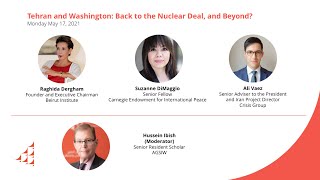
In this AGSIW webinar, moderator Hussein Ibish guides a heated panel featuring Raghida Dergham, Suzanne DiMaggio, and Ali Vaez on the prospects of reviving the JCPOA and its broader regional implications. Suzanne argues that sanctions should be a flexible tool toward policy change, warning that rigidly maintaining them risks failure. Raghida emphasizes the need for Iran to honor commitments on missiles and, crucially, to respect the sovereignty of neighboring states, citing ongoing conflicts in Syria, Iraq, Yemen, and Lebanon, and highlighting a 25‑year China‑Iran pact as a factor in sanctions calculus. The moderator intervenes to set ground rules, urging participants to speak for themselves without labeling. An audience question links the Afghan withdrawal to US‑Iran considerations; panelists note that regional stability in Afghanistan, Iraq, Yemen, and Lebanon is intertwined with the JCPOA, which they view as a gateway to broader diplomatic engagement. Suzanne points to a postponed UN‑Qatar‑Turkey conference in Istanbul as a potential venue for Iran‑US dialogue on Afghanistan. Closing remarks from Raghida, Ali, and Suzanne stress the necessity of a new narrative beyond zero‑sum pressure, the importance of regional actors taking ownership of their sovereignty, and the Biden administration’s role in restoring the nuclear deal while encouraging regional powers to resolve their own disputes.
Chapters
Hello, good morning, good afternoon to our audience joining us from various time zones. I'm Raymond Khairam, the Chief Program and Development Officer here at AGSIW. Today's program is titled Tehran and Washington: Back to the Nuclear Deal and Beyond, and as part of our ongoing coverage of U.S.-Iran relations, the return to negotiations over Iran's nuclear program, and repercussions for the region. I'm happy to introduce a really stellar panel of experts joining us today, starting with our good friend Raghida Derraham. Raghida is the founder and executive chairman of the Beirut Institute and is a columnist for The National. Previously, she served as columnist, senior diplomatic correspondent, and New York bureau chief for the London-based Al-Hayat for 28 years. She was a political analyst for NBC, MSNBC, among others, and has contributed to The New York Times, The Washington Post, and Newsweek.
And if I may add also, in Arabic, I'm columnist for Al-Nahar al-Arabi, I take pride in being a columnist for an Arabic newspaper. So it's an al-Arabi.
Thank you, Ragheeda, for adding that. Also with us is Suzanne DiMaggio, Senior Fellow at the Carnegie Endowment for International Peace, where she focuses on U.S. foreign policy toward the Middle East and Asia. She's one of the foremost experts and practitioners of diplomatic dialogues with countries that have limited or no official relations with the U.S., especially Iran and North Korea. Before joining Carnegie, she was a Senior Fellow at New America, the Vice President of Global Policy Programs at the Asia Society, among other distinguished postings. Last but not least, Ali Vaez, who is Crisis Group's Iran Project Director and Senior Advisor to the President of Crisis Group. He led Crisis Group's efforts in helping to bridge the gaps between Iran and the P5+1 that led to the landmark 2015 nuclear deal. Previously, he served as a Senior Political Affairs Officer at the UN Department of Political and Peacebuilding Affairs, and was the Iran Project Director of the Federation of American Scientists. Moderating today's session is Hussein Ebish, a senior resident scholar here at AGSIW. He's also a weekly columnist for Bloomberg and The National UAE. And with that, Hussein, over to you.
Thank you so much, Raymond. Thanks everybody for joining us today. This is— it couldn't be a more important topic, even though, you know, a lot of attention is focused on Gaza. We'll talk about that a little bit because it's not unconnected. But of course, today, what what we're going to focus on is the US-Iran negotiations, the re-engagement in Vienna, even if indirectly, and efforts to revive the JCPOA nuclear deal from 2015, and to see what can be done to go beyond it. Because, you know, it's obviously that's going to be the beginning of the conversation. It's not exactly an end in itself, in my view. So I'm really happy to have this amazing panel. With us today. I mean, it's just wonderful. So thank you all for joining us. What we're going to do is we're going to have a conversation, sort of informal, but I'll be asking questions to our panelists collectively or individually, and we'll speak together. And then after about 45 or 50 minutes, we'll start engaging your questions from the audience that you'll ask through the Q&A function. So Let's begin by taking a look at the most recent sort of pressing event. Raghida, you've written about the connection between the nuclear negotiations between Iran and the United States and the rest of the P5+1, and this sudden flare-up between Israel and Gaza. And I was wondering if you— and Hamas, really. I was wondering if you could give us sort of your take on that and then get— see if any of our other panelists want to engage with this so that we can effectively look at the news of the day and then put it aside and get back into the deeper questions. But I do think we can't sort of pretend this isn't happening or pretend that it's unconnected. So let's start with you since you've written about this directly.
Thank you very much. I appreciate it, Hussein. I appreciate you hosting me and referring to the column which was published yesterday in The National and on LinkedIn, two different versions. Because anyway, because one is shorter than the other. But the point is that you're making is the following, that you want me to talk about. Do I see a connection between the negotiations in Vienna and the flare-up in Gaza and Israel? Yes, I do. And here are the reasons. Because in case the Israelis decided to go in for a full invasion of Gaza, meaning that to really go in as a full invasion, not only strikes, I think it's going to change the balance of what's going on. I think at that point it will be quite necessary for the Hezbollah in Lebanon to come in. And as far as Tehran is concerned, I wouldn't even exclude the idea that maybe for the first time we might see the Revolutionary Guards engaging directly with their, their missiles against Iran in case that, I repeat, in case Israel goes for a full-fledged invasion of Gaza to destroy Gaza completely, destroy Hamas completely. If that does not happen, it's a different scenario. If it does happen, that in connection with the Vienna talks is very strong because there you would have Iran coming in fully and openly as a partner to Hamas in this engagement with Israel. Now guess who's going to be on the spot in such a case? The Europeans can always play it here and there, and they can just always say we're very afraid for ourselves because, you know, the nuclear for us is much more important than any Palestinian, or probably Israeli for that matter. But I think President Joe Biden and his team would be very much on the spot. Because in that case, the choice that they have to make between Israel, the traditional ally of the United States of America, and Iran leading the Hamas fight with the Israelis— and we say Hamas, we don't say it's the Palestinians, all of them, because there is a distinction we'll talk about a little later. The Hamas missiles are, you know, they are very much backed by or coming from Iran. So Iran is engaging one way or another on the side of Hamas in this conflict. Therefore, Joe Biden, the president of the United States, would have to really think very deeply of what to do next. It's not a good position he's in. He's being put on the spot, and it's going to be— it's now impacting the negotiations. But for the moment, the priority remains for the Biden administration is to reach an accord with Iran.
Thank you very much for that. I mean, I'd say my strong guess is that that won't happen. Not necessarily that there wouldn't be any ground action, but that I'd be surprised if the war really extended in the way that you suggest, but it certainly could happen. I'm wondering if either Ali or Suzanne have any thoughts on this before we get into the negotiations directly.
Yeah, I would just add, I think that is a very good analysis of what could happen. So far, what we're seeing is the talks in Vienna are progressing at the technical level and at the Joint Commission level. And it is a problem for Biden as Hezbollah gets more involved. I'm sorry, Hamas gets more involved. But we have another factor in here, and that is the political discussion here domestically in the United States. The narrative has changed quite dramatically. We see Free Palestine protests happening in every major city now. So it may not be as much pressure on President Biden and his administration as we think. This is a very fluid situation. And I think the narrative here in the United States is extremely fluid.
I think that's a great point. Ali, do you have any thoughts on this?
Or first of all, Hussein, thank you very much for inviting me. It's a great pleasure to be here.
It's an honor to have you.
To be on a panel with Raghida and Suzanne. So, you know, I think there is no scenario in which Iran would enter the fray in a conflict with Israel on behalf of Hamas. It's just very unlikely. I mean, the entire Iranian regional strategy of forward defense policy, as the Iranians refer to, is to deter an attack on Iranian soil by using proxies and partners away from Iranian border. And I doubt that Iran would would take any risk that would justify a direct Israeli attack on Iranian soil. And that is bound for sure to derail the nuclear negotiations completely. So I doubt—
Yeah.
Yeah. So I doubt that is likely. But I think what this conflict is doing right now is that it's increasing the political cost for the Biden administration to offer Iran sanctions relief. You've already seen members of Congress writing to the administration saying that sanctions relief is going to provide Iran with a windfall, that that windfall is then going to basically be channeled towards Hamas and other groups in the region to put pressure on Israel. I mean, we can argue whether that is an accurate warning or not, but the reality is, at the end of the day, this is just going to increase the blowback that the Biden administration will face once it restores the JCPOA and offers Iran sanctions relief.
That's a great point. I'd just like to throw out one observation of my own, which is that opponents, categorical opponents of the JCPOA here in the United States have been trying to use the violence between Israel and Hamas as an argument against re-engaging with Iran, as an argument against the negotiations themselves, in a way that strikes me as illogical. I mean, there's no direct connection. There's violence in Gaza, and Iran is connected to Hamas, therefore, you shouldn't talk to Iran about nuclear negotiations. It makes no sense, but it's a very concerted And I think a coordinated campaign, and it is bizarre, but you know, it's spin. So sorry, go ahead.
But why?
Why? Because Hamas is acting for its own interests. It's not acting at the behest of Iran. It is a point to say that in addition to the nuclear negotiations, there's this question of Iran's proxies' use of non-state militias that has to be addressed. But I think, you know, you can't throw everything into a bucket and stir it up. That's my view.
All right. So let me take this point up with you. Yeah, I would say that, you know, if you think Hamas is acting solely on its own without any help from Turkey or from Iran—
I don't say help. I say at the behest of. I think they felt they needed to act and they were going to do it no matter what.
Let's not get stuck because, you know, let's not get stuck with dissecting that. Because there is an important differentiation. But let me just say something here. There is no way that Hamas is acting on behalf of the whole Palestinian Authority.
Of course not.
In fact, Hamas is acting against the Palestinian Authority.
Absolutely.
So let us be very clear on that.
Yes, of course.
Okay. Sorry.
Okay, no, that's—
So with Zoom, when we speak on top of each other, then we— then it goes— okay, give me 2 seconds and I'll be quiet. But I will repeat, Hamas is not acting on behalf of the Palestinian Authority, nor for the whole of the Palestinian— Of course, the Israelis were terribly aggressive and horribly ugly in what they've done in the mosque, in the Al-Aqsa Mosque. And I think supporting the extremists amongst the— I mean, all of the Mustaqimim, what is it, settlers, all of them have got to be held back, but especially the ones who are full of hatred. They really have been used also by the Israeli, part of the Israeli government, just like as Hamas is using its weapons in order to accomplish its own goals. Who are the victims? Obviously the Palestinians. We will talk later about the victims being the Palestinians, not only in the West Bank and Gaza, but also the Palestinians, the Arab, the Arabs who are living in Israel, which I am afraid might lead the Israeli government of Netanyahu to use the missiles, the Iranian missiles of Hamas, as a pretext to have a forced expulsion of the Arabs, Palestinians, from Israel proper. We'll get back to that. But you can't tell me that there is no connection with Iran. Because these missiles, 600 of them, have been delivered recently by the Iranians to Hamas. Don't tell me that there is no connection with with Turkey because Turkey has been a great supporter, particularly of the extremists of the Muslim Brotherhood, in Hamas. And I don't think Hamas has, you know, I'm sorry, there is a history for Hamas. As we are told, I don't want to claim that I know the fact, and I know that as a fact, although you can check it, but there's been a lot of collaboration and cooperation between Hamas and the Israeli Mossad when it was needed.
So I'll let you have the last word on that.
Let us really not just consider this as if it's something disconnected. There is a huge connection.
I agree. Yeah, okay, so that's, that's all true, and that's an important point. I want to get back to Vienna, okay? So that, that's all fine, but, uh, you know, let's, let's, um, jump into our main topic, having, uh, you know, um sort of necessarily tallied with the headlines for a second, and good points you make. I'd like to ask Suzanne, who's a real veteran of these conversations, and then Ali, and then Raghida, what are you hearing from Vienna? Where are we? It looks like things are more, in some ways, more advanced than some people had hoped, and in other ways, a kind of bogged down. And if you can connect it to the politics, both in Iran and the United States, that would probably be helpful. You know, give us your sense since you've been involved in this stuff, TRACT II stuff, for, for so long. It's really a tremendous experience you have.
Thank you, Hussein. So on the current state of play in Vienna, they've clearly moved into their most challenging phase yet. As you said, progress has been made, but it's very slow going. I would say they're getting down to the nitty-gritty. Of drafting a document, which is always complex. All of the parties continue to negotiate on the remaining areas of disagreement. They want to get back to compliance for compliance. What does that mean? For the Iranians, it means getting back to January 2017 in terms of sanctions, but this isn't likely. The Biden administration has said it will only lift and remove those sanctions inconsistent with the JCPOA. Some are legitimate, most are not legitimate, but there's been progress here. And for the Biden administration, they also would like to get back to January 2017 in terms of rolling back Iran's nuclear program. This also is not likely. In fact, I would say it's impossible because the Iranians have gained knowledge the technical nuclear know-how that comes with advanced research.
The centrifuges in particular, right?
Yes. And that just can't be relinquished or wished away. I mean, the machinery can, but the knowledge in their brains cannot. So this, of course, means compromise on both sides in order to get to the finish line in Vienna. And I think both sides are experienced enough, they're savvy enough to know that. So there are some core concerns on both sides. The Iranians would like to see the US dig a little deeper on sanctions relief. There's been progress here, particularly on the oil and banking sanctions, which are the key sets. But also I'm hearing relief in other sectors like textiles, autos, shipping, insurance. So that's, that's a positive step. On the U.S. side, you mentioned the centrifuges. I think there are other sticking points relating maybe to uranium metal, the stockpiles and so forth. But as they move to drafting the common text, I think a deal is still within reach. Both sides are aiming to get their best terms. I don't see the gaps as insurmountable. I see a key question is timing. And this is the timing of the deal. What is the Supreme Leader thinking? Is it better to reach this agreement before or after their upcoming presidential election? On June 18th, which is now just heating up. The Supreme Leader would like to see high turnout. Reaching a deal would help produce that, but it would also move the momentum in favor of the moderates and reformists. Does he want that? And then let me just conclude on this point. This timing is also an issue for the Biden administration. They are facing a dilemma. They have distanced themselves from Trump's approach. Including the Trump-Pompeo sanctions in words, but not in actions. They are clear that maximum pressure is a failure, but they're still enforcing Trump sanctions, many of which were issued in bad faith to tie their hands in conducting diplomacy with the Iranians. How do you square that? How do you continue these sanctions, especially during a global pandemic? That has Iranian citizens, has hit Iranian citizens especially hard. So this is, I think, the current state of play. It's complicated.
Yeah, no, no, that was a really great summary. And I'm so glad you mentioned the word time, because to me, time is the governing metaphor in everything to do with the JCPOA. The JCPOA is a chronological gamble on all sides. So there are so many aspects to the question of time that we'll get into. But Ali, I'd like to ask you the same question. Where do you think the negotiations stand? With all the different aspects that I asked Suzanne just now?
I think Suzanne depicted a very accurate image of where we are right now. The reality is the fact that we're now working, both sides are working on a joint draft, in and of itself is, I think, significant progress. But there are serious differences remain. In addition to the points that Suzanne made, I would add that The question of verification of sanctions relief, which is extremely important for the Iranians, I think is a major hurdle because unlike Iranian actions that could be verified by an independent referee, which is the International Atomic Energy Agency, there is no objective mechanism or referee for making sure Iran's banking and trade relations will go back to normal. And part of it also depends on The Iranians basically getting their act together and, for instance, ratifying legislation related to FATF, because Iran is the only country along with North Korea that is now blacklisted by FATF. And it's hard to imagine that even if the U.S. lifted sanctions, any primary bank would work with Iran. And this might take time. And, you know, it is quite complicated. But eventually, I agree that all of these disagreements are surmountable. And the alternatives to restoring the deal is really, are really not attractive for either side. For the U.S., the continuation of Iran's nuclear program, the exponential growth of Iran's nuclear program, that with now with advanced centrifuges and 60% enrichment, is a real source of concern for the Biden administration. And for the Iranians, continuing to live under U.S. sanctions in the middle of the fourth wave of the pandemic is really hard to tolerate. But having said this, I think, Hossein, and I might've mentioned this to you before, that I do believe that the Supreme Leader does not want a major diplomatic breakthrough prior to the elections. It is true that he has traditionally seen the turnout rate as a testament to the system's popular roots and legitimacy. But I think this time around, he cares more about the outcome than the turnout in the sense that this is probably going to be his last president. And I think he wants someone who doesn't pose as many challenges to his authority as the previous four presidents who've served under him did. And this means that he wants a controlled electoral process. When usually you have high turnouts in Iran, you get surprised outcomes. And this is why a diplomatic breakthrough can mobilize the silent majority of Iranians to come out to the polls and could result in outcomes that the system does not like. Last year, there was a parliamentary election in Iran in the gloom and doom of maximum pressure. It produced the best outcome for the deep state. The hardliners had a landslide victory in the lowest outcome, in the lowest turnout in Iranian elections. And I think that's the model that they want to reproduce. So I wouldn't be surprised that the negotiations would make incremental progress until June and then get finalized near or right after the Iranian elections. And the beauty of this for the deep state is that they can still blame the Rouhani administration for any shortcomings of the roadmap. To reenter the JCPOA, and Rouhani would still do the dirty work of rolling back Iran's nuclear program, which is not popular in Iran, dismantling centrifuges, shipping out enriched material. And then the incoming president, who would be from the hardliner camp, would be in a unique position. In the past 4 decades, I think no Iranian president has come to office with the prospect of significant economic growth thanks to sanctions relief. And so my guess is that we see see slow progress until June and then rapid progress immediately after.
So that way, they would eschew all the blame and— or much of the blame and take all the credit. And it's— yeah, that makes a lot of sense. You did mention it to me, and I shamelessly pilfered it. And I appreciate it. Raghida, you have terrific sources, really some of the best. And so I'm wondering what your impression of where we are in Vienna and where we may be headed is.
Look, I think I agree with what Suzanne said and Ali, and the jury is still out. The progress has been made, but it's not final. And I want to— I know you probably don't want me to harp on this, but I've got to tell you that—
I couldn't say anything less.
President Joe Biden is very much on the spot right now because of the developments in Gaza and Israel. Why? Because there is two elements in these developments that are part of the discussions that have been— actually, these two elements have been pushed out of the discussions, the nuclear discussions. One is the issue of missiles. Two is the issue of regional behavior of Iran. Now, both are on the table. Both are right now happening. Don't call it a right-wing conspiracy or any such thing, because it's a fact. It is happening. Missiles are being shot. Then they are Iranian missiles. Iran is absolutely not hiding its own interest in supporting Hamas. Read them, hear them, talk to them. And secondly, so the issue of missiles. And secondly, I think that the challenge to President Biden is probably bigger than to anybody else, because what's happening is that Tehran, maybe the hardliners, are saying, prove it. You say that we are free to do— well, let me rephrase this. Prove it. You say that the priority is to be given only to the nuclear, and that is above all. So prove that you're going to get, you know, serious about that and stick to it while the missiles are flying into Israel, while the regional behavior of Iran is under question, particularly if it flares up on the Lebanese borders through Hezbollah, then really everything is up in the air. You guys have got to— I mean, I understand the optimism and enthusiasm about having the nuclear deal. Like the Europeans, all they want is to speak about the nuclear deal, JCPOA, and only that. The mistakes that were made by the Obama administration by agreeing to exclude any discussion and bow to the Iranian demand that you do not discuss our regional behavior, whether it is in the Arab geography of Iraq, Yemen, Syria, Lebanon, or whether it is about missiles. The fact that the Obama administration bowed to that has cost dearly, including a massacre in Syria, including the absolute falling apart of Lebanon because it's under Hezbollah rule and that's it. And it's really not only Hezbollah rule, Hizballah takes its orders, and they say so, from Tehran, in particular the Revolutionary Guards. So what regional behavior, or what is it that the Obama administration that said that was done to be proud of when it comes on these two issues, the missiles and the regional behavior, that the Biden administration is sticking to? Because it is history repeating itself. The same team is coming and say to the to Tehran and the negotiators from Iran, you know what, yeah, we really need that nuclear deal first. We really, okay, we will negotiate that traditional, the gradual lifting of sanctions. We will compromise on this, we'll compromise on that. But no, you could have it. You don't want to discuss missiles? We'll put this till later. Do you want to not discuss regional behavior? We could also postpone that till later. And you know what? Let's just entertain a possibility. Which I really just— it just occurred to me just right now. What if Netanyahu decided to escalate in order to put these two issues on the table and force Biden to say, all right, now what do you do about it? What if now Iran and Israel, by accident, by coincidence, each for their own reasons, obliging President Joe Biden to just choose? Do you think— and Susanna said something very interesting. She said there's a lot of sympathy now amongst the, you know, the public and maybe even the media towards the Palestinians. It's about time. But Susanna, I hate to tell you, I'm an American like you, and I lived in the States for 42 years, and I still have my home there. Unfortunately, this is always a fleeting emotion. Something happens, and then Israel is automatically the favored ally, no matter what. So really, this is going to impact the negotiations unless magic happens they wrap it up, everybody goes to, you know, back home, and Netanyahu says, it's okay, I will let Hamas claim that it's victory, or Hamas will say, well, that's okay, Iran said the Vienna negotiations are more important. Unless something magical like that happens, I see problems coming up with the negotiations.
Okay, let's pick up on that, right? So you've put two long-standing criticisms of the whole JCPOA framework on the table. And let me add another one, and let's see what the other panelists have to say about that, which is, yes, there's this existing criticism about missiles and non-state actors, but there's also the question of timing. And I'd like to look at the question of timing because there's this very heavy lift being undertaken to resurrect the JCPOA, the terms of the JCPOA that meant something different in 2015 than it does in 2021 and 2022 in terms of the sunsets, right? In terms of the timeframe, the timeline. And that's sort of really my question. And I'll go to Suzanne first and then Ali. How much would it accomplish in and of itself? I understand having a dialogue then can proliferate, but in and of itself, what would resurrecting the JCPOA— how much would it accomplish? And what about the problem of timing? We'll begin with you, Suzanne.
Great, great set of questions, Hussein. Thank you. So I think we need to inject a dose of reality into this discussion, and that is, you know, the Iranians coming to the table to discuss these whole other set of issues, how likely is that to happen without reconstituting the JCPOA? I would say the chances are virtually nil. I mean, even in this set of discussions in Vienna, which are exclusively focused on the JCPOA, the Iranians are still refusing to meet the American negotiators, right? So, and the reason they're refusing to do that is because they say the Biden The Biden administration is not part of the joint commission. And they also don't want to be seen as negotiating with the Biden team to their critics at home and their opponents at home. So this is a reality we cannot escape. But that being said, I do want to give credit to the Obama administration. They focused on the most threatening part of the relationship with Iran, and that was the nuclear program. So I do think the Biden administration is right placing the priority first on reviving the nuclear constraints on Iran's program. And let's be clear, the constraints put in place on the— by the IAEA are unprecedented. We need to get that back up and running and put Iran's nuclear program back in the box. But I think the Biden administration should, and perhaps it is, also looking at the reconstitution of the JCPOA as a potential strategic opening with Iran, the beginning, the entry point. So beyond this, what else can they do? They want to negotiate a longer and stronger deal, to use the Biden administration's lingo, follow up on the JCPOA and try to extend the so-called sunsets. They also have placed the priority—
Is that plausible to you? I mean, do you think that's—
Yeah, it seems plausible as long as we understand, the United States understands, that the Iranians are going to want something in return. And I think here we're edging into maybe primary sanctions. That would be something that the Iranians would have their eye on, and that might convince them to extend the sunsets in the JCPOA.
And at that point, though, if you get to primary sanctions, and I'll ask Ali also, as well as Suzanne, to weigh in here, and then Raghida, of course, you know, that then would lead us into the question of non-state actors as well as missiles. I mean, in other words, the closer you get to core concerns, then everybody brings up their core concerns, right, Suzanne?
Yes. And then You know, I think in the Biden team's mind, this would then set the stage for broader regional discussions to limit ballistic missiles, engage the UN and others in seeking a long-term regional security structure around the GCC countries and Iran and so forth. So there's a logic to it.
Sorry, a quick response from Raghida, and then we'll go to Ali.
Yeah, if you permit me. Look, I appreciate the fear of the nuclear, of course, but just put yourself in a position where you are from this part of the world, where you see the paramilitary forces that report to Tehran wreaking havoc, I mean, to the issue of sovereignty of countries. Look at the state of Iraq, the state of Syria, the state of Lebanon, the state of Yemen. But I want to tell you that I appreciate the preoccupation with the necessity of, yes, the nuclear, but that is bowing to Iran's demands and, what do you call it, in Arabic, I'm trying to find the right word. It's really blackmail that you don't do that.
Coercion.
Yeah. And so I want to just tell you, and that's the primary sanctions. You know, it's happened before when they annulled the Obama administration and the other 5 permanent members, 3 4 permanent members plus Germany, when they annulled Security Council resolutions that prevented Iran from exporting its weapons and men to other parties, to outside their own borders, that is when they contributed directly to the tragedy of Syria, to what happened in Iraq. You know, Iraq has been— the resources have been depleted by the revolution.
Okay, I want to come back.
I want to make sure that Jessica—
we're not going to lose sight of it. We won't lose sight of this issue. We're going to return to it.
That's all. I beg of you.
No, it's an important point. We're going to come back to it at least one more time for a deep dive, but I want to bring Ali into the question. Before we get into the non-state thing fully, which we will, I still want to talk about the timing question. Especially the problem— there are two timing issues that strike me as really important. The one that Suzanna and I were talking about, sunsets, right, that means something very different now than they did 6 years ago because, you know, we've eaten up half the time at least. So that raises a real question of how much you would really accomplish if, say, by the end of next year or the middle of next year, you reset the clock to what looked reasonable in 2015. Bit different. The other question about timing is not just the Iranian election, but Biden has only got another year or so in which he can be sure he has, you know, a clear field, because things may look very different after the midterm. And even then, you only get another year after that before the next presidential election. So timing is limited also on this side. But go ahead, Ali Vaez. What do you make of these problems?
Thank you, Hussein. Let me just react quickly to what Raghida said about the scope of negotiations. I do remember clearly that, you know, the Iranians actually in 2012 wanted to include the regional issues in the negotiations with the P5+1, and there were the Arab countries in the region who warned the U.S. against talking about the region behind their back while they were not at the table.
And remember that—
Let's table this. No, I'm going to come back to it, and I'm going I'm going to begin with you, Rangida, and then we'll do— but let's table the non-state actors for a second.
No, no, sure.
Let's go to the timing issue because otherwise we'll never get back to it.
You know, the P5+1 is a structure that is mandated by the Security Council to address one specific issue, and that's Iran's nuclear program. Its membership and its scope are determined by the Security Council resolution. And I think it's really one-sided to think that all the problems in the region have only one source, and Iran is the source of all evil in the region, and nobody else has contributed to the current turmoil that we're seeing in the region. But that's a lengthy discussion that maybe I shouldn't get into.
I mean, we can.
So on the question of sunsets, not what I asked you. I think you're absolutely right. The, the, I think, um, let me just, Hossein, add one more point, which I think is critical before I get to sunsets, which is that, um, you know, I think the Biden administration has learned the lessons of the mistakes that both the Obama administration and the Trump administration the Obama administration committed. So the Obama administration, I think, at best wanted to prioritize the urgent over the important, to tackle the nuclear issue first, but really didn't have a plan for the day after to tackle other areas of disagreement. And it ran out of time. I think the Trump administration's approach, which was what Raghida seems to prefer, which is to put everything on the table and resolve everything in one go, turned to be an abject failure. It exacerbated everything. It exacerbated Iran's nuclear program, Iran's regional behavior, behavior, and so on, and Iran's missile program as well.
But what about the timing question?
So now I think the Biden administration is doing the right thing of actually trying to tackle these issues simultaneously and not sequentially, in the sense that you see that the Biden administration is trying, in addition to the nuclear issue, to also de-escalate in Yemen and also support a regional dialogue process that would bring the temperature all together and address some of these issues that require regional solutions. You can't address Iran's missile program without addressing the regional balance of conventional weapons. These have to be arms control negotiations at a regional level, and the Biden administration, I'm sure, will pursue that approach.
Okay, go ahead.
There is nowhere— there's no way that the president would agree that Iran's nuclear program would grow exponentially in his last year of his first term. It's impossible. So I think there needs to be a follow-on agreement definitely before 2023. Now, if you frame this as the U.S. wants more, the Iranians are obviously going to reject that. But if you frame it as a better-for-better agreement, given the experience that the Iranians had with sanctions relief in 2016, that they were really unsatisfied with what they received, then you see a formula that could potentially work. Iranians would make more nuclear concessions, and the Biden administration can provide more sanctions relief, especially primary sanctions, as Suzanne mentioned, that would actually allow Iranians to reap the dividends that the JCPOA promised to them. And, you know, there's also another element to look into this, which is the fact that the Iranians also know that this deal is unstable. Do you really think that they want a year and a half of economic opening before either sanctions are snapped back or the next US president in 2024 decides to bring on the agreement again? I don't think so. I think they also want to be able to count on their economic policies in the longer term. This requires a follow-on agreement.
Point taken. Okay. So here's then the question, and I do want to get back into these other issues, But let me just begin, and I want to ask, actually, I want to ask Suzanne whether you think there's any, you know, what are the really the chances of going beyond? What are the chances of more for more? I think I'm skeptical about the prospect of more for more, and the reason is that what you have to give to get back to the original Sunset framework seems to me to set up a dynamic where extracting more becomes rather complicated.
Is your question focused purely on nuclear or beyond?
It's purely at the moment because I'm about to broaden it again. But right now, yeah, I'm talking about sunsets and nuclear and then maybe theoretically those. But yeah, I'm thinking really about the sunsets and the timeframe.
So let's imagine the JCPOA is reconstituted, compromise is made by both sides, and the Vienna talks wrap, wrap up either before the Iranian election or after. We can quibble about the timing. Then I do think the Biden administration, working particularly with the Europeans, will have to mount a very sustained, focused effort on getting talks back into the Joint Commission to think about more for more, precisely as Ali outlined. Now, keep in mind that the Iranians have a number of issues they want to discuss in the Joint Commission that could fall under more for more. First among them is the issue of, I was gonna say reparations, but, all the economic gains that they lost over the past few years.
So compensation.
Compensation. Thank you. And I think they're going to want to have that conversation right away. Now, do we imagine they're going to request pallets of cash being flown into Tehran by the billions? I don't think so. I think they're savvy enough to know that that's not going to fly. But what they might seek instead are direct investment opportunities, Europeans coming in, having those sorts of economic-focused developments happen quickly. I think that's what they're going to want. So there is incentive on the Iranians' part to continue the talks in the Joint Commission on issues like that. They may also want to discuss something called assurances, precisely because we might have a President Pompeo in 2024 or a president, I mean, take your pick, one is as horrible as the next, that we would come out of the JCPOA again and what will happen. So, there's incentive on the Iranian side to do this. And if you can accept that the Iranians have made a strategic political decision not to pursue a nuclear weapons program, which I do, then giving, extending the sunsets are in the realm of possibility. So these are the sorts of things I think the Iranians would want to discuss.
All right. Yeah, I mean, I'm still skeptical, but I'd like to go back to Ragheda for a second because I wanted to sort of table the question that we got into before, but I want to resurrect it now because I do think we've gone into the sunset and the timing issue quite well. Ali made a very interesting claim or guess or whatever it was, if you don't mind, that the Biden administration has learned from the mistakes of the Obama administration, right? And also from Trump's experiment. What do you make of that? I mean, do you see evidence of a learning curve here or no? What's your evaluation?
I don't understand even the statement itself. I don't understand even what's being said in that statement.
Well, go ahead.
No, first of all, I mean, I don't want to— look, I mean, Hossein, you know me, I don't appear in panels so that I don't engage in back and forth because I really don't do that. But I'm just going to say to you what really upsets me about this sort of discourse. First of all, I want to apologize to Suzanne for for calling her Jessica, because I don't know why I did. Sorry about that. And I agree with most of the things you're saying, Susanna. I disagree with the extent of your optimism, but I agree with the extent of your hopefulness that things might happen. I would love more than anything else that there is a good deal going for the region. I come from the region. I also am an American. So I wouldn't want anything more than a good understanding. But to exclude from the conversation people from the region, whether it's in the Gulf or whether those who are under the mercy and under the foot of the Iranian Revolutionary Guards, which are being applauded by some, probably including Ali Vaez, because I want to get back to Ali on this one. I don't appreciate that. I don't appreciate that it's okay to trample over sovereignty of other countries.
Why?
Because Iran needs to. Sorry, paramilitary forces operating in sovereign countries reporting to a capital is an absolute violation of sovereignty. It should not be tolerated by anybody.
Yeah, it's gotta go, of course.
So that's number one. So therefore, the Biden administration should not push this for later, to be discussed later. It should put it on the table now. I am against the two-step approach. We'll deal with the nuclear now, and then we'll deal with the— well, once we're done with that, and once we lose the leverage, then later on we talk about, oh, that regional behavior, or those very dangerous missiles. It is not acceptable. This is wrong, and this is an insult. It's not enough to send delegation as high— Do you want me to finish or not?
Yes, I want you to finish.
Okay, let me then finish. So I don't want a delegation to go to the region to just, you know, placate the leaders and say, you know what, it's okay, we're going to put you together later, we'll deal with you later, you're still a good friend. Because the region is falling apart. Because there is an absolute, you know, situation where I sit in Lebanon, this is a country going down. In the ditch, it can't afford this, you know, paraphrasing of events. And I want to just say, yes, I am against this two-step approach, because when you lose the leverage and then you give the money to the people who are executing the foreign policy of Iran, as far as everybody is concerned, including the current foreign minister, and I am speaking of the Revolutionary Guards, then You are really enabling them to do the wrong thing that the United States of America should not stand for. We are supposed to stand for respect of sovereignty, not killing sovereignty and then saying, "Oh, excuse me, I was really afraid of the nuclear." That is that Europeans can do that because they're weak and meek. The United States of America should not be doing that. I beg that, I beg that of the team of President Biden to pay attention because, you know, you've done it once, don't do it again. Right now there is a chance, especially because of elections, to tell the Iranian people, to tell the Iranians who are going to choose their own president, please, it is not allowed that you go on trampling over other people's destiny and sovereignty. It is not okay.
Point made. All right, Suzanne. You have a response?
Yeah, I just wanted to clarify that the assessment I'm presenting is not based on optimism by any stretch of the imagination. Diplomacy is hard, and sticking with this course is going to be very difficult. What I'm saying is based on my read of the interest of both Iran and the U.S. So what I see is that, you know, after a delay, the Biden administration is very clear that rejoining reconstituting the JCPOA is a U.S. foreign policy priority. There is an expectation of continuing diplomatic talks once it's reconstituted, if we get there. We have appointed an envoy on Iran. We haven't seen this done in the case of Israel-Palestine or North Korea or other crisis points, and they're engaging in indirect talks talks now. The rhetoric is completely different. There is an emphasis on de-escalation and dialogue. And I do think, you know, there's also indirect talks. We should bring this in on a prisoner exchange. They're not engaged directly in those discussions, but things appear to be inching forward.
That's sort of a confidence-building step. Yes.
But my point is that even though we're not back into the deal yet, the Biden administration has pivoted towards Iran, towards a different kind of relationship than, let's put it this way, the Trump administration had.
Right.
And on the point of regional dialogue, there's a flurry of diplomacy happening now among players in the Middle East, including the Saudi-Iran talks in Baghdad. This tells me there's a realization on their part that the U.S. return to the deal is likely, and they need to prepare for that reality.
For sure.
We've seen the Biden administration strike a more strategic balance, shall we say, towards the Saudis. This is a positive development. I think the Biden administration understands that a lot of the problems we're talking about in the region cannot be solved by the United United States. Yeah, the actors within the region themselves that have to get their act together and solve it. So we'll see some reduction in tensions there between Iran and GCC, right? Leaving out Israel-Palestine, which I agree is a complicating factor.
There's, there's a— I mean, I, I think it's obvious that all the players in the region, including Gulf Arabs and Israel and others, are bracing themselves for, you know, the resumption, the resurrection of the JCPOA, whatever that may imply for their interests. Now, I think the assumption is it's going to happen, right? Let me just give voice to what I think the fear is. The fear is that the Biden administration believes that there is only one major American national security interest in the Middle East beyond the defense of Israel, which can defend itself with its nuclear weapons. And that is the Iranian nuclear issue. And the fear is that if they put it to bed in this little timeframe of the JCPOA, you know, get it off the table for a few years that way, that they will then conclude that everything else is of minor importance for the United States and move on. And that that would be a terrible miscalculation. This is, I think, the fear of people who look at this policy. And get really concerned that this is a sort of monomaniacal focus on the Iranian nuclear issue, and that there would be nothing of substance after that. And so I'd like to see what Ali's response to that concern is, and maybe Suzanne also, and then we'll go to questions. Sure.
So Hussein, first let me say I don't respond to ad hominem attacks. But, you know, I was not defending the Iranian regional policy. I was explaining it, which I think if you don't have a right understanding of it, then you obviously come up with wrong solutions. The reality is, I think the Iranian interference in affairs of other countries is as wrong as U.S. deploying non-state actors in Syria or the UAE deploying non-state actors in Libya and and so on and so forth. I mean, Iran is not the only country that is engaged in this kind of behavior in the region. Look, you know, the reality is I think Saudi Arabia and the UAE have learned the lessons also of the maximum pressure era. They realized that, you know, if you engage in a zero-sum dynamic with Iran, the U.S. engages in a zero-sum dynamic with Iran, they are going to be caught in the crossfire. And the outcome is not necessarily going to be any better for them. But that is in contrast with the other fear that you were talking about, which I formulated in a different way. And Raghida referred to this as well, which is that I've always believed that regional countries' primary fear is not of uranium enrichment, it's of Iranian enrichment. And, you know, I think—
What do you mean by enrichment?
Meaning Iran—
The empowerment of Iran, the regional—
Iran getting access to more financial resources, projecting more influence in the region. But again, I think that's a wrong way of looking at it. One has to understand what is really driving Iran's regional policy. One has to understand whether Iran has legitimate security concerns or not, and then come up with non-zero-sum solutions. And, you know, I think the Biden administration has a realistic view of the path forward. Imagine, let's just play it out. Let's just play out what Raghida is suggesting. Testing, that we say, okay, forget about the JCPOA, let's negotiate a—
Well, she didn't say that. No, you didn't. No, that's fine. So just give us your point of view, but you didn't endorse Iran's foreign policy.
There is no other realistic way forward other than putting a lid on this exponentially growing nuclear program, which poses a threat to everyone. And the Biden administration wants focus on great power competition. It wants to reduce its— that's the fear in the region. It is not able to do so unless it can resolve its issues with Iran and at least contain them.
So that's exactly what I was talking about. So you've just sort of gotten into where the fear comes from. The fear is that the only obstacle coming from the Middle East to focus on great power competition is this concern about Iran's nuclear weapons And then once that's dealt with, even in a kind of piecemeal way, in a time-sensitive way, that the administration will feel that, you know, it's done and the region is no longer centrally important. That's a real concern.
That's not what was frozen in 2015. Again, they assume that the Biden administration has not learned that instability in the region can spill over into the JCPOA and destabilize the agreement.
So everything that Sure, they have learned that.
Diplomatic investment, the political price that this administration will pay for restoring the JCPOA will be lost in a few years again because of regional crisis.
Okay, I've got to bring in the audience now and we'll have plenty of time to revisit Avendragada. We'll come back to you as soon as possible, but let me— I mean, I've only got half an hour, so I've got to bring in the audience. Let's go to a live question from our chairman, Ambassador Frank Wisner, first, and he can ask his question on the air, and then we'll go to the Q&A on the Q&A function. Ambassador Wiesner, please.
Hussein, thank you for letting me come in. Ali, this is questions mainly directed at you. We're looking today at the prospect of the outcome of an Iranian election bringing a harder-line government to office. Think about that for a moment and think about the challenges before us to strengthen the nuclear arrangement, to deal with arms in the region, and deal with the proxies. If I thought of one element of Iran that is deeply involved in the creation of proxies, in the development of weapons systems, is the more conservative, harder-lined elements. How do you see them dealing with the prospect of negotiations that would perforce limit the use of proxies, limit the reach of proxies, and limit arms? How much more difficult is that going to be with a hardline government? Or do you see flexibility on that side?
Okay.
Hossein, would you like me to answer now?
Yes, yes, go over it, please.
Yes.
Thank you, Frank. That's a great question. So I do believe that counterintuitively, a harder-line president in Iran will help with negotiations on all of these difficult issues. And I explain why, because I think the Iranian system would become much more monolithic. All instruments of power will be controlled by the same faction, the hardliners, the conservatives, whatever you want to call them. And so they will be less bogged down by the same elements that basically paralyzed the Rouhani administration's ability to make further progress on these issues, which is the infighting about who's going to reap the political dividends of dealing with the West. And number two is the mistrust. I mean, you saw in the leak of Zarif tape that it's very obvious that different elements of the Iranian system under the Rouhani administration did not trust one another, kept information from one another. I think this situation will change post-August because all power will be basically in control of the same faction. And I think that would facilitate negotiations as long as, again, the approach to the negotiations is not zero-sum. And also that we understand that unlike the nuclear issue, in which the trade-off was between Iranian restrictions on its nuclear program and rigorous monitoring in return for economic incentives, If we're talking about issues that the Iranians see as core to their national security, which includes their ballistic missiles and regional policies, then the trade-off, the reciprocation, will have to come in the form of security concessions from the other side, not necessarily economic incentives.
So this is where what Rajed was talking about starts to maybe feel like blackmail, because while it's true that, you know, many parties use proxies and clients, Iran system of non-state, its network of non-state actors is really unique. And the way it undermines the sovereignty and the state system in neighboring Arab countries doesn't have a parallel in the Middle East anywhere. And I don't even think in the rest of the world anywhere. So it becomes, if Iran requires security guarantees in order to not, you know, kind of demolish the state system in the neighborhood, that then starts to feel very coercive. So I'm wondering if anybody has anything to add on that. You're not going to go ahead.
Yeah, first of all, I want to apologize because we lost electricity, so I didn't hear the full question of Ambassador Frank Wiesner. Hello, Frank, how are you? And so I apologize, I heard only part of your question.
It had to do with the Iranian election, the impact of the Iranian election.
And that is actually a very good thing to remember to talk about because I think And part of that, what we're threatened by, is to say, all right, you deliver— the Iranians are saying, you deliver what we want, then we can play that game that we can put a soft face, a moderate face, like we've done before with Khatami, with Rouhani, and we can put that moderate face on the result of the elections. But if you don't, we're going to put out the real face. Who governs in Iran and who runs the foreign policy in Iran, which is the, the, the, the hardliners, the Revolutionary Guards, who are actually the ones negotiating in Vienna, for our information, to remember, if you don't mind. So that, that factions is very clear. Now we know which faction is, is in control, and we know what they want. And I would love I would love that there is an agreement on everything that's on the table. I would love Iran to be recognized as the great country that it is, that it is a great country with great people, but within its own borders, that it does not have to flex its muscles at the expense of the Syrians in Syria, the Lebanese in Lebanon, the Iraqis in Iraq. I mean, to just say otherwise, we're going to go ahead and scare you with our nuclear. This part of the world says to the West, go ahead, get scared, and especially the Europeans, stop selling us down the drain because you tell me we are scared of the nuclear. Stop bowing to these threats.
I have a question from the audience for you which goes directly to this point. May I throw it into the mix? Okay. Okay, one of our audience, Patrick Cyrus, actually wants to know if you would suggest a return to the maximum pressure campaign of President Trump.
We need that pressure, whether it is Trump's maximum pressure or any other pressure. But you can't just always look like you're, you know, you're bowing to the demands of the hardliners in Iran without keeping any of the tools for, you know, a comeback. So then, you know what, they backed down from saying full lifting of sanctions, but you don't touch us. By the way, Ali made a very big mistake by saying, oh, the Iranians wanted to, in the beginning, they wanted to discuss everything and put all the regional issues on the table. He's absolutely right. It was at the very, very beginning of the talks. And then they realized, oh dear God, no. And then they fought, you know, tooth and nail. To make sure and demand and stipulate that there will be no discussion of Iran's regional role and its project in the Arab geography altogether.
That's really interesting.
Let's not make a mistake on this one.
Let me ask you, Suzanne has a—
Maximum pressure is important. I am not advocating that we go back to— because I know United States right now, you say Trump, people want to faint. Okay, that's, that's not the point. The point is that you do not give up leverage when you're negotiating. You do not give up all the leverage and then you just say, ah, now I will negotiate and I will give you, you know, everything you need by excluding what I want to discuss and responding to what you demand.
Point taken. Suzanne, we've heard from Ali Vaez, we've heard from Rana about this question of a period of time where Iran may have been interested in a more holistic conversation about all of its policies. What can you tell us about that?
Well, I think the Iranians have made it very clear that they're not going to discuss the region unless and until the JCPOA is up and running. And the reason they don't want to do that is because they feel that the United States reneged on an agreement. They know they did. This was an agreement enshrined in a UN Security Council resolution and supported by the international community. But they have made it clear in private discussions that once the deal is up and running, they will have more of an inkling to get into expansive dialogue. Is it guaranteed? No, but it's something that we need to pursue. And I think we have to be realistic about this. If the deal is reconstituted, it's not going to be Rob Malley and Abbas Zarqawi meeting in some capital to discuss Yemen. The Iranians are going to want to work through multilateral frameworks. So Yemen worked through the UN to hopefully reach a political settlement there. There are This is a point of discussion between the Iranians and the Saudis now. So I think, again, I want to inject a dose, a healthy dose of reality into this conversation.
Reality is what?
What you have described as coercion, yes, you're free to use that word. But for me, as a practitioner of diplomacy, negotiator, I'm interested in moving the ball forward. How do we get to point A to point B? And I think the, the approach the Biden administration is pursuing now is the way to do that. Let's be clear, with the JCPOA, we've had a very rare occurrence. Major powers plus key related actors came together on the nuclear issue. They agreed that was the most important, best to tackle it as a priority and move on to other issues. They did this this through peaceful means, not through military action. So I think this multilateral approach to Iran that the Biden administration is also looking to reconstitute is most productive, most constructive. On the issue of Trump's maximum pressure, let's be clear, it failed on so many fronts. But one thing that's not talked about enough is how he ended that hard-won consensus that multilateral consensus on Iran that existed. And when we saw that stunt in the UN Security Council last summer on snapback, I mean, it was an embarrassment. It further damaged our standing. So I think, you know, let's be realistic on our leverage, the best way forward. My own feeling is we actually have more leverage when we're back in the JCPOA. Because the Iranians know that even if we're in, unless the United States administration is telling the Europeans and other investors it's safe to go back into Iran, it's safe to have business dealings, engage in economic deals, it's not going to happen. That's big leverage to me.
Okay.
One quick word. You are a practitioner of diplomacy and I respect that. And you're saying, how do we go from step, you know, from one step to another? Why is it so difficult to demand of Iran the respect of the sovereignty of other neighbors? Why is that such a tough thing for the United States practitioners of diplomacy or otherwise? Why is it such a difficult thing? That's the only exception in the world where a country demands respect and recognition for its so-called right to abuse the sovereignty of other countries and have paramilitary forces there reporting to it.
I think you're misunderstanding what I'm saying. I am not saying that the two are mutually exclusive.
Hold on, hold on.
In fact, my point is that—
Hold on, wait, folks.
This is how you use from one place to another, Suzanne.
Hang on. No, no, let's Let's have a conversation.
Okay, so hold on. This is a charge that I must respond to. I am not saying—
Folks, hold on a second, folks. Wait a second.
Look, control this conversation, Hussein.
Yes, we have a question, which is a fair question, which is, you know, how is it reasonable for Iran to take this position and for the United States not to confront it? In a very direct way and put it forward as a major concern. So, you know, I'd like to hear from both Ali and Suzanne what they think.
So, you know, this is very important. I have never made the statement that we should not be confronting Iran. In fact, we should be incessantly, you know, pursuing a revival of the JCPOA and confronting Iran on these activities that undermine U.S. interests and the interests of others in the region are not mutually exclusive. My only point is, what is the best, most realistic way to do that? And when we came out of the JCPOA, President Trump severed the one reliable channel of official engagement that we had with Tehran. And that was the Joint Commission. It severed— it was a good working channel, not only on nuclear issues, but we've learned that also regional issues were discussed through that channel. We've learned that that channel helped to deal with crisis management in the region. So what I'm saying is we need to get something like that up and running and build on it. Yes, it will be hard, but I think that is really the only way forward. And again, multilateral, we need to put together that consensus on Iran once again, with the Europeans and others, to work together on these issues. So, what I have in mind is something that is much stronger than anything Trump was able, or Trump and Pompeo were able to put together. What they did was actually blow up that consensus. They undermined our interests. They undermined the interests of our partners in the region too. Make no mistake about it, it was a failure.
Let's bring in Ali here because we haven't heard from him for a while. And I'm just curious, again, you know, we could kind of be accused maybe of, you know, kind of obsessive focus on this issue, but this is the Arab Gulf States Institute. So it makes sense that the non-state actors is something that, I don't know, it takes a great deal of our attention. Ali Vaez.
Sure. Look, Hossein, this discussion reminds me of the discussion about terrorism. What's the best way of addressing terrorism? To kill terrorists or to address the root causes of terrorism? And this is, I think, why we have to understand why Iran uses proxies and partners in the region, why Iran insists that its ballistic missile program is non-negotiable. And again, you look at the root cause and you realize that if you put yourself in the shoes of Iranians, again, I'm not defending them, I'm trying to explain how they see the world, is that they feel that they're surrounded by the United States, which is not inaccurate. You know, we have 40,000 troops off their shores in the Persian Gulf every single day, in addition to other bases around Iran. From a conventional military perspective, a country like the UAE's air force can destroy the Iranian air force in matters of hours. Iranian air force dates back from the time of the Shah. The Saudis have longer-term, longer-range ballistic missiles than the Iranians. The Israelis have not just nuclear weapons but also longer-range ballistic missiles. So when we impose an arms embargo on Iran and then ask them to disarm from what they see as critical to national security, obviously this is a non-starter argument. I don't see how this is not obvious to people with a little bit of common sense. I mean, at the end of the day, if we're looking for Iran to make a compromise on what it sees as critical to their national security, then we should allow them to—
So here's the—
there is a certain technology—
Well, hold on. Raghida, I'm going to come to you in a second. But I want to make one quick point. There is a bit of a cognitive dissonance here in the sense that we're sort of being very understanding about why Iran would want leverage, and then being very skeptical about why the United States— you know, sort of there's this sense that US leverage through sanctions doesn't make sense for the United States and is self-defeating, but Iran's leverage through the non-state actors does make sense for Iran and is understandable. I think that— I just wanted to point out that it's sort of not working for me. Go ahead, Ali, and then I'm going to come to you.
Look, I'm saying the core bargain of the nuclear deal—
Oh, I understand.
—makes sense because the nuclear issue, at least since 2003, was not critical to Iran's national security.
I understand that. No, you were not unclear. Your answer was very clear. What I'm simply suggesting is that in the conversation, there's a certain imbalance that's come up in my view. But anyway, let's— You seem very keen.
Okay, Ali, go ahead and then we'll go to Rania. We can't continue selling billions of dollars of sophisticated arms to Iranian neighbors and then say, oh, why is Iran developing its ballistic missile program?
Excuse me, wait, I understand that, right?
If you're going to have an arms control, international norms by invading other countries, by doing some of the same things that the Iranians are doing, including supporting non-state actors, and then turn it around and blame the Iranians for doing the same thing.
Well, there is— I mean, it's not comparable, but go ahead.
Yeah, I mean, I would appreciate it, Ali, if you say that you are defending the Iranian regime, because then it's clearer and We are to the point. Don't say you're explaining it, and it's your right. Your absolute right.
I mean, I think he can define his own.
Let me finish. Let me finish. All right. First of all, first of all, you know, the U.S. presence in the Gulf, all of a sudden that Ali is equating Iran's right to go into Iraq and Syria and Yemen and Lebanon and others is to stand up to the Americans in the Gulf, which is at least in principle, if the UAE or Saudi Arabia or Qatar want to invite the US, or Oman for that matter, or Kuwait, if they want to invite the US presence in the Gulf, it is a sovereign right. They're not inviting militias of the United States. All right, so it is a big difference between sending your militias in a proxy war or inviting a country. And even you could argue with me, I don't appreciate when the Syrians say, or the Russians say, that the Russians are in Syria upon the invitation of the government of Syria. I don't appreciate it, but they're right. I accept that this is the notion. This is, as much as I dislike it, it is a fact. So to tell me that the explanation of the logic of sending militias, training them, arming them, and sending them to other countries is because the United States is present in the Gulf, I don't think this is a very solid government argument. I think you should really take another look at this.
All right. No, I appreciate that intervention, Raya. Let me throw out another question, which comes from Oded Meir. It's kind of interesting. It's very basic. Quick, but it probably ought to be thrown out. Start with Suzanne. He asked whether not having— having no deal is better than having a bad deal. That's just a theoretical question. It's an interesting one. As a practitioner, I ask you.
Sorry, I was on mute. Yeah. You know, I— when I'm out talking about this set of issues, that question usually comes up. And I find it very non-compelling, if I might say. I think it's a false choice. We've learned what life is like without a nuclear deal with Iran. We've lived it since May 2018. And what did we see during that period? You know, the Trump administration pursued a very draconian approach to sanctions. They didn't really offer a serious off-ramp for diplomacy. And what did we get? Iran's nuclear program expanded by leaps and bounds. They're now enriching uranium at 63%. Their activities in the region also expanded. We went to the brink of war with Iran over the killing of Qasem Soleimani and the tit-for-tat and escalation that ensued. And there's another thing that I'd like to bring up is that during the time we were in the deal, and we were living up to our commitments as the Iranians were, keep in mind, the IAEA consistently confirmed that the Iranian nuclear program was in compliance throughout that whole period. We also had the added benefit of what I would argue is a little predictability in terms of Iranian foreign policy. That now no longer exists, and we've been on a path of escalation ever since. So, another undercurrent I'm hearing in this discussion is that there is a favoring of— wait, I'm not finished, let me finish.
We'll come to you immediately after. No, let's let Suzanne finish.
I just have one more point.
Rahida, let's let Suzanne finish and then you'll have ample time to respond.
An undercurrent to this discussion is that the sanctions are leverage that should not be lifted. And I have a real serious problem with that. I think sanctions should be viewed as the means to reach an end goal, usually a change in policy. And if we cannot even agree on that, Iran, then I don't think we can agree on much. And I do think that's where the Trump administration made a serious mistake. It left no room to lift those sanctions. And that's what I'm hearing in parts of this discussion, that we should maintain those sanctions no matter what. I think that's a recipe for failure.
All right. Go ahead. I think we should maintain the sanctions until Iran takes it seriously. Takes seriously its commitment to the non-nuclear state, until it takes seriously its commitment to deal with the issue of missiles. But above all, and I know this matters little to people sitting in the United States, until it makes a commitment that it will not go on really, really killing the sovereignty and the ambitions of people who are independent, allegedly independent sovereign states. I'd like to invite you to come to this part of the world and see if things have changed or not. Go to Syria, go to Iraq, go to Yemen, go to Lebanon, and see why wouldn't— it puzzles me, it kills me that people who are talking about diplomacy and the right thing to do don't want to see that. It just makes me crazy. It makes me crazy that, for example, Ali speaks about the U.S. presence, military presence in the region, sitting in Washington probably, and he forgets that there was a China pact signed with Iran for 25 years with everything, you know, included weapons and what have you. It is very important that, you know, at least the value of some of the sanctions by the Trump administration— and I'm not going to sit here defending Trump, because as I said, this is—
you are, you're defending Trump whether you like it or not.
Oh no, no, no, I, I do.
Okay, all right, you're defending his policy.
We've had enough. No, I, I really think— look, wait, I want to put a ground rule.
Hold on, I am not—
hang on a second, there's a, there's a ground rule I'd like to understand. Hold on a second.
This is not that hard to say.
Hold on a second, please.
I think a policy of Trump that I find correct.
Fine, exactly.
Nothing is wrong with that.
Don't start to box people. Fine, look, everyone so far now, everyone has characterized everyone else's views as being X, Y, and Z. Let's agree to let everybody speak for themselves, right? I don't hear Raghida defending Trump. I don't hear Ali defending the Iranian regime. I don't hear Suzanne defending Obama. That's not what I'm hearing. What I'm hearing is differing perspectives, all of which have merit. And I think we just need to understand, you know, take that in as our basic starting point. Let me ask, there's a question which comes out of left field from one of our audience, and I'd like to throw it out, which is really interesting. It's from Jim Dingerman. He asks, does the unraveling of Afghanistan impact these considerations for the United States or Iran? And I think that is really You know, something that doesn't come up very much, but it's very significant. Ali, you're nodding your head. You want to chime in here, and then we'll see what others think? Yeah, sure.
I mean, look, Afghanistan, Iraq, these are issues that over the years Iranians and Americans have actually agreed upon. There's been a lot of common interest in having stability in both of these countries. Even there's been tactical differences, but all in all, the strategic alignment, I would say, between Tehran and Washington in these cases have been clear. Now, I also think, you know, the reason the Iran issue is a gateway issue for the Biden administration is that it's hard to really imagine stabilizing Afghanistan while Iran is under maximum pressure and is lashing out. Same applies to Iraq, same applies to Yemen, same applies to Lebanon. And then when it gets to the Iran issue, the JCPOA is the gateway issue. But this again does not mean that we should overlook or neglect other issues. But once we can stabilize the JCPOA, put a lid on Iran's nuclear program, prove once again that the U.S. is a reliable negotiating partner, it doesn't renege on its commitments and constantly move the goalposts, then we have a better chance of negotiating with the Iranians and again, if our approach is non-zero-sum, I think we really stand a chance of finally bringing about much more stability to the region writ large.
Okay, Suzanne, go right ahead.
And then a quick point on Afghanistan. You know, when Biden announced our withdrawal from Afghanistan, military withdrawal, the team signaled support for developing regional dialogue around Afghanistan to bring stability to it. And as a key neighbor, Iran has to be part of that discussion in order for it to succeed. So there was a meeting that was supposed to be co-convened by the UN, Qatar, and Turkey to be held in Istanbul. It was postponed. Hopefully that'll get up and running. The Iranians have indicated that they would participate and the Americans would participate. That could become a venue for beginning some nascent cooperation or coordination on stabilizing Afghanistan. So I do think this is another dimension of getting back into the deal. It does open up these possibilities. Are these possibilities definitely going to happen? No, no one is saying that. Again, they will have to be pursued, pursued vigorously. But the JCPOA is an entry point to having those conversations.
Okay, we are at 11:27, so I'm going to ask Raghida to answer this question and close us out. So you have the last word. Is there any other question?
Because I think this was already answered.
Okay, well, I'll just ask you if you have any closing comments. And, you know, we heard from Ali, we've heard from Suzanne. So let's hear from you and then maybe quick quick words from the other two, and we'll be done.
I just want to say that, you know, the news of the meetings between the Iranians and the Saudis, the confirmation of these meetings in Iraq, came during my interview with the president of Iraq last week on Beirut Institute Summit's E-Policy Circles, which are held every other Wednesday. So, and then I dug in and tried to find out if something is going on, and I know there's a goodwill on both sides to discuss these matters. And let's just remember that there is not, you know, again, it's not in any country. I mean, even in the United States, you've got the Democrats, you've got the Republicans, you've got the hatred and the divisions within the US that I've never seen like they are right now. It's like, you know, everybody is accusing the other, which is really disturbing. But the point is that yes, the region is trying, for example, to look after itself and have a conversation You have the Turks and the Egyptians are talking. You have, things are, a bit of a conversation is going on. But the policy of the United States remains very important. Right now you have the Russians trying to make sure to put the hold, to cement their control of Syria. If there is US American, very forward, is it 4,000 or 5,000, whatever it is, that they are there. Yes, as an American, I'd like them to stay there till we don't lose Syria completely to the Russians and the Iranians and the Hezbollah, because I respect the sovereignty of Syria, and I don't want it to be only in the hands of the Americans or of the Russians. The same thing goes within my conversation with the Iraqi president. The one thing that he spoke about continuously, and I wish people who our practitioners of diplomacy pay attention was the issue of how do we achieve sovereignty, how do we regain our own, you know, control of our own lives, rather than being pawns in others' considerations in the geopolitical game or as proxies. And I really want to say that I sit in this country called Lebanon, and I really want to tell you that the price being paid by this country for these proxies, not even a proxy, for the principle of allowing any country to control any other country through paramilitary forces is a destruction of the country. So I just really wish my American friends will start to think that it's not only about the nuclear. You know, it's actually insulting for us that you just think it's all about the nuclear. This is about our sovereignty and about the future of our children, about living here in dignity instead of just telling me, "Oh, it's justified because the nuclear is what scares us." For that, I say goodbye and thank you very much.
No, thank you very much. Now let's go to Ali Vaez for your final thoughts on any aspect you want to address.
Look, I would just say that the same mindset that has put us, the region, and I'm from the region, in this this situation is not going to extract us from it and even put the region in a better place. As long as we continue to have these kind of very one-sided analysis of what's happening in the region and put all the blame on one side or another and only pursue pressure and coercion as the way of getting us to our objectives, you know, we've seen the pattern in the past 4 decades of which continue. We need a different change, a different narrative, and a different discourse. And I'm pretty confident that if the Biden administration succeeds in restoring the JCPOA, they've taken the first step in the right direction to achieve that objective.
Okay, great. Suzanne, final thoughts? Thank you, Hussein.
I'd like to end on a positive note and give the Biden administration some credit of not only pursuing restoration of the JCPOA, but also they are no longer standing in the way of regional dialogue. The previous administration did. When there was interest either on the part of Tehran or Saudis to have a regional dialogue, the Trump administration made it very clear that shouldn't happen. Those days are now over. How long? Will be in this period is a given— is not a given. I mean, we don't know. So we need to make as much progress as possible in case things go bad here and we have another president that takes us out of all of our agreements, that reneges on all of our commitments. We need to make progress very quickly. So this is a very positive development. The US is not going to be the convener of this regional dialogue. We cannot and should not do it. But we now are actively encouraging the powers in the region to get together and solve their own differences among themselves, and we will be a supportive partner. That's positive.
Okay, well, thank you very much for that. Thank you, Ali. Thank you, Suzanne. Thank you, Raghida. This has been a very spirited conversation, and I appreciate that. Thanks for your patience. And the audience, thank you very much for joining us, and we'll see you again for another of these AGSIW webinars with another great panel. Thank you very much.
More from Ali







Israel and the U.S. at war with Iran: what comes next & what implications for the region and beyond?



Trump ‘Is Living in a Fantasy Version of His Own Presidency’ | The Ezra Klein Show
