The Iran Nuclear Deal Part 1
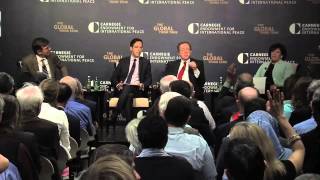
In this hour‑long panel recorded on April 15, 2015 and moderated by New York Times journalist David Sanger, senior experts from the International Crisis Group (Ali Vaez), Carnegie (George Perkovich), and former Joint Chiefs staffer Jessica Matthews dissect the interim nuclear agreement reached in Lausanne. The conversation moves from a rapid‑fire assessment of the deal’s strongest and weakest points for both Iran and the United States, through a technical deep‑dive on verification, the declared procurement channel, and the remaining ambiguities around centrifuge limits and 20 % enriched uranium. The panel then explores political dimensions: the Supreme Leader’s nuanced speech, the looming June 30 deadline, U.S. congressional pressures, and the risk of a “linkage” strategy that could unravel the agreement. Questions about possible military dimensions (PMD) and how long a breakout could take are raised, followed by discussion of sanctions‑relief mechanics, front‑loaded implementation, and the need for a robust post‑deal monitoring regime. The experts also touch on broader regional implications, nuclear safety conventions, and future cooperation opportunities. Throughout, the participants stress the fragile balance between technical safeguards and political will, warning that missed deadlines or ambiguous language could jeopardize the entire process.
Chapters
Well, good morning. I'm David Sanger from The New York Times, and it's great to see such a good-sized crowd out here. I think we've just about filled the room, which I attribute either to our panel up here or to the urgency of the issue or both. I won't spend a lot of time introducing our panelists. To my left, your right, is Jessica Matthews, who used to run the Joint. But now has a much happier life.
Now has to work, right?
That's right.
An honest job.
That's right. Now has a much happier life as senior fellow. Ali Vaez is from the International Crisis Group, and George Perkovich, who of course is also part of Carnegie and go-to on so many issues on Iran and other things nuclear. And you've got— so we're going to run for about an hour, and then you've got a lunch, and then June Torbati is going to come back and moderate a panel on the question of the regional implications of the deal. So you've got a full morning and early afternoon. So let's dig right in. We're going to assume a fairly sophisticated knowledge for this crowd, because if you weren't deeply into these issues, you probably would have figured out something else to do today, like go sit in Starbucks. But I want to do a quick round asking the question in slightly different ways to fit the expertise of our panelists here on the first question of what's the best part of the deal as we have understood it from reading the American fact sheet and the Iranian description, which I wouldn't say contradict each other, but let's say they're not always in perfect confluence. And then what's the worst part, which gets us onto the question of what needs to change between now and June 30th. And then we'll get into some of the politics of this. So, Ali, let me start with you. From a national perspective for the US and for Iran, run us through the best and worst of this thing in short order.
Well, David, I think let's start with the Iranian perspective. Remember that for President Rouhani, when he was chief negotiator, one of the primary goals from 2003 to 2005 2005 was to prevent the Iranian nuclear dossier from being referred to the Security Council. Well, now, after being in office for 2 years, he has been able to actually get Iran under consideration— out of consideration under Chapter 7 of the UN Charter, which for him, it is going to be the biggest political victory with which he's going to justify some of the nuclear concessions. That he had to make to get to this point. I think the weakest point of the understanding, at least as much of it as we know now, which makes it difficult for him to defend the agreement back home, is the fact that the issue of sanctions relief is still very vague. It's not exactly clear how this is going to work, although I tend to believe that the negotiators have been able to agree to much more on sanctions relief that they have divulged publicly. From a US perspective, I would—
Let me just stop you on that point. What do you think that deal is? Is it a certain day for the agreement to be signed and then a later date for the implementation?
Yeah, that is going to be part of the setup. But I think from the early days that the negotiations started, both sides came to the conclusion that you need to front-load this agreement in order for both sides to be able to go back home and show tangible achievements. So both sides decided to do maximum amount of implementation in the early months. And I think if we get a deal in July, August, sometime in the summer, in the next 4 to 6 months, the parties will start implementing. Iranians will start dismantling. Removing the calandria of the Arak reactor, you know, giving access to the inspectors, providing new design information questionnaires to the IAEA, etc. And the P5+1 will start providing the regulations, rules, and laws that are necessary for lifting the sanctions. And at a specific point in time, both sides will start implementing. And as I said, it's front-loaded. I think from the U.S. perspective, the most important achievement is that the agreement effectively blocks all the pathways to nuclear weapons, and it has very strong verification mechanisms. The downside, of course, is that at the end of the day, this is a compromise, and the U.S. had to allow, for example, 1,000 centrifuges remain in Fordo and had to accept that the restrictions will start gradually coming off at year 10. And at the end of the day, this is a 15-year agreement. It has a sunset period. So, you know, but overall, I think both sides have enough to be able to defend the deal back home.
Great. So that leads us naturally to George. So George, from a technical perspective on it, Ali has told us that this was a compromise, but he also said it effectively blocks all pathways to a nuclear weapon, at least for 10 years, maybe for 15. There's some question about in between. First of all, do you agree with that? As you look at this, does it block all pathways?
Yeah, I think basically, I mean, a lot of this depends on what, you know, your thinking was beforehand. So for me, I was never that worried, haven't been that worried that Iran would try to take declared facilities where the IAEA already is and then break out to try to achieve nuclear weapon capability from that. And so this agreement further kind of reaffirms that idea because it limits what they can do in the declared facilities. They roll back some of it at Natanz. The Arak reactor's redesigned. All of that I think is to the good. If the concern were more that Iran would try by undeclared means or secret means to kind of ramp up on a capability, then I think this agreement also is very positive because the verification elements of it are significant. I mean, there's one qualification about that, but in general, they're significant. You talk about on the uranium side, now there's an understanding of from the mines to the milling facilities to the conversion facilities, the centrifuge parts facilities, the assembly facilities, all that's before you get to actual enrichment. You're talking about monitoring. So that's unprecedented. There are two other elements that I think are potentially of even greater significance, though they're not detailed. And that is that it's said in the U.S. fact sheet that there would be a supply chain that would be monitored. So depending on what that is, it greatly would build your confidence that they wouldn't be able to have a secret supply chain. And then as importantly, it talks about a declared procurement channel. That would be registered also through the UN. So, if I understand that, and it says of sensitive parts. So, depending on what you put in there, if there's a declared procurement channel, by definition, anything that you detect through intelligence means or otherwise that's coming into Iran from a different channel is a violation of the agreement. Greatly eases both the burden of your intelligence collection, but more importantly, the burden of interpreting intelligence. A lot of what we've had under the NPT going back to Iraq is stuff gets detected and then people say, "Well, it's not really a violation of the NPT," or "It's not really a violation of the Safeguard Agreement," or "It's not really part of a weapon program, it's something else." And that takes years to sort out. Then you can't get the Russians or somebody else to agree with it. If you now have a commitment that they only procure through this declared channel, and then you have intercepts or other things that tell you, "Oh, there's an agent out buying this other thing," It's a violation. You don't have to spend all that time debating and sorting it out. It's a violation of an agreement that would be registered as a UN Security Council agreement among the P5. That's a huge deterrent against undeclared breakout. So I think it's very important.
Doesn't that just back it up a step because you've got to have then a long list of everything that—
It depends what's in it. That's what we don't know.
No, but you have still the same problem of making a list.
Right.
Which becomes a sort of a de facto shopping list.
Right, so the issue is having a declared channel is very important, and the question is what's in it. And you can start with very easy things, which I assume they mean fuel cycle capability, for example. I would assume it wouldn't be that hard to say neutron initiators. Or anything that's listed in the possible military dimension about past activities, you could put into declared channel and say, if you're procuring anything for that, you know, in the future, A, either don't do it, or B, it's got to be declared channel. So I don't think it's that hard.
George, let me push you on one element of the— of your analysis here, which is essentially that by doing the declared channel, you're taking some of that mushiness out of the system of, is somebody violating or not, which is taking up so much time, and ultimately would kick it right back to the Security Council, okay? So think about how we got here. We got here because Iran was not answering a series of questions from the International Atomic Energy Agency. It referred them to the Security Council. The Security Council ultimately passed an escalating series of sanctions, but that process took a long period of time. Whatever we think of the sanctions, whether you think they drove them to the table or not, what they certainly didn't do was slow down the construction of centrifuges, or at least they built up considerably over the past couple of years. So why are we to think that this time would be any different?
For a number of reasons. One, the history about the past was what Iran didn't agree to was the suspension that was— they agreed in 2003 but then gamed it and so they resumed activity. Then in 2004, Germany, France, and the United Kingdom, backed by IAEA, called on them to suspend. Suspension was the main issue that was a driver, and they said, no, we have a right, and clearly they were trying to get leverage. So, I think under this agreement as sketched, you know, the bad news is Iran retains capabilities, which actually is leverage. The good news is precisely because they've retained those capabilities and have leverage, I think there's reason to think they'll fulfill the agreement in the first place. But if you have a new agreement this explicit, done with the P5, and the issue of a declared channel, which isn't about rights and so on and so forth, and they violate it, I think precisely because we've just spent the last 13 years doing this, the US at least, and I would suggest France at least, and the UK at least, are going to say, look, this is a violation. We're not going to go debate it for a couple of months in the UN. Precisely that history is what's going to make it more likely that if they violate a new agreement, that's going to be laboriously negotiated in detail. I don't see people waiting that long to, to respond to it.
Okay, so Jessica, you've heard Ali lay out what the national interest for. You've heard George lay out what the technical strengths are and a couple of the vague areas. Tell us what you think the alternatives are, if there are any, between— I left, saved the easiest for you— if there are any between now and June 30th or beyond that would improve this in a significant way. Or alternatives of the risk if you walk away?
The best part of the deal is that it's not one of the two absolutely awful alternatives. And I wrote a piece 15 months ago that said there are three alternatives in dealing with Iran. And nobody ever said to me, oh, you forgot a fourth. So as far as I'm concerned, there are three alternatives. One is go back to more pressure and what we know— I mean, that one's been pretty well tested. More pressure leads to more centrifuges, and it's the route that Iran has taken all along, and it's lousy, obviously. It doesn't work. I mean, sanctions— what we know about sanctions are they They can raise the cost enormously, but if the sanctioned country chooses to pay the price, they don't stop the activity. We know that. The other alternative is military action, maybe a 4-year delay followed by rebuilding everything as secure as Fort O'Dowd, followed by not having very much idea at all, being essentially blind on the ground as to what's being rebuilt. Followed by the need to rebomb at some point, but without knowing very well how close Iran is. It's a terrible option that puts us in a state of perpetual war. And it would surely unite the Iranian people in a way that they are not now around the absolute necessity of having a nuclear deterrent. And would probably prolong clerical rule in Iran. It would radicalize, it would certainly strengthen Iran's hardliners who have been saying this all along. So that's a terrible deal. So a deal is, which is by definition imperfect, 'cause it's what you can negotiate, is the only route seems to me that is worth pursuing pursuing. And the question then is, can you get a better deal? Could you get a better deal? Or I suppose you could reframe that question as, does this deal have an Achilles heel, or one or more killer weaknesses in it? I think reading between the lines of what was announced in Lausanne and what was announced in the White House and what's been said in Tehran, that the work still to go is much more than filling in technical details and writing tight language. I think that there are aspects, if not fundamental ones, of both the sanctions lifting dance, what gets lifted when, and the inspections and verification regime that haven't been agreed to. That's my— I recognize that's a—
And maybe some of the R&D.
There may be some other things that haven't been agreed to. And a third one, I think, about which I feel very differently, So those two, the first two, the sanctions lifting and the inspections regime are kind of all-or-nothing things. If we don't get those right, we don't have a deal. The one that I think is in a different category but that is going to be very neuralgic is this question of when and how and if Iran comes clean about what it did in pursuit of weapons before it stopped. That. I have a maybe minority view, which is that knowing that will have some modest technical value to us, but countries hate to be put in a position of saying, "Oh, we violated this international agreement in the NPT Treaty." We're sorry. They hate it. And in Iran's case, it's multiplied by the fatwa. So now you have to layer on top of it a religious aspect of having to say you were wrong. I just don't think the Iranians are going to go there soon. And it may very well be— I mean, maybe there's a workaround. Push it to the way back end of this, backload this issue. I— but it may come to a point where we have to decide whether we care more about the future than the past. And I— for me, that's an easy call.
Before I press you on the— on your main point, I just wanted to ask briefly both George and Ali about this issue of the possible military dimensions, because it's an interesting one. I have heard from negotiators, American negotiators, Europeans, the same phrase you just used. This is an agreement about the future, it's not about the past. On the other hand, if your overwhelming concern here, maybe this is a good one for you, George, is if Iran actually did get one weapon's worth or two weapons' worth of material, how long would it take to fabricate that into a bomb? You'd want to know pretty well how much progress they made. And you would learn that from PMD unless our intelligence agencies have that knowledge already and haven't decided to share it with all of us.
But a couple thoughts. One is my sense is the Intelligence Committee feels like they do have a good sense of what they've learned, but I, that's just picking up things here and there. Secondly, I don't think it's as much a timing issue because we've already stipulated a benchmark in the agreement, which by the way, you know, one year, which is totally arbitrary in my mind, but it's a political necessity to keep score. You know, you needed a standard on how to evaluate, so somehow this came out a while ago it was going to be a year, but why not 11.5 months, or why not 14 months? I mean, it's basically arbitrary. And so the weaponization piece has just been kind of stipulated. I don't know necessarily based on actual calculations of how long it would take to turn material into a device. I think what you more want to gain by having an understanding of these past activities is who did it, where were they located, How was it organized? So that you're better able to try to detect if it happens again. You want modus operandi and people to deal with the undeclared issue. I don't think it's as much about a timing thing as it's about an intelligence thing. It's an important issue. I think it's actually more important for the IAEA. If the IAEA is a valuable institution, which I would submit it is in the overall nuclear order, and this is its job, and it says it has not received the required cooperation in order to do its job, then if the leaders of the international community kind of walk away from that and say, okay, the IAEA is important, but when things get really important, we don't care that much about it, it's— that's not good.
Bad precedent.
That's not good for the international system. So, to me, that's the strongest argument. Now, There are a number of ways that that could be addressed. The Iranians don't have to confess. I think they would never confess for reasons that Jessica talked about, saying, "Yes, we had a nuclear weapon program." All they have to do is say, "You can talk to Larry over there, and he's willing now to talk about the experiment he did." And so, Larry can talk about his experiment without saying why it was. He said, "I came into the lab here, and I used these materials, and I did it for 3 days." and so on and so forth. And there doesn't have to be an admission of purpose. Or the Iranians can say, you know what, we don't have those files. There's lots of ways to actually finesse this. So, at the end of the day, the IAEA can conclude, you know what, we think we've gotten all the information we're going to get. And we're not able to make a conclusion. But that's a conclusion. And so then you can check the box and say, you know, they got— so I think it's doable, but lastly, I think the Iranians for all sorts of reasons are going to save it for the end because it can be somewhat humiliating. And then, by the way, when you're in Iran, you talk to people, they say, wait, you want us to make scientists available so the Israelis can assassinate them? That's a hard one to answer. 5 of them have been whacked. And you say, well, you know, no, trust us. You know, we wouldn't do that. It's different. So they have rebuttals. I think at the end, though, is when this would happen. And the necessity of it really is about the IAEA, I think.
Ali Vaez, pick up on this point. What can you imagine the Iranians being willing to do on PMD? Believe George's argument here that you'd have to push this to the end when at that point, your leverage of sanctions for them to reveal is pretty well shot.
Well, David, my understanding of the dynamics in the negotiating room is that actually this issue is not going to be backloaded. It's going to be addressed in the early stages of the agreement. In fact, in very early stages of the agreement, But with one caveat, of course, this is not going to be fully resolved. It is going to be satisfactorily resolved, which basically means that the IAEA will need to make sure that, as George mentioned, there are some of these suspect activities are not ongoing, and they don't need to have a complete picture for that. And I also want to add on something that Jessica mentioned. You know, there are still disagreements on some of the details, but what happened in Lausanne is that they got a mutually acceptable formula on all the key elements of this comprehensive agreement. Otherwise, it would have been really political suicide to come out and stand on that stage and announce an understanding. I mean, the Iranians would never have accepted to announce that there is an understanding if the key issue of sanctions, for example, was unresolved. So unresolved, I think, is a is a strong word, but do they have all the details of the implementation plan? Not yet. And that the negotiating, the bargaining process of that is going to be difficult. I don't deny it.
I just, parallel announcements without a common interpretation is an open door for the kind of problems, for differences in interpretation to emerge in this period, say before June 30th, that are— that reach fundamentals. So I'm less optimistic than you are. I think— and there is always, you know, there is— and particularly in this case, there is this enormous push of the deadline to get it done. And, you know, in that push, you can leave some things And there have been many, many cases that come back and bite you.
So Jessica, tell us how you would interpret— I'm going to ask our other panelists this as well— the Supreme Leader's comments. What kind of limits does that put on Zarif, Foreign Minister Zarif, when he comes back before the June 30th? And then just Give us your rundown of what you think the congressional risks are here.
Well, if I may, I will leave to Ali how to interpret the Supreme Leader's comments. I mean, to me, they underlined what I suspected, which is that there is negotiating still to do. On the— I keep calling the dance— the back and forth of what happens when in terms of lifting the sanctions, and that that was a positioning thing meant to firm up the Iranian side. It may also have been directed at the Congress because it would not be impossible for Iran— and George has been writing this for 2 years— to be setting us up to violate this thing before they do. So Congress, for me, the most important thing I said at the beginning, what are the choices that we actually have? What are the policy alternatives that are available for going forward? For me, having a discussion in Congress about a deal that isn't finished, says to me that the people who want to force such a vote or who want to say the agreement is no good are people who don't want a deal. I don't know how else to interpret— I mean, it is irrational to think that you have a discussion, you have a vote, you say, I am flatly opposed to this, and then you say, you're flatly opposed to what? And I haven't yet read real criticism, serious criticism, and I put the Kissinger-Shultz piece absolutely in this category, the criticism of the deal that says, here's what I'd do instead. And for me, if you don't say that, you have said nothing. You don't even have an entrance ticket, in my view. So I am hoping Congress can find a way to assert itself to having some kind of role and to— that postpones decisions until they have something to evaluate, and which is either June 30th or sometime after that.
Ali, how did you interpret the Supreme Leader's comments?
David, Supreme Leader's comments are usually very confusing because, of course—
I was certainly confused.
He's always very Delphic in his speeches and he speaks to different audiences. But I think he had several specific objectives with this speech. He wanted to first reassure his core constituents. By pointing out that this nuclear deal, this compromise, is a very narrow compromise. It is not the beginning of a slippery slope in which the Islamic Republic is going to start compromising on other issues of strategic interest. So he insisted that this is a narrow negotiation just on nuclear issue. He also wanted to reassure the security establishment that this deal is not going to endanger our national security. That's why he insisted on the fact that inspectors anywhere, anytime is not going to happen. But he also had an audience with the government. He sent a message to support, again, once again, reiterated support for the negotiators and said something that was overlooked by most Western media, which is he said for the first time what the Supreme Leader has been saying for a— what President Rouhani has been saying for a long time, which is that if we get a balanced nuclear deal, this could become a gateway for further engagement with the United States on other issues of common interest. And I would say his third audience was the United States, and he wanted to send the message that Iran is not in a position of weakness, is not too eager for a deal, and he did it by not showing a lot of enthusiasm for this understanding, by saying that June 30th is not really a hard deadline, and also by reiterating some of his red lines. And let me add, sometimes it's more important to pay attention to what he doesn't say than what he does say. And it's really important that he didn't criticize some of the really painful concessions that Iran had to make to get to this point. I mean, it was just a few months ago when he said, "Iran needs 190,000 centrifuges in a few months," a lot of people in this city said, "A deal is not going to happen." Right? But now Iran has accepted 5,000, 6,000 centrifuges for 10 years.
Last point before we go out to open questions here. George, you've written, as Jessica mentioned before, that the trick here for the Iranians is to make Congress take the first step to blow things up so that you can then fracture the the alliance, and that if we did sanctions, additional sanctions, we'd have no one else with us. So if you were convening the grand meeting in Tehran this week of Carnegie's Tehran equivalent, and the subject matter was, how are we doing on our strategy of getting the Americans to blow this up first. How would you grade it?
I would say we have a problem that this Senator Corker guy is actually fairly enlightened and maybe on to what we're interested in. But we do have Senator Cotton going for us. And so, you know, there's a question of how how this will work out. And I think the challenges that— and something that Olli alluded to, which— where the leader talks about this is a narrow nuclear arrangement that we're focused on. And I think that's very important. And the issue is going to be linkage. And this is what happened with the Agreed Framework with North Korea back in 1994. It was a nuclear deal, but it called for normalization of relations between the United States and the DPRK. Except it didn't say how that was going to be done or sequences or other things. And so what happened is the DPRK went around doing things after that agreement, missile testing, sending a submarine down off South Korea, other things that people here didn't like. And so members of Congress naturally said, let's stop providing what we promised in the nuclear deal because they're being bad in these other domains. And I think on this agreement with Iran, which is strictly limited to nuclear, where the US has said, we're going to maintain the sanctions on terrorism and other things. How do you stop members of Congress from nonetheless, the next time, you know, an ayatollah says something nasty about Israel, or there's another Hezbollah missile shipment going across Syria into Lebanon, that somebody says, let's pass new legislation, you know, to sanction Iran, or let's block the waivers on this. And so it's this question of keeping it confined and the U.S. implementing it. Versus linkage. And I think the Iranians, especially Zarif and Rouhani, are so talented that any time the US does something that's not within the scope of whatever's agreed, they're going to get leverage internationally because the rest of the world's going to look at the agreement and say, well, you know what? They're right. And that is going to be a difficult challenge. Like I say, some hope with Senator Corker that you could manage this, but, you know, Okay.
So let us go out to questions in the audience. And we're going to ask you to, when you get a microphone, wait for the microphone, tell us who you are, and actually ask a question. I realize the last of that on that list is the hardest. We'll start with Robin since she's a professional question asker here.
Thank you. Robin Wright from the U.S. Institute of Peace and the Woodrow Wilson Center. I have a question for George first. Explain to us how long it might take to do all the things mentioned in the fact sheet. In other words, if there is phased sanctions withdrawal, how long would it take to meet the basic demands of dismantling facilities, cutting back on centrifuges, and so forth, so we have a sense of how long it might be if the U.S. interpretation applies and sanctions is then lifted? And a quick one for Ali. I'm curious. The Iranians seem so surprised by the fact sheet. Do you think that they were surprised by the content of the fact sheet or the fact that they looked like they were kind of preempted or the rug pulled out from underneath them? Was it the substance or was it just the process that they opposed?
Great questions, Robin. I'm not— truth in advertising, I'm not so adept on the technical implementation, I could give it to you precisely. But I think the big issue is it depends on what's in it. So, for example, we understand that part of the agreement would be that the Iranians agree to redesign the Arak reactor. So, how do you— what part of that process do you then say checks off the box, which then allows you to waive the the sanctions? Because is it they bring a paper design that says, "Okay, this is how we're going to design it now," and you say, "Okay, good," or are there things that they actually have to do in terms of pouring concrete and bending things? I don't— in the fact sheet, it doesn't say what that means. The fact sheet doesn't speak to the question of what happens to the 20% enriched uranium, for example. And depending on what it would say and how they would have to meet that requirement. For example, is it turning it into fuel for the Tehran research reactor? Well, how long does that take? I think it's unknown at this point, but it's a question of months. So, I think depending on how a lot of the details actually get nailed down will affect, you know, how many more months it would take to fulfill those elements. Because it talks about nuclear-related. When Iran takes the nuclear-related steps.
Key steps. So it's a question of what is a key step?
So I just— it's just impossible for me to give a precise answer on that.
Robin, on the fact sheets, you know, the dilemma that negotiators had in Lausanne was that they had to accommodate the Supreme Leader's demand of no specifics and Congress's demand of specifics. And it was very hard. So like everything else in these negotiations, they found the middle ground. And the middle ground was to put out a statement that was quite general. And Zarif can refer to that as the main document. And the US could put out its own interpretation version, fact sheet, whatever you want to call it, in order to be able to respond to Congress and stave off more pressure from Congress. I was talking to an Iranian official just a week before the understanding was announced, and he was saying, "We have two options. One is a 5-line statement. The other one is a 15-page document with all the details for both sides. But then we have to start the fight of defending the deal right now where we don't have it yet." So it doesn't make a lot of sense, but we also understand that the Americans need specifics. So I think it was inevitable at the end of the day, but again, it's one of the things we have to blame Congress for.
Okay, hand right here, young lady in the blue.
Oh, thank you for calling me young. Stephanie Cook with Energy Intelligence Group. I have a question. I'm not sure, I think probably Ali, but in Lausanne, the Deputy Foreign Minister Arakchi came in on Sunday night and announced in Farsi that, which you translated very well, that they—
I didn't translate it.
Well, somebody, yeah.
But somebody did for me, yes.
Right, right, but anyway, that they, their big news was they're not going to ship any uranium out of the country, which had been understood to be agreed as part of the three legs of getting to one-year breakout. Now, what's interesting is Kerry said in his speech in Lausanne, well, we'll either— I've forgotten what the first one was, but he said we could sell it in the international markets, which is very interesting. The Iranians are saying, we'll swap it for uranium. And I know that they're actually now getting short on uranium. And I'd like to know how you think the US would view this business of swapping for uranium, which obviously opens the door for more enrichment. So it's an interesting— it's just an interesting puzzle, and I kind of wonder how they're gonna resolve this problem of the lowering the enriched.
Okay, you can hand the microphone straight back to the lady behind you. Who wants to take on that issue? The Arachi statement, just to give context to people, led to an immediate denial by the US that there ever had been an informal understanding that they would ship this stuff out of the country, which struck us as a little bit strange because there had been an informal agreement that had been previously reported and never denied by the US.
But I think it's a categorical question. In other words, beyond this, I can't tell you what the US would say about swapping for uranium, but what I can say is anytime one of these things shifts, so for example they're not exporting it, there can become 4 other ways to address the problem. Okay, so you're not going to export it, but we agree that you only have 300 kilograms, so then what are you going to do to reassure us that 300 kilograms, you know, can't be used? Oh, and we're going to need more verification now because you just changed the terms. So I think you can be sure that there will be more moving parts depending on what they would do. So, if they're going to now trade for natural uranium, there's going to be all sorts of things about, you know, we need to know where the contract's done, we need to see the contracts, we got to monitor the ships, you know.
Okay.
Hi, Rachel Oswald, reporter with CQ Roll Call. My question for the panel has to do with the imposition of sanctions if a violation is determined. The administration has said that there will be— that no one country can have a veto over imposing sanctions if violations violations determined, and then there have been reports that this could be conducted by a majority vote, but it's not clear to me if it's a majority vote of the P5, the P5 plus Germany, or of the entire Security Council. Or maybe you guys are hearing something entirely different and Russia and China have still not budged on their preference for retaining veto power.
Thanks.
Jessica?
I don't know the answer to that.
I'm not sure I know the answer to that either. It was pretty unclear to us. Anybody else?
We don't know the specifics.
We will forward that question to the American negotiating team. OK, gentleman on the aisle in the check shirt, check blue shirt right there. There's a mic coming right behind you.
Can I just say one quick word on this, though? I think it does underline— the question's a good one— that it underlines the importance of what comes after the deal, right? We've got 3 terrible months to go. And a huge debate about is this a good enough deal once it's in front of us, we hope. And there will be an inevitable then sort of sense of, OK, we did it. And Bob Gallucci, in a piece this past weekend about the North Korean deal, made the point that one of the mistakes that we made in that was less in the deal than in its implementation and what came after.
And say, okay, the great temptation to say, okay, that's finished, next.
Yeah, next. And there's plenty of nexts in the Middle East. But the idea of setting up some kind of a group that oversees implementation of the deal on an international basis, just on a continuing constitutive basis, so you don't have to wait till the US intelligence comes in and says, we saw the importation of such and such and such and such. and then sit down and talk about whether that, you know, I think is a really important part of what would strengthen this.
Okay, so the gentleman in the blue.
Thanks. My name is Hart Schwartz. When the word linkage came up, it reminded me of the discussions over détente with the Soviet Union in the 1970s, and I'm curious, how do these negotiations compare to the Limited Nuclear Test Ban Treaty of 1963 or the SALT treaties that I think Nixon and Reagan signed with the Soviet Union. Is it a similar situation?
This is, I mean, I think this is much, much harder. The internet hadn't been invented then. Social media didn't exist. Cable news didn't exist. One of the parties, the Soviet Union, was a totalitarian state. You know, now all states have politics, but nothing like the politics in Iran. Which are quite fluid and dynamic and vicious. So it was, I mean, in those negotiations, part of the difficulty was relations between the military and the civilians and the transfer of information amongst the Soviet team was difficult. But I think it was much simpler. Back in those days, you could actually imagine and witness bipartisan cooperation in the United States. Members of Congress actually lived in the same kind of blocks in different parties and would associate in the evening with each other. It was a very, very different dynamic that I think was much easier than what we're talking about here. We weren't worried about terrorism then. You weren't talking about terrorism, state sponsors of terrorism. There's a list of 100 things I can think of that make this much harder than than those things were.
And also, we were under no illusions that we were dealing with a weak country who could be pushed around. We knew we were dealing with a peer competitor. And so there were no— and a lot of critics now seem to have this idea that Iran is some country that's been defeated on the battlefield and can be just forced into agreements that probably can't be.
Barbara?
Thanks. Excellent panel. Barbara Slavin from the Atlantic Council and I'll Monitor. A couple of technical things and then one broader question. George, on the 20%, David Albright came out with a— and ISIS, the other ISIS, came out with an analysis over the weekend And at one point he says that they have 50 kilograms of near 20%, and in another place he said they had 300-and-some-odd kilograms of near 20% LAU in various forms. What's supposed to happen to this stuff? He was very concerned that a lot of it is in oxide form, and he said that's not good enough. And is this related to what happens to the excess LAU in general? And what they're going to do with that. And then the broader question is, what are some of the positive things that might come out of this in terms of nuclear safety and more cooperation by the international community with Iran to do things like, you know, get rid of the TRR, which is antiquated, to make sure that they don't build more Bushehrs, which is a Frankenstein's monster of a reactor, and that in general you know, they actually have the cooperation they need so that this is a safe program going forward for the Iranian people who live around these facilities?
Thanks. On the first one, the short answer again is I don't know because I haven't seen any fact sheet that actually really speaks in any detail to the 20% material. It talks about LEU, Iran won't, you know, enrich above was it 3.57 or 3.67? And then the stockpile won't exceed 300 kilograms, but it doesn't give you the base from which they're counting, and it doesn't specifically address the question about 20%. So I just, I simply don't know. On nuclear safety, this is an important point, and thus far I think has been a missed opportunity that could be captured, and it could even be captured by the UN Security Council resolution or even Congressional move here. And that is to basically have Iran commit also to be party to all the conventions which other states that have peaceful nuclear programs are. So, for example, there's only two countries with reactors who aren't part of the Convention on Nuclear Safety, Iran and North Korea. Iran should become part of the Convention on Nuclear Safety. There's no reason for it not to do it. It hasn't ever really been a demand, it seems to me it could be part of a broader— the liability conventions, the international liability conventions, they're also not party to that. Well, if you're going to have a peaceful nuclear program going forward, you should be part of the international liability conventions. There are other kind of accoutrements or components of what states with peaceful programs do that Iran should be asked to join. And they haven't been, and they haven't done it themselves. This is more than window dressing because when you start talking about liability, as we know in India for the last 10 years, you know, your parliament gets involved and you say, "Well, wait a minute, we can have an accident with these things?" And you say, "Yes." And wait, and there's limited liability? And you start to say, "And wait a minute, the vendor's not going to be liable? So you're telling me the Russians aren't liable for this thing?" It starts to become interesting. Well, welcome to the grown-up world of peaceful nuclear energy. And so they should be asked to do that and not paid to do it because this is what, based on their own statements of purpose, this shouldn't be controversial. As far as I know, the U.S. and the other states haven't asked for this, in part because arms controllers don't know about peaceful nuclear energy. Nuclear industry does. And so there's an opportunity here, I would say.
If I can add one thing, Barbara, that we know is that nuclear cooperation is going to be a big part of this agreement. As part of positive incentives that are going to be provided to Iran. For example, some elements that we know of is cooperation on nuclear fusion with France, cooperation on accelerators. The Russians are going to help with fuel fabrication, and there might be other—
Ultimately, Fordow is supposed to have international representation.
AROC is going to be converted in cooperation with P5+1 members. And there were going to be some smaller reactors constructed in south of Iran with other P5+1 members.
Well, we're getting near the end, so here's what we're going to do. We're going to do a lightning round of 3 questions to which we will have 3 answers, and then we're the last thing standing between you and your lunch. So we'll start with the young lady right down here with her hand up, then we'll go in the way back over there, and then the gentleman in front here.
Hi, Mary Louise Kelly. Question for Jessica and maybe you, David. How firm is the June 30th deadline? We keep hearing hints that maybe it's not so firm. Do we risk losing momentum? Is there some magical development that's possible in July that's not in August?
Great. Gentleman in the back.
Hi, Daryl Kimball, Arms Control Association. A question about what happens if if there is no final agreement by June 30th, or if there is and Congress decides in an up or down vote to reject the deal, what are the actions that Iran could take given its nuclear capabilities? What are the actions that the P5 could take? And just very quickly, the 20% material, George, the extension of the interim deal in November of 2014 stipulates that all of that material shall be by June 30th, 2015. 2015, either diluted to low-enriched material or converted to fuel plates. So that's what's supposed to happen before June 30th. That's why it wasn't in the fact sheet from Lausanne.
Okay. And the last question was right here.
Excuse me. Good morning. Charles Newsted from the State Department. And I hasten to add, I'm speaking for myself, not for the department. To answer, try to get a couple of quick points across. First, on the 20% enrichment, that is a very vital point because enrichment is like a triangle. The bottom, where it's very broad, is lots of material needs to go in. You get way up to 20%, the triangle is much smaller. It's much quicker, much quicker to go to a bomb. 95% or 93%. So we have a very good idea. We can calculate. We know how many centrifuges they have, we think at least. And we can calculate how much material they had. We know how much 20% material they have. And that's vital to either get them under control, to blend that down to 5% material. They could make money on that and sell it. And all that could be worked out in a way.
Can we get to your question?
Yeah, sorry, sorry. The question is really this. Between the dilemma between Jessica and George as to the fact that Iran would probably not like to admit, no state wants to, that they were making weapons and bad boys and all that. We don't need to do that. We can find diplomatic language to finesse that but we'll get a secret protocol where we would have them tell us what we need to know. And then to take care of the assassination problem from the Israelis, the Mossad, we would give these people international protection if they wanted to and relocate so they wouldn't have to worry and have a good life.
All right, I'm not sure I heard a question there, but we'll Okay, so on the first question on June 30th, just briefly, we were discussing this before we came out. I'm not sure there is anything particularly sacred about June 30th. Certainly, Rouhani said the other day that it wasn't necessarily sacred. I'm not sure for Americans it should be.
Except the end of the JPOA.
Right, but so they would have to either extend it or figure out what was going to happen with that. So tell us what you think the options are to get to Darrell's question of what would the result be in Congress and so forth.
Well, there's so many degrees of freedom that you can't. I mean, Iranians almost by, I think, in their DNA don't meet deadlines. So negotiating deadlines anyway. So I thought part of it might be sort of setting up that it would be another few days after and try to raise the pressure. Or if you're going to do it, if you feel like you can't get there by June 30th, they would then have to also agree to extend the JPOA until a final agreement was reached. The difficulty, I mean, Darrell's question is the tougher one than what happens in Congress. Seems to me that the best outcome there can be now is Congress says, we want to have a voice, but we're going to wait till we see a final deal. My guess is they will be forced to say, if not June 30th, then some other date. But they're much more likely to say June 30th. And then what would happen then? I mean, you can always, if there's goodwill, you can always find a way around. But I don't think we're looking at a case of goodwill. And then that would then put more pressure pressure on the negotiators to get it done by midnight on the 30th.
Just quickly, on Darryl's point about the 20%, thank you for that. I do think if what the JPOA calls for in Iran dilutes it, then that's part of the 350 kilograms they would have. And so that would address it that way. But if it's turned into fuel, I would think that you would want further agreement about how long until that fuel is irradiated and so on. So I don't think it's done with, and I think it will have to be specifically addressed in an agreement. And on your point, Darrell, about what could Iran do if— to me, it's less about no agreement, but if an agreement is rejected or sabotaged here, what I would expect them to do is actually to then try to break up the sanctions regime. So I wouldn't expect them to start acting provocatively in the nuclear domain by enriching to 20% or raising the level of enrichment and so on and so forth. I think they'd wait on that. But I think they would go around to the key trading partners and you see what we're dealing with. This Congress is owned by somebody else and they will sabotage anything. We did everything we could. You supported this agreement. We need to start peeling off the sanctions. And be virtuous for as long as they could while trying to actually undo the sanctions regime is what I would predict.
You get the last word, Ali.
Let me just add a point to excellent points that Jessica made about the deadline. I think it's not surprising that both sides are trying to downplay the importance of June 30 deadline. No one wants to be seen as desperate for a deal. But I think this is actually a very dangerous gamble, and for 3 specific reasons. One is that if you look at the history of these negotiations in the past 12 years, and at the history of Iran's relations with the U.S. in the past 36 years, it has rarely happened that the 2 sides have been on the same wavelength. And if something happens and this opportunity is lost, I don't know if we can get there again. In the near future. Second, I would say, you know, we— what is most likely to happen is that we will get into another game of chicken that wouldn't get us closer to a deal, would only result in wasting the precious time. And this is what happened in July 2014 and November 2014. We don't need to go through that experience again. And then the third, which I think is a huge risk, is that as we get closer to 2016, we get entangled into electoral cycles in the U.S. and in Iran. Remember, in February 2016, there's the parliamentary elections in Iran. Iranians might very well argue, let's wait until the elections are over so that no one can exploit the outcome of the negotiations for electoral purposes. And of course, we have elections in this country. So I think the sooner the better.
Well, having resolved fully all outstanding issues I thank each of our panel members. I thank all of you. And I think they're resuming here around 1:00 PM. Thank you, sir.
More from Ali







Israel and the U.S. at war with Iran: what comes next & what implications for the region and beyond?



Trump ‘Is Living in a Fantasy Version of His Own Presidency’ | The Ezra Klein Show
