The Iran Nuclear Deal Part 2
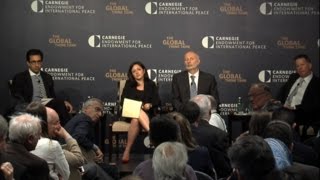
In this hour‑long Reuters‑moderated panel, senior Carnegie scholars Karim Sadjadpour, Yazid Sayigh and Frederic Wehrey discuss the prospective Joint Comprehensive Plan of Action (JCPOA) with Iran and its far‑reaching consequences for the Middle East. The conversation is organized around three analytical silos: (1) non‑proliferation – the deal’s capacity to halt Iran’s nuclear weapons pathway and increase transparency; (2) domestic Iranian politics – the split between reformist/moderate forces that welcome sanctions relief and hard‑liners who view the deal as a threat to revolutionary ideology; and (3) regional impact – how Iranian cash and influence in Syria, Iraq, Lebanon, Yemen and the Gulf could either be amplified or curtailed by the deal. Panelists debate whether the agreement will be a transactional boost for Iran’s proxy networks or a transformational lever for its foreign‑policy establishment, and they assess the role of the Revolutionary Guard in nuclear site verification. The discussion expands to Saudi Arabia’s defeatist posture, the prospect of a Saudi‑funded “Sunni NATO” force, the feasibility of a broader US‑Iran security pact, and the challenges of rebuilding collapsed states in the region. Audience questions probe the likelihood of overt Iran‑Saudi conflict, the influence of Israel, congressional options, and the possibility of a two‑track US‑Iran agreement that couples nuclear compliance with regional security cooperation. Throughout, the panel stresses the deep mismatch between Iran’s ideological rhetoric and its national‑interest calculations, the fragility of regional power balances, and the long‑term uncertainty surrounding implementation and verification of the nuclear framework.
Chapters
So I think we'll get started now. Thank you all very much for coming to what I think will be a very lively discussion about the implications of a nuclear deal with Iran on the region and the calculations of various regional actors. Let me introduce myself. My name is Yeganeh Torbati. I'm a reporter for Reuters based here in Washington, and I previously was based for Reuters in Dubai, where I primarily covered Iran. We have with us today 3 top experts on different parts of the Middle East who I think will be able to offer us some broad insights into how the nuclear deal might affect not only Iran's behavior in the region, but also the calculations of various regional actors. I won't go too in-depth as far as introductions, but to my right is Karim Sadjadpour. He's a senior associate in the Carnegie Endowment's Middle East Program and is a leading researcher on Iran. To my left, my near left, Yazid Sayed is a senior associate at the Carnegie Middle East Center in Beirut, where he focuses on the Syrian crisis and the Israeli-Palestinian conflict and peace process, among other topics.
And to my far left is Fred Wehry.
He's a senior associate in the Middle East program at the Carnegie Endowment, and he focuses on Gulf political and security affairs, Libya, and U.S.
policy in the Middle East.
So while the topic for immediate discussion today is the repercussions of a nuclear deal with Iran, given our panel's interests and expertise, it would also be good to touch on other key regional issues unrelated to the nuclear deal. So we have about an hour for discussion, and I think I'll start with a broad question to each panelist.
So Karim, let's start with you. There's two competing theories of how a nuclear deal with Iran would affect Iran's behavior in the region. The first posits that it could lead to wider cooperation. And reintegration of Iran into the regional order and cooperation between Iran and the US on other issues, perhaps. Interestingly enough, the Supreme Leader made some reference to this in his speech last week, although obliquely. The other theory posits that once Iran gets sanctions relief, they'll have even more resources to fund the Assad regime, to fund Hezbollah, Iraqi militias, etc. And actually Hezbollah's leader Nasrallah made a reference to this in his speech last week. So I was wondering if you could just kind of lay out for us which of these two theories do you find most persuasive and why?
Sure. First, thank you all for coming, and I'd like to, before I answer, to preface my answer with two points. One is to welcome Yeganeh to Washington, D.C. This is her debut as a moderator, and I'm sure she will do a wonderful job. She has a very bright future ahead of her. And so that's the ancient Persian way of disarming the moderator. So that's one. Number two is that the Middle East is, as you've widely heard, a graveyard for empires, and it's also a graveyard for forecasters and prognosticators. If you look at kind of the four major events in this region in the last three, four decades, The Iranian Revolution, the Oslo Accords, the 2003 invasion of Iraq, and the Arab Spring. These are all events that when they were analyzed in real time, the kind of broad assessment was much, much different to how they've been analyzed with the benefit of hindsight. I should say, they've been analyzed, they were analyzed in real time much more optimistically. I think with the benefit of hindsight, we've seen all 4 of these things as failures. That's not to say that this Iranian nuclear deal is going to be seen as a failure, but I kind of look at it in 3 different silos, this framework agreement with Iran. Silo number 1 is the nonproliferation silo. And so how does that— how does this framework agreement impact the nonproliferation discussion. And I think in that context, it's been positive, right? It's reversed Iran's program if the deal is finalized, and it's opened it up to greater transparency and scrutiny than it currently is. So that's silo number 1. Silo number 2 for me is how does this impact Iran domestically? And I think the fact that civil society and moderate forces are most enthusiastic about this deal, and hardline forces are most concerned about the deal tells you how people inside the country think it's going to impact it. So I would say silo number 2 is also positive. Silo number 3 is the regional impact, and this is the one that I think, you know, I'm certainly most concerned about, and I think that many of the folks who negotiated the deal in the U.S. are most concerned about as well. Because I think Yeganeh laid it out well in the question. And so you have strong proponents and advocates of the framework who argue that this is going to— this nuclear cooperation with Iran will then be applied to the broader U.S.-Iran relationship, and in particular the U.S. Iran, on U.S.-Iran regional points of contention, whether that's Syria, Iraq, Yemen, Lebanon, Bahrain, etc. And it will empower the forces in Iran who want to put national interests before revolutionary ideology. So this will lead to more U.S.-Iran cooperation and potential Iranian compromise on Syria, Iran being willing to entertain the prospect of a post-Assad Syria, Iran curtailing its support for Lebanese Hezbollah and turning Hezbollah from more of a kind of a militia to more of a nonviolent political party. And here, Yazid can speak to that more than I can. And, you know, we can talk about a whole host of issues in which Iranian behavior, regional behavior would be moderated. So that's the optimistic scenario. The more pessimistic scenario is that this framework deal, and if the deal is finalized, it would simply provide Iran much greater resources to pursue the policies that it's been pursuing in the Middle East since 1979, to double down on its current policies in the region, which again, the discussion about Iran's support for the Assad regime is always It's very nebulous. A lot of coughing in today's audience. We need to get people water. You know, there's some like Stéphane de Mistura, he's the UN special envoy for Syria, who said that Iran provides Syria $35 billion annually. I think that's probably a significant exaggeration, but even the low estimates are several billion dollars annually. There's a lot of discussion about Iranian material and financial military aid to the Houthis. I think the bottom line for me is that there's not a history of— Iran's domestic politics are famously unpredictable. Its regional policies, have been tremendously consistent since 1979. During the era of Mohammad Khatami, when you had a moderate president talking about dialogue of civilizations, there was no difference, there was no change in the Iran-Assad relationship, there was no change in the Iran-Hezbollah relationship. So I would say that in the short term, there is a valid concern that this nuclear deal will be transactional, that Iran will simply have far more resources to double down on its existing policies. I would also argue in the medium or long term, there is a valid hope that the deal becomes transformational, that over time you start to empower the Iranian Foreign Ministry and forces within the Iranian government and Iranian society who, who again want to put national interests before revolutionary ideology. The last thing I'd say is that I think that we need to put Iran's power in the Middle East in perspective. There's a lot of conspiracy theories and fears, especially in the Arab world and the Gulf Arab world, that Iran is bent on dominating the Middle East and Iran is bent on being the regional hegemon. Look at the 4 countries in which Iran exerts the most influence in the region, Syria, Iraq, Lebanon, Yemen. These are all countries which are either in a state of civil war or are mired in internal turmoil, and they have very weak central governments. And Iran has always been very adept at filling power vacuums in the region, at exploiting minority grievances, And in the same way that the U.S. has mastered outsourcing jobs to China and to India, Iran is very good at outsourcing militancy to Arabs in the region, whether that's the Houthis or Hezbollah or Islamic Jihad or Hamas. So, the long answer to the question is that I think there are valid fears that the skeptics who fear that this isn't going to improve Iran's regional behavior. They have valid concerns, and I think there are valid hopes that of the optimists who think that over the medium and long term, we may look back 10, 15 years from now and say that this nuclear deal was what led to greater U.S.-Iran cooperation.
I want to come back to you maybe after we go to the other panelists to talk a little bit more about Iran's interventions in the region.
But Yazid, if I could turn to you at the moment, can you give us a sense of within Syria and kind of the Assad regime, what are the concerns, if there are any, about what the effects of a nuclear deal would have on Iran's support for Assad or amenability to a post-Assad situation?
Well, I don't have any hard information, and I think I can't think of anyone I'm convinced has hard information as to what the Assad regime really thinks, what the inner core thinks. But they do seem periodically to fear what's coming from the outside world.
When they—
certain initiatives do tend to spook them. They get worried if they feel that the Russians, that Moscow's policy is not sufficiently supportive. And certainly the possibility that Iran would push for some sort of diplomatic framework that it can find common ground on with the US and people on the other side of the Syrian conflict certainly would be worrying the, the Assad regime. I mean, we have enough evidence of past moments when the Assad regime felt that there was a shift in the position of the external forces and got nervous about it. Right now, the question is, of course, Is there any deal that Iran is likely to sign up to on Syria that goes far beyond the proposals that Iran has been putting out there since December 2012, which says, yes, there should be a transition, however, most of the key powers on security and defense and so on should remain with the president, and it's other powers that can be transferred to a new national unity government, a cabinet? I have yet to be convinced that there's anything on the ground that compels either the Assad regime nor even Iran to go far beyond those parameters. Something that may eventually open the way for Assad to leave office, but not something that starts from that as the starting point. And from what we've seen of Syrian opposition debates, what the Egyptians have been pushing in the opposition conferences they've been hosting in Cairo, what the Russians have been promoting through the so-called dialogue in Moscow. None of this anymore starts with the precondition that Assad must go. So the Assad regime probably doesn't have too much to worry about on that score, and I think we're still some distance yet from the Iranians actually putting serious pressure on the regime itself. The one thing I'd want to add and throw into this mix is that Although clearly an Iran nuclear deal opens the way for new thinking on a number of other issues, most of these other issues in the cases of the countries that Karim mentioned—Iraq, Syria, Lebanon, Yemen—the local conflicts and dynamics are very much locally driven as well. They are not simply a manifestation of external rivalries, and I think that's very much the case in Yemen. Where despite, frankly, a lot of propaganda about Iranian expansionism in Yemen, this conflict is almost entirely driven by local dynamics and by local arms, for that matter. I mean, the US has just put into place a naval screen to prevent Iranian arms shipments. I don't think the Houthis need arms for the next 15 years, given how many arms there are already in the country. And the same could apply elsewhere. I mean, if we think of the positive scenario of the Iran nuclear deal and a comprehensive agreement easing tensions in particular between Iran and Saudi Arabia, that would be nice to see. I think though that at best is a medium-term prospect. In the short term, I think all parties, local and external, will jockey for position ahead of any sort of renegotiation of the deal in Lebanon or in Syria or elsewhere. So we are likely to see an escalation in the initial period, not a de-escalation. and moreover, let's keep in mind that local actors— there are new local actors in each of these cases. In Yemen, it's the Houthis who've totally overturned the previous elite game of Yemeni politics. In Lebanon and Syria today, we have Jabhat al-Nusra and the Islamic State, both of which are eyeing Lebanon as an area to expand in, and they may well respond to the prospects of Iranian-Saudi or Iranian-US understanding on any of these other files by actually trying all the harder to change things in Lebanon. So let's not fall too easily into complacency that even if the positive trend does happen, that the US, Iran, Saudi Arabia, and others start to talk about Syria, for instance, or Iraq in more constructive ways, that doesn't necessarily translate into less conflict on the ground in places like Yemen or Lebanon.
And, you know, you just came here from Lebanon last You're based in Beirut and you just arrived last week. Can you give us a sense of what the situation is within Beirut? What's the feeling in terms of we're seeing, you know, deeper sectarian divisions around the region, as you're saying, an escalation within Lebanon, which is sort of ground zero for a lot of these issues? What's the feeling at the moment?
I actually left before the framework agreement was announced. I've been sort of on the road for a while, but from the reactions I've seen, Lebanon, we've got an example of what I was just discussing. In other words, the— well, whereas we're focused on Iran nuclear, Iran-Saudi Arabia, the responses in Lebanon have been just as much to what's going on in Yemen. And so the Sunni moderate camp led by Saad Hariri, former prime minister of the Future Movement and the 14th March camp, which is aligned with Saudi Arabia, had, until a few weeks ago, been engaging in a very cautious, very low-key dialogue with Hezbollah to try and come to common understandings about how to seal Lebanon off from further inflows of Syrian refugees and how to insulate Lebanon from what will come next, which is Jabhat al-Nusra, Islamic State, and other flows across the border. Now, that was a positive direction. However, the moment that the Saudis went to war in Yemen, people like Saad al-Hariri couldn't remain neutral on this issue, couldn't go on talking to Hezbollah while Hezbollah was busily denouncing the Saudi intervention in Yemen. And so Saleh Hariri and his camp and their media have been back on the offensive supporting the Saudi position, denouncing Iran and the Houthis and their local allies. So that's, I think, a very good example of how the tensions between their regional supporters, in this case, Iran and Saudi Arabia, as seen to play out in a place like Yemen, whether correctly seen or incorrectly seen, immediately have a knock-on effect for the local dynamic in Lebanon itself. Now, this is problematic because if Hariri ends up, and his camp end up raising the tone too far with Hezbollah, that risks destabilizing internal Lebanese security. It risks feeding into the argument of more militant Sunni extremists and others in Lebanon who already say, you're being far too soft on Hezbollah. You should have already sort of announced confrontation with Hezbollah to defeat Shia domination or Hezbollah domination of Lebanese politics. And Hariri has been trying to steer a middle road between these two positions all along. He can't go too far in opposing Hezbollah without confirming and legitimizing the discourse of those who are further to his militant left or right or whatever it might be. But equally, if he doesn't stand up to Hezbollah, especially at moments when there are, you know, critical issues going on, then he looks soft and he loses more and more of his ground support within the country. One thing clearly he feels he cannot afford to lose is Saudi backing and favor. So he's been able to deal with his internal issues. He and his lieutenants have worked on sort of messaging Sunni communities in the north of the country, which are the most unhappy, for instance. But now that the Saudis expect a clear stand on something else, i.e., Yemen, Saad Hariri has gone along with that. So that is where, you know, you might have the potential for more understanding locally, which is then blocked externally, at a time when externally we may have a potential for understanding between Iran and Saudi Arabia. And it's just not going to be an easy matrix of how these things keep combining. I think we'll You have to keep an eye on the rolling ball all the time because it's going to keep shifting.
So let's introduce another element of the matrix. Fred, could you speak to some of the dynamics within the Gulf countries as it relates to specifically this deal? Is there kind of a defeatist sense? What's their stance on it? And do they feel like they can influence the United States when it comes to negotiating the deal?
Yeah. Well, from the perspective of the Saudis, I mean, there's obviously this formal recognition of the deal, but that belies deep misgivings about its sustainability and especially Iranian duplicity. And more specifically, the notion that an Iran that is flush with cash will feel empowered to project its influence even more. I think the tone of the Saudi press has been one of somewhat defeatism and also deep suspicion. One commentator said that the US has built a a palace of sand and is now trying to convince others to try and live in it. And I think that really sums up the way they see this, at least over the short term. I think Yazeed was right that I think in the near term, we're going to see increased Saudi posturing and jockeying to really make the United States realize that the Saudis have a very real concern about Iran's regional power projection. Obviously, the biggest example of that was Decisive Storm in Yemen, which I think was an attempt to sort of force the United States' hand. Unfortunately, in my view, the United States has fallen into that with this provision of intelligence support, the naval blockade, for what to my mind is a deeply flawed operation and is essentially a quagmire. We can get into the specifics of that. You find in some of the Saudi press is this triumphalism about this operation, that this is finally the Arabs are taking matters into their own hands. The defense minister in Saudi Arabia is held up as Saudi Arabia's answer to Soleimani. There was one statement that said, were it not for Decisive Storm, the Iranians would not have conceded on the nuclear front. And so, this speaks to my mind of a very dangerous overconfidence. And then we have the, of course, the formation of this supposed Arab League force. Let me just say a few words about this issue of guarantees, if I can, and sort of what the United States could or should be doing. There's talk, obviously, with this impending Camp David talks that the United States should offer some sort of guarantees. Some parallels were drawn to what the United States did to Japan and Taiwan after the '72 opening with China. That's a flawed analogy to my mind because we have to take into recognition that the United States is already giving extraordinary aid to the Saudis. I mean, we're in the middle of this 20-year, $60 billion arms deal. We've got a massive force presence there. We just conducted a massive naval exercise that, although officially was not aimed at Iran, I think we can agree who the intended audience is. So the question to my mind is what kind of assurances can we give to Saudi Arabia when the real nature of the Iranian threat is not, I think, a nuclear one? It may not even be a conventional one, but I think it's an asymmetric one and it's an ideological one. Certainly cybersecurity is a huge thing, perhaps greater intelligence sharing, perhaps some sea-based defenses, presence operations in the Gulf. But to my mind, and again, this goes back to what some of the other speakers said, I mean, Iran's real card that it plays in the Arab world and in the Gulf is that it exploits the problems of governance in these societies, disenfranchised minorities. And so the best way to shield yourself from Iranian influence, to inoculate your population, I think, is to do precisely what Obama said in his interview with Tom Friedman and to undertake real sustainable reforms. And I think that comment was spot on. Unfortunately, it rubbed a lot of Saudis the wrong way, given the situation they're in. But I think it was tough medicine, and it was needed.
And can you speak a little bit more about this sort of Sunni NATO force, as it's been called? Do you see that as being effective at all? Is it just a sectarian—
Well, I think there are real problems about the operational issues. Command and control budget. I mean, we can go into the weapon systems, but I mean, as I understand it, it's Saudi funded. The Egyptians are going to provide the bulk of the manpower, perhaps some other countries will provide forces. But the question again is we've been down this road before. We've seen this. And where has there ever been a truly joint multilateral Arab force? Even the Peninsula Shield that went into Bahrain was primarily Saudi forces. I think this is really, quite honestly, a bit of theatrics, and I don't think we should take it really, really at face value. But I mean, the other point of it is the sectarian dimension, and I think the sectarianization of these military conflicts, the fact that the Houthi, the anti-Houthi campaign is being portrayed by Gulf clerics and Sunnis in these starkly sectarian terms is having a very toxic effect throughout the region, as we just heard in Lebanon. And I think this force that is being construed as a Sunni force could have the same ripple effect. All right.
Well, let me turn back to Karim just real quickly. You mentioned earlier that you think perhaps the role of Iran throughout the region is being overplayed and we shouldn't see Iran as dominant as maybe the narrative says at the moment. At the same time, you see statements from Revolutionary Guards officials, from Iranian officials that seem very much to be celebrating their presence in these four Arab capitals. In your view, is Iran overextended, or are their comments merely hubris, or is this really kind of a crucial element of Iranian power, and is it long-lasting?
So it's a very good question, and I think that Iranians can never help themselves when touting their grandeur and their regional power. You will see in the same article statements from senior officials or Revolutionary Guard commanders in Iran who say that Iran is now controlling 4 Arab capitals and there may be a 5th on the way. And, you know, later in the same article they'll say this talk of Iranian influence in the region is significantly exaggerated by the United States. But I do think that the dilemma that Iran has at the moment is that its regional appetite is expanding while its economy is contracting. Those things aren't sustainable over the medium and long term, and that's why this nuclear deal, if it happens, comes at a pretty good time. But the other thing I'd mention is that I think that Iran, for me, if I kind of look from 1979 to the present, the moment in which Iran's regional influence, in my opinion, one could argue that it's peaked at the moment, but I think it's, Iranian influence in the region is, at the moment, is not the way the regime would like to see it. Its regional influence would be— meaning it's driven by hard power. It's driven by their support for militia groups, whether that's Shiite militias in Iraq or Hezbollah or the brutality of the Assad regime or the Houthis in Yemen. I think they're much more comfortable with their influence in the region being soft power. And I remember in 2006, in the summer of 2006, there was a time in which the Israelis were bombing Lebanon and Iraq was in a state of total carnage. And so there was tremendous sentiment in the region. There was kind of a regional outcry against the United States and Israel. And I think for that reason, there's kind of a, there's an inverse correlation between America's unpopularity in the region and Iran's popularity in the region. So the more unpopular America and Israel are, the more Iran's ideology tends to resonate. And I remember that year at Ramadan in Cairo, the most expensive selling dates were the Hassan Nasrallah dates and the Mahmoud Ahmadinejad dates. Now, given what's happening in Syria and in Yemen, Iran is no longer seen as this kind of pan-Islamic ideological champion. It's seen as this sectarian Shiite champion. And for that reason, there's tremendous Sunni and Sunni Arab antagonism towards Iran at the moment. I don't think that's something that Iran, Iran is not comfortable with this. This is, they always try to be kind of, you know, if you're a Shiite Persian country in a predominantly Sunni Arab world, you don't win followers by waving a Shiite flag and say, you know, come follow us. So I think that, you know, though they have, They seem to have a lot of regional assets at the moment. I think you will see a lot of efforts from Iran in the coming weeks and months and years to, you know, try to tone down the sectarian narrative which is currently prevailing in the region, play up the ideological narrative, and the best way for them to do that is some type of conflagration again with Israel. Because if the Arab world is— when the Arab world is focused on what's happening in Syria and Yemen and Iraq, that's bad for Iran. If they're focused on Israeli crimes against Palestinians, that's good for Iran.
And to bring it back to the nuclear issue, if we see the nuclear deal as perhaps the product of tensions and negotiations within Iran's government, Is there a chance that, you know, there could be a decision made, all right, you know, the moderates get the nuclear deal and some sort of rapprochement on that issue, but then the hardliners get, you know, their regional policy and they can push further with that?
Well, certainly the regional policies have been the domain of the Revolutionary Guards for a long time now, because again, Iran's regional policies are very much about, about kind of the training and supporting of these various militia groups. That's not something that diplomats in the Iranian Foreign Ministry are very, you know, they're not equipped to do that. So I don't see that balance shifting to the Foreign Ministry, also because in some ways, Iran feels like its regional policies have been vindicated 2, 3 years ago, the conventional narrative, I remember the U.S. government, top U.S. government official on Syria at that time said that Bashar Assad is a dead man walking. Now no one is talking about Assad having to go, it's simply his chemical weapons have to go. So if you feel like your policies have been vindicated, why would you shift that to— the Foreign Ministry. Second, it's true that diplomats and the Foreign Ministry led by Foreign Minister Zarif have very adeptly negotiated the nuclear framework. But it's also true that it's the Revolutionary Guards who oversee the most sensitive nuclear sites which exist in Iran, whether that's Fordow facility, Parchin, etc. And I know this is a concern that U.S. negotiators have as we look in the implementation of this deal. You know, is it going to be easy for the foreign ministry who negotiated this deal to force the Revolutionary Guards to open up to greater transparency and verification? That's going to be a challenge. I just would say one final comment, which is that I saw I read an article yesterday in Haaretz from— it was quoting— it was an alleged quote from Prime Minister Netanyahu who worried that his— it was alleged that in a meeting in the Knesset, he said his greatest fear is that Iran will actually abide by the deal and that 12 to 15 years from now, Iran will be that much closer to having a nuclear weapon. And I think frankly that would be a champagne problem to have. That 10, 15 years from now, Iran will be part of the NPT. I mean, I think that there are going to be some real near-term concerns about implementing this deal, let alone finalizing the deal. I think we've popped the champagne maybe too quickly in this town.
Well, I'll turn to questions soon.
I just want to— Fred, you mentioned— you know, your words, the quagmire in Yemen right now. Can you give us a sense of how you see that operation going? And it seems also that the U.S. is becoming more deeply involved, as you mentioned, with greater intelligence sharing and the naval blockade.
Well, I mean, this is a classic case of air power that's being applied to try to stop a deeply entrenched insurgent movement, and it's not having the desired effect. You've got, you know, 17 days of bombing, almost 700— civilian casualties. It's prevented the Houthi takeover of Aden, but in other areas, they're still deeply entrenched. In the north, sentiment is turning against the Saudis. I think the problem again is one of local proxy forces. Who do the Saudis actually rely on to actually clear and hold territory? I mean, they could depend on tribal forces, but this could really get bloody. We know from Iraq that tribal militias tend to be very bloody and ruthless. And yeah, I mean, the US, I think, is starting to get more involved in the target selection because of these collateral damages. My big concern is what is Yemen going to look like when this is all done? What the Saudis are doing is essentially decimating the Yemeni military, which is needed for some sort of political transition down the road. So I mean, I think we're looking at a very long and protracted struggle here.
All right, well, I think I'll open the floor to questions. I'll take them in batches of 3. And if you could identify yourself and your affiliation and keep them short, please. So yes, this woman here.
Hi, Stephanie Cook with the Energy Intelligence Group. I wanted to just ask Karim if he could elaborate a little bit more about to what you just said about the Revolutionary Guards controlling the military sites. And if you think that's a problem area for once, let's say, an agreement is signed, you know, the IAEA closing the file on PMDs, how difficult is it going to be if the Revolutionary Guards are a factor?
Well, I thought the previous panel covered that issue very well and And Jessica made a very good point, which that the focus of the agreement should be about the future more than the past. But listen, I don't think that's going to be easy by any stretch of the imagination. That was, I think, a valid— that for me was one of the most valid things which Kissinger and Shultz articulated in their op-ed about the implementation. And we could hold a one-week conference about the flaws of this framework agreement. And the question would still be, okay, what are the better alternatives? You have a situation in which two countries profoundly mistrust one another. This is why I think that the success of this agreement will be measured over the years, not in the weeks and months ahead. But I think the two points are worth noting. One is that if Iran signs this deal and they're caught with hidden facilities, that would be hugely costly for them in a way which it wouldn't be if there was no agreement signed. And then second, you have now a population which overwhelmingly wants to see this deal happen, which overwhelmingly wants to be economically integrated and no longer under sanctions. And I think there would be a very strong economic impetus for the regime to continue to cooperate. So I'm not going to— I would never make a prediction about having confidence in the Revolutionary Guards opening up their sites to verification and coming clean on past nuclear activities because in a way, they feel like they'll only incriminate themselves by doing that. So that's going to be something that needs to be worked out. I agree with the thrust of the first panel, which is that there aren't great alternatives to having to trust and verify—
mistrust and verify, I should say. All right, Barbara.
Thanks so much. Barbara Slavin from the Atlantic Council and El Monitor. And forgive me, I came in a little bit late, but I wanted to get a better sense from all the panelists of whether there was a possibility for overt hostilities between Iran and Saudi Arabia. I see that the Iranians have canceled the minor pilgrimage now to Saudi. There are big crowds outside the Saudi embassy in Tehran chanting death to Saudi Arabia. Do you think there's a possibility of actual overt hostilities, or will this stay a proxy fight?
Let's grab a couple more questions, maybe. Yeah, in the back, there's a hand there.
Thank you very much. Michael Kurtzig, formerly of USDA. I'm just listening to what everybody's saying here, and it sounds to me that no one in Hollywood could write a script to describe what's going on in the Middle East. It's sort of like the inmates in charge of the insane asylum. Having said that, you haven't said anything about the proliferation problem. Russia is going to build a nuclear something in Egypt, Saudi Arabia has talked about it. Where is this going?
Thank you.
And this gentleman here. Were we the inmates in that question? I wasn't sure whether—
Peter Wilson Rand. The question I direct you all is the state that has been mentioned which is Iraq and how this affair may affect either U.S.-Iranian cooperation in, quote unquote, containing and destroying ISIS, and what the implication about the future of Iraq, as they say, how is this going to turn out, and will this be affected by that?
Okay. So just a note on the Saudi protest issue and the canceling of the Umrah. The proximate cause is this case of sexual harassment of two Iranian teenagers accused by Saudi officials at the airport. But certainly underlying that is kind of all the existing tensions.
Fred, maybe you want to tackle that one?
I mean, I think a real conventional struggle or conflict is unlikely. I mean, I think Iran would, I think, be foolish to open it or escalate it to that level. I mean, look at the state of the Emirati Air Force vis-à-vis the Iranian Air Force. There's always the potential for miscalculation in the shared waterway of the Gulf. Some enterprising Iranian commander gets a little too aggressive. But I think precedent shows us that this war will be waged in the shadows, a proxy war. And I think the Saudis and the Iranians in the past have had the ability to almost compartmentalize their conflict. So in one region of the Middle East, there'll be this shadow war, this hostility, and they'll be talking to each other in another. On another file.
And certainly, it's probably the case in Iraq as well, given the Iranian-backed militias cooperating, or in some sense, with the United States.
Right. How would you answer the concerns? I don't think this came up in the first panel, that Saudi Arabia is simply going to buy a nuclear program, nuclear weapon from Pakistan, build their own indigenous program? I mean, how do you usually answer that?
Well, there's just tremendous political disincentives for them to do that vis-à-vis their relations with the United States, breaking the NPT. There's questions about the technical ability. I mean, this is the standard line, but I think that they realize that that would be such a break with their security patron and it would incur a series of follow-on consequences that I think they're going to try to hedge. I mean, they may try to build up a certain capacity, civilian capacity, but their primary response will be a massive conventional buildup.
I wanted to come back to the issue of Iraq, but take a different angle on this and not just about Iraq. I mean, what's being missed in all this, I think, is that even if there's a high level of cooperation between any of these major players, the US, Saudi Arabia, and Iran in particular, whether on Yemen or on Iraq or anywhere else, We have a reality, which is that Iraq, Syria, Libya, Yemen, and potentially one or two others are basically collapsed states. And the political dynamics, the institutional cohesion in most of these countries is worse than it's ever been. And it's not clear how those things are going to be rebuilt. Fred made a very good point, I think, about the Saudis undermining one of the key institutions in Yemen that's going to be needed for reconstruction, rebuilding, peace building, whatever. That same comment can be made of almost every other case. I mean, look at Iraq, where everyone's in such a hurry to push back the Islamic State, which as a strategic goal, of course, is entirely correct. But in terms of how quickly you go into that and how you go about it, all that I can see happening is the rush to put boots on the ground and guns in the hands of new recruits yet again, which is what the US response was back in the mid-2000s. When the Iraqi state needed to be built, but instead of which, you know, US planning went from a 40,000-man army to quarter of a million and, and still growing. And now yet again, we have immediate emergency measures undertaken to confront the Islamic State, creating a Sunni militia, tribal militia, Shia militias, under different names and with all sorts of caveats about how these are actually meant to be national institutions, none of which actually are a central state institution. Institutions. And so in a way, victory against the Islamic State might be worse than having a fight with the Islamic State, because victory leaves us with a big question of what is the Iraqi state? Is there an Iraqi state, at least for the Arab portions of Iraq? And so my concern— and this maybe touches on the question from the back about the inmates of the asylum— I mean, these— we're focusing a lot on the political players, the big names, the headlines. What I see is institutions that are failing and societies that are massively traumatized and dislocated in each of these countries. I don't see what's going to put Libya back together again. And if all we can think of is the Egyptian, Qatari, Emirati, Saudi, Shia, Sunni strife over Libya, we're missing a lot of the point, something that Fred has written about repeatedly, and that is the very local dynamics of the conflict. The same can be said of Iraq for sure, and of Syria for sure, and certainly of Yemen. And I don't see any of these players investing the sort of resources, whether these are political or financial or other, in these countries that can help them get back on the road to recovery. And frankly, even if they tried to put in these resources, you don't build states and countries and national identities easily, even if you're willing to put everything you've got into this. So what I'm suggesting, and this again goes to the question at the back, is that we are, I think, in a sort of a historical phase. It's a long durée in which we're not talking about a crisis for a year or two. There are massive social transformations in most of these societies that have finally started to produce political, very overt, very violent in this case, political consequences. So, you know, places like Iraq and Syria in a way are being reorganized at some level. I mean, there are the Sunni armed militias of Lebanon, Syria, and Iraq have a very different understanding of what the Sunni political space is. They're not going to end up actually creating a new alternative state, but that is how they organize violence. And the Shia militias that have become increasingly sectarian and Shia themselves from Lebanon all the way through Syria and onto Iraq, in a sense, have a counterimagining of what they see as a common Shia space, which won't result in a single Shia state. But I think we're talking about deconstruction and reconstruction of different kinds of political entities. It probably won't go as far as that, finally. And what will stay stuck in is a lot of very local conflict.
Speaking of oversimplifications, Fred, you've written persuasively on the oversimplification, specifically in Libya, between moderate and Islamist. and that seems to be kind of another dynamic in the region as well.
Well, I think it's a huge— I mean, yeah, in the case of Libya, it's multiple overlapping identities. It's a struggle between the old order, the old officer class, and the younger revolutionary camp. But I mean, we tend to overlay these categorizations, whether it's Islamist, non-Islamist, Sunni versus Shia, because it makes sense. I mean, and it fits into a broader regional narrative. But as we've heard in the case of Yemen, I mean, this is at its core primarily a center-periphery dispute. Dispute, it's about governance. The sectarian dimension is just one identity of many different affiliations that's driving the conflict, I think.
Take another round of questions. This gentleman here.
Hi, my name is Farzans, but I'm a visiting fellow at Georgetown and editing manager of IranPolicy.com. Thank you all for your presentation. My question goes to Karim. So you very nicely presented both a pessimistic and optimistic optimistic perspective on how Iran's policies in the region could change. And the optimistic view was that Iran's regional policy could soon be driven by national interests versus ideology. But it seems that Iran's interventions in places in Iraq, Syria, and Yemen also have very— may actually mainly be driven by national security interests, and that there's actually a consensus within the regime. So I'm wondering, do you really feel like there's an alternative centrist reformist perspective within the regime, and what factors could help bring such a shift about? Thank you.
It's a very good question. Yeah, please go ahead. Go ahead.
Yeah, this lady right here, and then in the back.
Hi, I'm Tova Norton from SAIS. I have a question about Israel. Somebody mentioned Israel just in passing. I'm just curious to know, how influential do you think that Israel has been in terms of its actions, and in particular, Netanyahu's behavior in pushing Iran into cooperation with the US to close this first deal? And how do you think that it's going to influence the rest of the next few months? Thank you.
The gentleman in the back.
Thank you very much. Lauren Hershey, a retired— semi-retired attorney. I've been following affairs with a big picture view, and I think you've generated a question which I'd like to make very simple. When will there be a— let's call it a Congress of Vienna that will reset boundaries?
All right.
You want to start? Sure. To the first question about, you know, is there— are there those in Iran who are arguing for a different approach towards the region, and what would that look like? Certainly not openly, you know, people like Zarif and others are not openly arguing for different Iranian policies in the region, but let me make a more broader point. Broader point, which is that I see distinctions between the ideological interests of the Islamic Republic and the national interests of Iran. A lot of people would disagree with me and say that the Islamic Republic is simply pursuing Iran's national interests. I'll tell you why I disagree with that. And now we can open up another debate about what are national interests, right? Yazid is the academic on the panel who can can speak to this more than I can, but for me it's fairly simple. Simple definition is that national interests are furthering the economic prosperity and security of your population, right? And so how does it further the economic prosperity and the security of the Iranian people to chant death to America and death to Israel? The urgent national security concerns of Iran, as you outlined, are these radical— these kind of radical Sunni militant groups who are now miles, tens of miles from Iran's borders, and if given the opportunity, they would behead, you know, behead any Iranian they could find. The urgent national security concerns of Iran is not Israel, which is thousands of miles away, and quite frankly, if you talk to senior Israeli generals, They would like to have a cooperative relationship with Iran. I think if, you know, John Kerry and President Obama could push a button and normalize relations with Iran and improve the relationship with Iran, they would do so. But I think there's an— and I think frankly a normal relationship between the U.S. and Iran would further the economic prosperity of the Iranian people and it would further the security of the Iranian people. But that's inimical to the ideological interests of the regime. And when I say ideological interests of the regime, I mean that I think the people who control power are shrewd enough to appreciate the fact that they do so, they can much easier, much more easily do so in a closed environment rather than an open environment. So, you know, just to go to the point, and again, I don't think this is being articulated by anyone in the Iranian system. But I think at a popular level, it's certainly articulated that, you know, our current regional policies don't reflect national interests. And the last thing I'd say is, I mean, when I look at the difference between Turkey and Iran in the Middle East, in the year 2000, I believe Arab foreign investment in Turkey was less than $1 billion. In about a decade, that number went up 10x, went up, I think, 10 times that. So, a lot of folks in the Arab world, whether the Gulf or elsewhere, were looking to Turkey as an economic example and they were investing in Turkey. Now, look at Iran's interventions in the Middle East. It's hemorrhaging tens of billions of dollars on the Assad regime, on Hezbollah, on Islamic Jihad in Palestine, on Houthis in Yemen, although that, you know, I think is probably exaggerated, but is this creating jobs for Iranian people? It's creating jobs for Arab militants. Is it creating jobs for the Iranian people? Is it this furthering the prosperity of Iran? Is it furthering the security of Iran? I would answer no to all those questions. So I'm one who believes that there is a real contradiction between the ideological interests of the regime and the national interests of Iran, but many would disagree with me on that.
Do you want to address the Israel question?
I think, Yazid, do you want to take that?
No, I mean— I can't. You live close to it. All I would suggest— no, I mean, I can't answer on the here and now, and I think you're probably— you've been following the nuclear issue, maybe Fred, but I would point out that —well, two things, actually. One is there was a very interesting recent article by Shai Feldman, who was one of the very first people to analyze Israel's nuclear capability, put this on public discussion back in 1981. He's arguing that if you actually read Netanyahu's speeches, and I think the one to Congress more carefully, then you see a lot of things which he's criticized but not closed the door on. Now, that might be an optimistic view, but It might relate to something else I was going to say, which is that over the past few years, whenever I've met Israelis who are very well connected and plugged into specifically the nuclear issue, it's been very clear, and sometimes in public, that there's a large part of the Israeli security establishment, the senior levels, which actually has a rather different view of the Iranian nuclear capability and the program and has never been as hawkish. Not that they're dovish, but just sort of saying, that there are some things we can actually live with. And my question would be, and I'd maybe add to what either of you might, the questions you're going to answer on this, will in the coming period, will we see a revival of that debate within Israel behind the scenes? Are there, in fact, going to be people inside the Israeli security establishment who will have a more accepting view of the whole thing, sort of saying, well, actually, yes, we should keep hammering home our criticisms, However, criticism opening up specific doorways to getting practical alternatives, as we heard in the first panel. It's not just criticizing, it's what you say we should be doing better. And I think there are probably going to be people inside Israel who do take that approach. So, it'll be interesting to see if that sort of debate does develop there.
I mean, just the one sentence I'd say on Israel is that in the zero-sum worldview of the hardliners in Tehran, that which is bad for Israel is good for Iran, and this has been a way they've tried to sell this to their own constituency. If Netanyahu hates this, it must be good for us.
There have been some interesting cartoons referencing Kahan, the very hardline newspaper, taking the same view on the deal as Netanyahu.
Fred, do you want to address this issue of maybe not a Congress of Vienna, but some sort of reorganization fundamentally?
Well, the reorganization is is happening. I mean, the question really is, does that lead to a formal, you know, redrawing of boundaries? And I mean, this idea has been floated throughout the 2000s, and again, like the Shia-Sunni divide, I think it's very seductive to sort of trace these problems back to the colonial, you know, era. I think there's a number of problems with it. I mean, first of all, the new zones of governance, I mean, establishing these new boundaries, I think it would be accompanied by by tremendous violence, tremendous population transfers. If you look at sort of the local micro level, these so-called blocks of communities that we would build these new states around are often very divided amongst themselves. A Shia living in eastern Saudi Arabia does not necessarily want to be part of a Shia state living with the Iraqi Shia. I mean, there's tremendous familial ethnic dimensions there. Same thing with even the Kurds. I think what we are living in is a return or a reaction to the hyper-centralization that defined much of the Arab political sphere under these Republican regimes that are collapsing. Certainly that's the case when I go to Libya. And so I think what we're seeing is the emergence of de facto zones of autonomy marked by what I call hybrid governance, where you've got, quote, official forces that are working with tribal and societal forces And so it's sort of de facto separatism or de facto autonomy federalism. That's the reality we're living in, and to be honest, that's the way much of the Arab world has been, I think, even under the Ottomans, under the British and the French. There were always these zones where the authorities had a very loose and tenuous relationship with local actors.
[Speaker] All right, we have time maybe for like one or two more questions. This woman in the front here.
I'm Veronica Cartier, researcher for international conflict management. You have brought up, considering regional policy, the challenge in greater transparency and future conflicts. So will it be possible, or is it ideal, to think about possibility of US-Iran deal into two sets of agreement, say that technical agreement which is we are dealing with now, also with bilateral cooperation between US-Iran which is guarantee that Iran supports for US foreign policy in Middle East. Whatever future conflict would be, or, you know, and I think is maybe that agreement of bilateral cooperation between US and Iran, especially in the security sector, considering that China expansion to the Middle East and maybe other element of, you know, security conflicts in the future. So that's my question. Is it possible that we could draft it, that U.S.-Iran cooperation in security sector, that Iran would be in support of U.S. foreign policy in the Middle East? Thank you.
One more question. Yes, this gentleman here.
Edward Levine, formerly with the Senate Foreign Relations Committee. I wonder if we could bring the discussion back to the Iran nuclear framework and ask, if you are, let us posit, a concerned Republican who is trying to do the right thing, and you have many experts saying this deal, for better or for worse, is about the best you're going to get, but at the same time you have Israelis, Saudis, and all of our other friends saying this is awful, what should Congress do?
Great question. Do you want to start?
Well, listen, I'd say on— could there be a security arrangement in which Iran supports U.S. foreign policy in the Middle East? No. Short answer to that. It's not going to happen anytime soon. We'll never go back to a situation which we were during the time of the Shah. When, I shouldn't say never, but at least in the next decade and a half where Iran and the U.S. are basically acting in unison in the region. I think there are tremendous overlapping interests between the two sides, but as long as you have a supreme leader in Iran who gives speeches when crowds are chanting death to America, there's going to continue to be a tenuous regional relationship. On the role of Congress, I thought that, you know, the previous panel, I don't know if you attended that, I thought they put that well. I would just add that there's two points about Congress. One is that in all my experience interacting with members of Congress, what animates them most about Iran is less centrifuges and enriched uranium, but more Holocaust denial and rejection of Israel's existence. And Hezbollah and these groups. And the concern they have at the moment is that if this nuclear deal is merely tactical, it's just, you know, nuclear compromise in exchange for financial relief, and Iran is going to pursue its same regional policies, that's a concern for them. So, I think it's understandable if that's the context, if they view things primarily in the, in the regional context, in the context of Israel's national security, it's going to continue to be a concern for them. But, you know, I think that the dissonance amongst members of Congress is the fact that on one hand they have that, you know, that valid concern and cynicism about Iran's regional policies. At the same time, they represent a country, a population, which doesn't want another war in the Middle East. And so if they somehow scuttle this deal, it will make conflict with Iran that much more likely, something which I think vast majority of Americans want to avoid. So, you know, I'm personally not opposed to some type of a process of congressional oversight if I thought that that would be a responsible congressional oversight, but that's a huge caveat.
Why don't I step in immediately on the way to Fred on that issue? As someone who lives in the region and is trying to reflect the viewpoint of ordinary local people who may be very polarized when, if they're pro-Iranian or pro-Hezbollah or pro-whatever, very anti-Hezbollah, they're going to support or oppose the deal pretty much along the same lines as you you see here. What I want to get across, I think, is that getting some sort of agreement on the Iranian nuclear program is extremely important. Let's keep that in sight. It is an important thing to do. What drives Saudi hostility or Israeli hostility, etc., they're not all one and the same thing. Saudi hostility, for instance, goes way back. I mean, the Saudis were nervous about Iran's military expansion under the Shah. Their bad relations with the Islamic Republic go back to the beginning, way before it was about the nuclear issue. So the fact that the Saudis are at war almost literally now with Iran is not specifically because of the nuclear issue. And resolving it, the nuclear issue, even to Israeli satisfaction and Saudi satisfaction, let's say the Iranians totally disarmed their nuclear capability or whatever, undertook to dismantle the entire program, would that necessarily end the competition and the distrust and the enmity? No. So I think from the Congress's point of view, the point of view of people in the West generally, is to try not to— you can't compartmentalize entirely, but you want to be able to say what constitutes a secure deal, a good deal, a deal that does really do what the earlier panel said it could do in terms of heading off nuclear weapons capability versus continuing to confront and challenge on other issues. And frankly, if those challengers, whether it's Israel, whether it's Saudi Arabia, whether it's the US and others, can't come up with better policy responses on all the other ills that face people in the region except more weapons, I mean, that's usually what the answer is. Here are some more precision-guided weapons to Saudi Arabia, which hardly needs them, to bomb one of the poorest nations on earth and destroy more of the infrastructure. That may be a necessary thing to do in the immediate situation, maybe, but I want to see more investment in all the other policy responses. That's something that the US has always tried to do, the soft power aspect, economic assistance, institutional training, capacity building, etc. Let's see a bit more of that rather than curtailing some of those programs, which is also happening. So, I think for Congress, the answer should be, you know, let's identify what is a deal that is workable and continue to monitor it and push it forward. And that is something separate from continuing to work with allies and friends in the region about what makes them unhappy, because they're not always right. And, you know, when it comes to Israeli expansion of settlements in the West Bank and East Jerusalem, that is a case in point of where the US has publicly at times, and sometimes not sufficiently publicly, distinguished its position or separated its position from that of Israel, just as it can do with Saudi Arabia on some issues or with Egypt on other issues such as human rights and democracy. And the idea that it can't distinguish itself from these countries and continue to have a dialogue with them and cooperation with them on strategic issues is wrong, of course. And Congress should be able to see its way through that.
I mean, on this notion of Iran becoming part of a regional security framework, I mean, again, Karima and I have written that, I mean, the real elephant in the room of this regional order, the thing that transcends whatever kind of regime is present in Tehran is the security of the Gulf. I mean, the Gulf states have always felt like the junior partner vis-à-vis Iran. Iran wants to regionalize Gulf security. The Gulf Arab states want to internationalize it. They want an external balancer. That goes back to the time of the Shah. Again, how can Iran be brought into a constructive regional framework that allows the US to extricate itself? I think that's going to be a long way off. Perhaps you could see some incremental confidence-building measures on maritime security, counter-piracy. I think some of this is already going on with the Omanis, but we're a long way off from the Iranians being totally brought in, I think. So.
All right, well, I'd like to thank our panelists and thank you all for coming and for your questions.
More from Ali







Israel and the U.S. at war with Iran: what comes next & what implications for the region and beyond?



Trump ‘Is Living in a Fantasy Version of His Own Presidency’ | The Ezra Klein Show
