TWITTER SPACE | Iran Nuclear Deal: The Window Closes?
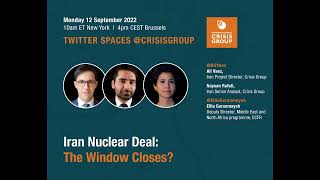
In this Crisis Group‑hosted Twitter Space, senior Iran analyst Naysan Rafati moderates a discussion with Dr. Ali Vaez (Iran Project Director, Crisis Group) and senior policy fellow Ellie Geranmayeh (European Council on Foreign Relations) about the prospects for reviving the Joint Comprehensive Plan of Action (JCPOA). The panel reviews the Crisis Group report “Is Restoring the Iran Nuclear Deal Still Possible?” and examines why negotiations have stalled after a year‑and‑a‑half of talks. Key points include: (1) mutual miscalculations by the United States and Iran that have created an impasse; (2) the persistent “guarantees” and “safeguards” issues – Iran seeks long‑term sanctions‑relief guarantees and the IAEA’s access to its nuclear sites remains contested; (3) the European Union and the E3 (France, Germany, UK) are deeply frustrated, having facilitated talks but facing limited leverage over U.S. sanctions policy; (4) U.S. domestic politics, especially the 2022 mid‑term elections, constrain the Biden administration’s willingness to make concessions, while sanctions enforcement has reached a plateau; (5) Russia and China’s shifting role – at times obstructive, at times supportive, but ultimately driven by their own strategic interests; (6) internal Iranian dynamics, where hard‑liners and former critics of the JCPOA now negotiate, balancing economic pressures, the “resistance economy,” and the desire for leverage against a potential future U.S. administration; (7) technical assessment of Iran’s nuclear program – enrichment up to 60%, breakout time estimated at four days, and a growing stockpile that could yield multiple weapons; (8) recommendations for limited, confidence‑building measures (single‑measure steps, red‑line agreements) and contingency planning to prevent escalation, acknowledging that a comprehensive deal may only be achievable after the November elections. The discussion ends with a Q&A on escalation risks, the logic of Iran’s nuclear buildup, and the potential for a snap‑back of UN sanctions.
Chapters
All right, well, hello everyone. Thanks for joining us. My name is Naysan. I'm the senior Iran analyst at the International Crisis Group. Happy to have you joining us for this Twitter Space experiment marking the launch of a new Crisis Group briefing. Very pleased to have with us Dr. Ali Vaez, who's the Iran project director and senior advisor to the president at Crisis Group. And Ali Vaez, who is a senior policy fellow and deputy head of the Middle East and North Africa program at the European Council on Foreign Relations. So the context for why we're having this discussion will be, I think, familiar to most people who've taken the time to join us. Negotiations between the U.S., Iran, and other parties to the nuclear agreement, and some parties that are not formally part of the nuclear agreement, but have very much been engaged in the process, have swung repeatedly from conclusion to collapse to near conclusion again, and apparently now back in the direction of collapse. So, Ali, I'm going to turn it over to you. The report title is, Is Restoring the Iran Nuclear Deal Still Possible? And there's a question mark at the end of it. So, is it? And can you tell us a little bit about what's what's in the report.
Thank you, Naysan. And I would also like to start by thanking Ali for joining us today. We've now been in the process of negotiations to restore the Iran nuclear deal, JCPOA, for a year and a half. I want to remind everyone on this call that it took the same amount of time to negotiate the original agreement between the conclusion of the interim deal in Geneva in November of 2013 to the conclusion of the JCPOA in July of 2015. The process is now really bordering on the absurd, as The Economist pointed out last week. Our report looks back at the making of the impasse and the Vienna talks, and I'm not going to go into too much detail about it. The reality is both sides committed mistakes, misread how much the other side wanted or needed the deal, and miscalculated. The real question is, where do we go from here? Now, we've been quite cynical about the prospects of a breakthrough for some time now, because fundamentally, the 25-page detailed agreement that has been sitting in Vienna since March and has been slightly modified in the past few weeks will not mitigate the risk for the Iranian leadership that in 2025, with a potential new US president, they might find themselves in the exact same position as they were in 2018 when Trump withdrew from the JCPOA, with one major difference in 2025, of course, which is the fact that the hardliners in Tehran will have no scapegoats this time around, can't put the blame on Rouhani and Zarif for being naive, and plus it will be the second time that they've been burned by the U.S. There is still a narrow pathway to an agreement, especially in November after U.S. midterm elections, But both sides are already implementing their Plan B. Every other week, the U.S. is imposing new sanctions or doubling and enforcing the existing ones. Iran is installing new centrifuges, and of course, the IAEA's knowledge about Iran's nuclear activities is shrinking by the day as well. Nevertheless, neither side really wants to pull the plug on the talks, and they both believe that status quo of no deal, no crisis is sustainable. Now, we disagree. We think that both sides have very limited space for additional escalation at this stage. Iran would have to really start doing, taking measures that would be highly provocative if it wants to get the attention of the other side, like activities that fall in the rubric of what weaponization, really. And for the West, the dial of sanctions is already maybe on 8 out of 10. And for them to be able to significantly increase pressure on Iran, they would have to resort to measures like snapping back the UN sanctions that would be highly provocative and could result in Iran withdrawing not just from the JCPOA, but also from the NPT altogether. And the last country that did this was North Korea in 2003, and we all know how that story ended. And of course, this is just the escalation that the parties control themselves. There could be escalation that would be external, like what Israel would do. We know the shadow conflict between Iran and Israel, which is multidimensional, is reaching new heights and can easily result in the kind of action that would spiral out of control. For instance, we quote a former senior Iranian official who says, that is certain if there is another Israeli covert operation against Iranian nuclear facilities or an assassination of an Iranian nuclear scientist, that for sure it would result in Iran enriching to 90%, which is not a measure that the Biden administration could sit on its hands and not do anything about. Now, if the escalation is to be avoided, our reports suggest that contingency planning would have to start now. The reality is when it gets to diplomatic options, there are not a lot of options that look promising. You know, if you want to come to the conclusion that the JCPOA's restoration is not possible, you might consider a more-for-more kind of agreement. The reality is that Iran has wanted more sanctions relief and more sustainable and effective sanctions relief, and the U.S. has wanted a longer and stronger deal. So both sides want more, and why not negotiate a more-for-more? Well, it has taken a year and a half to negotiate a deal that they already had. So it's not very promising to think that they would be able to negotiate a broader agreement. And plus, they're probably running out of time. What about a less-for-less agreement, an interim deal? Well, that was tried twice in 2021 and it didn't work. It's probably going to be extremely difficult for both sides to find a commensurate quid pro quo. And so that also seems quite unlikely. And even a narrower option, if you think of an interim agreement as a multi-measure package, a single measure package that Iran would freeze one nuclear activity and in return the U.S. would provide some sanctions relief, would that be possible? That too, we think, is going to be difficult to negotiate, although maybe more realistic than other options. Especially because it probably will fall short of the congressional requirement under the Iran Nuclear Agreement Review Act to basically for Congress to intervene and review such agreement. And then there's the, I would say, urgent humanitarian agreement. We know that there is a prisoner swap deal that has been negotiated and again has been sitting on the table for a while between Iran and the U.S. That could be implemented. Along with some unfreezing of Iranian assets for humanitarian trade, things should happen with or without any of the nuclear-related agreements that I just mentioned. But, you know, again, none of these look promising. So at minimum, the parties should agree on a set of red lines and tripwires that they would not cross so that they can keep a lid on this situation and prevent it from escalating to a level that could result in in a military confrontation. For Iran, that means not enriching to 90%, not undertaking activities that are related to weaponization, not further reducing IAEA's access below Iran's safeguards commitments, and of course not engaging in the kind of assassination that we've seen in the past few weeks with plots against former National Security Adviser John Bolton. And we know that there are other plots against other former US officials as well. In return, we suggested the US and the West should also not snap back the UN sanctions and also try to dissuade Israel from undertaking the kind of covert operations that could be highly provocative and damaging. So again, it's not a very promising set of recommendations. It's really the minimum that we're putting on the table now, because at least it would prevent a lose-lose dynamic that we're currently to turn into an absolute tragedy. I'll leave it at that. Great.
Great. Thanks, Ali. And before I turn it to Elie, I just want to remind everyone that you're welcome to DM your questions. We've already got a couple. I've certainly got a couple, but I'm happy to turn it over now to Elie. And Ali, your focus obviously is on the European side of the equation. And, you know, when we talk about the Europeans, we're really talking about a couple of different things. We were talking about the EU on the one hand that is the facilitator of the negotiations and then the E3 who are actually parties to the negotiations. And it seems as though statements over the past few days, even from the typically optimistic Josep Borrell, And then the statement yesterday from the E3, reading between the lines, there seems to be a great deal of frustration to a certain degree. And just wondering what your sense is of how Brussels and the E3 capitals see this, where, you know, to a certain extent, a lot of the key decisions at this point don't lie necessarily with them. Right. They come down on the issue of sanctions relief. They come down to discussions between the US and Iran on the IAEA front. Obviously, they were— they helped table the resolution in June at the Board of Governors. So I was wondering if you could unpack a little bit for us how you see the EU and the E3 to the extent that, you know, they're the same or different in their approach, as you know, the fall leads into a greater state of uncertainty on this.
Sure. Thank you, Nathan, and thank you to ICG for inviting me today. Thanks, Ali Vaez, for a great report from you and your team, which I had the chance to review. So many congratulations. I have some points that come in strong agreement with the report and some perhaps more optimistic takes about what the future might entail. But we can go into that later. Let me start by responding to Huneysan's question about where the Europeans are at the moment. So I think two words, deep frustration, summarizes the situation pretty well. You know, Josep Borrell, who has really gone out on a limb here over the summer, both in terms of pushing for that meeting in Doha between the US and Iran proximity talks that the EU was facilitating. You know, it's no small thing for the UAE representative to, to make a trip to Tehran during, you know, wartime in Europe with Ukraine and during a time where Iran is increasingly unpopular across different Western capitals. For an array of reasons ranging not just from nuclear diplomacy, but the issue of dual nationals that are detained in Iran to just generally the increasing image of Iran as a, as a problematic actor on the nuclear issue and in the region. So the— I think the EU team really made a gesture of good faith by going to Tehran and trying to bring Iran back into a serious negotiating stance after the long pause really created, I would say, by the Ukraine conflict. And we can go in deeper about what I think is quite a profound impact of Ukraine, both on the one side and the Iranian side. And I think many history notes will be written about what this meant for Iran's future with the West. But, you know, Doha, there was a real blowback to the European efforts because the US, I think in particular, saw it as a wasted opportunity from the Iranian side, that there were excessive demands made. And over the summer, the Europeans really tried to give it one last push, lots of back and forth between Tehran and Washington to try and get another meeting, another set of proximity talks, this time in Vienna with all the stakeholders of the nuclear deal at play. And I think it was really significant that we had representation from China and more importantly, I would say Russia on this nuclear file in Vienna, because it showed, I think, the seriousness of getting an agreement to a finishing line. If you have all the parties, particularly probably the most influential on the political front on Iran, which in my view is Moscow and Beijing, to try and get Iran to agree on some of the more thorny issues, including what we had thought was going to be somewhat a resolved issue, which was this issue of the access of the agency of the IAEA to get more information from Iran regarding the safeguards probe. And I think there was real optimism from the European side that they had gotten traction from Iran on this issue, particularly because the EU managed to include text in August which really pushed the E3 to, I think, go out of their comfort zone on this IAEA safeguards probe. Now, what has happened and emerged really is that my sense is the jury is still out in Tehran about whether the broader benefits of this deal merit Iran rolling back its nuclear advances that it has made since 2018 when the maximum pressure campaign from the Trump administration began. And, you know, I think that we are seeing a reflection of a lack of appetite in Tehran to take responsibility and accountability for getting back into this deal from any of the main decision shapers or decision makers in the system, in the political system in Iran. But at the same time, they know the alternative of This process collapsing would be terrible for Tehran from political, economic, security aspects all around. So nobody in Tehran wants, I think, at least the ones that are in the decision-making rank, nobody really wants this process to die. There are forces, I would say, that would like to kill this agreement, but I don't think in the top echelon of the decision-makers we're at that stage because they've been hanging on to this deal, you know, since Trump reneged on it. And there's still, I think, appetite to try and get a deal that's good enough for Iran in the, in, in the pocketbooks of the Raisi administration to try and alleviate the many, many different pressure points of the economy. But they just don't have the consensus yet in Tehran. Now, the problem for the E3, I would say France, Germany, the UK in particular, is that they have reached the end of, I think, their diplomatic openness and appetite to make concessions to Tehran on, let's say, the nuclear components of the deal. And we have hit a wall, I would say, or ceiling, let's say, with the US position on how far they are able to extend sanctions easing and relief upfront to Iran, or how far they can guarantee that this is sustainable. So we've reached an exhaustion point on the West that is not in line with the exhaustion point in Tehran. So we've been in this very, I think, frustrating game now for a few months, where the Europeans and the Americans really want to close this set of issues, and Iran is still insisting on keeping issues open or trying to nudge for further concessions. I think this comes back to the bottom line point that there is nothing that can guarantee that this agreement or any agreement with the US administration can be sustainable. Now, I'll just finish this question by saying that I think a key question that needs to be posed to Raisi if he does make it to New York to attend the UN General Assembly with his team is, you know, some top-line messaging from the Europeans. And I would say the Arab Gulf countries are going to be there at the highest level to really message some high-level political decisions that Iran has to make about whether really allowing this process to collapse, which could close the doors to going back to the JCPOA as we know it, really, whether that is worthwhile. And really, for me and myself and Sven de Baert-Markaryd wrote a piece several weeks ago, Iran is the party that has the most to lose from this process collapsing. Certainly everyone will share the blame and everyone will take a hit to their interests. But I think Iran will have the biggest costs imposed on it across the board, particularly the missed opportunities that it faces on the economy, about being able to reintegrate on a political and economic front back into the international markets. But this is going to be a decision that I think folks in Tehran are going to be very hesitant to make at a time when they feel, particularly with Ukraine and this perception that there is a multipolar world emerging. And let's not forget the Shanghai Cooperation Organization meeting is coming up when Iran is expected to become full member. There is this, you know, real push towards China, towards Russia, towards building up what Iran's Supreme Leader has for decades called for, immunity towards Western sanctions, with much more, I would say, reliable partners as they view it, China and Russia now. So, Naysan, I'll leave it there and look forward to the discussions ahead.
Thanks, Dalia. That's fantastic. And, you know, in the report, we kind of focus in on the early days of March as this almost hinge period that, I mean, it's a first draft of history that we're essentially doing here. But, you know, you have in the final days of February and early March, This— I don't want to use the word momentum because it's a bit cliché, but towards the end of February and the first few days of March, we have that photo of, you know, the Iranian and European negotiators, you know, huddled essentially to discuss the issue of safeguards. The E3 negotiators leave Vienna. I think it was on the 1st, 3rd of March, saying or tweeting essentially our job is done. And then Grossi going to Tehran and signing the safeguards roadmap on the 5th. And if you look at kind of historical hinge points, That's also the point where it seems to be the closest and also where it seems as well where the drift really begins. The Russians introduce more sweeping sanctions demands. The EU decides to put the talks on pause. There are no— and pulling out the prism a little bit more, we kind of point out as well how sui generis this entire process is, where you have multi-party talks with the two central protagonists, with the US and Iran, not even speaking directly to each other over a deal that they've already agreed to. And after March, we get until Doha, no kind of in-person negotiations. And even there, indirect ones. And it isn't until after Borrell's throw of the diplomatic dice that Ali was talking about, that all of the P5+1 and Iran are back in the same place at the same time, or 5 months basically passes, where you have no E3 US meetings with the Russians as well. So, you know, you've got a Russian doll process of different actors engaged in all of this. But you mentioned the dynamics in Tehran, and I want to take it over to Ali before we start to get into some of the questions. And once again, feel free to DM us. We've already got a couple of good questions coming in. But Ali, it seemed a couple of weeks ago that the Iranians were essentially getting their proverbial ducks in order for selling the deal more than they had at any process really since the negotiations started under the Rouhani administration. You had Bagheri Kani and Shamkhani briefing the Majlis, both the National Security Committee and then the wider Majlis. You had a couple of meetings within the Supreme National Security Council. You had Amir-Abdollahian, the foreign minister, saying something along the lines of We may not get everything we want in a deal, but the other side doesn't get everything it wants in the deal. And it seemed as though there was a process of softening it, which is, again, looking at it in a certain sense, it's very peculiar that a lot of the people that are responsible now for negotiating Iran's return to the deal are the same individuals who criticized the Rouhani administration for signing the agreement in the first place. Bagheri Kani is not a known advocate of the agreement, and neither are many of the other people who've been appointed. Under Raisi's cabinet and his diplomatic team. Yet now they are entrusted essentially with trying to finalize a negotiation that they spent a lot of time in opposition to. So essentially, you know, what's happened since there seemed to be this effort to close ranks? Wasn't an effort to close ranks. And if it is, what's basically happened since then where Tehran is moving back towards saying it's about guarantees, it's about safeguards?
That's a good question, Nason, and I think it reflects the internal debate in Iran, because there are some in the system, and I would put the Foreign Ministry and maybe writ large the government in that category, that they realize that this is as good as it gets, and that the opportunity cost of not getting back JCPOA for Iran completely, you know, outmaneuvers any potential marginal benefits that Iran would get from additional changes to the text. I mean, look, this 25-page agreement in the past 4 or 5 months, maybe even at best, there are only 4 or 5 paragraphs that have been changed. And again, marginally. In this period, Iran has lost tens of billions of dollars of potential additional oil revenue. And for a government that is dealing with daily economic troubles of the country, and I think is now disillusioned after a year in office, by the fact that it could resolve these without sanctions relief. It is essential to try to get the deal restored. But there are other elements in the system who either, because of the political risk, as I explained, or because they have vested economic interest in the continuation of sanctions regime, they have been trying to block the restoration of the deal. But again, the fundamental issue of economic guarantees that Iran has been seeking from the beginning, this is not a new issue. It was one of the things that Abbas Arokhchi, who was one of the original architects of the JCPOA, was pursuing, and so did Bagheri Kani, who was an opponent of the deal. They have been seeking economic guarantees that would outlive the Biden administration, and that is simply something that does not exist in the real world. There has been leaks in the press about a potential wind-down period if sanctions are snapped back that would be longer than the standard 90 to 180-day period. That the Treasury Department usually grants. But, you know, the reality is, again, the next president can come in on day one and say a 2.5-year wind-down period that the previous administration agreed to is now going to be 2.5 months. So, you know, there is, there is no economic or legal guarantee that any U.S. president can provide whether these negotiations continue for another 18 months or 18 years. And same issue with the safeguards, IAEA safeguards issue. I understand Iran's concerns. I mean, the fact that the source of the information that was used to conduct the investigation on the ground was the archive, Iran's own nuclear archive that Israel took out of Iran in 2018, is quite troubling for Iran. I understand that because basically, if they prove that the nuclear archive's information is accurate, then the broader lesson of nuclear archive, which is that Iran was indeed pursuing a nuclear weapons program pre-2003, would be validated. And that would be self-incriminating for Iranians. And plus, there are other elements in the nuclear archive that could be used in the future to continuously harass Iran and never allow its nuclear program to become normal. Those concerns are understandable. What is not understandable is how Iran wants this to be resolved, because in this particular case that we've had, traces of nuclear material that the IAEA has been able to find, there is just no way that the IAEA can look the other way. And there is no way of fudging this because this really goes to the basic mandates of the IAEA. It's raison d'être as an international agency to do nuclear accountancy. And so this is why I think there are people who in Tehran who might think that with more leverage, they might be able to extract better terms. That maybe this winter, with European energy security concerns increasing and U.S. and Israel's concerns about Iran's nuclear advancements increasing as well, that they would be able to extract better terms. But I think there are others in the system who don't want the deal and are using these demands as pretexts to prevent it from happening.
Thanks, Ali. For those of you listening, I mean, you may wonder why we're putting out this report right now. We actually started drafting this in the aftermath of the Doha talks because these two issues that Ali referred to, the issue of guarantees and the issue of safeguards, they're not new issues. They've been issues that have basically been there since day one. And for all of the technical progress that has been made on the specifics of how does Iran roll back its nuclear program, what is the sequence which general buckets of U.S. sanctions come off. These two issues of guarantees and safeguards have been there from the beginning. And in the report, we use, we borrow Philippe Herrera's photograph, the lead French negotiator, that says on the front page of the draft, they literally put nothing is agreed until everything is agreed on the very front page of the text in January. February. And so, you know, part of this report that we started to put together after Doha and then hit pause briefly to see if the August round could yield a breakthrough was that, you know, ultimately on these two questions, on the issue of guarantees and on the issue of safeguards, it may well be the case that not every circle in these negotiations can be squared. And Ali knows that I've joked that the easiest way for Iran to get a guarantee of extending sanctions relief by another year is to have agreed to this text a year ago. And it really hasn't fundamentally changed a great deal. And obviously, the safeguards issue is very much on the table right now. We have the Board of Governors convening today. Reports from the agency have come out that, as they usually do, are two sets of reports, essentially the state of play in Iran's nuclear program, which is extremely concerning. And if you look at Ali's thread today, we have an updated chart showing Iran's stockpile growth since mid-2019 when it began to breach the JCPOA's parameters. And by every metric, it's, it's quite concerning whether you're looking at the levels of enrichment, the continued stockpiling, the deployment of advanced centrifuges. Essentially, every day that goes past is another day where even if the negotiations are stalled, Iran's new program isn't. And then the second report is is quite remarkable as well. The last IAEA report in May was 10 pages, and I think it really drills into the heart of this Iranian argument about the investigation being a politicized one, because that report that the agency put out is granular in its detail of exactly what the IAEA has been doing. It's taken satellite imagery, it's done on-the-ground sampling, and found traces of activity prior to 2003. That simply require explanation, because that is the IAEA's mandate in nuclear accountancy. But, you know, again, over the past few days, the Iranians have made a closing of this file a precondition, and the rest of IAEA— and at early stages, I think, you know, including the Russians and Chinese, even though they voted against the Bogh resolution in June, I think the P5+1 consensus position throughout the talks has been that this does have to be addressed somehow, even if they disagree on whether or not BOG is the right place to actually address it through censure. Now, Ali, I wanted to come back to you for a second because, you know, Ellie talked about the views in Europe and you both talked about the views in Tehran. But talk to us a little bit about how you see the view in Washington as well right now. We've got the midterms coming up in a few weeks. This has been an issue that President Biden campaigned on to a certain degree, a return to mutual compliance. But at the same time, when he was in Israel, he said the military option is on the table. He's clearly, you know, planning in both senses. And you also mentioned that essentially the U.S. has over the past few months given a strong teaser of what its own Plan B could look like with a couple of rounds of oil and petrochemical sanctions in June, July. And August, plus a couple of other rounds of sanctions in response to other Iranian activities of concern in the US, including ballistic missile sanctions, the designation last week of Iran's intelligence ministry following an Iranian-sponsored hack against the Albanian government, according to Albania, the US, and NATO. So how do you see a Biden administration looking at this, both in terms of the negotiations, but also in terms of its own domestic politics going into election season?
Look, of course, dealing with Iran is always controversial in Washington, and there is a political price to pay. But, you know, my impression was that if Iran had come back to respond to the draft of August 15th and had said yes, the president and the administration were willing to pay the political price in Congress, even though the debate, in order to relate the debate in Congress, would be pretty close to the midterms because it will happen in September. But right now, I think there is a similar degree of frustration in Washington that Ali was talking about in in Paris, London, Berlin, and Brussels, and very little appetite to continue making concessions to Iran that Iran would only pocket and would ask for more. And we're now too close to the midterms, and with Democrats' electoral prospects right now looking actually better than what was forecasted a few months ago, they have very little appetite to have a controversial Iran-related debate on the Hill. Which means that most likely the U.S. is not going to show any flexibility in the coming weeks, although there might be some additional rounds of back and forth between the two sides through the European Union. But it's quite unlikely that we would see a breakthrough until November. Then, you know, the problem in this process is that again in November both sides thinking that they have the upper hand they could still once again squander an opportunity for a breakthrough, which might very well be the last opportunity. Because although I don't expect much to happen in this board of governors at the IAEA this week that would go beyond the E3 statement over the weekend, but there might be another resolution or even a referral to the Security Council at the last board meeting in December. And so the window might actually really close at the end of the year. But there are, again, there is also a possibility of a breakthrough. And I think the administration would be willing to pay the price for it even at that point, because just like is the case for Iran, Plan B options for the U.S. also range from unattractive to outright ugly. But, you know, at the same time, the U.S. is going to continue doing the maintenance of sanctions, which is this regular ratcheting up of new designations. That doesn't necessarily mean they're breaking new grounds. And again, unless there is a very provocative on the Iranian side, I don't foresee a major action from the U.S. They want to keep it steady until November. But, you know, there is also the possibility that post-November, if they lose control over the House, or maybe both chambers, that the Iranians, the opponents of an agreement in Iran, would become even more vocal of saying that basically this is a lame duck administration. It only has 2 years left in office and doesn't control Congress anymore, Congress that is so hostile to the JCPOA. And so there is no point in dealing with the Biden administration, and Iran would be better off keeping its leverage intact until 2025. So there are all of these complex calculations that could come into play. But right now, I think their preference is to continue the status quo of no deal, no crisis.
Thanks, Ali. And just a reminder to everyone, you're welcome to DM us your questions, the theme of a couple of which, and Elia, I'll throw this over to you and then to Ali for his thoughts as well. A couple of the questions have to do with Russia and China, in particular the Russian role. And fundamentally, not to oversimplify it, but to paraphrase a couple of questions that have come in, is Moscow a help or hindrance to concluding this deal?
Well, Nisarg, I think like most state actors, Russia does what is in its own interests, and that's had a habit of fluctuating over time. You know, we've seen from leaks of audio tapes from former Foreign Minister Zarif his take of whether Moscow was helpful or not during different parts of both the negotiations of the JCPOA and the implementation phase. And his reflections of that period was that actually, you know, there were real moments where Russia was putting a spanner in the works. And it, you know, became clear during that March hiatus with the talks was that even, you know, the Raisi government, which has probably had the most pro-Russian leanings, was facing difficult times with Moscow, where you had to have Iran's foreign minister travel last minute to Moscow to put, you know, some pressure on the country after the comments by Foreign Minister Lavrov that slightly rattled positions here in Europe about what Moscow really wanted out of the JCPOA. Also, from what I had heard, China also got involved at that point to lean in on Moscow to step back from its comments that JCPOA sanctions relief to Tehran had to also include a package for Russia so that Russia-Iran trade wouldn't be hindered. And, you know, China's involvement was partially the reason why Moscow backtracked on that. It does seem, from at least my discussions with policymakers that were engaged in the August round of talks, that Russia didn't hinder the talks, and that in itself was a constructive move given where things are at with Russia over Ukraine at the moment. And I don't think there is great, you know, expectation that Russia is going to go out on a limb and, you know, really force Iran into anything because, you know, there's a big question mark about what Russia would get out of a deal. I would say compared to, let's say, 2011, 2012, when we managed to get Russia on board with UN Security Council measures against Iran, we're in a very different setting these days in terms of firstly, you know, Western relations with Russia and what Russia thinks it can get from cooperation with the West. So, you know, we're at a real rock bottom at the moment in recent times. And secondly, also in terms of Russia's threat perceptions about Iran's nuclear program and overall Iran as a security threat is very, very different to European capitals and the US. So, you know, Russia is a security partner with Iran, is not an ally, but they do partner on different realms. And we've seen that intensify. And, you know, a nuclear threshold state in Iran is not the same threat to Russia, I would say, as it is for European capitals. And Washington and Israel. So Russia, I think, has a much more comfortable maneuvering space when it comes to Iran's nuclear advancement than we do in Europe. But at the same time, I think the fact that it has leaned in, for example, on issues like the IAEA safeguards probe and also the overall, let's say, sanctity of a nuclear arms treaty with Iran or nuclear arms control agreement with Iran shows that they are interested in being a participant to this deal and at least for now not acting as a, as is a main hindrance. But I, you know, I think that that switch can really be turned on and off depending on the state of play more broadly with the geopolitics around Russia going forward.
Thanks, Ali. And I'm paraphrasing one of the US officials. I think we included this quote in the report, but we may have ended up on the cutting room floor as some of the juicier ones did. But I think that the description was Russia went from unhelpful in the— from helpful in the winter to unhelpful in the spring to not unhelpful in the summer. Or paraphrasing, but it was something along those lines, which I think aligns with, uh, with what you're saying. Um, Ali, I'll turn it over to you.
I agree with everything Eli said on this. I, I don't have anything to add.
Wonderful. Um, again, you are welcome to send us, uh, more questions on, uh, DMs. Uh, Ali, there's a, there's a couple of questions about, um, the, the scope of of, you know, potential escalations by the U.S. on the sanctions front. One of the questions is, you know, has essentially the Biden administration done as much as it could have on enforcing the sanctions earlier on? And the flip side of that being, given the oil market dynamics after the start of the war in Ukraine and the appetite for energy from alternative sources. How is this market dynamic factoring in and how much leverage does the U.S. really have to go after Iran's energy exports at this time, given everything that's happening?
Good question. Look, there are two phenomena that I think we should take a look at. One is the fact that usually after the initial imposition of sanctions, after the initial shock, The economies adjust, and Iran particularly is pretty good at trying to circumvent Western sanctions. And so after the initial shock of the Trump administration in April of 2021, trying to push Iran's oil exports to zero and being pretty successful in driving Iranian oil exports down, Iranian oil exports recovered. So before the Trump administration left office, Iran's oil exports to China were hovering around 1 million barrels a day, slightly less than that. But when the Biden administration came in, of course, the expectation from them was not to double down on enforcement of sanctions, but for an administration that most of its senior officials were critics of maximum pressure, had characterized it as abject failure, to actually offer Iran goodwill gestures of sanctions relief, maybe because Iran at the time was dealing with another wave of COVID pandemic, even providing them with assets, releasing some of their frozen assets so that they would be able to purchase vaccines. It didn't do any of those steps, unfortunately, which I think was a strategic mistake in retrospect and deepened mistrust and especially pushed Iranian leadership to believe that the Biden administration is basically following Trump's policy with a slightly softer tone. But, you know, the minimum that they could do, which is what they did, was not to double down on enforcement of some of the sanctions. And so they basically continued the pattern that we had seen in the final few months of the Trump administration. But, you know, by late 2021, early 2022, already the fissure in US-China relations had widened and deepened to the extent that I think even if the Biden administration wanted to double down on enforcement of sanctions, it would not probably move the needle by much because China is much less risk-averse towards U.S. sanctions than was the case a few years ago. The Biden administration has tried to put pressure on the intermediaries that Iran uses to send its oil to China. But it hasn't really been that successful. And that's why I said, you know, one of the side effects of maximum pressure is that it has maxed the U.S. out of its leverage. There is not much more that the U.S. can do on its own. Now, of course, this administration is in a much better place to marshal internal support. The Europeans could potentially join in the sanctions effort. And there is the prospect of the snapback of the U.N. sanctions. And that, for sure, is going to have both a psychological and an economic impact. On Iran. But that doesn't necessarily mean that it would make a deal likelier or a better deal possible, and that it would be cost-free.
And Ali, I think that these issues that you're alluding to also come back to what we were talking about at the start, right, in terms of what Iran is asking in terms of guarantees. The issue of guarantees is partly a political one, right, where a second U.S. defection would make the Iranian government essentially look like suckers a second time for having entered into an agreement with Washington. But it also comes to this point about the economic side of guarantees. And like you mentioned, I think we wrote about this in the January report as well, that according to the World Bank and IMF figures, Iran's economy had clawed out of the red and into the black towards the second half of 2020. There are a lot of factors that go into this. Oil. Some of it is starting from a much lower base after 2 years of contraction. Some of it has to do with increasing regional trade. Some of it has to do with changing some of the financial bases for its own domestic economy, increasing taxation, and so on. So in the discussion on guarantees, one of the things that you hear, aside from, you know, the political risk of getting into a deal absconded a second time, is that on the economic side, A, some in Tehran believe that the resistance economy model now works. Iran's economy may not be able to thrive, but it's surviving. And the second one, which I personally would strongly contest, but it's that having now adjusted to a certain degree to sanctions, the shock of another withdrawal on the economy would outweigh the benefits of basically sputtering along for the time being. And again, notwithstanding the fact that GDP figures don't tell you everything, Iran's GDP is, you know, still well, well short of President Raisi's 8% projections, but it is in the plus column. And Ali mentioned that the SCO meeting that's coming up, I'm sure that the Iranians again will show that this shows the alternatives that they are to relying on Western companies and relying on oil exports. But when you look at inflation figures, unemployment figures, the currency to a certain degree, the problems are still very much there. So we're going to try to wrap up at the top of the hour. But I know Ali has got a couple of remarks she wants to share on our recommendations. I feel as though perhaps I'm the most pessimistic of the three of us, and Ali is possibly a bit more optimistic than I am, and I hope I can get there as well. But, Eli, do you see a snapback being discussed, or do you see either a snapback being discussed or an SC referral, Ali, hypothesized at a potential, at the next BOG meeting or through an exceptional meeting of the BOG if this stalemate continues? I mean, will there be, or rather, what will it take for Western maximum pressure as opposed to US maximum pressure if it comes to it?
Thanks, Lisa. So I don't think, at least in the European circles, we're at the stage where we are seriously discussing snapback. And, you know, as things stand, the US is not a party to the JCPOA. So the only countries that are most likely to resort to snapback are the E3. And as your report highlighted, out of those, it's likely to either be the the UK or France as permanent members of the Security Council that take that lead role. You know, and I've been facing a lot of questions since the premiership here in the UK changed over whether the UK is going to become much more hawkish on Iran. My sense is that all these countries are facing such monumental domestic priority issues with the cost of living crisis, with the war in Ukraine in terms of major foreign policy issues, that they are not going to really go against the US position or the joint E3 positioning, any of them. So I do think that the E3 will stay united, very likely with the US, on which pathway they take. I think the thing that is likely to trigger that step towards snapback would be a, you know, a major Iranian escalation on specifically the nuclear issue rather than other files. Obviously, the broader optics around Iran, the worse they get and the more deteriorating the relationship gets between these respective E3 countries and Iran. the more likely they are to resort to snapback. But I do think it will be based on what they view, what they will view as a legal justified step under the JCPOA to revert to snapback. And that could include something along the lines of Iran significantly limiting the IAEA monitoring on the ground in Iran, or Iran ratcheting up to 90% enrichment. I think those types of moves could really push the E3. And of course, you know, as your report also highlights, there's a lot of scope for non-JCPoA parties to provoke that kind of escalation from Iran, namely, most likely, the moves from Israel. So far in the last few weeks, at least, it seems that things are more calm. And maybe this is a product of the US leaning more heavily on Israel. Maybe it's a product of things being in flux because of elections in Israel. We don't know. And we don't know what that position will go in the near future. I agree with Ali's comments that if we are still in this state and in this sense of deep frustration with Tehran come December Board of Governors meeting, we are likely to see a much more punitive push from the E3 side at the Board of Governors in conjunction, you know, to bring the US on board with that. I don't foresee anything happening in advance of the UN General Assembly. I think the Europeans right now are focused on seeing what space there is, if any, to try and get a Band-Aid on the situation, to try and see if the text produced in August can be salvaged. And I think at the UN General Assembly, they might get a better sense of where things are going. And this takes me to some points I had briefly on, on your excellent recommendations in the report, which I, I'm very much in line with. I would say where my more optimistic nature comes in is that I think that for, for these single measure steps to work, they need to be part of a roadmap that's presented to Iran about how it goes into a more comprehensive arrangement with the US and the Europeans. My understanding also from the Iranian side is that they don't want to get stuck in what they view as, you know, a Western game of getting single extractions of concessions, which leads Iran at the end of it to be disarmed of its nuclear capabilities in return for a short-lived and not very tangible economic relief from the Western front. So I think that these short single measures that you have outlined in the report, some of the ideas need to be agreed as part of a short timeframe that put that Band-Aid on the situation. So the parties agree not to agree on a, on a JCPOA structured deal, but they don't escalate. But that's, that's for a short period of time. And I think these single measures need to then lead up, as agreed from the start, to some sort of interim deal. We don't need to call it that because there may be sensitivities, but some sort of a package like that, which take us to the US elections. And I think it's going to be very important not to leave this issue in a limbo phase at that point when we have a potentially new administration in the White House, whether it's Democrat or Republican, but that there is at least a degree of containment of this issue and a sort of roadmap presented to Iran for where it could go post the November elections. It may be something very similar to the JCPOA, if that's even possible by 2024, I'm not sure. And it may be more along the lines of a more and more deal that there may be greater political space to reach once we have clarity on whether the Democrats are going to hold office or not. But I do think that we should tie these single measures to a more optimistic end result and also give Iran a greater deal of— a greater measure of confidence that it's not just aimed at extracting and disarming Iran without much commitment on the other side. Thanks, Lisa.
Thanks very much, Ali. And Ali, I'm going to throw it to you as the resident actual trained nuclear physicist. Given that BOG is happening and given that we have now seen the latest numbers from the agency where on the one hand you have a nuclear program that is continuing to grow in size and on the other hand operating under considerable opacity. Right. We've seen grossly excuse me, talk about, you know, how difficult it would be, even if a deal is restored now in the safeguards report, to come back and establish continuity of knowledge. I mean, Iran has been limiting access since essentially April '21, further cutting off cameras after the BOG resolution in June. So taken all of that, taken where the size of Iran's nuclear program is, and given the limits and constraints that there have been on monitoring and access. And we'll close up with this, you know, cheery Monday morning thought. But given all of this, on a scale of somewhat moderately concerned to quite quietly alarmed, where are we in Iran's nuclear program today?
And that's a good question and depends on who you're asking, because, you know, it was exactly 10 years ago at the UN General Assembly that Bibi Netanyahu held up a cartoon bomb and drew a red line on it, which was the amount of 20% enriched uranium that if Iran would have would be a significant quantity that could be used, further refined to weapons grade in a nuclear weapon. Iran is now way beyond that red line, and it seems that it is Israel's threshold of concern that has moved. And it has moved from capability to weaponization, which is problematic because capability is something that you can monitor through IAEA and have exact numbers, and you can calculate rough estimates of a potential breakout time. But there is no way you can do so with weaponization that would probably happen in clandestine facilities. Look, Iran's breakout time now, according to my calculations, is 4 days. And, you know, given the amount of 60% enriched uranium that Iran has, which I think by the end of the year probably would be sufficient for 2 weapons, Iran has also about 2 weapons worth of 20% enriched uranium and another 2 at 5%. So it's like it's an arsenal. And with IR-6 centrifuges, and especially because the IAEA has not been able to monitor the production of centrifuges, there might be now hundreds of advanced centrifuges that have been produced. That we're unaware of. And so all of that, if the concern is really a proliferation concern, should be at a very high level. But again, we're living in a different world and the priorities have changed. And I don't think necessarily that unless Iran ventures into the weaponization-related category of activities, that if its nuclear program continues at pace, it would ring the alarm bells on this side of the pond. I just want to say I agree with what Eli said about the single measures eventually being part of a roadmap that would lead both sides to a more durable kind of arrangement. 100%. I think that's a very good point. But, you know, the reason we've been humble in our recommendation of a single measure is because of the record of the past year and a half that has proven that both sides have real difficulty in coming to the same page and trusting one another. We hope absolutely that we're wrong, that there is more flexibility and more political will on both sides. But that's the reason we went for a very, very narrow option. I also see, Naysan, that Borzu is on the call, and I want to just give the platform to him for a second if he has a comment or a question, and then maybe we can wrap it up right after that.
Hi, can you guys hear me?
Yep.
Okay, just a quick question, but I think kind of an important one, and I think, Ali, you just sort of kind of addressed some of it. But I'm a little bit confused about the internal logic of Iran's plan at this point. At what point do they stop, and what is the aim of amassing this much? They've proved a point. If they're not going for a nuclear weapons arsenal, you would think they would stop slow down and send a message of moderation? And if they are, why do it at this point in this way? Why wouldn't you kind of create an underground undeclared program? At this point, you know, the world knows Iran's capabilities. It knows what it's— that it, as you said, you know, 4 days is the breakout time. If they— if the point is to prove and set up the fact of Iran's potential nuclear capabilities, that point has been reached. So what's the point of putting the pedal to the metal and risking renewed international sanctions at the Security Council level? Thanks.
Good question, Borzou. I'll tell you what I think, and then I would love to also hear Ali's thoughts before we wrap up. Look, the reality is, for the longest time, Iran's nuclear advancements were made precisely because Iran was trying to strengthen its hand and have more leverage at the negotiating table in order to be able to extract a better deal. In fact, Ali Bagheri himself, when he was out of power, conducted a series of interviews about his time as a deputy negotiator under Jalili, and he explains the exact same logic, that he says, you know, from one round of negotiations to another, from Almaty I to Almaty II, from Istanbul I to Istanbul World War II, we made these nuclear advancements, and then the U.S., which was unwilling to make concessions on X and Y, agreed eventually to take a step back and basically offer those concessions to Iran. But now that Iran is so close to the verge of nuclear weapons, I think the allure of crossing the Rubicon and maybe taking that last step has become a subject that is more and more discussed among the leadership. And you even hear it being mentioned more publicly than was the case in the past. But, you know, the reality is I don't think Iran would be able to cross that threshold without being attacked by the U.S. and/or Israel, because this is also a program that is so deeply penetrated by Western and Israeli intelligence that, you know, evidenced by the fact that it has been target of covert operations for so many years. And so the current conclusion among the U.S. intelligence community, as well as Europeans, to my knowledge, is that Iran has not made the decision to move towards nuclear weapons. I think if that conclusion changes, then the calculation would also change. And we've heard that President Biden has also asked his national security team to revise a new all the contingency plans that the U.S. would have. I just simply cannot believe a scenario in which this U.S. president, especially any U.S. president, but especially this one, would want to be the one under which Iran would become a nuclear weapons state. Now, living with a virtual nuclear weapons state is a different proposition, but for Iran to actually develop nuclear weapons, I think it will probably be stopped before it. That doesn't mean that it would not eventually get to that stage. Countries that are keen and determined to develop nuclear weapons eventually will, and Iran has the know-how and the ability to do so. I'm just saying that it would not come cost-free, and it would also come at a strategic cost for Iran, which I think that has been the biggest reason, not for religious reasons but for strategic reasons, that they have not taken that last step, is because then it would start an arms race in the region. That Iran is almost bound to lose because it would not be able to compete with the financial resources that a lot of its neighbors have and access that they have in order to enter into a nuclear game of this that is determined not by your size or size of your population and, you know, the depth of your statehood, but by the number of nuclear weapons, the sophistication that they have, and whether you have second-strike capabilities or not. So it would be an entirely different game. And I think that has been the main reason Iran has not crossed that Rubicon. But, you know, things might change. Again, if Iran is attacked, that would be definitely a change in Iran's— it would trigger a change in Iran's nuclear doctrine. If there's a major change in leadership, if Ayatollah Khamenei is not there anymore, who knows if Iran would continue to adhere to its current doctrine. I hope that answers your question. But again, I'm curious to hear what Ellie, thanks.
Thanks. I'll keep this brief. Um, agree with Ali on all those points. I just had a couple. One is that I think that Iran genuinely expected more from a Democratic White House, and what we're seeing play out here is a sort of backlash from Tehran for that huge disappointment about the fact that President Biden didn't move in the first 100 days to quickly go back into a clean compliance for compliance. And they have now gone so far with this idea of reciprocity, with continued US maximum pressure and continued new layers of US sanctions that have appeared under the Biden administration, that they have no choice but to keep adding to these. Small footnote, probably an Iranian official would also say we're mandated by the December 2020 legislation to continue with these nuclear advancements until we have full economic relief from the other side. I think another point is that some inside Iran would argue that they have to continue building this leverage, even if they are in some cases crossing the Rubicon, particularly on knowledge and development. They have to continue going as they, as they see it, to prepare for a potential Trump 2.0 administration if they hit a wall. With the Biden team on getting back to a deal. They want to continue stocking up what they see as their chips and cards to play with a much more, let's say, aggressive, irrational White House under a Republican administration that will only understand, you know, the use of major force by Iran in terms of its nuclear advancement. And finally, I would say, you know, it goes back to a point I made at the beginning that I do think the Ukraine conflict and the way that the, that the different chips have been placed around the globe have made a lot of people stop and think in Tehran about their options. Not only that in terms of the East and the West, but we've seen very interesting advancement in Iran's relations with Eurasian states, with Arab Gulf nations. So I think that has fueled this thinking in Tehran that actually we don't need the West as much as we used to think we do, and we have options 'Even though that means we won't meet our full economic potential as things stand, but in the long run, perhaps if we are recognized as a kind of nuclear threshold state, and perhaps even more under a new supreme leader in Iran that will make a more bold decision, as some would want to go the whole way on the nuclear front, that they will in the long run better provide security for the Islamic Republic of Iran as they view it.' So, you know, I think that those forces have, you know, their position has been much more strengthened by the conflict in Ukraine to continue down this path. Thanks, Lisa.
Thanks so much, Ali, and thanks for joining us and Ali as well. Plenty to get us started on a dark Monday here in D.C. and lots more to follow in Vienna as BOG rolls ahead this week. President Raisi will be in Samarkand for the SCO meeting, and then it's not long before everyone convenes in in Turtle Bay for the diplomatic Super Bowl that is UNGA. So thanks everyone for joining us. Thanks for your questions. Feel free to check out the report, which is at crisisgroup.org and pithily summed up in a thread that Ali posted this morning. And if we haven't filled you with optimism, hopefully we've at least given you some better questions to think about. So thanks very much and take care.
More from Ali







Israel and the U.S. at war with Iran: what comes next & what implications for the region and beyond?



Trump ‘Is Living in a Fantasy Version of His Own Presidency’ | The Ezra Klein Show
