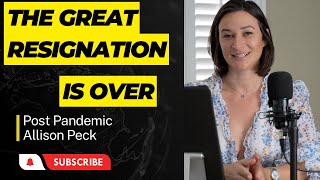
Alli Peck summarizes and reacts to a New York Times article about the Great Resignation, explaining that although tens of millions quit jobs during the pandemic (creating a period of worker leverage), quit rates have recently fallen back toward pre-pandemic levels. She interleaves data points (wage growth slowing, ADP payroll data), a personal anecdote about leaving a San Francisco startup for a remote Nevada role (took a $30k nominal pay cut but higher take-home due to lower state taxes), and commentary on generational job-hopping (Gen Z more likely to stay 1–2 years). She frames the labor market as moving from a musical-chairs period of easy switching to a more cautious environment amid recession and rate hikes, and closes with managerial advice to make employees feel truly valued (beyond superficial perks) and an announcement of a TEDx talk on Dec 3 in Hartford.
Chapters
Welcome back. Today we're going over a really interesting and relevant article by the New York Times titled the Great Resignation is Can Workers Power Endure? Somebody sent me this article. Thank you. To the friend that sent this to me. I read it this morning. And the data they present here makes a lot of things make sense with regard to unemployment, interest rates, quiet quitting, boomers, retiring, Gen Z entering the workforce. So we're going to go over some of that right now. Let's get into the article. The first part of this article reads, tens of millions of Americans have changed jobs over the past two years. A tidal wave of quitting that reflected and helped create a rare moment of worker power. As employees demanded higher pay and as employers short or staff often gave it to them, they're bringing up this notion of who has the power, who has leverage, who has the negotiating power, who has the bargaining power, employers or employees? During the pandemic, it seemed like workers and employees had the power. People talked about interviewing being a two way street. You're interviewing the company as well. If it's not the right fit, there are plenty more out there. People also changed jobs a lot during the pandemic. And now still because of the pandemic, because it is easier to get a pay bump by switching companies. Sometimes you even get stock. Sometimes you even get a signing bonus than it is making more money getting a raise and a promotion at your current job. So let's keep going here, this article reads. But the Great Resignation, as it came to be known, appears to be ending. The rate at which workers voluntarily quit their jobs has fallen sharply in recent months and is only modestly above where it was before the pandemic disrupted the U.S. labor market. So they're talking here about people quitting their jobs during the pandemic. I was one of those people. I worked for a startup in San Francisco as a senior program manager. It was a startup or they gave us a lot of really cool perks. I joined the company. I was working my butt off. I would say I was working 60 hour weeks. I was having nightmares about work. I was really stressed. They told me I could work remotely and then they started asking me to come back into the office. That was my first inclination. Something was changing. I didn't know if it was that we weren't getting funding. I didn't know if it was the recession or the economy or interest rates. Whatever it was, I thought that's an interesting thing that they're starting to take away perks. Then they took away some other things. They gave us a grocery stipend. They took that away too. So I thought it was interesting that they got me with the perks and I thought, this company really cares about its employees. These are the ways in which they care. I feel valued. And then they started slowly taking away the perks and I thought, you know what? This is trending in the wrong direction. I'm gonna leave and get another job. I reached out to a company and I said, hi, it was a recruiter on LinkedIn. I reached out and I said, I'm interested in working for your company. I'm job searching right now. The company I'm currently with said I was remote. Now they're changing their mind and trying to bring people back into the office. I'm looking for a fully remote senior program manager role at a medical device company. Here. Here's my Resume. I have 10 years of great experience. Let me know if we can move forward with an interview. After I sent that, I had a job offer in my inbox 14 calendar days later. That is one example of how companies started taking away some benefits and some perks during COVID and how easy it was for some people to find a new job right away. Let's continue with this article. They're saying the question is whether the gains that workers made during the Great Resignation will outlive the movement or whether employers will regain leverage. Particularly as many forecasters expect, the economy slips into a recession sometime in the next year. So in my story I actually took a pay cut because I moved from California to Nevada. California, remember, has high state taxes. Nevada has none. So I'm only paying federal taxes now. I took a paid decrease of about $30,000 but my take home is more. So in essence I am making more money but paying less taxes. I think I got that right. Let's continue. Pendulum may be swinging back towards Employers Wage growth has slowed, especially in the low paying service jobs where it surged as turnover peaked in late 2021 and early 22. Employers, though still complaining of labor shortages, report that it has gotten easier to hire and retain workers and those who do change jobs are no longer receiving the supersize raises that became the norm in recent years, according to data from the payroll processing firm adp. You don't see the signs saying thousand dollar signing bonus anymore. Let's talk about a generational shift that is happening from Boomer to Gen Z right now. With regard to what I just read, the boomer generation on average stayed at their jobs for decades. Then we had Gen X who stayed a little bit shorter Millennials who stayed even shorter, and now Gen Z who is considered the job hopping generation. They stay for a year or two, just enough to get trained on board, maybe some of your stock vests and you feel like you got a good grip on the company and then they leave. Think employers do not like that? It's a huge waste of money. Hiring is expensive and training is expensive, so let's keep going. The article compares the labor market to a game of musical chairs. When the economy began to recover from pandemic shutdowns, workers were able to move freely between jobs. But with recession warnings in the air, they are becoming nervous about getting caught without a job when fewer are available. I'm absolutely seeing this in pandemic times. People felt comfortable switching jobs because there was a major labor shortage, which there still is. However, now that the labor market is cooling off, as this article states, due to the Feds raising the interest rates, people are wanting to hunker down, stop being risky with their job searching and their job hopping and find a job that they can stay at for a while to wait out the recession. So they say everyone knows the music is about to stop. That's going to lead people to stay put a bit longer. I agree. This article goes on to talk about some data and there's also a case study in here showing somebody who left corporate America to start their own business. And now that AI has entered the chat, they're nervous that they won't be able to pay their bills anymore because they don't have the customers that they wish they would have. One takeaway I have from this article is since people are looking like they're going to stay put at jobs for longer now since the music has stopped and now it's musical chairs, we all need to find a place to stay put. If you don't want unhappy employees, if you are a CEO, a business owner, or a manager, if you don't want unhappy employees, if you want happy employees who are glad to stay and not miserable, make them feel valued. And I don't mean a pizza party. I recently made a video showing one way that you can go above and beyond at your company and the overwhelming response 12,000 comments is gen Z is saying we're not going to go above and beyond for companies that don't go above and beyond for us. We want fair pay and we don't want just a pizza party or a foosball table or beer in the fridge. We want to feel valued. We want to feel like we're not just a number and that you wouldn't just let us go if shareholders requested it or required it. I'll be giving a TEDx talk in Hartford, Connecticut on December 3rd about this exact topic. I'm in my research phase right now. I'm writing my talk, and it's all intriguing. We did this during the pandemic, and now we're coming back up and there's people are talking about a recession up here. And so I'll be looking into some data to support the theory that things will go back to normal or there is a new normal. And here's how we can move forward in that new normal. So stay tuned, like, and subscribe, and I will catch you in the next video.