Change Careers with Guest Marlo Lyons ( Part 1)
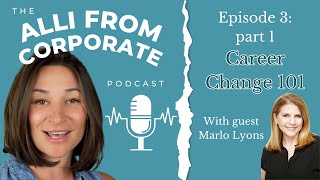
Alli Peck talks with executive coach Marlo Lyons about changing careers. Marlo's book 'Wanted a New Career' walks through identifying your values and translating skills to a new field. Gen Z prioritizes connection, impact, and flexibility over salary.
Chapters
Welcome back to podcast episode number two. This is the Ally from Corporate podcast. I am your host, Ally from Corporate, AKA Alison Peck. It is nice to see you all again. I have a very special guest today. She is a career team and executive coach and strategist, and we actually worked together at a former company. This is Marlo Lyons.
Hello.
Hello. I'm so glad.
I'm so glad to see you.
I'm so glad that I was able to drive down to Scottsdale and visit you.
I can't believe you're here.
I know. And it's awesome. Beautiful weather.
Scottsdale is very beautiful weather. Finally it's cooling down. Finally.
Yes. Vegas has been hot. I'm sure Scottsdale has been very hot. So it's really nice to see you. We haven't seen each other for a couple years.
It has been a couple years. I see you on Social everywhere.
Yeah, I try to be everywhere all at once, but, yeah. So we are going to talk today about a few different things. We're going to talk about mistakes that you and I have both made in our careers, what we've learned from it. We're going to talk about how to change careers, because that is what you absolutely specialize in. And your book wanted a new career. I have listened to it for the past couple of days, and it's. You give incredible advice that I have never heard somebody give before. So we're going to talk a little bit about that. So let's get started. First, tell. Tell everybody how we met, because it's. It's kind of a sweet story.
We met at Intuitive.
Yeah.
I saw you posting a bunch of things on Social and I realized you worked with me even though we worked in completely separate divisions and didn't have any interactions with each other. So I just reached out and said, hey, you want to catch up?
You were like, How. You were like, I want to write a book. But is that. Is that okay? Are you. Has anybody told you you can't be doing what you're doing and have a job? And I'm like, no, Nobody's sure.
It's. I was trying to figure out how to provide advice to the public and, you know, really do what I think I do best without, like, losing my corporate job at the time, which is hard.
Yeah.
Really hard.
Because, yeah, I felt the same way.
You got to be careful about not speaking as the company. Right. You have to only. And you're trying to speak for yourself, but you still work for the company. So it's a very delicate balance.
Yep. And I Had my, my worst fear has always been that HR calls me one day and says, hey, we need to talk to talk to you about your social media. And it happened once a couple of companies ago. It finally happened and I was terrified. Hr, I thought they were going to let me go, but it finally happened. My worst fear. HR said, hey, we saw one of your videos and somebody actually called us and complained, so we have to follow up legally. But we just want to let you know we're big fans and it's actually fine, but you just need to put a little tiny disclaimer at the end of your LinkedIn post saying, you know, these are my thoughts and not those of my company. I'm like, oh, I can do that. Sure. And they were like, good, okay. You know, we follow you, we think you're great, but we just had to follow up legally. So you're good.
You're lucky it wasn't that fun. Yeah, I had that posting on my LinkedIn for a long time. Yeah, exactly. Super critical.
Yes. So let's talk about your book. So your book is called Wanted a New Career and you won best. You won the award for best self help book in 22.
Yes, I did.
Congratulations.
Thank you. How was that? It was awesome. I was, you know, I wrote the book because people have been asking me for years and years, how do you change careers? How did you do that? How did you do that? And when they asked me, how did you do that? I'm like, okay, I'll tell you how I did it. But then I realized, oh, there's actually a way to do this and do it successfully and I can't talk to everybody in the universe. So if I put it in a book and I give basically step by step instructions, then anybody can learn how to change their career.
Yes.
So that's why I wrote it.
And I have a lot of people who are going to be listening to this and who follow you and I both on social media. And they, I mean, I've gotten a lot of DMs where they say, I'm in this job right now, but I really want to do this. I don't know how to transition. And so I try to teach them about transferable skills. And you talk a lot about that in your book.
I do.
And sometimes it's hard to draw parallels between a waitressing job and a project management job, but it can be done.
There are skills in every job.
Yes.
Every job. You could be working in a grocery store. And there's nothing wrong with working in a Grocery store. And there are tons of skills you gain in a grocery store. Everything from prioritization to organization to soft skills. You know, aligning with your management on how you're going to set things up, you know, being responsible and showing up on time. There are all sorts of skills. And every single job you gain skills, you just have to be able to look at them through the lens of the new job.
Yep.
That's the entire premise of the book, is how. How do you align what you want to do with your values so that you'll be fulfilled? Cause if your values are fulfilled, you'll be fulfilled. And then how do you transfer your skills through the lens of the new job?
Yes. So you talk in your book about how to identify what your values are, which is not so easy for a lot of people. Where would somebody start if they're like, I don't know what my values are. I mean, you can Google a list of values, but how do you really sit and think like, what are my values?
Values are what's important to you. That's it. What is important to you? What is important to you at work? What is important to you in the environment at work? What is important to you in the job that you're doing? What is important to you in the interactions that you're having? So if you ask yourself those questions, what is important to me in my work? Well, I like to do tactical work, or I like to do projects that are short term, not long term. I like things that have a big impact. What do you enjoy if you spend time during your week thinking to yourself, what gives me energy? What depletes my energy? Right. And you put a line down the middle of the paper. Here's what gives me energy. I love this conversation with Alison because I got to talk about career, and I just like Allison. Or what depletes my energy? Preparing for a speech that I'm not interested in giving. Right.
Yeah.
And then you can really hone in on what's important to you and what's not. The problem is people will say that they like something that they don't necessarily like because of societal pressures. Yes, they will. I love to learn. Okay, so if I gave you a stack of books and I gave you a television, which thing would you do? Well, if I'm going to watch Seinfeld reruns and doesn't mean I don't like to learn, but maybe I like to learn organically, or maybe I like to learn about history, or I like to learn about anthropology, but I don't Necessarily like to just learn all the time. I'm not Bill Gates. I'm not reading 20 books in the year or 30 books in the year. Right. So really honing in on what you like and what gives you energy is critical.
Absolutely. And you have so much experience with doing this because you've probably had to reevaluate your values because you've had a ton of different careers. Right.
Your values change as you grow up. Right. You have different values when you're first out of school than your values after you have children. Now that I have children, my values have completely changed. Things that are important to you change. And so you evaluate them every three to five years or after any big event and see, have they changed? Is there something does. Does a value? A specific value may stay in your list of values, but the meaning of that value may change. So, for example, if I ask you, what does flexibility mean to you today?
It means, I mean, flexibility to me means being able to do something different tomorrow than I did yesterday and not feel like I have to stick to my routine. You know, if I want to stay in bed all day, it's okay. I can. I can give myself grace and stay in bed. If I want to sign up for a marathon, I've signed up for a marathon. So it just means doing things differently without having to feel like I've put myself in a box and I have to stay there.
Okay. So flexibility for you means being able to do what you want to do every day and being able to do it at the time you want to do it.
Yep.
Okay. Flexibility for me means getting to my kids basketball game. Yeah. I was there yesterday with cheer. Being able to have the opportunity to work when I want to work and be with my children when I want to be with my children. And not doing it on a clock in corporate.
Yeah.
But doing it on my time.
And so people love being on a clock, incorporate. And they love the 9 to 5.
They love the structure, the rigor. Yeah. But if you look, the word flexibility is a value. It means completely different things to you and to me. And so that's why people don't. Don't align with other people or with certain jobs is because they say, you told me this was a flexible job, but that means something different to the company. It means something different to the company than it means to you. And so you have to understand what the value means to you, and you have to define that value. And then you align your values to the skills and capabilities that you have to find the career that you want?
Yes. And in an interview, if somebody says this is a flexible job or it's a dynamic working work environment, what does that mean? You can ask them to define it. You can say, what does that mean for you?
Right.
I've done that all, all, all kinds of interviews. I've asked people, what does that mean to you? What do you mean? High, high fast paced environment. And then it turns out people are working 80 hours a week and I'm.
Not interested in that.
But sometimes a fast paced environment means.
They make decisions quickly, which is, that.
Is a value of mine. I love quick decision making, so.
Exactly.
Good, good information. You also talk about in your book that life isn't linear. Can you tell me what that means?
It means that whatever job you take coming out of college does not have to be your career forever. Nothing in life is linear. Think about weight loss and weight gain. People go up and down and up and down. Nothing in life is exactly going to go in a perfect line, you know, or go perfectly up. Right. You have to take things as they come and decide, huh, why am I unhappy? Why am I not fulfilled? And then figure out what is the pivot at that point. And the pivot might be to go down before you go up again. Or the pivot might be to go up and then down. The one thing I have learned is that money used to be incredibly important to me. It meant security. Money still means security to me, but I don't need as much of it. Does that make sense? And so money may, you may want to be a millionaire, but understand the reasons why behind that. Or you may decide, I just want to be comfortable and be able to live my life the way I want to live and I don't need a million dollars to do that. Oh, interesting. So that's why life is a linear because life is never going to go straight up, it's never going to go straight across. It's never going to be perfect in the way you want it because something will always happen. But if you roll with it and figure out the whys behind it, then you can have a fulfilling life.
I love that life isn't linear. I'm going to live by that. That's a good, that's a good reminder because sometimes I look at my social media analytics and it's trending downward, but I know the next week it'll be trending in a different direction. So you will.
Absolutely. Everything changes. And it can change on a dime.
Yes. And it can change because of something outside of your control. Probably most of the time. It does.
Absolutely.
Yeah, absolutely. I love that. Now is a good time to take a break and hear about our sponsors. So we will be right back. I know I'm tired of the same old presentations at work, and I know you are too. If you know me, you know I talk a lot about how to stand out in your career. Here's one. Use MMHMM for presentations. That's right. They're called mmhmm. Fun name, right? This app helps you make an impression in meetings. By layering your video over your presentation, you'll blow people away. In your next meeting, they'll be saying, how did you do that? What tool are you using? Using MMHMM is just a better way to deliver information overall. It makes virtual presentations look innovative and it makes you look well practiced too. Step up your presentation game using mmhmm, the hybrid video app that transforms your virtual presentation into unforgettable experience experiences. All right, we are back and we're gonna do a fun segment that I like to call Grab Bag Stats. So I've chosen a couple statistics from Business Insider, Newsweek, Harvard Business Review, Forbes, and we're gonna pull some out of a jar or out of a bowl and talk about it. So why don't you pick the first one and I will read it to you.
Excellent.
Gen Z, which, remember, is people aged 11 to 26. So they're the youngest of the workforce right now. Gen Z values salary less than every other generation.
Oh, true. Wow. They value connection.
Connection.
Connection, connection and relationships. And that's why onboarding is so critical for Gen Z. You can't just give Gen Z their work and do your little onboarding sessions and expect them to connect with your mission, your goals, and just do their work. They need people connection and they want to know that what they're doing is making a difference. And so it's critical to have somebody that's connecting with them, assign them to a mentor, maybe multiple mentors check in with them more often than the average employee. And it's not babysitting people like, oh, they need to be babysat. No, they don't need to be babysat. What they need is to feel that they're bringing value and to feel that they are connected to someone and something. Meaning the mission of the company.
Yes. And I know that Gen Z, they became adults during times when we had incredible social movements like blm, like climate change, like the gender pay gap. So they are, they're protesting, they're posting about it on social media. They want to make a difference in the World. They want to be the change they want to see in the world. And so I'm also seeing they do want to make an impact at work. And so a lot of the advice I give to managers is if you have younger employees like young Millennials or Gen Zs, help them understand how their daily tasks and their responsibilities are contributing to the company vision and also the world.
The world.
Yeah. Because a lot of these companies are like, we're changing the world. Well, how, how am I changing the world as an employee? Helping you change the world. World as a company.
Right. They don't want to just sell a widget. Not anymore.
No.
And they not only want to connect and they not only want to change the world, they want flexibility to do it. They are the generation that is not going to work 80 hours a week. They are the generation that is not going to show up early and stay late. They are not the generation that are going to put their work over their self care. And so we have to understand that the world is changing and that if they're going to be the bulk of the workforce, how do we ensure that they have everything they need to have a robust life outside of work as well? Even though it's not the employer's job to make sure that your life outside of work is healthy and good. But how do we as employers or how do employers either come up with benefits or flexible working, you know, remote or hybrid, or you know, create connection, create those ERG groups, employee resource groups where they can connect with other people who are similar minded to them. And they may not just be ERG groups for ethnicity or diversity or things like that, but there might be an ERG group for environmental action or things like that. Sustainability places where it can enhance the employer as well. Because you might come up with great ideas out of those groups. Because ideas come from everywhere. Yes.
And I love that you mentioned that Gen Z doesn't want to come early and stay late. That was advice that I got from my parents growing up. Me too. And absolutely. I did a social experiment on TikTok recently where I made a video giving the advice that my parents gave to me. I said, if you want to excel in your career and you're at the very beginning, come early, stay late.
Yeah.
That video got so many. I think it got 20,000 comments. Wow. A million views. I was in the news about it.
Wow.
Hundreds of people stitched the video and said absolutely not wrong take.
Yep.
And while I understand that it's not the right advice for this new generation, it was the Right. Advice for me. I did come early and stay late and it worked. And I have built a beautiful reputation. But the comments I want to share with you, some of the comments I got in that video, a lot of people said, I'm not going to come early and stay late. I'm going to act my wage instead of act my. Wow, that's a powerful statement.
That's brilliant. I'm going to act my wage. Yep.
They're like, they're not paying me.
Right.
They're not paying me to, to break my back. And a lot of people said, why would I break my back for an employer that would replace me tomorrow if I died today? They. There's this sense of, I'm going to go on a bit of a tangent here, but we have these incredible devices at our fingertips and we can know the global news at any time point and there's people dying all over the place and we know about it. Every notification, breaking news, somebody else died. And so people don't want to slave away. It's not the right term. People don't want to work so hard and break a sweat for a job that wouldn't care about them if there were, say, a global pandemic.
Don't you feel in some ways that Gen Z figured it out before we did?
Yes.
And because that is what that is, the big thing for me is that, you know, I had the same advice from my parents. I'm older than you. And I had the same advice from my parents, work hard. When you work hard, you will succeed. Right. When you come in early and you stay late and you do everything they need you to do. And I can tell you, I watched myself in my last year of corporate, I was handed this huge project. It was high visibility. I loved every minute of it. But I also gained 30 pounds during it and I was still working out, but I was eating my way through it, basically. And I sat there afterwards and I'm like, I sacrificed myself for a big project that was really interesting that I thought would get me somewhere and I thought would have high visibility. But I sacrificed myself. I sacrificed time with my children, I sacrificed time with my husband. I sacrificed your body health. Yeah, my overall health and my emotional wellbeing as well. Because I was exhausted all the time because I was working evenings and mornings and it was crazy. And yes, the project went off perfectly. I couldn't have asked for it to go off better.
But was it worth it?
It wasn't worth it. It was not worth it. And I learned from that that I cannot sacrifice myself anymore to do things that are not aligned with my values and what's important to me. And my health is super important to me. Anybody who knows me knows that I work out every single morning. Now. I am not the most fit person, but I am strong and I feel healthy. And when you sacrifice what's important to you for an employer, that is where you are upset, you are unfulfilled, you are distressed, you are stressed, you are tired, you are anxious, you are depressed. All of these things come into play at different points for different people. But if you live your values and you understand what's important to you and you live those and you say no to that big project. Because yes, some of my values might have been fulfilled by doing the big project, by the way, but not all of them and not the most important ones. And I learned through that big project, a project that I wanted to do desperately, that gave me high visibility, that gave me credibility, that gave me everything, that my personal values were actually more important than the work values.
Good for you for learning that. I think a lot of us have to learn that the hard way.
I think Gen Z has got it right actually. I don't think they're lazy. I think they figured out that life is, is too short. I've lost both parents and I lost them within a year and change of each other and very recently actually. And thank you. And that was my wake up call of their own regrets of how they live their life. And how do I want to live. That's the key word here, live.
Because we're living people.
How do we live our lives? How do we enjoy life? It's not know living to work, it's working to live. And Gen Z figured that out already.
Yep, they really did. This concludes part one of the Ally from Corporate podcast with guest Marlo Lyons. Make sure to tune in for part two.
More from Alli








Change Your Career Without Leaving Your Job: Podcast Episode with Darcy Eikenberg


