Change Careers with Guest Marlo Lyons (Part 2)
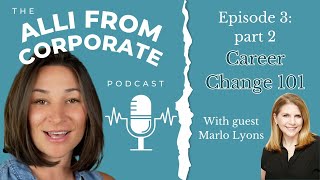
Marlo Lyons talks career change with Alli Peck. Gen Z and Millennials are 38% of the workforce now, but 68% report high stress and 34% experience burnout. Lyons recommends ranking your values, translating them into skills, then having conversations with people already doing the work you want.
Chapters
This is part two of the Ally from Corporate podcast with Marlo Lyons. Let's get back to it. All right, let's pick another one here.
Okay, let's see. What do we have? Here you go.
Okay. Gen Z and Millennials currently make up approximately 38% of the global workforce. And they will make up even more than that when boomers retire in 2032. Wow.
When boomers retire. So that means that employers need to adjust. You can't just do the same old, same old.
Yep. And I'm working. One of my missions is to help companies understand that the onboarding process is one of the ways that they can adjust and attract Gen Z. Because have you ever started at a company and you're handed a dusty product catalog and somebody told you to read it or you're sent through a series of training videos that make you want to fall asleep?
Oh, absolutely.
That is not the way to onboard.
That is not the way to onboard. Again, it's about connection. For Gen Z specifically, it's about connection and creating that connection and. And finding just not, hey, you be the mentor. Find somebody they connect with to be their mentor. Have them work for a week and meet maybe five, six different people and then ask them who they connect with and who they would like their mentor to be. We assign people. What if you don't connect with them? That mentor is useless.
Yeah, you got to have chemistry. Professional chemistry.
Chemistry. It's connection. It's chemistry. And of course, as we talked about, it's connection to the mission and how the work connects to the mission and how everything they're going to be doing connects to the mission and repeating that. So that will keep them happier and more fulfilled than just, hey, watch a bunch of videos or come to our hour and a half or three hour onboarding session. And okay, now you're onboarded. That is not going to work in the future.
And that leaves a lot of employees feeling like, oh, my God, I'm two weeks into this job and I hate it already. Did I make the wrong choice?
That and a lot of people jump. I can't tell you how many people that I coach in the Gen Z range. They take a job and then they call me three weeks later and they say, a recruiter's reaching out to me on this other job. And it sounds better. What, do you leave? I don't give advice. I coach and we talk about what's going on with the new job. Because when you're onboarding, there's a lot of stress involved with that. Right. You Have a new job, you have new work. You have to figure out how to bring new value to the company, new people, build relationships, all of that. So is it that or does this other job align with your values better?
But they might not even know because they're working in this one job and they see it for what it is. But this other job is still in.
The interview phase, and they don't know.
They don't know.
It's about aligning to your values and trying to figure that out. So I coach, I don't give advice, but I have seen people leave jobs within a month when they don't have the connection. And it's always Gen Z that leaves within the month. Not always. Actually. There are a few that are outside of Gen Z, but a lot of it is Gen Z that leaves within a month or two months. Because they're like, you did nothing for me to connect me to this company, to this mission, to the greater good, and you lied to me. Basically. They see that as a lie when they interviewed.
Yeah, I get those questions a lot from people, too. They say, hey, I've been at this job for two months and I. I just got another offer for my dream company. And I say it's okay to. To leave. Try not to make that a habit, though, because your reputation will be tarnished every time you do it. And I say, for next time, understand what you didn't like about the company you're currently employed with and ask those types of questions in the next interview. How do you onboard your employees? What takeaways will I have after onboarding in the first two weeks?
Great question.
How can I build relationships in the first two weeks? How can you as a company support me doing that? Questions like that. So.
Exactly.
Yeah.
Especially in that first job.
Yep, absolutely.
Will you assign me a mentor?
Let's pick one more.
And also explaining your values and what's important to you so that they can focus on those.
Yeah.
And a good employer will focus on those for you.
Yes, absolutely. All right, our last one here is Gen Z is the most likely generation to experience high levels of stress, 68% of them, and burnout, 34% of them. First of all, let's define burnout because I think, is it different for everybody or is it.
Burnout's completely different for everyone. And it could be working over capacity. It could be too much going on in life and work, and the. The stress has gotten too high. It could be anxiety, could be depression, it could be being unengaged at work, it could be having A boss that doesn't value you. It could be feeling not valued. Burnout could be anything. Yep. It's just not feeling fulfilled is what it boils down to. I'm not feeling fulfilled and I'm at a level of exhaustion that is not comfortable.
Feeling major fatigue, not maybe not knowing why I'm so tired, and maybe going to the doctor. And your doctor hopefully asks you, well, how's work going? And it's probably. They see a lot of it. Probably. So what do you think about this statistic that Gen Z is the most likely generation to experience high levels of stress? How can somebody be so stressed when they're so young?
It's not surprising. I think Gen Z wants to get it right on day one in their first job. I see this a lot with my niece and nephew and others where they go to college and they have to have the right major because, oh, my gosh, that's going to matter in their career. And they have to have the right first job at the right company with the right salary. And life isn't linear. It's not. And so all you need is a job. A job that aligns with your values. A company that aligns with your values doesn't have to be the right perfect thing. You just need to gain skills and experience. And I think they're very stressed over the right thing. Um, if you're not as focused on the right thing and you're just focused on getting a job that interests you, you don't have to get it right. You have to find something that aligns with most of your values. That's the key. It's. There's no right anything. And you can always make a change. You can make a change early in your career, you can make a change later in your career. I work with people who want to change careers in their 20s, all the way up to 55 people who have been in the same career for 20 years and want to change careers. So I think it's not. And I think they put too much pressure on themselves to get it right right away. Don't put the pressure on yourself.
Yeah. And they get asked, students get asked, or kids get asked, what do you want to be when you grow up? I wish the question was, what are some things that you could see yourself doing later in life?
Or what's important to you?
Yeah, what's important to you? What do you love doing?
What do you hate doing? What do you love doing? And people say I focus on strengths. Well, don't focus on your strengths. And I'LL tell you why. Because flexibility will never be a strength. Security will never be a strength. Those are values. Values will inform your strengths. But you could be great at math, especially in school, and never want to use math in your career. I'm a really good artist. I actually paint. I do watercolor painting. I would never want to be an artist. Because you are, you know, scraping by. Most likely. Very few artists become famous or become even viable. And I'm famous. But who. Who can make a salary and make a living? So focus on what's important to you, not so much what you're strong at. Because if it's important to you, trust me, you'll learn it.
Yes.
And you'll become good at it.
Yes. I know a lot of people say that working in a toxic environment is something they do not want. And the opposite of that is probably, I want to work somewhere where I can flourish and be myself. So let's talk about toxic work environment for a moment. What is a toxic work environment?
So a toxic work environment is different for each person. For some people, it could be I have a manager who doesn't support me, who is not giving me visibility to big things, who isn't being transparent in their communication, who is lying to me, who is doing bad things. But I can tell you right now, bad managers, there's nothing illegal about being a bad manager. They are everywhere. And there is. There is nothing illegal about having a bad manager or being a bad manager. All they are is a bad manager. They've never learned how to manage or lead, for that matter.
And also, some people who think they have a bad manager might be the best manager that somebody else has ever had.
Absolutely. Totally. A second thing for toxic work environment could simply be that people are backstabbing, people are gossiping. Really, if you boil down toxic work environment, is it an environment that does not align with your values, period? Because if your values are violated every day, it will feel toxic.
Yes.
And so it doesn't matter what is happening, if it doesn't align with your values, it will be a toxic work environment. I want to distinguish that between toxic and illegal. Harassment, bullying, discrimination. Those are illegal, right? Those are more than toxic. Those are. Report to hr, report to legal. Those are beyond toxic. Yes, but toxic is when you feel like you are unfulfilled. You're going home and swirling about work every day. You're upset, you're depressed, you're sad, you're anxious, you're stressed. That's toxic. And that's trauma to you because. Because what you're doing is you're fighting an uphill battle every day, kind of peeling up the wall, trying to help somebody align to your values and what's important to you.
Right?
I can give you a good example. I had a manager once who lied to me. And I was able to prove the lie. It wasn't to be emotionally reasoning or trying to figure it out. I could prove the lie very easily. And not only did that not sit well with me every night I kept thinking to myself, why am I working for this person? Why am I working for somebody I don't respect, who I know will lie to me on something that I can figure out very easily? And why would a company hire this type of person and allow this person to continue to exist at the company? Then I realized, huh, I need to look at that deeper. Are there other people lying to me? Is this what the company stands for? And I had to figure out that this was not going to work for me long term. And so I figured out an exit strategy.
And that's a hard realization to have. Because if you're going to make a choice to leave a secure job and you're getting a monthly or bi monthly paycheck, the choice to leave that on your own terms, not because you're laid off, not because the company's shutting down, not because you got another job, it's a tough. Like there can be a lot of resistance with coming to the realization that you need to leave your situation and not knowing what to do. Like, what's the first step? If you decide if somebody's listening right now and they're like, I that you're describing me right now, what is the first step?
The first step that I do. So the number one thing people need to do if they are just unhappy in a toxic work environment is figure out what's important to them, not what's important to the company, what's important to them. Do a values exercise. It's in my book. If they don't know how to do it, you could probably Google it as well. But the book's cheap. So figure out your values and then rank them. Meaning, you know, five, this value is honored every day in my job. One, this value is never honored in my job. And that will be eye opening. Every time I do that exercise with any client, they're like, oh, that's why I'm so unhappy. Oh, that's why I feel unfulfilled. Oh, that's why I'm unengaged. So if you do the values exercise, that's Step one, then figure out, can I improve? Can, can I do anything? Because you can only control yourself and your reactions. You can't control anybody else. So what can I do to make these values above a 3, right? To have them be honored right above a 3 in the ranking. And if I can get them at least to a 4, I will feel better. And if I can't, if I. Then it's time. It might be time to go. Right? Then it's time to look at other options. People don't leave jobs because they are fearful of. I won't be able to make enough money somewhere else. I won't be able to do what I'm doing somewhere else. I won't get the same salary or the same title or the same this or the same that. And without looking, you'll never know. I can tell you, when I moved from being a lawyer, I was an entertainment lawyer and I moved into hr. I got a bump in salary, almost a hundred thousand dollars. So yes, you can make big changes. You would think a lawyer would get paid a lot more. Nope. I took a huge bump up in salary because I moved into the tech industry.
Wow. So self awareness. So I think you're talking a lot about self awareness. Being able to put your values and your reality down on paper and really look at it and understand like, no, I, I don't need to be in denial. Things are not going well. Let me quantify this and figure out how, how I can improve it. And if I can't, having that realization that it's okay to, to leave and there are other things out there and it will be okay.
Absolutely. Yeah, there are other things out there. Now most people can't just walk away from a job because they need the salary. That's okay. But if you're putting a plan together to walk away from the job. Right. Not walk away, but get another job, then you will already feel like you're taking steps towards your future and that will give you the energy that you need to move forward. Because most people can't just walk away from their job. And I did an article recently for HBR on, you know, why people don't leave a bad job and they don't leave because they feel like they have a work family. We all know once you leave the job, you barely hear from anybody. I heard from three people. Yeah. From my last employer. And that's okay. Most people call me for advice because they're still there. And so, but you know, it's like you've died. People feel, you know, Loyalty, right. To stay. Because, oh, if I leave, who's going to do all this work? Guess what? They'll replace you. Trust me, they will. Yeah, fear, obviously. Another big one. And, you know, equity, of course people stay if they have equity and they're waiting for it to vest. And that's fair, I understand that. But really do the math on that because after taxes and if you're, you know, purchasing your options or whatever else, you gotta figure out how much you're actually going to see.
And also if you are burnt, burnt out and you're starting to go to the doctor for heart palpitations or stress or panic attacks and you need to be medicated, think about how expensive that is compared to the equity you'd be leaving. I mean, it's a.
Is that worth it? That's a. That could be a long term impact to your overall health and you can.
Destroy family and friendship relationships.
Absolutely.
I had a startup job once, this was probably in 2013. And I was so burnt out. I was having nightmares at work every day. I was dreading, I mean, the second half of every Sunday, I was like, I really have to go to work again tomorrow. Oh, my God. And finally my family and friends, they sat me down and they were like, something's going on with you. We think it might be your job. We're not really sure, but talk to us. This isn't you. You're acting different and we barely recognize you. And I thought, oh, my God, I didn't know it was that. Next week. Wake up call. Wake up call.
Wake up call.
Don't let it get to that point.
It's. I think people get in it and they're trying so hard to impress, do well, get promoted, move their career forward, make more money, that they forget how important they are. And it is important to work hard when you're at work. And I don't know what working hard means. Working, you know, well and efficient and effectively, I should say. But it is also important to make sure you take care of you. It's kind of like the old thing that they say, hey, put your life vest on before the one on your kid or put your oxygen mask on before the one on your kid. If you don't take care of yourself, how are you going to be able to perform exceptionally well for your company?
Yes. You can't pour from an empty cup.
No, you can't.
Yes. And I love that. And I think you and I were talking a little bit before we started filming. You were saying that this younger generation, they put Themselves first, more so than any other generation has before. And it was kind of a faux pas to put yourself first when you were growing up. Right.
It was not good to put yourself first when I was growing up. Very selfish. I am a big fan of Peloton and I was. Ben Aldis always says self care is never selfish. He says this during the stretching time and it forces me to stretch because at my age I need to stretch and, you know, I do my workout and I always put on bed also. And I remember self care is never selfish. And I love it because it's not. It's not selfish. But I didn't have self care when I was growing up. Self care was selfish. You didn't take time for yourself. You were too busy helping everybody else do every other thing. And that is who I became, was a pleaser, people pleaser, and trying to make sure everybody else was okay. And then I was trying to make my husband was okay and my kids were okay and my family was okay and everybody's okay. And you put yourself last every time. And you have to wake up. I did wake up eventually and realize, huh, I need time for me. And so I work out every morning by myself. Nobody's allowed in my gym except me. And that is my time. It is my self care. And I love it. I mean, most people don't like to work out. I love to work out. That's my self care. If I want a massage, I get a massage. If I want to go for a walk, I go for a walk. Self care is different for each person. Self care can be a walk, it could be a massage, it could be something free. Like, it doesn't have to be expensive. Yeah, self care could just be time alone. There are times I tell my husband, hey, can you take the kids out today? I need some time in the house alone.
Right.
That's self care.
Yeah, I love that. For me, lately, self care, I've been noticing I can do through social media, and it's being vulnerable on camera for me. Sometimes I try to act perfect, like, I have my stuff all together. I have my ducks all in a row. But I know I have this resistance in the back of my mind, and I'm like, you're lying to yourself. And so sometimes on Instagram, I will share just like on my stories, personal things that are going on with me. And when I can say them out loud to the abyss that is social media, I feel like I'm acknowledging them and I'm able to cope with them. And I've Kind of breathed them into reality. And I'm not just letting them be a little spot of resistance in my mind.
Bothering you in your head. Yeah.
So lately that's been a form of self care for me is just saying out loud to whoever wants to listen. And hopefully it can be kind of a double whammy for me because maybe there's somebody else out there who is going through the same thing.
Right. And they acknowledge you.
Yeah.
Acknowledgement is so powerful. People forget how important acknowledgement is, especially in the workplace.
Yes.
Acknowledging when somebody's done a great job. Acknowledging when somebody is stressed and needs a minute.
Yeah.
Acknowledging when somebody sat with you and.
Just, you know, listened and acknowledging when you went through a really hard project and it's over now. And that probably wasn't easy.
It probably wasn't easy. I always tell managers when I, when I'm coaching leaders, I talk to them about, how do you give feedback, you know, positive and negative?
That's a good question.
How do you give feedback? And they'll always say, well, I tell them, good job. Well, I can tell you, good job goes like this over most people's head.
Like a sticker that you put in somebody's yearbook.
Right. Like, here's your A plus on your paper. I ask them, I say, okay, well, give me an example. Oh, I told, you know, John the other day, good job. Okay, what did John do? John worked probably 18 hour days for the past six months. John executed that project flawlessly where everybody thought it was amazing. John saved the company $4 million. Why didn't you do any of that? Right. Tell John what John did. So that is acknowledging that you saw what John actually did. It's not the end result. It's all that work that went into it. And I always see this light bulb go off with leaders going, oh, they actually want to hear that. Good job. They don't hear. Yes. Because people don't hear the words good job. What thank you is. Yeah, but they, they only hear like, you saw me work 18 hour days. You saw how hard I was working. Right. You know, even telling me I was working hard. That doesn't mean you actually saw I worked 18 hour days. Be descriptive in your acknowledgment. Oh, I love that. That makes people seen, feel seen and feel heard. Yes. And feeling seen and heard is what everybody wants.
Everybody wants. Nobody out there is going to say, I don't care.
Feeling seen in her. They want to feel understood. They want to feel understood.
Yeah, absolutely.
And I don't know anybody who doesn't want to feel that.
I know, I love that. So I know you talk a lot about this in your book. How can people buy your book or listen to your book?
I highly recommend it for everybody listening Amazon and Audible. I used to be on Barnes and Noble and Apple, but nobody bought there, so I took it off. So they can buy the book on Amazon or Audible. The Audible does come with a companion guide that they could download off my website, which is marlolionscoaching.com it says it at the very beginning. Don't skip the beginning so you can download the companion guide. I like people to have examples on paper. It's very hard to explain a resume in an audiobook. And so. And you know, I wrote the book, like I said, for people who can't afford coaching. Right. One on one coaching, the book is your coach. And so if they have a guide like a book, that is their coach and they can hold themselves accountable, they can do it all for 15.95, which is a fraction of what private coaching is.
Yes. And your book wasn't just theoretical, it was actually, it was actionable. Steps you can take to achieve X, Y and Z. I loved that about your book because usually you read about this stuff and you're like, yeah, but what does that actually mean?
You know, and how do I do it?
And how do I do it?
How do I do it?
The first step, what does it look like when it's done? But you give actual step by step.
By step and examples and examples, which is critical. And I have a video series coming out that will even take you through it on video, which is going to be even better because people who are visual, it will be a lot easier for them. And they can pause the video and then do each exercise. And I even say, pause the video. So yeah, and they'll be able to do it. So. And the steps are very clear on how to get, how to transition careers, how to find your dream job. And it's all about aligning your values and then looking at all your skills and capabilities through the lens of that new career.
Yeah, you really have people drill down. Like, I think you even talk about finding your values and then trans, you talk about turning them into skills, skills and capabilities. And this is real advice. And if people are just thinking, oh, I don't know, you know, like, this book will actually make you think. And it actually is. I mean, it was exhausting for me to really think about what's important because I kept thinking to myself, well, my, you know, my mom and dad told me that this should be important, and I'm like, no, no, no, no, no. But you're advising me. Like, no, really think about it.
So it's important to you.
It was. It was tough. Like, the book really made me think.
It's supposed to make you. If you're not very self aware, it will make you self. Aware. If you are self, aware, it will help you drill down further. This is not therapy, this is coaching. So it's a little bit different. But you take your values and you define them like we did earlier. So you define your values, then you translate them into skills and capabilities. A skill is what you already have. Right. A capability is what you can do. And maybe you haven't done it yet, but you're capable of doing it. So you translate into skills and capabilities, and then you go search the world at every single job that exists on the planet to try to figure out what jobs align with your value, skills and capabilities. And I give a very structured way to do that because that could take years otherwise. That is the hardest homework, I will say, of the entire book, every client I have, when I do private coaching, the searching the world for the job that is going to resonate with them and fulfill them. Is the hardest homework overwhelming. It doesn't matter what level either. I work with C suite, all the way down to, you know, I don't want to say down to C suite. Teachers, C suite, psychologists, C suite. I mean, not that there's a comparison between the two, but it doesn't matter what level you're at, doesn't matter where you are in your career. Doesn't matter if you're two years out of college or 20 years. Doesn't matter if you're, you know, working at a grocery store and you want to do something different or you're in the C suite and you want to do something different. It is the hardest homework to actually sit there and say, does this resonate with me? And to dream. Do you know how hard it is to dream?
Yeah. You just asked me what my end game was when we were off camera, and I'm like, I don't know.
It is hard to dream because we have limiting beliefs in our brain, and until you get rid of the limiting beliefs, you can't dream. So when you're looking at all these careers trying to figure out what you want to do, the only thing you're thinking about is, huh, that's interesting. Not, huh, that's interesting. I'd have to go back to school. Forget it. Huh, that's interesting. I have never done that before. Forget it.
Right.
That sounds perfect. I could never do that. Right, right. It's just. Huh, that's interesting. And if that allows you to really dream of all the possibilities that are out there and then from there you have to talk to people. Because we both know being a lawyer on TV very different than being a lawyer in reality. You must talk to people in the field. I had somebody not long ago who said to me, I want to go into behavioral science. I am 100% sure I researched it. I know everything there is to know about behavioral science. I said, okay, we need to find somebody for you to talk to. Unfortunately, I don't know anybody. So. No, no, no, I'm 100% sure. No, we're going to find somebody for you to talk to. So we did. We found somebody for her to talk to. And sure enough, the next sentence was, I never want to go into behavioral science because it is never what you think it is on paper.
Never. And a job description doesn't do the job justice.
It's not going to be like that, not even close. And so you have to talk to people and understand what exactly is this? And then go back to your values and say, okay, what I learned, does this align with my values or doesn't it? Right. Is it still interesting? By the time they get through that, everybody knows what they want to do. Every single person knows what they want to do. Then it's a matter of tailoring your resume through the lens of the new job, having the right messaging, using all your skills and capabilities to do something different. So I've had teachers who become program managers at tech companies. I've had people who are in technology who move into something completely different. I don't want to give away everybody I've worked with, but people move into all sorts of things. It's. It's really interesting to watch what they come up with. Somebody recently went into becoming a chaplain, was a psychologist, went into becoming a chaplain, and is going back to school. It's fascinating what people are going into and finding their passion and finding what will fulfill them and finding life.
What are the types of thank yous that you get after somebody transitions? What would somebody say to you? I mean, are they like, you changed my life?
I get it all the time. I cry when I get people's. I have testimonials on my website, but I cry every time I get one. And I just feel like, this is the next step in your life. But remember, life isn't linear and you'll be able to use these tools when you go, huh? This isn't resonating with me anymore. Right. Life is long now. Right. People are living to 100. So you may do multiple things over the years or you may keep iterating on it. Even my own career, I've iterated on over and over and over again. And so, you know, but they feel so fulfilled. They feel like they've found an answer. They don't feel lost anymore. There's no more swirl.
That's priceless.
And yes. And they just feel like, oh, somebody understood me and somebody helped me get there. It's like I'm walking alongside somebody. I always say it's a partnership. Coaching is a partnership. It's about getting you where you want to be. And I'm your partner in that. I'm not your coach. I'm your partner.
I love that.
Wow.
That's powerful. This has been so lovely chatting with you. I loved reading your book again. It's called Wanted a New Career. And thank you so much for joining me today. I learned a ton and it's always nice being with you. So thank you.
I love chatting with you. Thank you for having me.
Absolutely. Talk to you next time.
More from Alli








Change Your Career Without Leaving Your Job: Podcast Episode with Darcy Eikenberg


