Exploring New Careers: Project Management with Mukhtar Kadiri
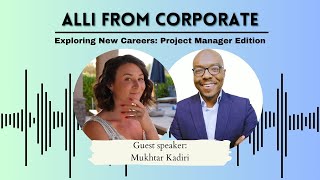
Mukhtar Kadiri, a career coach, explains how to break into project management, even without formal PM experience. Many PMs start as "accidental PMs" by taking on coordination work in other roles. He covers what makes you credible to stakeholders, how salary ranges from $60k to $150k depending on industry and skills, and why defining clear success criteria matters more than perfect planning.
Questions this video answers
June 3, 2024.
$105,000 per year.
$145,000 per year.
$100,000 to $300,000 per year.
Chapters
What's up? And welcome back to another episode of the Ally from Corporate Podcast. I'm your host, Ali, and today we have a very special guest. I always say that, but this one is extra special because we're talking about project management today, which you know is dear, near and clear in my heart. We're having Mokhtar Kadiri as the guest today, and in this episode, Mokhtar and I talk about what it's like, what working in project management, how you can get a job in project management, and our experiences with just the job search, the job itself, the PM career track. So if you are stuck and you're like, what should I do next? And you're thinking about project management, if you've always wondered what's the difference between program and project management, and if you want to know how you can showcase your potential as a PM or just as a job seeker so you can get a job in pm, this is the episode for you. So without further ado, let's get into it. Hello, Mukhtar. Thank you so much for joining the Ally from Corporate Podcast today.
Thank you for having me, Ali. Excited to be here.
Of course. Yeah. So for those of you that have never met or seen Mokhtar before, he is a career coach who specializes in helping people land 100 to $300,000 a year people. PM roles. And by PM is that project manager and program manager?
Yes, yes. Predominantly so project and program manager type roles. And it could also be roles that don't necessarily have the PM abbreviation. So it could be chief of staff, it could be supply chain manager roles, it could be program coordinator. So, you know, within the project program space, so to speak.
Cool. And you and I share a special thing in common. We both used to work in the program management space or the project management office, pmo. So I wanted to tell you a quick little story about how I busted my way into the program management office at my a couple jobs ago. And tell me if this is kind of what. What you think it takes to. To break into a PM role. So my experience was 10 years in the medical device industry as a mechanical engineer. And you and I have talked about this before, that everybody's a project manager, regardless of if you have that title or not. And we can talk about what that means later. But I decided that I didn't want to be an engineer anymore. I wanted to be a project or program manager because I like tracking budgets, I like making timelines, I like updating people above and below how things are progressing. I like reaching goals With a team. So what I did was I found a position that was available within my company and I made a document about it was basically, even though I've never been a project manager, here's all the projects I've managed. And it was just an explanation so that I was helping somebody see me in that light. And I ended up getting the job. And program management turned out to be a really good fit for me. So have you seen somebody do that before? Why do you think that worked?
Yeah, so I think this is the thing with project on program management. I think many of us, if not most of us sort of fell into the role and there's this thing called the accidental Project Manager or the accidental Program Manager. So a lot of people are actually managing projects and programs, but they don't realize it without having the titles. Right. Some of you might know. So basically the definition of a project is something that has a start date and an end date and that has this particular outcome. So it's temporary, it's not repetitive, but it's geared towards a specific outcome. So even planning a vacation is a project, planning a wedding is definitely a project. Right. So having said that, many people have done these type. Types of things. Right. Where it's temporary and it's geared towards a particular outcome. So I think your story is very familiar. Even for me, before I had the official titles, I was managing and leading even multimillion dollar projects and programs. Right. And I think that this is what you would tend to see. And I think that, you know, a lot of people tend to be intimidated, like outsiders, they tend to be intimidated by the title of Project Manager or Program Manager. Even people in the PM space, like maybe they're not a project coordinator, but they are intimidated by the program manager title. And, and one thing I like to say is that, you know, just really look out for program manager titles because one person's project manager is another person's program manager.
Yes.
You know, like in a lot of companies, they don't even have the project Manager title, they just have program manager, 1, 2, 3, and it goes all the way. Right. And if you look at the requirements, you would see that in a lot of cases you would actually meet those requirements. Right. So yeah. So to go back to your question, I think that your story is quite common because many people sort of fall into project and program management.
Yeah. And there's no degree for it in school, there's no concentration. You can get a certification. I think it's called a pmp. Right?
Yeah. Yeah. So the PMP is the most popular, well known certification. But what I've noticed, especially here in Canada is that there are now these degree graduate degree diplomas that have a, you know, that I just geared towards project management. So it's not like I haven't seen the undergraduate degrees where it's like four years doing project and program manager. But I've noticed that there are these maybe one year diplomas that you can do maybe in addition to other things. And a lot of people, you know, tend to have that here in Canada and then they, that's sort of their entry into the Canadian job market.
You know, that's really cool. And I think that that would be a cool series of classes to take as a student because the skills that you learn as a project manager are so transferable to other areas in your life. Like you said, planning a wedding or being a parent and just managing all your kids schedules or even like household duties like dishes and laundry and you know, everything like that. So what do you mean when you say that we're all project managers?
Yeah, because I think that, you know, many of us have, you know, that thing where we have a goal and it's, you know, it's limited in terms of timelines. Right. So you know, there's something even, it could be even getting a certification, even getting a project management certification. You can even consider that a project. Right. Because it's finite and then there is a particular goal. Right. So I think in that case you can consider pretty much all of us project managers. Of course there are degrees. Right. And there's a reason why people get paid lots of money to manage projects. Right. Because there are best practices. There is refining and honing the craft and all of that. And there are situations where, you know, the stakes are really high. In some cases it's life or death, right?
Yes.
So yeah, but you know, I guess it's a spectrum. Right. So you know, like maybe planning something that's very low risk, maybe inconsequential, like a trip to the grocery store or something. Yeah, that could be considered a project. And then on the other end there could be, you know, building, maybe building a bridge or you know, launching a rocket to space with astronauts in it that also consider the project and you know, that's more consequential and high risk.
Yep, exactly. I love that spectrum description. So let's go back to pay. I really believe in salary transparency and I have no shame or embarrassment telling people how much I've made. So I was shocked to see how much more I could make as a program manager than a manufacturing engineer at the same company for a surgical robotics piece of equipment. So when I was an engineer, a manufacturing Engineer with about seven years of experience, I was making 105,000 a year in California. And when I made this special PM document and got that PM role, I was a program manager and I was making $145,000 a year in my first PM role. Nice. And I mean, you help people get jobs between, you know, from 100 to 300,000 a year. What would be the difference between a PM that was making 100 and a PM that was making 300? Let's say same company, maybe same industry, same state. Just so they're comparable.
Yeah. So I think that might be. We can pick that apart. That might be a. It might be a bit difficult to find that range within a particular company. Right. 100 to 300. But I would say so when it comes to entry level PM roles, maybe like project coordinator, so below the level of a project manager. So you can find those below 100, it could be below six figures, right. It's not uncommon. Some might stretch to that 106 figure a limit. But when you now get to the project manager roles, typically many of them will now cross the six figure mark. But when you now start to head into the 200 or even above that. So there are two things. Either you are a people manager, you're managing other project managers or other program managers, or you are an individual contributor that is senior, right. So in some companies you would see maybe like a lead program manager, and then you would see maybe a staff program manager and then a principal program manager. So this sort of, it's sort of similar to some of the levels that they have in engineering, in tech, right? It is, you know, you have senior lead staff and then principal. So principal tends to be like maybe at the VP level. Right. So in some organizations you also have a similar track, right. So that's how you know, when you climb the IC contributor track, you also start to get into some of those high figures. Industry also matters, right. So some industries pay better than others. Another thing that I'll add is also in demand skill sets, right? So for example, now AI is hot. And if you are like somebody with your background, now you are an engineer and then you became a program manager. Like that combination is very, very attractive because you can speak the technical language, you can better lead engineers and you have credibility with the engineers because you can speak their language, right? So if you, if you have that, and I think that that was probably also one of the reasons for that. You know, that jump that you had, you know, because it's justified.
It was a killer combination, the engineering. And they said that they were like, you could lead a team of engineers and they would respect you rather than these project, these program managers that don't know how to talk about the engineering things.
Yes, yes. And that like that credibility is crucial. I think that for a project manager, program manager, like that is the one thing that you have because a lot of times you are leading without authority, right? You are, these people are not reporting to you. And that's one of the very challenging things I think. But also I think many people consider, find it frustrating, right, because you don't have authority over people, but then you need them to do the job to get the project successful. So you have all this responsibility but no authority. But the way you actually bridge that gap, the way you get things done is through your credibility. And a lot of times with credibility, you can even have more authority than somebody with direct authority like you can be. I've seen people that, they don't have anybody reporting to them, but they are more influential than maybe some people in the C suite. Right. But it's because of that credibility. Right. So, you know, going back to your case, I think one of the reasons that, you know, I mean, I was in your company, but I'm guessing one of the reasons why it just made business sense to give you that position and to give you that raise was because you, you already spoke the language of engineers and you know, you could lead them credibly. And also, you know, they probably saw your good communication skills and leadership skills already. So that was a killer combination like you mentioned. Right?
Yeah.
So, yeah. So just going back to my point, when you are, when you are, you can really command high salaries when you are an expert or when you have, you know, particular in demand skill set. So, for example, like cybersecurity now is like a lot of people, a lot of roles in that space are still unfilled. Right. So there's this demand for some. So if you have cybersecurity skills or if you have experience leading cybersecurity projects, so, you know, that's an in demand skill. Another one now could be AI. Right. So I mean, I know there's a lot of buzz around AI, but if you have the actual skills that many of these companies are looking for, then that could, that can be a potential way to really boost your pay.
Yeah, I agree. So I want to go back to something that you Said, or maybe it was last week. You and I were talking about showing potential. Do you think being a program manager and if you want to show your potential to your employer to either get a better job or a raise, do you think program and project managers save the company money or do you think they're making the company money? If you want to, like, showcase your value to a company, are you going to say, like, I'm a project manager and I can make you money because this, this and this, or is it the other way around?
Do they save money or do they.
Make money like the ro. Like the company? If they want to get a good ROI on hiring you, are they going to look at how much money the project manager could potentially save the company?
So are you talking about a project manager that's already in the company and that's making a case for a raise? Is that.
Yeah, let's talk about that scenario.
So I think that project managers, program managers, in as much as the field, is quite specific. The range of projects that we manage are very vast. Right. So, um, you know, you can manage a process improvement project, for example, which is, you know, trying to find efficiency, so. Exactly. In that case, you know, whether you're saving time and all that, all of that translates to saving, saving money, right? It's saving cost. But you can also do projects where you're launching something to market, right? So, you know, maybe you're launching a new product and that happens a lot. So in that case, you are, I guess, you know, making money for the company. So I think it really depends on the initiative that you're leading. But I think you can always justify, you can always justify both. Now, the one thing that's very important, and I think that this is a mistake that we often make until it's time to look for a job. And then we realize, okay, you know, we now start to look back. So one thing that project manager and program managers should do before they venture on anything is that at the beginning, you try to define what success would look like, right?
Yes.
So you might not exactly know, but just going in, you should have an idea of, okay, this is what I'm targeting. So that you're constantly measuring, right? And you are very outcomes oriented. And so that, you know, at the end of the project you can say, okay, this is what I achieved. And the reason why I say that, you know, this is. A lot of times this is missed is because a lot of times not many project managers or program managers have the luxury of starting from the beginning.
I know sometimes they inherit a project in the middle of it, which is tough.
Yeah. Sometimes even worse is that the project started, people thought that they could do it by themselves, and then they realized, oh, crap, we need a project manager, a program manager. So a lot of times that's when you come in. You come in when they really see that they need you. Right. And it's very easy to just forget about metrics. And, you know, it's just like, just stop the pain right now and let's move on. So you are like in this firefighting mode, and then sometimes the outcomes can sort of recede, you know, to, you know, to the background. So. So, yeah, the one thing I would say is like, be very, very outcome. Because whenever. Whenever you start anything, it's almost like, why am I doing this? And what impact is this going to have in your organization? You know, if you can't really answer those questions, then I would really question what you're doing that, you know, try to find the answers and just get alignment with leadership. And also, I feel like if you're able to do that, it just really showcases your maturity as a project leader. Because at the end of the day, you are in there, you are hired to actually make an impact in an organization. And sorry, I know I'm going on a bit of a tangent, but the one point I was going to make is that in many cases you also see situations where people question the value of a project manager. And I think that that comes because people are not necessarily seeing the value that you're bringing. Right. So when you start off anything saying, okay, this is the value that I intend to bring, this is my success criteria, and you're always communicating that. So I think it helps to sort of. It helps to remove that questioning, that constant questioning of what value you bring to the table.
I agree. And I've also heard that be called definition of done, success criteria definition done. And so, you know, I launched my new community this week. Career catalyst on school. One of the first challenges that I gave people was to define their career vision. And that's essentially like you're setting a goal for yourself and maybe there's a deadline in mind, you know, in the next five years, I want to be here, but I think it really helps to have that definition of done or that success criteria, especially like, not only talking about project management, but talking about your goals. Because how do you know when you've reached your goal? If you. If your goal is just to get better at learning German, like, what's the, you know, like what's the metric you're holding yourself, like what's the rubric you're holding yourself to? So yeah, yeah, being a project manager definitely kind of shown it shined a light on that of like you need to know what the definition of done is for the project. And sometimes I would go to leadership and I'd ask them like, hey, is this right? Is this the success criteria? And sometimes leadership would argue and they don't even know what the definition of done is for the project. And so part of being a PM was facilitating these conversations up above and gaining alignment so that clear, a clear set of tasks could trickle down.
Yeah, yeah. And I think that that's one of the most important roles of a pm. You know, like you mentioned facility. If you look at a lot of JDs for program managers and project manager, it's really that cross functional collaboration or stakeholder management. Right. So a lot of times like, you know, people are not on the same page. Like even in meetings people think they're on the same page. But as a project manager, program manager, you have to say no, I, I think I'm hearing two different things here. Or, and, and you know, you have to sort of, you know, clearly state the different sides and, and sort of help, help drive alignment. And it's not easy. It's not, it's not easy because you know, like I mentioned, credibility is also very important. You know, you need to be credible for. And a lot of times you're going to be managing people that are above you in rank. Right. So these are people that can fire you, you know, so, but you need to have their, their, you need to be able to hold them accountable and, and, and also even sometimes challenge them and, and even, you know. Yeah. Hold them to task when it comes to delivering on, on their task or their, their, their deliverables. Right.
Yeah. And for anybody that's listening who's never heard of stakeholder management, first of all, I have a joke for you. Why do vampires make bad project managers? Because they don't want to talk to their stakeholders.
Right.
So okay, for anybody who doesn't know.
I was going to say because, because they suck. You know, because they suck.
That's a good one too. And they all come out at night. I can think of a lot of reasons now. But so for anybody that doesn't know what stakeholder management is, I'll give you a simple example. So let's say you're, you're the project manager for a project that's making a widget and you need Somebody from the quality department on your team. You need somebody from the engineering department on your team. Somebody from the manufacturer, manufacturing department on your team. The leaders of all of those departments have different agendas. The quality department wants you to stay in compliance. The manufacturing department wants you to save money with packaging, you know, and so on and so forth. And so sometimes during a project, you need to go to these heads of these department and ask questions. And sometimes they have conflicting agendas with the other heads of the department. And so that's kind of stakeholder management is keeping everybody aligned, which is not easy. Like. Like you're saying, how do you maintain alignment among people that are above you? That was like the hardest part for me.
Yeah, no, it's definitely not easy. But I think a lot of. A lot of. Yeah. I came on saying, I might sound like a broken record, but I think credibility is really the foundation, and there are ways to increase your credibility. So I like to think of it as it's kind of like an investment. So you sort of are putting deposits into the credibility bank. Right. That will pay off later on. Right. And one of the ways that you can do that is my teacher, he used to say that there's this credibility equation and there are three things that affect credibility. So number one is expertise, knowledge and expertise. So you need to be able to hold your own when you are talking to people in their own areas. Right? So, for example, when you're speaking with engineers, they need to feel like you get them and you can follow along. Right. When you can do that, you know, your credibility goes up. If not, your credibility goes down. Another thing is that you also need to be able to show that you're an expert in your own area. Right. So, yeah, I'm not saying all program managers should be experts, should be technical or all of that, but, you know, for the people that you're dealing with, you need to be able to question, maybe challenge and facilitate, understand, et cetera. But you definitely need to show that you're an expert in your own field of project or program management. Now, I know we said that in a way, everybody is a program project manager, but there are levels, right? Levels, yeah. So you need to be able to not show that you're a glorified, that you are. That you really know your stuff, you know? And when you can show that, when you can demonstrate that, then that increases your credibility. Now, the second part of credibility is just closing the say do gap. I don't know if you heard about the say do gap.
No, tell me about This, I love it already. Is it like showing versus telling?
Yeah, something like that. So if you say you're gonna do something, yeah, you better do it. And it could be as little as, I'm gonna send you that email tomorrow. When you don't send it tomorrow, people will notice. Like, I think a lot of.
That's so funny that you're saying this. I promised somebody a business proposal last Friday and I did not get it to them on Friday, and I'm gonna get it to them probably tomorrow. And that's so funny that you're saying that because shame on me. I know it's like, I never do that, but it felt bad not saying, not doing what I said I was going to do on Friday.
Yeah, yeah. And even on that, like, you know, stuff happens, like, we get busy, but, you know, as long as you just sort of mention that and you're proactive with communicating, like, I know that I was gonna. I knew I said I was gonna do this, but hey, stuff happened. Like, if we can do that, like, that still maintains your credibility and even that might even enhance your credibility because you're keeping to your word, right? Because, you know, and people notice that because unfortunately, it's not common for a lot of people will, oh, yeah, it's not a big deal. I will send it maybe two hours later or tomorrow or something like that.
It is a big deal.
Yeah, but people notice, right? Exactly. So when you keep on breaking trust, like you mentioned, when you keep on closing the gap, then you are breaking trust and it just really harms the credibility. Right. I mean, I know if someone is like, whenever he says, oh, I'll get this done tomorrow, I know, I know not to expect as a project manager, as a program manager, I know not to expect it to be done. Right? So, like, that is like, you know, I know it's not going to be done, and I have to start thinking of, you know, alternatives and risk, you know, so it just adds just another level of cognitive overload. And you are not. You're seen more as a thorn as opposed to, you know, oh, I can trust you and just not worry about you. Right? So. So that's another part of it. And then I think the third part of credibility is just really, how do I put this? Not putting your self interest above the group's self interest. Right. So, you know, because there are some people, like, the way of operating is just cya. Like, you know, whenever we speak about anything, I'm going to put it in email, copy everybody, you know, so if you're always doing stuff like that, you know, people. Yeah. It just comes across like you're just covering your butt, you know, you're just. Yeah. And that doesn't quite breed trust. Right. So you know, or you are, yeah. You're basically just putting your own self interest above the team or the group self interest. I mean, not to say that you shouldn't document things, but you know, when you're always doing that, you're not going to build, you're not going to earn trust. Right. So these are the three components I think that really helps with, with credibility.
I have an example of one way that I put my team back when I was a pm, that I put my team members. Well, being above my own in a mild way. One of the team members was going to present a status update in my meeting that day, but she had an emergency with her child and she messaged me the update and she said, can you please give this update for me, I have to go. And I said, absolutely, no problem. So I covered for her in the meeting. I gave her update, people had questions, I gave them to her later. But that's like one small way that a PM can have their team members back and then in turn they will do good work for you. When you say, can you get this done today or can you give me an update asap? Okay, so before we wrap up, I have one more question for you. Two more questions, but one more PM related question. So I love graphic design. I love making things look beautiful online. But I thought that Ms. Project, Microsoft Project had the ugliest user interface and the ugliest timeline visuals. What was your favorite tool for making good looking timelines? If you have to show them in a presentation.
This podcast is not sponsored by the Ms. Project.
It's not spot. This is not sponsored. It might be sponsored by a different company, but definitely not those.
Yeah, yeah, I'm also the same way as well. I'm very creative. I love to do, you know, like, yeah, creative stuff, graphic design and all of that. Even videos, I do that like myself. But yeah, so I really love beautiful visuals, especially when you're, you're trying to represent project status to a particular audience. Right. Maybe people that are, you know, that are high up. Right. You know, so being able to communicate like in a, in a single slide or just picture what is going on and what's most important. I think that takes skill and I think, you know, it's, it's a very, very important skill to have. So. So yeah, to be honest, it's something that I'm still looking for because I find that, like, for the different tools that I've used, they might be good with one thing, but then they lack, you know, another. So, so, so it's one thing to be, you know, to have the visuals, but it's also, it's also another thing to be able to, when you drill down, to be functional, like, to be able to say, okay, yeah, I have these dependencies. I'll be able to alert somebody when it's almost close to the deadline, you know, to be able to just drill down, like, you know, And I, I haven't quite found a tool that combines both, so I'm still looking. But I, I know that there, there are a lot of tools out there. But I would say that from a Gantt Chart perspective, when you're like looking at things from, you know, for those of you that don't know, but the Gantt chart is when you're looking at timelines, basically from the high level. Right. I found Tom's Planner to be quite helpful. So. Tom's Planner. Yeah, so. And it's easy, like, to configure. It's almost, you know, like you just drag and drop and as you're doing that, it's updating, it's updating the data.
I love this.
Tom Spanner is one. And then I mean, like, you know, no affiliation with tomspana. I'm just, you know, mentioning tools that I've seen. Let's see, there was one other one.
Have you ever used Office timeline Pro, the PowerPoint extension? That was my favorite. Yeah, check it out. Office Timeline Pro. They used to have a free version. They might only have a paid version now. And I feel like it was only $19 a month back when I was using it a couple years ago. But it's a PowerPoint extension and it's like you say it's beautiful visually. There's lots of cool templates with color schemes, but it's not good at managing all of the tasks and subtasks and dependencies and durations. I liked smartsheets also. They were kind of the best combination I found of, like, really tactically and detailed in a good way, but also like beautiful timelines. But yeah, there's a ton of different tools out there. And yeah, there's no one size fits all. Perfect solution. Microsoft Project is not visually appealing, but it is probably one of the best for just tracking every single detail.
Yeah, and I think that that's where, because, yeah, Microsoft is like, you can pretty much, it's like heavy duty, I should say. And then Smartsheet, you know, sort of. I could be wrong, but I seem to remember this from somewhere where it's like, okay, for Microsoft, most people don't use a lot of the features of Microsoft, but a lot of people use a subset. So I think that's Smartsheet sort of created that. I could be wrong, but this is sort of what I remember. So they created that. So it's, it's, you know, smartsheet is very useful for many people. For most people. But then in other areas it might, it might fall short.
Yeah. Yep. Well, I really appreciate you coming on here. I know you're a career coach and you help people land jobs that are very, very well paying jobs in the PM space. Are you taking on clients right now and how can people get in touch with you if they are looking for a PM job?
Yeah. So you can reach out to me on LinkedIn. Thanks for mentioning that. Yes. So right now we are taking clients, but if you go on my profile, you can book a call and then it will take you through our pre screening phase because usually we take clients that are a good fit. So yeah, if you pass that initial fit, if you pass that initial screening, then you'll be able to book a call with me or somebody on my team and then we can have a conversation to see if we are going to be a good match.
Awesome. And I've heard good things and you definitely sound like you've been there, done that. You know how to help a job seeker showcase their value in this crazy job market we're in. I really appreciate you joining us. This was awesome. I think this was really helpful for a lot of listeners who maybe don't know what a project coordinator is or a program manager or what PMO is or stakeholder management. So thank you for coming on here. You are an awesome guest.
Yeah, no, this was fun. Yeah, we should do it again.
We will. Cool. Well, I will talk to you later and thanks everybody for tuning in. Don't forget to like and subscribe and I will see you for the next episode.
More from Alli








Change Your Career Without Leaving Your Job: Podcast Episode with Darcy Eikenberg


