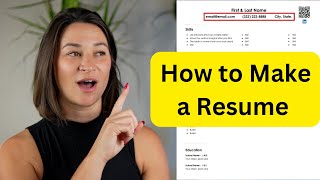
Alison Peck walks through resume formatting for tech jobs: lead with name and contact info, add a LinkedIn QR code, list skills prominently, then 5 bullet points max per role with numbers. Tailor each resume to the job and skip anything that invites bias.
Chapters
Hello and welcome back to my YouTube channel. My name is Alison Peck and you can call me Allie. I make career development advice on social media and today we're going to go over what a resume should look like and what different things you can have on it and you should have on it for us based tech jobs. So let's get into the video. This video should be used if you want to beef up your resume or spiff it up because you're going to be job searching or because you just want to add some new skills that you've gained to to your resume. So let's get into it. All right, over here I have my resume template that I have carefully crafted over the years. I have had help from HR personnel recruiters, hiring managers, other employees, and I have carefully picked out elements of a resume and formatted them in a way that I think conveys the person's skills appropriately. Education, background and experience. So let's get into it. All right, the first thing you see at the top is first and last name. Won't go into that pretty self explanatory. On the next row we've got your email, your phone number and the city and state that you live in. Now what I want to say here is that you don't need to be providing your whole address and I'll tell you why. I see a lot of people putting their full address on their resume and you only really need to put city, state or zip code. And the reason is, unfortunately, some people can have a bias when looking at your resume. And I've heard some horror stories of this happening where a recruiter will look up where you live or what neighborhood you live in or what part of town and they will consciously or unconsciously have a bias for what salary or hourly rate to offer you. I am not condoning this. A lot of companies say they do not have any bias when hiring based on race, gender, ethnicity, location. So what I would advise you to do is they're not going to be sending you anything in the mail unless you get the job. So just put your city and state or zip code. That should be sufficient. All right, the next thing you'll see in my resume on the right is a QR code with a LinkedIn logo right below it. This takes people to my LinkedIn and I put this on my resume because I think it helps me stand out. And also people are starting to look more and more at social media of the job candidate to see if they have drunken college pictures on their social media or maybe they have posted Career development content or content related to their industry. And so I think it's really cool to put a LinkedIn QR code on a resume because it is very forward thinking and everybody is very QR code happy since COVID started and all of the restaurants started having their menus using QR codes. So by now everybody knows how to use a QR code. I think it's pretty cool to have one up here because it makes your resume stand out in a pile of resumes that might look similar to this. So if you want to make a QR code that takes you to your website, a project portfolio, or anything else that you've made that's online, what you do is you go to Google and you search free QR code generator. You enter the URL of the website you want the QR code to take the person to, and then it generates a JPEG or a PNG file, which is an image file. And then you can just copy and paste that on your resume. All right, let's keep going. Next we have the skills section. So I like to put this up at the top because oftentimes people aren't really hiring you for what you did at previous roles. They're hiring you for the skills that you utilized and the skills you gained and the experience that you've gained in those previous roles. So it doesn't matter that you generated reports at your last company. What it matters is that you have the skills to generate reports. So what I like to do is I like to put the skills in an invisible table here. So if you'll notice, the bullet points are lined up perfectly in three columns. I think that looks really clean and nice and organized. And so what I've done here is that I've inserted a table and I've made the borders. I think I clicked no borders. And so it's an invisible table, but it just lines up the columns really nicely. The skills that I would put in here, you can put hard or soft skills. I like a combination of both. Soft skills are how you work, how you deal with people and conflict in the workplace. Examples of soft skills you could put here are leadership, organizational skills, communication, verbal and written skills. And then hard skills are talents that you acquire through practice or usage of those skills. And these are learned skills, for example, Excel or Microsoft Office, or generating reports like we talked about, or high hiring, things like that. So that's the skills section. I think everybody should have a skills section on their resume. Because like it or not, on average, recruiters spend about six to 10 seconds on a resume. That's not every recruiter disclaimer. However, on average there are lots of people that apply to hot jobs. And so if a recruiter has a stack of 50 or 100 or 500 resumes, they're going to be scanning through them pretty quickly. And so what I recommend is that you have the skills section at the top so that if they look at your resume at a glance, they can see what you're good at and they don't have to leaf through a lot of text. All right, let's go onto the relevant experience section. Another disclaimer here. I like to see one page resumes. Now this is a very controversial topic because in the US resumes are pretty standard in in other parts of the world, like for example Europe, some of people use a CV instead of a resume, which stands for curriculum vitae. And I believe that is Latin for the story of your life. And so a CV is often a five page or more document that lists out all of the publications, all of the awards you've ever had, all of the memberships and associations and licenses that you have, books that you've written, talks that you've given or attended, every single job you've ever had. Alternatively, a resume which is used for most US based tech jobs is one page. If you're watching this video and you're thinking, but I have 25 years of experience, how am I supposed to fit that on one page? A good rule of thumb is one page for every 10 years of experience. So if you do have 25 years of experience, you can have a two page resume. However, like I said before, if a recruiter is only looking at your resume for 10 seconds, you think they're going to flip to that second page. Maybe, maybe not. Let's give them the benefit of the doubt and only include the last 15 years of experience on your resume. I think that's a really good rule of thumb. What I like to say is let's not include things from the 1900s on our resume. I know that makes some people feel old when I say that, but you shouldn't feel old. What you should feel is an inclination to provide the recruiter only what they need, only what is relevant for the job you're applying for. I believe that is the last 15 years of experience. The experience you had from 25 or 30 years ago probably isn't relevant. Now. Try to stick to one page by only having the last 15 years of experience on here. Alright, so what should you have with each bullet point section in Your relevant experience. So I have the title of the job, I have the years that I worked there. Now you can put the month and the year, I think if it was less than a year. But what I like to see is just the year. So like 2020 to 2023, for example, or 2005 to 2007, you don't necessarily need to put the month unless you were there for less than a year. And then below that you have company name and the city and state that that was in. All right, for the bullet points, I like to see quantifiable impact statements here. And no more than five bullets per job. So I see a lot of people using 10 bullet points for each job and that will get you a three or four or five page resume really easily. And we don't want to do that. So let's stick to three, four bullet points, five max. If you stayed there for a very long time, but usually if you were at a job for two, three years, four bullet points is good. You should be able to describe exactly what you did at that job in that amount of space. And what that will tell the recruiter or the hiring manager that's looking at your resume is this person has good written and communication skills and they can concisely convey the information they want to with the least amount of words. So what do I mean by add quantifiable impact statements here? Instead of just saying I generated reports for the quality department, for example, what you want to say is I generated five reports per week for the quality department and then say what the impact was. So they were able to present that to the board of whatever. So, so what that will do is instead of you just saying on your resume what you did every day, your daily job duties, which we don't want to do, we want to say what impact we had at the company. And this is going to come in handy later when you ask for a raise or a promotion someday because the manager is going to want to know, what impact did you have at the company? What positive impact did you have? What changes did you make? What money did you help the company make? What money did you help the company save? What, what goals did you help the company reach? So not only can you use that information to ask for a raise or a promotion, that should also be on your resume. All right, so as you can see, I've got a couple different sections for different jobs that I've had here. And if we scroll to the bottom, I've got the education section. Now I get a lot of Questions about what if I got an AA degree? Or what if I went to a trade school? Put whatever education that you have on here that's relevant to the job. That's another point I want to make here. You should have a slightly different version of your resume for every job you apply for. So the skills at the top that we talked about before, I want you to look at the job description for the job you're applying for. And if they list verbal and written communication skills, I want you to have that on your resume. If you're good at that, if that is a skill that you have, if you're applying for a plumbing job and they require a license, put that on your resume. If you're applying for a teaching job, don't put your plumbing license on that resume. See what I'm saying? So again, we want to convey the most amount of relevant information for the job we're applying for using the least amount of words, because we only have potentially 10 seconds for the recruiter to look at this. So education, you can put your school name, what major you were, what degree you got a master's, a Bachelor's, a PhD, whatever it is, and then you have the option to put the year that you graduated, you don't have to. I would say that unfortunately there is age bias out there. And so if you are applying for jobs and you have over 25 years of wonderful experience, maybe you got your degree in the 1980s or the 1990s or the 1970s, you don't have to put the year on there. And what that will do is it will help a recruiter see you through an unbiased lens, not knowing that you might be five years away from retirement. Now, again, I do not condone bias such as bias against age, sexual orientation, gender, ethnicity, etc. However, you have to know that there are recruiters out there, unfortunately, that do have biases like that. And so we don't want to give them ammunition. We don't want to equip them with information that could lead them to be biased. And if you have your LinkedIn QR code at the top, they can still go to your LinkedIn and look at when you graduated, but you don't necessarily need to put it on your resume. One more thing I want to mention is consistency throughout your whole resume. Notice that I have a period at the end of the third bullet point in the relevant experience section. If you're going to have a period at the end of any of your sentences on your resume, do it for all of them. I don't want to see sentences that don't have a period and then a sentence that does have a period. Either have a period at the end or don't. All right, that concludes the resume lesson for today. I hope you found this useful. And again, it depends on what job you're applying to, what industry you're in. Comment below if you have any questions and I'll see you in the next video.
More from Alli








Change Your Career Without Leaving Your Job: Podcast Episode with Darcy Eikenberg


