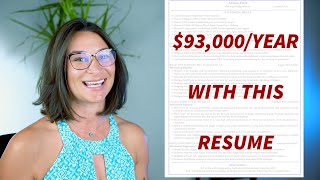
Alli Peck explains how her "golden" one-page resume helped her land a $93,000/year manufacturing engineering job in 2016. She walks through concrete resume choices (tight margins, city/state only, technical skills at top, verb tense conventions, periods at line ends, month+year dates, justified alignment, education at bottom) and stresses tailoring each resume to a job description. She also describes the job offer (base pay $93,000; semi-monthly $3,875; 15% bonus ≈ $13,950; 75 RSUs; 75 stock options), timeline (recruiter reached out June; offer August 2016), and outcomes (stayed 4+ years; RSUs grew to ~$300,000).
Questions this video answers
$93,000 annually.
$3,875 semi-monthly.
15% bonus, equating to $13,950 per year.
75 restricted stock units (RSUs).
75 stock options.
Chapters
In this video, I'm going to tell you how I landed a $93,000 a year job with my golden resume. First, I want to talk about the importance of having a strong resume in finding a job and your job search in general. Your resume is essentially your skills and qualifications and background and experience and education all wrapped into one single document. Now, I know what you might be thinking, but there's so much more to me. What about my personality? What about my goals? What about my work ethic? What that can live on a LinkedIn and people can find out about that in an interview. But a resume is what's going to get you in the door or get people to look at your LinkedIn. Also, the importance of having a resume lies in the fact that if you are able to sum up a lot of things about you in one page that says something about you, here's what it says. You're a good communicator. You have good written skills. You're able to follow the rules and conform to the system we've created of having resumes when you're job searching and, and you're prepared. Let's back up a little bit and I'm going to tell you a little bit about where I was when I was job searching and how I came about sending my resume to the hiring manager for the job that I got. I was working at a company and they let us know that they were going to be shutting their doors. And that freaked all of us out. And I thought, oh my God, I need to start job searching immediately. You know that that is never a good feeling to have because it makes you desperate. It makes you have a deadline for finding a new job because we all need to pay our bills, we all have mortgages, or we have rent to pay. So I immediately thought, oh my God, I need to start job searching. And so I did. Now, the funny thing was my manager at the time said, I want to be a source of support for you in your job search. We are shutting our doors in the next few months. It's really important that you find a new job before we shut our doors so that you don't have a gap in your employment or a gap in your paychecks. Let me know how I can help you. I and I said, there's one company that I've always wanted to work for that I have applied for almost every year since I graduated college. Now, I graduated in 2013, this was mid 2016. So I had applied for this company at least three times. And he said, what company, is it? And I told him. So he said, oh, my gosh, I have a friend who works there and I can introduce you and maybe he can help you get a foot in the door or at least get a phone screen from a recruiter. And I said, thank you so much. So he made the introduction. I didn't hear back from the guy, but about a week after that, I got a message on LinkedIn from a hiring manager hiring a manufacturing engineer, which is what I was doing at the time. And he said, are you interested in applying for this role? I see you have the experience we're looking for on your LinkedIn. Let me know. Send me your resume. And I said yes. So I sent him my resume. We lined up an interview. The funny part is I went back to my manager at the time and I said, your friend came through. He somehow got me an interview. And he said, my friend hasn't even gotten your email yet. He's out of town. And I said, are you kidding me? So this was just by chance. So that was a little bit of magic. And I loved this job search process. It was pretty awesome. So I sent the guy my resume. I'm going to show you right now what is on the resume that I sent him. Now, the first thing I want you to notice about this resume is that the vertical and horizontal margins are very small. I don't recommend them being anything less than about a half inch. I'm not sure what I have here, but it's very small. And the way you can do that is you go to View in Microsoft Word and I think you click on rulers or guides and you can see the rulers at the top and you can just drag them a little bit to make the text go a little bit further towards the edges of the page both ways. That allows me to have a lot of information on one page without it overflowing to two pages. The next thing I want you to notice is that I do not have my full address. You guys know I've talked about this before in my resume videos. People are creepy. I don't want people to know where I live. And they only need a city and state, maybe a zip code to make you eligible for any role. So don't put your full address on a resume. The next thing I want you to notice here is I have technical skills at the top. Now, no matter what industry you work in, if you're a project manager, if you work in tech, if you're a teacher, if you're a construction worker, you have skills, you have Technical skills that are required for jobs that you apply to. Now, oftentimes job descriptions will list out the technical skills that are required for the job, which makes building resumes a little bit easier because then you can say, ah, I've got those skills. Let me put them on my resume so I look like a great fit for the role, which I would be. Now. This experience that I had in 2016, they reached out to me and sent me the job description. I looked at the skills required, added them to my resume because I had those skills, removed the ones from a previous role that were not relevant, and I sent him this resume. So the technical skills here are in different categories. You'll see I have some computer skills in here, I have some of the machining skills in here. I have some project management skills in here. I have some soft skills in here. I like to see a combination of both hard skills and soft skills on resumes. But really, it's whatever the job requires. So make sure you see a job description before you send somebody your resume. All right, next, I've got professional experience, so let's break this down a little bit. The first thing I want you to notice is that all of the verbs, the action words in my current role, end in ing, because I am currently doing them. Assisting, designing, creating. And now I want you to notice the verbs in all of my past experience end in the past tense of a verb, ed. I actually had two roles at the time because I was consulting. So look at the third job experience section. Worked, collaborated, skilled in. So that's really important for verbs that you have, your current role has, I think it's called the gerund tense. You're ending in ing because you're still doing those ve. And then anything before you end in ed, because you did those verbs in the past, you'll also notice very small, nitpicky detail. Every single sentence on my resume ends with a period. You will not find a sentence on here that does not end in a period. This is such a small detail that it shows consistency. And if you screw up with this meaning, if you have some that end in a period and some that don't, a recruiter might notice that and think, ah, they don't have attention to detail or they lack consistency, or they work in a rush and they didn't look this over twice before they sent it to me. Next thing I want you to notice, which is also a very small detail, but it's part of what makes this a golden resume. I do not say the day of the Month, which I started working at all these companies. I have the month and the year. Now, what I'm doing here essentially is I'm conveying the most amount of information possible with the least amount of characters. When a hiring manager or a recruiter looks at your resume, we don't want them to be fatigued or tired out or exhausted from the massive amounts of text you have on your resume. We want them to be able to pick out dates, skills, years, you know, titles, numbers, quantities, numbers of dollars you made for the company, things like that. They're going to skim your resume. Hardly anybody reads a resume line by line by line by line. So we don't want to exhaust them with too many words, too many characters. Now, another thing I want you to notice about this golden resume is the skills I have listed up at the top. I have incorporated them into almost every line item. Down below. A lot of people can say they have skills, that's easy, that's free, but can you put them into a sentence? I used this skill to make this impact. That's what is my entire experience section. And you should do that too. Another thing I love to do with my resume is I like to use justified alignment. Now, what that means is if you'll notice some of these lines go all the way to the end, and I think that looks nicer instead of being left justified. You can do this using the text formatting tools at the top of the ribbon in your Microsoft Word document. Lastly, what I want you to notice on this golden resume is I have my education at the bottom. I want you to take note. I am not listing a bunch of certifications or awards or licenses or publications that are not relevant to this job. I think I have probably one certification on here and it's at the top and it's relevant for the role. It's okay that you have lots of licenses, awards, publications, and certifications, but if they're not listed as required or nice to have in the job description, do not include them on your resume. Only list what is required for the job. Again, we don't want to fatigue or exhaust the reader with things that they don't need to be reading that are irrelevant. It's called relevant experience for a reason. Now, I'm going to ask you a question. When the hiring manager initially asked me to apply for the role and he sent me the job description, I told you before that I looked at the job description, picked out which of the skills that I had put them on my resume. Do you think that I would do it differently for a different job description. The answer is yes. You should have a slightly different version of your resume every job you apply for. Yes, this is a ton of work, but it gets easier every time you do it because it becomes second knowledge. You look at the job description, you say, okay, I have these skills, Great. I'm going to pop them in my resume. It takes maybe five minutes to do that, but it really makes a huge difference because then the recruiter or the hiring manager and they're looking at your resume through certain lenses, the lenses of the job they're hiring for, they look at your resume through those lenses and they see, ah, she's very qualified. Resume matches the job description very closely. So that's key here. You should know the lenses that your hiring manager or recruiter are going to be looking at your resume through and tailor your resume to that job description. I cannot emphasize that enough. I feel like I sound like a broken record, but do it, trust me. Now let's talk about some common mistakes that I see on a lot of resumes. Something I like to do is I like to give a resume to friends and family and I'll say, I'll give anybody 20 bucks so they can find a spelling or a grammar mistake. Hopefully nobody can find one, but if they do, it's well worth the money. And people are incentivized to read line by line because they want the 20 bucks. Try it. It's a fun little game to play with friends and family. Another mistake I see on resume, and some people might not consider this mistake, but I do, is having a second page with only a little bit of text. If you are going to have a second page and it's definitely okay to do so on a resume, if you have over 10 years of experience, it's important that it's a full two pages. You don't want to have one and a quarter or one and a half. It just looks messy and it looks like you could have rearranged some things so that it could have fit on one page. Another mistake that I see people making on resumes is that they just describe their daily responsibilities that they had at previous roles. But what's really important to do is you can describe those responsibilities and in the same sentence mention the impact that those things had on the company's goals or the company's mission as a whole. You really want a recruiter or a hiring manager to be looking at your resume and and being able to taste the impact that you had at a previous company, the goals you helped the company reach, the impact you had at the company, the money you helped the company make, the money you helped the company save, changes you helped implement at a company, such and such things like that. Another mistake I see people making on Resumes is using three letter acronyms or TLA's that are not common industry knowledge. So every single acronym that you saw on the resume that I just showed the person that is viewing it, the jobs that I would be applying for, they know exactly what V and V stands for. Verification and Validation. They know exactly what FDA stands for, Food and Drug Administration. They know exactly what an ECO is, Engineering Change Order or an NCR Non Conformance Report. So whatever industry jargon is, make sure that people know what those acronyms are. And if they don't, spell it out, makes your resume a bit longer, but it doesn't leave people going, what does that stand for? Now let's talk about the fun part. The actual job offer that I received. This is a copy of the job offer I received in August of 2016. The recruiter originally reached out to me in the beginning of June. So June, July, August, this took about two and a half, three months to actually get a job offer. Be patient. During job searching and interviewing, they probably had to interview multiple candidates. They probably had to have multiple meetings with the interview panel to say, what did you think about this person? What did you think about that person? They probably, their hiring manager probably had to meet with HR to say, okay, what are we going to pay them? How many stocks are we going to give them? How many stock options are we going to give them? How many restricted stock units are we going to give them? What benefits, what paid time off, what's the title going to be? So that is all here in the job offer. And then we're going to go over exactly what's in this. So like it says $93,000 annually. And they even broke it down for the state that I was in California, crazy taxes. They even broke down what the semi monthly pay would be, which is $3,875. They also mentioned that I would get a 15% bonus every year, which equates to $13,950. Now you should know that in California, whatever state you're in, California, I think the taxes on a bonus are about 50%. So when I see that I just cut that number in half. They're also saying in the offer letter that they're granting me 75 RSUs restricted stock units. And they vest over a certain amount of period of time. This is what people call golden handcuffs. They want me to stay for at least four years, so they're giving me a lot of money and a quarter of it vests each year. I did end up staying at this company for over four years and I used all of that stock, which was about $300,000, to buy multiple houses. If you can, I highly recommend you get a job with a company that is a publicly traded company. Stock is awesome. They also grant me 75 shares of stock options which also have a vesting period. Stock options are slightly different than restricted stock units. If you're curious about what the difference is and how you can leverage those to maximize your wealth, let me know in the comments. I'd be happy to do another video talking about this. So that's it for this video. I hope you learned something. This was the resume that I used to land a job that paid $93,000 a year plus lots and lots of benefits, stock options and bonuses. And you deserve a job like that too. If you've been job searching, drop a comment. Let me know how long have you been job searching? Have you ever heard somebody say that you should look at the job description and take elements of and pop them into your resume? I'm very curious. If you want lots more resume tips and job searching tips, follow me on my social media channels including LinkedIn, Facebook, Instagram and TikTok. There's lots of great content there and I also do interview prep and resume reviews. So let me know if you are having difficulty job searching. You shouldn't have to do it alone. I have always had help when job searching. Now I'm happy to say that I can give help to you. So let me know what assistance you need and I can be there for you. Don't forget to like and subscribe and I will see you in the next video.
More from Alli








Change Your Career Without Leaving Your Job: Podcast Episode with Darcy Eikenberg


