Supply Chain: Job talk with Alli From Corporate & Abhi Kulkarni
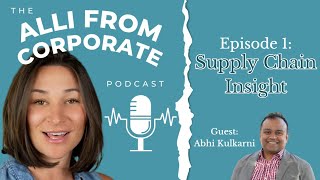
Abhi Kulkarni, a supply-chain leader in medical devices, walks through his career from industrial engineering co-ops at Delphi and Toyota to global supply-chain roles. He covers the core functions (plan, source, make, deliver, return), how AI handles repetitive tasks like PO creation, and the risks that keep supply chains up at night: geopolitical shifts, capacity, cybersecurity, climate. His advice: curiosity, communication, collaboration, and financial literacy.
Chapters
It is so good to see you. Thank you for joining me here in beautiful sunny California, San Jose. We have a very special guest today, my good friend and former colleague ABHI Kulkarni, who is a leader in global supply chain for a medical technology company. Thank you so much for joining. I'm very happy that you're here with us today.
Thank you. Alison, excited to be here and congratulations on this podcast. Making it to California.
Yes, absolutely. Yes. The drive was long from Vegas, but we always love coming back to California, especially on beautiful days like this. So I'm glad you could be here with us today. I would love to ask you questions. I've actually gotten questions from my social media followers previously before today on what you do, how you got into this line of work, any advice you have for them, any advice you have for people in today's certain economic times. So that's what I would love to talk to you about today. So let's start with a little bit about your current situation. So you work for a medical technology company in California. Tell me a little bit about what you do and what you love most about it.
So if I can share my experience over the past five years, help launch products for a medical device company here in Sunnyvale, California and always been passionate about where am I impacting, especially in the human healthcare sector and when I combine my skill set or my passion. This role came about to another good friend of mine who referred me here. But more than anything, peeling back a little bit, you asked me about here and how did I end up here. One of the things I remember 18, 20 years ago, I had no clue that I'm doing supply chain. Most of us fall into it by default or we navigate through certain things. Like when I say some things by education. I have industrial engineering as my degree and also grad school. I went to University of Detroit. It was definitely not focused on global supply chain. It was more business oriented. I ended up in global supply chain when I had a chance to do my co op at Delphi Automotive System. Nothing remote to medical device. That's also because I worked in a year at Toyota in Bengaluru, India. That's my hometown. And when I ended up doing the co op at Delphi, I was allocated to the Global Supply Management Group. If you think about automotive space, I was doing planning in Toyota and then I came to Delphi and it was more of purchasing and the cost measures that they had, especially when they were about to file for bankruptcy, which I didn't know at that point in time.
Right.
And they needed all hands on deck to negotiate contracts, to execute not only purchase orders but also work through supply management issues.
So it was almost on accident.
Yes.
You fell into it.
I fell into it. I also enjoyed the analytical aspect which we talk about spend analysis and how the suppliers perform. And again all done in little bit older version of SAP and more. We still do an Excel analysis. And then the second aspect was going out and meeting new suppliers, understanding the technology and actually walking through the plan and what we do.
And isn't the economics of supply chain so interesting? It takes a million things to make one thing and you have to make sure this supplier is doing their job and this supplier is doing their job and it takes a village to make one thing. It's amazing.
Yes, indeed. If you, if you, if I have to explain to my fifth grader who's my inner child, think, think about making a Lego or is playing with Lego. We have to plan for the resin that makes it, the mold that makes it and then you have to source the resin. You know, we think about plan source and then making it. After you plan source you make it and it becomes a Lego piece. And then we talk about delivering to the retail and each each wholesale or retail companies. So it's plan, source, make and then deliver. In some cases we'll have to returns and we talk about service delivery. So in a NutShell, it's a five word still score model widely used in the industry. Plan, source, make, deliver, return or replace.
So it's a stick cycle.
It is a virtuous cycle and you pick what you're really passionate about if you want to navigate to the carrier. I realized it's been more than 15, 16 plus years for me is if you're passionate in any one of these, start off a career in any one of those plan, source, make, deliver domains. Go deep, as deep as possible and be become the expert. Don't worry about rest of the supply chain yet, but see how you can connect the dots. As you start growing your career, you can always pivot. I pivoted from planning to sourcing and I support all the make and work with the service planning team, work with the delivery teams, warehouse, distribution centers. One of the things I enjoy most, doesn't matter what industry I haven't been, it is connecting the dots with multifunctional cross functional teams.
I like that too. I like working with other people because then you have suddenly a new perspective and you like. If I have a conversation with somebody from a quality department, suddenly I'm seeing the project through the lens of the quality regulations that we have to abide by. And I think, oh, I didn't even think of that. Or oh, I'm so glad this person's on the team because they're looking out for the quality things, as am I. But they're the experts, so I like that too. The cross functionality of different projects because no one person can do it on their own. You can't do global supply chain on your own. I'm sure it takes one, all of those suppliers and then two, you said plan, source, source, make, make, deliver and then return. Yeah, yeah. So I mean that must take a huge team. So do you lead teams at work?
Correct? I do lead teams at work. Both cross functional and direct teams, both in North America and Europe at this point in time. Wow. It's exciting. Sometimes it's also exhausting because you're getting up early or taking late night calls. But it is fulfilling for the day. Here's what I question myself. Even end of the week, every question I ask, I make a difference. Everything that we built or made a decision today, is it helping a procedure or is it helping a patient? Another day did we deliver. That's what keeps me going.
That is exactly what kept me going to when I was a program manager for the exact same company.
Yeah.
I loved when they had patients that had received the medical devices or interactive doctors that had used the medical devices in practice. They actually had them come on stage and talk to us in our all hands meeting. And they said, you are making a difference. You are saving lives. Maybe not directly, but indirectly. You are close to the customer and close to the patient. That always warmed my heart so much. And if I was ever having a rough day or a week or a rough month at work, I always looked at these people that maybe had a lower quality of life because of a disease or an illness or cancer or whatever their ailment was. And I always thought, you know what, I'm doing this for them. And it makes me feel so good that I can help the world in that way. And I always found that so motivating, so awesome. Yeah. Glad to hear that you felt the same way.
One of the things that I have always driven like, you know, what's my purpose? As much as you have worked across multiple industries, I've worked in automotive, biotech, earthworm to high tech and then now med device. And you know, who are truly delivering solutions. Not just, hey, this disease, you take care of this. But going back to even diagnose it early, let's prevent it that makes a huge difference. There have been multiple instances where my family members have received care and also devices like a stent that you've worked on. No, my colleagues have worked on.
Really?
Yes.
That's really close to home. And you'd probably trust. We meet all these colleagues and these peers and coworkers and you think you worked on that project. And my aunt is having that surgery tomorrow. I trust your abilities and I trust that my aunt is in good hands or my family members in good hands. Because you worked on that.
Correct.
That's a beauty in networking at work in such a small industry like Med Device.
It is.
I love that. Yeah. And I've met a lot of people that have had different procedures from the things that you and I have worked on. And it's so cool meeting them because they say, where do you work? And I tell them and they say, oh, my gosh, I had a procedure with that. I'm like, oh, how did it go? Have you ever met anybody that has said that?
Yes, Actually, one of my mentoring guide. I didn't even know this company existed. This is about 14 years ago. He had to go to an emergency procedure and he said it was outpatient. This is in Minnesota. I was working for other Med Device company back then, and he told me when both came to California, he's working for a different company. And he said, I was a patient and they used this device. That's a platform. I didn't even know they had the device back in Minnesota. Back then.
Wow.
Yeah. We lived in such a small world that you don't think or reflect. This is what we do. And then end up coming to the Bay Area. Here's a company that's operated in one of our Metroid and feels good to go again. Damn. That's the same shake.
That's so great. I love Med Device for that reason. Yeah. Had the opportunity. When I was studying engineering at Cal Poly, I had the opportunity to do aerospace engineering or civil, and I thought, you know, do I want to build airplanes or bridges? Probably not. And then I learned about Med Device and biomedical engineering, and I thought, that sounds so cool.
Yeah.
And I just love the human body aspect of it, because a bridge, you know, it's not supposed to move that much. A plane isn't supposed to move that much. I mean, when it's in the air. But like Med Device, it integrates with the human body, which is changing and adapting every single day. And so you have to build something robust enough that can integrate and interact with such a dynamic environment. I think it's so cool. Thank you.
Yeah. And I had one more question on the current economic conditions.
Yeah, I'm curious.
Yeah. Yes, I'll answer to the best of my ability. I'm the Fed chairman. Or not yet. Not yet. Yeah. Or a financial advisor. But I keep listening to a couple of podcasts that helped me to stay up to speed. One is Financial Times and then of course some snippets from Wall street that help me understand what's going on at the macroeconomic level. Of course, everybody knows there is high interest rate. Bay Area has one of the highest cost of living. What has made me more aware as I'm growing as a parent and as a employee and also as a person. It's your net cash flow that matters a lot. So we can earn as much as you want. How much? Everyone. But you need to really look at what's the cost, what's the outgoing expense. If you're able to control that aspect, you're good to go back. The economic conditions every 10 years. We have seen the cycle. Ten years ago we had the recession. Now we are actually coming back not from a recession, but post pandemic economy, which is different.
It's weird and different.
Yeah, way different. Where we have now returned to office management. Certain tech companies and some companies are still remote. How do we party balance? Nobody knows. Absolutely nobody has any answer. No. We need to be able to react or adapt. So to me it's all about adapting yourself and how will you adapt to your specific condition? Because you may be a person working in a restaurant. Restaurant. There is no way there can be a remote job. But if you're a tech worker who's able to code both at home or at work, you still need to show up at work. According to certain folks, there is more interaction, more brainstorming that happens. And in my world, what I have experience is especially if you're launching new products. But synergy that you work with engineers, dealers and working with suppliers on the site, it's invaluable that in person interaction while you're developing a physical product or MIDI OS product can do it in the port. It's not possible to launch product if you don't interact with your engineers early in the process.
A physical product.
A physical product.
I would tend to agree with you. I'm a huge fan of remote work and I got into remote work in December of 2019, so three months before we all started working from home. Luckily, and I was an engineer before, I would not have been able to go remote But I'm a big fan of remote work because it allows for the individual's flexibility. I don't know if it's the best thing for companies, and I've never said that on the record before, but you're absolutely right. When you're building a physical product, you need to see it and look at it and see, oh, there's a scratch. I need to take this to the material review board or whatever. But hardware, it's way more tough. And I think if you're selling a service or maybe software or making an app or a website, sure, remote work works. But I would have to agree with you that for hardware it's really tough.
Absolutely. Yeah. I keep getting asked a question from my 10 year old or 5th grader. What is supply chain? How do you explain that to 5th grader?
How do you explain that? I mean, do you ever take them to the grocery store? I would probably explain with food. Yeah, yeah. So there's stickers on avocados like made, grown in Mexico. So you can talk, you. Maybe that's how I would do it. I would show them. Okay, this tomato is not from here. Yes, you've seen tomatoes grow in the garden, but this tomato is from a different country. And remember, we've gone to a different country. Yeah, that's how I would explain it. So how do you do it?
One of the funniest examples I have is where does. Where do you get low? It's Costco was the answer when you used to.
Cute.
Yeah. And then we went to a farmland and he saw how they would extract dairy farm and where the milk comes from, like a cow and that gets bottled, pasteurized, then pasteurized bought food and then comes into source. So simple terms. So again you have to go through that cycle from the source. Where do you source it?
Yep. So speaking of source, back when cryptocurrency was. And stay with me, back when cryptocurrency was the hottest topic, I heard a lot about how companies wanted to put supply chain on the blockchain just to track it and make sure that there were good ethical practices, sustainable practices, traceability. Have you seen that happening at all and whatever happens with that?
Yeah, good question. I always wonder when I looked at Gartner's hyper Hype cycle that goes on every one year and sometimes we see we are here there with this cycle, the cryptocurrency, it's fantastic tool to use what we have not seen as actual application in the cloud, source to make what we have seen is in the delivery aspect in the distribution logistics of certain high value goods and not necessarily in the Mac device in art form. Right. People are selling the art piece. And then how do you authenticate this is the actual authentic person or artist who's selling it and they are the one who gets paid. That's a real live tactical application. I may be limited in my knowledge of cryptocurrency and how it gets, you know, monetized to the point where it becomes the standard gold currency. Right. But it's not there yet because adoption and your understanding of cryptocurrency right now is still limited to only certain sectors.
And I think it's probably that you ask to adopt it for it to work. Kind of like self driving. You drive a Tesla. I used to drive a Tesla and I used to think, how are they going to have self driving be on the roads if only some cars can do self driving. It almost is like they have to flip a switch where all of a sudden every car is self driving. That's the only way it would work. And maybe it's the same with blockchain. If everything was on blockchain suddenly, maybe it would all work. But yeah, you bring up a good point that it's probably not. Yeah, I don't know how you can do the planning part on blockchain.
We Turn all the ERPs to Blockchain Convert all those algorithms, all the manual process that we do today feed into that. But again, one of the things I found is blockchain. How do we look at blockchain as digital currency or digital layer that sits on top of everything is a tune to machine interface. We haven't yet cracked the core, at least in my purview of what I've read and experienced so far.
Speaking of machine, AI is the hottest topic right now. Have you seen any uses of AI or machine learning in supply chain? And what do you see as the future, even in the next six months or year for artificial intelligence with global.
Supply chain, it's widely used and it's really cool to use AI and everything. Now in the sourcing and procurement world, what's come down to is what's the most repeatable process? Can it be done by two systems that interact?
Okay.
It can be as simple as cutting a purchase order.
Okay.
On the indirect side, when I say indirect, the material that is not used to make the product.
Okay.
When you do that indirect side, it's easier because they know they want a service purchase or received. They know the parameters. There's a buyer, there's a seller. There's a beat up on price and then all you have to do is push a button. I'm simplifying headquarters. And same thing with contract management too. But there is negotiation that happens before we upload a contract. Smart contract as they call it in some parts of the world. I've seen some use cases where the smart contracts are used. Okay, I'm not sure we call it artificial intelligence, but the machine reading code of an old contract, uploading all the electronic data, we call it the metadata to be able to extract when the contract is expiring. It triggers an action to the buyer or the company whether to renew or renew the terms.
That is so cool. I'm really glad that you're telling me that that's being implemented because I hate doing purchase orders. Ariva, that was the. I think it's Ariva. That was the worst part of my job. I hated working in SAP too. I love product, but it just, I mean some of that stuff was not intuitive. And so I love that AI is being used for some of these more repetitive tasks that don't really require human interaction like negotiating does. Like you're saying. Yeah, but yeah, purchase orders, invoicing. Yeah, I think that that's great. So do you use AI at work?
We use some version of it. Not a full fledged version. It takes a long time to adopt. Again, we always think about technology wise. First it will all be used in military or space research, then it'll come to aerospace, then it'll go to automotive, then automotive and high tech or semiconductor world. Then rest of the industries follow. I would say that this is how I've been seeing the trend over the past several, at least two decades. Makes sense in my career. And then there's medical technology. There is certain technology in med device where we're using chips or nodes that are still built in the 90s technology.
But if med devices are one of the last sectors to get this new technology, we know that it's safe because lives are at stake and we're holding the human heart in our hands, literally and metaphorically. So I think it makes sense that these new inventions and technologies would take their time, take a longer time getting to medical technology.
Another thing I have seen in planning slowly we are using certain algorithms which we know if you plan, you put a limit. Example, I don't want to buy more than $10 million. Here's my limit. And they know the simple calculation. This is so many. I have $5 million on hand and I only need to buy Phi like 10 -5 is 5. So you go buy 5, you can put that algorithm in place in certain ERPs. It'll do it for you because you already have the supplier who will supply and you know where to ship it.
That's nice. So then it's less for you to remember. Yeah, it's something that triggers something automatically and then you can free your mind to think about other things. Correct.
And then take that off and those simple calculation that can be applied. Same thing goes to how I was observant on distribution centers and how they optimize inventory levels. We have the ABC analysis, we have complex economic order quantity that can be fed in. But the point is when you have a mid device or any physical product based company, they have to always worry or they have to be very cautious about what's the inventory level at all distribution center. They can't have multimillion dollars sitting there without throwing. So based on how slow the goods or physical product moves, they can automate. That will make it a trigger point for people to buy less or buy more. And even they have to think about excess and obsolete portion of the inventory. Because if it's obsolete, how do you do it? It's in a loss to the company.
I see. Okay. So this is obviously a skill that somebody needed to have before this was able to be automated.
Yes.
So you've also mentioned ERP is that enterprise resource planning. Okay. Resources as in people or material?
Both.
Okay.
And the machine.
And the machine. So tell me a little bit switching gears here. Tell me a little bit more about the skills required for supply chain. Maybe some that you learned at the very beginning that were absolutely necessary and then some stranger ones that you've learned along the way that have helped.
One of the biggest things an asset doesn't matter what part of supply chain you're be curious. The first C and the second C is communicate. Communication is nothing but listening and talking back or understanding what's being asked of you. Third thing, collaboration. Again, as a supply chain individual you need to know how to connect the dots or where are you, are you at the dot and how do you drive solution but also finding unique problems that you can solve. That's such a key aspect. But if you're starting out, be very curious. If it's plan source like deliver or return service, go as deep as possible. Go not 1, 2 but 3, 4 layers. One very good example in main device or in automotive. You want to know how am I purchasing a specific nut that goes into fixing a hardware or a screen panel. Now this go by a Hexagonal mat from Home Depot. But would you understand what the material lay off, where is it actually coming from? Where do they actually machine it? What machine's being used? How much time is it being used to make it? You can go as deep as possible. Then can the machine wear 5,000 today? Can they make it 10,000? Then it's capacity questions. Then going back to the material. Why only that material? Go ask and talk to the engineer. Why did we use this specific material, stainless steel versus an aluminum part. Then you can go even deeper. Aluminum. Now we're just looking at where is the aluminum ore found. There are only a few sources. You have to go back to the source, which is you mine bauxite. Then you get to the aluminum pure form, convert it.
So this is really deep. You could go.
Yes.
These are rabbit holes. You could go down.
Yes.
Okay, so the be curious you're talking about is ask questions and find out as much as you can about the material, every aspect of it. And then also probably with all of those, there's something that could go wrong with each of those. With the material, with the supplier, with the timing, the price.
Yes.
The availability, the quantities. So do you also do risk management?
Absolutely.
Tell me a little bit about that.
We call it global supply chain risk management. We have all aspects. When we look at our source or supplier, we look at from a risk standpoint, there are five to seven elements, depending on which industry. So let's stick to the example of you're buying a specific hexagonal nut.
Okay.
Risk would be the supplier in a geopolitical conflict place.
Take that into account too.
Yes, that's just one of it.
Okay. America has a lot of drama. So that's probably a complicated part of this.
Yeah.
Okay.
Take one example. If it's close to the Ukrainian border trade live example, that is a risk. Then the next question is how does a person in local supply chain mitigate that? What's the action plan? It can be a secondary source outside of the conflict, or even closer to the manufacturing plan. The other aspect of risk is the supplier does not have capacity. Right. The person and supplier's financial health rating. And you also think about suppliers, cyber security, cyber risk. And personally, this is something which we never grew up in is reputation.
I like it because of reputation.
Yeah. Another risk is reputation. So like for example, Nike or the shoemaking brand took a hit when folks found out this is part of the ESG risk ethical social is they use child labor from somewhere in Southeast Asia to make the certain footwear.
So if People find out something bad about one of your suppliers, it makes your company look bad too.
Yeah. And that is now part of a core tenant of any company you pick up out there. They have to follow this. And these are the risks that you think about when you source anything.
Yeah. You know what another risk is that I learned when we were working together is climate risk. Because sometimes a company's warehouse can be wiped out from a hurricane or a fire.
Yeah.
So you have to have multiple suppliers that can give you the same part in case there's a freak accident like that. That's expensive to keep backups of backups just. And in case something happens.
Yes. Now, this new concept called digital twin, where if any reason, everything is in digital world right now, for any reason, ERP shut down, there is a blackout. Now, talking about Die Hard Part four, what do you do? Well, then we have cloud backup. Not we people. How Mitigations in place, especially big companies, to have the digital manufacturing twin, where all the nova, all the algorithms are already set in place, we can duplicate as easily as it was before.
Ah. But that would have to have major cybersecurity.
Yes.
Wow. But the risk, the gain is probably worth the risk because it's almost like insurance. If you need it, it's there.
Yeah, absolutely. And think about this. You come to Bay Area, you lived and worked in Bay Area too. Half the Californians live on the far flag. Sometimes we take earthquake insurance.
Yeah.
What's our backup? We don't have much, apart from pray to the Lord.
Good enough. The thing about an earthquake, knock on wood, is that it's not like a hurricane where you see it coming from a week away.
Yes.
An earthquake is like devastating immediately.
Yes.
I hope that never happens here.
Hope not.
Hope not. So there's a lot that goes into global supply chain. And I mean, is all supply chain global, or can you have just national supply chain?
Unlikely. In this day and age. Yeah, maybe 40 years ago, probably. No. You can pick up any phone. You talk about global supply chain. The components, the chips, the processor, even the software that goes into it. Where is it assembled? We all know it's assembled. Yes. Designing peer several outside the U.S. right. Same thing with if you go to Whole Foods or any grocery store. You see product of Lexico, product of Venezuela, product of Manila. There is hardly anything which is. We can call it national or localized supply chain.
And I've heard politicians, a lot of them, say we want things to be built in America again. So do you think it's unrealistic for a complex Piece of equipment like a cell phone to ever be just manufactured in one country.
Very unlikely to happen. Maybe we can assemble it just like the auto automotive folks have done it in building in Canada. When I was in Delphi, they were. They had to. How much percentage was sourced in the US or North America versus percentage source coming from other countries. Eventually built in some parts of Michigan, some parts of Canada. They had to declare where it was assembled in usa. Yeah, it's very, very unlikely given how and how deep each tier of supply chain goes.
Yeah, I think we're. We're a very global economy. We have. I mean, I'm sure it's. It looks like a spot if you were to draw a map between country to country, what we buy, what we trade, what we sell, what we import and export and.
Yeah, let's pick up even dress or the jacket. Where is it sourced from?
I got this from Indonesia last month, but I have a feeling it was not made there. But who knows?
Yeah, and same thing. If you buy things again from the local retailer, Republic or Costco, you pick up the cloth material, they'll tell you where it's made it because they've declared.
And I've seen some really horrific videos of things like sweatshops for fast fashion. There's some companies that are really quick with turning around trendy shirts or dresses or pants or whatever. Do you think that consumers who care about things like that can do their own research about a company and find out the truth? Or do companies try to hide the truth when they have shady business practices like that?
I would say consumers are smart enough today, most of them are informed consumers because everybody has a walking PC in their hand.
Absolutely.
They can find out. And one of the companies, Patagonia, in fact, had a slogan, don't buy from us.
Really?
Yeah, they do. And it was driven by the fact. Buy from us because it's direct to the fact. Reuse, repurpose and then how they recycle and when they source, where they socialize. It's amazing. And people who are welding farm, it actually worked the reverse. Their sales went gangbusters.
I bet. I've heard Patagonia does things like on Black Friday they'll shut down and they won't sell anything.
Correct.
They're like, go, get outside. Go for a hike. Go, go whitewater rafting today.
Yeah. And Patagonia is probably one of the companies. I had read they are walking the talk on esg, governments and making a difference for the global climate.
Yeah, they are definitely a role model model for companies out there. I know I've heard some of the things that they do and I think that's pretty amazing. A question from one of our listeners is what is the hottest thing in supply chain today or one of the hottest things in supply chain?
Being knowledgeable of how artificial intelligence will impact your carrier or some part of your life in the next six to 12 months or even 18 months, no.
Matter how old you are or where you are in your career?
Absolutely. The biggest reason is think about 25 years ago, people have still dial up link to the Internet or even the rotary phone 30, 40 years ago. They're now in museums. It's hardly however you see it in movies.
That's horrifying. I feel old. Okay.
But now the next generation, or even the current generation is the application of AI and how we are able to remove the repeatable process. Or can we replace AI or technology to help you assist in as simple as grocery shopping to getting things delivered to your home?
That would be so nice. Do you think that AI will help people have more free time because it takes the repeatable, maybe tedious activities out of your day? Or do you think it's going to be an added complication to people's lives because it's a new technology?
So the technology adoption is always the most trickiest part. I'll say this. Humans are there for movement at this point in time. If I was given some more free time, I would go hike in Alambraq right now and come back and think more of more creative ways to use AI in daily life. Yeah. There are already tech companies who use drones for delivery in certain part of uk. It's still not approved here in the US because the Federal Aviation rules are still a little bit more complex. There's a small barrier to breach at this point in time.
And you're talking about drones dropping off a carton of eggs in somebody's front yard. Yeah. That's amazing. So they're doing that in the uk.
Wow. That's amazing. You can cut it out. But Amazon is doing it. They test it out. They got approval from the UK Federal aviation authorities and they have a space where it's lightweight because some drones are just watching you satellite mapping. These drones can carry about 1 pound to 3 pounds weight.
Okay.
And they drop off groceries. Wow. So you don't have to. That's also lower carbon footprint, right?
Yes.
Gas or recharge, just.
Yeah. You have to drive to the store. Wow. So another question I have for you is how important is education in supply chains and do you ever stop learning? Is it a continuous thing? Tell me a little bit about that.
I love this question because one of the things I learned not just from my mentors here, but also from my own parents. If you are a student forever, that means your learning never stops. That also means you accumulate knowledge and see how you can apply to rest of the community where you live.
I love that.
Yeah. And to me, I've always looked at different avenues and modes of learning and it can be formal or informal. Currently finishing up a course, a leadership course at School of Business.
Oh, congratulations.
Thank you. And it's called Lead certificate, stands for le, A D, Learn, engage, Accelerate, and Disrupt. I'm about to finish up and then there are a couple of courses extremely valuable that I thought have made a difference in my view of the world and also my own leadership style.
Let's talk about resources. What books or podcasts have you listened to or read lately that you want to recommend?
One of the most recent ones that have made massive impression from my own communication skill, apart from the meet course. So this is a podcast by Matt Abrams. It's called Think Fast, Talk Smart.
Okay.
And multiple episodes available on podcast. But the recent one I was listening in while driving up was the episode he interviews Dan Pink, who's multiple author and also one of the speechwriters for former Vice President Al Gore. He talks about being curious on the power of regret and how reflective it is in his book, which to me is super helpful when I'm not only a dad, but also husband. And keeping all those things in balance, it's not easy.
There's a lot to juggle.
Yeah. And it's fulfilling when you think about what's the power of regret? Not about having the regret, but how do you energize and move forward.
Yeah. You know, talking about family, you are essentially the supply chain leader of your family, too. You're a dad, you're a husband, you have a job, you need groceries, you have a car. There are things that you need to get your family running and keep it running smoothly. So do you ever employ things that you use or learn at work to your family life? Do you feel like your skills come in handy at home?
A little bit. But I'm also learning more from my 5th grader on how to negotiate.
No. Oh, no.
As much as I learned formal, like, it's about how do you put the message across in the most simplified way that fifth grader can understand. I cannot use the. As you know, I cannot use all complex terminologies. And it's all about simplify your message and be more patient with how things will run eventually. They're all good, you know, they'll all come to pass. They'll all be happening for the good and positive things in your life.
I love that. I love that you negotiate. I think negotiation is so important, especially for people in an office environment or in a corporate environment. One thing that I have learned about negotiation is there are givers and there are takers in the world. But if you can figure out what the other party wants and give that to them while you're getting what you need and you can both give to each other and also take, that's the key to negotiation, in my opinion. I think if both parties can feel like they walk away winning at the end of the day, that's the best kind of stuff. Strategy. It's the best kind of negotiation.
Absolutely.
It's not always easy though.
Yeah, it's. Each negotiation is different because how you negotiating? Who are you? Who's across the table.
Right.
You know, in a business setup is different versus in a home environment is completely different. Sometimes you have to give a lot before you win. Always in a business setup it's always what's the long term end goal for both parties? And then how do you navigate finding the balance towards it? Sometimes it's difficult. I'd like to have done a course in Harvard negotiation program on negotiation. Oh, I should look into that. That sounds cool. This was several years ago, but most recently a couple of my resources that I've gone into is Mark Rafael R A F F A in Mark Rafael. He's a great podcaster, a great publisher. He has a fantastic series in his LinkedIn profile. I enjoy watching his videos even with small clips. Great resource. And then one of my very good ex colleagues back in Minnesota, her name is Danielle Hanson. She also went to advanced negotiating class at Harvard and she started her own, I would say consulting, but also she teaches along with being the VP of supply chain right now. Another great resource if anybody wants to look into.
I think everybody should look into it. I think negotiation skills is something is one of the. That is relevant in any field, any job, if you're a waitress, if you're a CEO and everything in between. Absolutely. So I want to switch topics and talk about. We talked a little bit about the economic landscape, the political environment. There are a lot of layoffs happening. I'm not going to sugarcoat it. I think Oracle just laid off thousands of people today or yesterday. Google has laid off, I think almost 15,000 this year alone, do you think that there's anything that employees can do to prepare themselves for that? And if there's anything special with your job, you know, how do you keep going at the same time as being cautious and preparing yourself for what's to come?
There's a famous quote. I believe it's either from Kobe Bryant or Michael Jarvu. I was actually listening to a small clip from Kobe because my son had to put across a message that you got to prepare and practice. He can throw up and think, I'm not good enough. It's because he's in practice. Like how do we say it? Because as a dad, he doesn't give me anymore. I have to have two hours working.
It doesn't think here all knowing anymore.
Yeah, no, it's not cool enough. Also, there's another saying where you need to have sharp life before you use it. Right. Because you have to prepare it. We're back already. Back to your question. It's unfortunate that companies are laying off. It's impacted everybody, especially in the lives if people are supporting if this whole breadwinner. There's always anxiety and concern. One thing I do advise everyone is do keep networking even while you are employed.
100%.
Yeah. And it's not your first level network, not the family and friends, you know, it's your second and third level network that you rely on and be able to tap into when you have to, you know, you have to really tap into it.
It's more important to network and communicate with people. When you still have a job and you don't need their help.
Correct.
Then when you do need their help, you're not just coming to them out of the blue, oh, I haven't talked to you in five years, but can you help me with the favor? It's better to just reach out to a couple people, say, hey, how you doing? I was thinking about you the other day. I saw this and it reminded me of you. How are you? Then in six months say, oh, lost my job. Do you know anybody?
Exactly, yeah. And it goes back to another saying. I don't know if it's Art of War, but I've had this come to my mind right now is when you want to go to the battle, you don't go with a blunt knife or sword. You have to have the sword sharp enough. That means are your skills relevant today? It can be as simple as negotiation skill to deep category expertise. How relevant it is not 10 years ago, but now and then. Second thing is, are you getting back to the Quality that can be publish something on LinkedIn daily or do you go to local chapters like Procurement Foundry to institute supply management? Local chapters. And are you actively volunteering, sharing your knowledge? That makes a big difference and I.
Think that's so important, especially when we talk about personal branding. Yeah, giving back and providing value to people that are of no value to you necessarily, but just giving out of the kindness of your heart and sharing what you know, just to make the world a better place. Maybe you share something and somebody goes, that was the missing piece. I didn't know that. I think that's so important for personal branding. So tell me, are you actively using LinkedIn? Is that one of the things that you like to use? I know that you've put some videos out which were wonderful. So tell me what, what do you use LinkedIn for and what tips do you have for people on LinkedIn?
I use LinkedIn for a couple of myself. One is sharing some of the knowledge that I have gained by interviewing certain leaders in my domain or outside my domain. But the purpose is even inspiring one or two people, individuals who may be in the phase of their career that if certain individuals have got to go out and become VPs or have bigger titles or responsibilities, they also started somewhere. And you can too, but you need to prepare and practice. So it's not a rocket science. You can do it too. The second aspect is you can call it personal branding but I enjoy LinkedIn and I'm following few folks too, including yourself. Nice, nice career advice for up and coming professionals which is helpful and I take few tips. But I also avoid, you know, social scrolling.
I'm not very good at avoiding that. Sometimes I find myself two hours in and I'm like there's better things I.
Could be doing and there are great events, fun events both in my Stanford Business School alumni network and also former colleagues network where I statue I'm able to talk to them for a long time and understand industry news that comes out. LinkedIn has a really cool feature where there's a summarized version of daily news that comes out.
Ah, I should look into that.
And then one of the favorite, especially healthcare related was Becker's Healthcare's podcast or summary. He's Becker, I think he's well known in the industry and I enjoy his publishing and the methodology of how he interviews leaders. So I, I look out for inspiration myself and including networking, that's, that's how I use LinkedIn. And where I've seen LinkedIn is it's more relevant in North America slowly it's getting more, more relevant and outside of North America, in most parts of Europe, definitely going big now. I was, I was seeing Asia, specifically India. Yeah.
Good. Yeah, I've noticed that too. That sometimes I talk about LinkedIn and I have some international followers and they say I don't use LinkedIn.
Yeah.
So, yeah. I mean if it's, if it's relevant to you, use it. If it's not, that's okay. I'm sure there's other apps, other professional social media platforms in other areas too.
True. But, but LinkedIn definitely is more powerful than it was 10 years ago. It's. Yep.
That's how I've gotten my last three jobs.
Wow.
I just message recruiters and I say, hey, I saw you posted about this open job. Here's my resume. I think I'd be a great fit based on this, this and this. Let me know if you want to have a conversation. And they, a lot of them say yes.
Wow.
Yeah, I get jobs.
The power of simple ask with more cortex gets you there.
Yeah. I used to be so afraid to ask for what I wanted or ask for something because somebody would say no. The answer is always no.
If you don't ask exactly as you, as you with a no that it's always a no.
Yeah. You can't win the lottery if you don't buy a ticket.
The worst thing that can happen is they can say no. But at least you made the attempt and they at least know you by name.
Yep. Have you ever heard of rejection therapy?
No, I have not. Please.
So rejection therapy is if you are a people pleaser, if you are scared of rejection, you are scared of somebody saying no. So you just don't ask for what you want. Rejection therapy is you can do it for a week, two weeks, a hundred days, whatever you want. It's doing things and asking for things that you assume would be a no. For example, and it's random, it's not work related. You go into a grocery store and you say, hey, can you give me a tour of the back of the grocery store? And if they say no, then you go, okay, no problem. And then you leave. But what if they say yes and then you get a tour of the back of the grocery store. So the point is not to ask about things that matter all that much, but just to ask things that are kind of a ridiculous request. But if somebody says yes, then you start to realize that, oh, the answer's not always going to be no. And even when they say no, it's okay that the Grocery store didn't crumble on me and catch fire. I didn't burst into flames when somebody told me no. So rejection therapy is a form of getting to ask ridiculous questions to people and getting told no once in a while. But sometimes you hear yes and you start to understand, oh, it's not so bad. It's sometimes the nos or yeses.
I love the way you worded that. But also reflecting on that, it's also the courage to even ask something even irrelevant. Yeah, it doesn't matter. I don't they, it doesn't matter. Yes or no. There's a remote chance they'll say yes. Then you get something that you never thought widely that would be possible.
Something that I'm trying to train myself to do is not ask for what I want, but ask for 10% more than that. And then I can use negotiation to if the other party says, I can't give you that but I can give you a little bit less, then I still get what I wanted. But I, I, it's they're feeling like they got a good deal. That's something that I've learned is ask for more than you need. And that's been helpful for me because, you know, asking for a raise, for example, if you want a 10% raise, ask for 15%. And if they said no, sorry, then say, okay, how about, how about 10? It's funny, we learn these things through our career and something that I'm trying to do lately is build a video course and write a book about things that you don't learn in college. Like we're talking about negotiation skills and how to deal with a no opportunity objection therapy. So yeah, we talked about giving back on LinkedIn and sharing what you know. That's one of my passions because I felt like I didn't know a lot starting out and I stumbled a lot at the beginning of my career and this is what my TEDx talk is gonna be about in December. You've come a long way in your career. So have I. It's. And it wasn't easy at first, was it?
No.
Did you stumble?
It's all the time.
All the time.
All the time. Yeah. And I call it, it can be minor bruised and I think about injuries kids have while playing in a play cup. It can be a scratch on your knee or elbow. Sometimes somebody has intellectual grievous. It's always somebody there to catch it and that age its parents and some at a point be guide your mentors in your early career. I'll shape you do this, this is how you want to shape your communication and navigate through that path of where you want to land eventually. Having that visual. Sometimes early in your career, it's very tough.
Yes.
My biggest suggestion and my if there's one takeaway for early career professional is try to read one book a month, if not one per week, and seek out winters outside your network. You never know what to get that will get you and go away.
I love that. And sometimes you don't know what information you're looking for, but a mentor can help you with that.
Yes.
And I talk about on social media, I talk how to ask for a mentor, why you need one, why they're wonderful, what you can learn from them. And I think one thing that I want people to understand is that you don't just go and ask somebody, will you be my mentor? It almost sounds like, will you be my valentine? There's a lot more to it than that. It has to be a mutual understanding. You have to be grateful if somebody is able to mentor you. And I've seen it. I've seen mentorship be more of a casual, unspoken thing than a formal will you be my mentor? Yes. Let's meet twice a week. Let's talk about these things. It's oftentimes more like, wow, there's that person I really admire at work. I'm going to ask them out to lunch in the cafeteria, just ask them a couple questions, see if there's anything I can help them with. And sometimes it blossoms into a beautiful professional relationship where you can lean on them, they can offer you guidance, and it's a wonderful thing. Do you mentor anybody at work?
I do at work, but also outside work. It's a different form of fulfillment for me on how I can give back. I also get mentored at work and outside work too. Although it's most of it for me has been informal.
Yep.
But I seek our advice when I went to crossroads of hey, am I doing this right? If I need you on a sorting board, I have a couple of ex co workers, ex managers, who I call even if it's three months, six months. Because like, here's where I'm like, how do I do this? How do I balance this? Am I doing this right? I have these tools that my mind. I thought I was doing it right.
Yes. And your mentor doesn't always need to be older and more experienced than you.
Yes.
I call friends all the time and I say I call them mentorship moments. I'll just have a conversation. It's not like they're mentoring me long term, but I'll just say, hey, I got a question. Am I crazy for doing this? And they'll say, yep, don't do that. Or they'll say I wouldn't do it if I were you, but. Or they'll say, yeah, go ahead. You know.
Yeah.
So yeah, I call up friends all the time and I say, especially in different industries and I say, hey, if you were in this situation, what would you do? And sometimes they'll just give me a whole different perspective that I just hadn't even thought of. And I am so appreciative to people that I can call on and lean on like that.
Yeah.
So another question I have for you is what transferable skills do you think are important for global supply chain?
Fantastic questions. This is all about favorite questions I get asked by students or soon to be graduates entering the workforce. One thing that I tell all the folks entering global supply chain is understand the financial workflow of your industry or wherever you are. How does money come in terms of how does the revenue get generated? It doesn't matter where you are and how does the expense flow? It's essentially income and expense. If you understand where income is growing or increasing or decreasing versus the same thing with the expenses increase or decreasing, you know where to act. Ah, to me doesn't matter what industry. For example, if you take my carrier I've navigated through to Moto out to biotech Medical Device Class 3 My Device Pharma and a tech company and now again in medical technology med device space. One thing that's always helped me is understanding the financials, cash flow. How does cash flow impact the company and where does your specific function pay off?
Okay, did they teach that in school or is that something you had to learn on a job?
When my co op at Delphi was my eye opening experience while the VPS was now well retired. God bless his heart. Dave Nelson, he's a shipment award winner in Hoda Supply Management and he was a great influence on 30, 40 of the CO ops and most of us have gone on to do really well. I pride myself listening to that specific advice and always look at where's the cash flow and how are we making an impact. It makes a big difference. You understand the business middlewing work to me. So then because it's also agnostic to any business or company you are.
That's true. They all have money flowing in and money flowing out.
Yeah, yeah. And then other aspect of transferable skills, it's more on the software side is we Talked about the three Cs earlier. Key to me is collaboration. How well do you collaborate not just with our immediate team but the leaders outside your function. That goes a long way. And then we talk about negotiation skills. We negotiate all the time. Following you may not call that you negotiate with your spouse.
You negotiate at the grocery store, at Starbucks, at the laundromat. That's all a negotiation.
And those are skills will go away. No matter how many AIs come in, there will be some level of human interaction and these soft skills will again go a long way.
Yeah.
And last but not least, I would say this. Understanding your technology where technology is impacting you make technology a friend. Just like financials. How do I use technology to help my long term goals? And we are simple as to or be a coder or do you want to be using neuro linguistic programming? It can go as complex or as simple.
Yeah.
Understand.
Yeah. I think a lot of people might be intimidated by technology especially with this boom in AI this year. It's overwhelming. Maybe not so much to younger people because they grew up with an iPhone in their hand.
Yeah.
We're starting to see generations of people who were iPhone users from middle school which is wild. But I think older generations maybe like Gen X and above, they. They sometimes get intimidated by new technology because it's hard to keep up sometimes.
Yeah.
There's a different thing that comes out every day and do I need this and how much is it and is it going to bring me any value and are you using it and how do you use it? It's. It's overwhelming. Is a lot.
Yes. Yeah. Apart from skill set that does come to mind is growth mindset. Having growth mindset. There is a very famous author I will speak Carol Dweck. She is the proper head of growth mindset and I've read the book. I've heard her podcast as well. That's something that always in the line is more off yet using yet at the end of a sentence where you think it's impossible makes a big difference. And I'll start using it in my own conversation with my fifth grader. And I bring it up because I'm like yeah, you've not done it yet. And that's a big iota for me as a parent.
That's nice. It keeps the door open. It doesn't. You're not just bad at multiplication. You just don't. You aren't an expert at multiplication yet. Or spelling.
Yes.
Yeah. It leaves the future open ended and doesn't have your permanent state your forever. That's cool. I like that. Avi, it was so good talking to you. I feel like I learned a lot today about supply chain. To be honest, I thought it was a simple thing, but it's not. It sounds like a very complex cross to functional endeavor and I'm glad that somebody like you is taking care of it for med device companies out there. So thank you for joining us today.
Thank you, Alison. It was a pleasure to talk to you and also be part of this series. Energized to do more.
Absolutely. We'll see you next time. Thanks.
More from Alli








Change Your Career Without Leaving Your Job: Podcast Episode with Darcy Eikenberg


