The Journey to Enough
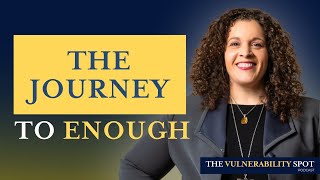
Dina Skipper, founder of Enough Labs, talks about helping women and girls believe they are already sufficient without external validation. She traces the feeling of not being good enough back to age 9 or 10, and describes quitting her job after confronting sexual harassment in Egypt to champion inclusive leadership instead.
Chapters
Hello everyone, thank you for tuning in. I'm super excited to welcome Dina Skipper to the V Spot. Dina is the founder and CEO of Enough Labs. She's an empowerment coach, a gender equality advocate, a motivational speaker, a goal-crushing boss, And the title I'm most grateful for? Friend. Deena, thank you for joining me in the V Spot.
I am so grateful to be here. Don't mind me. I'm just like tearing up already, getting emotional. So I know where this is going. No, so happy to be here, Andrea, seriously. You know I adore you and can't wait for this vulnerable conversation. Thank you.
Thank you. So let's jump right in. Enough Labs, tell us more about the work that you're currently doing with women and girls from around the world.
So yeah, I mean, Enough Labs was created 3 months prior to the pandemic based off of a vision that I felt was placed on my heart to create a space in the form of a coaching practice. But beyond that, like through authentic connected conversation, around the topic of enoughness. I think there is a universal story that women and girls experience as a result of not feeling enough in some shape or form. And I've had the honor and blessed opportunity to be able to travel to over 30 countries around the world as a gender advisor working in the international development space. And what I found is Through my work, I felt like I was holding hundreds and hundreds of stories of women and girls throughout my travels. And this conversation around not feeling enough, for me, from my perspective, transcends borders, cultures, context. It might look different, it might feel a little bit different based on age or, you know, ethnic background or whether you're in a city or in the rural areas, but We're all going through a very similar story, and it's always struck me how, how much more alike we are than different. And so Enough Labs was created to be part of this radical conversation around self-acceptance and just really embracing that idea of how enough we already are, that we don't need to look outside of ourselves. Enough Labs is a coaching practice that has been designed to support women and girls in one-on-one coaching, but also in group programs with programs that are curated specifically for the workplace and even in schools. And so I feel really proud of what this growing community is creating and will continue to create and I love seeing breakthroughs come from both women and girls around different things that they, you know, questions that are put forward to them or different perspectives that allow them to see like, oh wow, I can totally relate to this. So I think there's something really powerful about being vulnerable enough to reflect on certain things that we may have just accepted about ourselves and never really questioned. I love that.
I love that. So in honor of moving backwards from where you just were and something that I thought about before, you love seeing breakthroughs. What about having breakthroughs in this particular regard?
Meaning me personally? Meaning you personally. Got it. Yeah, so that is a really interesting question, Andrea. I feel like when I'm able to witness someone, like be in the presence of someone having a breakthrough, whether it be a client or someone I'm just talking to, it is— there's like a shift that happens in, in me. And I think I get really excited for people to make certain connections about themselves or just to kind of like release or let go of a story that they've held on to. I think women and girls get caught up in stories that they can tell themselves and believe, or that they've been told. And the reason I feel like witnessing someone's transformation or witnessing someone's shift or breakthrough is so powerful for me is because oftentimes I'm experiencing something similar while I'm watching them. And it's, it's funny how this world of coaching works because I think you're often drawn to people in conversations with breakthroughs that you need to be having as well on some level. Um, I would say that sometimes as a coach it's a little easier to help someone else arrive at a, at a breakthrough, like facilitate that process. And I think as a coach, you have to be mindful to be looking at the spaces where you have to peel back the layers and where there's opportunity for you to grow and shift. I will say that it has not always been a straightforward, comfortable process for me about having breakthroughs, whether it be about how satisfied I am in a relationship, whether I feel like a friendship is balanced, whether, like, how I truly feel around how I'm showing up at my job versus what I'm really feeling called to do. I think there's a lot of areas for breakthrough, um, and, and the examples that I just gave were like all in relation to something or someone else. I think the biggest breakthrough that I'm currently experiencing is my own journey to enoughness, to not feel like I need to be defined by accomplishments and goals achieved and, you know, busyness, um, to be perpetually tied up when in some form of chasing. That is, I think, for me, the biggest breakthrough, that it starts with me. And I think it always starts with, you know, me or you. It always starts within. To not need to collect things, people, accomplishments to feel worthy. That's the biggest breakthrough I'm, I'm in right now.
I love that. I love that. And I— what I also heard you say is in witnessing others have their breakthroughs, you gain access to having your own. And I think that that's incredibly powerful about the work that we do, right? And I'm going to actually circle to that point again later on because it was something that I thought about in terms of our conversation in particular. I love that. And you know, something you mentioned before that I think is super powerful to revisit. You mentioned that you have visited 30 countries, which is, you know, for those of us who love the wanderlust and think about traveling all over the place, it's super inspiring. And in this moment, is there any particular country that stands out where you had an experience or anything that really serves as a, you know, significant piece around your journey with Enough Labs and your own personal journey?
That is like the hardest question to answer because there isn't a single place that I've visited or a single conversation that I've had that hasn't impacted the vision for Enough Labs. But I know that we don't have all day, nor do we have all year to have this conversation. I would say I'll share just like a couple of examples just to illustrate, because it's so hard to just pinpoint one. Walking in a refugee camp in South Sudan, watching women carry firewood from outside the, the camp to earn money for their families, and having conversations with them around what they saw was possible for them and really looking at roles versus responsibilities, like expectations that were thrust upon them and that they didn't have the space to question. But even in that refugee camp, seeing women still organize through informal groups to provide like support and, and like informal mentoring to younger girls in a refugee camp. Um, having a conversation when I went to Palestine and speaking with a woman who was a gender specialist on an energy project but also had so many things to say about the conflict and women's roles in the region and everything that she wanted to study and pursue and questioning her own role in her marriage and really holding it from a space of, what am I searching for? I'm literally trying to reach for all of these different things. I spent a significant amount of time in Afghanistan. And I think about girls that are born in Afghanistan who are part of the Afghan diaspora and how they feel connected to themselves, what they see as possible versus what's going on right now in the country. I think about girls, women and girls in Afghanistan all the time because they've each, anyone I came into contact with had such a profound impact on me. And I'll say one more and I'll end here. I did a trip to Rwanda and I sat in a group of survivors of gender-based violence and hearing them tell their stories and what they were, going to what they were personally dealing with, how they trusted me with their stories, how they were so honest and vulnerable about what they had personally experienced at the hands of their partners, and then how they continue to show up for their children, how they continue to show up in the businesses that they want to start. So it's, it's hard that like Just giving those 4 examples is just to show like a snapshot of like, there is— it is impossible for me to say one country or one conversation because I feel like every conversation that I've ever been able to have, whether it be in the cars driving hours and hours to some rural part of the country I'm visiting, or if it's been in like a cafe with the person I'm there to work with, I don't know, it's just— I love, I love conversation.
Yeah, no, this is incredibly powerful. And I, uh, one of the reasons I wanted to circle back to the 30 countries is because I think there's so much value and importance in highlighting that the voice that you bring to this work is really representative of women all over the world. And, um, when you speak and you are actually sharing of your process and the magnitude of the narrative that enoughness holds, you're not just speaking for you and your experience. And I think that you're right, there's not enough time and, you know, unfortunately, to be able to capture every woman's voice in this particular conversation. But I thought it was really important to highlight that when you speak, you are speaking on behalf of countless people, women and girls that we will never meet, you know. So I just want to highlight that and say thank you and for powerful examples, you know, and I look forward to hearing more offline for sure. Um, so yeah, so you're currently doing a 40 to 40 countdown on social media as you prepare to celebrate your 40th birthday on October 10th, which is very, very exciting. Um, and so in honor of your countdown and your upcoming birthday, let's stroll down memory lane together. So we're gonna rewind. You all can't see, but Dina just had a face.
I'm scared.
No, no, don't, don't be scared.
Don't be scared.
Or be scared and choose courage, right? Um, let's rewind to the first decade of your life. First decade of your life. So would you be willing to give us a glimpse into the lab that is your life and share a memory that you can see now was one of the most— like, the first times, I call it, um, where you were made to feel that you weren't good enough?
Ooh.
Ooh. So we are rewinding the clock and looking at the first decade of Deena's lab to get a glimpse of anything that stands out as a potential first memory where you were made to feel or experience the feelings of not being good enough.
Yeah, so I mean, I love the question. I love how you talk about my life as a lab because I oftentimes refer to Enough Labs as experiments and possibilities. That's really what the whole crux of this was. So my life is definitely a lab, one that I explore. And part of the reason that I created Enough Labs was because of this research that signals to the fact that a girl's confidence peaks at age 9. When I came across that research, it stung. And it stung in a way because I feel in that first decade where everything started to fall away and feel unsafe was right around 9, 9, 9 to 10. So prior to, I'm happy-go-lucky, I'm a super expressive kid, I'm, I'm creative, I love I love, you know, creating little projects. I had a crazy imagination, never held myself back. When I hit 9, 10 years old, my family was going through probably one of the— the beginning of, like, the roughest part of our story as a family. My father had just um, had come to terms with the fact that he was struggling with drug addiction. My mother, as a mom of 3, felt it was in her best interest as well as ours to separate from my father. And being 9 years old, not having any clue as to why these things were happening and why were my parents arguing all the time and Why were we suddenly being uprooted from our home to go live with my uncle and have to change schools and all of this upset? Nothing made sense. Something in me, as the oldest, had me thinking, don't ask. So I was wildly confused, really unsure about what was to come. So I feel like it was the beginnings of like, frankly, trauma. Yeah, right. There was no— there was, there was very little safety that was created in that moment. And by, like, no, no, like, disrespect or, or shade to my, my parents. They did the best that they could with what circumstances were in the moment. But I would definitely say that that was the moment that I felt like, as a child— and I feel like you can appreciate this given your background— like a child is trying to make sense of that situation. So I think when I saw my parents officially separate, when I learned at 10 that my dad did have a drug addiction— I was the first to know in my family of the kids— I think there was some kind of conversation that I was like, were we not enough for him to stay healthy? Was I— did I do something wrong? And I think that that narrative of like, I'm wrong or I'm bad, like, has sort of like manifested in a lot of different ways. And I think that that's the origin, coupled with the fact that you're going through puberty and, you know, all these things are happening in a girl's body. Um, so, you know, not easy times. Uh, and I was an early developer, like, in terms of my body. Um, so yeah, I think it was, it was like a perfect storm. But I would definitely say at 9 was the first signal because Prior to that, everything was ostensibly smooth sailing, you know, great family, great sibling relationships. We were having fun, we were playing with our cousins, and then boom, everything changes.
Yeah, yeah, thank you, thank you for sharing that. And thank you for pointing out the age, right? Because when you said 8 or 9 years old is when, you know, this sort of begins. Um, I really had an opportunity to sort of think back to my 8-year-old self, and it's no mistake that that is when my not good enough narrative, um, absolutely started. It's, you know, right in between 3rd grade and 4th grade. I, you know, went from being like the tiny one in the class to being chubby and starting to put on weight in a new way. And it was then, in this moment, I'm able to identify it was then when I first experienced, you know, not pretty enough, not good enough because of the size of my body. And I have gone on to struggle through that. You know, I would say it's one of the things that I struggle through most. But in this moment, it's incredibly powerful to really trace it to its origin. And it's right there, 8 or 9 years old. And like, you know, depending upon where I was in the 3rd grade at what month, it's when it all began. So thank you for putting that out there.
And just to like, I thank you for sharing that too, because I just think whatever was happening around 9 years old is in direct, like you not feeling good enough or like myself, feeling unsafe, feeling not good enough, not feeling all of these things are in direct proportion to what you're making sense of your world to be. So it's like, you know, definitely struggling myself with the not good enough or not pretty enough or not thin enough because of the messages that we're receiving as early as 9 years old. Wow. What 9-year-old should be thinking, I'm putting on weight, I'm bigger than the rest of the girls in my class? Like, Who— why, why is that something that you should be worried about? Because it means that you're already receiving some kind of subliminal messaging, some subconscious, like, you know, directive that you should be a certain size wherever you are. And yeah, the podcast episode, I'm just like, yeah, yeah, in this moment, that the insanity of it.
Totally. And I think, like, to echo and to kind of piggyback off of some subliminal and some very direct I remember feedback that I received in the 3rd grade pertaining to my weight. I could hear it. I could hear it now as a 42-year-old woman. So it's— some of it's very subliminal in terms of like societal, you know, family, like undertones that maybe aren't necessarily blatant. And then there is some that is very much said out loud. And, you know, there's no space for confusing the two, you know, so I think that that's, that's significant. So yeah, thank you, thank you for that. Let's fast forward to your 30s. Okay, so can you share something from your 30s that also supports the reason why you do the work you do with Enough Labs?
Hmm, I would have to say that My 30s, I definitely stepped into a more confident version of myself than I was in my 20s. So I think there's something very powerful about like navigating certain twists and turns in life, whether they be personal or professional, and, and sort of getting the momentum, you know, behind you thinking like, okay, I'm in a comfortable groove, I've got this. My 30s allowed me an opportunity to do the work I was dying to do in my 20s. What I realized is in my 30s, I still found myself, although I had like the dream job that I was chasing for over a decade, it still didn't feel enough, no pun intended. I would have to say the moment, the singular moment in my 30s where this was confirmed for me Actually was on the heels of a trip that I took to Egypt. And I was in Egypt and the head of the project that I was working with, um, touched me inappropriately. And it came to my attention that he was touching many women on the project inappropriately in his office, out at coffee, dinners, and people were reporting it to me as the gender advisor. And so I, I, you know, living, working, breathing this stuff like every minute, and then having it happen to you personally, I felt like I had an obligation to voice these concerns not only for myself but for on behalf of the women that didn't feel comfortable coming forward with it. When I put forward the claim, the decision from the company was to say, oh, don't worry, we've talked to him about it. And no repercussions were yielded until he touched a government employee inappropriately. And that sent the— just that was the impetus to actually do something and remove him from the position. What was worse than that whole experience was when I was invited to a meeting of all of the senior representatives of the company where I had organized a conversation around inclusive leadership and what that looks like and really the importance of gender equity in our own office, not just when we go to other countries. I raised the issue that something that was continuously brought to my attention was that sexual harassment was rampant in our industry and that women who worked in the office didn't feel safe. And they didn't feel safe enough to even bring it forward because they weren't convinced that these cases would even be taken seriously. And no one even knew my story until I shared it. And then it opened the floodgates for all of these women to share.
Wow.
I'm sitting in front of this team of senior leaders, all men by the way, and they looked at me and they said— one in particular looked dead at me. He goes, I know exactly what you're talking about. And we took care of that situation. That's no longer an issue. So basically telling me in that moment, we don't believe you, or, you know, like, that's not an issue here. Basically minimizing my whole experience. It was in that moment, Andrea, that I was like, I am sitting here waiting for these leaders to show up in the way that I'm expecting them to, because this is the type of organization that I want to be a part of, and I'm not passive in that way. And I'm realizing I'm just sitting around here waiting for them to model leadership that I can be proud of. I would much rather create my own outfit to stop waiting for leaders to step up and allow myself to step up because I was so frustrated by having conversations with people who just weren't interested in hearing it because it rocks the status quo. Totally.
Wow. Wow. So, okay, a couple of things.
I quit that job that day. Wow.
All right, listen, you know, that's— there's— therein lies the celebratory, um, you know, action step around that piece. So, I mean, first and foremost, you know, thank you for, for owning your, your truth and being willing to share it here, because I do believe that, um, speaking your truth paves the way for other people to speak their truth as well. So You know, thank you first and foremost, um, and the vulnerability involved in sharing in that way, you know, and the willingness to be the leader that you desire is so admirable, and it's, you know, such a huge, um, testament to who you are, you know. And so I just want to highlight that and really celebrate that decision, you know, as opposed to waiting for the leader to show up. It's It's stepping into being the leader that you desire, you know, and out of personal experience, you know, and again, I want to highlight this like magnitude of being a woman who is simultaneously having your experiences while holding space for other women to have theirs. And so, you know, second time it's sort of coming up in this particular, you know, conversation, and I think that it's worthy of being highlighted each time. Because it's not for everyone to do. And the fact that you chose to do it is huge. So thank you for being the type of leader that we want and need. That's for sure.
I appreciate it. It's hard to receive a compliment, but I will receive it with so much gratitude. Yeah. I want to just signal something that that you made me just think about in this moment is I'm having this simultaneous experience alongside women who are feeling like they can trust me enough to share some of their deepest, most vulnerable experiences. And my experience that I'm living as a woman through navigating my own insecurity, navigating my own like process and reconciling like my place in the world. I'm also just— I won't say just as, but very impacted by just holding the story because like vulnerable moment here, like there is such a deep level of frustration when I hear about stories and then I feel this tremendous sense of powerlessness. Like, it's, it's, it is enough to just be a safe space for someone, but recognizing that there's so much in the world in terms of like oppressive systems and, you know, power structures that are doing harm to people, and there's just It's a lot.
Yeah, yeah, it most certainly is. And I think that there is, uh, the ability to really honor what is occurring in real time and navigating what is happening within and recognizing all of it and holding space for all of it at once is no easy feat. And so, you know, the fact that it is occurring and you choose to do it right, because nobody's twisting your arm to do this work. The fact that you choose to do it is, is a testament to the type of leader that you are. So kudos to you for doing what is not easy work and doing it day in and day out by choice because it matters that much, you know. So that's, that's huge. And no mistake that, you know, one of the next things I wanted to ask you was and sort of highlight is the fact that I know your work is designed to empower women and girls, but let's actually talk about the men and the boys. Mm-hmm. And so I've worked with countless men and boys who struggle with not feeling smart enough, good-looking enough, successful enough, strong enough. So what would you offer to the boys and the men who are listening to this podcast and are presently struggling with not enough feelings?
It's such a layered conversation. I think whenever I think about what is occurring for a woman and girl, any— for women and girls who are feeling this way, I oftentimes point to societal pressures and expectations that we've internalized. That we should be showing up a certain way so that we can belong, so that we can be, um, in like-minded company, that we can be accepted. And I don't think that that reason is all that different for men. The pressure shows up in a very different way because of expectations of what a man should be, how they should present, um, all in the spirit of, of what, like reaching all of these life milestones of being deemed good. And good can mean like successful, wealthy, attractive, a good parent, like all of these things. I oftentimes, when I work with women, a lot of the work is around unlearning It's around being vulnerable enough to get in touch with who do you want to be if you didn't have all of this pressure? Like, who would you choose to show up as? What would you choose to do? And I feel like just being— giving yourself permission to explore that, I think, is advice that both women and men can take to heart. But I really think, like, that conversation has to start way earlier than it is currently taking place. You know, I have this huge dream of wanting to work in schools because I think if we were able to facilitate this kind of conversation and getting honest and vulnerable— and don't get me wrong, I know there's a ton of programs across the US that are happening, which I think is amazing, and I follow a ton of groups that are doing this work. But I know that it's not happening in every school. And if boys weren't called out by teachers or other educators of, you know, calling out certain behavior because it wasn't like, be a man or don't cry or don't be sensitive. And the behavior patterns that are reinforced maybe so unknowingly by teachers, by parents, by other educators, by people in the community, by other friends, I think that's what like sort of kicks this conversation into high gear at an early age that once you realize how much it's not serving you, say like in your 30s, 40s, maybe 60s, you're trying to reverse all of this time where this conversation has been ingrained in you. The unlearn— I'm not saying it's ever too late 'cause it's not, but the process of unlearning something that has been with you for so long, I think like you need to acknowledge like it's not going to happen overnight.
Yeah, total process, total process. And I love what you, you said about, you know, this conversation. Well, first I love the pointing out and reminding the piece around us unlearning, you know, because I think that much of personal development work is that, right? Really unlearning. But I love what you highlighted about, um, asking the question, who do you want to be without all of the pressure of who you are expected to be? And I think that in speaking directly to boys and men in this moment, what are like way to support them traveling lighter with all that society puts on them in terms of expectations, right? Because there's certain expectation to be strong in a way that doesn't allow for the full human experience. And when I hear your question of who do you want to be without the pressure that you are actually given, how freeing, right? For boys and men to be able to create from a space of this is who I want to be, not this is who I am expected to be because this is how I was you know, I experienced my family and all of it, right? School, and on and on we go. But I love that in terms of creating and answering the question with there not being a particular answer, but just sort of like going with it. Who are you if you are not having to be what everyone else tells you to be?
It's a big thing. We don't talk about choice enough. I think we talk about what's expected, what's appropriate, what's appealing. Yeah, what is pleasing, like what's palatable. We talk about things in those terms. I just think the world would look very different if we were having conversations that, that allowed the space to be curious enough around choice and who would we want to be in this world, because we're not this homogeneous population, and everyone's got to be the same and walk the same and fulfill the same expectations. But totally, it can also be so terrifying to stray from the pack, you know.
I love, I love, love, love that you said that, because what I was just thinking was, you know, um, in addition to what you were sharing, um, in terms of highlighting the power of choice, highlight the power of courage. Because in choosing to be whatever we want to be, it sometimes means going against the grain. It sometimes means not everyone is going to like us. We are not for everyone. And the courage that is involved in honoring that and moving forward anyway is courage. I mean, that's like— there is so much magic in that particular piece. So shining light on choice, shining light on courage, and really giving permission and encouragement to be with this discovery around who would you be if you didn't have to show up as all of the things you were told to be? And really supporting in unraveling and unlearning the not enough narrative in the reverse engineer of it all, right? So I think that there's so much power in in that. Thank you for that. Yeah, so I want to circle back to what I mentioned earlier and said I would come back to a little bit later on, which is really this belief that I have that there's this common misconception connected to the work that both of us do, that we need to have fully arrived at our mission in order to promote our message, right, and support others the way that we do. You know, I actually believe the opposite. I believe that it's the fact that we are knee-deep in the trenches of our stuff, right? Sharing of ourselves and of our process so vulnerably that it could sometimes like knock the wind out of us. Um, that is the magic about why and how we are able to support people the way that we do. So with that being said, I know that you are currently in the trenches of your own lab. Digging deep, doing your own work. And we know that the coaching process is all about the power of questions, right? So in this moment, I want to invite you to think of one or two questions that will call you forth to reflect on as you continue your countdown, your 40 to 40 countdown, so that when you wake up on your 40th birthday, there's a new experience of what it means to embrace enough. So think of 1 or 2 questions that you can reflect on from this moment moving forward so that when you wake up on your 40th birthday, there's a new experience of what it means to embrace enough. There's power in the questions with that, with the coaching process. So, Dina, you can't see Dina, but she's just nodding and thinking. And, and take a second to be with it.
It's No, I just, I love the question. I love all of your questions, Andrea, and I knew that you were going to trip me up in this conversation. What a, what a like beautiful space to be in because I'm sitting here thinking like, where am I going to be emotionally the day that I wake up on my 40th? And I really want to just make a nod to that because I think there is very much that misconception that Coaches should have all of their stuff together. Yeah, before they can coach others, which I think is complete bull. Um, if you're not brave enough or vulnerable enough to, in, to, to be with your story, to, to unpack and, and really like look at the origins in order to propel you to take different action. Like, how can you trust someone with your own stuff who— if someone hasn't— has been unwilling to do that work on themselves to be with those questions? So I would say—
and I just want to— I just want to add to that.
I just want to say that, you know, um, the process and the journey here that we're speaking of is one that is absolutely not—
you know, they say healing is not linear, right? And so in our journey, um, there's so much that we get to sort of peel back to look at. And like, in a pink elephant worthy of mentioning in this particular moment is shame, right? And sometimes that as we navigate our own process and decisions and life choices and all of it, there's an unpacking and being with facing, um, shame in a way that allows for us to sort of like flow through our journey. And this is all being done simultaneously to holding space for other people. And so I just think that it's so important to highlight that, you know, as someone who does the work that you do and as someone who does similar work with, you know, from my standpoint, it's really about us like rolling up the sleeves and being willing to get into the trenches and like figure out stuff out and hold space for people to do the same. Versus, ta-da, here I am, and now I'm holding space for you. And I think there's so much power in highlighting that because it just really outlines the magnitude of commitment to this work that we show up to hold space for people at the same time that we are potentially staring our own shame in the mirror and being with our own experiences. And nonetheless, here I am, and I'm giving it my all because this matters to me. So I just, you know, I wanted to like highlight shame and just really, um, celebrate, celebrate the whole process of it, but, but really invite you on this particular like question to be with, um, yeah, how are you going to feel the day of your birthday? And that's something that could potentially happen to you, or you can actively design, as I like to say. And, and these 1 or 2 questions that you come up with in this moment, I hope, is, uh, paving of designing the experience you want to have on the birthday morning.
So I got my 2 questions.
Yes, yes, go for it.
Question 1 would be— is what does your decade of 40 look like if you let go of control. I think there's been a very profound experience for me around trying to anticipate outcomes from all 4 decades of my life.
I cannot relate.
So weird, right? So I am really like curious and excited about my own healing journey, my own journey to expanding my business, stepping into who I, I am fully by virtue of letting go. So I am actively in that question of that, look like if I'm, if I'm not controlling. Um, and I would say the second piece when we're talking about healing not being linear and things that you and I have talked about that somehow tend to pop up again, even though we may have thought they were healed. Yeah. And on the heels of that piece that you just mentioned around shame, my second question would be, what would it look like if you actually truly forgived yourself? Like, offered yourself forgiveness for mistakes, missteps, not having the answer, not acting, uh, you know, responding in time, not having stayed in situations longer than you should have. Like, true forgiveness for it all.
Wow, I love that.
Those are my two questions.
All right, look at that, look at that, right? So those are two great questions. I love them, uh, really looking at what will the 40s look like if you let go of control and let go potentially in general, right? And also this aspect of what does it mean, what does it look like if you truly step into forgiveness of self, um, for all things, you know? Uh, I love that. And so, um, the, the invitation is to be with those two questions as you continue your countdown, so that, that, you know, on your birthday morning there is a different experience created. So I, I hope that is something that you are willing to try on. Thank you for that.
Thanks for the gift.
Yeah, way to go in terms of like great questions in the moment. For, for our final piece, let's do a speed round.
Okay.
So I'm going to call this the Forwarding Four. So I'm going to ask you 4 questions, and you will answer quickly with the first thing that comes to your minds. There's no right or wrong answer. It's just really about giving yourself permission to share your automatic response and potentially forward someone who is listening to be with it.
I love it.
So you ready for the first one?
Absolutely.
Okay, what's one life lesson that you recently learned?
Say what's on your mind.
Love it.
Don't hold back.
Great. Number 2, name one area of your life where you are intentionally healing.
My relationship with myself and how I see myself. Great.
Number 3: share a song you currently have on repeat.
The song is "On It" by— I'm gonna miss— I can't recall the artist. Um, it's like a meditation song, and the line is I'm on it because I want it. I'm on it because I want it. Whatever it is, I want— I'm on it because I want it. Whatever it— wherever I go, I'm on it because I want it. That's been on repeat for me right now.
I love that. I love that. Um, great. And, uh, number 4: what's your— what is your call to action to everyone who is listening?
Give yourself the space to actually truly listen to your intuition. Like, build that foundation of trust within yourself as opposed to needing to look outside of yourself for validation, approval, and like being affirmed that you're on the right path. That would be my forwarding advice. I love it, I love it.
All right, well, thank you, Dina. Thank you for, for being a yes and joining me in the V Spot. Thank you for your courage. Thank you for your generosity, um, but most importantly, for your vulnerability, you know. Um, thank you for creating and holding space for me and other women and girls to journey alongside you as we all embrace enough. Um, so tell folks where they can find you.
What an honor. Um, thank you for this conversation. I definitely feel like— I, I feel like I shared vulnerably. There's so much deeper to go, but, um, thank you for creating the space for sure. Um, if those are listening are interested to get in touch, you can find me on Instagram @enoughlabs or Um, the website is www.enoughlabs.com. Uh, always willing and ready to have a conversation about enoughness.
Yes. Thank you. Thank you. Thank you, Dina. And thank you for tuning in everyone to the V Spot. To be continued.
More from Andrea

From Rejection to Resilience: A Conversation with @thedegoviagroup on Thriving Through Challenges 💥









Reclaim Your Worthiness: A Journey to Internal Value - The Unlearning Lab Live, Washington D.C.
