16 Outlook of Catholic Investment Funds: Andreas Widmer
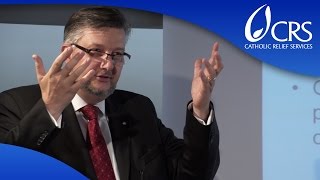
Andreas Widmer (director of Entrepreneurship Programs at Catholic University of America and president of the Carpenter's Fund) argues that Catholic investment funds and impact investing must distinguish clearly between humanitarian (crisis) intervention and long-term economic development. Drawing on a pastoral counseling framework (crisis vs long-term counseling; sympathy vs empathy; redeemer problem), he warns against codependency and ‘‘sympathy-mode’’ aid that disempowers local actors. He advocates focusing on local SMEs (the "missing middle") as engines of prosperity, promoting role models and integrating the poor into networks of productivity and exchange rather than treating them as dependents.
We just discussed the outlook of Catholic institutional investors, and now we're going to discuss the outlook of Catholic investment funds. And it's my pleasure to introduce Andreas Vidmer. Andreas is the director of Entrepreneurship Programs at the Catholic University of America and president of the Carpenter's Fund. He's also an author and published a book, the Pope and the CEO Pope John Paul II's lessons to a Young Swiss Schol, which I know Pope Francis is now a proud owner of a copy as well.
Andreas Vidmer, thank you. I realize I stand between you and the open bar. I'll make you a deal if you let me go first. I'll be very brief, so I want to shift to gears as they did being the last speaker here. There's very little left to say. And I think this last panel was very interesting and stimulating in terms of Catholic investment funds. So I just want to give you some four or five points that I came up with that I want to leave you with. Some of these are maybe in the beginning rather disconnected, but I promise you, eventually I'll tie them together and it makes sense. My background is, as you know, I started here in Rome with my career, but then went to the United States, and I was very involved in the software industry. I was blessed with a very successful career in running software startups. I was involved in FTP software and in Dragon Systems and then a few others. Then eventually I went into strategy consulting with the Monitor Group and then had a philanthropy that looked at enterprise solutions to poverty. That was the seventh fund together with the Templeton Foundation. I tried to specifically bring in my what I have learned from the church and what I have learned in my business life and try to bring the two things together. Took me most of my career to even realize that maybe it's a good idea not just to be a Catholic on Sunday, but actually a Monday through Friday as well. And so I started to study theology at the side. My spiritual director said, you know what? There's enough theologians around. You ought not to study theology, what you ought to do. I have a very wise spiritual director. He says, if you want to do this study ministry, like actually do it, there's enough theoreticians around there. You go and do it. You go and evangelize, be a part of the new evangelization. So one of the courses I took was counseling. Father John Grimes was my professor, and he started to talk about the five traps of development, the five traps of counseling. He said, first of all, what you have to understand is that there's Two different situations, fundamentally different situations. Let's assume you're at the parish and somebody comes in and their whole family died in a car accident. And it's like absolute shock and terror. And this person comes in and you're assigned to counsel this person, to take care of that person. What do you do? Crisis counseling. The church is very wise. We have a lot to learn right now. We're sort of. Today it was sort of us from the industry trying to tell the church what to do. It's very good to do this the other way as well, like what sister was talking about this morning. And so in her wisdom, the church actually says in this crisis counseling, you speak, you approach the person with sympathy. That means you immediately you're actually allowed to take over. You probably send somebody home with me to make sure I don't hurt myself. If I come to you in that state, you probably will call my employer to make sure that they know that I'm not coming to work. You'll take over. But what he says is there's a huge difference, that when you have this intervention, this crisis canceling, they shouldn't do it for very long. You know why? Because very quickly that pattern of behavior, of intervention leads to dangers of codependency. And you know, a crisis is typified by the fact that it's timely, it goes quickly away because then otherwise it wouldn't qualify as a crisis anymore. If it's longer, then it's a state of being. And that, that's not, that's not a crisis. So what he says is eventually you have to go into long term counseling, long term ministry to somebody there. You change the approach. You talk about the person's patterns in their life, what is going well and what not. What of your behavior has to do with the outcome in there. You shift from sympathy to empathy. You don't do it for the person. You just say, have you ever thought of this? Or you help the person reflect upon their situation, the outcome of the things that happen to them. And one rule, he said, father John, never ever, never ever have the same person who gives crisis counseling give the long term counseling. Because you cannot. We as humans, we cannot shift between the two. When I was sitting there, I was in the midst with my philanthropy. I was in the midst of working in Africa and Rwanda, of talking about how to deal after the genocide and everything. How do you, how you know, the country was trying to figure out, how do you rebuild that economy, what to focus on? And it was exactly at that time I could Close my eyes, which I wasn't sleeping. I was just closing my eyes in the class. And I imagined I was sitting at the conference that I was two weeks earlier in Rwanda and that Father John would have spoken to us in this development community rather than to us of these people being trained for ministry. And I felt that he could have said the same thing, that what we do is we need to fundamentally distinguish between a humanitarian crisis and economic development. And you know what? While we in the church are so good at doing this on a personal level in ministry every day, all of you do this in all the congregations, all the priests. You do this on a daily basis. But when it comes to look out at the world and how we deal with humanitarian crisis versus economic development, we actually leave this all behind and violate our very own principles. Because now we're dealing with groups and not with individuals. But you see those rules, they still hold. How often, how many of us have entire aid organizations? And we, even as a government in usaid, I've seen this, that the same people who do the crisis intervention stay behind and say, and now let's talk about your economy. That is a non starter, guys, we should have an entirely different team going to do economic development than do the humanitarian crisis. And so when we talk about impact investing and investing in general, we need to step back and say, what are we actually trying to do? Why are we here? I teach at Catholic University and our first course in business is to say, why are you doing business? Why would you study business? And what is business all about? What's the goal of business? Right. Why are we here? What do you mean by impact investing? We want to help people. Does the economy exist for the person or the person for the economy? The economy exists for the person, not the other way around. And what we're trying to do with our investment is to better the world, to help the world. I'm very hesitant of creating different segments such as impact investing versus the normal kind of investing because it gives people the chance to say that normal business isn't about people, that there is a marketplace where it's okay that the person exists for the business. And then in the halo effect of the corporate social responsibility, there is the place where the companies recognize that businesses should serve person versus persons rather than the other way around. So what you're seeing is here are the five traps that Father John told us about in this. What I'm trying to make is this distinction. First I want to set up that this is the distinction that we need to look at. Also in our investment and impact that we're trying to have. Are we trying to have humanitarian impact or are we trying to develop the economy? What we do then, that's this first. Is there a light on here? That's this first crisis versus long term. The second one he says is when you do the short term intervention, it's okay to go in with sympathy. That is, you take over. When we go into Haiti after the earthquake, it's okay to go in and take over the airport, it's okay to, to hand out bottles of water and all of that stuff. But you know, at some point that crisis is over and we need to start building the economy. That you don't do with sympathy, that you do with empathy, which means you don't touch anything. You say, how do you think you're going to get out of this? Because this is their economy, not ours. We would ask father, how long is it? Where is the line? How long am I allowed to do crisis intervention versus long term development? And he says, there's no specific number. I'll tell you 10 times for an individual interaction because it's not 20. And you know, when enough is enough. And I think for us to look at this as the Catholic Church, when we go into an area and try to help people, when do we move from crisis intervention from humanitarian aid to economic development and are we then willing to, to change how we do things? In crisis intervention, you hand things out, you save a life. In long term development, you're not handing anything out because you would make people, you would cause codependency. If we're looking at this field and there's this danger with impact investing as well. I always felt when I went to Africa that the last thing Africa needs is one more middle aged white guy who won't tell them what to do. This is full of them, full of people like me to walk around and say, and here is what we need to do. This is all. We're all in the sympathy mode. We think we're God's gift to the world over there, you know, and we as a world react like this. You know who represented two times ago who represented Africa to the G8 summit? You think somebody like Nelson Mandela or do you know who it was? Bono. What the heck does Bono know about Africa? I want to point out to you how we as an entire industry, as an entire society are stuck in this sympathy and in this crisis intervention and that we honestly suffer from codependency in our whole approach. And that when we do impact investing, that yes, it's okay to feel good and to make you feel good about this, but we should run a serious risk of falling into that same trap if we don't watch out. What we. The problem, the last problem there is, he said, the redeemer problem. He says, when you walk into that room where you are with a dying person or you are with somebody who has this most horrible thing happen to them, Father Tom would say, before you go in, you do your prayers, you ask for the Holy Spirit and then you tell yourself five times, I am not Jesus Christ because I am not going to save that person. You know how important that is? And do you know how often when we in a really male culture, the western culture, show up and think we are going to solve your problem? That's how we show up. We go, ta da. Like we expect drum rolls to come up when we show up in an emerging markets trying to help, but we don't show up as equals. In saying, what do you think is going wrong here? It's like what I love about your approach, that we go there and say, what do you think needs to be done? And then to take people at face value and treat them as brothers and sisters, not as dependents, that we don't rob them of their dignity by appearing parental or telling them what to do. In our research, what we found. I'm shifting gears now. This is my second point at the 7 funk. We went around and I believe very strongly in the power of role models. I told you, I feel very uncomfortable going to some village in Africa and doing, going there and giving something or something like that. I think it just feels wrong to me. So what we have proposed and what we did with the foundation is to go and find the best entrepreneurs we can find in those markets and then hold them up as examples. These are locals. You see, when I came to America, I'm from Switzerland, I came to America with nothing. I lived the American dream. And you know, I could relate to Bill Gates in the sense that, you know, that was a kid, he was a bit older than me, but I showed up and felt like, wow, I'm going to do this. And I was in the software industry and met him even a couple of times. And that was my goal, right? And I could achieve that because I could relate to this guy. But me going to Africa as a role model is even, you might as well send a Martian over there. But there are local role models and role models are very important in economic development and saying, how is this going to work? Because the solutions we need in Africa are African solutions, not Swiss or American solutions. So what we try to find is find these SMEs small and medium enterprises to find them as role models. What's an SME? Small, medium sized enterprise, actually a Microsoft term. These are companies that are anywhere from 10 to 500 employees or something like that. It's in a way it's the non multinationals, it's the local companies, but it's not the one guy with two cows. It's not the micro enterprise, it's the SME in the middle. These are very important in the economy. 90% of all companies in in the world are SMEs. They pay usually over 50% of all the taxes, non ag taxes in the country and they employ over 80% of all people who are employed. They are what I would call the engine or the pioneers of prosperity. Our project was called Pioneers of Prosperity because they're the ones who bring prosperity. They're the machine that creates a prosperous economy. And we found a very sad pattern. If you look at my own country, Switzerland or the US or Canada or any country like that, you would find the distribution to be like this. This is one person, 10 people, 100, a thousand. Most companies are right here, engine of the economy. And we started to see a pattern that when you go into emerging markets, poor economies, it starts to look like this, where you have a ton of micro enterprises and more than average multinationals and absolutely known as SMEs. It's called the missing middle. That is what creates the economy, that is what creates jobs, that is what creates tax revenues for the local authorities to actually do something. And they're not there. Why? Why are they not there? I don't pretend to have all the answers here. And these issues, all the things we're talking about, this is complex stuff, okay? But I have some things I propose to you, some ideas that I can contribute and, and then maybe in the discussion, in your own work, you can add your own insights to it. One of the things has to do. You know John Paul? I'm a big fan of John Paul ii. I tell you, the man was ahead of his time. He said some very, very intelligent things. Best definition of poverty I've ever heard. He said. To be poor isn't a matter of how many dollars a day you have. Because I wouldn't want to measure your life by how many dollars of hay you have. It's demeaning. Being poor is to be excluded from networks of productivity and exchange. That is so brilliant. To be poor is to Be excluded from networks of productivity and exchange. You see the issue with the $2 a day. Posing the problem that way begs for the solution of redistribution of funds, which we all know it's an oxymoron. The economy is a pie factory. So you don't want to split up the pie more. What you want to do is make more pies. So the whole problem statement begs the solution. And the real issue of poverty, and Francis talks about this is networks inclusion, networks of productivity and exchange. So when you want to look at solving poverty, how can we include the poor into our networks of productivity and exchange? What is a network of productivity and exchange? Financial markets are networks of productivity or exchange. Bank loans, cell phones, education. Notre Dame. Look, once you're a grad at Notre Dame, you have a huge network all around the world you can go to and have immediate credibility. What do you do if you come out of the slums of Nigeria or Kenya or something, and where's your network? These are things that we can. And in solidarity, what do we do? What should I do with the poor next to me? How can I integrate them into my networks of productivity exchange? What we do.
This is.
Sorry, this is Africa. I just use it as an example because it's compact and I can find the numbers for it. 14% of all people in the world live in Africa. 14% of all people. 36 cents of every dollar spent on charity goes to Africa. You throw $1 into a basket somewhere for charity, 36 cents of that finds its way to Africa. You know, on average, There's a term called fdi, Foreign Direct investment. I like to call that Opportunity Chasing money. You know, the money that goes around and says, hey, do you have an idea, something really high risk that we could do together, you know, And I want a high return. That's fdi. It's money that travels around the world and says, hey, I'm looking for a high risk opportunity. You want to do something with me? Fdi, there's a ton of money in the world that chase us around the globe for these opportunities. 4% of that finds its way to Africa. You see what's wrong here? The poor don't need. When we try to develop somebody's economy, the poor don't need our charity. The poor need our business. We need to start doing business with the poor. So when you look at your investment portfolio and you say, well, this much I do for the social impact, but the rest is business as usual. Friends, there is no business as usual. We live in integrated life. All of your Portfolios ought to reflect this. I don't want to carve out a little side of something that says, this is what I do, where I apply the high ethics and then the rest. It's a little bit like that attitude of boys will be boys. One of the beauties of our faith is that we fully integrate. We look at integral human development. There's not one space, you know, trust me, I was the champion of being a good Catholic on Sunday and then doing business as usual from Monday through Friday. You don't want that. I've tried it. We should do this all week long. And this shows that we're not doing this. And granted, we're not only talking to Catholics, there's all kinds of other people. But what if we as Catholics who just start to take and walk the talk and just start to do this? How many of you have a portfolio and how much of this portfolio is in solidarity with the poor? So now to the fund that Diko Mahundra, who sits in the back row there, and I have as partners the Carpenters Fund. What we're trying to do is just a very simple idea. The reason why we don't. What I found here with this, the reason why we don't have these SMEs is because they are not into. They don't have these networks. One network they don't have is the legal structures, rule of law, there's corruption and things like this. They also have access to borrowing money. Michael Nowak likes to say that lending is the mother's milk of prosperity. You can't have a business without a credit line. There's no bank there who lends them money. And I'm saying, you know, there's a micro lender, but I would find my pioneers of prosperity and say, this guy needs $500,000. They need $2 million to grow their company in Kenya. And, and I would go to all the NGOs and do aid and everything and say, I need a 200 million dollar loan. And first of all, they say, I'm sorry, we only got to 5,000. That's the first reaction. Second reaction was when they look at the numbers, they say, hey, hold on a minute. I mean, if this works, this guy's going to be rich. I'm saying, well, dude, what do you think? What are we here for? To eradicate poverty or to just manage poverty? They say, no, no, this wouldn't look right. If we lend this money to this person and they are successful, they'll be very rich. I said, well, what are you trying to do here. This is our double standard where we don't integrate them into the actual networks of where there's an upside. Africa ought to have their Bill Gates just like anybody else. So what I found in these top in the best entrepreneurs I found in Africa is they all belonged to large faith communities. Why, these are people that you had to be at least five years old as a company. You had to be profitable and what we call a positive company. It's too complicated to get into now, but you had to be a good company with a good. I don't do triple bottom line and stuff, but it would be something like that. Five years. You have to be profitable. I tell you, if you find an entrepreneur who does that in Africa or in South America or in the Caribbean or something, you have found somebody that belongs to a group of less than 0.1% of the world of top business execution. I mean they know something nobody else knows. So what we did is we tried to approach them and said, I'm going to give you rocket fuel because you're Einstein and I'm just gonna give you rocket fuel and let you grow. We found that they're all, all these entrepreneurs, I mean most of them are part of these faith communities. They're a part of a very strong diocese where everybody knows each other and they have large churches or Pentecostal churches or Anglican churches, you name it. Why is that? And I found religious and non religious reasons. Think about it. The reason why these companies don't grow is because when you grow a company, you take risk and you need lending and you need most of all a rule of law to develop this company so that you won't be cheated every time. And every time you grow up, somebody cheats you and you fall back down again in these communities. I like to call them paralegal universes. You know, when we all belong to the same parish and I start to cheat you, my faith in social life is just about over. They can't afford to cheat. They don't need a judge to go tell them you ought to do. You get this and you get that? No, the judge is the community that if I start to cheat you, I'm out of there. So they are in an incubator. Their community creates an incubator where they have certain laws that are actually higher than a normal law. And also they have a marketplace where they can do business with other people where they, where they are safer. This way they grow to a certain size that by the time they go beyond their faith community, they're sturdy enough to actually be able to engage in the competitive market out there. So when I found this out, I got together with Dick and said, let's create a financial mechanism to lend money to those companies. And Dick has been doing this for what, 40 years, 30 years, and he has come up with this idea of a senior collateral lender where we would go in and give them, and give them a loan at a competitive interest rate where they could, over five years, get this kind of risk loan, if you wish, or expansion loan that I believe acts like rocket fuel to expand or scale the company and get this at a rate that the company can live with. And then the investment would get back at a reasonable return. I'm giving you the idea of somebody like this would usually get a loan for about 25 to 80% a year interest rate from us. They would get this at about 12, but that still means that an investor could get 8%, 7% return on investment. So this is a win, win overall. What I want to leave you with is, is that I don't want. I want to push on the fact that Catholicism is the religion that believes in integral human development. We don't create a new group of people every time or a new market every time we see something going south in one group. We all come out of the same society, we all come out of the same culture. There's no, there's a danger of creating halo effect groups. The root of evil actions in companies isn't a system. The root of those actions are personal decisions that people make that are bad. And we sort of abdicate that responsibility by saying it's a system and we go somewhere else. What we really need to do is to hold our community of business people to a higher standard. Because as Pope Francis said, business is a noble vocation. Thank you.
More from Andreas



He Teaches Entrepreneurs How To Be The Leaven of Society | Andreas Widmer | The Pope and the CEO



Principled Entrepreneurship with Andreas Widmer: Lessons in Leadership and Humanity

Principled Entrepreneurship with Andreas Widmer: Lessons in Leadership and Humanity



The Virtues of Free Enterprise and the Heroic Spirit of Entrepreneurs | Villanova University | 2024
