2016 Faith and Business Conference: Andreas Widmer - Faith and the Workplace A Practical Perspective
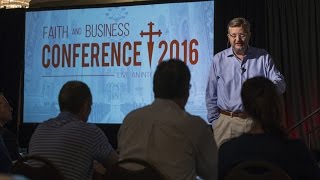
A recorded talk by Andreas Widmer (introduced as director of Entrepreneurship programs at the Catholic University of America and author) describing his personal journey from a Swiss village to serving as a Swiss Guard for Pope John Paul II, conversion/faith formation influenced by John Paul II, and a long business career (early Internet companies, an IPO, later ventures) used to illustrate how Catholic social teaching and the theology of the body apply to work. Widmer frames work as participation in God’s creative activity and proposes three co‑equal objectives for business — creative, supportive, and rewarding — illustrated with anecdotes (Swiss Guard service, meeting John Paul II, startup growth, a failed acquisition and resulting existential crisis) and practical suggestions for virtue formation in organizations.
Chapters
That's our next speaker. He is Andreas Widmer. Andreas Widmer is the director of Entrepreneurship programs at the Catholic University of America and president of the Carpenter's Fund. He is the author of the book the Pope and the CEO, Pope John Paul II's lessons to a Young Swiss Guard, a book exploring leadership lessons he Widmer learned serving as a Swiss Guard for protecting Pope John Paul II and refined during his career as a successful business executive. He is a frequent speaker around the world on issues related to business ethics, entrepreneurship, business leadership, productivity, and the challenges of executive management. Andreas works closely with top entrepreneurs, investors, and faith leaders around the world to foster enterprise solutions to poverty and promote virtuous business practices. He is a leading promoter of the relevance of Catholic social teaching in the business world and supports entrepreneurial initiatives at the intersection of business and faith. Please join me in welcoming Andreas Widmer.
Thank you. Thank you. Thank you very much. Okay, everybody, can you all hear me? You know, I can show it how it looks, but I'm too tall for this thing. This furniture, usually it looks like children's furniture, so. And I don't want to hit my head on the thing, so I'm going to stay down here. Is that okay? Well, thanks for having me, Joe. I owe you one. This is a great experience, and I compliment you for putting this together. This is really cool. I haven't seen many organizations like this. Hey, I worked for a saint. It's cool, eh? I'm a secondary relic. Do you want to touch me? I am. I tell that to my wife all the time. Never works. She doesn't. Yeah, she's a smart woman. Look, I feel very much at home here in Sioux Falls because I come from a place in Switzerland that's much smaller than here. Probably like one of the little villages outside of Sioux Falls. I come from the canton of Lucerne, Switzerland. Very mountainous. Have you ever seen Heidi? Do you know Heidi? I'm the male version of Heidi. I'm not kidding you. I grew up in a village of 400 people. My family, we were six kids, two parents. We owned that town. Politically, we could sway elections. Everybody was a farmer except. But I pretty much grew up like a farm boy. Like a farm kid. Now, the only thing is, I was the youngest of the six, and so I. How many are the youngest in here? Yeah. Quite a few. Good. We have a special bond here. A common experience of. Look, if you have many siblings that are older than you, no matter how good you're at anything, they're better than you. At it. They can be bad at it and still are better than you. It impacted me in the sense that when I grew up, I couldn't figure out what I was good at. I felt like I sucked at everything because they were always better than me at it. Except that God gave me size. And soon, with four older brothers, I learned how to fight like he wouldn't believe. And I won all the fights at school. And I was the bad kid in school. When something went wrong, they would come and look for me. Usually that was the right thing to do, But I had this, what do I do? Who am I? Kind of problem. And so I started to hide behind my toughness. And the military in Switzerland has a militia. They love this. So I got involved in that. From 12 years on, you're part of the militia. They check you through school and everything. And I excelled at that. And so I went into the military and the officer school, and that was the one thing I knew how to do well. School, forget it. All the other things failed. And then I found out that a friend of mine came and said, hey, guess what I am? You know, I'm like, what? He says, I'm a bodyguard. I'm like a bodyguard, you know, with a thing in your ear and a gun in here. And so. And he's like, yeah, man, that's what I am. I said, this is the coolest thing ever. Like, that has, like, me written all over it. How did you get there and what? You know, he says, you can do it. They pay, by the way, not only do they educate to do this, but you. They pay you to do this. That's the coolest thing ever. Where do I have to go? Where do I sign up? He gave me the address and everything, and then I signed up. And then I found out that the person he had to protect was the Pope. And I'm like, hey, I have nothing against the Pope, but I wasn't religious or anything. I mean, I was a cradle Catholic, product of the confusion after Vatican ii, Not catechized, but, you know, baptized and confirmed. And lo and behold, they accepted me. Now, the Swiss Guard is a militia, is a foreign legion. So it's not really associated with the state of Switzerland, because the state of Switzerland is actually Protestant, and this is Catholic. So they had to give up my Swiss passport when I became a Swiss Guard. But lo and behold, they accepted me. If I would have known how tough it was to get in, I would have never applied. But all I knew about it was my buddy saying, apply here. And I did. And lo and behold, they took me in. And I went to Rome and it was an amazing experience. And I met John Paul II. Now I'm this tough kid, 20 year old, and didn't really do anything with religion and stuff. I sort of felt that was for my grandmother or so, but not for me. But I was seeking. And at some point, I mean, when you're the bodyguard of somebody, you're with them 24 7. Like I was with John Paul. Whether he eats or sleeps or talks or meets with anybody, we're there. We have these colorful uniforms, but usually we do service in a black suit and tie. So it's just like the Secret Service here. You're with this person all the time. And imagine me at 20 being John Paul and I'm like, totally nobody, okay? Other than being tall and well trained. And he starts to engage with me and say, so, you know, tell me about yourself. And he would start to know my name and ask me how I'm doing. And he always. Whenever I had an interaction with him, he was fully there. Like, I felt like this guy got up to say hello to me. Like he was fully present. You know, we talked about. Michael talked about this presence that if you can live in the moment. Well, I saw this man do what he did. You know, I'm somebody who did whatever I did. I wasn't sure whether I was missing something else or should I. And then you do this, you feel guilty, maybe you should do something else. I'm not sure, should I do this, that what am I even doing here? And so on, full of doubt and questions. And this man was like just there. And when he would come and meet with people, he would just be there, not trying to be his thought, not somewhere else, just here. He would invite poets and singers and things into the Vatican and he would just be there with them. Like you could feel he's just there. Sometimes he would come down to the barracks and have a beer with us, and he'd just be there. He did everything well, profoundly well, because he was there. There's an inner peace that this man had that I remember once I saw him pray. You know, at times he prayed prostrate on the floor in front of the Eucharist. This is all stuff I never heard of and seen before in my life. I was so impressed that when I stood there, sort of, you know, he's over there and I'm sort of supposed to pay attention to something else. And I see this man and I say, you know what? Whatever that guy has that's what I want. He has what I want. And he noticed that I became fascinated by him, probably in how I talked to him or how I looked at him. You know, this is sort of what we do in our world today, even when we were young. And now they do it even more, this idolization. He became my idol, you know, he became the guy, my celebrity. And he noticed. And he wouldn't take it. He would not accept my admiration because he would say, you know, Andreas, I know you think what I'm doing is cool. What you're admiring is not me. It's who I have. It's him. I have Jesus Christ. That's what you're admiring. That peace you're looking for. That's not me, that's him. And you can have that, too. But it blew me away that he said I could have what he had. And I had this major, you know, you can't say conversion because I was Catholic before. You can't say reversion. I had a major change in life to actually start to recognize what it is that I want and start to seek a relationship with God. And you know what? And he would always say, be courageous. Don't be afraid. Like, go. You know, if you haven't had a tangible experience of God, I think it's time you tell him, say, lord, you know what? I'm waiting here. I'll do this and that and the other thing, but I need to feel you. And I felt God. So much so that I had to get off the fence of being an agnostic. You know, the easy thing is to be agnostic. Well, maybe, maybe not. You know, I'm on the fence here. So, you know, the last second, you can go either way. It takes guts to be an atheist. I respect every atheist because it takes guts to do that, because that has consequences. The only thing that doesn't have consequences would be the agnostic on the fence. Well, I had to go to the other side and say, I know God exists. And I started to learn about the beauty of the Catholic faith. It was like John Paul would take my hand and literally, like, walk up with me on this hill and say, look, with all of his sermons and his talks and say, come here, come here. And then he show me the whole. That vision you have with that information, with that new sense of viewing the world blew me away. One day I was in. Had my. You know, I was in the room. And he knew that when you come through, when he would come through, this is now the. There's every corridor. There is an audience for the guards who leave. And I was in that room, and he comes in and he sees me and he says, hey, Andres, what are you doing here? Did you get lost or something? I said, no, holy fella, you know, I have to go. I've been here two years and everything. He says, what is it? You don't like it? Am I not nice to you? You know, am I a bad boss or what is it? And I said, no, you know, I'm not getting any younger. And then he started to laugh and says, what? Look at him. He's saying, he's how old are you? I'm 22. And he thought that was funny. I said, I have to get on with my life. And he says that you do. Go and bring Christ into what you're going to do next. You found Christ here. Now go bring him out. Take him with you and go out and spread. Bring Christ to wherever you go. I came to America because I met this really nice girl in Rome. Her name is Michelle. She's now my bride 26 years. And I fell head over heel in love with her. And I didn't speak any English. And I came to America in 1989 and started to learn English, and I had to go. The easiest way for me to get into America is to go to college. I already did school, but I just went back to school and went to college and pursued Michelle. I thought I'd see her on the weekend. She lived in Chicago. I moved to Boston. Who ever said that Americans don't know geography? Europeans don't know geography either. I did that once trying to see her on the weekend in Chicago. Me living in Boston, it's a bad idea. It's a little farther than going from Zurich to Geneva. And then at college, I found somebody who said, hey, we're having this little company here. And I hear that you speak all these languages because, you know Switzerland. I can't drive for 10 minutes without somebody speaking a different language than where I'm at. And in the guards, you learn more languages and so on. And they said, well, you know, we have these friends, and they have this little company, and they always have these foreigners call them, and they hate it, and why don't you come in and help them? I'm like, well, you know, I don't really have a work permit and so on, and says, oh, that's okay. They can't pay you anyway. And I thought, okay, whatever. And Michel said, look, you should do it, because there's no such thing as working for free. Because you get experience and connections and this and that. I think you should do it. And they actually took me on and they say, look, we invented this new little product and if you take over the get all this headache of these international people away, you can actually, whenever you're free and from school you can actually go see these customers and these resellers and everything and we'll pay. I'm like, you mean I can go to Switzerland in the summertime and travel around Europe and you pay? Yep. Okay, I'm in. Little did I know that that company, when I was an early. Well, you couldn't say employee because I didn't really get. I started as a non paid intern we called it. That company came out of MIT and there was a few guys who figured out, you know, the Internet was invented in the 60s, but it's a UNIX system, you know, it's different than personal computers, long before personal computers. And so the Internet had this protocol, the language of the Internet that a PC couldn't understand. It's totally different systems. Well, these guys figured out a way to create a translation so that the PCs could jump onto the Internet and be a part of the Internet called TCP ip. I'm telling you, that was a heck of an invention. There was just a few of us, but the company grew. It felt like, it felt like being inside a rocket ship. The things start to go up. I would go to work at 3 o' clock in the morning to deal with the Europeans and then go to my lectures and go back to work and work with the Asians in the evening. If we wouldn't triple our revenues every year, more than triple. We had a bad year. The company was called FTP Software and boy did we grow. But we were all like thinking it was the coolest thing because you could make these connections and there were others who had proprietary network systems and we felt that that was not freedom, that we had to have an open system and everything. What was called the Internet. We thought that was the greatest thing and we thrived. None of us ever did this before. I was 23 years old, I didn't graduate. And then by the time they said, well, oh, by the way, you can have some of these shares, you know, if we ever. This was 1990, if ever, you know, but who knows? And I'm like, yeah, whatever, just keep sending me to Switzerland. So, and, and then eventually they hired me and they gave me a salary and I became the vice president. We created an international company and I ran that company for everything outside of the United States. And it was wonderful. And then we went public. It was the first big public offering of the Internet age because we were like the mother of the Internet, if you wish. The enabler of the Internet as you know it, man, was a ride. I felt I could walk on water. But I forgot all about the guy who actually can. I thought I. You know, you become, like, very self confident when you have success. And our IPO was a huge ipo, and I felt, like, super duper. But I never took a vacation. I worked seven days a week. I remember I got into a fight with my wife because she wanted to take a day off for Christmas, but I felt we couldn't afford to do that. And then the same thing that happened to you happened to me, Michael. They bought a company. The parent company bought a company where I was in Europe. And I knew it was a bad company. And I had to answer to the press and so on about this because I was the head, you know, And I totally lost, like a room with the press like this at cbit, this huge computer show in Europe. And I lose my complete train of thought because I know that I'm lying. I'm standing here trying to tell you something, and I suddenly see myself and saying, andreas, you're lying. My papers fell to the ground, and I had one of these moments of standing in front of a group of people and suddenly seeing. All I could see was you watching me. The terror that you experience when you have that is so much that I never give a speech, I never give a talk. And I almost do this for a living, okay? Without feeling that. All the eyes at you, and you have nothing to say. And actually, the only thing you say is you lie. And, you know, was so strong that I went home to Michelle and I said, I gotta leave. I gotta quit this job. I don't care about the money. I gotta quit. And she's like, okay, then let's go. I started to look and I went back to Boston. Then we lived in Europe. We opened up all these offices, and I moved back to Boston because I love Boston. That's where I first went to. And I found another group of people. You know, I have a way with engineers who, you know, I understand them because actually, I don't know why. Because. Very shy people, but geniuses. So I met this couple. They were quite a bit older than me. And the husband figured out how to make a computer understand what you're saying. It's called speech recognition. You know, the Siri stuff, this stuff here, that's from that company. It's called Dragon Systems. Have you ever heard of that? So I met this couple and they're like, hey, you know what you did there with FTP? Why didn't you come here and do this with us? Because we're just about to. In a year or so, we'll release this product and you can do your magic here, you know, and go and set this up worldwide and everything. I'm like, yeah, my magic. I'll do that. You know, give me a piece of the company. So I went to go do my magic. Oh. And it worked all over the world. We had Chinese and I even came up with an Indian version and an Aussie accent version. And then we sold the company. We wanted to go public, but there were some hiccups with accounting rules and, you know, they changed. And we all went out to find a buyer, my buyer. So there was a senior executive team, the group who ran the company, and everybody went out to find somebody to buy us. My group would have been Sony, because I did a lot of work in Japan and I was very close with Sony and with the president of Sony, actually. And they offered us $400 million in cash. But then there was this other company that somebody else brought in, and they offered us $600 million in a stock swap. And that other company was. And we knew that they were our competitor. And actually, I knew for a fact that we had 80% market share in the speech recognition field, because unless you do it on our technology, you're not having proper speech recognition. So I know how much market share we have. Yet that other company was bigger than us. I'm like, what do I know? I don't see their books, but we hired Arthur Anderson. It's on. I hope if we film this, we're not going to play that. And they gave them a clean bill of health. And we all had a sort of a, you know, we did it for the money. 600 million versus 400 million because, you know, it's a difference. Sort of look away, you do it anyway. And two months later, we make the trade. And it turns out that this company that we sold to was fraudulent. The stock in one day went from $110 to zero. Nasdaq pulled it off and bankruptcy proceedings started to be opened. I just lost a fortune. What do you do? Well, first I went into about this position. It's equal to what a fetus does. And I lay it on my table for two days. No, literally, you feel like you went, somebody beat you with a baseball Bat. No fault of my own. These people cheated and we lost $600 million. Poof. You can't even sue them because you're a part owner. After the liquidation, you're standing so far back in line that it's like, beyond the curvature of the world, right? That's. The line of creditors is so long, like, I'm in the back, okay? I tried anyway. I threw bad. Good money after bad, right? Because it just. I felt hurt because here I am. I'm the guy who can do all this, and I have the golden touch. Remember? This didn't work. Boy. I got angry, I got depressed. And then I started to pray again. God must have been. Hello. It's been a while. How are you? What can I do for you, huh? I started to say I had an existential crisis. Of course you get depressed. And I started to say in a more. On a higher level, you know, I love this country. I kissed the ground of America. I became an American citizen, and I am so proud of it. I get goosebumps when I hear the national anthem because this country is a great country. I lived the American dream. I came here with nothing. We talked about this yesterday, about going to the store with a calculator and, like, having to put this back and this to get. You know, when we first got married, like, we couldn't spend more than 30 bucks, right? So you have to. I made millions of dollars just like that. I'm nobody. I'm a schmuck from a small little village, okay? And I come in, they give me this chance. Is this a bad system? You know, the people run around and say, this is a bad system and capitalism is evil, and there's no way that this works. And now I just saw it. Is it true that this system ends up in corruption? I didn't know the answer to that, but I was. I was bound to find out. So I did two things. Well, I quit the other job. I joined. I ran a consulting firm in Boston that did business strategy consulting. And we did that in extremely difficult environments, unpredictable environments. And I felt the business belonged to Harvard business professors. And so I felt like, this is like my mba. I'm going to go in there because maybe. Because maybe I'm missing something. So let me go back and learn from these guys by. Instead of going back to school, just run their company. And then you absorb it that way. And maybe I'm missing something in strategy or something like that. And so I learned all this stuff. Michael Porter, and you name it. These were all people who fed their IP into the company. And I learned all that, and I started to study theology. So I went to the seminary, to the local seminary in Boston, St. John's as a lay person studying lay ministry. And I would. You know, these professors started to hate me because they want to talk about this and that. And I keep coming back to saying, I'm here to find an answer. Is capitalism compatible with Catholicism? And I got different kinds of answers from different people in the seminary. It was inconclusive. And so I figured I had to go find myself and find the answer myself. And so I started to study it more intrinsically or more deeply and started to read everything I could find on John Paul on the topic and on Ratzinger on Benedict XVI on this topic. And what I actually find is something that I remember. How John Paul would tell a story. And I remember, but I never put this together, because he would tell this story about Genesis, you know, Adam 1 and Adam 2. And he would go with Adam 1 and say, you know, many years ago, God took this piece of clay and built this man out of it and this person out of it and breathed life into it and said, hey, you're now the first human being, and I'm God. And dude says, hey, nice to meet you, God. And he says, yeah, you know, I made you in my image and likeness. You'll never die. And like me, you're called to be a creator. And like me, you're called to love. Oh, I created a whole world here, and I created a world of objects. And you're the only subject you can act upon others. Come here and show them all of the world, all the animals and everything. And this person says, wow, that's beautiful. Who made that? God is like me. And this person says, you're a genius. Thank you. I like it, too. Like, when I finished it, I said, attaboy, right? God liked it. He was proud of this. He says, now you take reign over this. Well, how can I? How can this be mine? He says, I'll tell you what. Because these are all objects, and you're a subject. You see that little furry thing over there? Yeah. You know, the long ears? Yeah. Give it a name. Bunny. Yeah. God says, I think that'll stick. It's a bunny, right? Since then, they call it Bunny, you see? And that was a long time ago, you see? Have you ever gone to a shelter? You know, we have several dogs. Why? Because my wife says, let's just go look and we go to the shelter. No, if you would just look, nothing would happen. You know the point, the turning point comes when you go, look. And then you say, oh, his name shall be. And I'm like, no, no, no, don't do it. You say the name. It's your dog. It's an act. We can act by simply even speaking upon this to say, you shall be. This Bam. It becomes my dog. Well, that's how God played with this person and said, look, you can do this. This is why I made this for you. And this person goes around and starts to name everything. And God says, how is everything? And he says, wow, brilliant. But I'm alone. Totally. I mean, nothing against your creativity and everything, but there's nobody like me in here. I should have thought about this. I'll fix it. Puts this person back to sleep. And remember, he could have made a second person like this, but he didn't. He put the person back to sleep, and he splits the person apart and makes two figures out of the clay. Two figures out of one. Two figures breathes life back into them and says to one, you're now Adam. You're man, and you're woman. You're Eve. And Adam looks at Eve and says, finally, I will never be lonely again. I just adore her. And she looks at him and says, okay, it'll come in handy somehow. Here's a list. Do this right? So. And then God says, come here. Group huddle, right? Come in here. And he brings these two people that he just created back in with him and said, look, guys, everything is like I said in the beginning. You will never die. And this still all belongs to you and your creators. And I'll give you one additional privilege. The highest privilege I give you is I will allow you to create everlasting beings like you are. I will allow you to, in a sense, replicate into. To make other subjects rather than objects. And we'll call that marriage. That's why one woman and one man have to come back together into this original form to create a child. We call that marriage. And that's why there's a one woman and one man come together. And that's a family, right? But you can also go and create out there, create more objects. Like, you can go. Two people can get together and say, let's think about something. You go and get some plant and squeeze the juice out of it, and I go find something there, some fruit and something. We put it together. You try it. And we find out that it's against headaches. And it's a new combination of things. He tried it. So there was little Risk for me, and we'll call it Advil. And bingo. It didn't exist before we made it. We created a new object, and we'll call that business. See, there's different ways we can express our creativity, but whenever we do, when we do use our creativity, we call back God's creation. When God created the world, he said, you know, let me think. You know what? I'll create the universe. Is that a good idea? Yeah, it's a good idea. Boom, there it is. You know what? Let's have the Earth and it have mountains and seas and. Is that a good idea? Yeah, it's a good idea. Do it. Boom, there it is. You know, when we did Dragon Systems, we thought, wouldn't it be cool if you could talk to the computer? And they could actually. The computer could actually write down what I'm saying. Is that a good idea? Yeah. Okay. Boom, there it is. And it has its own identity and this product. I am no longer connected with this company in any way, but here it is. It doesn't understand me, but it understands you. Speech recognition is very sensitive to accents. And even though I hope you don't hear too much of my Swiss accent, this thing will throw up over my accent. But I have nothing to do with it. And there it is. It's our little creation. It keeps going. The Internet is the same thing. TCPIP, it's on the iPhone 2, but it's on your computer and everything. We give it this independence. So when you create something, you're actually imitating God. I didn't make this connection because I focused so much on the marriage and sex part that I didn't hear him say the other part. I was 20, and he meant it with this marriage and sex part, because that's called the theology of the body, when you understand that, of the person coming together. And why this is. This is the core of what he calls the theology of the body. If you understand that. You get his point about what he calls the theology of the body, the core of it. But that applies to business as well. So if we. If we imitate God every time we go to business, we do business every day. You think up something. Think about it. You're making something out of nothing. I mean, we. We started this code with nothing other than my brain waves, and then we go and we type on something. A carpenter does the same thing. This started with a tree, like, in a sense, with nothing. And it has now meaning. It's a meaningful object. Like you would know what to use it for. They Create something out of nothing. When you do that, you imitate God. What happens if you imitate somebody a lot? What happens if you imitate somebody a lot? You become more like them. And what is God? Holy work is a path to holiness if you do it this way. But God gave us a free will to choose to what John Paul calls the culture of life or the culture of death. And God does not force us either way. He wants to propose, not impose. And so God gives us this choice to choose life, to choose the culture of life. One of my favorite quotes of his is that he said, you see, because of this, because of this ability of ours, that when we work and we choose to work in God's image, we don't just make more, we become more. Through your work, you become more. And I tell you, I stopped working for a while after this disaster. And it's as if somebody would have sucked the lifeblood out of me. I became depressed. I lost interest in everything. Food didn't taste good anymore. I just. I didn't care about things anymore. If you take work away from somebody, work is essentially necessarily a part of the human nature. Because work is. We are made in the image and likeness of God, and God is a worker. The first thing we know about God in Genesis is that God does stuff, create. God is the great creator. So we have to be the great creators. When we work, we don't just make more, we become more. So now we have this business. How do I apply this? We talked about it. Michael, you said in the finance book, they say that the objective of business is profit. And I teach at a business school as well. Although I'm not really an academic, as you can see. I'm an entrepreneur. And to me it always seemed. Of course, it's not just about the money, because I build companies. It's not just about money. It sucks if you don't have it. But I'm not doing it just for the money. Otherwise you can go rob a bank. Much more profitable, right? Let's apply this. The first objective of work. We said, why am I doing this, Michael? Why am I doing this? I'm doing this to imitate God. We're doing this to imitate God. So what's the first thing we should do? Be creative. Create. And in your creation, you have a choice. Yes, you can produce and sell addictive drugs, or you can produce and sell all kinds of violence or smut that goes through the Internet. But is that life? The coin, the phrase, Michael, that a good pastor said sticks to me. Ask Yourself. And that's the culture of life. Are the goods that I produce truly good? Are the goods that I produce truly good? Are the services I do, the services I provide, truly serve? Do the services I provide truly serve? What's the logical question on this? What is serve and what is truly? John Paul said overall in this. If we say made to imitate God, why did God create the world for us? Because he didn't have to create it. Why did he. Why did he create the world for us? Or why did he send his only son for God? So he did it because of love. So you do it for love. You do it for love. And here's the application of how you do this for love. It's not Kumbaya and hugging, okay? That's where I draw the line. Like, I'm not gonna hug and we're not gonna sing Kumbaya. So actual application of love, you know, love has become a cheapened word. I love these. What do you call these? The origins of words, etymologies. Well, I like to do this on the side of. With different languages, that love in English is sort of a crippled word because it means too many things and then it means nothing. In Italian, on the other hand, which, by the way, is the language of lovers, because I met Michel there. The way you would say I love you without it being weird, like, if I just come to you and say, I love you is weird, you know, because in English, it doesn't work that way. You don't really have a word there in between that I can say. In Italian, in any case, you say tivoglio bene. Yes, it is beautiful. Tivoglio bene. It means, I want your good. Maybe we could say I wish you well. It's like the goodwill for somebody. Tivoglio bene. I want your good. What's the greatest good I could wish for you? I want you to go to heaven. We're not related. First time I meet you. But the good I wish for you is to go to heaven. Here's the highest good I could wish for you. Do you wish that for your employees? Do you wish that to your employer, to your investors and to your customers? Produce goods that are truly good? Provide services that truly serve? Is the product or the service helping people get to heaven? I'm not saying that it has to be an evangelistic product, right? But it should not detract them. It's our free will that goes with the create. The first objective of our company and of our work is to be creative. The second objective is to be supportive. Second objective is to be supportive of what? Why do I work on the high level, metaphysical level, theological level, if I'm doing this to imitate God, and it's supporting everybody around me, all my workforce and people who do the work, I need to support them to reach excellence, be perfect, like your father in heaven is perfect. I need to support my employees to excel, to pursue their vocation. And, you know, there's a lot of us who are in the wrong vocation. I've met so many people in my career who are in the wrong place. And because of human nature, we're sort of. Unless you kick my. You know what, I'm not going to move. But then it's my responsibility as your employer, as your boss, to. To say, you're in my. You're under my benevolence. I want your good. If you don't fully flourish, you're not gonna be the saint that God wants you to be. But you're in this job, and quite frankly, you suck at this. You have no talent in this. What you should do is, honestly, I see you have this and this and this talent. You. You should go and do that. I don't have that. But if you want, I'll tell anybody you find that you should do that. But this I can't let you do because this is not you. You should let that person go because of human nature. We're too complacent to do this ourselves. Sometimes we need help. You have stewardship over this person's career. You have a responsibility not to lie to them. You have a responsibility to help, to support their vocation. And if you know that they're in the wrong vocation, you owe it to them to help them make a change. If somebody doesn't wake up over and over about even having a vocation, you know what it says? You have to hit rock bottom sometimes in order to figure out that things don't go that way. You owe it to that person in love to let that person go, because maybe that's the event that they need to experience to turn their lives around and seek flourishing. You can't do this if you don't know your people. And you can't do this and then send somebody from HR to let them go. I've had people scream at me, but I think like that, you know, I owe it to them that you. If I have to come and let you go, the last at least I can do is sit here and let you be angry at me rather than this system that's how you get. People go crazy because it's some system. Who says this? No, it's me. You know who's letting you go? I do. Okay. You want to sit down and call me names? Great. Just let it out. That's what you owe them. But then you can also say, look, I know you. I've worked with you this long, and I think this and this and this is your talent. So that you take them as a person and you help them, or you help them if they want to channel them into where they can flourish. Support. The third objective of business is reward. Work should be rewarding. The most obvious level of reward is profit. You wouldn't have a garden if there were no tomatoes. Come on. God does everything God does in creation produce a surplus. Nature is abundant. God can't help to be abundant. That's profit. What you do with the profit is another question. But it's abundance, right? And if you imitate God, there will be abundance. And we ought to imitate God in that. But not only abundance in terms of financial gain. I often say that profit to a business is like white blood cells to a person. Are you thinking about white blood cells right now? Only because I said it. You weren't. Oh yeah, Good. Thanks for playing along. Well, did you know that if I take my blood cells away, what happens? Much worse. Oh yeah? How long? 10 minutes, 15 max. How can she afford not to think of white blood cells? She'd be dead. She needs it. It's vital. So why aren't you thinking about it? Yeah, she has them. How do you know? You didn't check? Yeah. White blood cells are a product of a healthy lifestyle. White blood cells are a natural consequence. You don't have to worry about it because you eat and drink water and have fresh air and move and then the system will produce it. That's profit to a company. Believe me, I've tried to be in a company and say, profit, be profitable, be profitable. I couldn't do it. By the way, I only tell you about my successes. Although that last one wasn't such a great success. But it would have been. I only tell you the successes, not the failures. The failures, of course, are many fold in entrepreneurship rather than the successes. And so I know very well that you can't go to a company and say, be, be profitable. And that you sit there and say, profit, profit, profit. It's like you sitting there saying, white blood cells, white blood cells, white blood cells. It's part of being rewarding. Above average return on investment, high and rising Wages, competitive prices. Those are rewarding to the people around you, not being rent seeking, those are rewarding for the people around you and for future generations. Hey, how are we doing with time, Joe? Oh boy. Just back to support quickly. So with support, I want to support my employees on their vocation and also in their holiness, of course. Look, I've never run a religious organization, so I can't go and say, you know, I really work on your holiness. It just doesn't work that way. And so I don't, when I do my work, I don't wear my faith on my sleeve. I run sometimes they were public companies or private with investors, with VC and so on. I can't walk around and, and you know, be like Mr. Super Catholic. But what I do is I turn this into different language and I say in order for us, for our business, and I want you to do that same thought process for your business. What virtue would make your business as a superior experience for your customers or say in another way, your customers looking at you, what virtue would they want from you? Is it honesty, diligence? You don't even have only to go with the religious virtues, but with all the virtues you can think of. I would do this in a group in my company and say, what virtues do you think customers want us to embody? Because you can, if you guide it a bit. All of these virtues lead towards the same thing. Goodness. It's an intrinsic thing. And so if you guide it and just shut down some of the stupid things that comes up, because it's funny, you guide this and this is actually an exercise in holiness, you say, okay, we're going to come up with five virtues for the year and we're going to train in these five virtues. If the virtue, let's say you're in, in banking. And what would be a virtue? Can somebody give me a virtue in banking, what the customer wants of you or in insurance, I don't know what industry you're in. So character. So we want character as a virtue in our company. Then we get back together and say, okay, how does character manifest itself? What do people of character do? And we come up with five or six things of what they do. And then we say, how can we train in doing these things? And you see, eventually you come down to, what are we all going to do for this quarter? To train ourselves in character. So now what you have is a virtue training inside a company that's completely humanistic, if you will. But some of these virtues that eventually come up as you go through and keep going with it are love, charity, patience, faith. And you will have the whole company, in their way, practicing it. That is the s. The support. Remember, it's like it's the other version of cr, csr. It's creative, supportive, and rewarding. So those are the ranked but simultaneous objectives of business. Now let me go back to you and your life and to me and my life and what happened with John Paul. I want to challenge you to change your tone with God a bit and to be a little more direct. Have you ever thought of telling God that you don't really want to be at Mass right now? Well, I encourage you to start talking to God like that. God wants you. God knows what you're thinking. There's no point in glossing over it. So you benefit if you're honest to. Actually, you know, the Jewish tradition has this beautiful tradition of being angry with God. And, you know, you can read Job and things like that. Argues. There's a lot of arguments going on, and I want you to do the same. My biggest question was always, now that I know that God exists, what do you want me to do? Isn't that the biggest question? What do you want me to do? Look, if you just tell me what to do, I'll do it. Just tell me what to do. But God just wouldn't tell me. Eventually, I figured out what the answer to that prayer is. Lord, what do you want me to do? I didn't figure this out until I had a child. And my little boy, Eli, God love him. We homeschool Eli, and from very small on. My wife is an artist. Michelle's an artist, so she paints and draws, and. And she actually integrates Eli with her into the painting and drawing. And so they actually do this together. And they love to do this. And so he's very small. He was very young still. And I, of course, travel so much that I feel guilty for being away all the time. And so in true male fashion, what do you do when you feel guilty? You bring home a gift. Right. So I would give him gifts, stupid. But I. So I give gifts, and then you forget the gifts, and you have to get something on the way on the drive back, you know, from the airport. And so one day I get to Boston, I forgot it, and I found in the gift shop a box this big of crayons. It had every shade. Have you ever seen this as a piece of art? Every shade of crayon you could think of. I bring that home, I open that up. Eli has eyes like this. Oh, this Is for me. Thank you. What do you want me to do? Well, obviously I want you to paint. I want you to draw something. Ah, okay. So I give him a piece of paper and he opens the thing up and he says, which color? And I say, you know, have at it. I mean, any color. He grabs one. You want the blue or the yellow? Do I care? No, he says, what do you want me to draw? I don't know, Eli, just draw your heart out. What do I care about? I'm his father and I gave him this gift to draw something. What do I want him to do with that drawing? Yeah. And then give it to me. I want him to paint for me. I want to give him the gift and he uses it and gives it back to me. We call God the Father. Not for God, for us. This is when I was like, ah. The reason we call God the Father is because we can then relate. When you were born, God didn't just. You're not an accident. What's your name? Mike. You're not an accident. Well, wait for this, Mike. You're not an accident. You are meant. You are willed lovingly into this world. God had a plan for you from the beginning to exist and. And not to be born last century. This. Well, actually, you were last. That's good. Okay, Mike, God wanted you to be born last century, but not the one before. And he wanted you to be born exactly to those parents, you know, because God was there at your conception. He wanted you. And he's the one who puts the life breath into you, the soul into you. He wanted. You have siblings? Yes. How many? Two. Brothers and sisters? Yeah, older brothers. So I should talk to the younger one. But. But he. He wanted you to be the oldest one because maybe you carried it well, you know, maybe you have the talent to be a good older brother. And God wanted you to have these siblings. He wanted you to be born in that city at that time. He gave you. What do you do for a living, Mike? I work for healthcare system. So do you do like the math on that or the selling of it? Oh, so he's a guy who has vision and can put things together. So that's a talent. He has. God knows how many hair you have in your head. No, Mike, he does. He has these beautiful eyes you have. He gave these to him. You see, when Mike was born, God gave him a box of crayons. With every talent, every attribute, every situation, every circumstance. Some of these, like his talent for vision and understanding are bright yellow, beautiful crayons. Many maybe Mike has been ill at times, and that would be a darker crayon. Maybe somebody died or maybe somebody was really unfair to him. Those were darker crayons. Going back to the question of what do you want me to do? What do you want me to do? What is the Lord's answer to that? I want you to paint. You see, with all the circumstances and all the things you have in your life, the difference between you who are Christians and those who are not is that you can put purpose into this, of doing what you're doing for God. You're painting for God, you're drawing for God. Some of you, that's another thing I ask you to do, have crayons you haven't used. Maybe you have a talent you haven't used. But more likely you have some bad situation, some situation with one of your employees or with a person, a business partner, or with somebody in the family where you're shying away from this because maybe it's a dark crayon. I challenge you to think about this. Also, if you have some bright crayons that you haven't used to, identify those and start using them, but start using them for God. If you know you're gonna draw for God with this, what would you do? Because what you're building over your lifetime is this beautiful masterpiece of your life. The reason why John Paul created so many saints is because he wants us to, like, walk into a museum and see all these beautiful pictures of lives created, to say, wow, look at this person. Look at what this person did for Faustina or Padre Pio or all these different people they did with their lives. And you're supposed to take inspiration from that to say, hey, I'll draw really big, and I'll draw a beautiful painting. And I want you to take a resolution today, that every morning you get up, starting with tomorrow, you say, God, watch me. This one is for you. And then at the end of your life, you can roll up that nice, beautiful masterpiece that you have drawn or painted and stand in front of God and hand it over to him and say, lord, I have made this for you. And that God then can embrace you and say, welcome, you good and faithful servant. Welcome into your Father's kingdom. God bless.
More from Andreas



He Teaches Entrepreneurs How To Be The Leaven of Society | Andreas Widmer | The Pope and the CEO



Principled Entrepreneurship with Andreas Widmer: Lessons in Leadership and Humanity

Principled Entrepreneurship with Andreas Widmer: Lessons in Leadership and Humanity



The Virtues of Free Enterprise and the Heroic Spirit of Entrepreneurs | Villanova University | 2024
