Andreas Widmer joins the Faith & Finance Forum Podcast
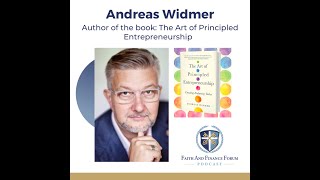
Transcript of a Faith & Finance Forum podcast (July 2022) featuring Andreas Widmer (Catholic University of America). Widmer recounts his journey from a Swiss Guard for Pope St. John Paul II to a tech entrepreneur and business professor, summarizes his philanthropy (the Seven Fund) and explains the thesis of his new book, The Art of Principled Entrepreneurship, including five core pillars that connect faith, human dignity, and market activity. The conversation mixes personal anecdote, practical advice for leaders, and a call for entrepreneurship as the sustainable path out of poverty.
Chapters
Hello everyone and welcome to the Faith and Finance Forum, presented by the Catholic Finance association and sponsored by Aquinas Wealth Advisors. I'm really excited about today's show. We have Andreas Widmer with us from the Catholic University of America. This is going to be a great program. Andreas has a new book out. We're going to talk about that. We're talking about principle, entrepreneurship, leadership in general and all the topics that Andreas spends his time thinking and writing about. Andreas, if we could open with a prayer please. Father, Son, Holy Ghost, Amen. Hail Mary, full of grace, the Lord is with the blessed art thou amongst women and blessed is the fruit of thy womb, Jesus. Holy Mary, Mother of God, pray for us sinners now and at the hour of our death. Father, Son, Holy Ghost, Amen. Andreas Widmer is with us, known to many of our of our listeners and viewers already. I think many of you have already read his book which was released earlier this year in April. I'm still working through my thousand page biography of President Ulysses S. Grant, but as soon as I'm done with that, I'm going to jump to Andreas book for my summer reading. Quick bio on Andreas. He is the director of the Art and Carlisle Sioka center for Principle and Entrepreneurship and clinical professor at Catholic University of America's Bush School of Business and Economics in Washington, dc. As mentioned previously, his new book, the Art of Principled Entrepreneurship was released in April. It's not his first book, not by a long shot. The other book he's well known for was published back in September of 2011. This is the Pope and the CEO Pope St. John Paul II's lessons to a Young Swiss Guard. That Swiss Guard was Andreas actually, and I'm sure we'll touch upon that briefly. Andreas is married to Michelle and you and Michelle have a son.
Yes, we have a son. 18 years old already.
Amazing. Time flies. One of my favorite quotes from Andreas. There's so many, but I'll share this one. Entrepreneurship is an invitation to be creative, to participate in God's creative act. The human person is the only investment with potential for infinite returns. Thus, person centered entrepreneurship is the most noble calling. Very beautifully said. Andreas, my friend, how are you today?
I'm well, John. Thanks so much for inviting me. It's good to see you and I'm so glad to be here with everybody.
Thank you. Likewise. Andreas, for those of our listeners and viewers that don't know you so well, will you just tell us a little bit about your story, where you grew up, your early life, anything you'd like to share.
So I'm the youngest of six kids, grew up in Switzerland, in mountains of Switzerland, really small village. Had some trouble figuring out what my life was all about and eventually joined the Swiss Guards, which is a Foreign legion elite unit in the military. That's the only thing I was good at was when I was a kid and so and there met John Paul II who not instantaneously, but converted me into actually practicing my faith. Of course I grew up Catholic and all that, but it was my dad's religion, not mine. Well, through John Paul it did become my religion and sort of changed my perspective on life. Met my wife Michelle in Rome, introduced her to the Pope and he thought she was a nice girl. So I pursued her to come here to America and I married her here. I lived in Boston, Massachusetts for the first 25 years. Got involved very quickly with technology startups, even though I don't know anything, I didn't know anything about it, but I got involved early on in the Internet, like in 8990 with the Internet with one of the early companies and then later on in the 90s, later 90s with speech recognition, you know, like Siri and stuff you have on your phone. And had this tremendous career in here and live the American dream and saw the ups and the downs, right? That last company, Dragon Systems that we, that I was a part of and helped grow actually turned out we sold that to somebody who turned out to be cheating financially. And that was an inflection point in my life to say, well, I come to America and I live in this American dream. Super fan of all things American. And then I see somebody cheated just the most simple way I'm financially cheating on the books and questioned the whole thing is capitalism is the free market a bad thing? Went on the one hand to run a strategy, a business strategy firm and on the other hand study theology and ministry. Came up with this answer which I put into the book, the Pope and the CEO to say that yes, the free market is actually a good thing, but it needs, just like democracy, a well formed population, it needs a public moral culture that we all agree to and therefore it's focused on people's conscience. And that book propelled me into the Catholic University of America, asking me if I would help them start a business school. And so I believe it or not, I became a professor after not the most stellar experience as a youth myself in school I became a business professor and I have been out here for 10 years helping to build the Bush School of Business and I run the entrepreneurship center called the Sioka Center. And I just absolutely love today, the classroom, working with my students and having the privilege to teach them what business is all about.
You know, Andreas, so many elements of your background are interesting to myself and others, but your close relationship with Pope St. John Paul II, of course, is one of the ones that always comes up. That's not the focus of our conversation today, but I'd love it if you could just share, you know, one anecdote for those that don't know your story as well, of your relationship with that great Pope.
Yeah, it's important to say, I mean, he was not my best friend like I was. I was. I was a Swiss Guard, which looks really great to the outside, but the inside, it's a bit like the valet driver outside of. Outside of your hotel. There's 130 of us, and we do our jobs best when. When you don't even notice that we're there. But he did notice, and he did reach out. I actually didn't like my job in the beginning, and I questioned whether I should be there. And I decided that I made a wrong decision to join. And that's exactly when I met him. And he reached out to me, actually, and said that he was very glad that I was there, that he was happy to work with me. You know, this was. John Paul was pretty much my first boss after I came out of school. So in my first job, really, my boss was the Pope. And people look at him in a spiritual sense, but for me, he was just my boss. And so I would work with him. And he started to model to me what a good leader is. And he focused more on me than I on him, in a sense, in the beginning. And he started to notice my strengths and started to say those. And I remember one small anecdote. He met my parents. You know, the Pope invites the parents to come down to Rome. When you're pledging your life, when you're swearing in, your parents are invited into a private audience. And so my parents were there with me, and as I walk up, he starts to say, hey, Andreas, my tallest guard, you know, and it looks to my parents and says, I love having him here. It's so nice to work with him. He does his job exceedingly well. And he starts to go into some things that I do that he likes. And, of course, my parents were so moved and so proud. And I saw later on that this is something that I pay attention to now. How many times do you have a chance to praise somebody you work with or somebody who works with you, that you praise them individually to people they love and who are important to them, and to praise them in a way that shows that you know them and that you appreciate what they do. I tell you, the build up of this is beautiful. It's, it's. It's changed my life.
Yeah, it is pretty remarkable. I mean, 130 Swiss guards, and then you take all the cardinals and bishops and heads of state and, and the thousands of other people the Pope interacts with. But he knew something about Andreas Wittenberg specifically, you know, with great specificity that he was able to share that with your parents. And then he also took the moment to share with them. That's pretty remarkable. Beautiful story. So, Andreas, has your faith always been a big part of your life? You mentioned it was your father's, you know, faith earlier, but when did it become a driving force for you?
I suppose so. It became. John Paul was, of course, a huge catalyst of this mostly and the way this happened. And I think evangelization and conversion happens. It's a good model of it to show how this happens. I met him and I felt he was like the best thing since sliced bread. I became such a fan of him, but not of the religion, like just of him, because he was a. He was. I felt that he was the most human person I've ever met in my life. He was real, he paid attention to me. I know he liked me. And he. I looked up to him and he became, in a sense, my idol. And then he turned around and said, listen, you don't want me. You want who I have. If you're admiring me, you should. I have a relationship with Jesus Christ. That's what you want. He refused my admiration and turned me away. And so became a way sign to Christ, taught me how to pray. And then from then on, it was always one step forward, two steps back. But it's moving. And I had this profound conversion in the beginning in the Vatican and then went through my first 10 years in the high tech industry, which is of course, with the amount of opportunity, money and privilege, very difficult to withstand the temptation to keep Jesus just on Sunday. Which is what I did. And sort of the book, my first book, the Pope and the CO speaks of this transformation to bring of me to effectively realize that Jesus is as much Lord of Monday through Friday and Saturday as he is on Sunday.
Yeah. It's such an applicable story to many of our audience and many of the Catholic entrepreneurs and CEOs that you and I engage with frequently, Andreas, including graduates of The Bush school that are going on out to business right now, that a CEO, a boss, through his integrity, through his example, through his authentic leadership, can win souls for the church and convert people to Catholicism through that example. Because their employees, the people they interact with, are going to be naturally curious about what makes them special, what makes them tick.
I want to point to the fact that I had no concept of what the Pope is. He was not the Pope to me. I want to say, people say, well, you were evangelized by John Paul. No, I was evangelized by an older gentleman that I worked for. And I was interested just in being a bodyguard. And the rest I could really care less for. It's the same opportunity that we all have at our work. It's, you work with somebody, he's an elder, that you end up saying, wow, I want to have whatever this person has. Guys, this is exactly what every man and woman who's listening to this is probably experiencing in their life among younger people that they look at you and say, I want to achieve what they're achieving. That's the opportunity you took. Not I'm the Pope opportunity, but the opportunity of seeing that a young person looks up to him and says, I want what he has. And then turning around and saying, well, that is Jesus Christ, that is. And to do it in a way. You know, John Paul never told me what to do. He always said what he was, what he would do, what he is doing. And it became this, it became my aspiration. And then the faith he had in me. I remember what he would say. And I realized later on that he said this to many people. And it was always, I cannot wait to see the great things you're going to do. This is a loaded statement and it speaks of the human dignity and of the God given greatness that we all have if we collaborate and cooperate with grace. And so I cannot wait to see the great things you're going to do is one of the great gifts we can say to younger people.
Wow. So beautifully stated. So again, we're going to do the Cliff Notes today because we want to focus on the book. But you, you were a soldier. You were in the Swiss guard serving Pope St. John John Paul II. Tell us, you know, briefly, how did you transition to becoming a businessman and an executive?
So I came. So I met Michelle, my wife, over there, and then pursued her. And the way to pursue, I mean, she went back to America. She was studying over in Rome as an exchange student. And. And so I left the guards after money. My two years that I had to serve and basically said, well, I'm going to go where she is. And I came to America. The only way to come to America was to go to school. So I went to school. I didn't speak a word of English, by the way. I mean a word of English is too much to say. But I spoke like in song titles, I didn't know English and so. But I got into this school and then we got married a year after and I didn't have a working work permit. And so she said, let's just work for somebody for free because if you do a good job, nothing is. Nobody will not pay you. So the wisdom of my wife and I joined a small tech startup that was called FTP Software, which is now like Linux. You know, it's like the people who brought the Internet to the PC and it was this few people there and they're like, well, we can't really pay you because, you know, we're a growing company and this and that, but you can have, you can have some shares or so. And I wasn't allowed to work in that sense anyway. And I said, well, I'm fine. And they said, well, we pay for your travel during the summer. And so I started there because I was motivated to also on my student budget it would allow me to fly to Europe because I took over all of international in the company. And little would you know, this company became one of the biggest startups in technology back in the early 90s. We went public in 93, I joined in 90 or 89 and suddenly I was the head of all of international. I was 23 years old, 25 years old, and I had this huge organization on the me incredible. And had absolutely no idea before of computers and everything, but God works marvelously gave me this chance and I grew into it and had this super ride. And then when we went public and afterwards, it sort of became the fun went out of it. We used to call FTP Fund that pace, not file transfer program that pace. That's how I felt about it. We were all thriving. And then once we went public and it's just, it drained the fun right up out of it. And so I ended up leaving and I joined Dragon Systems, the speech recognition company just before they hired me to say, look, we invented. We were at the cusp of continuous speech recognition and it was Seagate Software actually was involved and they found me and said, listen, do what you did at FTP there. And I took over international there as well. And it was a super ride. Bringing speech recognition to all these foreign countries and foreign languages. And I was in charge of course with the development as well on that. I tell you John, it was an amazing ride. But then with this firework at the end that we sold the company for $600 million and we sold it to somebody who was fraudulent. And so then we dealt with all of that, which was a huge lesson. It's again a gift. It's a huge lesson to learn from that. And that sort of provided the impetus for me to actually examine what's going on. I would have not examined it otherwise. And that's of course the benefit. Now that's what I'm doing. As a result of these highs and lows, I am now interested. That's what gives me the interest to help to build a business school into a Catholic business school and say, how should business be taught?
Yes. Integrity, character, ethics. Not doing shady stuff like you encountered. Absolutely. So Andreas, we could talk on and on about your accomplishments in business. Over 100 leading edge tech products brought to the market, certain services, CEO, founder, every type of startup. You have such an interesting story in all that and I don't want to take anything away from that. But one thing I did want to focus on is the seven fund which is this bringing enterprise solutions to alleviate poverty. I always thought this was an interesting project and company. Will you tell us a little bit about that?
Yeah. So that's a philanthropy that I had and started that. One of the things I recognized through my studies both. So I was with this business strategy consulting firm. It was a subsidiary of the Monitor Group up in Boston, that's the Harvard Business School professors strategy firm. And I took over at one of the smaller firms that they had underneath and I spun it out. It was called OTF Group and we did business strategy for uncertain environments in emerging markets. So I became my whole team. We were a company that focused on business strategy in uncertain environments, specifically as it applies to post conflict societies and emerging markets. So we had offices all over like Africa, Southeast Asia, South America and so on. And I learned a lot. And most of all what I learned is there's only one way to create prosperity and that is through business. And that the poor are often poor. And this goes back to a definition that John Paul actually gave, which I rediscovered. John Paul said, do not measure the poor based on income. Poverty has nothing to do with money per se. Poverty is, he said, is defined as to be excluded from networks of productivity and exchange. That is so profound. It's beautiful because it's an Actionable definition. If poverty is to be excluded from networks of productivity and exchange, then when we want to bring prosperity, we have to include people in networks of productivity and exchange, which is business. So the only sustainable solution to poverty is not redistribution of money, of what is assumed to be a fixed amount of money, which is not true. But what we need to do with the global poor and the local poor is to integrate them into our networks of productivity and exchange, which is business. And so then I started a philanthropy together with, with Sir John Templeton from the Templeton foundation and a friend of mine, Mike Fairbanks, that we called the Seven Fund. And we went around emerging markets to find the best entrepreneurs we could find in emerging markets. We called them pioneers of prosperity. And our theory of change was to find them and then give them a prize and promote them and hold them up. Because if I showed up in a, let's say in Kenya or in Rwanda or something, I might as well come from Mars. They have no way to relate to me. I show up as this rich guy from Switzerland. To them there's no value of this. But if we find a local entrepreneur who's made it and we put that person as the role model, then the way humans work is mimetically is to say, if he can do it, I can do it. If she can do it, I can do it. Then we can change people's behavior and role models. And so that was our theory of change. And so the semifinal did a lot of work with that. And it sort of culminated in us being the seed funder for a movie called Poverty Inc. And you should all Google that. It's a really great movie. It was made by the Acton Institute by Michael Miller, Michael Matheson Miller, great guy. That became a super successful documentary that pretty much talked about what it is that we did at the semi fund. Like many of these entrepreneurs in the movie are people that we gave the prize to. And it was super inspiring and I loved it. But then I stopped it because I feel also that if you're a philanthropy or an ngo, you become, if you, if you don't have, if you don't say, look, we're going to achieve this and then we finish. If you don't do that and then cut it off and get rid of that organization and do a new one, you become what in the military is called a self licking ice cream cone. Which means, and it's a funny term, but it's totally true, which means that you end up existing for your own sake in the sense of poverty then becomes Your business. And therefore more poverty is more business. It's a misalignment of incentives. And then you become a part of the problem rather than a part of the solution. And so we dissolved it after seven years because we said, okay, we went out to achieve this, we did it, that's it. And that's when providentially I was led to help start the business school, the Bush School at Catholic U.
Let's drill down on that for a moment. And by the way, 7 Pun's story is incredible. Thank you for sharing that. I do encourage all our listeners to check out the video. What an awesome project. Thanks for sharing that, Andreas. So the Bush School is a lot different than everything else you've done. I mean you're an entrepreneur, you're a businessman, you're kind of an out in the field guy. You're going into academia, which has a reputation for being more bureaucratic, perhaps slower moving. What was that shift like? You going from the business world, the world of entrepreneurship to academia?
Yeah, I'm not a big business guy, I'm a startup guy. Yeah. I have add. Okay. So I won't pay attention long enough to. For something to grow that big. My expertise and I think my talent, my God given talent is startups and ideation and things like that. And so here's about this is a startup. I was very blessed to. The person who asked me to join the Bush school is Andrew Abella and he's the first dean and he's the dean now and we have a really great relationship and he is a great manager, a great leader in the sense that he knows what I'm good at. And this is something I hope we talk a little bit about later about my new book is the way when you start a company you should find people and match and see what their strengths are and then match them with other people who make up for my non strengths. Right. And he knows that I'm a startup guy and I'm an entrepreneur and so I have this Sioka center and I get to actually do the outperfacing entrepreneurial stuff. And I have very little to do with the actual bureaucracy of the university. Because he knows not only that I would hate it, but he also knows that I would drive them crazy in 10 minutes. It's just, it's water and oil and it's not my fault or their fault. It's just, it's just one of these things that you don't let. You don't take somebody's non strengths and put that in the front of their job. But I have to say, my overall experience at the Catholic University has been a very, very positive one. First of all, I don't know whether you have ever seen the campus, but we have certainly one of the most beautiful campus in the United States. And then to have this environment of 13 different schools surrounding the National Basilica of the Immaculate Conception and having this real desire on campus to really live out our faith in Christ, our Catholic faith, is always inspiring and I absolutely love my time here.
Beautifully said. And as a frequent visitor to campus, I can testify that as well. That culture just permeates everything you see and all the people you meet. So let's get into the art of principled entrepreneurship. Your new book, Andreas. This is. This book's creating a lot of chatter. A lot of people are reading it and reacting to it. It's a really good book from everything I hear, and I look forward to reading it myself. Tell us what inspired you to write this book?
So I always wanted to. It's sort of a sequel, in a sense, to the prop Neco in that I wanted to update what I now learned and what I teach. And so I always knew sort of what I wanted to say. And I wrote this book twice before and it. I don't know whether I can say this on this podcast, but it sucked each time so, so bad that my wife, like, you can't publish. This is a. This reads like a sandstorm.
Wow.
It's like so dry. And then I'm in this men's group in a prayer group where we meet every week in the morning, early morning, and I brought it to them. And in early 2020, we do this virtually. And I was actually in Rome because I was going to teach there for the semester at the Catholic University's Rome campus, which, although also, by the way, is a secret tip. Like, this is the best Rome campus of any university. So anyway, so I brought it to them. Then my wife said it was horrible, unreadable. And then they. We prayed with each other and so on, and they basically we prayed and they came back and said the reason why it's no good is because you're not talking about somebody, but you're talking about something. And you're a storyteller. You need to talk about somebody. And that was made the first book good and that would make the second book, but. Except then I'm like, okay, I got it. Now I have to think of who to talk about. And I actually did. The question, the answer gave itself out of the question because one of the people that I knew years before, when I was still living in Boston, nothing to do with education. I met a CEO, an entrepreneur. His name is Art Sioka, who changed the wine industry into what you know it to be today. Like he said, you know, my buddy Bob, who introduced me to him, who's one of the guys in my prayer group, always said, he's the CEO you should know, but have never met. You should know him, but you don't. And it's because he's the guy who came up with boxed wine with wine spritzers, wine coolers, who made wine to taste, to fit the American palate, you know. And he built the second largest wine company in the world, largest wine brand in the world, and so on. And yet nobody knows him because he feels like, why should they know me? They should know the winemakers and so on. He says, I'm the impresario. They should know the first violinist, and they should know the oboe player. Not me. I doing. I'm just going like this. I'm just orchestrating it. And I just immediately knew that this is the guy I need to write about Art Sioka. So I call Art. Lived in San Francisco, I'm in Rome. I call Art, say, art, you got to do me a favor. I have this great idea. And he said, sure, what is it like, Art, I'm going to write this book. I didn't tell him about the bad efforts before. I'm going to write this book, and I have an idea of how to do it, but I want to tell your story in the book. And, you know, it would be really great if you would agree to this. And, you know, I won't take too much of your time. And he says, well, I'm very flattered, and so on. And I have. He says, I have good news and bad news. And I said, well, let's give me. Give me the bad news first. And he says, you see, the truth is I have like, reoccurrence of cancer, and I have two months to live. And then I said, okay, what's the good news? And he says, I have lots of time till then. And this is how. This is Art. And I'm like, single Art. I don't know what to say.
Like what?
And he says, look, if you're in, I'm in. I have a lot of time. No appointments. I have a lot of time until then. And so if you want to do this, I'm. I'll do it until I die. And I started to record. And so we have here an 85 year old man who's looking with me back on his career. I record every one of our. I have hundreds of hours of recording and I, in a sense, get to sit with him as he looks back on his life and his career. And you know, death was always something we talked about because after two months we're like joking that he hasn't died yet. As a matter of fact, art lived for two more years and he only died last December 18, after we finished the book and he saw the COVID and it was three days before the book went to print. And this privilege of turning around now and giving you this story of what one of the most successful CEOs, Catholic CEOs in the United States, has to share about his life and what he thinks is important in business is one of the privileges of my life. And that's what the art of principled entrepreneurship is, because he is the art of principled entrepreneurship.
Wow. Deeply moving. I can only imagine how you must feel to have enjoyed that privilege and now to be able to publish this book that sprung from those last few months and years together with your good friend and your mentor. Wow. Just incredible. So principled entrepreneurship, this is a term that has a definition and it's how you open your book. I mean, my takeaway from reading those pages at least, was that it really ties into all the important aspects of our society, right? The founding vision of the United States, our Judeo Christian heritage, which is so central to the formation of this country and this country's prosperity and general moral character, but also the free market system, this great driving force which Americans did not necessarily invent, but to a degree we've perfected and made better. It seems to me, in a sense, it's kind of the fusion of all those things. But, Andreas, walk us through your definition of this.
So with the subtitle of the book. So here's the book and the subtitle of the book is Creating Enduring Value. And that is what principled entrepreneurship is all about. Think about this. The core question of business. We make this too complicated. When I talk to the students the core question of business, the first thing to ask is, how may I help you? Do you know that that's the most businesslike sentence you can say? It's not how can I be profitable? Or give me your money. It's all the cliches are actually wrong. The truth is that the business person asks you, how may I help you? This is two people, a customer and a supplier or a creator, and somebody's creating for And I use my God given talents to solve a problem, to create value for you. And the value is of course measured in value that hasn't been there before. And we can call that profitability, but that's just the transfer term for it, profitability, but it's creating value that hasn't been there before. For us Catholics, the spiritual value of this or the spiritual insight in this is that this is a very Christian, a very godlike thing to do that we. So John, you and I, we started this blog, this, this post here, this video together and there was nothing here before. And when we're done, we're going to look back and it was your mind and my mind and there was nothing there before. And we create this thing together, we put a bow around it, we send it out and people can see it. So when you're watching this now, this is something John and I did before you watched it. We came together, we use our God given talents and we add value for you. So if this is an insightful conversation for you, this is something that wasn't there before, right. What does that remind you of that reminds you if you go back to Genesis in how God created the world, it's like a third person now comes in here and the three of us say, hey, I have an idea today, how about we create the world? You know, create this animal, that animal. And God said, okay, this is a great idea and created it and give it this, give it some independence and then turn around and say what it is good. And so John, you and I were going to turn around afterwards and say this was good, this is a good, you know, podcast and we're imitating that when we were. This gives a few insights into, into this enduring value, is that it's of course what a crowning of creation, that we were made in God's image and likeness, which means we now have the freedom to go and create goods that are truly good and to go and provide services that truly serve. But just like with love, we of course get the choice to not we. God created us as human beings in his image and likeness in the sense. Imitating God. If you do this well, what, what happens when you imitate somebody a lot, you become more like them. This is why the church teaches that work is one of the integral parts of the path to holiness, you know, and therefore we, we hear too often a totally wrong perception of what it is that we do at work. This is what helped to define my divided life where Jesus is on Sunday and enduring the week. He. It's only. It's just business. It's only business. No, no, no, no. If you had this out of this, John, grow these ideas of saying, well, then afterwards you have to have corporate social responsibility and philanthropy to give back. Look, let me tell you something. If you have to give back for what you've done in business, then you have a wrong conception of business. Because when I say, how may I help you after I do that, I don't have to give back because I just gave. And so my hope with this book and with my teaching is that we all start to understand this in a more profound way and turn this into a way that we can live this out in the secular world. This book is not written for Catholics. I have other things that I did. The Pope and the CEO, I wrote for Catholics. This is a secular book and it explains all of this, what I just said, because I'm here with the faith of finance. So I'm saying it in a very Catholic way. But I say all of this in this book in a very secular way, that you can actually live this out in a company like Arts Yoka did in the wine group, and make a life change for everybody who's involved in your company.
Yeah. To be clear, principled entrepreneurship is a philosophy that anyone can embrace. Catholics, non Catholics, anyone.
Yeah. It's about human flourishing and creating enduring value. But because we have a nature and natural law and the world is made by God, there are certain rules and certain ways of doing things that reflect his law. And that's, of course, something I can explain in detail in Catholic language, but I can also explain it in secular language.
Let's spend just a few minutes previewing the five pillars that you go through in the book. And again, this will just be a preview. Everyone needs to order the book today to get the, you know, the real thrust of what we're talking about today. But pillar one is the economy exists for people, not people for the economy. Comments on that, Andreas?
This is the first thing that people get wrong. I hate it when somebody says it's just business. It's nothing personal. There is no thing that is not personal because we. Because John Paul's personalistic norm.
Right.
People are to be treated for their own good. And so this is not a chicken and egg question. What was their first people or the economy? People were first and the economy serves people. And that's a very important understanding. And we lose the forest for the trees constantly. Companies do not have a right to life.
Well said. Pillar two. To work is to create, to Create is to be human.
That goes to this thing I just went through about what are the objectives of a company. Milton Friedman says the only objective of a company is to create shareholder value. That is true and not true at the same time. It's like Milton Friedman, as brilliant as he is, he looks at a watch from the outside and says what the watch is good and what it works for. He's never run a company. He needs to from the inside. Me as a guy from the inside, let me tell you this. Nobody starts a company to create shareholder value. People start a company to create something they try to solve. How may I help you? Is a much better way to start. People start companies because they see a problem, an issue, a need, and they create it. It's a part of them that they give. If you would only start companies to create money or create shareholder value, most companies would never exist because you'd give up before it takes so long to get there that you would give up beforehand. Companies have three objectives. The first objective is to create. Of course, this goes back in our understanding to the idea that to work is to the stewardship mandate. We continue God's creation through work. Companies continue God's creation of the Garden of Eden. Work comes before the fall. If your work is not creative, creating something, and it could be creating order, I can go downstairs now and I create order in my kitchen or in my living room by vacuuming or something that counts as creating. If you're not creating something is not right and you should take a step back and look at it because that creating helps you flourish as a human being. Because what John Paul says is when we work like that, we don't just make more, we become more. Because when you imitate God, you become more holy. Right? Now, if this is good for you, it has to work for both of us. You, John and I, we're working at this together. This should lead to both of our holiness. So if it's good for you to do this with this podcast, then you invite me and it has to be good for me too. And so that is the support. The second objective is to support the entire team and everybody involved in this goal in a sense of holiness, of fulfillment, of flourishing, human flourish. And then the third objective of the company is rewarding. Because when you create value, you should get on all levels, spiritual, physical, mental. The reward of the fruits of your labor, which is, which belongs to you, is a matter of justice. Right? And, and that's why I'm actually very suspicious of non profit companies. What do you mean non profit company. Why would you waste resources? Talk to me about for profit companies and then take the profit and do something else with it if you don't want it. But don't say nonprofit, you're purposefully destroying value or what. So the reward is a non negotiable, but it also has to be physically, spiritually, psychologically rewarding for your team, for everybody involved, which may not necessarily just stop at the border of your company and with your customers, but society and everything in common, like through taxes that the company pays the, the government and the common good helps and so on and so forth. So that's this second pillar. To work is to create and to create is to be human.
Pillar 3 Culture eats strategy for breakfast Andreas, I do think I've heard this before.
It's an old cliche and I picked it up because it is used a lot and misunderstood. And let me say exactly in a brief way what I think this is all about. When you start a company, most people think that they're creating a product and that all their focus goes on the brand. They bring in people to help with the product and get the product out and do this. And at the end they realize that they have now a product. But the company is stuck because they didn't pay attention to the culture in the company. And so now they're stuck with a product and they can't go on. Then they have to search and exit because they made a product. They don't have a culture of a company. And so you're not enduring. Right. And so they have to flip the company and sell the company. Art never sold his company. He never even went public because what he did is he created a culture that was conducive to human growth and to collaboration. And so they had so much fun doing this that this company gets larger and larger. There was no sale, there was no going public because the culture, what they built in that company was first and foremost a culture and everything else became a result of it. So we have a complete misunderstanding, a misfocus in our companies. The first thing you should focus on is the culture. VCs know this when they say, look, I invest in teams. You know, it's like, what is it Jack Welch who said it's the team on the bus, not, not where you're going. A B team can figure out, it can never figure out an A plan, but an A team can find out, figure out a B plan that has to do with culture. Yeah. And so I think we just have.
A wrong focus Pillar four is principled entrepreneurs always seek to create win win solutions.
It's so difficult with, I want to say this generation, but it's been going on for some generations to show people that business is not a zero sum game. In business, you're creating new value. You know, most people don't understand that there is not a fixed amount of money in the world. That every time somebody sells or buys something in the free market for more than what it costs the other person to buy it, there's new money there. That money is. Money is like, is like the loaf and the fishes. You know, in the parable that when we do good business, it's loaves and fishes, there's more and more and everybody can be participated. So this whole idea, this is why this redistribution idea is so strong, because people think this is a pizza. And of course when there's more people, you have to cut this up. But the truth is we're a pizza shop and we can make more pizza. It's again, networks of productivity exchange that when we create win win solutions, and that means that we have to have free will participation and not somebody else coming in. Oh, no, no, John, you can't do this, of course, with reasonable legal frameworks. But to say I should be free to buy my telephone service from this company or that company, whichever satisfies my need and creates most value for me, should be the one that gets my business. And I get to decide this as the end user. And so that's just the big. It's also remember in the 90s everybody was into the Tsung Tzu, the Art of War. Do you know the dumbest comparison, I say this as a soldier, the dumbest comparison to business is to say that business is like war because that has seriously bad consequences. It's apples and oranges. Business is much more coopetition and much more like the Olympics. You know, Art loved this. We finished a book right when the Olympics were on and he kept referring to this to say, you see all the people who went to the Olympics, the athletes who maybe didn't win, but come back and said, this has been the experience of my life. I have my personal best and because I ran next to these people, I'm so much faster. Now he says it's much more about the Olympics than about war. And boy, was he right.
Pillar 5 is always think like an entrepreneur.
This was Art's foundational thought model, mental model. He says there's two ways of thinking about the world. You can think about the world as a creator or As a harvester, Harvester always say, what's in it for me? How much can I get? And short term, give me, give me, give me, like, take, take, take. And just. He compared it to the vineyard. He says, if I would only focus on the harvest, I tell you, my vineyard would be bare barren in three or four years because I would just show up and grab every last grape and just. And then leave and come back when there's. When there's a harvest again. He says, no, the good farmer, the good winter focuses on the soil and on the environment. And it's a creator. I actually invest. I create the environment that. That leads to the harvest. It's not that you never harvest, but that's not your mindset. Your mindset is the mindset of a creator, which actually goes back to the first principle of what work is all about. And he says, he always said that the entrepreneur is first and foremost a creator. And what he wanted to point out with always think like an entrepreneur is he says, entrepreneur is not the person who starts a company. There's entrepreneur. Everybody should be an entrepreneur. That's why he said, always think like an entrepreneur. There's a little test on my or a little quiz on my website, andreas-whitmer.com where you can take a test and see what kind of entrepreneur you're at right now. You can change over life. But he says the entrepreneur can be the employee entrepreneur that comes to their manager not with a problem, but with the solution to say, I take this on and I create solutions. So then you show it's a mental attitude of a creator rather than a harvester. And he gave a lot of examples in there of how that happens.
And Andres, as the book winds down, you talk a lot about the future, you know, rising generations, young leaders coming up, et cetera. Was that a major goal of this book was to have heavy influence on the rising generation of business people and entrepreneurs to affect their thinking?
Yes, two sides of the focus. We want to give people hope. Both Art and I, to different degrees, of course, were fortunate and blessed to live the American dream. I would like to communicate that American dream to the younger generation and to tell them how much I admire and respect it and love it and to show them what it has achieved, even around the world. I'm not saying that our free market system is perfect or ever will be. I don't think that only in heaven do you get perfection. But we are moving in the right direction right now. With COVID there has been a bit of a bump, but Think about it. Poverty, abject poverty, which used to be 95% of humanity in, let's say, 1850, 95% of humanity lives in abject poverty. Today it's less than 10%. That's the free market right there. And that's, in a sense, capitalism. I don't like the word, but we can say that people would never hear this. And I write about this in the book to say, look at the achievements, and then to say, look, you have a chance to participate in this, and with the right mindset, with the principal entrepreneurship mindset, you can bring about so much good to business as a force for good. And that we encourage students to start and to be an entrepreneur at every level. One of the things at the end of the book that I asked Art, so what do you have, you know, what did you learn out of our hundreds of our two years of discussions? And he said, I learned that I was an entrepreneur long before I owned my own company. I was an entrepreneur in my first job, and I want others to do the same. And the second aspect of what I'm doing, and I had a bit of a struggle in convincing the publisher to keep that in, is I have a chapter in there about teaching this because, you know, I'm at the Catholic University of America. And our whole purpose is not to become the sole provider of education or something like that, or in a sense, competitively, in that sense that I want to be dominating it. We want to add value to everybody else in the United States. So everything I teach and everything I do is available for everybody else. And so I wanted to have a chapter in there for other people to copy what I do in the classroom, even if you homeschool, to take this and do it yourself. And also our website@siouxacenter.com, we have something called the Gospel of Work, where you come in and just take it like we give it to you in video format in every conceivable way for us to add value for you and society at large. Because the way we're teaching business now isn't the right way, and we need to change that.
Why do you think so many people in the mass culture misunderstand the purpose of business as you've so nicely articulated here in your conversation around principled entrepreneurship? So many people, their first impression of a successful business or a successful business leader is, he's a rich guy, he's greedy, he's just in it for the money. A lot of the rhetoric in our public discourse, you know, that's what it sounds like right now. I mean, why do you think people get it wrong so much, Andreas?
Two things. It's. On the one hand, it has to do with this ideology of the fixed sum game, like the fixed pie, which is a devastating lie about economics. The other thing has to do with short terminism. And we have lost the love of mastery. You see, you can say what you want about a Steve Jobs or about a. You can name any one of the gates or whatever, but one of the things that they do that led to their success is mastery. That Steve Jobs can create something. His team creates something that is so darn good, and that is not something that you snap a finger and say, here it is. There are thousands of hours, tens of years of experience behind this, of learning tedious, hard learning, like learning an instrument or something like that. And our world, in a sense, fell out of love with this. We urgently need to fall back in love with this to find out what is my talent and then practice my talent to get mastery, human mastery. And that's the cornerstone of my teaching, is to say, you know, I start a business with every student, and they're like, well, I don't know what to do. I said, I tell you what, God gave you gifts that you're not even aware of. If I help you, let's find those gifts, and then I can help you. I can teach you how to add value for others with those gifts, then you're on the path to mastery, because then what you do is also in line with what God gave you. And it's in. Therefore, it's in line with your entire soul and everything. And you start doing something and you use that. You know, in the church, we say you live for others, in a sense, and if you create value for others with this, you're on the path that actually, what we have created, both the Friedman doctrine and the csr, the corporate social responsibility stuff we have, we're only focusing on the end of work or the outcome of work, and nobody focuses on work itself anymore. That's why today we have two thirds of our workforce is disengaged. They hate their job. And that's because we don't focus on helping people to really achieve mastery at their job.
You know, Andreas, your perspective on all this is so interesting because you're both, you know, engaged on the high level, you know, as a professor and a thinker and writer on these topics, but you also have this long record in the trenches as an entrepreneur. As you put it earlier on the inside, I'm Wondering if any of our listeners, CEOs, senior managers, financial executives want to bring practical applicable tools for creating culture of principled entrepreneurship in their businesses. What are a few tips you could give them now?
So the first thing, and I'm actually just doing this now, I do this every few years in my own team that look at yourself and say what are my talents and my non talents? And we need to start to adopt that language. You know, every year people go and do their 360 review and do employee reviews and everything. And I want to suggest that you revise that a bit. Let's talk about talents and non talents. One way to do this is actually to use and I have it on my desk right here because I'm working on it is you could do the Gallup strength finder, right? And say what are the God's talents that you have? But then also ask around. So I'm somebody just what you just pointed out, I have the grand vision. I'm sort of somebody who sees the big forest and everything. But as soon as it gets into detail, like you don't want me to set up the budget or to manage the budget because it won't be exact at the end because I'm sort of much on a bigger scale. And so I'm trying to be self aware of this. And then when I go into a team and by the way, anytime I start help a company or start a company, the first thing I hire is an absolute obsessive compulsive detail finance person next to me because I know that that's what I need somebody who, and I tell them, financially, you manage me, okay? Because you tell me when to stop and I give you authority to say widmer, that's it, we're done spending. Because otherwise I get too enthusiastic, right? And so what you do is you have a strength and you create a team where everybody's strength covers for the other person's non strength. Almost like circling the wagons. Boy, when you have that, everybody fires on all cylinders. Yet think about what we're doing in our review process. To say, John, you know, the thing with the details and maybe we send you to more accounting classes or something like that. An accounting class on me is totally a bad investment. It's not that I don't want to learn it, it's just like teaching a cow to dance. It's just not going to happen. Whereas if you tell me, let me give work more with your mental models and speaking and performance and things like that, that's where you get A return on investment. And so if we do this and we approach our teams like this, I tell you, this is when a team isn't just one plus one is two, but it's one plus one is three, four, five.
You know, last question for me today, going back to a theme that's come up a few times. Just this burning desire that every practicing Catholic has especially and other people as well. But it's particularly strong in our Catholic tradition of alleviating poverty. We hate human misery. We hate poverty. We hate, you know, any oppression of the poor. We're called to serve them and lift them up and walk with them and improve their circumstances. Andreas, you've mentioned a couple times that really it's only the free market, it's only entrepreneurship that can truly lift most or all people out of poverty sometime in our lifetimes or soon thereafter. That's just the truth, right? I mean, you've seen a lot of the world, you've studied a lot, you've done a lot of different kinds of work. There's no other alternative except a vibrant, invigorated free market with lively entrepreneurship. That's the only way to do it, right?
It's the only way that corresponds to human dignity. There's a difference between humanitarian aid and economic development. Right now, for example, starvation and hunger is on the uprise, upkeep because we had Covid with a disruption on many levels. Also supply lines, aid investments, all kinds of things have stopped during COVID And the fallout of this is a dramatic increase in humanitarian disasters. And that means I think we're going to face severe hunger in certain places. That is not something you're just going to say, oh, let's do some economic development. That is a humanitarian crisis. And in humanitarian crisis you show up and you provide. Okay, that's, I'm never going to question that. It's a non negotiable. That's the Good Samaritan. But even the good Samaritan, he didn't say and here's the check. He can live here as long as he wants. He was only going to live there until he's better. And when he's better, he goes over and he has to focus on being the profitable servant. And the profitable servant is to be perfect as the Father in heaven is perfect. And that means I grow through these gifts that God gave me. And there I have to produce these returns, this value add that is both a privilege. The church teaches there is a right to work and there's an obligation to work. You know, Paul says you don't work, you don't eat. He doesn't say this to the person who, who can't work. He says this to, to all of us to say, when we work, we don't just make more, we become more. So to help everybody to develop in our full human dignity, we have a right to work. That means that economic development programs that do handouts rather than hand ups in a way are demeaning to the human person. And that is often where helping hurts, that we create dependency. We create. What's a good word for this? We make people feel less equal and dependent and we infantilize the poor by saying, well, you are not, you know, you're not good enough. You can't play at this level. It's almost as if we sent the poor a message that they're stupid. But you know what? The poor are not stupid. What needs to happen is we need to recognize them as equals and give them access to our markets, to our networks of productivity and exchange.
Very well said, Andreas. As our time comes to a close. Any parting thoughts or capstone thoughts for our audience today?
So I'd love, you know, I'd love to have you come and check out the book. It's at andreas-widimerwidmer.com and, and I'd love to hear from you. There's all kinds of opportunities there. And then also if you have a chance, we just released a new program, an eight video series called the Gospel of Work and that you can find on siokacenter.com and maybe we can put it into the notes below. And there it's a free course. You have to sign up for it because it's unteachable. But it's an eight video series that I developed pretty much on the basis of the Pope and the CEO that teaches that deeper meaning of work and what we can specifically do, each one of us personally, to reach that deeper level of both gratification at work, but also the pursuit of holiness through work.
Andreas has been such a delight. I hope this is a conversation that Artsyoka would have appreciated and approved of. I think he would have, I'm sure. I've loved our time together, my friend, you're doing such great things. It's good to touch base. Continue. Good luck on the book. I know it's doing great. It'll continue to do well, I'm sure. And God bless you and all your work. Ladies and gentlemen, you've been listening to the Faith and Finance Forum hosted by the Catholic Finance association, presented by aquinas wealth advisors. We'll see you next time. Thanks again, Andreas.
Thank you.
More from Andreas



He Teaches Entrepreneurs How To Be The Leaven of Society | Andreas Widmer | The Pope and the CEO



Principled Entrepreneurship with Andreas Widmer: Lessons in Leadership and Humanity

Principled Entrepreneurship with Andreas Widmer: Lessons in Leadership and Humanity



The Virtues of Free Enterprise and the Heroic Spirit of Entrepreneurs | Villanova University | 2024
