NYE 16 - Doing Business in Uncharted Waters
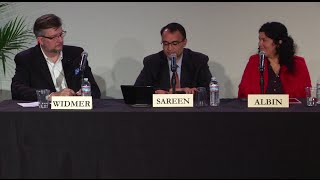
Andreas Widmer, a former Swiss Guard, and Nancy Albin, founder of a nonprofit that employs people with disabilities, discuss why business matters beyond profit. Widmer argues for vocation-driven companies; Albin shares what she learned running the Los Angeles Habilitation House and contracting with for-profit clients.
Chapters
It.
Okay. Welcome everyone. Before starting, I would like to thank the Work center for helping to organize this event. I think there's some cards on the seats out there that explain to you a little bit more about the Work Center. The Work center is a volunteer association of workers who strive to accompany people in the challenging journey of seeking a job or considering a change in career path. Their mission statement reads as follows. Together we try to unveil the real needs at the basis of the job search and the positive aspects of this journey. We offer help in reviewing and editing resumes, preparing job seekers for interviews, encouraging them when difficulties seem to prevail, and building contacts. Starting from our own professional networks, we also organize events on a broad range of topics related to the nature and meaning of work. In light of the Christian event, you can learn more by visiting our website@www.workcenter.org. and I would just emphasize that all the services at the Work center are freely offered. Okay, so the event at hand. Doing business in Unchartered waters. So I work for an investment company in Boston. We're in the business of investing our clients money around the world in the most successful businesses we can find, the most profitable businesses we can find. But over the last 10 years, we find that our clients are increasingly asking us about what's the ESG score of the companies we invest in? ESG stands for environment, Social, and Governance. So environment. Are these companies helping to preserve the environment or doing the opposite? Social. Are these companies, how are they treating their employees? Are they selling products of integrity? And how are they impacting the communities in which they operate? Then governance has to do with how are their executives compensated? How are they treating the shareholders and employees? And also a sense of transparency and disclosure. There's some preliminary evidence that companies that take some of these issues seriously do better. Now, maybe that's because they avoid litigation. Maybe that's because customers want to support these companies in some of the things that they're doing. Or maybe they are more sustainable businesses when they consider some of these factors and what they do. I actually don't think that's necessarily the most interesting aspect of this. What's interesting to me is that over the last 10 years, since the financial crisis, there is a different question being asked. What is the business of business? What does business serve? Who does it serve? I'm really excited today because I think we have two speakers with us that can help us go a lot deeper into these. Into these questions. To my left is Nancy Albin. Nancy is co founder of the Los Angeles Habilitation House or lahh, and she is providing vision, management and leadership in the major corporate economic strategies, objectives and policies, overseeing LAHH accounting, budgeting, tax, treasury, administrative functions and automation efforts. Nancy has over nine years of combined experience in corporate balance sheet audits with a Big four accounting firm and financial budgeting, forecasting and analysis with a Fortune 500 company that is a leader in family entertainment. And then to my right, to your left is Andreas Widmer. Andreas is a Director of entrepreneurship programs at the Catholic University of America and President of the Carpenter's Fund. He was previously the co founder of the Seven Fund, a philanthropic organization run by entrepreneurs who invested in original research, books and films to further enterprise solutions to poverty. He's the author of the Pope and the CEO Pope John Paul II's lessons to a Young Swiss Guard, a book exploring leadership lessons that Andreas learned serving as a Swiss Guard, protecting Pope John Paul ii, and refined during his career as a successful business executive. He is a frequent speaker around the world on issues related to business ethics, entrepreneurship, business leadership, productivity, and the challenges of executive management. So welcome to you both. So I think maybe the place to start is really with the theme of the New York encounter, which is longing for the sea, yet not afraid. I thought maybe we could start with you, Nancy, and really focus on this point about longing. You have this job at Walt Disney 2000-2008. Sounds like a pretty good job. It sounds like a job you liked. And something changes. Something changes in terms of what you want to be doing and what attracts you. And I was hoping you could talk more about that.
Absolutely. Thank you so much for the question, because it's. I like the question that your customers are asking after the crisis because. Because after the tsunami that hit Sri Lanka, I don't know how many of you remember that. For me, the question about work changed after I saw the destruction on the news in Sri Lanka and I didn't know anyone who had died from that event. I started to ask myself a very important question, which is, what am I doing with my time, my talents, and my education? And it was a question full of hope and possibility. I had lost friends in 9 11, which was much more personal. But this question wasn't, oh my gosh, the world is in a moment of destruction or a moment of end. But it was a beginning because I understood the value through what you are doing at your workplace. But specifically to be so much more than to stop at the task or to stop at the supervisor's approval or praise that you may see so that question, what am I doing with this specific talent? Because I can't do many things. I'm not interested in everything. So the interest even that I had was I felt very personal and specific to me, and I shared it with my very good friend, Guido Piccarollo. And through a discussion and dialogue that we continue to have to this day, which is one of the best things that's a fruit of this question, I would say that we've deepened that initial longing and that initial attraction of what is your specific interest, your work, your energy that you're putting to your task today? The meaning of that and the depth of that has become more a point of departure for us day after day.
Great. Thank you. So maybe the same question for you, Andreas. I mean, I know in your background you've been an entrepreneur, the technology company, you've been a philanthropist. Now you're a professor that teaches about entrepreneurship. And before all that, you were in the Swiss Guard. So there's clearly a sense of searching, of longing for something. Can you talk to us about that?
Yeah. My life is a big old search. Right. People always are surprised that I didn't go into the Swiss Guards because of any religious piety or any religious belief. You know, as a Swiss, you have this privilege to go into the Swiss Guards, but really you only have to be Catholic, like baptized and confirmed. And that's about as. How as high as you have to jump. So on that side, it's a bit more strenuous on the physical side. And of course, they like big guys like me. And I joined there because I'm the youngest of six in my family. I grew up in the middle of nowhere in Switzerland. My village has 400 people in it. You can't even find it on a map. And I really struggled in finding who I am. You know, if you're the youngest, all your older siblings, even if they're terrible at something, they're still better than you, you know? And so I really struggled, had a tough time in school and just didn't know who I was and what life was all about. And I. And I started to basically try to prove myself. I was sort of a tough little guy, you know, So I excelled in military and eventually went into this. You know, when I heard that I could be a bodyguard, I could be trained to be a bodyguard and be paid for that, I'm like, okay, that's me. That's what I'm going to do. And I did this to impress others. The fact that I had to protect the Pope didn't really mean anything to me. And then I met John Paul, and he. Actually, I met him right when I started to find out that now that I've impressed others by being a Swiss Guard, I found that very empty. And I started to accuse myself of being a total idiot, of having gone to a foreign country. You know, Italy is not an easy country to live in. As a Swiss person, let me tell you. I tried to cross the street in Italy and I couldn't. The Italians are colorblind. And I actually had this crisis where this all came to a head, of saying, now you've looked for, you know, you've looked for this happiness and for what makes you happy, and here you are. And I was as miserable as ever. And basically it happened. I was on duty one night, it was actually a Christmas evening, and I just totally lost it and I cried my eyes out. You know, many posts in the Vatican where I went as a Swiss Guard, you're on your own. Like you're up in some room up in the Vatican palace or something, and nobody's there. And especially during the night. But that night, suddenly she. John Paul comes out and I'm like crying. And he noticed, and he ministered to me in a very profound way of not telling me what to do, but in reaching out to me as a human person, not as the Pope, but from one man to another, and telling me that he would pray for me. And that was the beginning of the change of my life. It just. I still get goosebumps now when you, you know, when somebody reaches out to you and you're totally alone and you totally think that you're worthless and that your life is worthless, that is really. That really makes a. Makes a difference. So much so that I then looked at him and said, wow, you know, whatever that guy has, that's what I want. You know, I want to live like this. And then instead of taking this on himself, he pointed to Christ and said, what I have, you can have. And then by the grace of God, I received a gift of faith and that, you know, you want to do sort of a bookend and say, and then everything was fine. No. And then I continue to be an idiot about winning it, losing it, living in the grace, I want to say. And then not. It's sort of a, you know, my life is one step forward, three steps back. And. Yeah, so. But the theme of it has always been this longing. And I think it comes out of this idea of longing for acceptance, for peace, for what they said yesterday, that it's okay, you know, to take the plunge into the faith that it is going to to be okay. Because I kept thinking that I had to prove something to somebody. And John Paul showed me that I actually don't. That my dignity doesn't come from what I do, it comes from who I am.
Thank you. So maybe, Nancy, we could come back to again, the title here is Longing for the Sea, yet Not Afraid. So there's an element of risk in that quote. And I'm really, you know, struck by the fact that you've got again, you've got this really good job at Walt Disney. You know, it's 2008, the world's falling apart, we're going into one of the biggest recessions in U.S. history, the unemployment rate is shooting up to 10%. And you want to start a business to help people find jobs. Like that's a lot of risk. Like, what helped you take that step? What helped you carry that risk during that time?
Absolutely. There was a person that we met whose first name is Peter and he would call us naive and he said, maybe you're naive enough to succeed because he thought we didn't see all these factors that you're pointing out that the recession in and of itself to start a nonprofit, so we're going to be asking people for money when everybody has much less money, was just instead of a for profit company, which you can then charge for a service, was something that I think was very striking to many people along the creation of lahh. But to what helped to take that step or to take on that risk was if you go back to that and maybe you can have your, you have an experience similar in your life. But when that question arose in me, what am I doing with my time and talent and experience? It was a very helpful question to keep taking steps because I wanted to find the answer. I wanted to continue to answer that question. It wasn't enough just to say, well, this is family entertainment. You know, I could watch a movie with my grandma or my niece. I'm not going to offend anybody. There's going to be some type of moral lesson which I probably won't discuss, agree with. So I'm doing, I'm putting my efforts to use. I'm in Los Angeles. It's either like aerospace or like entertainment. So I'm in a good field. So I could have, I could have, I couldn't. Honestly, I couldn't have stopped at that and said, yes, this is enough. And this is the answer to the question. So the companionship with Guido Our dear friendship was also something that allowed that risk to be accepted for the most part, with calm and serenity. Understanding that it's a journey, that characteristic was extremely apparent to both of us. That it's not going to be overnight. We made the decision early on to keep our jobs at Walt Disney and write the business plan on the evenings and weekends. So financially I could support myself. He could support. So sure, it took a lot of our free time, but it wasn't something asked of me that I couldn't do. And I would say that's a characteristic of my faith. I haven't been really asked something that is totally unreasonable and without and beyond what I can respond. And even my response may be less than what someone else can give. But it was reasonable for my. It was reasonable for me to spend my time this way because it was connected completely to answering that question. And then we learned dependence, which is beautiful when you really learn it. We ask for help. We ask for help almost on everything. We would follow the advice that people took us, where that advice would take us. We would go from this person to this person to this person to this person. You know, I can name all the names that we. Finally, when we meet Peter, who would give us the office, and then he said, just improve it and you can have it. That's your rent for the first six months. I should have tried to get 12 months, but we took six. So I tried to get six at six months. And he actually said, you're actually asking me to give you more free rent? And I said, yes. And he said, no fair, I should have asked at the beginning, but it's okay, we got six. So I was comfortable with dependence. I was comfortable with asking. I was comfortable with, I don't have the answer. Guido and I both studied finance and accounting. We didn't study social services. We don't have family members who have disabilities. We didn't spend that much time with people with disabilities. And now we're also employing veterans with disabilities. So all of the war related trauma. So we didn't have. In some ways we were. You could say you guys are really either very, very stupid or you're taking an extreme amount of risk. And so, you know, these factors were part of the journey. But I never felt like it was the end game, like we're going to end on the fact that we don't have something we need. Instead, I said, well, we must. We need to ask for it. We even went as far as to ask different people to review our business plan and secretly among us, we had decided if they say, you guys are totally out of your minds or you totally haven't understood the industry, we were going to stop. We didn't tell them that, but we said, these are three reasonable people. If they tell us it's not feasible, we'll keep our jobs. So even this. So it came, and these three people embraced us, and they're like, absolutely, absolutely, you understand? Keep going. And so it's beautiful to depend. It's beautiful to understand that I'm not alone in front of this big unknown, this big risk. And that's a huge gift that I've received and I still receive. Today. We're talking. I mean, we have 28 employees. It's just two of us most of the time in the office. And so in Disney, I had, like, if I could show you an org chart, I would. But I had all of my departments of resources mapped out. If I needed something, I knew who to call, and I could call anyone within the company, and I could get usually my answer pretty quickly. So the org chart of LHH is pretty simple. So if Guido doesn't know, who am I going to call? So even that, you know, made us reach out to other nonprofits. And I can tell you that it's one of the most collaborative industries. People gave us their HR paperwork as copies. People let us do interviewing with them to understand the laws and regulations, which California, of course, is progressive. We'll just say, so we're like the most legislated and regulated employment market there is. So easily we could be sued. That realization came in quickly, like, we'll make a mistake and just be sued and just shut down. So I would say those factors allowed the risk to not seem overwhelming, but instead to really be part of the characteristic of this. And then when you go in your office that you didn't have. So my last day at Disney was August 8, 2008. My first day at LHH was August 11. I just took off the weekend Guido went to Rimini and took off like three weeks. That's okay. I just took off a weekend. And so when I would go in this office, I had to say, but this didn't exist before. And now it exists. The walls were painted. He put three windows in. He gave us different floor. I mean, I had to recognize I didn't do any of the hard labor to make the office exist. And here it is, and I have keys. So for, I mean, it still is a moment of real awareness of the concreteness that, of course, it doesn't happen. Overnight. But step by step, keeping the question open, which is. Or the desire is another way to say that is essential because each step you relate back to it becomes an answer, but it's partial. Or maybe the desire grows. So you want a new. You want to find out more, however you look at it. But I can't deny that everyone goes to work. It's still impressive to me that everybody goes to work every night at LHH or every day. I thought for sure they're going to quit. They're going to say that we don't know what we're doing and they're going to quit, but they go to work. I don't know. We have enough money for payroll. I'm looking specifically. I mean, that's amazing. Every month we pay the bills. I don't know about you, but I recognize I didn't make all of this happen myself. I'm a steward or I, I need to be in service. I need to have a spirit of poverty for these things. But it's an education that the risk, without the risk, I think we would not have the depth of. I would not have the depth of what is this reality in front of me? I think I would take it much more for granted if it had been a lot easier.
That's great. Thanks, Jesse and, and Andreas, for you as well, this question of risk. We've had a chance to talk a couple of times and you have a certain, I think a natural optimism and a certain energy about when you start talking about entrepreneurship and your students and your experiences. But still, in all the things you've done, there's clearly some element of risk. I mean, an entrepreneur takes a lot of risk. Right. And so some things have worked out, some things haven't. In your experience as well, how have you lived the problem of risk?
So I wouldn't call it risk. So I ended before. One of the key aspects that we need to understand and this ails our business and our world community today is where do people take their self identity and self esteem, self awareness from? And if that's from your school and your grades or from, you know, we ask each other. First thing you ask me, if you meet me, say, so what do you do? Well, the first thing we ought to ask is, who are you? I'm a son of God. I'm a child of God and I have dignity because I was made in the image and likeness of God. It's pretty cool, huh? Try to top that. So my quest, and this is sort of what John Paul conveyed my quest for Meaning and for self esteem rests with that. Now beyond that, I'm given opportunities. I don't like to call this risk because that same God who made me in his image gave me all of my talents and my physical attributes and my. And just all the dimensions of who I am. All the way from my hair, which I was luckier than you to, but not lucky as her to my size, to where I was born, when I was born, to every one of my talents and non talents I can be lucky to. I mean, I could never do what you're doing. I can't count to 10 without making a mistake. So all of these God has given me when I was born, it's like God has given me a box of crayons when I was born. And then God says, and you know, this is the thing is, I know there's a lot of young people here and you know, the most common prayer God hears is probably, what do you want me to do? What do you want me to do? Right, so just tell me what to do and I'll do it. God doesn't do that. God looks at you and says, well look, I gave you all these crayons, I want you to paint. And you say, well, what do you want me to paint? Well, I don't care what you paint, just paint. It's like when I give this to my son, what do I want from him? When you give him? Think of yourself. All these kids out there, we have crayons out there. What do you want them to do? You, do you want to paint with one color or all the colors? Right, all the colors. What God is asking us to do is he gives us a blank canvas and all these crayons and say, this is your life. Paint it. Paint your heart out. This is an opportunity to express yourself and take all. Even some colors are dark, some colors are black. And you're asked to paint with those. This is not a risk, this is an opportunity, the challenge. And that's what a circle ends again. It starts with us being made in the image and likeness of God and that this is a gift. And it ends with the question of who do you paint for? Do you paint with all of these gifts that God gives you for yourself or for God? Many people are gifted with talents that make a lot of money, that investment, or they know how to count money and teach people how to make this or, or in art and, and they become immensely successful in everything. And that's a celebration of our being made in the image of God. And the question Is what do you do with this? John Paul was a gifted man. He had so many crayons and painted, I'm telling you, in broad strokes and beautiful, beautiful. And then when he had the success and the admiration, like from myself, he was like my, my idol, if you wish. And he wouldn't take it. He would point at Christ. You know, so with all your crayons, all the things you paint, this is beautiful. It's not a risk, it's an opportunity. The risk is when you receive the success and when you are successful at what you do. And if you paint with all the crayons, you will be the risk there is. Will you then point to Christ or do you take this for yourself? Right? And that's, you know, that's what I learned from John Paul. And John Paul didn't do this as a, you see the risk. Risk is a negative word because it has to do with failure and with criticism. Don't be a critic of yourself. Be a coach. You know, a coach is tough, but the coach has a conviction that you can do it. Like you can do it. Your nonprofit is going to be very successful. And now what you need and what you had in these people reviewing your business plan, these were coaches, they probably did tell you some things that you needed to fix. But they had every, they started off with every confidence that you can do it. What ails us today is this vision of humanity as a problem rather than a solution. If you're honest, I see this in my students at cua. Often we in our approach to ourselves look at ourselves as a problem rather than a solution. But we are. Humanity is the solution.
Thank you. So let's move on to the theme of this actual talk business doing business in unchartered waters. And so Nancy, maybe you could tell us a little bit more about, more deeply as to what you do in your business. And in particular, you know, you're part of a nonprofit organization that works with for profit businesses. What is that like?
Well, when you're the nonprofit in the room, when you're working for, for a non profit in the room and you're with, you know, a lot of for profits, sometimes you're, you know, you're kind of the, and we've, you know, sometimes you can be the charitable work in the room because you have a social mission. Maybe technically you're not as great as the other guys, or maybe you don't have as many resources as the other guys. And so what I like very much about LHH is that Guido had visited a Nonprofit in Oregon that's been around for many years. And they have multiple lines of business and they have over 1,000 employees and they are professional. And so we modeled after them because we didn't want to. We didn't want to be a. We wanted. We didn't want the organization of LHH to be something that wouldn't contribute to our employees with disabilities having a technical excellence, a professionalism in their everyday life, a sense of pride at a job well done. We didn't want it to be messy, as some nonprofits can be. And just by the seat of our pants or with the last penny, we've achieved this goal. So we do two things at lhh. We provide janitorial services to office buildings and we provide administrative services to a naval hospital in San Diego. For the janitorial side, we are using a system of cleaning that for profit janitorial companies use. And we attend the same trainings that their executives would attend. And one of the reasons why we use the system is because one of their philosophies in the janitorial cleaning system is to treat cleaning workers as first class citizens. So when we go to a symposium or a conference or with all of our colleagues or our contemporaries in building services, I'll tell you what, we win that win. We win that we treat janitorial. We win in the sense that treat cleaning workers first class citizens is something that, by the way, we employ people with disabilities and look at them simply through our faith. We become an authority for the four project management teams of these other companies and the way that they have the relationship. And that's something that was very unexpected. We didn't set out to do that, of course, but when you have this, you know what you were just saying about this idea that everyone, this goal, to paint in broad strokes and to allow your humanity to be the driving force of your identity and of what you're interested in, even in janitorials, a seemingly unprofessional piece of the for profit industry. Maybe you would blame the janitor if something was missing or broken, would be an example of that. We strive, as do these other companies, to, to give room and space for all the employees to really become themselves with an expression of an identity that is not manufactured or directed by Guido and I or by the management team. And this is something that. It's an area that we are look to as an example. The United States Postal Service just started using the same cleaning method and they came to visit us with a union member and our guys are developmentally disabled. So maybe the intellectual capacity is not as great as people with a physical disability. So if you ask one of our employees, tell me how to get to your house, maybe he can't tell you the directions to ticket to his house, or if you ask him to memorize something, he maybe can't memorize the whole thing. So there's an. But if you ask him to follow, and you train him to follow a job card on what time to arrive at this building to start providing it, he can do it. And so without having looked at the job cards before we arrived to one of the buildings with the US Postal Service. And here comes Mark around the corner, and without saying anything, he takes. He looks at Guido, he looks at his watch and he says, guido, I'm one minute early. And let me tell you that. I mean, you can't deny that this is a guy with developmental disability pushing a restroom cart, and he's one minute early. Then he talked to us for one minute, and he says, I gotta go in the middle of some questions. So, I mean, that type of. And that's something we celebrate. That would be a success for us. And that's something that you can't really relate that necessarily to the bottom line, or you can't relate that to donations or contributions, or you couldn't relate that to, you know, when we invoice for that service, what's the percentage that is to overhead versus to the program. But that in and of itself is the expression of the humanity of that man in these broad strokes, where what we've done is try to set him up to. To have this experience of achievement, an experience of, I am confident in what I'm doing. And so our for profit, like GMI or like school districts or, you know, a lot of universities use this. You know, the. The goal for them to use this was to save money on the bottom line, because it is just a better system and it is much more efficient. So, but for us, you know what I mean? So that's what their success would be. But instead for us, our success would be that Mark arrived one minute early. He's talked to us for one minute. And then he continued with a joy and with a smile. It wasn't a heaviness. He was very proud of himself, as he should be. So that's been a very unexpected but wonderful relationship that's developed with our for profit contemporaries that you never could have expected. But it's. And it's to be shared, too. I mean, you invite, you let people come and meet you, you let People be a part of that because everyone goes away. And they were, you know, they were kind of silent. And we're not in front of a painting or the Dolomites. We're in front of a guy pushing a restroom cart who's on time and who's extremely happy about that.
And Andres, when I first read this title, doing business, Uncharted Waters and heard your story, you kind of fit this really well. I mean, you've been all over the world doing business in all kinds of places and you kind of live, breathe and teach business. So can you just share some of your experiences and are there any common elements of your time as entrepreneur, philanthropist and professor that kind of jump out?
So I think every business is a for profit business. I would challenge you to create your company into a for profit company. Because by separating the two, think of what we're doing when we're saying this is nonprofit, this is for profit. What's, what's the difference? Does this mean in a for profit company we can't be nice to a guy like that who actually is so much on time, he probably is a very profitable employee at the end of the day. Do we give a halo effect to one group or did we see that some people behaved so badly in the for profit world that we're going to take our bag and go somewhere else and say, you know what, the good ones are over here. And we seized the territory of for profit companies to those who abuse it and who do bad, you know, who have bad intentions. And I think I'm not ready and I'm not willing to cede that space. I believe that if you're looking at the true, the truly and then the really good, long term, successful companies are person centered companies. And in our entrepreneurship program at cua, I'm teaching how do you create person centered companies? And I call that centrepreneurship, putting the person at the center of what you do. Because think about it, it used to be that land was the most important thing in business. And then it started to be work, you know, the trades and all of that. And with just sheer physical force. And then you had capital that ruled today. Today it's knowledge. We're in a knowledge economy, we're in an innovation economy. We're in an economy that depends. Our best raw material is no more in the ground, is not on your bank account. It's right here and it's right here. It's vision, it's getting participation from people. And the thing is, you can't force anybody to Participate in a company like this and to make it successful, what you have to do is to, you know, John Paul talked a bit about this, that you have to, you can't have people work for you, you have to have people work with you to reach a common goal. Otherwise you're never going to get ahead in that knowledge economy. You have to create person centered companies on every level. You have to produce goods that are truly good. You have to create services or provide services that truly serve. You have to provide meaningful work. You have to create good profit. If you don't do this, people will not be able, will not be willing any longer to follow you. All these large companies that, that sort of would give for profit world a bad name are shrinking and they're falling away. And what we're called to do is to educate our young rising stars to go into that environment and to not cede the space and say that when we work we don't just make more, we become more. Business exists for man, not man for business. Business is a path to holiness. Business is a force for good that if we do this, we imitate God, we participate. You know, this is the beauty. At Cyway I started a startup, I started a company with every business freshman at Catholic University. And my whole spiel, the whole trick of it is to start with them. I teach this course called Business as a, as a vocation. And I, I start with him and I start building this little Internet company. Everybody does it. And then eventually I take a step back and the business is there and they get all excited about it. And then I, I talk to them about Genesis and I tell them about, you see what God does. God has a thought and then he creates this. And maybe there's version two, three or four, you know, but then he creates it and he had this idea, he contemplates it, he works on it and then he gives it a certain independence and eventually he creates man and gives him full independence and invites him to be a co creator. Why don't you finish this? I gotta, you know, I'm gonna hold back a bit. Why don't you finish this? You may have made in mind you were made in my likeness. And right now then I can I say, you know, your little business is out there, maybe somebody's interacting with it right now. You just, you, you yourself, you can't make something out of nothing. But that's what you just did. From a neuron fire, neurons firing in your head to now this, this, this reality existing out there. You just participated in God's creative power. And this is my favorite part of the class because their eyes pop out like this. Because if you recognize this, then you understand what work is about. When you recognize this, you're not going to say, oh, therefore I'm not going to worry about profit anymore. Because God certainly did care and does care about profit. There's no plant that doesn't produce fruit, you know, and a surplus, in a sense. But what it does is it reorders. What I found is it reorders the priorities. These three priorities of work are pursued at the same time, but they are ordered, just like in our own life. And the first priority of anything we do with each other has to be creative because we imitate God. And in love, love is giving. Therefore we have to create. The second thing is that it has to be supportive. It has to support legitimate customer needs. It has to support the flourishing of the persons. All the persons involved in has to support. Work is a path to holiness, is a path to heaven. Our work and our companies have to support that. And finally, it has to be rewarding, physically rewarding. That includes fair wages, fair prices and fair profit. You can call it good wages, good prices and good profit. And I think we shouldn't split. There's no different categories on this. There's one category, and it's called work. And we should all do this together and do this and not give anybody a pass that they don't have to do this, you know, by us doing something else, we give somebody else a pass to get away by not pursuing what business and work is really about.
Great, thank you. And maybe then this is the last question again. The theme was doing business in unchartered waters. And that theme again also speaks to risk, but it's about unchartered waters, which is set something to me about discovery. So in your experience, Nancy, what have you discovered? What's been unexpected in the things that you've seen?
I would say the depth of the need that we perceive in our employees and of course in myself and in Guido, has been a wake up call or a recognition that I may be able to articulate what I need. Simply put, when it's lunchtime, I'd like to eat lunch. But the depth of that is a discovery that continues, which is. I feel privileged to be able to share that need with Guido with our employees and to share my need also with. With them that there's not a. It's not as though I'm. I love it that we do not fix the problem of our employee. Be it the relationship with their family, the relationship with money, the relationship with themselves. We provide a job that's supportive. Absolutely. That we help to maintain that job. Absolutely. Doing a lot of different things. But there is not a power variance. I would say I'm just as needy as our employees with disabilities. I am just as. And the depth of that has shown me that the friendship and the understanding that the heart does of your reality is phenomenal. The heart of a person with disabilities can understand the day when I. The heart of one of my guys, Steve, when he came in the office one day, he understood I was very stressed out. And he looked me straight in the eyes and said, but Nancy, it's going to be okay. He understood me completely in that moment. And he's developmentally disabled. So I'm really in awe of the depth of that which exists in each of our employees to a point where I would say that the heart is not disabled. Maybe the mind, maybe the body, sure. But not the heart. I have another guy who Omari. He didn't get along with his supervisor at the beginning. Omari also grew up not with his parents and now lives with his aunt. He lives in a gang area of la, so it was probably. He has brothers in prison. So it's probably very likely that he could have also joined a gang. But he has a disability, so he had a lot of different support systems. So now he works with us. So this supervisor. This was a couple years ago, this supervisor. We had our bowling party recently. We do an annual bowling party and Omari was the first one to call Ken, the supervisor who wasn't there because he was sick, and ask him, are you coming? Are you okay? I mean, that's. I didn't teach him that. I didn't say call Ken. I didn't say be nice to Ken. Throughout the years, we said, this is the job that we're hiring you to do. This is the training. We're going to continue training. The emphasis was all there. I never reached. I never. We don't go reach further into the life and try to then solve the problem of family relationships. The effective question, which all of my guys have, I mean, that's another interesting discovery. It's not as though people with disabilities don't want to get married and have a family. It's not that they don't want to have a house, they want to have a yard. They want to have pets. So it's a. There was a real gift given, but still that. That still we receive to be in relationship with him. And I have just a few photos if it's. Do we. If we have enough time here. So the. This is Brandon. There we are in our office with the guys are learning a. They're becoming certified in restroom specialist. And actually, no, that's light. That's vacuum specialist because the bags are blue. They're becoming certified vacuum specialists. And people with developmental disabilities sometimes have a really hard time focusing and paying attention. And they also. Many of these guys don't drive, but they're all on time, and they all were paying attention because they understand this is something good for them. That, to me, is remarkable. This is Brandon. He normally doesn't do vacuuming, but we needed him to do vacuuming this day. And the equipment is something that we've always tried to educate. It's something to be. There's dignity in using the equipment. And there's the correct way or the incorrect way. There's the safe way. Incorrect way. And so this kid also didn't grow up with his parents around a lot of gang violence, but he's. The relationship with authority with Guido is something that is. I love it that they're all looking at how to put on the vacuum. Not banal. Here we are also in our office after a training, and the smile on the face is a recognition. And the arm of Brandon on Steve's shoulder is a recognition that these people love me and they're with me. Justin, on the far left after training, said, I'm very loved here. Again, that discovery of what the heart is and what it can recognize. Andre loves drawing, and I get a lot of his drawings. He takes pictures and sends them to me because I'm not on Facebook, but Guido's on Facebook, so a lot of these images are on Guido's Facebook feed. But this kid's passion for drawing is completely related to his job as a janitor. It's not something outside of it. To welcome that in is to welcome in who is Andre? These are three new guys that are hired recently. Ivan, Anthony, and Keene. And they're being hired to do janitorial work. That's very hard manual labor. And they look very, very happy. Again, the heart has understood something. Here's Anthony in action. He also had a water bottle, which you can't see in the photo, which I was praising him for having a water bottle because we've had a drought in California. And this is a woman in the middle from Ohio State University. She wanted to come and see how we clean this building or these three buildings. And it's very humbling to have somebody who's in charge of a university take notes on what we're doing. Here's the same building, a different crew. And this is before work. And I just love. I love the smiles. Here's another crew. You'll notice Omari. That's him in the front. He became Catholic last year. He did everything. He went through two years of RCIA he had to do. His aunt invited us. He lives with his aunt and he wanted Guido and I to be there. It's moving to us because it's in a neighborhood that's Latino and African American. So you only imagine at a gigantic Catholic church that was half in Spanish, the Mass. There's Guido and I standing in the front as he's getting baptized. Again, we didn't. We pray together, absolutely. But we don't evangelize or try to make these people Catholic. But yet he wanted us to be right up there. And it's. Again, it's an amazing experience. What the need in the heart we can understand of this. This is a commander of a Coast Guard base that we clean. And she wanted to take a picture with the janitors as she was retiring. Again, I don't think that's normal. Here are two of our shining stars veterans. The guy on the left is a Marine. The guy on the right was in the Navy, and he controlled planes. Chris and Melvin. And they're down. They're supposed to be working, but they decided to send me this photo to show me how much they're working because the phone is taped to the face. But again, it's that recognition of the people these people around me are. For me, one of the problems that veterans face is that they can't find that level of camaraderie that they had within their. I don't know that I was not in the military. So you have to forgive the lack of terminology, but in your unit, that's the correct word. That you don't find that outside. Maybe in the way that Andres is talking about creating these businesses, you could find it. But that willingness to take the risk to stay with you, no matter what. They give their lives for each other in the military, as you all know. And so that's a big problem of how to come back into society for veterans that is not really present in many companies because. Because the profit is the goal, the advancement of the career. And for these two guys who have been deployed in Iraq, what you care about are your brothers in arms, that you want to come home. So I had to show you this photo because you would never know that these guys were veterans. This is Melvin graduating from college. When we get these type of pictures, he's not the first guy, but I feel as though I didn't, of course, help him do his homework. I didn't get him enrolled. We have nothing to do with that. We just hired him for administrative job down in San Diego. But the fact that this is related to me shows again that what the heart needs, the depth of that you can find in reality in a way that's very unexpected, because again, Guido and I are sometimes very poor in front of these guys that have had this experience of war. And yet it's something he wanted to share with us. He sent me this one like a week later. He's like, oh, I forgot to send you the most important one. So I wrote him back. I'm like, I'm glad you didn't forget. And this is Mike, who's one of our supervisors. And this help he's giving Brian is. It's indicative of. He received an award, outstanding Cleaning Worker Award, at a banquet. This is the type of banquet that we go to once a year. And the way the janitors are honored, so we really appreciate the type of cleaning system. We were helped by our really good friend Jennifer in LA to have an update to our website as Guido. And I know nothing about that. And so these are the people that had sat in front of us. And I show this picture only because when you're in front of something, these are designers. And I said, what do you design? And I didn't understand. So it's not clothes, it's like websites and things like that. But they wouldn't say it that simply, but they're computer scientists and they sat in front of us and were asking us questions in such a way that I understood their desire for design was enough. And so we could give them our website, our brand, our image, you can put it together. So we spent an hour with them, but the passion that they have for their own work was that indication of that humanity that's not a problem, but a solution. And I just really like their office and their exposed concrete. And then lastly, we went to the beach with these guys because we wanted to have a moment of introducing them to beauty. And so I was being closed one day and I couldn't think of what to do. And then I remembered we have the Pacific Ocean. Got it.
Next door.
Got it. And it's close, so it's like a 10 minute drive. So, you know, in moments where I'm closed, I've been helped greatly and we asked Father Jose to come out to help us to be introduced to what happens to you in front of something beautiful. And these are guys with developmental disabilities again. And it's just, it's amazing to see how the heart is constantly in a search. The heart is constantly trying to, trying to discover. And this through work is a. And I'll stop with this picture. But this through work is something that I never expected the beauty of the humanity to be so tangible, to be so right there in front of me in a way that didn't take power to create, but truly being a companion on a journey to what it is. What do you need? What do you want?
Wow, that's really amazing. Thank you. Thank you for sharing that. I think we're running a little tight here on time, but maybe you could offer just a few thoughts also to that last question about disposal.
So we make a big mistake. Sometimes we try to help, especially with fighting poverty or people with disability. And sometimes helping hurts. Helping hurts when we, you know, you said in some of our conversations they don't want to be your charity du jour. Right. It's very demeaning. We take dignity away from people when we do this, when they become our project. We do this a lot to poor people, be it all the way over in Africa or in Asia, South America or right here. It leaves an impression. Especially when we try to say, well, we're going to do economic development or help or something. It leaves an impression. You can't help to. If you look at some of our programs and some of our even well intentioned ways of trying to help, it leaves always the impression in me that we think that they're dumb. You know, we think poor people are stupid. Look around, look around. We think they're helpless, they can't help themselves and they're missing something. One of the smartest things that, or one of the most enlightening things to me that John Paul has said on this topic is he said, if I look around at poverty, it's not a matter of dollars. If you measure somebody's life on dollars and cents, like this person lives on $1 a day, this person lives on $2 a day. It's the wrong problem statement. If you make that statement, you're logically calling for a redistribution of wealth, which is actually a fallacy because our economy is a wealth factory. The more we do business with each other, the more money there is. The money is not a fixed pie. But we're a pie factory. We make money, we Call them making money. We need to do business with each other. We need to work with each other. That's how you get out of poverty. And so John Paul said, don't do this measurement of dollars a day per person because it's demeaning, undignified, and by the way, it's begging the wrong solution. So they asked him, so what is it then? How would you define poverty? And John Paul said, to be poor is to be excluded from networks of productivity and exchange. To be poor is to be excluded from networks of productivity and exchange. You know what Nancy does for these people, she's including, she's providing them, she's integrating them into a network of productivity and exchange. And it's not somebody else's network. It's normal companies. She's competing like everybody else in a normal market because these people have what it takes to compete. They have a value proposition for the normal market. What we don't do is we do not. We keep the poor over there. And as long as we say we give them a little bit of charity, then we can lead them there. True solidarity that the Church calls us to, means for us to go there and bring them into our networks of productivity and exchange. Include them in our investment plans, include them in our company, include them in our church, include them in our home. That's a solution to poverty.
Well, great. Well, thank you both of you for your comments. A few last words. I always feel privileged in situations like this because I get to know both these speakers a little bit more than the rest of you folks out there. But there is an opportunity this time for you to talk to both Nancy and Andreas at 1:30 on the fourth floor. Both of them will be available for. For a Q and A session. So please do come and join us up there and take that opportunity to get to know a little bit more about their experiences. Just a couple of maybe final thoughts. You know, when I listened to both Nancy and Andreas, there are a couple things that really, for me kind of jumped out, one of which really was provoked initially by Nancy. But then as Andreas talked about his life, it emerges there as well, which is that this, this separation that sometimes we think exists between work and charity is really false. Pope Benedict talked about this in his encyclical after the financial crisis. And he said, look, charity doesn't happen after work. It doesn't happen in our spare time or merely with our spare money. It happens throughout work. And Nancy lives this very vividly. What I was struck by is that not only is it in the output that she's helping these folks who are disenfranchised to find work. But it's also in the way in which she looks at them, the charity in which she looks at them, that gaze is the way in which work can be, I think, rediscovered and renewed in the way Pope Benedict was suggesting. And Andreas, you know, lives this in a very dramatic way, I find, in the course of his life, Pope John Paul, you know, meets him in a way that changes his life and that. That catalyzes him to pursue business in a completely different way. And then he writes something about faith out of that experience. And then someone comes to him and says, listen, I'd like you to run this philanthropy for me. And then those experiences catalyze him to teach today those same gifts that he's received to others. So this dynamic of work and charity aren't separate from the business of business. The second thing that kind of jumped out is, is this idea of risk. They both talked about it differently, but what's apparent is in Nancy's case, it's his friendship with Guido and others, in Andreas case, his friendship with Pope John Paul and others, that this, that you are not alone. You don't carry this risk alone in the world of business and in the world of life. And then lastly, this element of discovery, you start with an idea, you're given those crayons, you start to build, you start to try different things. And yet business then reveals something to you that's new, that you didn't expect, that helps you discover something more about yourself as well. So again, thank you both very much and hopefully we'll see you at 1:30. Thank you, nancy, andreas and anaj.
More from Andreas



He Teaches Entrepreneurs How To Be The Leaven of Society | Andreas Widmer | The Pope and the CEO



Principled Entrepreneurship with Andreas Widmer: Lessons in Leadership and Humanity

Principled Entrepreneurship with Andreas Widmer: Lessons in Leadership and Humanity



The Virtues of Free Enterprise and the Heroic Spirit of Entrepreneurs | Villanova University | 2024
