Poverty Cure Launch with Andreas Widmer and Newman Centre - September 2018
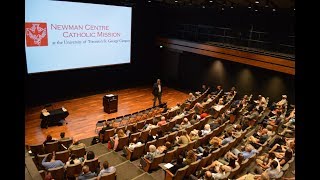
Andreas Widmer argues that work is a Christian vocation, not just a job, and that fighting poverty through aid misses the point. Real prosperity comes from local entrepreneurship and investment, not zero-sum transfers. He draws on his time as a Swiss Guard and conversations with Pope John Paul II.
Chapters
Everybody think you're gonna hear me in a second. Much better. Thank you for being here. Do you like the movie? Is it interesting? A lot of mental model changes in the movie. No. Things that surprised you? Can somebody. I'm gonna first try to see if we can interact on this. Otherwise, I'm a professor. I can talk. My shortest thoughts are 70 minutes long. So this. This is really up to you. What are some of the things that surprised you in this movie? Yeah. Population growth. Is it bad or is it good? What is the movie saying? It's good. Is that really true? Yeah. What other things did you. Human ingenuity is incredible. Yeah. So that a slum is worth more than what, an oil field. What else? What are some of the challenges? Yeah. Is every culture ready to do this? Is culture static? What really causes poverty? Or is that the right question? Did you ever ask yourself why you're not poor? Because if you're here, you're not poor. That's not true. Yeah, that's very good. Why is that not true? Because that's an assumption. You don't know who's in the spirit. Yeah. I think if you're here, you're not poor at the level of that, in material terms, we may be very spiritually poor. Or is poor a relative term? Is poverty really a dollar and 20 cents a day? Maybe not. Somebody that I met early in my life. So I'm from Switzerland. I'm from a small village in the mountains of Switzerland. And I grew up. Now, after all of my travel in the world, I want to say grew up privileged. But we were far. We're a farming community. Everybody was a farmer where I come from. And I didn't really, you know, I didn't know what to do with my life when I was young. And I. I ended up finding out that as a Swiss person, I could go and become a bodyguard for. For the Pope. And I thought, that's pretty cool. I'll. I'll go do that. And I was, you know, I was many pounds and without wet hair ago, and I went there and started to really. It was my first foray even into going abroad. I mean, if you grow up in a. In a rural country like Switzerland, you never leave. It's insular. Switzerland always has this international image as being this cosmopolitan or this. It's not really true. There's a couple, you know, Geneva is not exactly Switzerland. Most of Switzerland is very rural and very farm country. And so I come to Rome not knowing, you know, Italian, not knowing the world and really questioning myself of what should I do? What am I here for? And what is life all about? I thought of myself as being poor in the sense that I, you know, everything I had came from my parents. I didn't see any of my talents. I didn't see anything that I would. That I contribute to society. The only thing, because I was a big guy and strong, I could do the military very well. And that's where I went. But then once I went there, I sort of started to do a double take and try to see and sort of say, well, I'm here with these people. I don't know them. This is very strange. And I sort of had an existential crisis, which. Of saying, what mistake did I make to come here? And now I'm signed up, I'm in this foreign legion, and I can't get out. And, you know, bad decision. I didn't do what I did for Faith at all. As a matter of fact, I did it really just for the bodyguard thing. I wanted to be allowed to wear a carry gun and everything. And hey, I was only 20 years old, okay? And then I met John Paul II, and he actually noticed my confusion, and he started to reach out to me, and never in the sense that you would expect of, because let's face. I didn't see him as the Pope. To me, that didn't mean anything. You know, I grew up. I wouldn't even say culturally Catholic. I mean, I come from the Catholic part of Switzerland, and I was baptized and confirmed, but I wasn't really practicing in any meaningful way. And I didn't. The Pope didn't mean anything to me. And there I was, and I started to interact with this man, and he was just that, to me, an older man that I was sort of. My job was to protect him. And this is in a way, very fortunate because I was able to meet him in a very personal way as a other human being without sort of the formality. And we started to, you know, as a Swiss Guard, you may not know this, but the. Not just the ceremonial. The ceremonial stuff you see is outside. It's the recruits, actually, the young guys are outside. If you. Once you pass the test and you're inside, you do your service in a. It's like a secret service with suit and tie. And wherever the Pope goes, that's where we go. And we're his actual bodyguards, like the closest people to the Pope or the Swiss Guards. It's just they're not wearing the colorful uniform. And then if you're always the ones right Close to him. Then, of course, who else are you going to talk to? Like you? And that leads to all kinds of conversations. Also, he read my mood, if you wish, or my soul in the sense that he said, yeah, what is going on in your life? You don't seem happy. And I started to tell him about my confusion, which really boiled down to a lack of meaning and not knowing what I was, therefore the meaning of my life. Like, I learned something in Switzerland. I studied some and I just didn't know where to go with things. And he started to reach out, and there were several of us who went sort of through this. He started to reach out and talk to us about work. And one of the things he talked to us about is that idea of what work really is. Have you ever thought about why do we work? You know how Muhammad Yunus talked about the animals running around and around and around, and we're not that, we're something else. There's a very particular Christian anthropology to this. But before I give you all the detail, all the complicated words about it, let me first give you what he actually told me. That many, many years ago, God had an idea and said, hey, I'll tell you what. And you know, God is of course, the Trinity. So they talk to each other and they say, hey, I have an idea. How about we create the world? The universe, space. Bang, there it was. Space. How about we create time? Day, night, the world. How about we create matter? Space, time and matter. The first thing that God created. How about we create matter? And matter start to exist. And every time God created something, God sort of turned around and went like, attaboy, right? It's good, I'm happy with it. And then God started to create all of the rest of creation on earth. All the flowers, all the trees, all the fish in the water and everything. And was always proud of it afterwards. And eventually he created animals. And for that he created. He took clay and formed all kinds of shapes and all kinds of colors, and off they went. And then at the end, God said, everything here is an object, no subject, nobody like me. I act on these things. I made them. Nobody like me here. So God decided to create one animal in God's image and likeness. And he goes again and he creates the first human person and creates this person, same as the animal, out of clay, but what's the difference? Then once he finished creating this person, he breathes his spirit into the person. And this person comes to and goes, what's going on? And he's like, hello, I'm God. And you're the first human being. Come here. I want to show you this. And look at all of the creation. This is the first human being who could now enjoy, just like God, the creation. And this person said, what is all this? Who made this? It's beautiful. Who made this? God says, me. It's me. This is Europe. This is incredible. Look at this. Beautiful. Why did you make it? God says, for you. For me? How could it be me? How could you make something from me? God said, well, I give you all of this, and how can I own this? Like, how do you make this mine? He says, here's a first example. You see that little funny thing? The funny furry thing with two ears? It hobbles by. Give it a name. Come on. Rabbit. It's stuck. Call it rabbit. Okay. I was gonna expect bunny, because it goes better call it Bunny. And it sticks. And. And it's been a bunny ever since. And it's our bunny. So the first action of a human person is to name something and claim it that way, because we can actually act upon things, whereas the animals can't act upon each other because we're made in the image and likeness of God. And then God said, I'm going to give you a stewardship mandate. I started this. And it's beautiful, isn't it? You know, God always feels a little proud about that because it's a reason for joy. It's absolutely beautiful and meaningful. And then God turns and says, and now I want you to come in and help me continue as the steward. You come into this garden and you keep doing this because I brought this out of chaos, and it has a tendency to go back into chaos. But I'm gonna have asked you to keep bringing this out of chaos and creaking, bringing order to it. And we'll call that work. And we'll call that work. So you, as my image and likeness, are going to imitate me in how I created the universe, the world, all the animals and everything on earth. You're going to imitate me and finish or continue my job. I invite you into my creativity, and there you have it. That is work. So when I ask you, why do we work? What is work for? With this? Anthropology. This is, of course, Christian anthropology. Then why do we work? To do what?
To continue to create a work of God.
To imitate God, One of the high goals and high achievements of humanity. I thought it was because we chose the wrong parents. Yeah, yeah. What happens if you imitate somebody a lot? You become more like them. If you Work like God works. If you create goods that are truly good because the earth is truly good, and in our sense, services that truly serve, then you imitate God. And because you imitate God, you become more like God. And in religion we call that, you become holy. Work is a path to holiness. In a more secular way, you could say work is a path to human fulfillment. Have you ever taken. Have you ever been without a job for a while? I have for two years. Once one of the most miserable times in my life. I wasn't lacking food or shelter. I was lacking meaning and self esteem. It was some of the most miserable times in my life. When you take work away from a human being, you are taking part of their humanity away. And I don't just mean work that is paid or something like that. I'm saying work taking care of the elderly in some way. Many people don't get paid for their work, but it's work. If you take that away from them, you take part of their humanity away. You see, because when we work, we don't just make more, we become more. Work is one of the fundamental expressions of your individuality. It's one of the fundamental expressions of your uniqueness, because you can do it just so. This is why the church talks about a right to work, not because of the fixed pie and all this other stuff. All this other stuff comes later. But the one thing is, I can make one big point here that we haven't made in here, is that the reason why we have a right to work is because you need to work to fully become who you can be. We work because when we fully want to flourish, work is a central part of who we are. In the Catholic language, work. Work is one of the main contributions, the main path, one of the main paths to holiness. And now let me tell you, we have entire institutions that focus on eradicating poverty with the heart in the right place. And what we're doing is handing things out, giving people stuff. And my criticism of this is not that it's done out of a mean spirit. It isn't. My criticism is that the actual question underneath is not the right one. That's where we end up with the wrong problem with the wrong solution, because we're defining the problem the wrong way. That we created a whole industry that is, quote, fighting poverty. And we're measuring poverty by $1.10 a day or whatever, you know, the daily things that they're measuring at a time. And so when we say it's A$10 a day, immediately what comes to mind is the fixed pie. Take from her, give it to him. You know, if she has. If she has more than him, then let me take some. Give it over. Which for your heart is in a way the right thing to do. But it's the wrong problem statement. What it does is it bakes into our solution, the zero sum game. And it bakes into our solution that the goal of actually the thing that creates the wealth in the first place is just material. But you all know that your work is not just material. One of the great discriminations today is the discrimination against the poor from work that if you are on a certain social program, they kick you off if you start to work. Right. We. I'm not into politics. I'm more into the church side and the business side of things. And so I'm going to lead the church. I'm going to leave the government out of this. But we as a church and we as businesses, what can we do to fix that? Let's say we as a church, we can start to. I mean, we can. I don't want to say every piece. I think we should have a discussion about it. That we can start to invest in people rather than giving things. You see, my friend and I. So the seventh one, for example, that I did with Mike, we went through the world and we found the best entrepreneurs and see there. The part that I want to stress is to say that there's no point in me going over into Africa and go talk to somebody and tell them what to do. Because you know what? I don't know anything about Africa. I'm the wrong guy to ask. You want to know about Africa, you want to know about Ghana? You should talk to the guy from Ghana, not the guy from Switzerland. But we keep doing this of sending the big tall white guy from Switzerland over to Ghana and tell them what to do. That just isn't going to work. I mean, this is a pretty logical thing unless we have an expect. Unless we think there's something wrong with the Ghana guy. Right? There's something that we can start to do as a church to say, first of all, who do we send in our help and then how do we help people develop? And there I want to introduce a quick dichotomy, something that we know in the Catholic Church, in ministry, you would. Let's say you're working somewhere at the parish and you have a crisis in some family in your parish. The one parent loses all the rest of the family in a car accident. Three kids and spouse, and they come to you and they're saying, you know, this is just like a horrible disaster. And you see that this person is completely unable to help themselves. And so what should you do? Well, the church has a whole program on this that we use to basically start to get in, you start to help, you start to say, okay, let me help. And you make, first of all, you make sure I won't hurt myself. Maybe you shouldn't leave me alone. Maybe you should call my work and say, hey, Andres isn't coming tomorrow. He's not doing so well. Maybe you should make sure that all the balls that I have to keep in the air aren't falling on the ground. Maybe during the next week you're going to help make sure that my responsibilities are taken care of because I can't take care of them myself. Sympathy? Yeah, sympathy. That's called in counseling. It's called a crisis intervention. You're allowed to come in and take over. Canceling rule number two is that you can't do this because it's a crisis. It's time bound. You can't do this longer. When I was trained in this, we were told our professor said, you can't do it longer than five to seven times. So you can meet with this person five to seven times. And then they said, then you have to hand them over to somebody else. Why? Why do you think that is? Dependency. You may not see everything. The biggest pitfall here is codependency. You know, I sort of like it to play the hero and the other person sort of likes it that I start to do everything for them. And even without our proper intention, we start to create a relationship that is actually not a dignified or an equal relationship. Because you got a leg down and I got a leg up five to seven times. I was taught, because then the definition of a crisis is it's time bound. After five to seven times you have to stop. And then it becomes normal. You see, there's a difference between a difference between a crisis and a dysfunction. Did you ever think about that? There's a difference. It's not a crisis if you constantly do the same thing. That's not a crisis, that's a dysfunction. You're doing something wrong. And so what they're doing is they're switching you over to somebody else. And that person is now not allowed to have sympathy. They're having empathy. They're allowed to say, yeah, I understand what you're doing and everything. But you know, when I, you know, what's true for me is this and this and this. And then I can propose to you maybe what you could do. But more than that, I should ask you, have you ever thought of this? Have you ever thought of that? And so on. I don't touch anything. I don't do anything for you. Because there. That canceling can actually go on for a long time. But I'm not doing anything for you. I'm just your friend. Remember Haiti? Remember the earthquake? Who did we send in there? The Red Cross? Yeah. Do you think they're still there? How long has it been? We are not allowing ourselves to become friends of Haiti rather than rescuers. So it was like, just funny little side note, once Ronald Reagan came to see John Paul ii. And I'm standing there at the door at the palace, and he comes, 32 cars. Like, I never saw Ronald. I'm from the village. I'm from the mountain village. I've got this farm boy. And they put me there at the entrance to the Vatican. And in comes. And I remember just. I'm standing there with the whole uniform, and I'm standing there, and in comes Ronald Reagan and Nancy Reagan. And I remember all I thought I said, dude, man, this guy's old. He was like, oh, he looks so much older in person. And so he goes in and he goes to see John Paul ii. And then. And then once they're in and everything, we're like, at ease. And then you can sort of go around and wait. And then suddenly the commander pushes the button and says, okay, everybody on the opposite, on the opposed. Because all I'm doing is I'm there as a statue. Like, the guys in the suit, they're the ones who do the protection in the uniform. I'm not protecting anything. I'm just standing there. And so I go back, I stand there, and the journalists were right over there. They were sort of, you know, roped in there. And I just. I'm looking forward, and suddenly I see, like, all these slashes, and I see something go. And I look down. Nancy Reagan's on my feet. She took the last step and went down. And then I'm like, okay, well, what do you do? What do you do? What am I doing? What do I do now? Right? I was about to help when I couldn't even see her anymore because everybody came towards me and tried to get her up. And there were so many people trying to help her get up that she couldn't get up. And I think that's a metaphor for Haiti, because we're. And, you know, I mean, this is a very serious topic. And I don't want to make light of what's going on in Haiti, but in a. But we can't keep blaming Haiti for this. Okay? We have a lot to do with this. And if your church or your parish does something in Haiti, maybe we should rethink. Think of your. I don't know whether in Canada they have 401k plans, do they? RSE's or your other personal investments. How much of this is in funds that focus on the third world? One of the things that struck me is that when we look around and I keep saying Africa, but this is like, you know how people always say I'm from Switzerland, they think I'm from Sweden. And so it's a bit like when you say Africa, it's like a African. You're talking about a continent anyway, so it's just because it's a term and it's sort of easy to measure and people think of Africa as an island. Yeah. The Americas is an island. Yeah. So Africa has about 12% of humanity. Out of 100 people living today, 12 of them live on the continent of Africa. Yeah. Imagine that of all the money that's being spent on charity in the world, about 30% out of $100 on charity, 30 bucks go to Africa. We're really trying to help Africa. Something. I'm a high tech entrepreneur. I was in B.C. and I do, you know, the kind of money that I would represent is foreign direct investment. Money that chases around the world and say, hey, you have a good opportunity. I'm looking for risk. I'm looking to invest in something that has the potential to grow and everything. FDI, foreign direct investment loosely said 1.4% of FDI goes to Africa. You see the picture? We're not trying. We're trying to do poverty. We're trying to do poverty with Africa, not prosperity. How about if we would turn it around and say, let's not fight poverty, let's start to create prosperity. And after this, we need to move it. I told you, I only have 70 minute thoughts. I'm surely running out of time. So when I learned to drive in Switzerland, it's funny they should do this in Canada. I don't know whether they do or not, but one of the tests is you have to drive on an icy road downhill, and then you have to maneuver your car and stop. Right. I mean, you're used to that. And what they do is. Did you. Yeah. You know, you don't, don't you? There's like one tree. So the long road Goes a little bit curvy. And there's one long tree on the right side, slightly off the street. And out of a hundred people who lose control over their car, how many people hit that tree? Why? This is what they teach you in driving school in Switzerland. Why do you hit that tree? You're looking at it. You think you're out of control, but guess what? You're not out of control. If you ever are in an accident, you have enough time to realize that you're going, that you're moving somewhere. Don't look at what you're afraid of. Look at where you want to go. Fighting poverty. Do you really want to fight poverty? Or should we create prosperity? Because if we fight poverty, we end up sending 30% of all charity to 12% of the people. If we're fighting poverty, we're sending 1.4% of foreign direct investment to 12% of all the people. If we're fighting poverty, we're starting to look at a whole group of people, a whole continent, a whole group in our own society, in a sense, as under performers. Eventually we look at them as a problem, as the issue. And you know what happens when you look at people as the issue or as a problem or as them? Somebody is going to get hurt. And I think we're on the best way to do that, because now something happens there and people are going to get chased out of their countries and then they start to migrate, which is, by the way, what you and I would do. If somebody would bomb my house, I would start to pack up my bags and start to walk north, I think. And then we start to have the US and them mentality instead of looking at this as a. As people with potential. Thirty years ago, when Castro took over in China, Cuba, there was a time, remember in the 70s, there was a short period of time where he says, okay, everybody get out. Like, get out of the Cuba. If you don't like the revolution, get out. And I. A ton of people, an immense amount of people left. I mean, wouldn't you? And they left. And where did they go? Miami. Yeah, but where? The Cubans don't just go to Florida. Where did they go? Little Havana. Yeah, they all go to Miami, to Little Havana. And that's where they all went. And if you look back, you can see cartoons with the. With the panhandle dipping into the sea. Because the prediction was, here come all these Cubans and the Florida is going to sink into the sea because they're going to ruin Miami. There's going to be too Many people there and there's going to be crime and yada, yada, yada, yada. And the 10 years afterwards is when the biggest prosperity happened for Miami. But everything starts to spread up and the growth happens. Humanity, including migration, is not the problem. It's a solution. It's how we deal with it that makes a difference. We have to make a distinction between humanitarian aid and economic development. And the same people who do humanitarian aid should not be allowed to do economic development because that's the crisis management versus the long term development. The same people are not supposed to touch this. But in our organizations we don't make a difference. That's the one point. Second point. As far as our business is concerned, if it's so I teach business. I teach all the at Catholic University. I teach all the business majors, undergraduate and graduate. And I'm much more into mindsets and mental models than I am into accounting and marketing strategies. Because it's because culture eats strategy for breakfast. What you have underneath and what your deep desire is, wins out. It gives meaning to everything else. And what we have to understand is that work. We have to say just so here you are, you come in here, you study business. You say, I want to be a business person. And I ask you why?
Why?
What is business all about? What is the economy all about? What is this all Now I don't have, even though I'm a Catholic university, I don't have a room full of Catholics and I never ran a Catholic company, so I can't. So my answer can't really be you want to become a business person because of your personal holiness. Which is actually true, what I want to do. But we have to express this in a way that makes sense for everybody because there's a deep truth in this. You want to practice business because you believe that this is your deepest calling, that this is the path for you to become the best person, the best self possible, that you can fully flourish in this environment doing this job. You notice that I didn't say anything about money yet. Or you know, because if you really. If we explore this with the students and we said we put this all together, money is actually more like an effect rather than a cause. Milton Friedman famously says that the only social responsibility, the only responsibility or goal of a company is, is to generate shareholder return. 1971 famous op ed. I am the last to be against profit. Okay? But it's to me, Milton Friedman is like, you know, I'm Swiss, so I have a Swiss watch. Milton is like looking at the outside of this watch and say why is this thing going around? And he sees the outside of this and he's going to make predictions about it. And so he may be right as far as the observation is concerned. He has no idea what's going on inside the watch. Because Milton Friedman, as much as I admire his intellect and his intelligence, has never run a business and has never had to take the risk of putting his own livelihood at risk for building a company. So what would he know? Why somebody does a business. I have. Profit is to business. What white blood cells are to the human body. Did you just think of white blood cells? Yes, I did. But what about five minutes ago? Do you know what happens to you when you have no white blood cells and you sit here not thinking about white blood cells? What's wrong with them? Yeah, you don't even think about it. Profit is like this. You know, I once took over a company and it's funny, I like usually in public to talk more about my successes than my failures, but in the classroom I talk about my failures because you learn so much more about stuff where I totally ransacked the company and just off the cliff, because you learn more and you know, you sit in the office and you're running out of money. You know, at the Runway the VC gives you this much money and I'm running out of money. And this is like bleeding. And the money goes to my hands like sand in my fingers. And I'm saying profit, profit, profit, profit. Once I sold furniture, like I started to sell the office furniture, I did all kinds of stuff, none of it was profitable. I learned the hard way that profit doesn't come from that. And I can't sit here and will profit. I can't. Believe me, I tried. Profit is a result of something else. Profit is the result of a healthy company, just like white blood cells are the result of a healthy body. You, you drink, you eat, you exercise, you live a healthy lifestyle. And the result is to have enough blood cells you will never have to think about it. And profit is a little bit like that to the company. And profit comes. Can there be too much? How much is enough? So one of the papers I have my students write, how much is enough? Tell me now because as you get older, you know, I want you to be respons. I want you to be responsible to or responsible to your 20 year old self who tells you how much is enough? Because as you go along, you change it. Profit is the result of a business that is inherently overdirect. If I start A restaurant. And I start to serve breakfast and you guys come into my restaurant and you have, you know, I make eggs. I'm not going to serve you the eggs the way I want. I'm going to serve you the eggs you want and the coffee the way you want, not the way I want it. It doesn't matter what I want. It matters what you want. Because if you're happy. I have a business that's called Win Win. Right? Win win situation. We often talk about the selfish bastard business guy, which is often in every movie. I always get very annoyed at this Scrooge Lord Business. I have a son, 14 years old. So we're going through all the Lego movies and everything, Lord Business and all these. Every, every evil person ends up being the business Wolf on Wall street, you name it. But there's an inherent obvious issue in this, that if I would behave like this, that basic business wouldn't work. Because you come back to me in a free market. This is what we call free. If you have a choice to go somewhere else, you'd never come back and eat my eggs because you don't like my eggs. You want to have them cooked your way. Business has to be inherently of the director. This is why I think business is a deeply religious, deeply spiritual activity. To say, how may I serve you? How may I take care of your problem? How can I help you? Right? It's a deeply spiritual activity. This creates the win win situation. Once we get involved and we skew the markets and we allow somebody to have too much power too, be it a very large company or a very large government, we start to have win lose situations. My favorite for that is in the US the dmv, because if you go get a new driver's license, you know, the service, meh. Because you have no choice. Either you do what I say or you're out of there and you go back in the line. And that's a win lose situation. Right? So what we should do is to create companies that are inherently other directed. And we need to create companies that understand why it is that we work, namely for the flourishing of the individual around. And that when we work, the most important thing is not the end result of the path. Just like in life, the path don't be nice afterwards, be nice now. Right? That's why I have actually a suspicion of corporate philanthropy, a suspicion of CRS programs that are like butter on a bread, but a concern for the people involved in my company and everybody around. It should be like oil in my bread, not an afterthought it's at the end, you put a little bit on it so you look good. We need to look at the process of our company and say, how is that sanctifying? I keep switching back between the Catholic language and the more secular language. How is that fulfilling? How does the process of me making my product and the using of my product, how is that flourishing? And I want you to think about it. Many of you, most of you are at an age where you are somehow involved in a company or you're at least investing in a company. Are the goods that you produce truly good? Your company or the companies you invest in, are the goods they make truly good or the services you provide them? Do they truly serve? Question is, of course open, what does truly serve mean? And truly good? Maybe that's something we can talk about in our Q and A. Let's discuss questions, criticisms, pushbacks, please.
Sarah, you began to ask us about the challenges we saw in the film.
Segment and one that came up was the problem of institutions.
So the Archbishop of Ghana talked about the IMF and other institutions ramming things that were contrary to the values around him down their throats.
So once we persuaded by the anthropology.
You'Re talking about he ethos of entrepreneurialism.
And service, do you have any strategic.
Suggestions about tackling these entrenched institutions that are addicted to ongoing crises?
So what I'm trying to do, so look, first of all, remember, let's go back to this idea that I'm the Swiss guy who lives in America and I have no business going to Ghana telling Ghanaians what to do. And neither does, neither would I, even if I would live in or if I work for the imf. Right, but we have to go back to the idea that I don't. In this field of aid and help and development, I do not want to project and we should never project intent and bad intent. Not trying to be bad, right? They're trying to help. I mean, many people who do this, it's not, I'm not saying these are the bad people and these are the good people. I'm saying how could we grow? And that always starts with me. The biggest enemy of development and human flourishing is that somebody is trying somebody else what to do. We like top down situations. We like to have a decree and tell everybody what to do. How about I tell myself what to do? I try to teach my students to go on a virtue plan and I talked to them about the Greek idea of the ergon of the one thing only you can do the best A hammer is made to hammer. So that's the ergon of the hammer. Everything that makes it a better hammer becomes a. Is called a virtue. Anything that makes it a worse hammer is called a vice. Now I ask you, your ergon, which I would define as you being. What's your name? Johan. The best Johan possible, right? And if you don't do it, nobody will do it. And see, here we are trying to be a little bit more like him or him. No, if you don't do you, it'll never happen. Right? This is a huge miss. This your ergon. Now if we and I tried to do development. Let's just come out the blue with this. Just like I'm at you now. But what virtue does Johan need to be the best Johan possible? And what are the vices that Johan needs to fight and reduce? And I'm not talking about somebody halfway around the world. I'm talking about you. Because one day you are going to lead a company, and then you need to have the wisdom and be the best version of yourself to. To do good, to know how to do good. But if we don't practice with ourselves, it's not going to work. I'm always amazed that somebody as powerful as Jesus Christ comes down here and you know, there were tons of people who felt just like me at the time, comes down here and doesn't lead a general revolution, because that's what I would have done. You know what I mean? Instead this guy chooses like these 12 lame guys who have fickle commitment. Boo. And they all run away. It was a little more than boo. But you see where I'm going with this, okay? And he's much smarter and much wiser than me. And therefore. Let's take a page of that. The first step to world improvement is actually me. The world first step of world improvement are the 200 students in my lecture hall. And so we practice three virtues for the whole semester. And we practice them by saying, let's define it, and then come up with virtue with practices that you can practice this virtue a hundred times a day. Virtue is like muscle. You don't go to the gym and do like one big lift and then go home, because then that doesn't do anything. You want to lower the thing and do more repetitions. And that's why I want you to practice your virtue in something, let's say moderation. You want to practice moderation, then, you know, the students live. We have a dining hall that is just like the death of moderation. And so I say, well, Then walk through there and say, I'm going to have dessert once a week. And you're walking through there three, four times a day. That means three, four times a day you can go like this and say, no, I do this once a week. Why don't you keep going? The virtue, you can train it and then later on you start to have, you start to build yourself in a way that you flourish the best. And when you flourish the best, you have the best chance to help others flourish. I know that doesn't exactly answer what you're saying, but where I'm going with it is I'm actually steering you away from the imf because I'm not looking for top down change, I'm looking for bottom up change. This is why when I got involved in this field, I started to look for entrepreneurs and I started to help them be better entrepreneurs. Because I'm not going to go fight with the IMF or fight with some president or something. I'd rather help an entrepreneur be a better entrepreneur. Because the solution comes from there. How much time? Seven, seven minutes? Yeah, you want to know? Well, two things. First of all, your idea of the way you would be Jesus, that's the Jewish messiah that they're waiting and there's 15 million of them and 2.2 billion of us, number one. Number two is what you showed there.
With the empowerment is working.
Why is that not taking off exponentially? It is the other thing I would like to point out, and I'm glad you're bringing that up because let me point something out. One of the first questions I always do is do you think the world is getting better or worse? The world is getting better in every measurable thing. Okay. You just hear more. It's like my mother in law right now is at home watching the hurricane. She thinks she like told me to go to Home Depot and get this hurricane, Isn't it coming? It's not even common where we live. But I'm supposed to go get water, get sandbags and everything because that's all she's watching. It's again watching the tree. She's looking at the tree. Every measure, every common measure you can take, we're doing better. We will reach. So let's go with the UN numbers just for the sake of going with them. $1.50 a day. 100 years ago, 85, 90% of humanity lived in abject poverty. How much is it today? It's 9%. So don't tell me the world is getting worse. The world is getting better. But we have problems. Would I like to be abject poor or poor? Poor. Would I like to be in the middle class? Yep. So you can't stop. Just because you stop the bleeding in triage doesn't mean it's okay. Right? We can go much further than that. The next issue we have is this SME crisis, the missing middle, that we're not allowing people to flourish. We need to have a society that goes back to recognizing human dignity and start to talk about people as the solution rather than the problem. But in our. And see. So I'm going to just quickly point it and come right back to us because I don't really want to talk about them. But in our culture where we just scream at each other rather than actually communicate with each other and these sound bites, it's not going to work. But I can't change that system. All I can change is how you and I are going to interact now. Right? So let's all do that. Because if that was good enough for Jesus to do, then it's good enough for me to do. Please. Firstly, crisis versus dysfunction. Yeah. Thank you. Question. Profit as the prime motivator of future progress of a company, the analogy of white blood cells. What happens when there's too many white blood cells in the body? That can be a real problem. I have suffered from it myself. Look, the reason why I talk about personal virtue is because I fell down that whole myself. And this is one of the things I talk to students, opening my. I want to teach from a position of vulnerability. And the vulnerability is that I was one of these high tech kids. I came to America in 89. I joined FTP software, which has brought the Internet to the PC. Think about it. This thing grew like we went public in 1993. Netscape was built on us. The World Wide Web was built on us. And then I joined and I get out of there. I joined Dragon Systems that invented speech recognition. You know, Siri, I started to think that I had a golden nose. And you know what happens when you think it's you? You become an idiot. I'm just saying you become an arrogant idiot. Unless we start much earlier with virtue being the best Andreas I can be. Because I didn't become a good Andreas when I had that much. See, it blinds. Money blinds. I like money is not a bad thing. But you have to know how much. How much is enough? How many white blood cells do you really need? This is why I'm doing this exercise with them. And I can't do this. And I don't Want to do this on a general level and say, okay, everybody, this is how much everybody gets. No, I want to do this on an individual basis with 200 students a semester and tonight with all the people in this room. How much is it? I don't want to talk about other people. I want to talk about myself and Hugo. It's so tempting to talk big and always about other people. I want to talk about us in a way. I just. I can't go too deep into this issue. But, you know, I moved from Boston to Washington, D.C. i lived in Boston for 30 years, and all my companies were there. And, you know, I lived in a bubble. I lived in Andover, Massachusetts. Total white bread and, you know, big lots and villas and everything. So beautiful. America, right? Then I moved to D.C. i live in Maryland. Prince George's county, one of the poor counties, poorest counties in the United States. Hyattsville, Maryland. Very, very, very poor. I'm shocked. Oh, shocked. This the capital of the free world. I see poverty there. You do like a double take. I see unemployment that goes on for generation and generation. That's robbing people of dignity. And so what should I do? Go to the White House and hold the picket? Maybe we should have been. Let me not criticize that. Let me say. So I go to the university and say, you know what? And I often do this. I open the. I said, you want to help a poor person? Because they're all saying, oh, I want to fly to Africa and go help somebody. You don't even know how to run a company in the US when are you going to go help somebody in a really difficult environment? They'll tell me. Many open the door and say, hello, somebody who's hungry and who's poor just hurt me. Why don't we save the 1500 bucks it costs you to fly over there and we'll do something here. So why don't we start an incubator for local companies in D.C. and we. Right now we help 130 small SMEs, small, medium. We do this in the United States. Sad. We need it again. And we focus on maker companies. Not software, whatever. No maker companies. People who pour concrete, who do dry cleaning, who create food, stuff that you can't outsource, stuff that stays here, lawn businesses, pool businesses, stuff that you can do even if you don't have a college degree, stuff that you can do profitably and stuff that can be meaningful to you, except that we just need to show them how and invest in them and approach them as friends. Not as problems, as partners, not as problems. And then, yeah, we help 130 companies. And yeah, I'm not standing in front of the White House holding a picket sign. And I bet you that the effect that we're doing there in Brooklyn, in our area of D.C. it helps those. I just want you to develop a little more about wealth is not just transferable around, but can be created at the very end of the. I'll give you a quick example on this. So I have this phone. How much do you think it costs to make this actually an iPhone? How much do you think this cost to make? 30 bucks. How much do you think I paid for this? Yeah, so let's say it's 30 bucks. But then also, you know, the Apple Store cost a lot and this and that. So let's say this cost 100 bucks by the time it goes point of sale. So from a hundred bucks point of sale, it goes to 600 bucks. Where is the five? I know that the material I'm buying is worth a hundred dollars. This is actually, if I take it apart, everything, it would be theoretically worth a hundred bucks. I know where that comes from. Where's the other 500 bucks come from? That's new money. That's new. That's value add. This is gdp. This is what we're creating. When you make that, you in a sense create new value. Because to me, this isn't worth a hundred bucks. This is worth 600 bucks. Actually, it's worth more, else I wouldn't have bought it. Right. So I know we're getting. I'm not teaching economics the other class. I'm teaching an intro to business. Value add is new money. Therefore, the more we do business together, the more value we create. I have a kid, so when we start a business with every student, they start a business themselves. And I don't want to start a business together. No, you, you, you. Because I want to show you individuality and the expression of the beauty that you are and that you have something to offer. And of course, I'm a techie, so I make them do. If they don't know anything else, I help them do an affiliate blog, like to do online recommending of things to talk about something interesting. And people go and buy it there. And you get. If you're an affiliate of Amazon, you get somewhere between 5 and 15% of what's sold. Just like that. I had a kid who started to review Marvel, Marvel comics and how they're being turned into movies. And he has a channel that, that talks about Which. Who. What actor is going to be the voice for which villain? I'm like, who cares? But I'm telling you, lots of people care. And this kid, out of nothing creates a company, has 16 employees now. And these kids, they love their job. They don't want to go anywhere because they. They are becoming. Create. They are you. It doesn't make any sense to me what they're doing, but you can just see them, and they flourish in our own little microcosm. This is what we're after. That is prosperity, because those kids become better versions of themselves.
Thank you very much, Andreas.
Thank you.
Thank you for being here this evening. My name is Father Peter Turone. I'm the pastor of the Newman center and the chaplain. And I want to thank you again, Andreas, for coming here for the second time for launching this series. One of the things that really strikes me about this whole series is that by its title, so Poverty Cure, it's not so much us trying to find ways, ways to be able to deal with the situation of poverty to correct an issue, as Andreas was pointing out, but it's also to help us, first and foremost to help us understand how poor we are in our understanding of the issue of poverty, in fact. And it's a whole issue of the approach. I worked as a missionary in Mongolia for three years, and just listening to what you were saying, we worked, we did a bit of micro financing with the people, but it takes years to be able to go in a position where you go listening, not going to impose a system, a Western system which does not work there, but being able to walk with the people and then being able to learn from there and find ways that emerge from themselves. So, again, it takes a lot of patience as well, and a lot of humility, which is not easy, but it's the most fruitful for the people themselves. So thank you for that. We really appreciate that. Now, I'd like to thank Jim Milway as well from the Archdiocese of Toronto for moderating this evening, my wonderful staff. Alexandra. Alexandra Whittle, she's a program and volunteer coordinator. Patrick Douglas, operations manager. All of our wonderful volunteers, the students that took time out to come here tonight to help volunteer for this event. And as I just wanted to show you this magazine over here. So as you leave here this evening, especially for those who did not receive one on Sunday, if you're part of our community, we have as a magazine, so a newsletter which introduces you to the Newman community, the students, the staff, the life that we have there, and also about our mission so the mission that we have here at the University of Toronto, to make Christ known and love to other people, and we do that in the spiritual realm through offering liturgies, adoration, a place for prayer, the chapel in the midst of a busy city, and also through intellectual formation, which we're trying to do this evening with this. We have many different programs throughout the year. It's very simple just to sign up on our website to receive bi weekly updates. And we'd like to thank also one of our sponsors for this evening, Morneau Chappelle, for helping to provide this event here. So we thank them very much for that. It's their generosity and it's the generosity of many people that allow us to continue on with this critical mission as well. We know that everybody here is Catholic. We're here, Our Lord came for everyone. So we're here to be able to make Christ known and loved and to recognize first and foremost the dignity and the love that God has for every single person. Everybody might not understand that, but it's how we offer life giving ways, life giving programs and things, encounter with God also through his people, for the people of the community that we hope that people will come to join us in our mission. So thank you very much for this. You will find out if you have any questions, you're welcome to ask Alexander or the students afterwards. As I said, this is the first of a six part series. And again, we're not trying to do something just so it looks good and we're trying to attract a lot of people. Actually we have almost 200 people here today. But besides that, what I wanted to say was that, and we're very grateful for that because we know a lot of you are business people, you have very busy schedules, but there was something that drew you here tonight. And again, we believe that's a grace from God that leads us to want to be able to do something meaningful in our lives, not only for ourselves, but as a good friend of ours of the Newman community said that especially also in the young today, there's a selfish desire to not be selfish. A selfish desire to not be selfish. So, and the youth again, also the new generation of students are part of the solution. They're not part of the problem. And this is why these opportunities are a way to be able to provide ongoing Christian formation. Again, that is also something that is accessible to all people. So thank you and hope to see you again. God bless you all.
More from Andreas



He Teaches Entrepreneurs How To Be The Leaven of Society | Andreas Widmer | The Pope and the CEO



Principled Entrepreneurship with Andreas Widmer: Lessons in Leadership and Humanity

Principled Entrepreneurship with Andreas Widmer: Lessons in Leadership and Humanity



The Virtues of Free Enterprise and the Heroic Spirit of Entrepreneurs | Villanova University | 2024
