Should Our Faith Shape the Way We Do Business?
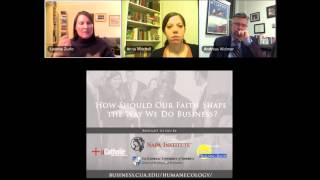
Anna Mitchell hosts Luann Zurlow and Andreas Widmer on whether Catholic faith should shape business decisions. They argue profit and the common good can align, but only with ethical limits. Meaningful work and human dignity matter for both flourishing and business outcomes.
Chapters
Well, hello and welcome to this webinar. Tonight, should our faith shape the Way we do business. My name is Anna Mitchell. I'm on the Sunrise Morning show on the EWTN Global Catholic Radio Network Monday through Friday. You can hear me at 6am and for 3 hours if you get the app@sunrise morningshow.com this webinar is presented by you Catholic the Napa Institute Catholic University of America is live tweeting this, by the way, so if you have a Twitter account and want to follow along to their tweets, they are underscore business and they will be live tweeting the webinar throughout the night. So it should be fun to follow along there as well as we listen to the fabulous insight that we'll be getting from Luanne Zurlow and Andreas Widmer tonight. I'd like to start off, if you will, with a prayer to St. Joseph. In the name of the Father and the Son and the Holy Spirit.
Amen.
Glorious Saint Joseph model of all those who are devoted to labor, obtain for me the grace to work conscientiously, putting the call of duty above my many sins. To work with thankfulness and joy, considering it an honor to employ and develop by means of labor the gifts received from God. To work with order, peace, prudence and patience, never surrendering to weariness or difficulties to work above all with purity of intention and with detachment from self, having always death before my eyes and the account which I must render of time lost, of talents wasted, of good omitted, of vain complacency and success so fatal to the work of God. All for Jesus, all for Mary, all after thy example, O Patriarch Joseph, such shall be my motto in life and death.
Amen.
In the name of the Father and.
The Son and the Holy Spirit.
Amen.
I thought that an appropriate prayer to start with tonight as we talk about how the Catholic faith can influence our work in business. And we have two fantastic panelists tonight. Luann Zurlow is a Professor of Finance at the Catholic University School of Business and Economics, where she also teaches a graduate seminar in education in developing countries. Prior to teaching at cua, she spent nine years working as an equity analyst on Wall street following Latin American corporations. After 9 11, she left Goldman Sachs to found and lead World Fund, a New York City based NGO with operations in Brazil and Mexico, which provides teaching and principal training to underserved communities in Latin America. Luann, thanks for being here tonight.
Thank you for having me.
And the guy over here is Andreas Widmer. Professor Andreas Widmer is the Director of Entrepreneurship Programs at Catholic University of America School of Business and Economics. He's the author of the Pope and the CEO Pope John Paul II's lessons to a Young Swiss Guard, which explores leadership lessons that he learned serving as a Swiss guard protecting Pope St. John Paul II and refined during his career as a successful business executive. His experience spans the fields of high tech, international business strategy, consulting and economic development. He has worked extensively in the United States, Europe, Asia, Africa and Latin America. Everywhere but Antarctica, I guess, and has brought more than 100 leading edge technologies products to the market. Andreas, thanks for being here as well.
Thanks for having me, Ana.
I'm glad to be here, very glad to have you both. And I want to start out this conversation with the thought as I was thinking about this. You know, we live in a world where we really compartmentalize our faith and we see this very prominently in the political world. Of course, we see it very prominently in the business world as well. That my faith is basically reserved for when I'm sitting in the pew in church on Sunday and it doesn't have anything if much to do with my actual work during the week. But Andreas, the church would disagree with that premise, wouldn't it?
Yes. It's sort of the way I would put it is that on Sunday when you go to church and you receive the body of Christ, that's the gas station, your engine is supposed to run all week and you're supposed to go out there fueled, inspired and fueled and strengthened by this. But while in the church you receive and you participate, you actually do become the protagonist during the week, and that's sort of where you play as a Catholic in the future.
So, Luann, what does the Catholic Church have to say about the way that we do business?
Well, the Catholic Church has a lot to say and it's been really articulate in helping, guiding us, particularly as lay Catholics out in the real world, if you will, how to behave with respect to our business relationships, our home relationships, and most prominently, starting with the Wehrum nibarum cyclical by Pope Leo XIII, the latter part of the 19th century. It was a moment where things were getting difficult for workers for various reasons, and the Pope and the Catholic Church stepped in and said, we've got to animate this, animate the world with specific guidelines on how a baptized Christian can operate in a more Christian way in their environment. I think one of the clearest ways that one can operate and do business well with a Christian perspective is by serving as a witness. You mentioned people more and more compartmentalizing their faith. Well, our broader society has become more and more difficult to operate in on many levels. And so when someone is truly living their Christian vocation, they become a much brighter witness. And not only does that have profound impact on those around them for the Kingdom of God, it also actually has positive business consequences which we can get into later in this program.
So let's start defining some terms that we're going to be using throughout this webinar. I should also also make note that you can ask questions if you're participating tonight. There is a little question bar on your little control panel that you can type out questions and I'll be following them throughout the night and we'll have a Q and A session at the end. If there's anything that you're pondering as you're listening to them answer tonight that we can go deeper into if we didn't get deep enough for you at the beginning. So with that said, Andreas, what is the common good and what does that have to do with business?
The common good, in a short explanation, is all the conditions that allow a human person to fully flourish, to develop and fully become the best version of yourself if you wish. Common good, however, is something you have to opt into the common good demands of your response. It's not something that is forced upon you. It's like grace. It's something that if you cooperate with, can work, but it's something that is there as a condition if you wish, and then it requires of the person to participate. But as a society, what we're looking at is to say how can we create conditions that actually are conducive to human people to become the best version of themselves. That in essence is what the Church calls the common good.
And Luann, we actually, we talked about this on the Sunrise morning show yesterday. Does the idea of working for the common good and the idea of working for profit, do they have to be opposed to each other?
Absolutely not. You know, unfortunately, people like to put them in opposition with each other. And one can understand why people do put them in opposition with one another when one sees a lot of really bad behaviors happening out there for the express purpose supposedly of making profits. But in reality the production or making of profits is a discipline. It is following the law of economics in our world and it helps businesses and other types of organizations manage their resources, their precious God given resources, in the best way possible. Having said that, if one puts all their emphasis on maximizing profits, which is a key objective for corporations, particularly here in the Anglo Saxon world, the United States and Britain tends to be more of an emphasis. There is a risk of then treating the employees or people in that endeavor in a utilitarian or a fashion. That's not human, that's not Christian. So the question then comes down to is, where's the balance? Where are the trade offs? And often they're difficult to make sometimes. And often they can be very small or they can be very large. You know, a major obvious question is if a company, a manufacturing company, for example, is having challenges making profits in the United States, let's say in upstate New York, for example, or some of the old rust belt, is it proper and Christian, if you will, for them to go overseas and do the same kind of activity with cheaper labor costs? Well, you could say no, that's you're making people expendable for profits. But then on the flip side, you could say if that company isn't profitable at some point they will go out of business and the market will, will effectively put everyone out of business. So these are not black and white clear cut questions, obviously. Having said that, I'll just finish by saying generally it seems more and more in recent years, unfortunately a lot of businesses have tended towards profitability to levels at the expense of the well being of a lot of employees. And we particularly see that with profitability with those at the very, very top of organizations that are often making multiple hundreds of salary versus those at the lower end. Those are questionable. Questionable benefits of profitability, if you will.
Well, let me follow up on that with you. With your work for founding and leading an ngo. One of the things that you said to me yesterday morning that I thought was really interesting was that if a nonprofit doesn't work with the bottom line, they're not going to end up doing much good.
You know, unfortunately, most nonprofits go out of business, metaphorically speaking, or obviously not an obvious normal business, but it's because they don't manage the resources well oftentimes. And you know, another thing, I would say it is harder to run a not for profit than a for profit business because you are trying to do a social good on one side, then on the other side you are trying to fund that social good from a completely different audience. So you're dealing with a for profit company. If you're selling an object, the person buying that object also enjoys that object or that service. With a not for profit, you're providing a service to one group of people, but you are having to market or sell that service in terms of bringing in the resources from another group. That's extraordinarily difficult. And a thing I mentioned yesterday, which I think people may not put enough emphasis or credence on, is it is the for profit sector, particularly in, again, Anglo Saxon countries like the U.S. and, and great Britain, which have a deep legacy of philanthropy that makes our not for profit, our social service sector, so vibrant and alive. And for my personal situation, if it were not for all these Wall street people and corporations that I met through my prior career, there is no way World Fund could be doing what it's doing to improve education levels in Latin America.
Okay, Andreas, I want to talk about this idea of human dignity which we hear thrown around in our church circles all the time. What does that mean and what does that have to do with work?
Human dignity has to do with the fact that you were made. Every one of us is made in the image and likeness of God. We are a small representation of God on earth. We are different from the rest of creation. The reason why you have human dignity is not because of what you do, it's because of who you are. The way this applies to work, and this is where Catholic social doctrine and the Catholic sort of, I like to call it, the mental model of Catholicism, makes a real difference in how you approach this. If you look at your employees and you look at them as having human dignity, the way they work for you is they have this special power as human beings because they're made in the image and likeness of God. They have this ability to cooperate with God in creation, in the actual act of creation. They have this permission by God, this invitation by God to, in a sense, continue the creation that is described in Genesis, that God is doing. Animals can't do that. We can do that because we have that spark in us that is the image and likeness of God. Now, when you deal with these employees, you in the first line are not paying them for what they do. This is a foundational Catholic principle. In the first line. I don't pay you for what you do. I pay you for who you are on the basic level. Because if a donkey could pull more weight than you, I'd pay the donkey more. Right? If it was productivity, I'd pay the donkey more. But I don't, because I pay you for who you are on the basic level. This is where the idea, because of this human dignity, because of this privilege that we have of having the presence of God in us and representing God in a way, why we get paid for who we are to begin with, this is what we call the Living wage. That's why the Catholic Church talks about the first thing to look at is who you're employing, because otherwise we'd be competing with animals and machines and everything for wages. But we actually compete, if anything, with each other for this, because we are. When we work, we don't just work, we. We don't just make more, we become more. Now, above that, of course, there are levels of more innovation and more productivity and so on, and people get paid more. But the basic threshold of payment, the basic threshold of how we treat people has to do not with what they do, but with who they are. Human dignity is something that is God given and no one can or should take it away. It's one of the core principles of Catholic social teaching.
Well, if that's the case, then can a Catholic employer morally fire an employee?
Absolutely. The question is, what you do with an employee is, in a way, the way you see employees, is to say that I. I want you to become the best version of yourself. I want you to develop your talents, develop your opportunities, develop your character to a level of where you can be the best version of yourself. If that is not possible here, I'm going to have to let you go somewhere else. In my career, I have talked with, when I deal with this, and I had to let go of people, many people in my career, and I have to honestly say, many times I did that wrong. Okay, I just fired somebody and was sort of wimping out in dealing with it and just said, oh, yeah, you're fired. And maybe even delegated to somebody else to tell them to fire them. Donald Trump started to understand that what I'm going to do is take a whole different approach to people with this human dignity and say, look, I have your good in mind, what you're doing here. And of course, you don't just stand up one day and say, okay, you're fired. When you're talking with employees, you're starting to talk in that sense, and with that vision of what is the best version of yourself that demands your participation and to say, look, come back when you're ready to pursue the best version of yourself. Because right now, by showing up late every day and this and that, I think you need a jolt. And the jolt is, I can't have you here and you let somebody go, but they're not going to question the fact that you have their good, or to say, look, at this point, the resources that are deployed. That goes to what Luann says. The resources that are deployed here aren't returning a Profit by what we do. When we are at our best, we return a profit. Think of a garden, think of tomato plants not producing tomatoes. I mean, at the end of the day, it's a natural law to produce a profit. And if we're not doing this in this scenario here, then we should go do something else. Many times I found staying in touch with people that I unfortunately had to let go, or fortunately, because that shook them out of something, that they wouldn't quit on their own, but they actually found the better thing to do through that experience.
Luann, do you think that. Oh, go ahead.
Yeah.
You wanted to add one thing. You'd asked before, Andreas, about the common good. And there's also perhaps a way to think of the common good, a smaller organizational perspective. So with perhaps having to let someone go, it might be because of that person, to make them the best of what they can be, or there wasn't a fit. But it also could be. It might necessarily be for the common good of the organization. So it might not be a function of that person isn't doing a good job. It might be a function of the market is not allowing us to have 100 employees. We have to scale back to 75 employees if we want our organization to be sustainable. So that's a function of thinking of the common good of the organization.
Is it a matter of justice as well?
Let me take the other side quickly. So now I endorse saying, okay, we can't let go of people. And I gave you some examples when there's also a side where you shouldn't let go of people. And that's that whole question of profit. People see this in a bit of a strange way. Profit is a little bit like this, like everybody's watching right now. And did you, who watch, did you think about white blood cells in your body right now? Because if you didn't, you're at danger of dying. Because if I take your white blood cells away, you're going to die. 10 minutes. I'll give you 10 minutes, you're dead. So why didn't you think of white blood cells? It's critical for your life. I tell you why you didn't think about it. Because you live a system that produces white blood cells. Even if you don't know or you can't sit here and say, make white blood cells. Make white blood cells. You live. The white blood cells are a result of your living, your virtues, in a way. You sleep enough, you eat enough, you drink, you move, you breathe good air. And as a result, your body produces white blood cells which are absolutely critical for your survival. Well, white blood cells is like profit to a company. If you don't create a profit, you're going to die. But to sit there and say, let me do a profit, let me do a profit, that's not how it works. Let's say you and I, Ana, you and I, we're going to start a business right now. Let's make a profit that doesn't work like this. What are we going to do? We have to think of something else. And what we're going to do is going to have to do with creation. We have to create something. We have to imitate God. The first thing we know about God is God is a creator. Is the Creator, not a creator, is the creator. When we work, we imitate God. That's this privilege of ours to participate in creation. So when we start a business with each other, the first line we do is let's create something and hopefully this creates value. The employee needs to be the so called competitive advantage in your company. Therefore, when you hit a snag in the business and it might be profitability snack, you should first step back and not look only at this profitability meter and say, oh, profit is down. I'm going to let people go. You should step back and say, what are we doing here? And how can I deploy my employees to create that competitive advantage again and let them be creative to come back. There's many beautiful examples of entrepreneurs who did this who experienced the disaster or experienced a downturn and instead of letting go of everybody went into their reserves, reinvested in their employees and said, is there another way? Let me reinvest and let the employees shine and actually do, you know, practice their dignity and do what they can do to return to profitability. Simply because there's a downturn, you do not let people go. It has to be a serious concern. Part of this has to be with performance and the other part has to deal with that. In the business I'm in, the resources we're deploying are no longer capable of returning an investment, which is a sign that I'm fighting a losing battle. I should redeploy the resources somewhere else. Then you let people go.
Luann, is there a difference between value and profitability or am I splitting hairs here?
Well, profitability ensues from creating value. So to make a business sustainable over the long term, they need to be added value in some shape or form on a consistent basis. You definitely get moments where, and you certainly see it in the Economy, you have companies providing services that offer questionable value or from our Christian perspective, negative value. So in that respect, I think we're looking at it from when we're talking the flourishing and the integral person perspective rather than just a pure profit perspective. So I think are value and profit the same thing? I think from a Christian perspective you would say yes, value being what is good for the human person from a pure secular or non Christian perspective and what we see out there. Absolutely. There's a lot of profit without value.
Do you think, Luann, that the average worker out there is thinking about the average Catholic worker, Add that part to it, is thinking about the fact that they are participating in God's creative power when they're sitting in their cubicle, you know, working on whatever it is that they're supposed to be doing. I mean, it sounds like we're kind of over spiritualizing things. Are we?
I think you make a really good point and I think you're hitting on a challenge in our current economy and that is we've become hyper specialized, if you will, such that our jobs, we're playing in narrower and narrower channels, many of our jobs. And in fact that is kind of part of what led to the crisis of 2008 and many crisis. No one person can see it all. Everyone is doing their little narrow thing and it's hard to see what's happening in an integrated whole. Certainly the CEO should have seen it, but that's another. The average employee, let's call them. Yeah, getting stuck in a cubicle doing the same thing over and over again. Seeing creative flourishing in that can be challenge. I think, you know, it's impossible if one didn't have a sense that that's what they're made for or a sense that those moments that they're doing that are just a waste or just to hit the paycheck. I think it takes superhuman grace, if you will, to be open up and to be open to the idea that yes, I may be doing this. And let's be frank, most people in the world are doing mind numbing work. And so it's a question of how can they? God has to. They have to be open to God giving them the grace that they're adding value. So whether it's mopping someone's floor, you are doing God's work. And that is just as important by doing it with your heart or doing it well as writing a Shakespearean novel, if you will. All is equal in God's eyes. But as I said, it's easier said than Done. And I think we can even. It's easy to romanticize that kind of work even. But I guess I don't know if I can answer that any better than that. I do think it.
Sure. Andreas, you have something to add?
Yeah, absolutely. Let me give you statistics. I don't think, Anna, that this is over spiritualizing work. There's actually work without that. Spiritual meaning becomes mind numbing. And because we do not provide that meaning at work, statistics show us, Research shows us, and I can put that online later. And 60% of our workforce is disengaged, meaning they don't care if their company is successful or not. Something like 25%. It's a quarter of our workforce is actively disengaged. They actually try to hurt their company. You'd be better off not having them. Why? Because they're looking for meaning. I teach here at Catholic University and I teach 18, 22 year olds and some graduate students who are up to their 30s. They're looking for meaning. If I make you work and not give you meaning, you become resentful. You actually start to turn against me. This is when I violate your dignity, that you're not a machine, okay? You're not a donkey, you're not a computer. When we work, we don't just make more, we become more part of work. And that's why I go back to the spiritualization of it, like. Like John Paul's idea of the theology of the body. When I do something with my body, I just don't do it with my body. I can't disconnect my body and my spirit because I'm an incarnate spirit. Therefore, what I do is not just physical, it is always spiritual as well. Therefore, as I work, I become more. And if that's mind numbing, it hurts my spirit. And then you see how people start to revolt, start to destroy the company, start to not participate. And you're starting to see this frustration in the workforce that is actually leading to bad profitability. We have an entire generation now, and I mean, come on, it's our generation as well. I mean, I want to do work that means something to me. I'm not there to put one brick on top of the other. No, I'm building a beautiful house. Anything I do has greater meaning. Humans are transcendent by nature. They cannot do anything without thinking of what it is that they're doing and what it means.
Oh, go ahead.
I'm just going to add one element to this. You mentioned that cubicle, you know, one element of I Think that makes work less meaning, can make work less meaningful, is we are lacking more and more the relationship element. Not to get into the whole is technology good or bad or the negative impact of technology on us. But the fact is you see it in the workplace where you used to hear phones ringing all the time, people going to each other's cubicles and talking things. You go into offices and you go on to a trading. Trading floors used to be a hum of excitement and moving around and noise. Now they're silent. And so I think that's an issue. And I think we are relationship creatures. And I think even if the work might not be exciting at every moment, if we were to encourage environments in which there is more interrelationship, interreactions going on, I think that's very important.
Well, actually that, that leads me to the follow up question that I wanted to give to you, Andreas was, you know, when Rarum Novarum was promulgated, we were looking at a society that was coming out of being primarily agricultural, and it was still very agricultural, into this industrial revolution. And then now we look back on that time and we see how society has progressed, if you want to use that word, to where we're not creating things like you were back then. You know, like most people are, as I was saying, sitting in a cubicle, typing. They're not even talking on the phones anymore, they're writing emails, you know, they're not talking to each other, they're sending instant messages to each other. So the idea of understanding that you are part of a creation I think is probably harder to get these days because of technology. You're not in a factory actually creating something with your hands. You're part of a, you know, a bigger picture. And I'm wondering if you think that that might be part of the issue here.
I actually, I'm not sure that I connect with that now. You know, I've had, I didn't have every job in the world, so, but I started out as an unpaid intern and I went through marketing and sales and I was in production and all of that. But no, at no time. And this, I was in high tech companies, you know, with the Internet and the whole thing. At no time did I ever look at what I did and didn't understand of what it is that we tried to do. Like we're trying to build this and you know, now you go around and you talk to people, they say, oh, we're building this company and I have to start up and we're trying to reach this or that or change the behavior here or change the behavior there. And yeah, what I'm doing individually is sort of maybe mundane, but it feeds into a greater change or something like that. If you go back to Rerum Novarum, there was actually this. What happened there is the distinction between capital and labor. There's a very unfortunate thing that happened, that labor became utilitarian. It was used at the command, I tell you what to do. You know, today you don't tell an employee what to do anymore. Okay? Today you need leadership. You can't force somebody to want to innovate something. They have to want to. This is the beauty of how this comes first, full circle. But their capital, in a sense, in one sense of how people like Marx or so understood this, they reigned. And then labor was told what to do and was sort of marching mindlessly like they were animals. Leo said that that's not true. I think in paragraph five he points out and says, you're making this distinction between labor and. And capital. But that's a false dichotomy because there's only humans involved and business is for man, not man for business. So labor and capital in that sense is at the service of the greater good and of the common good. And it is absolutely. It's like two interlocking parts you can't really pull apart. Today, what we're seeing, Leo, has been proven right and Marx has been proven wrong in that labor and capital have been fused now to the point that John Paul II says in Chantesimus Annus that the new great resource is now in the human mind. It's a human ingenuity. It's the human will that today is the greatest resource. Human beings are the only investment with unlimited return on investment. Everything else has a limit, but human beings don't. And that's beautiful that it's come out like this because it proves Marx wrong and it proves Pope Leo right.
Can I add to that on Jason? I love to disagree. I'll actually argue on an element that Marx was correct. And what Leo XIII was writing about in the 19th century is something we're seeing again today. Despite the fact that I absolutely agree with Andreas, human capital has become the more important form of capital. But the fact of the matter is, what Marx diagnosed, what we only started seeing in the 19th century, was a separation from the owners of capital to labor. So, meaning in a corporation, you have employees that work in the company and management and who are different from the people that actually own that company. That's what a publicly traded company is. When you get or even a privately held, where the capital is owned by someone other than that's working in the company, that had profound implications. The implications are such that you potentially create a conflict of interest between those owners of capital that want to much profit back the greatest return that they can achieve versus the people in that company that want meaningful work and reasonable and good, healthy, flourishing work conditions because they can sometimes work in counter purposes. And so I think there's a whole topic that I think the Catholic Church, we all need to think about more, and that is what does the role of widely held publicly traded companies where those owners of capital have no relationship really to the company. And a lot of that capital, most of it's sitting in pension funds, mutual funds. These owners don't even know what they're owning. There's such a separation versus those employees. And you know, we've seen beautiful examples in history and in the Catholic Church where kind of coming back to if you're an employee a la what Andreas is describing, and you feel part of the building and creation of something, but you also can benefit of it, you are in it. You are kind of the owner and the creator, if you will, of your fruits, then that's a very different kind of work environment and huge different kind of implications. Yeah.
We've been talking about this idea of human capital, and that's been springing into my mind another vocabulary term that we haven't really brought up yet, which is human ecology. And Andreas, I'm wondering if you could explain what that is. I mean, this, this webinar, of course, is a prelude to the Human Ecology Conference at cua. Why did you call it that?
Call it inspired by Pope Francis. Human ecology is very similar. It pretty much covers what the common good covers. I think that Pope Francis has a specific agenda when he uses human ecology, because what we're looking for, he calls this our common home. Our common home. And it is meant the world was created to help us and allow us to flourish and to become fully human beings and to flourish as human beings. There has been recently a movement that you could call an ecological movement or the environmental movement that actually started to put that into question to say, you know what, humans are sort of outside of this and the world would be better off if it wasn't for humans. So you started to have an entire environmental movement that started to criticize humanity. It was like taking care of the world meant getting rid of humans. I mean, it literally comes down to this. It's hostile to humanity. Of course, in our Faith. We have a creation mandate. We were given this mandate to, to co create, to be the caretaker, the stewards of the world, of our common home, of our environment. It was very difficult for a Christian to participate in that and to say, yeah, we do have a responsibility to create, to protect our environment and to participate in this, but that should not include killing humans and say, you know, there's too much, too many humans and humans are like rodents. And I mean, there's all kinds of, you know, the worldview. Francis comes into this and picks up on the environmental movement and in essence splits it by saying, here is the Christian version of the environmental movement. It's called human ecology. And he points out that trying to protect an animal while killing innocent human beings isn't what this is all about. You cannot say humans are expendable. And then because we're trying to save this marshland here, if you don't value human life, all the other life, in a sense, goes down the drain with it. And human ecology is that term that he uses to re explain, not redefine, but re explain the common good, to show Christians and people of goodwill out there that the church has an understanding of this and has a place for them to go so they don't have to run after some environmental movements that end up being very hostile to humanity.
Luann Speaking of Laudato si leading up to the promulgation of that, of course, it was called, and still is called Pope Francis environmental encyclical. And so I think there is a whole chunk of humanity that decided they didn't care what Pope Francis had to say about saving the planet. And I'm wondering, do you think that people working in business should read Laudato si and what would they find there that might be applicable to their lives and their work?
Absolutely.
I mean, in an hour or less.
You know, one of the challenges with, I think, for Americans who tend to be faster and we tend to, I think, sometimes be some of us, not all of us, a little more concise when we speak is Pope Francis is expansive when he speaks. So, you know, Laudato sees over 200 pages. It's long and it's, you know, you can even argue, maybe in places a little rambling so that you have to get through that. That's just his style. And absolutely, there are parts of it that might hit our ears in a questionable way. But what's critical about it is what Andreas has said, and that part about the human ecology and trying to separate natural good for the human being is from his or her environment. And also trying. What I think the Pope does so beautifully is he puts the emphasis back into relationships. I mean, human ecology, it's the study of the relationship of living beings in their environment, whether it's work environment, home environment, community environment. And you know, I thought for me, one of some of the more beautiful lines is he described even in really, arguably from our eyes, despicable living conditions. You can see these beautiful little microcosms of relationships amongst families and communities that are actually creating a beautiful little. It's a beautiful little human ecology, which on the surface looks awful. On the flip side, boy, I mean, how many New York City penthouse apartments you can go into and you go in and they're just frigidly cold anti human ecology, if you will, in terms of the lack of authentic relationships and care. And so I think he brings out those elements in a beautiful way. And I think bringing it back to the business world, I think how a business person can think about this is the term we hear a lot is corporate culture and the culture of an organization. It is so critical. And as I get more and more experience and run an NGO for 12 years, I never appreciated in the early years how important that corporate culture is. And to Andreas Point, getting everyone to feel like they are part of a common effort and valued. And I think that's what I would suggest a business leader get out of it. Maybe just, you know, skim through the sections that might not speak to him or her as well.
Absolutely.
Andreas, does a business need to have sort of a mission that's bigger than just what they produce?
Yeah, that's actually the core of it. I mean, it's again, the transcendence. You see more and more that businesses try to explain themselves in terms that go beyond what they do. You know, with Google of saying do no evil catches up sometimes with people. But the, you know, ge, we bring good things to life. You see that all of these companies are trying. If you look at their taglines, which is their mission statements, you see that they're going after something greater. It's very difficult to motivate people to participate in putting one brick on top of the other. It's against human nature. So the transcendence of the company to bring people, John Paul called it in Chertesimus Andros, that you should not make employees feel like they're a cog in a system that moves that employees should be. They don't work for you, they work with you. You don't tell somebody what to do. You show them the truth of what you're trying to do, and then they join you. They don't work for you, they work with you. It's an understanding that John Paul talks about. It's just almost philosophical to say that we are. He calls the company a little family. I think in Polish, it's kajinka. He says, we're a little family as a company, and we work together. And just like in a family, nobody lords it over the other that we come together and huddle around or form a circle around a common love, a common goal, a common thing that we pursue even in the secular world. Now I understand. Look, I've only led secular companies. I have never led, like, a Catholic company where I could say, okay, let's do this the Catholic way. In the secular company, people are wired for this, that they want to see that vision, that they want to rally around this rallying cry to say, this is what we're all about, and it's a transcendent thing that we're doing. I mean, how much secular does it get? And no offense to ge, but how much secular does it get since GE as a company, as you say, Luanne, was hauled by whatever funds and mutual companies, and their motto is, we bring good things to life, and they don't mean good things as in just a light bulb.
I had a specific example on our board of the NGI Iran at a board meeting a couple years ago. He's a very senior person at JP Morgan. I'll never forget this. He said, you know, there's something special about this organization. It feels like being part of a family. And he kind of was mystified because he didn't. I don't think I sensed he didn't experience that in other work or maybe even nonprofit experiences. And I hadn't thought about it to that point. And, you know, I know from our experience, if it hadn't been that big or transcendent sense, in that sense that we provided really a rich kind of relationship opportunity for people. I don't think we could have gotten half the support or the interest. You know, I sometimes think it was these kind of very successful board members that are getting almost as much, if not greater benefit from the experience because they are being. They feel like they're part of something beyond themselves, and they feel very particularly valued in this. In this endeavor.
Wait, you mean to tell me that human connection is important for, you know, even twigs? How interesting. How interesting. So counterintuitive to what our world is like today, you know, in the world of typing emails instead of talking on the phone. But, Andreas, I want to talk about subsidiarity because I think that that's an important concept in Catholic social teaching that not a lot of people know about. And I'm wondering, does that mean that the Church prefers small businesses to big businesses?
Me, as a small business guy, I'm going to say yes, but. But there is a beauty and a vitality in staying somewhat nuclear. There is actually a danger in something getting too big and unwieldy. What the Church says is not necessarily the way I interpret it. Okay, I don't speak, but the way I interpret it. The feeling I'm getting reading all these documents is she doesn't say big is bad. What she says is allow people who are actually affected by the decision to decide for themselves. If that's possible, be prudent. But the best thing to do is to allow local decisions. You know, the famous thing headquarters told us, and then some crazy decision is being made that everybody sees is like, count to three and it'll blow up.
Okay?
But headquarters said, so what the Church says. And you know, the Church has her experiences with this. Believe me, they have 2000 years of experience of having thing headquarters told us to do so and so. And they had bad. And they came to see this is not a good idea. Allow localities to make decisions. Look at how the Church is organized. A bishop has really to say it's the most local presence of. The apostle has the say of what's going on. They're in communion with the Holy Father, they're in communion with the worldwide Church. But they really have the say on the local level. If it gets too big, we make a new bishop so that the group stays familiar. We should do this in anything that we do in companies, in governments, in everything. This is the whole federal system that we have, that we should allow decisions to be moved down to the local level. And the core reason for this is that dignity gets lost if you become too impersonal and you go too high up with a decision. And when dignity gets lost, creativity gets lost and productivity gets lost and the transcendence gets lost. It's one of the brilliant principles that Catholic social doctrine is proposing to us.
All right, I'm going to start. I have a lot of questions in front of me, and I apologize to everyone that's participating in these questions because I don't know that we're going to get to all of them. But I'd like to try to get to question a few if we can. One question is, and I'M not sure. I'll let one of you jump in first. You can decide. But one question is, is distributism a viable solution? Who wants it?
So, Luana, I'm not an expert on distributors. My opinion is, and I'm not sure what the Church, you know, the Church doesn't take side and say distributism versus capitalism versus the Church works on a different plane. So it doesn't endorse a particular system. That said, my opinion is that distributism is something that is. You can't get there from here. It's something in the past and the market economy as we have it now, with all the achievements and all the niceties that we have with the Internet, with all we have, that's no longer a possibility. But that's a dream. And you can't place a dream into reality. We can't go backwards. History doesn't go backwards. So that train has left. And so I think distributism doesn't. It's not a viable option anymore. It's not a possibility.
I would say it's viable in small little groups, if you will, but not on a broad scale. On a broad scale basis, but I think you can, and you've seen examples where it works. In Spain, there's a prominent example in small areas, but I think on a broad scale basis, you know, having said that, one can understand the yearning for it and the desire for something different from what we have now. I don't know if people realize, but the top 800 multinational corporations that operate globally today control or generate over 60% of the GDP that's generated in the globe. I mean, there is such. We talk about concentration of political power. There is an extraordinary concentration of economic power and these multinationals, extraordinary levels of power. And so, you know, there's good and bad consequences to that. And the negative consequences, I think, you know, have created this more going back to the land or back to simpler times or back to guild kind of system. These systems that I think do offer a much more obvious way that the humans can flourish. But as I said, on a broad scale, it's not likely.
Okay, Andreas, another question here is asking about consumerism and if it's making our nation and our world sick was the term used here.
It was one of the big things that John Paul talked about. I think Benedict talked about it. Now certainly Francis is talking about it. Many people celebrated the downfall of communism and said that Pope John Paul II was all for capitalism and said, now we've won and therefore, let's go. And right after the communism fell, John Paul turned to us and said, and wagged his finger and said, consumerism is the new enemy. Man does not exist for the economy. The economy exists for men. This is where I do feel that the sentiment of distributism, the sentiment of the slow movement, the sentiment of small is beautiful. The sentiment of the threat of utilitarianism, where you see where profit only happens if you consume more. There is a new movement that says that you could. And Benedict talked about this fast from consumerism instead of giving up chocolate fast from consumerism. And I think that's something that is our challenge today. The reason why I think so many people react, almost shocked and really negative to what Francis is saying is because Francis is a prophet and he's been sent to us to say, guys, you're going too far with this. This is not. You cannot. Consumerism can't be your God where only more consumption is going to be the solution. We cannot have every month higher, higher, higher, higher returns. And that is fueled by more and more and more consumption. That can't be it. That is, in a way a frontal attack on our system. What people miss, though, is not. He doesn't. Francis doesn't work on the level of communism versus capitalism. No. A prophet comes in and just tells us, guys, you need to repent. And it's not repent from capitalism or this. It's repent to say we can't make consume to consume our God and we can't make the economy our God. That has nothing to do with criticizing the, the idea of the free markets or the system of the free markets, but it criticizes us and that we should train our consumption and that we should almost have a movement, a bit of deconsumption. Is every good that I produce truly good? Are the goods I produce truly good? Do the services I provide, do they truly serve? The answer is not always yes. And the task for us is to say no when that goes too far. Many people talk about. So, you know, does Catholic social doctrine hurt profits? Yes, it does, because it's not profit at any price. There are things that, for being a Christian, you say no to that when a good isn't good, no matter how much profit it makes, you're not going to do it. Slave labor isn't good, but very profitable. You don't do it. And there are more of these things. And I think Francis is coming and reminding us of these things and of that responsibility. And it really rubs a lot of people the wrong way.
You know, what I thought was most striking in Laudato Si was a section where I think he was talking about. I think he was talking about technology in the section. But he had some really words, these words that really struck me about how it seems today, with the advent of technology and where we are in the world of technology, that man is seeking to dominate nature instead of work in conjunction with or in harmony with nature. Were you struck by that as well, Andreas? Did you. Do you remember that? I was wondering if you would comment on that.
Exactly. We sometimes misunderstand that we're the master of nature, but we're the steward of nature. Right? And there's a whole. There's a whole understanding of this stewardship mandate. That's what I keep. Instead of environmentalism, or so I call it stewardship mandate to say, God put us in charge. And, you know, Jesus talks about this all the time. When the master comes back, what are the servants going to do? And in that sense, we're the servants who have been put in charge. Like we're stewards. And I think that that's something that Francis specifically reminds us of. And that's very difficult to our ears in our culture, which this hasn't been challenged for the last 20 years because we all celebrated the downfall of communism and so on. And so there is lots of excess, lots of outgrowth of excesses which we have suffered from in the recession that we just went through. And I think it's right. I think God is. I'm really convinced God is sending this man to us as a prophet to remind us that we're steward, not masters.
And when you say prophet, you mean P R, O P H E T.
Not P R O, F I T. Good one. Yes.
All right, Louie, I want to get back to you to another question that came in here, and I think it's an interesting one about the tension between who has the responsibility here? So it says, is it up to the employer to satisfy the employee's needs for their life and lifestyle, or is it up to the employee to develop skills and education to get the kind of wage they want to sustain their family and lifestyle? Where do you find that balance?
I would tend to emphasize the second, the latter. It's, you know, it's. It's kind of like marriage. You're not going to achieve all your. Your happiness isn't dependent on your spouse. It's dependent on yourself and your relationship with God. And like a good job or happiness on the job, it's not solely dependent on the employee doing, making it good for you. There's a lot one can control. And I see it like Andreas teaching 18 to up to 30 year olds. There's a big difference in those students that really kind of take the initiative and are working hard. And in today's world where human capital is the critical driver of I think, interesting work and success as we, you know, many people think of success in more secular terms, it is up to that person to really develop them, their capital. Now I'm assuming they've been brought up in a family, in an environment, they've been enriched that way. And in fact, this is a whole other topic that I think really needs, is worthy of a discussion unto itself. And that is, you know, the equity in the world of those that are receiving the human capital because it starts when you're in the womb. And those early years are critical to those that are not. I mean, a child, by the time he or she's five, six years old, you've almost, that child's almost marked for life in terms of what their ability to develop themselves.
And.
So back to this employee question, especially now in recent decades where there isn't as much loyalty and there isn't as much you go and you work in one organization for your whole career, it is even more incumbent of individuals to kind of develop themselves and develop networks of relationships so that they can drive their career and drive their, drive their employment opportunities that best suits them. And that's what I'd say to that.
Well, what is the responsibility of an employer to the employee? You know, I keep thinking about this debate, this fight that has been going on in the news over the past, I guess year or so about the minimum wage and where minimum wage wage should be. And you know, you see Wendy's workers striking and lashing out because they're making $10 an hour. And what I think, I think they've set the living wage at somewhere like between 17 and $20 an hour, I want to say. And it's like, you know, high school students aren't working at Wendy's anymore. In this economy, we're actually having people that are trying to support families working at Wendy's or whatever you know, low paying job you want to name. So does an employer have a responsibility to the employee in that regard? Should the minimum wage be raised, for instance?
It's such a charging, you know, absolutely. In this context, there is a deep responsibility for the employees to make sure that the work environment is safe and good and that the employee is being paid well. What that minimum wage should be. I don't even dare answer. I think it really depends on so many circumstances. There are so many examples where you create a minimum wage that's too high and then you end up. You end up thwarting employment and trying to strike that balance is, I think, back to subsidiary. It's situational to situational. I think that this is a broader question of trying to make a sustain a family on minimum wage. There are so many other issues involved with that around. You know, Why that person can't move beyond just the lowest level job at a burger King or McDonald's. Why can't that person be more educated or. More and more, we have the single families and the breakdown of the family. We haven't discussed here really, on this webinar, anything much about the family. And the family is so critical. And so if you've got kids being brought up in situations where a single mother is relying on a McDonald's wage to raise two, three kids, they're bigger issues than just that minimum wage. I don't know what more Andreas, you can add to that.
Also, it's a false dichotomy. So often the way we ask the question sort of dictates the answer. And I was actually just in my class today saying, when I ask you to make a choice between two things, the natural answer as a Catholic is to say both end, because that's a brilliant principle of Catholicism. And I'm saying both ends to this one. Is it my responsibility? Are you my keeper? Am I my brother's keeper? Yeah. Does my brother have a responsibility to pursue excellence? Yeah, it's both ends. And we should apply subsidiarity to it. How could the government possibly know what all the little jobs that need to be done and all the little situations, and there's one size fits all. Absolutely. Absolutely not. You can't dictate a living wage in that sense. There are some high school students that made a buck at the side and that's perfectly fine. But then there's a single mother. We need to go more with common sense and subsidiarity. Again, let's put, look, the moral actor, the moral agent is the human being, not the government. The government doesn't define morality. The human person is the moral agent. Let the manager of that store or the owner of that company and go as far down to the face to face as possible and say, what's a fair wage for you? I think you can have both ends. Do I have a responsibility towards you? Yes, I have a moral responsibility. Towards you? Do you have a moral responsibility towards me? Yes, you do. And you know what? If you, if you loaf off your job and everything, then I shouldn't pay you that when I'm talking about a living wage that's based on human dignity. You have to live up to that dignity. If you just sit there, you're not showing me, you're not applying any of your God given dignity from me. So this is something that I'm going with both end.
All right. Sorry to end with such a politically charged question. You led me there.
We hope to address all. Look, we're about, we don't want to wax theory here, okay? We want this conference that we're going to have is all about how do we practically deal with this? I mean, tomorrow I have to go to my job and go pay somebody. What do I do? We can't skirt around these issues.
Right? Exactly. And actually, well, that leads us to wrapping this up to talk about the Human Ecology conference. Luanne, will you tell us when is it and who is it for?
So it's March 16th, 17th and 18th at Catholic University. It's for all people of goodwill who want to learn more about Catholic social doctrine as it relates to their environment. And we're going to have fantastic speakers. It's going to be led off by George Weigel, who's going to give a history on Catholic social doctrine. We have Cardinal Turkson who's going to be giving address some other ambassador, Michael Novak. Just a couple of the titles of the panels, the foundations of Human Capital as they come from the encyclical Rerum Navarrum. And we can't, I don't, I don't know if everyone knows this, but this is the 125th anniversary of Rerum Navarro and it is a watershed, extraordinary document that anyone should read. And what's amazing is it was written in 1891 and yet it is so relevant for things today. And then we have another panel on Syntestimosandas. That's the hundred year anniversary, that encyclical written by John Paul II and the implications, because human ecology has been a theme that's run through the last few popes. And so we're tracing that theme through these panels. And then Laudato Si and the call to personal conversion, as Andreas says, it's understanding what is the pope as prophet trying to tell us, particularly as Americans. I think there's a lot we can hear here. So that's it. Andreas is going to be leading a panel. And so in fact, Andreas, yours is on how we integrate people from the peripheries, a theme that is so beloved by the Pope as well.
Yeah, absolutely.
I saw the brochure for this, and as a reporter, my eyes got really big and I said, I have to go. This is a who's who. I'm going to be there, hopefully interviewing just about every speaker who is going to be presenting. I'm very much looking forward to that. And if you are participating in this webinar, you are watching us right now, you actually can sign up to attend the Human Ecology conference and get $500 off the fee to be there. So that's pretty, pretty hefty sum that you can get lopped off just for being a part of this webinar. There will be an email with all the information about this coming out in a couple of days. And another benefit of being on this webinar is that you get access to the Catholic Social Doctrine Certificate course that you guys have put together. Andreas, can you tell us a little.
Bit about that real quick? Oh, it's amazing. Look, what we did is basically Luann and I and about five other professors here at CUA got together, four others we got together and we said, how would we present a whole course on Catholic Social Doctrine? And not particularly just what we think, but what does the Church actually teach? And then talk about, how do you apply this? I mean, what are the ideas? What are the best practices? And so each one of us took one or two of these segments, and these are each a week long. And it's an online course that is very interactive and is monitored. And we really gave it our best to really get you through the whole history and the whole key terms and issues of Catholic Social Doctrine. And we hope that that is something that business people, people in the workforce, laity most of all, can really benefit from. So that, I mean, once, if Luanne and I understand it, then you can understand it too. And so that's how we sort of worked with it. So say, let us understand it and tell you what it is. And it was a lot of fun, wasn't it, Luann?
It was a lot of discussions. And, you know, to emphasize the point, Andreas made all the key documents we used and we provided in each week, snippets, so you didn't have to go through hundreds and hundreds of pages. We provided the most relevant, just Church documents. So all the encyclicals, the Compendium of the Social Doctrine of the Catholic Church, the catechism. So we've chopped it up into really I think relevant, bite sized pieces. Because what I think we all learn through this is the writings of our popes in the Catholic Church are extraordinary and there really isn't much better out there in terms of addressing these themes. And it's extraordinary, the prescience and the depth of understanding of this modern world that these popes have. So we're excited. We hope people like it.
Excellent. Well, I'll be participating in that. I hope it starts on April 11th. My notes tell me, is that correct sound right?
Yep. So Andrea says it's going to be monitored. Not by the KGB or anything like that.
I mean moderated guys, somebody there who helps. Okay.
I thought it was some kind of like secret Swiss Guard thing that you had to.
We keep our eye on you.
Excellent. So you will be getting an email with all of this information as well from, from the Napa Institute and Catholic University of America. And you Catholic. Thank you to all of them for sponsoring this webinar tonight. Thank you, Luann, and thank you, Andreas, for your wonderful insights tonight. It has been a fabulous conversation and I wish we had, you know, several hours to talk. But of course we have to be considerate of people's time. But I thought we could just end quickly with glory B. Would that be okay?
All right.
Glory be to the Father and to the Son and to the Holy Spirit. As it was in the beginning, is now and ever shall be, world without end.
Amen.
Thank you again. I'm Anna Mitchell and I'll be talking to you tomorrow morning on the Sunrise Morning Show. Tune in if you can go to sunrise morningshow.com and you can listen online or download our app. We'll look forward to that and thank you again, Luann and Andreas. I look forward to meeting you guys at CUA next month.
Great. Thanks for doing this. It was a lot of fun.
Hope we can do it again sometime. Take care, everyone. Good night. God bless.
More from Andreas



He Teaches Entrepreneurs How To Be The Leaven of Society | Andreas Widmer | The Pope and the CEO



Principled Entrepreneurship with Andreas Widmer: Lessons in Leadership and Humanity

Principled Entrepreneurship with Andreas Widmer: Lessons in Leadership and Humanity



The Virtues of Free Enterprise and the Heroic Spirit of Entrepreneurs | Villanova University | 2024
