What is Ergon and how do you hire for it?
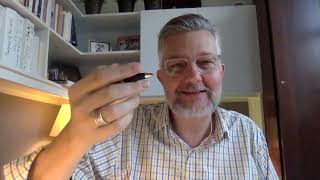
Joseph Pieper explores ergon, an ancient Greek concept meaning the unique function or purpose of a person or object. The conversation examines how to identify your ergon and hire for it, connecting personal mastery to the spiritual dimension of work and creation.
Talk about the idea of ergon is that. How am I pronouncing that correctly? Ergon. Ergon. So in being the best version of yourself, so you talk about this in your book, and you encourage individuals to find their ergon, but you also encourages. Encourage businesses to hire for ergon. I feel like this kind of goes into that same idea. Can you tell us a little bit more about what. What this kind of idea is and what does it mean to hire for it?
Yeah, I mean, ergon in a very simple way is. This is, you know, this is a pencil, a pen here. And this. This. The ergon of this pen is to write right on paper. And so that is the ergon is defined as the thing, the. The activity that something does that it can do better than anything else or anybody else. So this is a pen. It's a ballpoint pen. And it does one thing really well. It's not meant to write upside down because that would not work, but to take notes or something. This is a perfect thing at its price point and everything. You can see how this was designed to fulfill its ergon. So it has this thing on there, so I can clip and take it me whatever I want. It has a plastic here, so it makes it easy to write. All of these are things that enhance its mission in life, if you wish. It enhances its ergon. And this is an old Greek concept. And you know what they call something that enhances the ergon of a thing to do, what it's meant to do is called a virtue. And now guess what it would be if we put something on this pen that makes it less good of a pen. The Greeks would call it a so virtue. And vice comes from that. From that Greek.
Wow, I didn't know that.
And so a virtue is something that makes you better at what you're designed to do. And a vice is. Makes you something that makes you worse. So if this was completely rubbery, it would be a vice because it makes it worse at what it's supposed to do. And if this becomes for my hand, a little bit thicker and easier to handle, it will be a virtue for it. And now I'm asking, what is your ergon? Everything or every person has an ergon, which is a unique opportunity that you can fulfill better than anybody else. And of course, your best ergon, your ergon is. And I do this often with the students. They think when I say, what's your ergon? They immediately start to think of other people. And I'm saying, no, your ergon is to Be the best Joseph you can be. You're meant you are born in a certain time, at a certain location, with certain parents, with certain opportunities, with talents and non talents and in a, in a time context that is so unique that if you don't live up to that potential, nobody ever will. And what you're competing with is not the person sitting next to you. What you're competing with is the best version of yourself. You're competing with your potential to say can I live up to that? And no, I don't care what the person does next to you. I only care about what your potential is to live up to that intrinsic potential in you. Now as it pertains to business, this is why I'm using this language of saying how can you add value for others? You know, like this pen adds value for me by its existence, by writing. And that's worth something to me. This pen is much less worth than you and I as a human being. And so the kind of value we can add for other people is, is tremendous. It's actually you could invest in this and get some return on investment. You can invest in you or me and you get infinite investment because we are like the gift that keeps giving if you invest in us as humans. And so there we make a huge mistake both in companies, in not investing in people, but even ourselves that we don't invest in ourselves. And I want you to look at yourself not as a problem to be solved, but as an opportunity to be pursued. I want people to accept, to realistic, realistically accept who they are and to find out here are my talents, my non talents, my opportunities. And then say how do you optimize this and how do I invest in my talents and mitigate my non talents? And in a sense, I know it's funny you say that like this, but with self love to accept yourself and to boldly then go into the market and add value where you can. And I'm telling you that is the secret in my opinion to a really beautiful career that is also a satisfying career. Because when you do that you don't just make more, you become more.
And scene. Now that man that is. So that self love component is really, I think that's a bit of a missing link and it's not talked about much because I think it is, it's a little uncomfortable, right? But, but like see this very quickly.
Sounds esoteric what I'm saying, right? Very quickly I'm, I'm at that point and I'm sort of leaving the God talk out of It a bit, and I'm skirting it. But. But this work ends up being a spiritual affair.
Yeah, I mean, it. I mean, a lot of our existence is a spiritual affair. You know, how we interact with others and how we. You know, because at the end of the day, you know, no man is an island. We all have to bump into one another and we're connected.
Exactly.
And sometimes. And sometimes the way we love ourselves means that we can see ourselves for what it is. It's almost like we're dusting the. We grab a box off of the counter and you dust the top off to see what it says. You know, I feel like that's what. That's what that self love does. And I think that's really important. Important. And I appreciate you boldly talking about it because not a lot of people.
Are, you know, an aspect of this self love. And. And about just the. The metaphysics of work is that why do we pay extra money for something that was crafted by somebody and made so beautiful that I could buy for three bucks, but I pay 300 bucks? I tell you why. It's not just because of the physical work. This is what I mean is that work is beyond physical. Because we're spiritual. We're incarnate spirits. We're spiritual and physical that when we work an object like this, then a part of me is. With a part of me is communicating through this piece. And so when somebody loves themselves to the point that they become a master and they're putting their love into this piece of work, guess what? That love comes through to you. That's why you love it. It's lovable because it was made with love. And this kind of, you know, this is what I love about mastery and excellence. That we care enough to put something into a product that the other person then can enjoy. This could be as simple as some, you know, making coffee for somebody. But you can tell when somebody paid attention. And I. I like to believe that there is that spiritual component that comes along with the product. And the people who buy it, they can tell.
Yeah, yeah, there's a. There's a. There's an impression left. You know, I was looking at this. A friend of mine, we were at their house the other day, and they had a cutting board that was made by a friend, and their friend gave it to him. And I was like, oh, my God. And I remarked on how the beauty of the cutting board, how incredible it was. And I could see, you know, I. I love the reason I love these kind of handmade products. Is because there's a story that it tells. I can see where like I can see the struggle that or the I can see the material that was used here and I can see that they planed that down and had they not, they would have probably had a problem on this area here. And like, you know, oh, they used epoxy and I can tell because like whatever. And what a beautiful color on this epoxy. I wonder how they got that. You know, that, you know, you don't look at a store bought plastic product from Walmart and think, you know, like what story does this tell? You just grab it and put it on your counter and then move on. Like, exactly.
There's a different value in it. And of course, and this is the part I'm not sure how, how I wouldn't want to lead with it first. So I'm not sure we should include it in the video.
But sure.
You know, of course what this perfectly mirrors is creation. And when you see a sunset. Yes, you cannot. When you see the universe, the center of the universe, you're like, who ever made this is. This is like. You see, there's a, there's a spark of God is in that creation. And that's what we're seeing. And that's why we are. You know, when it says we're making the image and likeness of God, it's not. God doesn't look like this. Yeah, God is creative like us. And so we have that same ability to put a bit of ourselves into our creation, which is exactly what God did. And that's what we're reacting to. So the person you looking at that cheese board is about the same as somebody looking at a sunset. Wow, this is amazing. And they're looking at that and there's a piece of the creator in that thing. And the robot can't do that because they don't have a soul and they're not a spiritual and.
More from Andreas



He Teaches Entrepreneurs How To Be The Leaven of Society | Andreas Widmer | The Pope and the CEO



Principled Entrepreneurship with Andreas Widmer: Lessons in Leadership and Humanity

Principled Entrepreneurship with Andreas Widmer: Lessons in Leadership and Humanity



The Virtues of Free Enterprise and the Heroic Spirit of Entrepreneurs | Villanova University | 2024
