Andrew Feldman, Cerebras | Raise Summit 2025
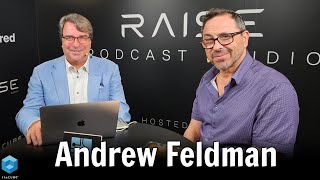
Cerebras CEO Andrew Feldman discusses the company's growth to 650 employees, customer wins including Mayo Clinic and Notion, and the shift toward consumer AI. He emphasizes AI sovereignty, open compute standards, and the rise of domain-specific models as the company prepares for an IPO.
Chapters
Hello, I'm John Furrier. We are here live in Paris, France for TheCUBE's exclusive coverage of the RAISE Summit 2025, 2 days of wall-to-wall coverage where it's an international forum, a lot of US representation, but again, this is about international, global scale AI coming into action. Investments we've seen over the past year continue to thunder away, but now the value creation is coming to the table, harvesting that value, that's the key topics. Of course, the entrepreneurial activity is very, very high, as well as the leaders who are doubling down on their momentum. Andrew Feldman, co-founder and CEO of Cerebus, is with me again. Cube alumni Andrew, great to have you on theCUBE. Thanks for coming back on.
Good to be back.
I know you're super busy. You always got the super chips. Just put that up there.
Look, one of the great things about being a hardware company is we've got good show and tell.
Show and tell.
And so when you build a big chip, you may as well bring it around.
Got the big dog out. We love hardware props. Just saying. First of all, we've been following Cerebras for a long time. So again, congratulations on the continued growth and we appreciate what you do. You're providing the horsepower that's needed, inference and the speed. You guys are hitting records and, you know, need for speed. Scale and speed are competitive advantages. I know you're super busy here at the event here in Paris. Also, you had a keynote feature with Eric Schmidt, also a veteran like yourself. He's leading a lot of the AI thought leadership. You guys are building and enabling all that. So we'll get into the Eric Schmidt, but I want to get to Cerebras. Give us an update. It feels like we're at the mid-year point. Obviously, a lot's happened. In the first half of the year. You guys had your first big event, Supernova, you got the Supernova replica here. What's happened in the past year? Give us an update on just the progress with Cerebrys and as it relates to the industry. I know also your manufacturing scale is going up. Give us an update on what's happened this first half of the year, then we can go talk about what's going forward.
I think as you know and as your audience knows, the rate of change in our space right now is extraordinary. And the improvements in the models— we've gone to models that are primarily reasoning, we're seeing agentic workflows— these put additional pressure on inference time compute. And so this is something that we foresaw, we built a company around, and we are sort of the undeniable champion in the performance domain for real-time compute, for inference and for training. And this is an exciting development. And this is what you, when you start a company and you make a big technical bet, as we have, and the market breaks your way, right? This is enormously exciting. And so we're expanding on every front. I think we're now more than 650 people at the company. We have offices in the US, in Toronto, in Bangalore. We have quadrupled manufacturing capabilities. We manufacture in the US, one of the few companies that designs, packages, and manufactures computers in the US.
And you're expanding too, right?
We are expanding. It has been an extraordinary run.
As a founder, you know, it's always Sometimes you have to celebrate those moments. What are some of the highlights for you? Obviously, you mentioned some of them. Can you elaborate on some of the other highlights? 'Cause sometimes you gotta pinch yourself, pinch me, I gotta, what's happening? It's breaking our way, the surge is coming.
You're right, I think as founders, every day we focus on the stuff that's broken and how to be better. Every day you go through your organization, you think about how do I improve my product, which part, Can I make better? Which part isn't working and needs improving? How do I hire more and better people? What can I do every day? And then a few times, sort of in a quarter, you get a chance to step back and say, holy cow, the problems we were working on 6 weeks ago are deep in the rearview mirror. We've solved these. We've got a whole new set of problems. There are 40 new customers that have been onboarded since then. There are trillions of tokens that have been served since then. There are new, new problems that have come our way. And so, you know, when we, when we finished a model for, for Mayo Clinic, we partnered with them to train and serve a model that is the premier foundation model for genomics and that predicts with impressive accuracy which is the right drug to take for rheumatoid arthritis, you step back and you say, this is what we, we set out to do when we founded the company. We set out to solve important problems for society.
Yeah, and the demand curve is high. I mean, I actually interviewed the Mayo Clinic leader who spoke at your dinner last night, which I attended at your Supernova conference, and he's progressed. That was how many weeks ago? Like 8 weeks ago maybe?
Oh, for sure.
And so in 8 weeks he went from just doing one thing. Now he's got 4 more things on the docket.
That's, that's what's going on with all our customers. You begin with a project and, you know, you show value, and right away there are half a dozen projects behind it. And it is a mind-bogglingly exciting time.
I was talking to another entrepreneur, and a little bit different space, probably a customer of yours actually. I won't say their name, but yeah, I know they're a customer. He's like, "I'm doing deals on text." Talk about the demand side, because I know there's a huge demand curve you guys are heading into. You mentioned the market's breaking your way. Talk about some of the demand side, what action's happening. Obviously you have Sovereignty nailed down.
We're seeing exponential growth. I mean, you're seeing extraordinary growth in usage, in customer acquisition. I mean, it is a, They talk about our market as being consecutive S-curves, right? We are in the steepest part of that S-curve and we can't see the top. And it is—
You're pedaling as fast as you can.
That's exactly right.
What are you guys doing to share the growth strategy? Obviously, almost hold on to the rocket ship, don't fall off kind of mentality. What are you guys doing? What are you optimizing for? Because you have the growth curve. It's clearly there. Take us through the day in the life of what you're working on, how you focus, what are you optimizing for? Because the growth is there, what's the strategy?
I think we're trying to think about where the world will be in 6, 9, 12 months. I think sometimes people will ask us, sometimes investors, sometimes others, where will this be in 5 years? And you think back and say, 5 years ago we didn't have transformer architecture. Right? We didn't have ChatGPT. We didn't have the things that are now sort of accepted weren't there. You know, Sam Altman had a great quote. He said when we brought out ChatGPT or GPT-4, said everybody said it was the best thing since sliced bread. And then 2 weeks later, it's like, it's slow. Yeah, right. It was great for 2 weeks and then it wasn't fast enough. And then what do you have for me next? And that's the world we're in. And we're trying to think about that. And when you build chips that require a year and a half of planning, all right, you have to get those bets right. And we were able to create an architecture before transformers existed that turned out to be the best in the world at transformers. You know, that's when you get something right.
All right. As you look at the bets going forward, second half of the year, we're going to see supercomputing. Will probably be a monster show, Open Compute, as people start to think about open source. All these events are going to be hopping. As you go into the second half of the year, into 2026, obviously we know that you guys had filed for an IPO, so you got all kinds of business things going on, but on the tech side and customer side, what's the focus? How are you guys seeing it play out? Obviously you're going to have a lot of go-to-market opportunities. What's the second half look like for Cerebras?
Well, I think you will see more customers with interesting use cases that solve fundamental business problems. I mean, we announced at the event partnerships and new customers. So we announced Notion, right? An extraordinarily fun company as a customer. We announced partnerships with Docker, with Hugging Face, with recently with IBM, with Meta. We announced that we were available through AWS Marketplace. You know, just a continued expansion. And I think you will continue to see in the months ahead large enterprises deriving real value. Not just experimenting, not just doing some demos because the CEO banged their fist because the board said, where are you with AI? Seeing real value delivered across the board.
It's interesting, I love talking with you because one, you're a founder and you're still leading the company and probably will be for a long, long time as you make the right bets. That's always a good way to keep going.
A good way to keep your job is to not make bad bets. Thank you for that.
And don't run out of money. Those are two things I tell. Make good bets and don't run out of money. That's the secret to success.
No doubt.
As you look at, and what I like about this show is AI has been hot in the enterprise. We've been seeing that. We've been covering it like a blanket on TheCUBE and SiliconANGLE. But now, here at this show, I'm starting to see what I've been seeing in the US, but not as much as here, the entrepreneurial consumerization side. 'Cause the builder culture has now probably a good year under their belt with open source. A lot of people are coming in through clouds like yours and others, and getting those prototypes into sizable pre-production ready apps.
[Speaker:ANDREW FELDMAN] That's right.
[Speaker:ROBERT] And so I smell and feel a surge of consumer apps coming. Oh, and I think that's going to be a big story going into next year. What's your reaction to that?
I think that's exactly right. I think when a foundational technology like, like AI hits the big time, it's when people embed it in their applications. You build an application and what do you need? You need a shopping cart. So you have an API to Stripe. You need a chatbot. You have an API to Cerebras, right? You— it's not It's just something that's in every app. And at that point, right? You're cooking with gas. It's left the domain of the AI practitioner and it's now part of every app that's being built. And that's what we're seeing right now.
It's almost interesting. I love how you brought that to the table because the theme in this AI wave that I would say, maybe love to get if you agree or disagree on this one, love to riff on this. it's almost like the script has been flipped. And I hear that a lot from when I interview founders and leaders. The script has been flipped. The old days, consumer led the way. In the internet, the consumer apps were first, enterprise lagged. Enterprise is leading and now consumers lagging and coming on board because I think you're right, it's infusing into everything and then people can see as a consumer, "Hey, I like this retail app, I like this financial services app, I'm an oil and gas customer, I see this app." you start to see the verticalization on the consumer side, but in the aggregate, it's all consumer.
That's right.
At the end of the day, it's just an app.
That's right. One of the things I spoke to Eric Schmidt about was how AI would be adopted by the consumer. And what I— what we said at that time is, is if you think about what happened to your phone, right, at some point you woke up one day and you'd rather have your phone than your wallet with you. Yeah, right. Choose between losing your phone and losing your wallet. You'd way rather lose your wallet, right? Because with your phone— and then it became more important than your car keys.
Yes.
So you could lose your wallet and your car keys and keep your phone because you could get home. Yeah, right. You could buy something with your phone, and it's gonna be the same embedded in your— and interestingly, with the phone is if you're under 30, you actually no longer use it as a phone. You don't make phone calls, you're busy texting nonstop, right? And so I think the AI is going to infuse our lives in the same way. It's going to be part of everything we do. Yeah, right. It's going to be the way we make a restaurant reservation, the way we order a burrito. It's going to be the way we, all right, get a question answered by our HR organization. It's going to be the way financial reports are made by large companies. It's going to be the way we do research to understand an investment.
It's—
you just keep going and going and going.
I think that's so awesome. I mean, I think if Steve Jobs were alive and you had to talk with Eric Schmidt, I want to get to in a second, you have Eric Schmidt on the Google side and he's done a lot of other things, but Google side, internet search, internet websites, Steve Jobs with the iPhone. I'll never forget the— in 2018, I went to CES. It was the first CES I went to where I had my iPhone and needed to carry my laptop around.
Right.
So lugging her laptop around, I had my phone, I did everything on the phone. I said, this is going to be a game changer. It was a game changer. So, you know, that's clear, the same with AI. We're seeing that first, this changed my life in how I interface with data. Eric Schmidt, you were featured on the keynote last night, the signature keynote here at the RACE Summit, talking about kind of the historical perspective to the, superintelligence journey. What was that conversation like? Take us through that because you both have similar characteristics, leaders, historical person. I won't say historian, you're kind of a historian. We're both historians, but we've seen—
You get to a certain age and you're a historian just by lived experience.
You're still in the arena, trust me. You're taking bullets every day. But as a kind of historian perspective, you've kind of seen some patterns, but now we're in a whole nother game. What did you guys talk about? What was the conversation?
Well, I think first Eric is an extraordinary mind, and it's very rare that people have both deep technical expertise, have real managerial experience, right? And he ran Google from 2001 to 2011 during some of the fastest growth in the history of industry, and have a global perspective. Have a policy perspective around a technology like he has around the, the implications, the geopolitical implications of AI. It was an absolute pleasure to, to be a part of a conversation with him. I, I think, um, we focused on, on a couple things. I, I think what it means globally for artificial intelligence to, to reach some sort of superhuman capability, how it would manifest and when He's of the belief that it's in the 6-year timeframe that we'll reach this super intelligent level. Others in the Valley believe it'll be a little bit sooner.
6 years is like a blink of the eye.
It's around the corner. The truth is, it doesn't really matter whether it's 3 or 5 or 6. It's really fast and it's coming. He had some very interesting thoughts about what that meant for security, national security. Right? That it has some of the same impact as the race for a nuclear bomb. That it is a very powerful thing and has to be thought about very carefully in the same way. He also had some very, very interesting thoughts about the impact of open source.
What was his thoughts there?
Well, one of the things he pointed out was that in the US we tend to focus on who's the best with open source. And we are in a head-to-head battle with China. And that China might be playing a different game in that if their open source is second best, but they win all of Africa with it, they win all of collection of hundreds of nations that the US doesn't focus on. All right, that might be the game they're actually playing.
Yeah, they're playing another game.
Right, that was really interesting. I hadn't thought about that because those aren't markets that we think about every day. And he clearly had been sort of thinking about a global game. And that was, you know, how rare is it you get to have a conversation where you learn something on stage?
I mean, I think that is actually a great topic because I want to double-click on that because you're in the middle of the power game because power, you know, compute and inference is bounded by power.
That's right.
And so is Bitcoin, the power of money. You mentioned Africa. They all got mobile devices. Money systems, programmable money is coming.
It's coming. And you know, that was actually something that he pointed out too. He pointed out that it was his bet that if you took a map of the world and you looked at who had power and at what price, you could predict the future where big data centers would be. That would be, those would be AI hubs.
Well, one of the things that you guys are also in the middle of is sovereignty, which is a topic that's The most important story that's not talked about much, I think it's going to be talked a lot going into the second half of the year as well as 2026 on two fronts. One is sovereign AI, which you know well because your company's founded with a core relationship in the Middle East and sovereign cloud. Yep. And data centers. So, so if you look at power, that could tip the scales on global alliances because if, if you're, say, Taiwan or, you know, You're in Malaysia, you say, we don't have a lot of power. Maybe you have an alliance with someone who does. So there's now a shift in power, quote power, not power as in powering devices, power struggle or power alliances.
I think that's true.
Where I think China, Middle East, and the US obviously are big players. I think Middle East just wants their sovereignty. They just want their language, they're happy.
I think that's a very reasonable thing that seek to have AI in Arabic or in Spanish or in French and Portuguese that is as rich as the AI that's in English. Those are eminently reasonable national desires. I think to not be dependent, and that means not be dependent on US cloud providers, but also not be dependent on NVIDIA, right? To build infrastructure that is domestic to have models that represent your people, to be not dependent on any single vendor in your path to independence.
I want to talk about Open Compute as a reference architecture or metaphor or just an example template maybe. We covered Open Compute when that was founded almost a decade ago. I think Facebook and Microsoft donated a lot of the open source.
Frank Berkowski at—
Frank and Andy Bettsenstein, Intel. Justin Ratner was involved. All the key players at that time, all now kind of senior historians. It has now become quite the community because open systems is a big part, that's like a gravity point.
It is.
For open systems. What's your vision around how open, you brought up NVIDIA, might as well go there because I think open systems and closed systems, there's a lot of miscommunication or misinformation around what is open, what is closed. When's the hard top okay? I mean, I don't care if a chip's proprietary. I mean, that's a chip. I mean, that's closed, that's a hard top. Good luck, thank you very much for doing that. I don't mind that that's a high-performance piece of intellectual property. If it helps me get better inference, do I care? Now, I want it to interoperate.
That's right.
So I think, take us through the balance between when something can be proprietary software and it's not a problem.
Sure, so the rise of open systems came from an observation that the differentiation among server providers was very modest, and that what they were delivering were x86 machines. They used approximately the same chips, they used the same memory chips, they used the same NICs, they used the same components, and the difference to the customer was, was modest. And yet the cost of having all these different flavors, all of which were basically vanilla, um, was high. And that if we could agree on some things, right, you could put enormous, enormous volume on the, the mechanical enclosure, the box. Yeah, you could put enormous volume on the way the motherboard was constructed, and that this would benefit everybody. And I think they've made tremendous progress to that end. And I think, you know, I put a LinkedIn post up that describes the exact opposite. I spend 100 days a year on the road. Every hotel I walk into, the shower knobs are different. You're tired, you arrive, you want to shower. It's an adventure. You say, "How do I turn it on?" "How do I turn on the damn shower?" Right? Every single one. Servers were a bit like that for a long time, right? Even though they're all delivering the same thing, right? Little tiny differences just made it annoying as could be. And that by sort of reaching some agreement, that we were going to always have the hot on the left and the cold on the right, that we would always go left for on, right for off, right? We were able to move forward. Where we've reached agreement in industries, like the Ethernet standards, we've been able to make tremendous progress.
And Ethernet is a great example, and that was supposed to be dead decades ago. It just gets better and better, and now we're seeing 100 gig.
400 gig, 800 gig.
I mean, it's monstrous, and then now it's all in the fabric too. That's right. So you guys are integrating into the silicon. That's right, that's right. And open compute, your vision on open compute, doing the right things, people are okay with open compute?
Absolutely, absolutely. Get to it via Ethernet, all right, a truly open standard. You can, you can buy switches from Arista, you can buy them from Juniper, you can buy them based on Broadcom silicon, based on Cisco silicon, right? A huge number of choices. If the machines are doing— if they're using the same chips, delivering the same thing, open is great.
All right, final, final question on the Eric Schmidt piece. Any other takeaways for you that were either a surprise or an enlightenment or a ratification of your current beliefs?
I thought there's a lot to learn to being a CEO. Yeah, that's the fun part. And there was a guy who ran one of the great companies during one of the fastest growth periods in history, and that was a very enjoyable conversation to think about and to learn how, uh, how he thought about our industry.
Is there a pattern of winners and losers? We see behaviors, any patterns around I don't have to name names, but like I just had an interview with the CEO of Stack Overflow. You'd think there'd be like a knee-jerk reaction from him to like, well, LLMs are stealing. He's leaning in and he's actually got opportunities coming out of that that are a surprise and a delight for him because he's actually helping the LLMs get better.
He's actually got some of the best data around.
And so he's growing.
He's got some of the best data. I mean, I think what's interesting about these entrepreneurs is that These curveballs are both threats and opportunities. And that sounds trite and ordinary, and everybody always says it. But I think they are thinking about how their basic assets change in value. Right? Before, it was a place to have conversation, and now it's, I've got a history of conversations and expertise unlike any other. And that I can use this, this is suddenly a value in a different way.
It's a new unlock.
That's exactly right. And I think when the world is moving as quickly as it is in our space, that is one of the really fun parts of the job.
Never fight fashions, I always say.
That's right, run with them, find better.
Yeah, okay, final question. Entrepreneurs out there are watching. There's a lot of excitement right now and experimentation, builders. Not just developers, not app dev, it's building things, which means application development and data development. The rise of vertical specialization, domain expertise, where you have vertical models emerging. On your 100 days a year you're traveling, talking to the big enablers, whether they're large-scale customers for you, they're also enabling their customers. So what is your view on the idea that the specialty models, about some of these vertical models that are emerging, and of course that will map to sovereignty as well because a country will have models too. So like, what's your vision of as these models expand, what does that mean, how does someone capture and create value?
I think you have to think really hard about what is similar across large organizations. Say, take Procter Gamble, take Boeing, and take an oil and gas company. Right? The truth is, is your HR organization is more likely to be similar to people of your size than it is to be people who are vastly different size even in your industry. Right? So those are horizontals. And there you're going to see models that are perfectly fine for HR of companies larger than 50,000 people. And there's going to be no specialization beyond that. It's going to be an HR. Right? Now, there'll be different models that will be good for the type of electrical or aeronautical engineering that is done in aerospace, right? And so you will see finance models that work across industries. You're going to see domain-specific models for drug design. You're going to see— and so it— in the parts of industries that are differentiated, all right, you're going to see domain-specific models. And in the parts of of your business that we all have that are similar, you're going to see general models.
Got it, and I think that maps to kind of like the personalization wave we're seeing on the consumer side.
That's right.
Andrew, thank you so much for coming in. Great to see you.
Always a pleasure. Fun conversation as always.
Andrew Feldman, the co-founder and CEO of Cerebras, again on the front end of this massive tsunami. We're bringing it all here in theCUBE. I'm John Furrier, your host. Thanks for watching.
More from Andrew



How Cerebras is Democratizing AI at Scale with Andrew Feldman, CEO of Cerebras



Cerebras CEO, Andrew Feldman on Why Raise $1BN and Delay the IPO & Why NVIDIA’s Worried About Growth

⚡️Raising $1.1b to build the fastest LLM Chips on Earth — Andrew Feldman, Cerebras


Andrew Feldman, Cerebras Systems | theCUBE + NYSE Wired: AI Factories - Data Centers of the Future


Andrew Feldman | How Cerebras Built the "Impossible" AI Chip Now Challenging NVIDIA