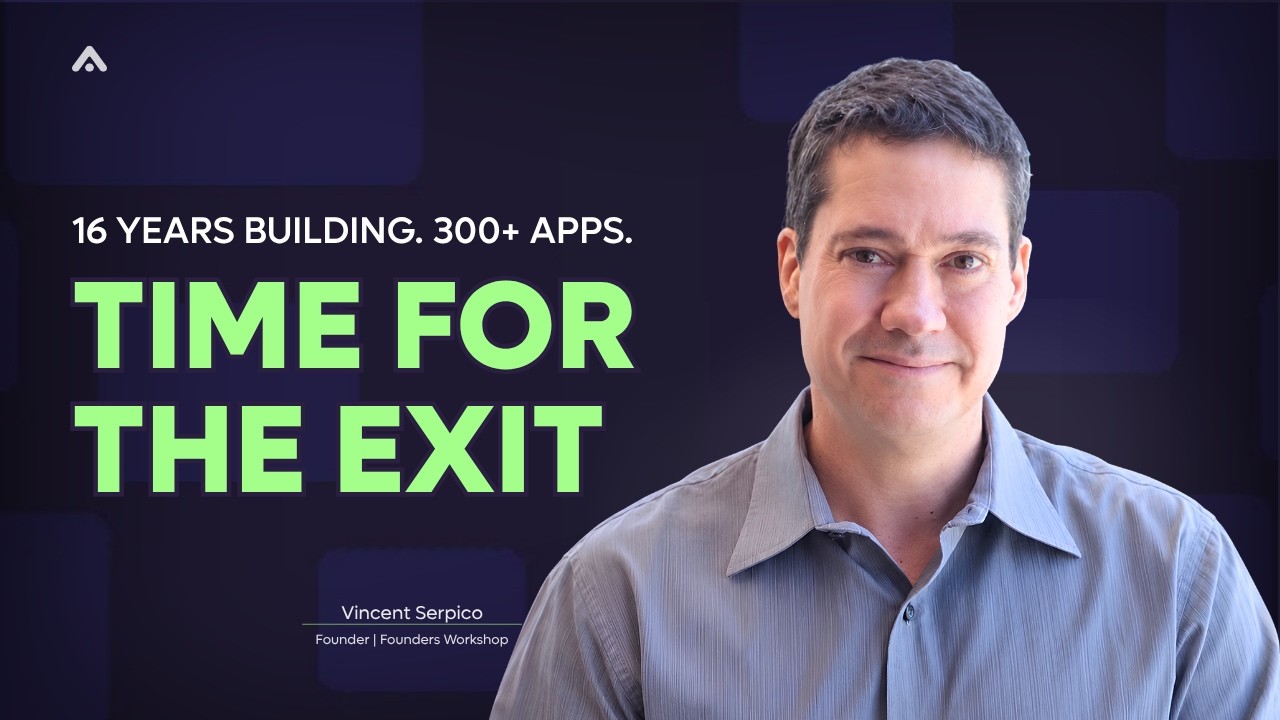
In this interview, Andrew Gazdecki talks with Vincent Serpico, founder of Founders Workshop, about his 16‑year journey building a product‑development shop that delivered over 300 software applications to 300+ customers. Vincent explains the company’s horizontal, product‑first approach, how they acquire customers through deep networking and, more recently, AI‑focused public speaking, and the operational challenges he faced. He discusses why he chose to sell the business—seeking a new focus on AI—and walks through the acquisition process with Acquire, including expectations, a year‑long timeline, due‑diligence, data‑room preparation, and the buyer’s technical background. Vincent shares practical advice for founders preparing to sell, emphasizing clean financials, robust yet just‑in‑time operations, and turnkey readiness. After the sale, he celebrates by buying a custom high‑end workstation and devotes his time to AI projects like a Prompt Maker app. The conversation offers insights into building, operating, and exiting a long‑running software services company.
Chapters
All right, I'm here with Vincent, the founder of Founders Workshop. Vincent, how you doing today?
I'm doing well, Andrew, thank you.
I'm excited to chat with you today, hear your story. But before we dive into that, do you want to give a brief introduction of yourself for people that may not know you?
Sure. My name is Vincent Serpico, and I've been in technology and owning businesses for a long time.
All right, tell me about Founders Workshop. What did the company do? What problem did it solve?
Founders Workshop is a company I started after being CTO in an acquisition. Basically what I did is parlayed my business skills and my technical skills to start Founders Workshop. Founders Workshop was around for 16 years before I sold it. We built over 300 software applications and the business was doing really good. I mean, like a cyclical up and down, but before we sold it, we were hitting our highest numbers ever.
That's incredible. Tell me more about the projects you work on. Was it kind of everything?
It was more horizontal than vertical. In the types of companies that we work with, but vertically our niche is getting an idea out of your head and into market. And we don't just do that by doing like a 30-minute discussion and giving you a quote. We consider that gross negligence. So yeah, if any other dev shop owners are listening, I think it's gross negligence to give a 30-minute interview and a quote. So what we do instead is we have a discovery session that lasts about 2 weeks. To fully and completely understand a person. It's not just technology we do, Andrew. Well, I sold the company, but it's not just technology at Founders Workshop you do. Anybody can build an app. Any monkey can build an app. What we do is we help you understand the app in conjunction with your business. Don't overbuild and build just enough what the users need so you can go out and get feedback. We're more of a product development company than an app builder. Okay. Yeah, we have great technical people, but more than else, we have people who understand business inside and out.
I love that. Cause I think you can get so carried away with an MVP and you could spend a ton of money and never actually get a chance to go out and talk and get feedback to actually try and grow the business. So I think that's great. Tell me about, like, do you have a favorite project that you built? Was there like one that, you know, you guys built MVP and it turned into a big company or anything cool like that?
Let me think about that. I mean, yeah, a few. I'd say my favorite project was working with a company called WellPsych. WellPsych is a psychiatry company out of Beverly Hills. I'm not sure how many employees they have, a couple of hundred, I think. And they came to us years ago, probably a decade or more ago, wanting a small Zoom integration app before anybody even knew what Zoom was. And that's it, the only thing they want. Then they asked for something else and something else. And then I found out that, hey, this guy is rather brilliant who owns the company. He's a pleasure to work with. And I really enjoyed working with Dr. Adele and I really enjoyed working with WellPsych. And yeah, I liked them all. I mean, look, I had 300 customers, so it's hard to remember all of them, but yeah, I liked WellPsych, but I liked a lot of them too.
Nice. 300 is a lot of customers. How did you get the first customer though?
So I got the very first customer through my network. Like I said, I built up a really solid network when I was a CTO at Flypaper. That was the name of the company that was acquired. And I basically took that. I'm technical and I know business really well. And I'm able to translate tech into business and business into tech really well. So my very first customer, just when I said, hey, I'm hanging out my shingle, I started getting customers, you know? And just to let you know, I'm really bad at marketing. Everything I did was through my network, handshaking and that kind of stuff, you know?
Nice. If you were starting again, how do you think you'd get customers? Same thing? Just build a network?
Well, start again today or start again 16 years ago?
Today. That's a—
yeah, different world. It's a completely different world. Yeah. How would I go about getting my first customer today? I do a lot of public speaking on AI. I do a lot of keynotes. So I would say that if I wanted to get customers today, I would hop on stage and do an AI presentation. I mean, I do it all the time anyway, but just to get out there and hang your shingle today and say, I'm a software development company, doesn't do shit. I think what really matters is getting out there, telling them how you understand the business, explaining AI, And building trust that way.
Nice. What was the hardest part about running Founders Workshop?
Operations, hands down operations. Look, I'm good at sales. I have really good vision. I'm very good technical, but operations, I absolutely suck. Either I suck at it or I really hate it or both. So when I brought aboard operations folks starting in 2018, it really helped me expand the company because I didn't do ops before. So my recommendation is this. I also started another business about 8 months ago and did all the ops upfront because at Founders Workshop, I was like, oh man, I waited all these years to do ops. But I made another mistake. I went completely the other way. I spent like $40,000 or $50,000 on putting ops in and realized I didn't need 90% of it. I should have been focusing on sales. What I'm trying to say here is that if you're starting a business for the first time, yes, you absolutely need solid operations, but I'd only implement It in just in time. You know what I mean? Because if you do, you're going to build out something that you may never need. You're going to burn through cash. So just build your operations just in time.
I think that's great advice. I think founders naturally love to overbuild where they try and scale the company before it's actually ready for that. Tell me this though, I think this is a good transition. Why'd you decide to sell the business? You had 300 customers that seemed to be doing absolutely fantastic. Why'd you ultimately decide to sell?
Yeah, a few reasons. First of all, I've been doing it for 16 years and I want to change. You know, I mean, those people who run companies for 30, 40 years, I know them very well, but it's not for me. 16 years and I wanted to do something else. That's number one. Number 2 is I am heavily into AI. I'm a programmer, so I'm creating a lot of apps with AI. I do a ton of public speaking on AI, not like bullshit AI, like here's how to write a prompt, more like here's how to implement agents within a harness, how to set up agents and sub-agents and build it out like an org chart. So I spend literally every single day on this, 10 to 12 hours a day, and I wanted that freedom to do that. So those are the 2 main reasons.
I think that makes a ton of sense. I mean, 16 years in startup world is like 200 years. And then with how fast things are moving with AI, I mean, it's just an exciting time to be building companies. So I talked to a lot of founders that are feeling the same way where they built a great company, you know, having the opportunity to sell it, to focus on something new with AI is super exciting to them.
Yeah, yeah, absolutely. I totally hear you and I totally get what they're doing.
Tell me about the acquisition process. What were your expectations going in? I know you worked with Kai on our team.
Yeah.
How was that? Just tell me about maybe like expectations and—
Yeah. So a few things. First of all, Acquire did a good job. Okay. There's no doubt about it. Kai did a good job staying in touch with us. We have zero issues with Acquire. And if you're watching this, I suggest you go through it. The issue that we had was it took us a year to sell the company. There was a lot of going back and forth between the buyers and the sellers. And it took a year. I was honestly expecting it to take 3 months at the absolute most. It's a small company, you know, you're not buying IBM here. You're buying a tiny little company, 30 people at the most. And I thought it would go quickly. Kai pushed really hard to get it done quickly. So did the bankers. So did the lawyers, but it took what it is and it is what it is. So that was my expectation going in, but Acquire has absolutely nothing to do with that. And Kai did a great job. So. I wouldn't have agreed to this podcast if I didn't think you guys did a good job.
That's incredible. I appreciate that. Tell me about due diligence. How's that process?
I didn't do the due diligence. My COO did the due diligence. He's gone through an acquisition before, so he understands it. He said that there was a lot more due diligence to do than he thought was necessary, but he got through everything. He did an amazing job. His name is Mike Vanderslice, and he is probably the best COO that I've ever met in my life, and I've worked a lot
of them. Nice. What did you guys do to prepare for the acquisition? Did you put Did you have a data room? Did you prepare financials? What did that look like?
Yeah, we had a data room and we kept on dropping stuff inside the data room, financials, you know, client list, all that kind of stuff. So we use a data room and I think Acquire set that up. It was really helpful, really useful to have a data room.
Nice. Tell me about the buyer that you ultimately sold to. Was there something in particular that stood out about them? Did you get along with them really well? What made you eventually want to sell to this individual or company?
A couple of reasons. First of all, he has a deep technical background. He was a programmer for many years. He owns dev shops, so he knows what he's doing. And I started this thing 16 years ago. It was originally called Serpicode Dev before I changed the name, and it's partly my legacy. So I really appreciated that. Also, he owns a marketing company and his idea was to join the two together, and I thought it was quite brilliant and I'd love to see where he's taken it. So that was really
it. Nice. And then in terms of You know, you've been through an acquisition. Let's say you were talking to another founder and you were going to give them some advice on potentially selling their business. What's a couple of pieces of advice you can give them?
Okay, so if you're ready to sell your business, the just-in-time operation doesn't work. What you need to do is really put in full operations and try to automate it as much as possible. That's what your buyers are looking for. They don't want to buy Joe's software and only Joe can do it. They want to buy something that is somewhat automated. And so we put a lot of work into putting in operations, some we didn't need, but that we knew the new owner would need. And we spent about 6 months to a year doing that before we even listed. Again, my COO, Mike Vanderslice, did an amazing job with that. And we brought aboard a product specialist, UI/UX. His name was Wayne Neal. He was an equal partner and he did an amazing job too. So between the two of them, they helped us prepare for the sale.
Nice. And then what can a founder start preparing today? I know you mentioned operations, but any specific docs or things that they should come prepared with the sale before they speak to buyers, anything like that?
Number one is pretty obvious. Make sure your books are all clean and everything like that. I'm not talking about anything shady. I'm just talking about that they're able to read it without any weird cross-references and other shit like that. Number 2 is, yes, prepare for your ops. It's more important than you think it is. We sold Founders Workshop as turnkey. And it seriously was turnkey. We were around for 90 days to help. The new buyer needed hardly any help, partly because he's really smart, but I think mostly because we put in solid systems that all he had to do was just step in there and continue on.
That's great advice. What'd you do to celebrate, Vincent, when the wire hit your bank account? Did you go out to a nice dinner? Did you take a vacation? Did you buy anything cool?
Yeah, I bought a, I bought a supercomputer.
All right.
Yeah. Super high-end workstation. Yeah. That was my present to me for selling the company.
Right on.
I absolutely love it.
Where'd you get it? What kind of supercomputer are we talking? Like something super crazy or?
I don't know. It was a custom build actually. I got a nice, it's a Linux box with a pretty sweet Blackwell 6000 and I think 256 gigs of NVM. So sweet ass machine.
That is crazy. Well, what's next for you? You've successfully sold a company. What does your next chapter look like?
I don't know. We'll figure it out. I spend every single day on AI and building some apps. You know what app is getting some attention is my Prompt Maker app that basically chains together image, video, audio generation, and all you have to do is put in a vague idea and it does all of it for you. I'm getting some pretty good attention on that one. But honestly, Andrew, I'm in no rush. I don't know what I'm gonna do next. Absolutely 100%, I will not be golfing all day, but I have a lot of fun playing with the AI.
Love it. Well, Vincent, thanks so much for coming on the podcast. Loved hearing your story. Glad we could be just a small part of your success story. If people want to follow you online and reach out to you, where can they find you?
You can find me at LinkedIn at Vincent Serpico.
All right. Well, Vincent, thanks again and congrats again on the acquisition.
Yeah, thank you. I appreciate that.
More from Andrew



The Buyers Who Made the Move: What They Bought, How They Did It, and What Happened Next