How Building in Public Turned Trust Into a Clean Exit
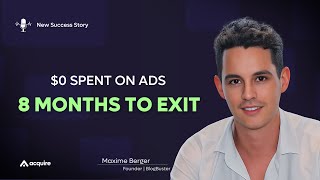
Podcast interview (YouTube, 2026-01-20) where Maxim (founder of Blockbuster) tells the story of building and selling an AI-powered blogging/SEO SaaS. Key points: V1 built in ~2 months with heavy prompt engineering (~100 hours); go-to-market via building in public on X with a $100/year introductory offer that produced first paid customers; product evolved to offer monthly pricing and saw traction. First paid sale occurred in March and the business was acquired in November (about eight months between first sale and exit; ~10 months counting build). Maxim chose a buyer with SaaS experience and marketing capital; due diligence went smoothly because of trust; he remained involved post-sale as an advisor. He has launched a new SEO product, Scalepages (programmatic SEO) and shares his X handle: maximmd_.
Questions this video answers
About two months.
About 100 hours (he said "I spent like honestly 100 hours of just hunting").
US$100 for one year (one blog article per day for a year).
First sale in March; acquisition completed in November (≈8 months from first sale to exit).
Based in Singapore for the past seven years; originally from Paris.
Chapters
Foreign.
I'm here with Maxim, the founder of Blockbuster. How you doing today, Maxim?
Hey. I'm good. Nice to meet you, Andrew.
You as well. Thanks so much for coming on the podcast and congrats again on getting acquired. Before we kick off the story, do you want to give a brief introduction of yourself for people that may not know you? Sure.
So I'm Maxim. I'm based in Singapore since the past seven years. Originally from Paris. I've been working in startup basically all my life, all my working life. So started in a more like traditional funded startup and then decided to do more bootstrap and that's what led to the first acquisition actually.
Nice. Well, tell me about Blockbuster. What did it do? What problem did it solve? Let's start there.
Yes. So Blockbuster, the tool that just got acquired was a blogging AI SEO tool, right? So basically it helped like companies get more visibility online with SEO, but also AIO. So being referenced on ChatGPT and other LLMs on autopilot, by basically scanning what the brand does, understanding the needs for the audience, what type of requests and what type of information your audience is looking for. All of that is done automatically and it will craft a content plan based on this and automatically schedule and publish to your own website the blog article every day. So then you get more visibility and more organic traffic.
Nice. That's slick. That sounds like a marketing team on Autopilot in a way. How long did it take you to build the product?
So it took about two months to build like the V1, which is of course very different than the version at the time at the exit. But yeah, the initial version of VP was like two months and most of the time actually were spent building the prompt. So the AI guidelines instruction that we generate, actually the blog articles to make sure that it sounds as human as possible within the limits of AI that it incorporates like all the SEO best practices like you know, the snippets, the internal links to other pages pages of your website, which is highly valued by Google. Also the tone of voice. Yeah, that is sound like rhetoric that is attracted attractive for the users. So I spent like honestly 100 hours of just hunting because I really wanted it to be like the best blog engine out there.
That is slick. What was the business model? Was it monthly subscription, yearly, one time use.
So it evolved over time, but I started as like a no brainer yearly deal. So it was only yearly for let's say the first two, three months. And then when I saw that there was traction, that user liked it, that the product Got stronger with more features and more like essential functionalities as well. Then I decided to introduce the monthly plan as well.
So user could choose.
But yeah, very much SaaS business model.
Nice. How'd you get the first customers? What did the initial marketing look like?
So it came from just building in public, like literally. I decided around like 1.5 years ago to start building on X. And I told to myself, month okay from now on like X is very new to me. I got like no audience, nothing. My account was like zero. But I started to say okay, I'm gonna give it a try. But a very good try. Meaning for the next year, 365 days, no exception. I need to post at least once a day, no break. Sometimes I would schedule ahead, but that was really my goal. So I started growing a step by step an audience. And Blockbuster was not my first product that I launched while building in public. So I already got a little bit of audience and I went really full on X. And that's what I, that's where I come, that's where the first clients come actually on the life, on the first yearly deal that was like a really discounted price. So very important here. Like I made that first yearly price a real no brainer deal. So it was US$100 for a year which would get you as a client one blog article a day for the whole year. So I wasn't even profitable on this if you would use the product for the year. But that was the goal to make it like really no brain for the, for the client and then validate if there was any interest or not. And my hypothesis was like okay, if even no one is buying at a no brainer deal like this, then I better stop working on it right away and start something else. But quickly I could validate the traction from this deal and then increase the price after one week and then kept on increasing slightly the price as the product matured.
That's smart. You're able to get customers pretty quick and get their feedback and get reviews and build up a little brand. Then that leads to more customers at higher prices and you create this like snowball effect. Was that kind of your thinking with the discounted yearly subscribers?
So it was not really planned actually. But now with the step back I would 100% do that same strategy for all my, my future product. One of the really good thing is like the no brainer deal made me like my first perhaps 1015 paid customers and that kind of changed everything because I could see the product being real, being like not Just me working on like delusional features, but actually doing what customers were needed, hearing the feedback. And also you got your first supporters, right? Like they want you to win. They want you to keep running the product for as long as possible because they pay and they use it. So it's in their own interest. And I could see them like sharing their experience also on X. So yeah, that created kind of that snowball effect. But also for me as a founder, it was, it was, it was great to see some supports.
I think that's super smart because if you're building and there's no one paying for it, you don't have that like dopamine rush you get when someone signs up and get that stripe notification. And then a week, regardless of what they're paying you, as long as it's a dollar or anything. Exactly.
There are so many products out there that are, you know, crappy, that will be abandoned within just a few weeks and stuff. So it's also kudos to, you know, the first clients to, to take the risk and take the leap and be the first to trust my product when no one else does and I think be rewarded for that. So also I think it's just fair to start with a, with a great deal for them.
I love that. That's, I think that's great advice for other founders and a good way to look at it. It's a win win. Sounds like you had product market fit. The business was growing. What made you ultimately decide to sell it?
Yeah, so business was growing. The first sale was in March and the acquisition was completed in November. So it was like just eight months actually from the first cell to exit. And it has been growing ever since. But it was not like the perfect linear. There were sometimes like low times, there was like euphorical times as well. So, you know, it's like, it's like this was a lot of up and downs. It's never like straight. But ultimately it was growing. And then I felt at some point I reached like a threshold of like what the public breathing in public. Sorry. Could bring into, into clients to the product. I felt I reached that limit kind of. And if I wanted to really go it further to the next stage, I felt like I needed to do much more in marketing, to invest in ad, to invest in like partnership, influencer promotion and stuff like this. I didn't necessarily want to put so much cash flow into that. So it was a good time to sell. But at the moment when I received the offer and even when I listed on acquire I actually didn't really know if I wanted to sell or not. I saw there was a market fit. I saw a lot of competitors were doing great. So the potential was still like, at the very beginning. And I know it has like, room for a lot of scale still, but at the same time for my network, I received a proposal. Someone wanted to take over, like 50% of that particular product and made me an offer, which I think was a bit low. But then I realized, okay, already this product, it has like tangible value and already potential buyers or partners are willing to pay for it. So it's not just immaterial anymore. It's real. It's here. And I, even though I declined the offer, I decided to list it on acquirer just to see actually, like, what would be the real value people would be paying for. But even at the time, like, I didn't really. I wasn't sure to sell it or not. And then I got like a few chats with, with some buyers very, very fast actually after listing it and great fit with one of them, I could see they really had like a vision for the product to create even further, to take a huge care of the existing clients. So, yeah, that was. I reflect like 48 hours and I decided to make the deal.
That's amazing. I think that's a huge win. I mean, huge congrats on being able to accomplish all that, especially in eight months. Is that right?
Yes, from first, I mean, I don't take the build into account, but from the first sale to exit, it was eight months and with a build, it's like, yeah, somewhere around 10.
That's amazing. And getting that under your belt too early, I think is huge because I think the next startup you, you know, really go all in on is going to be even bigger. And you've been through an acquisition, you've been able to acquire customers, you've been able to grow a startup from scratch. I think that's an amazing accomplishment. And then you're able to sell it to a buyer that can potentially take it further and you could see the product continue to grow. I think it's awesome.
Yeah, I'll be, I'll be like, as happy as him if Blockbuster keeps killing it and keeps scaling to his full potential. Like, that would be. That would be great to see run on.
Tell me more about the buyer that ultimately acquired the business. Was there a specific reason you decided to sell it to him? Did you just get along with him really well? Did he have expertise in the industry that you're in? Did he give you the highest price? Like what, what about that one buyer made you decide to move forward with them?
Yeah, exactly. It was more fit. I got like three serious chats with three different buyers and like I very quickly decided who I didn't want to sell it to. Like some, some buyers who had like a totally different expertise, who came from a totally different business, sometimes like brick and mortars or real estate, but like nothing related to SaaS. And I was worried about my users at the time, right? So. And then I had this guy who basically knew what he was talking about. Fun fact is like, he actually wanted to build. I mean, I say him, but it's like a group, right? It's a, it's a small company of several, several people that operates and scale like SaaS digital products. And as a matter of fact, they really wanted to build AI SEO blogging tool as well. They had this idea, they were as convinced as me by the potential of it and they saw my offer on, on Acquire and it was a click because instead of like redoing everything from scratch themselves, which we took like a few months of development, then finding the first users scaling, actually it would take like at least 3, 4 months at the very least if you have like super good developers using like the latest AI tools out there to build. Because from the two months I took to build the mvp, there was, there has been like a lot of improvements since. So the buyer just saw like the time he could gain just by buying that out. And also he would not buy something that is just a shell, but he would buy like a living ecosystem with already like a lot of, you know, backlinks, a lot of good SEO visibility, a lot of traffic and existing clients full of the product. There's already a bit of branding that is, that is known on X and wherever I advertise the product. So yeah, it was a good fit for them as well. And they had what I didn't, which is like the capital to invest in ads and in marketing to really grow it to the next stage.
That's amazing. That sounds like a great buyer that, you know, checks all the big boxes for sure.
Yeah, yeah, it went, it went very smoothly actually. And it still does. We're still in touch. I still help on the development of Blockbuster. I'm still like, I had the roadmap in mind right when I, at the moment when I sold it, I told you, like, I wasn't sure to sell it or not. So I had a lot of plans for Blockbuster and he really tagged along with those Plans. So I'm actually helping and advisoring on, like, implementing that world map.
Right on. How was due diligence? How long did it take? Did you enjoy it?
I just simply did not enjoy it because it's just the way it is. Right. It's just like pure admin and pure. Like there's no value out of it. Right. It's just admin stuff. But it went fairly smoothly, I would say. Once again, I think it all comes down to the relationship with a buyer. I mean, that's what I felt from my first experience. Perhaps you'll be able to confirm. But if you get a bad relationship with a buyer, due diligence might be a nightmare. But since we got, like, we got along very well. Due diligence was very serious from, from his side, but it went quite smooth. And, and, and that was fair. So. Yeah. I mean, is there any specific points about the due diligence you refer to?
No, just kind of a high level. That was great. But to your point, based on all the acquisitions I've seen, the bad ones are usually when the buyer and seller, they don't get along. Almost all of them, actually. All of them. And then the best ones are, you know, buyer and seller get along, meaning they're on the same page. There's a shared interest of where to take the business, because there's a lot of risk involved in an acquisition for both supplier and the seller, and you need trust to get it. Get it over the finish line. So I'm glad you found that with this buyer.
Yeah, exactly. Because there's so many sensitive parts, you know, like you showing all the code and when the asset transfer comes later on, like, it's very touchy, very sensitive. So you get the contract as well, the asset purchase agreement. So you just want to make sure it's fair. And for that you need to have trust on both sides. And hopefully it was not only we got along well, but it was also very trustworthy. So everything went smooth.
Well said. What'd you do to celebrate when you closed and the wire transfer hit your bank account? Did you go to dinner? Did you find fun? Did you get back to work? What'd you do?
Yeah, I got a little celebration. It came at the end of the year, actually. All the finalization and the final payment released by the escrow provider. And so we plan out with my girlfriend a little trip. And we went actually to Oman in a very nice hotel to just disconnect for like four or five days before going back building the next one. Nice. Yeah, that Was good. And I think, by the way, Andrew, I think it's important to celebrate like those milestones. It doesn't have to be like a huge celebration or just throwing money away, but it's important to just have a break and reflect on the accomplishments, on what we've achieved. I think it's really good because yeah, the journey is really hard. And so I think it's very important to balance with like those celebrations. They don't happen often, so it's important to take them.
I feel I could not agree more. I mean, what you accomplish truly is what every entrepreneur dreams of doing. You start a business and you have to get acquired one day for a life changing amount and you work every day towards that and most of those days kind of suck. You have something bad that happens or doesn't go right. And so when you finally get a milestone in place, I think it's hugely important. I think you should save your money and invest it and stuff like that. But you too, like go create a memory, go out to dinner, go take a nice vacation, give yourself a pat on the back. Because I think as entrepreneurs we're just not wired to take a step back and say, hey, you know, this was great, I accomplished something amazing and I deserve this.
Yeah, agree. I agree.
Right on. If you had a founder come to you that was looking to sell their business this year, now that we're in 2026, which is crazy, what's like two pieces of advice you give to them given that you've been through an acquisition?
Yeah, good question.
Could be anything. It could be make sure you have the right buyer stuff on preparation.
Yeah, definitely like what we touched on. I think it's important to phase it but you really need to have like a good relationship with the buyer and trust. It shouldn't be just transactional. It should be like really, really human fit as well. I mean that's what I would recommend. Otherwise it can really get troublesome at some point. And also. Yeah, now I think. No, no, no specific advice. I believe like acquisition can be like, I mean, you know, that much better. But like my feeling having just done one is like acquisition can be so different from like one acquisition to another depending on the product you're selling on the buyers. So I would say just go with the flow. At the end it's just a sale, right. So it's just like every sell you just need to have a good fit with the, with the buying party and just make sure that everything things done right. And if you do that should be you should go through without any issues.
The trust is great advice, 100%. We tell founders that all the time at Acquire, because I was saying previously, it's just there's a lot of risk involved and a lot of headaches can come up when things aren't going right and you two aren't on the same page or don't get along well. So that can be absolutely massive.
Oh, perhaps one that I just thought of is like, as a founder, I would advise, like when you make the decision of selling, you need to be sure, like there's, you need to be sure that there's high chances of the acquisition to go through because then it would create like a huge defocus on your current business. Like, I was still focused until the acquisition because even when I listed on Acquirer, I just wanted to see what I could get, but didn't mean to actually sell it. And when I got the offer, when I got the good fit, then I took, I told you like 48 hours of reflection and then decided to accept the offer. And from this moment, it was really hard to get as much motivated as before, working on the product and being like as involved as before. Because in my mind I already kind of like closed this chapter when I made the decision of selling. And so that's really important. Like it really changes the perspective. And if the sell like didn't go through, that would have been like hard for me to go back on the, on the boat and keep, keep sailing. So that's something to really be aware of. I think when you make the decision of selling, it should, you should do it only if, if it will go through no matter what. If you have like several options and concrete, like concrete deals, offers. Because it can be, can be hard to, to go back at it after.
I 1000% agree with that. A lot of times that acquire, when we're representing sellers, we'll work with buyers when there's a lot of different offers. And our main job is just figuring out which offer has the highest probability of close. So we'll figure out who has the funds, who has the experience, and why they want to acquire the business. Just to see if there's anything we can feel out, such as they don't have the money. That's a big one. It's completely appropriate to ask buyers if they have the cash or to show you a bank statement, stuff like that. Or just asking for what we call a due diligence schedule. So just asking basically what their plan is. You sign the loi, what's going to happen week one, week two, just to see if there's any plan in place because you don't want to go down a path where you get to like week four and you both don't know what's happening next. Stuff like that. So like you just knocked it out of the park with your acquisition, being able to work with the buyer that you did.
Yeah, that was like, that was great. That turned out to be super good. I think I was lucky as well to meet like a good, a good buyer. But yeah, at times I really thought like, if after going through weeks of like due diligence of contracts of and then the deal does not go through, then it can be really harmful for funders. So. So yeah, the best tip is like make sure like you have trusted buyer and also protect yourself from that eventuality. Right. Which, which could happen. You need to either be ready to go back at it or have other offers around that you know, you would still exit no matter what because they can really be harmful for, from their like, mindset mind and also the business naturally.
Right. Well, Maxine, thanks so much for, for sharing all this. This has been awesome. I loved hearing your story. Now I wonder what, what are you working on next?
So I just released actually another tool. It's also in SEO, but completely different part than blogging. I'm doing like programmatic SEO. I just released the wait list and yeah, I'm gonna keep, keep building in public and keep, keep launching it. I learned so much thing around SEO when working on Blockbuster that I got like many other ideas in this industry. So I want to keep, keep sharing value around that.
Right on. Do you want to share the name of it or is it not yet? No worries. If not, I can put it in.
Sure. Yeah. It's live, it's public, and I appreciate it. It's called scalepages. Scalepages Co. And yeah, it will basically help anyone without any technical skills. And even if you're not a developer, whichever CMS website hosting you' who do programmatic SEO at scale like the big guys do, like Wise for example, transferwise, they do a lot of programmatic SEO Nomad list as well from Peter Levels. All of those big companies actually surge with programmatic SEO and I want to make it accessible for anyone.
Right on. That sounds sick. I'm excited to see how it goes, man.
I'm excited too.
I see an emerit for you. Congrats again on the acquisition. Thanks for coming on the podcast and if people want to hear more about your story online, where can they find you?
Sure they can find me on X. My handle is Maxim. M E at the end. MD underscore.
Right on. I'll put down a shout out. All right, Maxine. Appreciate you coming on.
Yeah, likewise. I had a good time. Thanks for having me, Andrew.
Of course. Cheers.
Cheers. Here.
More from Andrew




The Buyers Who Made the Move: What They Bought, How They Did It, and What Happened Next






