SaaS Acquisition Stories Podcast w/ Michael Michelis, Co-founder of Intelistyle
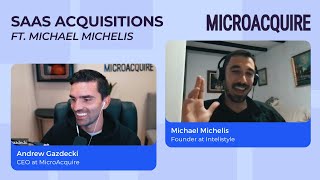
This is a YouTube video titled "SaaS Acquisition Stories Podcast w/ Michael Michelis, Co-founder of Intelistyle" containing an English podcast interview recorded in November 2022. The conversation features Andrew Gazdecki interviewing Michael Michelis about Michael's experience building and selling a Shopify app via MicroAcquire, discussing startup acquisition processes, valuation, and advice for founders.
Foreign.
I'm here with Michael Miglis. How you doing, Michael?
Hi, Andrew. Good. How are you?
Good. Just wanted to thank you for coming on the podcast. Definitely excited to hear about your story getting Microcard recently. But for those that may not know you, do you want to give just a quick intro on yourself?
Yeah, sure. So my name is Michael. I'm from Greece originally. I spent a lot of my time in London. So my background has been in data engineering. Engineering. I used to build big data solutions for companies like P and G&GM. But I always had this passion for entrepreneurship. I started a company around five years ago in the fashion tech space. So it was a enterprise SaaS which is still going on. And I've been always passionate about startups. And in the middle of my journey I thought, you know, I found this amazing platform, Macro Acquire, and I thought it would be a good challenge to build and sell something there. And yeah, here I am.
Nice. So for everyone listening, Michael was telling me the. So I don't know what company Michael had acquired, so I told him, don't tell me. Let's get this live on the podcast. So, Michael, what was the company that you had Microacquired? What did it do? What problem did it solve? All that fun stuff.
Yeah. And the funny story is when I, when I decided to build something for Microacquired, I had no idea what was going to be. So it was like, I'm going to spend some time finding a nice problem, solve it, build something, and then in the end sold it. And the app was basically a Shopify app and it was solving the problem of merchants or Shopify store owners installing Google Analytics onto their shop, which could be a bit complicated if you're not technical. So it would just make the process very simple. Just one copy paste and. And you set it and forget it. So it was a pixel, Pixel installer for Google Analytics on Shopify stores.
Nice. I like that. Just nice, simple, clear to understand problem. You'd be surprised at how many startups we see at Microquire where we look at them and they're really good, but we're like, what do you do? What? So when you, when you see the newsletter, actually that's usually us kind of doing them. Some help in terms of. Clearly explain that I can clearly understand the problem that you were solving there. I guess my next question would be, so, you know, you, you decided to sell. What made you want to sell in the first place?
So initially I think it was the whole idea that I wanted to build something, grow it in a certain state and sell it. So it was a journey from the beginning to the end. So selling was part of the completion of the journey. It was at a point that I had a lot of going on in my life with my current startup that's enterprise as big company right now. It was getting really busy. The app came in the lockdown kind of period that everyone had some free time, picked up baking for a while. Then I tried to build the micro SaaS. And yeah, at some point Shopify was. Was doing some changes on the authentication and had spent like a couple of days working on the app. And at some point I was like, okay, I need to sell this and move on and focus on my current startup.
Nice. That makes total sense. Well, congrats on the larger startup as well. And then it's always fun to have a side project or just build something. I can relate to that more than you know. But for those listening, focused on one startup anyways. So you, you decide to list on Micro Acquire, I'm assuming multiple buyers reach out. Do you want to walk me through how that process went and how you finally landed on, you know, the buyer that ended up acquiring your Shopify app?
Yeah, so after I got some, some traction, as I said, it was the plan to sell, obviously one of the problems, it was a new app, so it didn't have like a lot of history. It wasn't running for 12 months. I believe I listed it after three months. So a lot of the buyers wasn't meeting their criteria at first. Obviously I had kind of overestimated the value of the app. Being a new app with low record, low traction, I kind of set it at a high price point. Then I just actually I read the report of the evaluations of Shopify apps. I believe was 2.7x the ARR. At the end, I sold for 3 something. And when I lowered the price, I got more qualified buyers. And the whole process was super, super simple, to be honest. So the buyers would just ask for a few final some screenshots. Then we would see if it would meet their kind of like investment thesis or acquisition thesis. And yeah, just at the end, we had one, two calls with actual buyer and a last call where I handed everything over. And it was really smart.
Nice. Well, congrats, I guess my next question would be, in terms of from the time you listed on Microquart to actually finding the buyer, how long did that process take?
I think that the process took around three months, but I think that was only because at first I had said like A high price and it was just three months old up. But once it got some traction, it was the six month period I got more qualified buyers and I ended up selling nice.
Yeah, I would say that's probably the number one reason we see startups not sell on Microcar is when they just price way too high. And by doing that, what you do is you, you know, as buyers are going through Microquire, they quickly will skip over it and you'll lose that initial interest. So reading the multiples report, I'm glad you did that. If you're in line with those valuations, your buyer interest is based on our data, it's like two to three, four times higher, if not more. So good job on that. And then I guess my next question would be how did you transfer all the assets over? I know Shopify is a little bit easier in terms of just kind of. Did you just kind of hand over the keys? Did you have a Zoom call? Did you have like a list of all the items that you were going to transfer? How did, how did that part work?
Yeah, I think because I had, when I went into this kind of like journey or challenge, I had in mind that I'm going to sell it at some point. So from the beginning I had structured the entire infrastructure like that. So I had like separate AWS account, separate Shopify account, separate hosting, web hosting. So everything had a separate account. So I would just hand over the accounts to the person that actually acquired them. And I think that saved me a lot of hassle and time because usually all my projects are under one umbrella and it's, it's a mess, but that really helped. So the whole process was easy. We jumped on Zoom Call. He sent over some terms that I think he the first buyer as well. So he found the terms on Macro Acquire. We went through escrow. So it was kind of just a journey that we were discovering the process, both of us. So it was really smooth, actually.
Very nice. Yeah, I would say that's probably another, maybe not a mistake, but just something to think about if you're looking to eventually sell your business is I can't even tell you how many times I've talked to founders who maybe have, you know, one AWS account with multiple different projects or startups in it, then you have to pull it out and do all this extra work. And just being able to kind of hand over the keys is so much easier for both you and both the buyer too. Also in terms of just building confidence, like because when you move something you got to make sure it works and it's new environment, etc. All that fun stuff. So good job on that and good job on using escrow too. I can't recommend people that acquire stuff without using escrow surface. I think are, are crazy. So yeah, it's just an unnecessary risk. Luckily we don't see that too often. But you know, some people can be fast and loose. I, I guess now I'm wondering, you know, are you able to maybe talk about, I guess, you know, with founders, you know, looking to sell their business based on you going through the process successfully, is there any like, tips you would give new founders looking to sell their business? Like as a. Because I really like how you came in prepared, your accounts were separated, you had a realistic valuation. Maybe I'm giving all the tips away, but, but if you had, you know, any tips to share in terms of how to maximize your chances of being acquired, what would those be? I probably just gave you like five.
Sorry. Yeah, you, you, you, you did a good intro there. I believe also how you handle potential buyers is really important, like being honest, being upfront, having everything ready, respond on time. I think all these kind of things help potential buyers see that you will be honest through the process. You will be there to support if needed. So we build a good rapport with an interested buyer. And I think that's helped the process a lot because there's so many apps right now and being, being able to have a good cooperation between the buyer and the seller is really important in the process. And of course, having a data room as well, I think that's important, especially when you have a bigger company having everything ready, like your P and L statements, everything that potential acquirer might ask, that would definitely help with the process, I believe.
Yeah, I completely agree, especially on the P and L. That's usually depending on the size of the business. I think once you get into the six, you know, seven million dollar acquisitions, a P and L is absolutely required for larger buyers to really understand the health of your business. So that's, that's really, really great advice I guess, you know, given that you built, you know, multiple startups, are there any sort of like tips you would give to, you know, startup founders just looking to build a startup? Are there any sort of, you know, themes that you, you know, believe in or any sort of quotes that are your favorites?
Yeah, I think a good tip would be to do a lot of market research before you go into building something. Usually because I come from an engineering background, I might get excited from this idea that I have and the technology is really exciting and there might not be a market for it. Well, another very, very simple and stupid thing like the app I built might actually have a market for it. And, you know, you might not enjoy that much, but once you're getting their first customers in, that will be a good payoff. So I would definitely recommend, especially to all the engineers out there, do your market research, make sure you have a go to market plan and make sure there's an actual market out there, hopefully a competitor or two. I would never go into building something without a competitor trying to educate the market. Um, yeah, I think that that will save you a lot of time and a lot of headache later.
I. I couldn't agree more. I always say if there's no competitor in your market, that's a really bad sign. And you're right. Educating a market is very, very expensive. Because one of my favorite business quotes is, what is it? It's one of the hardest things to do in business is to change consumer habits. So people are so used to doing something a certain way and your business does it completely different. I'm trying to think of a company that actually did this and it worked out. But anyways, if you're coming to the market with something that you're right, like they've never heard about, there's no competitors, it's not clear what problem it's solving, and you have to just educate, educate, educate. You know, you're going to need a lot of time and a lot of capital. So I like that. And I do agree. I think competition also just breeds improvement and kind of fun too, to have competition in markets.
Yeah. Plus you. It gives you ideas on what, what to do, what to avoid, what to do better. So it's definitely good to have competitors. They'll push you forward, you'll push them forward. So it's going to be good for everyone.
Yeah, I completely agree. All right, I got, I got one last question, then I'll let you run my goal. So I've been asking this random question just for fun, because I think it's funny on every podcast, but if you were stuck on an island and you can only bring one thing, it could be a book, it can be a tool. What would that one item be?
If it was an island with good waves, I would bring a surfboard for sure. I think that would make me have a lot of fun in the island and I wouldn't mind staying there.
Have you seen the movie Castaway? Is it Castaway with Tom Hanks? He gets stuck on an island.
Yeah. With Wilson. Right.
I literally thought that exact same thing. Because if you watch the movie again, the waves are actually really good.
Yeah.
Yeah. I'm like, this guy needs a surfboard and he wouldn't want to leave.
Exactly. And you're set there and you wouldn't mind for it at all. I do surf sometimes here in the island. And it's. It clears your head. It's made it a. Like a meditation for me. So I. I would recommend it to everyone.
Yeah. I grew up surfing, so I can relate to that. It's probably the only way for me to go anywhere without my phone. Even though I believe the new iPhone is completely waterproof, but still. All right, Michael, pleasure speaking with you. Thanks so much for sharing all this and congrats again on the acquisition. I'm remind.
Thank you, Andrew. And thank you for making it possible. It wouldn't be possible without micro acquiring. Did give me the inspiration to just build something, sell it. It's a big market for anyone listening for new ideas. So. Yeah. Thank you for making it happen.
Yeah, my pleasure. All right, cheers, Michael.
All right, bye, Andrew.
More from Andrew




The Buyers Who Made the Move: What They Bought, How They Did It, and What Happened Next






