SaaS Acquisitions w/ Daniel Jakaitis Founder of Chatkick
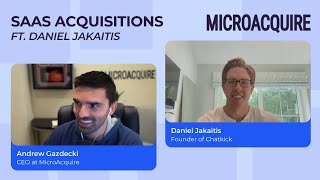
This is a YouTube video titled "SaaS Acquisitions w/ Daniel Jakaitis Founder of Chatkick" containing an English conversational interview recorded in October 2021. The discussion features Andrew Gazdecki interviewing Daniel Jakaitis about his experience acquiring a startup via Microacquire, covering topics such as deal structure, due diligence, technical code review, asset transfer, and advice for buyers and sellers in the SaaS acquisition space.
Foreign.
I am with Daniel Katanis. I say that right. A lot of podcasts I go on, I don't tell the podcast host how to say my last name so they guess it live and that joke just backfired on me. But really excited to have you on here. You recently acquired a startup in Microacquire for around a quarter million and you were telling me about something else as well, but we can skip over that. But to start, Dana, do you want to maybe go over just your background and maybe a little bit about the company you bought?
Yeah, for sure. So up until recently I was the VP of engineering and head of product at a YC backed company called Next Caller. We were actually acquired back in March of last of this this year and I stayed with the parent company up until essentially the close of this acquisition in July. So I have an engineering background by trade, been in a few different startups, was also in quantitative finance for a little bit and then obviously found my way to acquiring businesses here.
Nice. What's your opinion on PHP version one?
Never touched it. I was a Net guy in the beginning of my career, like a Node and Typescript developer.
My first company was on PHP and like my whole team hated it. But anyways, tell me about the acquisition. I frankly only know the details that you told me in the two minutes before we chatted. But tell me how it went, tell me how you found the business, what made you comfortable, what attracted you to the business, anything at all and then also what it does. That's like a three question question. So maybe, maybe you can start with the one.
Knock them out. Yeah, so yeah, just giving a little bit of context. Right. So I'm currently the founder of a company called Chat Kick. Essentially we provide interview management software to corporations and when it came time to looking at Microacquire and thinking about acquisitions like the biggest thing that we were looking for was basically something in the same vertical. We wanted something in the HR tech potentially recruiting space, something that could be sort of clipped on to our existing product that we're trying to bring to market today and offer us not just customers to sell to, but also an opportunity to have revenue that would drive the flywheel of the sort of newer products, you could say. So we were really looking to stack something on top of our company and with that we looked specifically for HR tech SaaS type plays. We did look at some tooling stuff as well. There were definitely some things that we saw as maybe just feature add ons to our existing product, potentially things of that nature. But Then in late April I think it was, I saw the Trinsley product, which we ended up acquiring, come onto the market on the platform and I immediately reached out to the founder, David. So essentially what the product is, if anyone out there is familiar with like Yesware or GMass or even Outreach, it's campaign sequencing. And it connects right into users inboxes, whether it be Google Workspace, Microsoft 365 also connects on prem to custom IMAP SMTP servers. It essentially allows you to set a sequence of emails and then let it just run. Right. And so this is used specifically for recruiting purposes as opposed to the kind of standard marketing or sales purpose that you'll see in all of the other automation tools. I would say the biggest, the closest comparison you can make is gem.com, i think recently raised a relatively massive Series C round. Effectively it's the same type of tool and it's sold into the recruiting and HR space.
Nice, I like that. Sadly, actually my team uses all three of the tools you mentioned. Yes, we're GMass and Outreach. But I love hearing, you know, tools like that being, you know, positioned to another space because you know, the use cases can be completely different and just with, you know, a difference in positioning, maybe feature set, cater towards like recruiters instead of sales teams can. Yeah, like you had a big market opportunity on your hands now.
Okay, there's a super subtle thing too, right? Like yes, we're in gmass, you're usually looking for business emails, right? Like you're looking for people's corporate emails. We have to look for personal emails because you don't send recruiting emails to a corporate account. Right. So there's very subtle things.
See, that's what I love about software so much is like those little nuances, you know, if you get those right for a specific customer segment, it makes like that's like a 10x feature, arguably. So that's awesome. Okay, so you found the business, you and the founder begin chatting. How did you get to terms and what did the acquisition kind of play by play look like?
Yeah, yeah. So we had a pretty unique deal structure I would say, compared to I think kind of the standard acquisition that goes on in this call, like tier size, whatever. So originally I think it was listed at 350,000 asking price and when I first stepped in, I was hoping to get to that price. I think the numbers just didn't end up working with the multiple on the, on the revenue that we were looking at. And I backpedaled a little bit and Then basically brought to David the original founder, kind of slightly modified plan of a partial cash, partial equity package because we have a product that we're bringing to market and we sort of have this longer term vision of providing like the hiring stack, so to speak, to companies. I think David bought into that vision and really saw the upside in taking on equity as a component of that acquisition deal.
Nice. So I like that. So you bought this company, integrated it into your existing company and you gave the original founder some upside in case this thing blows up and you go public or something like that.
Yeah.
Which I hope you do.
Yeah. Knock on wood, right? So, yeah, so we gave him a nice tranche of cash. I would say we got to about the 60, 70% range of his cash expectations. And then I would say a healthy block of equity that if there is an exit event, he's going to see some very nice returns off of it. And then because of that, it kind of ties into our success, which is for us very beneficial. Because even you get six months down the line post close, you still have questions from the original.
Oh, yeah, there's.
No matter how technical you are and how much into the weeds of the product you can get, there's always like little corner cases that you'll want to ping him about. And because he has skin in the game today, he's always willing to pick up the phone and chat with us.
So I think that's a very smart move. Nice. How did, how did due diligence go? Any. I guess this would apply mostly for other people looking to acquire startups off Microacquire. If you had like two or three main tips or things you wish you knew prior to this acquisition. I'm not sure if this is your first or your 50th deal, but any tips you'd share with potentially new buyers or existing buyers or even sellers.
Yeah, so I've been fortunate. I've been through a handful of acquisitions on both the buying and selling side in the last couple of years, ranging in deal size from $10,000 all the way up into the nine figures. So I've seen it all and I think there's a few suggestions I'd always make, especially if this is somebody's first acquisition that they're going through, especially as a buyer. Keep it simple to start. Especially don't bite off more than you can chew. The other aspect too is if you're buying a technical product and you're not a technical founder, or if it's a tech stack that you don't work in find an expert who's going to be on your side and look at this. Right. Relatively speak. When you look at a deal this size, it's relatively straightforward. I gave some initial requests to David just when the LOI went out. So things like looking at software licenses, making sure there's no GPL or not allowed like commercial licenses that weren't.
I know you're talking about and I actually know you're talking about when. So my, my first company Business Apps we went into due diligence. We did something called a Black Duck dive or something. Have you heard of that?
Yep.
Yeah. And so this delayed closed for. Because we had to remove some licenses that we have that were I believe. What's the one that you don't want to have? MIT or something like that?
No. So mit is good. GPLs can get a little sketchy depending on how you're using them.
Yeah, we had I think one. So we pulled that out, put an MIT in. So that's a tip for just like everybody is just open source libraries like understand the license behind them because during an acquisition that's definitely something buyers look at.
Yeah, yeah. In larger acquisitions it's always been the, the practice of pushing it through like Black Duck. There's a few different providers and they do like that. That audit for you in this case I basically just asked for like it's a Rails app. So I asked for the gem file and then the front end package JSON files and just kind of flip through myself and then as part of that is like just going through like a manual code review. So like sitting on a screen, share for a couple of hours with whoever's selling you the product, going through the code, making sure it operates, making sure you know how it functions. These are all things during diligence that are, that are super important.
I'd love to dive in on that. What are like, what's like your biggest tip when doing a code review? Because you know you're sharing your screen, you know, maybe the seller is only showing you like the good parts. You know how do you. What would be your best recommendation? Make sure like you do proper, you know, technical due diligence.
Yeah. I'll speak to the engineers out there. Right. Because I think this is going to be different if you're non technical buying a business. I think you do need to bring in some advisor on the technical side to look at this. But for me the biggest heuristic that I go off of is organization and consistency of structure. So it's really hard if you're just like eyeballing thousands of lines of code over a zoom or whatever it is to figure out if it's quality code. But what you can do really quickly is to see if that the folder structures and the file naming conventions are incredibly consistent and that the original seller can explain that to you, why they organized it in that fashion. There's all sorts of patterns out there and ways to do this. You hear the terms like end to your architecture, mvc, whatever it is, as long as there's consistency within the product so that you know where to go to find a given file. I think that that's like the number one thing. I think the other big thing is that, like they've just kept stuff up to date. Big red flags if they're like on versions that are outdated like two, three years ago. And it's very clear they've never updated it. I know I went into diligence with a couple of different products that never ended up closing because you'd get in there and they hadn't touched the thing in two and a half years. And you don't want to be the one who's kind of taking on that type of debt. So you want to make sure it's actively updated and then you want to make sure it's maintained in a way that is at least consistent. And there's like a mental model that you can wrap your head around, how it's built.
Nice, I like that. So don't buy spaghetti code or something like that.
Try your best not to some organization.
Okay, so got through due diligence. Now I'm assuming, you know, everything's signed, now it's time to transfer the assets. Any comments on that, like how you went through that again? Any tips you would give for buyers going through and transferring assets?
Yeah, that can be especially again, at like a scale where we were at right in that like quarter million range. Like, that's. That's a tough one because you're not at a range where the dollar amount makes sense to start using like data rooms and start having these escrow agents manage all for you. So you end up using these services that are challenging. Like we used escrow.com for our payments and we had all sorts of issues getting payments into the platform and then also out, like delays up to two to three weeks, which was challenging because you want to impart trust on each other. But at the same time, it's like dollar amounts that are meaningful.
I hear that all the time. That's one thing we're working on. At Microcurrent is like a milestone base, something that's just built a little bit more for than just like, domains or something like that.
Yeah, yeah. So I think that that's like, a thing you just got to be prepared for. I think in terms of asset transfer, the way to do it really well and really cleanly, put everything in, like, a One Pass account and then just hand over the keys to the One Pass account and then wash your hands of it. Right. And my recommendation as a buyer, right, like, when you get your hands on all that, roll the passwords, make sure you can get in, and then obviously swap out all the two FA codes that you can and do that as soon as possible for literally even the silly things that you don't think you'll need. Because, like, I've had moments recently where I've had to go back to the original founder and ask him for access when we never went in there the first couple of weeks we had acquired it. So definitely do that upfront. And that's really. That's really it. Once that's all set, you release payment, and you may have some type of holding period there for like, 30 days or so, but other than that, it's pretty. Pretty straightforward.
Nice. Well, it sounds like this deal went pretty smooth for you and both the buyer. Congrats, man. I really liked your perspective on the One Pass. Just kind of one chunk Andover. I've. I've heard of a number of different ways that people are transferring assets, whether it's a. A whole list, like an Excel sheet with the password, which probably isn't as secure. So I really like that suggestion. Anything else you. You would add to, you know, kind of the story? I mean, you. You did an awesome job on due diligence. It sounded like you knew what you were doing. Transferring the assets went really well. Anything else to add to the story? And that's another hard question. What else you got? What else you got, Daniel?
Yeah, I think part of it. Right. I think for us, the creative deal structure has definitely helped a lot. Like adding in the equity block has helped us just in terms of retaining David as a sort of assistant in some issues we've had, I would say, too, a big part of the process at deals this size is that it comes down to really trust between the two individuals. So that's a huge thing. I think people ignore the human element of this, and they just see the potential returns they can get on buying a product and then yielding off the cash flow, whatever it is. You do have to at the end of the day, really trust the seller and get to know them a little bit. So there's a very personal aspect to it. And then the other aspect is just speed. Right. You need to be able to step on the gas when push comes to shove. So if you're unsure about buying, it probably just means you're not ready to pull the trigger. The thing is, you have to remember these sellers are getting courted by tons of people now. The private equity markets are hot, even all the way down to the $5,500 tier of sales like we see it on the platform today.
Yeah.
Fast stuff is moving, so you gotta.
Move every day and it free. It literally surprises me and shocks me sometimes.
Yeah, you've gotta be. You gotta be ready. Right. Like, I knew what I was looking for the moment that the translating popped up. And you gotta be ready to pull the trigger and get it under loi as fast as possible, if you're interested.
Nice. I like that. Well, this has been super helpful, Daniel, I guess. Final questions. I always ask these just for fun, but who is. Who's your favorite entrepreneur if you. If you had to pick just one.
Oh, man. Tough one. I think I woke up to a lot of different people for a lot of different things. I think there's. There's always the respect for like an Elon Musk, right. Like, because I. Elon Musk has so many different things going on at once that it blows my mind. He's successful at every single one of them on such a degree that it's not even comparable to anyone. I think that's a big one. But then in even other aspects. Right. Like there's like naval. Naval is great. I love what he's done with Angel List. I love that whole business there. And I sort of love all of his sort of, I guess you call it, philosophies today. And then my father in law, also awesome. Ran and sold his business after 30 years. Have a ton of respect for what he built and held onto. Basically the entire business. Never had investors, so a ton of respect for that as well.
Nice. Any books or podcasts you're reading?
Yeah. Recent book, finished book called Deep Survival. Orange Gonzalez. Highly recommend. It's basically. It's not an entrepreneurial book, but it's a book about why the human ego can get. Get in the way when it comes to extreme events. Right. Like our. Our inability to understand tail risk and going after things. So it's mostly about interesting climbers and groups like that that have gotten killed along the way. And like, why they. Why they failed to succeed at their journey. So.
Interesting. I'll have to check that out. I mostly read just business books. I've been trying to mix it up really badly, so maybe I'll check that one out. Well, Daniel, thanks so much for your time. This has been super, super, super helpful. If people want to learn more about you, where can they find you?
Yeah, so you can check out our parent site@chatgic.com. you can also check out trinsly.com, which is the product that we acquired on Microacquire. Um, and you can also find me on LinkedIn. Daniel Jacaitis should be one of the few up there. It's a pretty unique.
Yeah, it's. I can relate with my name. There's. There's actually one other Andrew I've located. Um, and I don't know him, but we're like, friends. It's weird.
Good for fco. That's what it is.
So, yeah. All right, man. And I'll add all those links to the bottom of this podcast. But thanks so much for your time, man, and congrats on, uh, successful acquisitions. I'm rooting for you.
Yeah. Thanks, Andrew.
All right, see you, man.
More from Andrew




The Buyers Who Made the Move: What They Bought, How They Did It, and What Happened Next






