Acquisitions with Amazon Vendor: Key Insights for Private Equity Firms
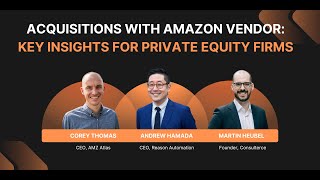
Andrew Hamada, Martin Heubel, and Corey Thomas break down Amazon's 2024 vendor terminations and what they mean for PE buyers. Amazon cut small vendors under $5M and is using a PORT framework to assess vendor health. They show how to calculate net margin and build a backup 3P plan.
Chapters
Thank you again for joining us today, everyone. I'm Andrew. I'm co founder and CEO of Reason Automation. Joining me today is Martin Huebel, founder of Consultors and Corey Thomas, founder of AMZ Atlas. We're here to talk about a lot of the recent trends in Amazon vendor data, as well as vendor terminations and their implications for both private equity acquirers, but also brands who might be considering exits or recently acquired, etc. So today we're going to walk through a few basic topics. First, Martin is going to summarize a lot of the high level trends as well as some of the implications that he's seen from 2024 for vendors as well as specifically for PE brands and acquirers. We're going to walk you through some of those implications in detail and compare what some of the termination notices might mean for you and how you can think about them as both an opportunity and a wake up call. And we'll give you some ideas on how to model the viability of an exit. And then last but not least, we'll go into some details on how to start calculating your vendor margin, which is much more difficult on 1P than it is for 3P. All right, so starting with Vendor Central in 2024. Martin, can you take us away please?
Yeah, thanks, Andrew. Hi everyone, my name is Martin Hoibel. Very pleased to be here with you today. And I think if you are operating in the vendor space or if you're looking to also acquire firms in the vendor space, then of course we'll also need to take a look at the bigger picture of what is happening in the Amazon ecosystem right now and what happens with this online marketplace. And when we're looking at the latest kind of quarterly earnings, but also kind of look backwards roughly two years, I think the most obscure trend almost that you're seeing here on the left hand side of this kind of chart in the a yellow or orange line, depending on how your screen is also calibrated, is that we are actually seeing a significant upwards trend when it comes to the profitability focus that Amazon under its CEO Andy Jesse is pursuing. And if you're directing our attention towards the fourth quarter. So on the very left hand side of this chart of 2022, where Amazon's operating margin has stood at only 1.8%, I think it's quite interesting to see how over the course of the next two years, Amazon has been able to to elevate that into the double digits for the last couple of quarters. So particularly in the first, but also now in Its latest quarter, we're seeing Amazon's operating margin standing at almost 11%. We saw a slight dip in the second quarter due to headwinds, of course from AWS, but also its vendor vendor operations, but overall a very solid performance which has really kind of focused Amazon on an elevated profit margin. Focus on the other end also, of course, we are expecting Amazon to continue a lot of its capital expenditures that Amazon has started so far in those quarters as well. Based on the latest earnings call, Amazon has highlighted that over7.5 billion US dollars are going to be invested only this year into the expansion of aws, particularly driven by this Gen I trend that we are seeing, but also in its retail business, because we're seeing, of course, that fulfillment and warehouse expansion are putting a heavy weight onto Amazon's capacity right now in the fourth quarter. I think many of you who will be active in that space will have heard at least that Amazon is reaching capacity constraints and limits now in its fulfillment centers, not only in the US, but also here over in Europe as well as in the uk. And nonetheless, Amazon seems to be quite bullish in terms of its profitability guidance that they have stated for the fourth quarter, which is around 16 to 20 billion US dollars. So we're seeing a similar trajectory in terms of upwards trend as compared to the latest quarter. So expect the profit focus to really be a sustained topic and theme, which of course has severe implications if you're looking to acquire and also operate on the retail side of Amazon's business. Simply because we're seeing that, yeah, vendor Central has changed a lot and this is also the topic of today to really dive into it. Moving to the next slide. What we are seeing here is that Amazon's profitability initiative that has really emerged under its new CEO, Andy Jesse, following the outgoing of the original founder, Jeff Bezos, has encompassed four key areas. The first one, I think we all know and have seen this over the last few years, is automation and offshoring, where vendor managers, or the classic and traditional buyers of a retailer at Amazon, really spend sometimes 50, up to 70% of their time not furthering the business development with vendors, but actually working on those tasks that they have to manually process multiple times per week. They're automating and offshoring almost their own headcount and their own kind of positions and whatever cannot be automated through processes is getting offshored to regions with lower labor costs. So we are typically seeing that, for example, operational service providers from AVs, but now also more and more vendor managers are coming out and Operate the vendor business from Eastern Europe and often also from India. Which is of course a significant trend change from Amazon to kind of ensure that they are really prioritizing their bottom line when it comes to fixed cost components. Second, key trend is very much linked to exactly that, right? I mean, we are seeing a significant reduction in corporate headcount where Amazon optimizes further its bottom line and is also looking to further continue to continue this trend. Estimations are that Amazon has reduced its corporate headcount, particularly in its retail business, by roughly 15% year over year. So a lower number of vendor managers has to now deal and manage a similar or even a higher number of brands these days. And that is of course having significant implications for the way that vendor managers or traditional buyers at Amazon can spend time with their suppliers to further the account, to further the category. And they all have to make tough choices on whom they spend time with and where. They are also really kind of focusing their attention towards. Third, we're seeing a backwards integration focus with suppliers. Now here we are really talking about those operational efficiencies, whether it is through purchasing the goods off of the harbor directly in China via direct import model, or by asking brands to further backwards integrate by delivering goods and picking and packing goods directly out of the vendor warehouse towards the end shopper, removing the need for the supplier to even ship the goods to an Amazon warehouse. Which effectively means Amazon can save a lot on storage costs, but also ensure that its operating headcount once again goes down and is being offshored or externalized to the brand. And this is, I think, very much with, or very much combined with the reduction in the inventory coverage that a lot of brands have seen. And I think that we also need to really take more advantage of because Amazon has significantly reduced its cost footprint, also ensuring that they are not having as many weeks of demand in inventory as they used to. So while during the pandemic Amazon was willing to stock up on goods, sometimes keeping 12 up to 16 weeks of demand in its inventory. So in their warehouses they have now drastically reduced that with a target of maintaining a two to four weeks inventory, but sometimes even less than that. And of course that means we also need to be very focused on ensuring availability and keeping on top of all of those inputs and outputs metrics that are quite drastically important in order to further our business in a sustainable way. And I think this really kind of also sheds light on why Amazon has done certain things that Corey will guide us through, especially when we are talking about the terminations that you, I'M sure have read about in the mainstream media but when we are in the PE environment and industry also need to take note of because it of course has significant implications for us commercially for looking to acquire an account that potentially is at risk of getting shut down later on.
Yeah, thanks Martin. So my name is Corey Thomas, I'm co founder and CEO of AMZ Atlas and we've got, we've got brands that have gone through this. Our, our business is in the support of 1P 3P and you know, exclusive selling brands and starting this summer and with Martin's comments there in mind, that screams from my perspective Amazon cares about quality. If you're going to have fewer people servicing brands, you're going to look for better and more devoted partners. And that, I mean that's not a new concept. Retailers do that all the time is rationalize who they purchase from. It is unfamiliar or it feels like Amazon doesn't do that often, especially coming out of a pandemic. But this isn't the first time. Amazon did a major brand and vendor termination in 2018 and now it seems to be coming back around. So what we have seen kind of boots on the ground with vendors that both we support as well as the industry is that at least three different times so far this year there have been some sizable terminations between August, September and then in November brands were alerted that they are, you know, Amazon is ceasing their relationship and no longer purchasing from that brand based on the termination notices between know the US and European markets. It seems to be occurring in waves and to be clear it does look like they are at this point smaller vendors or smaller brands within a larger holding company or portfolio. And so it seems to be around kind of the sub $5 million in wholesale revenue for a brand or purchases from Amazon itself. So again this is not the. Well the, the hot take would be vendor central is going away. That's totally not true. But if you're call it a tier 2 or tier 3 brand in a space that is where we are seeing Amazon look to get more efficient with the vendors that they partner with by announcing these in waves, it is allowing Amazon to learn between each wave and see how brands are adapting so that they can adjust who they actually terminate. And it also I don't think will be a surprise to anyone that as we turn the calendar year Amazon will leverage this as a negotiating tactic in avn. So just continue consider that I would say as you go into your negotiations and planning for next year that it wouldn't surprise us at all if vendor managers come to us or else in certain ways, shapes and forms depending on the size of your business. US vendors so everyone knows is appear to be given 60 days notice each time that these terminations go out. And then in the EU they're given 180 day notice which for anyone who's been in the space, if you try to get to stand up a seller central account, which is essentially what these termination notices offer to brands and vendors, is we're no longer buying from you, good luck, go to seller central. That is effectively what the message boils down to. 60 days. To do that, especially in the US is nearly impossible if that is not a preplanned step by the, you know, the holding company or the brand itself. Maybe in 180 days, but it's very abrupt for any brand with a 60 day notice. We do expect this to continue into 2025. Back to Martin's point earlier. It only seems logical when the operating income as a percent has gone up from sub 2 to well over 10% that in two years time at a business the size of Amazon's. I, I'd be shocked if this reverts. There's really no reason for it to with Amazon's business model and the things that they continue to invest in. And this streamlined business on the retail side allows for them to select higher quality vendors to partner with. But those are tighter run operations, they're more strategic and the assortment overall is more high quality which in an environment where customers are looking for what they want, those are the types of brands Amazon wants to buy from.
Corey, before we keep going, I just want to double click on one thing you said even though I just said double click which I really don't like saying. You mentioned that, you know you're seeing this occurring in waves starting with smaller vendors under small revenue thresholds. But you also added that you're seeing it happen to smaller brands within holding companies. Can you talk to me a little bit more about that? Because I think that has major implications for a lot of this audience as well as PE audiences.
Yeah, very much so. So we have seen it directly with our portfolio as well as I've seen it, you know, across the industry is that Amazon appears to be analyzing these at the vendor code level. So you can set end up in an environment where we've all seen it, where a holding company's got, you know, some it's eight brands and four vendor codes. And you know, we, we've all had the dialogue of how do you consolidate those or is Amazon actually seen this as multiple companies? There, there's some, there's some nuance as to why these portfolio companies are in the place that they are. But many smaller PE firms and holding companies have maintained multiple vendor accounts for the brands that they've acquired. You know, as a strategic way to main, you know, ensure that they don't lose the assortment with Amazon by trying to change or consolidate those vendor codes. Well, that leaves open some of these to be analyzed on a one off basis. And we've had brands that an entire vendor code within their portfolio is becoming effectively inoperable. So I don't know if that answers your question, Andrew, but basically cutting off limbs of a business and Amazon is making very much making these decisions at a brand and vendor code level, not necessarily at the holding company level, which is challenging because it forces a brand to basically support both strategies of 1P and 3P.
Yeah, that's exactly what I was getting at Corey, and that's both good to know, but a little scary for a lot of brands, I think. You know, I think a lot of larger companies, particularly holding cos, are used to thinking about vendor termination notices as not really being directly applicable to them and for the most part they would have been right. But if they are in the business of acquiring growing and starting smaller brands, then suddenly things like vendor code setup have much more significant implications. Martin, as somebody who works with larger and often multinational and global brands, do you have anything to add about implications for those companies of hearing that sometimes brands within a portfolio are getting terminated?
I think if you're a large multinational that has quite a mature business with Amazon, you have nothing to worry about when it comes to the terminations. They're really aimed at those brands who have fallen out of the love from Amazon, so to say. Right? So if you're a, a vendor typically below 1, maybe 2 or 3 million in annual revenue and you have had not a very solid growth trajectory and worst of all, you also don't have really a solid relationship with Amazon, I. E. You do not have a designated vendor manager contact, you are not subscribed to the Amazon vendor service. All these are factors that increase the likelihood and the risk of getting terminated. Now if you're a multinational who makes 50, 100, 200 million in annual sales, you have nothing to worry that Amazon is going to boot you out of vendor central for the same reason that Amazon cares about those brands, because they carry category critical selection. And of course Amazon, I mean we've seen it over the last 12 to 24 months prioritizes even more price sharpness as they call it, so that they can offer the products as very competitively compared to retailers like a Target or Walmart. They do not want to see price gouging on their platform through 3P sellers, which is also why they often support press the buy box if there's a non competitive price point available from a 3p. On the flip side, Amazon also deeply cares about shipping speed fulfillment speed, opposed to its recent launch of the Temu like store discount discount store hall where shoppers are more willing to wait category critical selection, particularly in CPG categories. So consumer packaged goods is of utmost importance for the online retailer. So I think the profile of those brands who have typically received those termination letters is fairly different from those who should really care about those or shouldn't care about those. However, I think it highlights also that look, diversification is really important and you should never put all of your eggs in one basket. Meaning that if you are solely dependent and exclusively dependent on Amazon as your number one online retailer, it's probably a good time to understand, okay, what other ways to accessing this marketplace are available and where else should you potentially over invest outside of Amazon in order to reduce your dependency over the next three to five years.
Got it. I'm going to try not to take the take personally the note about dependence on Amazon as an Amazon Pure Play service provider, but your point is understood.
So what's interesting is they also take a step back and like how did we get here? So certainly, you know, not even mentioned here, but layer over on top of this, a pandemic. When retail stores were closed, Amazon picked up a lot of vendors and saw that as a way to grow. But in that same backdrop for private equity and holding companies, the three of us have walked around enough trade shows to see that every year it's like, oh, they gobbled up some more stuff over there, you know. And these holding companies continue to grow, especially in the backdrop of low interest rate environment. But you know, on Amazon, according to estimates there's around 7,500 1p brands doing at least a million dollars a year in sales. Clearly the tail selection versus the head of that where as Martin's point, you have nothing to worry about. But there are hundreds, or call it even thousands in this range that have our tier three brands. By the very nature of it, Amazon for a lot of these brands has been a huge growth channel over the last 10 to 15 years. In a lot of ways Amazon keeps buying, it keeps growing, we keep fulfilling. Is a model we have seen and that has been attractive for acquisition a lot of these acquisitions. And back to the portfolio that we support in the brands we work with, we've got brands that have done this exact strategy. They were acquired pre2022 at high valuations and now they're under tremendous pressure because it's a tier three brand in a category and that brand is competing with direct import manufacturers that are selling on the 3P environment at lower prices. And Amazon is being more strict about their purchasing plan and what they will carry from an inventory perspective. So despite a PE holding company having $100 million or more under management, these brands are being pulverized from competitors. And so they look like worse and worse selection, which is pretty challenging both from a valuation perspective and all, you know, somewhat of a challenge even within the PE environment as to why these brands were acquired to begin with. It very much feels like the stakes have changed from what was bought pre2020 to today. That's been a pretty dramatic shift. These then, as I mentioned earlier, the portfolio brands may be terminated at a brand level, not necessarily an entire PE firm level, which creates challenges. And we've talked about this Andrew and Martin, at different times. But there's a very big fundamental difference between how A company operates a 1P versus a 3P strategy, never mind whether it's easy to do or not. There's just very basic fundamental differences in that strategy. On a 1P basis, that's very wholesale oriented. I think of like the sporting goods or CPG category. You know, sell it wholesale on po, you got AR financing and you're a manufacturer. That's a business model that grows and works. If you're thrown out of that business model for one of the brands that you own in your portfolio, what's available to you, and it's somewhat dis, I guess I would say it's different than being thrown out of a traditional retailer because if you get thrown out of a retailer, you'll feel like you lose your selection. That's not actually what happens on Amazon. Those products, Those reviews, those ASINs are still live on platform. So in a weird way, it can either be the worst thing or it can be an opportunity. But it's all in the details of that transition. But Amazon's essentially saying, go marketplace. We're not throwing you off the platform, we're just not going to buy from you anymore. And that's very different than going to a traditional brick and mortar and selling into Walmart, Target or any large retailer. You actually can continue to stock your products. But you have to understand that it's very different. It's much more like a website at that point. You're carrying your own inventory, you have risk, you recognize revenue at the top line. It's more of a cash based environment as opposed to financing the business with accounts receivable against large pos. Just a very different business model. So as a holding company, it is not, it is not the end of your brand on Amazon if you get a termination notice with 60 days notice to figure it out. But it certainly is a dramatic shift in what you need to do because now you really are forced to find either a new customer who will sell for you on the platform or become your own seller on the marketplace. Kind of with that in mind to get into what that means specific to this industry. Between if you own a brand in this space that could get terminated or you know, know you see it as an opportunity to acquire distressed assets. We've got, you know, some of the different options to think about if you have brands in that sub $5 million a year revenue position. Consider your metrics. Martin will talk about these in a few minutes. But there are ways to diagnose the health of your account even beyond just the notion of whether you have a vendor manager or you're subscribed to Amazon. Vendor services like those are, those are challenging things to pay for. As a $2 million brand, a $20,000 a month fee is difficult to stomach. But understand your metrics and see how healthy your business is. It doesn't cost you anything but time. Do that now. I'd also then recommend that you run the financials of the 3P strategy, at least for your top 80% of your products or your parade away products because those fees are published. There's nothing about that that's hidden. That's the one advantage of the marketplace is there's no negotiating with the marketplace. It is most likely 15% of your fee Amazon's going to take as their commission effectively and then you're going to pay for fulfillment. What does that leave you from an economic model? Do that in advance on your top selling items to see if you can even tolerate the 3P strategy if you were forced to take it. Martin, you talk about this a lot in the content that you share. But one thing that I do believe the ecosystem underestimates is just going to 3P doesn't solve your reseller challenges. That's entire whether you stay on 1P forever or you move to 3P, Amazon is not going to help you limit who can sell your products on Amazon almost under almost any condition that is on you as the brand or the firm owning the company to ensure that there's a robust authorization and distribution agreement program. And I would say that that's very important in an environment where you move over to 3P because Amazon's not going to be there to match prices on the random reseller with 10 units. So if you move to 3P it can actually be more lucrative, which for PE is great, increases margins. But it's not helpful if a bunch of random resellers you don't recognize come out of the woodwork selling as they source through distribution, it becomes problematic. So that's a very important part of the process. Review whether the three piece strategy fits your business model. AKA do you want to own your inventory at a warehouse you don't control? Is that something your CFO's head's going to, you know you're going to blow a gasket over? Well, you're going to have to confront that head on if you want to actually take advantage of the transition. Determine if you've got an internal team that can do it. It's very much on on you and your team in an environment of the 3P. It's not we fulfill the POS that show up on Monday through the EDI feed from SPS Commerce. I was like it's now if you're going to ship it, are you going to stock it? Can you manage your capacity limits? Can you turn your inventory? It's really on you. Oftentimes that's then where a company like ours steps in and supports a brand like we've been thrown out or we need help. There's a whole cottage industry of support that can do that. But you definitely need a different set of skills to be successful on 3P. And then again I would say all of this does is take time but 60 days notice is not enough. If you have not thought about 3p before you get that notice, there's no reason to not scenario. Plan that notice as starting now. And if you never get it, it'll be quote unquote wasted time. But you will certainly be more prepared. Consider it insurance plan out what would happen if you got terminated with only 60 days and have an action plan in place and then go back to your 1P business until something changes. And I think Martin, you've been a good stressor of this as well. If you're a large category leading brand, Amazon actually has a policy in place called the Standards for Brand Selling on Amazon policy where they preclude brands from selling directly on 3P. We can talk, we can make a whole conversation just out of that for our opinions on that program. That said, in the U.S. amazon can prevent you from selling yourself. Keep that in mind in this transition as you prepare. Because if you haven't been terminated, that doesn't mean it's open season to transition. So just be aware that that is a policy that is still in place. And Andrew Martin and I have all seen scenarios where brands who want to get to 3P are prevented from doing so. So again, there's nothing but preparation here to help unpack this and move forward. But you certainly won't regret the prep. And then if you're on the other side and you see this as an opportunity for this, you know, if a brand has 20 to 40% of its sales have been going to Amazon and that gets turned off at a moment's notice, that is a major, major opportunity to step in with a plan. Because the value destruction for that brand without a plan is pretty dramatic. Let's say brand does quick math. 5 million a year in wholesale they were to get terminated. Call that 10% margin on Amazon, that's $500,000 in EBITDA that now is looking for a home on a valuation basis. If they feel like it's gone, that's an opportunity to step in and say, well, you don't have a plan for Amazon now, but if you have your plan, that's a quick way to recover dramatic value within your acquisition. And what's really interesting about Amazon's marketplace that as I mentioned, that's very different than traditional retailers, is those products don't disappear. I was on a call earlier this week with one of our companies that has moved to 3P and retraining executives at companies to realize a product that's been on the platform for eight to 10 years, that has 4,000 reviews, let's not discontinue that or let's acknowledge that that has a legacy to it. As long as you continue to sustain that product and that would take place in this environment as well. These asins or the products aren't being removed from the platform. Amazon is choosing not to purchase them. So in an acquisition environment, you can still acquire that brand and step right into the void that Amazon is making available. There's nothing that stops the demand from continuing to be there. It suggests then proactively analyzing brands in your industry. Obviously usually these roll ups are with a focus, be it cpg, sporting goods, healthcare, whatever it is, you know, do your usual due diligence, but start to see brands that have a specific size that seem like they would be a good fit, because a lot of that information, at least on a directionally accurate basis, within, kind of call it plus or minus 20%, is pretty available from the tools that are out there, determine those products that fit a 3P environment. And as a potential acquirer, I would start down the path of building out 3P expertise in either inside your management team or with partners. Because what that allows for is when an opportunity comes and there's a distressed brand in your space that you would normally acquire who now is potentially off 20 to 40%, you actually have a solution upon the moment of acquisition to recover a huge portion of their value. That's a big opportunity if you know what to do with three pieces. If you don't, you can't really monetize that opportunity. And so we'd strongly suggest finding partners to help you be successful on 3P for your own portfolio or for your acquisitions. And a big part of that is, do you own the inventory? If you're going to own inventory, that's an asset to you to capitalize on the margin available. If you don't want to, there are accelerators in the space that will own the inventory and sell in a partnership with you. It's just a matter of figuring that strategy out. But you do need to think who's going to own the inventory if it's not Amazon. And then I would say as a trigger for if this is happening, if you see fluctuation on brands that you're monitoring and Amazon's availability, as in where it shows on the listing ships and sold by Amazon.com if that starts to wobble, that's a highly technical term called wobble. But if Amazon looks to have less inventory and regularly is going out of stock, that can be an early indicator that Amazon's buying patterns have changed for that brand, that could mean that they've just discontinued the item. There's a lot to that. But if you see a wide swath of a brand that you're interested in and Amazon is no longer selling, that, that would be an early indicator to Amazon may no longer be sourcing that product. They could have terminated that brand. And the last piece is, although it sounds scary, I would say 3P actually has the opportunity to be more profitable. We see that all the time. For a brand that has good control over their distribution and their products fit a model of low, you know, high price to weight ratio, the Fees work and kind of all this, it can actually be incredibly accretive from margin basis. You know, a quick version of the math is Amazon's typically buying $100 item for a retail price. They're usually getting it for somewhere between 52 and 62 cents on the dollar after everything's counted. Depending on the item's dimensions. Brands selling on 3p, that same hundred dollar item can net 75 to 80 cents on the dollar depending on their fulfillment fees. So there's in some cases $0.20 on the dollar available. That flows directly to the bottom line. If a brand is acquired and moved to 3P, which can be very significant on a, you know, call it a 50% gross margin, you stack another 20% on top of that. That is incredibly value accretive for the PE firm now owning that distressed asset.
Thanks, Corey. This is one of my favorite slides in this deck because it's sort of a all in one cheat sheet. And up next is my second is my other favorite slide in this deck as Martin gives us a model for actually assessing the value of 1P brands.
And it pretty much builds on all of the excellent points that Corey has highlighted just a moment ago. And I think to kind of give it a little bit of a framework for PE firms to either assess, okay, how viable is my existing 1P business that I'm going to manage in my portfolio, or for those who are looking to acquire, as Corey said, maybe a distressed, maybe a not so distressed vendor account embedding. This decision in key KPIs is of course of utmost importance. It just helps us to really understand, okay, are we acquiring or also managing a business that is fairly healthy or are there certain warning signals that we should keep note of quite early onwards? So others would usually call them red flags. And the port model or business framework gives us usually a good way to assessing four different areas. First of all, the overall performance, then the operational setup, the relationship which I kind of skewed here towards, okay, what is the trade relationship with Amazon like? And then also the tech and compliance setup with Amazon. And I think, I mean everyone will start typically looking at the kind of key KPIs, like a CAGR, so compound annual growth rate. My recommendation here is really to kind of zoom out a little bit. It's very tempting to look at the last six to 12 months, particularly if the pitch decks that you may be receiving for focus on that time frame. But you also really want to understand, okay, how has this brand performed during the kind of peak of the pandemic and then after it. Right, so what happened once? Also the kind of demand online normalized again and was the brand able to kind of capture the same kind of market share or at least brand penetration in the wider market as compared to before? It's not always easy to define market share. It's a little bit easier to of course just look at your net sales and to understand, okay, how have we performed here over year and over a three to five year time frame. But you're typically aiming to understand, is the offline market share fairly equivalent to the market share or at least the category visibility share, some will call it share of voice that you would expect on Amazon? Or is there a significant delta, particularly for brands that are non online exclusive now? Not always will you have this data available unless you subscribe to often pretty expensive research reports from certain market market research institutes like a GFK or Nielsen. So there are ways to obviously proxy your status and also your performance in the category where you can take a look at how many products of your portfolio have and are in the target best selling range that you want to kind of aim for. Right? So how many products are a preferred or have the Amazon choice badge? How many are in the top 10, top 50, top hundred of any given category for those keywords that you're targeting and that your unique market is set up as well. You also want to put, especially in the performance evaluation, enhanced emphasis on understanding the number of resellers in the buy box. This goes particularly for those brands who may be in your acquisition target, because that gives you a strong indication of whether the distribution control of that brand is in check or whether you're actually potentially buying into a brand who is selling everything to everyone. And then that leads to kind of significant reselling issues and a negative price spiral to the bottom on Amazon, who really acts as a mirror of your distribution control and distribution strategy. If you're looking to kind of acquire products and brands that have a more exclusive setup also understand, okay, do they do anything that is specifically exclusive to the online channel? That doesn't mean that this brand needs to sell any exclusive SKUs to Amazon only, but do they, well, have they differentiated their portfolio enough in order to kind of create this unique selling proposition through the lens of the end shopper? That then also gives you a certain pricing power that does not just follow the market and also ensures that, yeah, you're kind of getting this premium positioning from a gross to net margin perspective as well. Speaking of margins, of course you want to understand, okay, is this brand in line with your gross margin targets that you have in your portfolio so that you're not acquiring a brand that negatively dilutes your overall portfolio mix by acquiring it and having potentially an above average sales performance. All of these considerations are of course very critical when you want to purchase those or acquire those businesses, but they're also very critical to look at when you are already owning a vendor account because it lets you understand, okay, is there any opportunity to improve the performance in any of those areas before you're looking to potentially sell such a business or put it up for auction? When it comes to the operational setup, then take a look at your availability performance here. It really comes down to how often are your products out of stock, how often do you see that the product is not reordered, such as Corey said earlier, where Amazon may actually have reduced or suppressed ordering due to profitability concerns. And you also want to understand the wider and more general performance of the account when it comes to your lead times or how long it takes from the order confirmation up until the product is delivered to Amazon and whether the brand is already utilizing any of Amazon's supply chain initiatives, particularly for first party vendors, Vendor Flex, Direct Import, all of those initiatives that take out individual steps of the joint value and supply chain with Amazon can be quite attractive, but also hold the risk that Amazon is asking in exchange for onboarding those on the account for a very high accrual fee. And that of course would once again negatively unfold on your gross margin performance. So you really want to understand, okay, is the brand effectively utilizing those supply chain initiatives or have they potentially over invested during the pandemic and now they are facing the brunt with having those high costs to serve Amazon without it actually aligning with their operational excellence and thereby being a blocker to future growth as well. And I think needlessly to say, the trade relationship evaluation is then very important here, especially in light of the recent vendor terminations. I would personally always encourage brands to look and PE firms in particular to look whether the brand has a designated buyer and how close this engagement is. So does the vendor manager sitting on the other side regularly regularly engaged in monthly or at least quarterly business reviews? Is there a three year strategic plan in place, such as a three year joint business plan? And has the brand had like annual vendor negotiations for the last few years or were they opted in and out from that? Because that is typically a signal that vendor managers have not put enhanced emphasis on the account and do not really focus their resources on it as well. Another warning signal that goes into both directions. Whether you're owning this brand or whether you're looking to acquire it is to understand whether the brand has access to the Amazon vendor service, because that typically gives you an additional headcount and also voice from inside of Amazon. But you also want to expand on that and really understand, okay, what else is the support framework? Here is the brand working with designated agencies will ensure that the brand owners staying up to date with the latest trends on Amazon. Because we all know things are changing almost by the minute. Whether it's the ranking algorithm, whether it is how to get products unsuppressed, or whether it is to stay up to date when it comes to any of those policy changes that Corey has already mentioned. And of course to also understand, okay, is this brand already set up on a hybrid approach or is it exclusively dependent on vendor central, which for better or for worse can be sometimes an advantage, sometimes a disadvantage. Because as we've explored before, the standards for policy standards for brands policy that Amazon strictly enforces comes typically into force for brands that make more than 10 to 15 million in annualized sales on a vendor central and where Amazon is then also not really willing to give up this vendor relationship and would rather deprioritize a hybrid or 3P setup in exchange for an exclusive 1P relationship. So if you're seeing that any brand that you're looking to acquire is inching towards those limitations or those thresholds, and you're seeing that they are heavily dependent on maybe 3p but also have a 1p account, that should certainly shrill the alarm bells. Lastly, we're then talking about tech and compliance. Now this will be probably Andrew's favorite topic to talk about because here it's really his genius zone to ensure that a of course data are automated. And this goes obviously also for the reporting that is to understand not only in vendor central through retail analytics, but particularly through the selling partner API, what you can do and how we can aggregate the metrics that are not natively available in vendor central. We're talking about conversion rates here or sell through rates for example, but also to understand how the order processing is conducted. So is the brand already onboarded to EDI, which hopefully forms a standard in 20, 24, 25, but oftentimes it may not be in place. And believe it or not, there are still a lot of vendors out there who manually by hand confirm or reject orders. And of course this is certainly a warning signal and an opportunity to be automated. Should you look to acquire or look to get a brand ready to be acquired. And then also look at the hidden charges that may sit on the customer P and L beyond the front margin. So cost prices, as well as the typical trade investments that a brand will have with retailers like Walmart, Target, but for sure also Amazon, because beneath all of that sit more retailer agnostic issues such as penalty charges or financial disputes that a lot of vendors will have with Amazon. Here we're talking about price variances in the catalog, which means that the invoices will not necessarily be paid in full, or that Amazon sees that you basically raise an invoice and in their system they cannot actually reconcile it and thereby they create shortages. So you're actually not being paid the full amount that you would think Amazon owes you, which then leads to a very long disputing process in order to recoup that lost money. And you want to really get a good understanding of those hidden cost centers in the customer P and L. So how much in relation to the overall net sales is the total amount of financial disputes amounting to? Right? Is it 2 or 3% of the total net sales or is it below that which would be an ideal benchmarking range that you should really look for? And of course, if you're particularly looking at the or understand based on the performance evaluation that this retailer, this business, has a fairly high share of resellers that are selling through the third party business model, then you also want to understand here in the tech and compliance area whether this brand has any means to implement a minimum advertising pricing policy, or whether they're already using any kind of virtual shelf monitoring tools to ensure that map compliance is guaranteed to really just get a better understanding of how they're ensuring that they are selling those products profitably. Now, I understand that this can feel quite overwhelming to look at all of these KPIs, which is why I typically recommend to not obviously only do that natively in house, but to also work with external service providers who have the benchmarks for those kind of key KPIs and can also guide you through the kind of evaluation process, so doing your typical due diligence. But whether you're looking to acquire a vendor brand, or whether you are looking to actually sell your existing vendor brand as part of your portfolio development, it certainly makes sense, even well ahead of any kind of acquisition and well ahead of any intended sale, to conduct such an exercise and then to maintain it updated in order to ensure that you can work towards the right benchmarks of all of those KPIs and get them into the kind of desired range in order to increase the valuation and also ensure that the risk profile gets lower over time.
Thanks, Martin. And to Martin's point, there's a lot of KPIs and data here and it can feel very overwhelming. In order to start putting all of this together, there's a lot of help available, typically from firms who specialize in either helping you get ready for sale or helping firms evaluate for sale as well. But there are certain steps that you can take on your own today or, you know, next week, maybe after Black Friday to get yourself ready. And the way that I like to tell brands to start is by actually doing your own vendor margin modeling, because that's completely controllable within the ecosystem of just your own data and Amazon's data available directly through vendor Central or the APIs. And so first, calculating vendor net margin for a lot of firms is something that has been a little bit challenging because of a lot of the hidden cost centers that Martin described in the port framework, but also because a lot of the valuation expectations and methodologies for E commerce brands has been predicated on FBA aggregators and FBA third party acquisitions rather than first party. And unfortunately getting to a seller discretionary earnings and a multiple is quite a bit harder on the vendor side. And so in instead we really recommend that folks start by calculating what is the actual net margin of your vendor business on Amazon. And this is going to be a combination of three income buckets, the actual payments from Amazon for your cost of goods sold, so everything that they actually write you a check for on your pos. It's also going to include some things like reversals for any claims or chargebacks that you successfully disputed to Martin's earlier point, as well as any refunds for any co op fees or any other deductions for return to inventory that Amazon has had to return to you. On the expense side, there's quite a bit more. I've tried to simplify this universe to be a little bit easier to grasp, but the buckets tend to start with first and foremost, what are the actual terms that you've agreed to with Amazon, whether that is your co op accruals, that standard 10% or higher that Amazon takes as part of funding, personalization and whatever it else that they're claiming this week, as well as things like freight allowance, damage allowance, et cetera. But these are, you know, generally predictable charges, percentage of cogs that are charged when inventory reaches Amazon's warehouses. Second biggest bucket is actually on the sellout side. So when you're actually trying to sell to customers. What are you spending on advertising? Not just for ppc through self service tools like sponsored ads, but also through dsp. Whether you're doing that self service or leveraging an agency or another partner to drive that for you, those costs add up and it's really, really important to make sure that you are accounting for them. They don't necessarily show up the way that you would expect in Amazon's vendor remittance. So it's important to go and actually pull this number separately from the ad console or from the advertising API. Third up is price promotions and any other price discounts that occur on customer shipments. This can be everything from price support agreements to coupons to lightning deals or other marquee event deals and then the fourth bucket being all other types of straight payment co op agreements that might need to be applied. These are. This can be often a big risk zone because straight payments often aren't associated with specific products or specific time frames. And so you need to create some sort of attribution model in order to apply that. Whether that's creating a per net unit value and applying that equally across every unit in the P and L or something else like a demand weighted average. Next bucket claim and chargeback deductions. These are for things like to Martin's point where Amazon has perceived some sort of operational defect. Whether that's a shortage in the number of units that they've received compared to what they ordered, some sort of variance in pricing on your invoice compared to what they issued on the po, or any number of operational charges that get listed in the defect report. In Vendor Central, there may be incremental returns that are not covered by any allowance agreements you have with Amazon. It's important to bake those in and not just assume that every single thing that Amazon ordered was something that they kept and paid for. And last but certainly not least is any sort of payment term discounts or partner processing costs. Whether that's a quick pay discount or if you are in certain regions, Amazon often leverages partners that do a lot of payment processing integration for a small fee. And those fees will often show up in your vendor P and L as well. So the good news is that most of this data can be found in just a couple of sources. One is in the remittance section of Vendor Central. Go and download all of the payments from Amazon and then all of the associated invoices from Amazon. Those will have in the PDFs themselves line item detail that will help you understand what deductions are for which of these buckets and plan accordingly and model your P and L. Once you've got that data, the main challenge to get really tactical for a second is aligning when to apply, sell in and sell out co op costs and other business costs. Because unlike sellers, Amazon does not provide vendors with per transaction accounting for sellers. You get that really nice transaction report that shows you for a given item what are all of the exact income and expenses attributed to that specific order. Vendors don't get that, they have to make assumptions. And so in order to align your costs for really accurate accounting, you have to decide on what that offset looks like. So just to give you a specific example, you have to decide. You know, in a shortage claim process, you might issue a claim in one month and it might take three to six months for the dispute process to completely settle. You have to decide in what time period are you applying each of those shortage claims and reimbursements net of disputes versus for example, something like customer price promotions, which occur in a very discrete time frame. If you sell things on Black Friday or Cyber Monday for a 30% off discount that you funded, that funding is all going to hit in a very narrow time frame of when the products get shipped. And because of that, the nature, the very flexible nature of this, it's possible that this decision can cause noticeable shifts in a given year's P and L. So it's important to not only make this decision consciously, but to expose it so that others can see your mental model and taste and adjust as necessary. And last, the way that I would encourage you to leverage this data for that port framework is to model your P and L over time. To Martin's point, it's not enough to look at the last three to six months. It's important to look at these trends over time, over multiple years if possible. Not only to understand how the business has performed through various contexts like Covid, et cetera, but also so that you can claim value for any sort of long term improvements that you've been driving, or so that you can, as the acquirer, identify opportunities to drive those improvements yourself. And so what those look like they're operational improvements upstream, like in your product prep ship, et cetera, and outbound supply chain that can ultimately reduce chargebacks, claim reductions, etc. There are catalog quality improvements that can ultimately result in chargeback reductions. So for example, if your catalog data is accurate, you get a lot fewer chargebacks in the receiving process. If you've been going through auditing of your remittance from Amazon looking for dispute opportunities, then you should be able to show a trend of chargeback and claim reversals over time, or the lack thereof. To both Corey and Martin's point, channel management is a really, really critical aspect of the success of a brand long term. And so if you've been working on that and cleaning up your channels, you should be able to see that in things like ASP growth over time as you stop unnecessary matching. Strategic Selection Management we could do a whole session on this alone, but assuming that you're leveraging PPM reporting and understanding how you have the ability to drive portfolio level margin changes by selectively pushing different sections of your of your assortment and by funding them differently, that can lead to overall PPM gains either at the total portfolio level or at the product level. And last but certainly not least is leveraging strategic promotion in order to drive improvements in selection across the catalog. And that's really it. I rushed through my section a little bit here because I know that we're short on time, but I want to really thank Martin and Corey for all of their input. If you have any questions about any of these topics, please follow up with us here. I've given you a URL reasonautomation.com Amazon Analytics Corey can be emailed@coriamzatlas.com and believe it or not, if you go to amzatlas.com, that's his website and Martin has given you his consultors.com contact URL as well as an email to reach out to him. If you have questions about the Port framework or just general Amazon strategy in the last few minutes here. If you have any questions, please feel free to type those into the chat or to use the raise your hand function and we will go ahead and get those answered.
So Corey, myself, Andrew, really, really a kind of insightful session. Maybe just to kind of take it away with the Q and A. We had one question in the chat that I already answered, but the question was what gross margin targets do you have when looking to acquire CPG brands and what cost do you capture in that calculation? Now? Very interesting question, I think I don't even know how many different types of calculations I've seen over the several years that I'm now doing my consultancy, where even the gross margin definition seems to be something that nobody can really agree on, what needs to fall into it and what doesn't. But if we boil it down to the very simplistic formula, right? So we are including your cost price basis, so your front margin, we include your trade Investments, excluding your ads and retail media spend, which typically is allocated into the net margin and then also chargebacks which you would include in there. Then typically what you want to target for range. And Corey, very keen to obviously also and Andrew, to get your perspective on this, but what I'm seeing is the lower end would form like 40% the higher. So best in class end would be 70% plus. So if you are looking to expand your portfolio or if you are looking to become more attractive for a private equity firm to acquire to being acquired, then a good range to target is usually between 50 to 65%, depending on the kind of category that you're operating in. Because you want to have enough margin to account for all of these hidden cost centers that we've discussed before. Right. So all of these kinds of disputes, all of those hidden charges and of course a significant chunk which typically takes 10 to 15% away of your gross margin when you're accounting retail media into it. So the higher you can aim, the better. But that's usually a good range to start, obviously. Andrew, Corey, if you have any builds, please feel free to correct me or to build upon that.
Only one. I would add, Martin, to your point is it's category specific. I think the biggest category difference I see is thing, you know, repeat purchase products and soft lines have their own kind of characteristics and then hard lines that are, you know, higher average order value. But it's a, you know, a product someone buys once in their lifetime or every three to five years. Those just have very different profiles. It's really nice to sell an energy drink and, you know, and the gross margin on that is really high. But the actual investment to prop up a brand and something consumable is really aggressive. So just it varies tremendously by category.
I don't have anything to add other than that the category variance is something that when I was at Amazon would constantly shock me. You know, going from one team's WBR to another org's WBR and just seeing how the benchmarks radically evolved. Yeah. Look for the closest thing, the most niche benchmark you possibly can. And I think to Martin's point, because everybody is doing gross margin calculations somewhat differently, I think the biggest way to build trust in your methodology is to expose as much of it as possible so that people can see how you calculated it and taste and adjust accordingly. And that way no matter what the standard is that you have the ability to earn trust with whoever is evaluating the business.
Yeah, agreed. We have one last question, I think.
Sorry, Corey, take it out the open question was for the number of vendors we listed on the slide that was specific to the US market of around 7,500 vendors in the north of 1 million a year sales. To be clear, that's directionally accurate. It's not proprietary from Amazon, but that's, you know, with the tools that do it and track sales against revenue and rank in a category that's around what you're seeing. So that's specific. Just though, to the brands on the US platform.
I love it. Corey, you say it's directionally accurate, but you give a specific number of 7,449. One of these doesn't jive exactly, you.
Know, round, you know. Yes, round that number. Thank you. Know the. This I would recommend the tool Smart Scout for some, some, you know, bottomless analysis that you can all do is. It's a good one.
Yep. All right, we're at time, so we're going to call it now. But thank you again, everyone. It was really great to have you here. We appreciate your time. We will be following up with a copy of this presentation, the recording, as well as the deck so that you can poke at it yourself, ask questions and share it with any other stakeholders. And if you do have questions, once again, our contact information is up here. We're looking forward to hearing from you.
Thanks, everyone for joining.
Thanks, everybody.
More from Andrew



Beyond Chatbots: AI for Cross-Channel Media Optimization | Amazon X AI Working Sessions




How we scaled 2M+ Amazon content updates without losing control | Amazon X AI Working Sessions

Connecting to Amazon’s APIs with MCP servers and Skills | Amazon X AI Working Sessions

Working directly with LLMs, code, and your Amazon data | Amazon X AI Working Sessions

