Amazon Vendor Recoup: How to Recoup from Amazon Commission-Free | Reason Automation x Baros Webinar
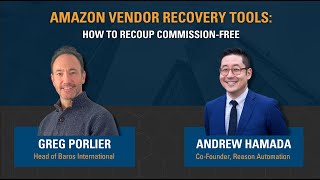
Andrew Hamada and Greg Pouier break down six types of Amazon vendor deductions you can recover: shortage claims, price disputes, co-op audits (often 1-3% error rate), chargebacks, open statements, and receivables provisions. They compare manual recovery against outsourcing and fixed-fee tools, then recommend choosing based on your catalog size and internal resources.
Chapters
Good morning everyone, if you're stateside, or good afternoon if you're joining us from the eu. I'm Andrew, co founder and CEO of Reason Automation. Joining me today is Greg Pourlier from Baros International. We're here to talk about Amazon vendor recovery tools and more specifically, how you can potentially learn about some new solutions and maybe bring some of those recovery operations in house. Greg, you want to give a quick intro on who you are and why we're why we're here? Sure, sure.
Thanks for that, Andrew. I'm Greg Pouier. I run the team for Baros International here. We have a sister company, Baros Solutions, over in Munich, Germany, and we work with some of the world's largest 1P global vendors to help them with basic accounting reconciliation as it pertains to vendor central, as well as claim fee deduction, reconciliation, recovery and management as well. So thanks for the opportunity, Andrew. Appreciate it.
No problem. Thanks for joining us, Greg. And I'm Andrew, as I mentioned, co founder and CEO of Reason Automation. We provide data for brands that sell on Amazon, whether you are a small brand, a large brand or an agency. And we specialize in highly accurate, extremely high quality data, particularly in the finops space. Which is why we're here talking to you about recovery. Just to get us started, the goal here is to walk you through a few things. First is to just go do a quick overview of the different types of recovery, some of which you'll already be familiar with, but some of which might be new to you, as well as some related topics there. Then we'll talk about some different types of solutions, helping you understand what the universe of solutions looks like today, from highly manual to highly outsourced, and then how to potentially make a better decision for you and your business. Our goal here is that Greg and myself are friendly competitors. And normally a webinar like this would be a giant sales pitch from one or the other of us. But we're hoping that by combining forces here, we're keeping each other a little honest and agnostic about what's best for you and your brands. With that in mind, Greg, you want to kick us off by talking about shortage claims? Sure, sure.
I have to imagine that everybody on this call has an idea of what a shortage claim is. In our experience in dealing with over a thousand vendor centrals globally, this is probably one of the most pervasive type of claim that Amazon deducts from a vendor's vendor central. So basically a shortage claim. Anytime that Amazon claims that they receive fewer products than what they originally ordered and what the vendor says they sent, they will create a debit to the vendor's account in the form of a shortage claim. The tricky part of these is that the onus is 1000% on the vendor to try to do the research necessary to file the dispute with Amazon, letting them know that, hey, Amazon, perhaps you've made a mistake here. You might want to take a closer look at this. Sometimes Amazon does locate product and then receive the product correctly and adjust those claims or in some cases reverse them totally. But the onus is on the vendor to be able to address those claims and try to fight to get them reversed once they receive them.
Yeah, Greg, if you were a brand trying to bring shortage claim work in house, what are some potential pitfalls or things that a brand should be aware of?
Yeah, it's. Well, first of all, this is not always the case, but we do see it quite often. The level of shortage claims that Amazon hits a brand with tends to be commensurate with the amount of volume that a brand does with Amazon. Obviously if you're shipping more product, you're shipping more frequently. There's greater opportunity for there to be either receiving errors or logistical errors somewhere along the chain that causes a shortage claim. So when, when brands are looking to file these disputes, a lot of the folks we work with, they just do it manually. There is an software in vendor central. There is an opportunity for you to go in there and file a dispute for these claims. We have had customers tell us it's very common for some brands to attach a proof of delivery with these disputes to say to Amazon, hey, I, I, I delivered this. Here's a piece of information from ups.com as evidence showing I delivered it. We have customers that attach bill of ladings to these disputes when they file them. And then we have customers who have told us that Amazon has told them, don't bother attaching proof of deliveries or bill of ladings with your initial disputes because we don't really even look at them or consider them. So it's kind of all over the board. But when brands are doing this in house, it does involve a lot of manual keying. It does involve a lot of repetitive disputing. For the brands that do want to attach these documentations, they have to go and locate them, they have to upload them. So there's a lot of manual repetitive labor that is involved with staying on top of shortage claims, particularly if you're getting a large volume of them.
Absolutely. I think you just nailed it, Greg. The only Thing that I'd add there is that you mentioned early on that sometimes Amazon detects their own shortages and reverses them because they realize they've made an error. What's really important for brands to keep in mind is that for a shortage you get to press a dispute button once and then you don't get to take another action until Amazon responds to that dispute. And for that reason, we really suggest that you wait at least 60 days before disputing a shortage claim, because oftentimes Amazon will correct their own error and that will prevent you from having to go through that dispute process. But also if they detect their own error and correct it incorrectly, then you immediately have the opportunity to dispute their own correction without needing to jump through more hoops.
Yeah, that's an excellent point, Andrew. We also recommend waiting a significant period of time. We have a lot of customers that wait 35 days. We do have some that wait 45 or even 60 days, as you had mentioned, but waiting is definitely key for that. And second thing I would add as well is opening support cases, from our experience, tends to greatly increase the success rate of a vendor disputing these shortage claims from Amazon. So it's a lot of work to not only stay on top of these disputes, but then having some sort of mechanism to be able to filter and identify which claims have been resolved, the brand's dissatisfaction that we want to escalate in the form of a support case. Staying on top of that activity is also something that's a little tricky and hopefully can be, you know, automated with tools like what, what you and I offer. But being able to do that is key in order to be able to fight this fight.
Absolutely. How about price claims, Greg?
Oh, these are fun. These are disputes, as it says, over discrepancies between agreed upon and invoice product prices. So in some cases when a, when a vendor sends an invoice to Amazon, Amazon will say, you know what? You charged me the wrong price for this particular product. I'm going to adjust this in the form of a price claim, which is in essence a debit to the vendor central account. These price claims, again, 1,000% of the onus of investigating and disputing these falls on the vendor to prove that indeed that Amazon is mistaken. And this involves looking at historical agreements. This involves looking at product pricing. This involves looking at dates, times to be able to say to Amazon at the period of time where you issued this price claim, this was the, actually the agreed upon price for this product. So I'm disputing This price claim. These aren't as prevalent, nearly as prevalent as shortage claims in most cases. And if you're not really altering your, if you don't have a lot of promotional activity or there's not a lot of price fluctuation between you and Amazon, this really isn't an issue. But we do have some customers where this is an issue that requires work to stay on top of.
Agreed. What we found in our experience, Greg, is that the, the amount of price claim activity that you have to deal with is a little bit in your control, just depending on how you manage pricing with Amazon. And we found that the more that vendors try to use cost increases as a lever, and in particular vendors who have been told, perhaps incorrectly, that you can sneak cost increases in and if Amazon places the po, then you're ok. This is the consequence of that is that they might place the PO and you might even accept it and get to bill them for it. But that doesn't mean that you've, you know, snuck anything past them. They have the ability to come back later on during their audits and claim value for that discrepancy and it just leads to more conversations down the line.
Yeah, these are, these are usually pretty, pretty, I wouldn't say easy to recover, but if you are, if you're using tools to recover these price claims, a little tip and trick we've seen is if the price claim is under a certain threshold, and that threshold is a few hundred dollars, they tend to have a high degree of recoverability, if you will. It's when they start to get in the higher values that they seem to get a little extra scrutiny on the part of Amazon for you to be able to win those, those disputes. But you can go back pretty far with these price claims. That varies by geography, but typically you can go back a year, if not more than a year to try to fight these and get them back from Amazon.
Perfect. In your experience. Greg, I know you mentioned that price claims aren't as common, but what would you guess is the ratio between shortage and price claims?
Again, varies by brand, but I would say it's probably a. This is just off the top of my head. I hadn't really ever thought about at least a 10x shortage claim to price claim. I've seen at least, if not more. Would you agree with that?
Yeah, I would agree that it is a significant ratio. I don't know what the number is exactly, but it's, you know, at least a factor of 3, 4, 5 or even as high as 10 or 20 to your point?
Yeah.
All right, quick show of hands. If you've ever had to use an Open Statement with Amazon and you're already familiar with this concept, go ahead. And there's Greg raising his hand. And I'm seeing some raised hands in the attendee panel. Amazing. So, for those who don't know, the Open Statement is the tool that you can use. It's almost like an escalation tool for any unresolved and open claims with Amazon, whether they're shortages, price claims or anything else. The idea is that the normal dispute process for these, these opportunities is to go through Amazon's normal tooling, pushing the dispute button, assembling evidence when necessary, opening cases when necessary. However, a lot of brands get intimidated by the fact that there is a huge amount of volume there. And so if you're dealing with, you know, hundreds of price claims and shortage claims and you are, you may be tempted to try to find a solution that tackles all of them at once. And that's essentially what the Open Statement is. It's your offer to Amazon to settle all of the outstanding claims that they've identified and that you are preparing to dispute for some sort of offer. And essentially you are going to aggregate all of the information for all of the open claims, send it to Amazon and they're going to make an offer, usually of a percentage of the value. The Open Statement is an amazing tool, but it's also very risky. The it's powerful. Once you've issued the Open Statement to Amazon, they almost always respond. But there are two caveats there. The first is that the response time tends to be very, very long, while a normal dispute process you might within weeks. The Open Statement can take months, if not quarters, for Amazon to fully debate and bake and decide how they're going to respond and make an offer for you. And the second is that it is an escalation tactic. And just like any other escalation tactic, you should be aware of the potential relationship impacts and other conversations impact on other conversations that you're having when you decide to use the Open Statement instead of going through the normal dispute processes. So no one can tell you for sure one way or the other authoritatively whether or not this is a powerful option for your business. But you should keep in mind that you have this lever available, particularly if you're not seeing success or less success than you expected with your disputes.
Yeah, yeah, I would, I would agree with that, Andrew. And one thing I would add is we see a lot of cases where our customers will go through this process with Amazon, but in addition to reaching some sort of settlement, which is usually a percentage of the overall open statement amount, they're also, they have to agree to things like they will never ever dispute anything along these lines again for that period of time that the open statement settlement is looking to cover. So it really does sort of bind you if you, if you're going to go down this path. Once it's done, it's done.
Exactly. So it's your, your last giant big red button to push if you are running out of other options. All right, and one last concept. This isn't a type of recovery, but rather something to be aware of as you're trying to identify and audit your recovery opportunities is Amazon's provision for receivables. For those who have never seen this before, a provision for receivables is a temporary credit memo that Amazon charges to your account because they're anticipating the things that they need to deduct from your payments for purchase orders is going to exceed the amount of the payments that they owe you. In other words, for timing reasons or whatever it happens to be the accumulated amount of co op allowances, subscribe and save, promotional charges, returns, etc. Are all going to exceed the amount that they owe you for whatever open POS that they have. And so instead, to make sure that they can claim value, they're going to issue a provision for receivable in your account and it's going to show up as a line item, literally called a provision for receivable in the amount that they believe that they're going to be shorted net of the next payment. And so is this a type of recovery? No, but it's really important to be aware of what a provision for receivable is and how to find it in your data set so that you can understand when you're seeing a discrepancy between payment amounts and what you're expecting, whether there's a provision for receivable in there. Otherwise you might waste cycles filing incorrect cases or providing the wrong evidence to Amazon. And to our earlier point, you get that one shot with the dispute button before they say yes or no. So definitely be aware that provision for receivables are a thing and look for them in your data. The nice thing about provisions for receivables is that they're temporary. They typically don't last in your account more than two to six weeks on the outside is the longest that I've personally seen because they exist only while Amazon doesn't have planned payments for your purchase orders. And so in the normal course of Most businesses, additional POs get issued, additional merchandise gets shipped, and Amazon ultimately then debits against the provision for receivables. Last, but certainly not least are chargebacks. And I think that a lot of folks, when they think about recovery, get fascinated with chargebacks. And it's easy to do that because it's a laundry list of things given to you by Amazon with reasons. And it can feel like a way, a checklist, a piece of homework. That is a discrete list of things that you can do to improve your business with dollar values attached that are going to potentially make Amazon happy. And that could be a valid way to look at it. However, in my experience, and Greg, I'm curious to hear yours, we find that the chargeback recovery opportunity is often the hardest and the smallest long term, despite what it looks like. And that's because oftentimes chargebacks are issued for reasons that Amazon is very, very sure about. If they are issuing you a chargeback for something like a carton content accuracy because they didn't think that there were the right things in the box that you sent them, they're usually going to have a reason and some proof point to actually generated that chargeback with you. And they're fairly accurate about it. And so for the average brand disputing chargebacks, which happen very at the individual item or shipment level and are often, you know, less than $100 each, it could be a very labor intensive and not very fruitful process. But it's super important to keep your eye on chargeback trends and monitor them over time so that you can start to understand not only are there dispute opportunities just starting to crop up, but then aggregating that chargeback performance by product and by issue type also gives you the opportunity to understand if there are trends you can diagnose and work on upstream. Just because you can't dispute chargebacks very easily doesn't mean that they're not a super useful signal of your recovery opportunities and your prevention opportunities. What's better than recovering from Amazon preventing them from charging you anything in the first place. And so we absolutely recommend setting up some chargeback monitoring and understanding where biggest opportunities by product line, by product, and even by issue type are occurring. There might even be seasonal trends. So we recommend mapping this out over time. And in particular, if you start to do work on improving your prep processes in your warehouses and fulfillment centers, monitoring your chargebacks over time helps you understand whether that additional prep work is having downstream dividends for you.
Yeah, Yeah, I couldn't agree more with that, Andrew. I think these tend to be a little bit lower ROI when compared to how much work it takes to, to pursue them. But that being said, it does it can point the finger to more pervasive issues upstream that are causing those chargebacks to happen in the first place. And you know, like for an example, like SIOC certifications and staying on top of them before they expire so that you're not getting hit with CYC chargebacks. Sometimes it costs more to certify than it's worth to actually get something certified. But just understanding so the total picture of all that is really important to prevent the Keep these at a minimum wherever you can.
Exactly. One thing to note with chargebacks, especially if you're planning to dispute them, is that unlike shortage claims and price claims, you have a very limited time to dispute chargebacks. There's a 30 day window when you have the ability to push the button in vendor central. And so it's not only the lower ROI opportunity, but you have a tight window in which to actually take action. Again, why we emphasize that chargebacks are primarily a tool for informing how you improve your prevention rather than a true recovery opportunity. It still belongs in the same universe as your other recovery tools and thought processes though. Co op deductions Greg yes, this is.
This is a fun one. This is co op deductions, basically deductions taken by Amazon every time they receive product from a vendor. And those deductions are based upon co op contracts that the vendor has with Amazon, usually for joint promotional or advertising activities. Sometimes there's, there's other logistical type agreements as well. But I'm still surprised by how many vendors I talk to that don't audit these co op deductions that Amazon is taking. A lot of times they seem to take them at face value and they assume that the deductions are accurate, that they're based in an enriched data that Amazon has. When in fact we find anywhere from 1 to 3% of a vendor's total co op contract values that they have with Amazon, we find them to be an error, those deductions. So you know, if you're talking, if you're talking millions of dollars of co op contracts, you're talking quite a few dollars in terms of erroneous co op deductions that can be recovered. So these are definitely something that should be audited. It's hard to audit them, right? Because it's a lot of data. There's a lot of things you're looking for There are tools out there that can help you audit these automatically and at scale, which is, you know, the two guys on the phone that you're talking with here. But this is something that every vendor should be looking at if they're not looking at it today, because there's a big opportunity here to prevent revenue leakage and to recover these bundles.
Absolutely, Greg. It also surprises me as a former vendor manager at Amazon, how infrequently folks are auditing their co op deductions, because frankly, that's an automated system doing its thing. And you would all be, I think, both amused but also terrified at how easy it is for an internal Amazon person or system to make a mistake that results in downstream financial impacts for you and your company. One common example of a co op discrepancy that we see is not that they're charging you the wrong accrual percentage. For example, you know, if you have a 10% co op agreement, you're probably getting charged 10% pretty consistently. But a really common example is an item appearing in the wrong vendor code or in multiple vendor codes by accident and therefore getting charged co op for multiple accruals, even though they don't need to be. So if you can imagine your product is listed in both sports as well as an outdoor or no, this is the same GL sports and tools, for example, two different Gls, two different co op agreements, and one of them is 8%, one of them is 10%. One of those might feel fair in isolation, but you stack those on top of each other and that might be your entire margin and then some. Greg, are there any other examples that you can think of that folks should be aware of?
Yeah, there's a big one that we see that we identify with our tools automatically and at scale. And it has to do with co op deductions being taken for items that also appear on a shortage plan. So if the item's not received in the first place, the co op deduction should not happen. So it's in essence a double dip, if you will. And you know, when you dispute those, you'll win. You'll win those 99 out of 100 times. So keeping an eye on that, which is obviously, as you imagine, pretty hard to, pretty hard to identify in the vendor central data, this particular product got charged a co op fee, but it also appears on this shortage claim over here. So that's why tools are critical for identifying this type of activity and remedying it.
Yeah, and just to add more detail there, when we say tools, we don't just mean that you need like a dashboard or something to actually look at this stuff in a little more friendly way than the PDFs that Amazon gives you. We mean that you need to be able to actually structure the data differently and look at by item or by product, all of the things that might be impacting that product. And that's the only way that you're going to find, for example, even think about the idea of shortage claims and co op interacting if you're looking at those things side by side. The only way that you're going to find products being overbilled for co op because they appear in multiple agreements is if you're aggregating your co op by product rather than by agreement. Yeah.
Great call out, Andrew.
All right. It's a lot of different types of recovery out there and we know that folks on this call have been inundated with different types of solutions in the market. When Greg and I got into this business, even before we got specifically into recovery, this was a completely manual process for pretty much everybody. And it was a lot of downloading and a lot of manually extracting data from PDFs, comparing it in your own ERP and accounting systems and whatnot. And certainly that's still an option that a lot of folks take. But soon thereafter there was an advent of a lot of new tools. So first, what we've come up with here is a mapping for how you can think about the trade offs here. There are multiple different attributes for different recovery solutions, but we really think it comes down to a trade off between cost and your resources mainly. And we'll go into a decision making model a little bit later. But just to map the universe for you, all the way on this side of the spectrum where there is no cost but a ton of your resources are required is your manual processes, your existing teams, whether that's your Amazon sales team, your Recovery team, your FinOps team, your AR team, going into vendor central and doing this recovery completely manually, that's certainly better than nothing. But if you're doing that, I imagine it hurts a lot and it certainly doesn't scale. And then shortly, very quickly, a lot of commission based outsourcing services came onto the scene. And you're probably familiar with a lot of these, like chargeguard and Dime Tide, et cetera, who promised to take on as much of the work as possible for a percentage of the recovered money. And that was a very attractive offer to a lot of brands. But over time I think a lot of brands are realizing, number one, that's A very high price to pay. Number two, that a lot of these services are not doing as much as you would hope that they would do in terms of recovering for your business. And then number three, that, you know, long term there's got to be more operational opportunities and efficiency opportunities for you to bring some of these solutions in house. And that's where Greg and I come into play here. So at Reason Automation, we see ourselves as being a solution that helps equip your internal resources with much better tooling. We don't automate away significant chunks of the process, but instead our dashboards and data sets help empower your existing AR team, FinOps team, or your sales team to potentially do some of this work themselves as well as start to understand some of the business strategic trends around it. Greg, how would you talk about Barrios position on this spectrum?
Yeah, I think thanks for that, Andrew. I think it's. We've positioned ourselves. We've created a product that empowers a vendor's team of people who might be already doing this manually. You know, the business continues to grow more and more workload for this team. This team now needs help to be able to stay on top of all of the claim fee deduction recovery, stay on top of all the accounting reconciliation associated with with vendor central. This tool empowers them, reduces their workload, tremendously identifies revenue leakage at scale, and will recover that revenue leakage at scale as well. So I think this is really empowering a vendor's team to be more efficient, more effective.
Awesome. All right, now the fun part, how to actually make a good choice for you and your business. So Greg alluded to this earlier, but we see it as a function of two major things. So one is your specific business's recovery opportunities. Not every business has the same level of issues and leakage with Amazon. And it's important for you to actually do an analysis on what your opportunities look like. These are often a function of the size of your business first and foremost. So if you're only doing a million dollars a year with Amazon, your opportunities are going to look a lot less and a lot different than if you're doing $100 million a year with Amazon. It's just a function of the number of POS they place, the number of shipments that go through the barns, et cetera, and the more opportunities for error discrepancies. The second is the complexity of your business. Companies and brands that ship five products that are very easy to manage and go into case packs and pallets really nicely and are really, really easy to differentiate from each other. See less issues than somebody who has, you know, quantity packouts of tiny things. You sell toothbrushes, for example, and you sell a one, a three, a five, a 25 pack and they all come in one. Things like this, if you have a giant catalog of a thousand plus asins or skus, there's just more opportunities for errors. Just in general. Anything that adds complexity or more opportunities for folks to make mistakes or things that just go sideways is going to lead to a bigger recovery opportunity for your business. And last but not least is operational excellence. And what I mean by that is we talk about recovery as being the thing you do post. The ideal is that you're catching a lot of this stuff and preventing it from ever happening upstream. And so businesses with really, really amazing internal operations and who have gone through the gauntlet with Amazon multiple times and made changes to the way that they pack, ship, et cetera, in order to accommodate those things, oftentimes have fewer recovery opportunities. And so if you were a tenured brand with Amazon and you've been iterating on this problem for 20 years, maybe your opportunities are smaller. But that said, Amazon's still Amazon and they're always going to amaz. So recovery opportunities always exist. And even the absolute best prevention isn't going to capture everything. There's still always going to be claims, discrepancies and chargebacks for you to kind of go after. The second thing this is a function of is your own resources. So again, thinking back to that slide before, there's always a cost somewhere, whether that's dollar cost or a time and human labor cost. And to us we see that really being a function of two things there. It's the finance and accounts receivable bandwidth. So the folks who are accepting payments and then responsible for reconciling those things, do they have time to manage these processes? Are they empowered to actually look at and audit the payments received from Amazon? Do they have the tools to do that? Or is that siloed away and the responsibility of a business manager who only looks at it once quarter? And then secondly, is Amazon and E Commerce recovery expertise? Large brands with omnichannel sales and centralized departments will know exactly what I mean here. But sometimes your AR and your finance teams don't speak Amazon. Go figure. They don't know what an ASIN is. They don't know Amazon specific weirdness around deducting from payments. They might not be familiar with your specific brand specific context problems and opportunities with Amazon and all of that. Together means that the more the higher context your Amazon team is and your FinOps team is the more options that you have for solutions because it means that you can use tools like Baros and Reason Automation. Compare this to if you have no resources internally, all your Amazon expertise is already overworked, doing 500 hours a week trying to sell things, then they're probably not going to have time to audit the work that your team is doing. And maybe a fully outsourced solution is better. Greg, talk us through the opportunity of and why commission based recovery ends up becoming very difficult for brands to bear.
Sure will do. I think this is a very rudimentary spreadsheet representation of just apples to apples costs associated with a commission based recovery pricing model versus a flat fee based recovery pricing model. And it really accentuates the difference between if you're, if you're a brand doing low volume with Amazon, perhaps you just started out 1,000,000, 2,000,000, 3,000,000. The commission based recovery pricing model can be very attractive because there's zero cost to you. Unless they recover something, it's a pretty safe bet. Very little skin in the game. So in the case of a brand doing a million dollar turnover with Amazon, you're looking at roughly 3% recovery rate on average 15 commission, which is generous. Sometimes they're more than we've seen them be. More than that, you're looking at a fee of 4, $500 to recover $30,000. That's, that sounds fantastic. Whereas a flat fee based recovery pricing model, let's say $20,000 is sort of a tent pole. We, we charge less than that, but the annual turn for the same annual turnover for, let's assume the same amount of recovery of $30,000, you're going to end up paying more with a flat fee based recovery pricing model. But these change drastically as the volume that a brand is doing with Amazon goes up and as the recovery potential that a brand is doing, that a brand has with Amazon goes up. So in, in the bottom half we can see someone doing 10 million. Let's assume a $300,000 recovery potential already at only 10 million in annual turnover with Amazon, you're going to end up paying more for a commission based recovery model than you would by subscribing to a tool or tooling that helps your team be more effective when it comes to recovering these things from Amazon. And this really gets sort of pronounced. Even if you're looking at a brand doing 50 million a year turnover with Amazon and let's say they get an ultra generous commission based recovery percentage of only 5%, you'd still end up paying $75,000 to recover 1.5 million, which by the way is a great ROI, let's not kid ourselves. But it's even better ROI if you can spend to 20,000 or less than $20,000 to recover 1.5 million. So I guess the point here is with scale comes cost for commission based recovery. With scale, when you're using tools and you're using software and you're, you're really empowering your team to just be more effective and more efficient, those, those are fixed costs that allow for that same, that same work. So that's the, that's the messaging here. Anything to add, Andrew?
No, I think you hit the nail on the head and that it's if you're a small business with limited recovery opportunities, then outsourcing me for a commission and no guaranteed payment may make a ton of sense. But the math very, very quickly changes as your business grows. There's also one dynamic that we've started to observe and heard directly from brands and customers like you all on this call. As the commission based recovery space has gotten more competitive, you've probably seen more and more companies springing up and driving down that commission rate lower and lower and that can be exciting to a lot of folks. But what we're finding is that the level of service has been rapidly declining as well, and that the feedback that I hear from a lot of prospects and customers who are using those commission based recovery services is that as the commission rates go down, the depth and the breadth of the cases that they pursue has decreased as well. And now a lot of these recovery services are either going for things that are too easy and then not doing any of the harder things, or they're disputing things too quickly and trying to claim value for things that you might have already received back. Anyway, thinking back to Greg's earliest point about shortage claims and how Amazon sometimes corrects them on their own, a lot of these companies might, for example, take credit for disputing a shortage claim that Amazon may have automatically corrected themselves, and then you've paid a commission on something that you didn't need to pay on at all. Those are the sort of hidden opportunities that don't get revealed through these kinds of math analyses. The only other one I'd nod to, and I wish I'd thought to do an ROI thing here, Greg, is your point about co op. These sorts of ROI math recovery based pricing tools tend to be focused on just price claims and shortage Claims, they don't tend to include co op at all. And so the opportunity to then potentially go in and find co op discrepancies, maybe for the first time for your business, can't be overstated.
Yeah, and that's, that's a good point, Andrew. And those, those usually come back fast from Amazon. So for somebody who has $500,000 worth of CO op recovery opportunity, when you're using proper tooling and filing disputes in a proper method, you, you'll probably reclaim a good portion of that money month two, month three, month four after getting started.
Exactly. All right, thank you so much for bearing with us so far, everyone. And now for my favorite part. We talked a whole lot about different types of recovery, different types of solutions that are out there, kind of how the space has evolved. But we are proud of what we've built. And so we'd love to tell you a little bit about the solutions that we, that we're bringing to the table here.
Yeah, yeah, thanks for that, Andrew. This is, this is one such tool that we've been referring to all along during this conversation, which is the Baros cloud tool. We do have. A lot of, a lot of effort has gone into putting together something that again, can empower a vendor's teams to be able to better and more quickly reconcile Amazon vendor central accounting data. So understanding payments to invoices, understanding deductions being taken without receipts being provided, perhaps deductions being taken that Amazon's not entitled to because they're not necessarily paying on time, but they're taking that pay on time deduction. But then on the flip side of that, automatically deducting or automatically determining revenue leakage opportunities in the form of a co op deduction taken for something that also appears on a shortage claim that requires a different look and analysis of the data that is in vendor central. And this tool does that. So these things that we've been talking about all along, a nice tool to give your team something that is a fixed cost, but allows them to greatly increase their efficiency and their effectiveness of managing vendor central and fighting the claim deduction fee recovery fight.
And we at Reason Automation have built a tool that we're calling the Vendor Profit Toolkit. And very similarly, it's designed to empower your own team to start bringing these operations in house. It's built by myself, my coworker David, who is on this call and we're all ex Amazon. David, prior to coming to work at Reason, also worked at an agency where he helped build tooling for a lot of similar brands and working on recovery tools there as well. And so we're leveraging a lot of industry expertise to put a lot of the correct data in your hands. Things that we're proudest of are not only helping you connect the dots between your co op, your invoices, your purchase orders, your deductions, your disputes, etc. But then also helping you make sense of a lot of the most complicated data sets that lie within that. For example, those of you who are doing invoice research have often noticed that Amazon loves to add suffixes to your invoices to make it even harder to connect the dots between them every time there's a shortage claim and a shortage claim reimbursement you see in new invoice variant, et cetera. Our tooling now allows you to do things like identify every single related invoice, put them into sequence so that you can start to understand a true history of the financial transactions related to a given invoice, net of all of the claims, disputes, etc. We also give you direct access to the underlying data in a SQL database. And so if you're a data nerd like me, that might be very exciting for you because you not only get the opportunity to work with this data in a dashboard, you can bring it directly into your ERP or other tools for further analysis, maybe even some machine learning and identification of opportunities beyond the manual. And that's it, everyone. If you have any questions, we'll hang around for a few minutes here, but we want to take a minute and thank you. We know it's early if you are in the west coast and late if you are in the UK or the eu. If you have questions or you want to follow up with either of us questions, please drop them into Q and A here. But if you're interested in speaking with either Greg or myself, you can find us online@Barrowsincl.com or Reason Automation.com we're also going to email a copy of this presentation and a recording to all of the attendees shortly after this is finished. Thank you very much everyone. We'll hang around for questions.
Heather, thank you for your note. This was insightful. I'm glad it was this, you know, when you do something all day, every day, it just, you know, becomes. Just becomes what you do. But for folks to find this insightful is very important to us. So thank you for that. Mr. Ryan Burgess has a question. Andrew, you see it there?
Yes, I do. So Ryan is asking, is there any average amount that most vendors are able to recover There is and there isn't. I'm going to give the super consulting answer of it depends. It really just depends on the type of business, the complexity of business etc. The cleanliness of the operations and the different types of opportunities that are present for a given brand. That said, the, the success rate that I have benchmarked across the industry, no matter who's doing the solution providing etc is about 50%. Greg, what would you add there?
I think it certainly varies by varies by deduction type or claim type on what you know, most vendors are able to recover. We like to say that, you know, based on an annual volume with Amazon, you're looking at anywhere from 1 to 5% of that annual volume in deductions that most likely you're able to recover. And that all is impacted by the things that Andrew talked about earlier, operational excellence upstream. You know, logistically is the brand tight and are they often changing prices? So, so anywhere from 1 to 5% is probably a good rule of thumb I would say. Brian, of a total volume, annual volume looks like Ross Simpson. Is there a limit to how far back in time you can go when auditing potential incorrect co op charges with Amazon? And I'll weigh in here, but I'd love your take on it, Andrew. It varies, it varies by geography. So what we found is, you know, as we're an international company, we can go back two years or a full 24 months to audit and recover, dispute and recover inaccurate co op charges in the United States. That is different in Europe. In Europe in some countries you can go back three, four, five years. So it really varies by geography, but in the US it's two years.
That's exactly right, Greg. The only nuance I'd add there is that this information is actually enshrined in your vendor agreement. Part of what you agree to when you sign that vendor agreement is the terms for how far back both you and Amazon can go back to dispute these things. And you've, and so check your agreement for what those terms look like. They're almost always what Greg just said. But it's possible that there's additional nuance that you can pick up from there.
Yeah, and I see, Heather, I think that's more of a comment than a question. Unless I'm mistaken there. Andrew, should we go to the Nathan question?
Yeah, Heather, feel free to clarify the question. But in the meantime let's, let's jump to Nathan. So starting at zero experience with this topic in vendor central, what's the first type of reimbursement you would recommend someone researches for recovery. I'm gonna trumpet shortage claims, shortage claims, shortage claims and then also shortage claims.
Greg, I would add shortage claims and the reason for it A it's, it's the biggest, if not the second biggest one next to co ops. But number two, Amazon does a really nice job of listing all of the shortage claims for you right in front of you in vendor central. So you just go in there and you get started. Whereas co op auditing, Amazon does not give you a list of times that they accidentally charge you too much in co op fees. That requires research, that requires diligence. So definitely, definitely short of for sure.
Yep. All right, we've got a question from Isidra. If Amazon reported to me that there are product quantities that have been sent extra to their fc, how viable is this? If I'm understanding your question correctly, you're asking that if Amazon reports that you've shipped extra products to the FC rather than a shortage, is there an opportunity for you to recover there? The answer is absolutely yes. The methodologies are going to be a little bit different. Typically what Amazon will do there is rather than try to return and incur anything, any costs there, they'll try to understand whether they can take that on and just hold it as extra inventory and extra weeks of COVID if your demand allows for it. But if they are objecting and they want to return it or do something else then they'll usually let you know. Their propensity to do that is going to depend on their terms with you. So if you have very very generous return allowances with them or return terms then they might send it back but otherwise try to get them to keep it and if they do, make sure that they pay you for it. All right, last or one more question here. There is an anonymous one. Does the self service tools that you're brewing presenting guide what is required to win co op disputes, shortages etc or does it only show the opportunities to dispute? Really good question, Greg.
Yeah, on the, on the barrows front we have developed tools that will assist a vendor in filing the disputes but also winning the disputes for co ops shortages, price claims, co op shortages. So there's the idea of the tooling is to take workload off of the the AR managers or the finops person's plate who is responsible for it today. So in addition to identifying the opportunity, the tool will absolutely help you file and recover those recover those funds from Amazon for sure.
Absolutely. And that's one area where I think baros and reason differ reasons tooling doesn't actually take the step of filing disputes for you or pushing the button or submitting the cases and whatnot. What it does do is present you with the opportunities in priority order best that we see them for your business. And then we present instructions in line for your team members on each screen of our dashboard so that, for example, you understand how we recommend processing your shortage claims. Like, how would we go through the opportunity identification if it was us trying to train our own teams? What would we give them? That's what we've given you.
Yeah, and that's a good point, Andrew. I think when Andrew had the Spectrum view earlier in terms of cost, in terms of resource, different solutions fall in different places along that spectrum. And actually Andrew said this to me months ago and he's absolutely right. So it depends, I think a lot of it depends on a brand's the resources they have in house. A lot of it depends on the skill set within those resources that they have in house and how they're doing it today in comparison to how they could potentially be doing it where, where the majority of where is the biggest area for wins for that brand to go from how they're doing it today to going to something that's a little bit more using tools and using data. So I think a lot of that has to be considered when brands are looking at, you know, what do I do to try to, you know, remedy this situation.
All right, Connor asked, can you send more details in a pitch deck on the Barrows tool? I think Greg can do that for you. Yes.
Again, make that happen. Connor, you're talking to the right guy.
Another question from Asidra is, is it possible to switch to a different key account manager on vendor? The one that we have doesn't answer our messages. And I wish I could open this up to everybody else on this call because I imagine that most attendees on this call have experienced this pain, a vendor manager not being responsive or disappearing or what have you. In my experience, it is very difficult to start switch vendor managers and get attention from Amazon when they're not already giving it to you outside of the context of some other sort of strategic event negotiation, QBR or something else where they're reallocating resources. The unfortunate fact is that a lot of VMs have, you know, 500, 1000 plus brands that they're technically responsible for managing, which means that they cannot possibly talk to all of them. They're talking to the top 10 to 20 and cherry picking which ones they speak to after that. The only thing that we recommend instead of trying to switch your account manager is try other tactics. So first and foremost, if you're not already over communicating, don't be afraid to start speaking as somebody who was on the other side of that table. I was getting hundreds if not thousands of emails per day, both internal and external, when I was at Amazon in a buying role. And so sometimes it's just about the squeaky wheel getting the grease. And with apologies to all my Amazon friends who are on the other side of this recommendation, you really should just bug them more and see if that, if that gets you more, more attention. The second is don't just send them messages in the void saying hey, can you look at this? Hey can you look at this? Hey can you look at this? But try to help the vendor manager understand what is in it for them of paying attention to you. They try to put yourself in their shoes. What are their goals this year? They've probably expressed them in an email or if they've ever met with you before in a qbr, you know, what are they trying to optimize for this year? And then how can you position yourself as a good guy in that battle? That almost always unlocks attention from a vendor manager and it doesn't necessarily need to come with dollars attached. So I'm not necessarily saying, hey, they want you to sponsor father's with some co op package of MDF on like the store that nobody sees. I'm not saying go out and do that just to get a response, but I am saying that when you're emailing them, reminding them about things that you need or asking for a response, show them the carrot as well. Remind them that you're considering some other change that is accretive to their goals, whether that's a net PPM goal or a selection goal or something else.
Yeah, Nassidra, this is something we hear all the time, almost every day. My account manager doesn't reply to me. We hear that almost every day.
Yep. Any last questions anyone?
Yeah. Great group. Thank you everybody for your participation and for your interest. We really appreciate it. This was, this was great.
Yes, thank you so much. Really great questions. You know, having done a lot of these, I don't usually get many questions and certainly not, you know, intelligent ones that actually add to the conversation in the way. So thank you so much. Look for a. Oh, Greg, you're pulling out the dog. That's cheating.
I'm pulling out the dog. He's been tapping me the whole time and he wants to say hi to everybody. So I have to have to bring him in here.
All right. Well, that's now. Now, you're all going to think about Barrows and the dog as we end this. So, you know, we'll just call it there. But on a serious note, thank you again for attending. You'll see a follow up email from myself and Greg, not only with the recording here, but with some more information about our own products and services. If you do have any questions and want speak to us further. Whether it's about this or anything else related to Amazon, vendor central or vendor recovery, we're happy to help. Greg and I are both just like helping people in this space, and it's a good way to get us to spend a disproportionate amount of our time with you. So just email us and let us know. Thanks very much. We're really excited to hear from you.
Thank you, everyone.
More from Andrew



Beyond Chatbots: AI for Cross-Channel Media Optimization | Amazon X AI Working Sessions




How we scaled 2M+ Amazon content updates without losing control | Amazon X AI Working Sessions

Connecting to Amazon’s APIs with MCP servers and Skills | Amazon X AI Working Sessions

Working directly with LLMs, code, and your Amazon data | Amazon X AI Working Sessions

