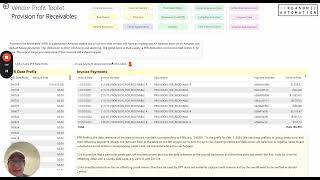
The video (Vendor Profit Toolkit demo - Provision for Receivables) explains how Amazon applies "deduct from payment" entries (sales discounts, quick-pay discounts, freight/damage allowances, co-op, etc.) and how a Provision for Receivables (PFR) is created when Amazon's claimed deductions exceed a purchase-order payment. The speaker describes that a PFR is an outstanding negative balance that Amazon debits against future purchase orders until it is zeroed out (example: a $24,000 PFR). The demo introduces a tool that tracks each PFR line item and flags PFRs that do not net to zero within an expected window (ideally two weeks), indicating the need for vendor investigation.
Chapters
One of the most confusing line items in vendor remittance is the provision for receivables. And to understand what that is, we first need to understand how Amazon collects money for things that they believe the vendor owes. Amazon uses what's called a deduct from payment. And that means when they pay you for a purchase order, products that they've ordered from you, they're going to deduct from that payment any money that they think you owe them in return for sales discounts, quick payment discounts, freight allowance, damage allowance, and basically anything else that's on their receivables list. And if the amount that they think that you owe is greater than the amount of the purchase order that they're paying you for, then Amazon will issue a line called a provision for receivable that is essentially an unpaid balance that you owe them. And they're going to debit against that balance for each additional purchase order that you submit that they pay you for until that balance goes away. It's basically there so that instead of needing to send you a bill, they're just going to keep billing you for co op and other deductions against future purchase orders. It's not a huge deal financially, but it can make reconciliation extremely confusing because part of a payment might be deducted from this PFR provision for receivables, and part of it might be in an actual payment from Amazon. And that'll make it extremely difficult to bridge an actual payment amount to an invoice amount to an original purchase order. This tool that we built is designed to help you track provisions for receivables every time Amazon issues one. The idea is that that provision for receivable deduction will be a large negative number. Here you can see this One is for $24,000. And that means that Amazon believes that you owe them $24,000 more than they've paid you or that they owe you in the near future for purchase orders. And so for the next, however many purchase orders, until Amazon is billed for 24 grand, they're going to just deduct from this amount. And then once they've deducted or paid for a full $24,000 using this PFR, then they will start to issue payments again. And then you would start to see line items like this where the original PFR starts to have an actual credit against it. Ideally, every single PFR line item should net out to zero this way within two weeks. Otherwise something might be wrong and it could be worth investigating. So this tool is really here to help ensure that every single previous PFR that you see in your data has actually been zeroed out. And if you don't see that, it's an indicator that you need to do some research with Amazon and understand what they still believe is owed and why.