I Spent $500K On Ads. Here’s What Actually Works

Andrew Leedham spent $500K on ads to generate $2.3M in revenue for his coaching business. He breaks down the complete system: defining your ideal client, building trust content, then running ads to feed a sales process. Most coaches fail because they skip the strategy work and focus only on ad spend.
Chapters
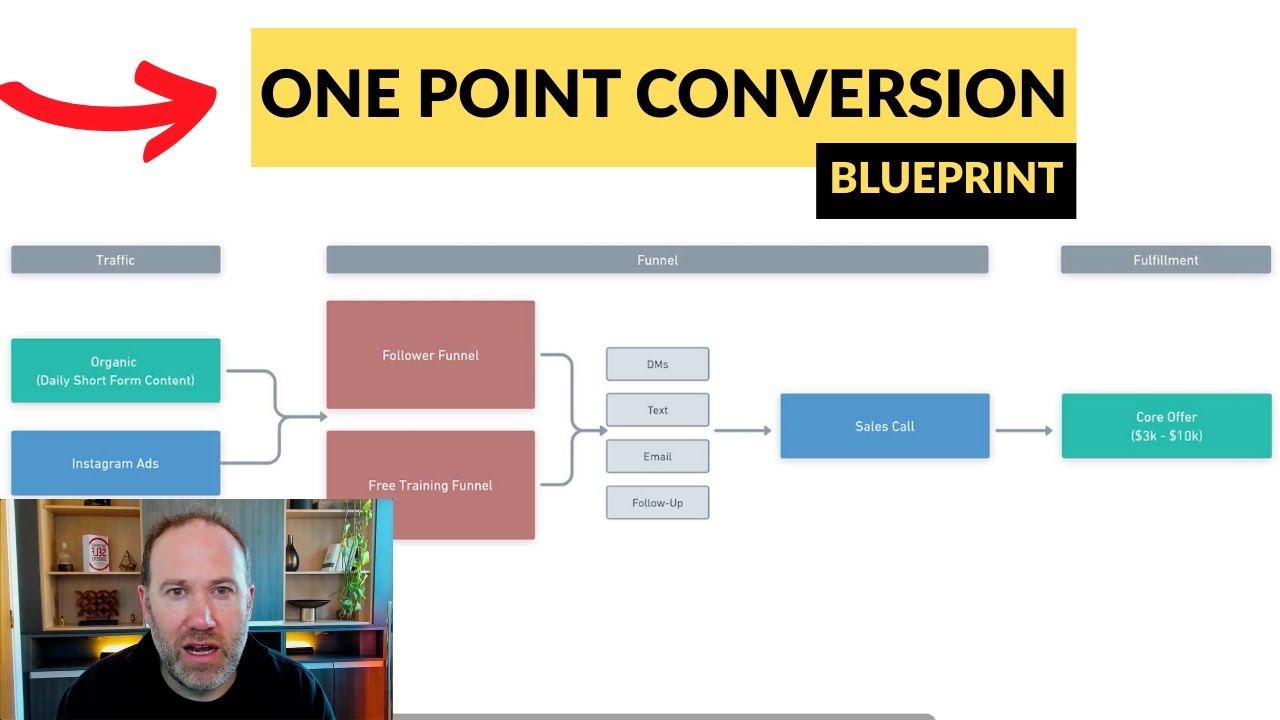
What if you could buy as many clients as you wanted for your coaching business? I spent over $500,000 on ads to prove exactly how it's done. And the truth is that most coaches fail badly with ads because they see ads as the system instead of as the entry point to a client acquisition process, one that generates leads and converts them into qualified, ready-to-buy prospects like clockwork. Now, what I'm going to show you today is the exact method that I've used to generate over $2.3 million for my own coaching business, and it shows you how to turn ads into ready-to-buy clients like clockwork so you can make as much money as you choose and have full control over your income. So let's dive in. Now, remember that paid ads are simply a system, and the reason why systems matter is because they create predictable results, and that's how you build a business that truly works. And for any coaching, consulting, or information product business, paid ads are the critical system by which you consistently, predictably generate new leads, new calls, and new clients. Remember that in the overall system, ads give you traffic, content builds the trust and nurture, and the two together are how you get clients predictably, right? You get those predictable results. So let's talk through why paid ads are so important. The truth is that you can't scale what you don't control, and organic content is great for building that brand, but if you want those consistent $30K, $50K, or $100K months, you need that predictable lead flow, and that means ads. When you've got the right ad system in place, you can wake up each week knowing that here's how many leads I'm going to get in, here's how many calls that's going to lead to, and here's how many clients and the revenue I'm going to generate as a result of that. Now, I mentioned earlier that most coaches fail badly with ads, and here's why. It's that ads are simply the magnifier of whatever foundation you've got in place, whether that foundation is good or bad. And most coaches' foundation isn't where it needs to be. Firstly, they don't have any end-to-end strategy. They don't have a system. Without a real process, a mechanism for taking people from click to client, you're gonna bleed cash every time. You have to have a process, as I said, that generates those predictable results. Secondly, ads don't operate in isolation. You've gotta also have your brand of trust, your organic content, that nurtures people so that they're ready to buy. No one is going to go from an ad to spending thousands and thousands of dollars with you until they've got to know you, like you, and trust you. And your content, your brand is how you do that, is how you build the relationship. This is why I said ads don't operate in isolation. They're part of an overall client acquisition process. The next reason is that most people have terrible follow-up in place, okay? Sales happen after the click. You've gotta have that strong follow-up system, ways of reaching out, ways of connecting, ways of nurturing. The fortune is in the follow-up, one of the most important sentences in business I've ever heard. The next reason is that people don't know their numbers, they don't know their KPIs, so they don't know whether things are working or not. I heard from one mentor of mine that you have to track your numbers like your life depends on it, and that is totally true because your business literally does. In simple terms, do you know your cost per lead, your cost per booked call, and your cost for every new client you get? If you don't know that, you've got no way of understanding where your business really is. You've gotta have those benchmarks in place to understand when you scale, when you pause and when you kill something. The other reason is that you've gotta have the right messaging in place so that your ads reach your target, your ideal client. If you run ads that could apply to anyone, if you're not polarizing, if you're not actively rejecting people in your ads, your right people, your ICP, aren't gonna stop and when they look at your ads, actually take action. You're gonna burn your budget on the wrong people. So be really specific in your ads. You've got to also have really good, high-quality creative. Now, that doesn't mean high production value. It means that the ad itself has got to be something that actually appeals to your ICP, okay? You've got to be clear on the next step. You've got to be clear on who you're talking to. You've got to have a hook that appeals to your client in the first 3 seconds. Otherwise, it won't work, okay? And then the last reason is they have offers that aren't profitable. My clients know I bang on all the time about having high-ticket offers. If you don't have the right price point, you can't afford the paid ads and the systems that build that predictable foundation. You won't have enough margin. It costs money to acquire a client in any business, and if your offer pricing doesn't absorb that, your ads are going to drain your business and you can't afford to get things set up right. Okay, you're gonna lose on every sale. If you assume roughly it's gonna cost you somewhere between $500 to $1,500 to acquire a client with paid ads, so if you're only charging a few hundred dollars a month or you're selling low-ticket courses, you're gonna burn cash fast. A high-ticket offer isn't optional, it's absolutely essential. You also need different ads for people at different stages of their journey with you. Those are the, just at the awareness stage, what we call top of the funnel, This is where you're gonna be reaching new people who don't really know you yet. You're gonna be using your ads to just get some attention and some visibility, get them aware of who you are. The next stage is the people who are in what we call the middle of funnel, the nurture stage. They already know who you are, they have some awareness, but now you need to build trust. That's all about your content, that's all about giving them more messaging, all about your email, case studies. It's all about education and relationship building. And then the final stage is the conversion stage, the bottom of funnel. So this is where people have already built that know, like, and trust with you. They understand who you are, they understand you can help them, and this is where you can be more direct to get people onto sales calls, to get people to buy from you. Okay, but those are different stages and you need to have different messaging ads for each of those points. So your success with ads really starts before you even write or launch any ads themselves. You've got to do the pre-work that turns the ads on and makes them really get the results that you're looking for. And the starting point of that is knowing your client avatar, what we call your ICP, your ideal client profile. Think of this in the same way that you know your best friend. Can you articulate clearly and specifically who they are, how they think, what they need, what they want, the things that they're struggling with the most right now, and the results that would change the game for them? And can you speak to that in a way where they almost think that you understand them better than they understand themselves. So this is why I think of this very much like your best friend. So take a moment before you write your ads and actually just go through, who do I want to bring into my business? But just as importantly, who do I want to push away? Because both things matter. Your copy, your ads need to do both of those things. So get really clear, as I said, their pain, their desires, their ways of thinking, the results and outcomes that they want, and speak to them in a way that they emotionally connect with. They say, this person gets me. Now, for example, I run ads to target coaches and consultants who are stuck somewhere between $10K and $30K a month. I know their pain 'cause I've been there, I've experienced it, I understand the words to articulate that. I know the results that they're looking for. Because again, for the same reasons, I've gone on that journey and I know what it feels like. And I can describe that kind of journey from pain to result in a way that they connect with, in a way that they say, this person gets me, they know what I'm about. So that's really key. When you get that right, when you've got that really clear and you can talk about it in the same way you can talk about your best friend, you can roll all of that into the ad creation process. And it makes a monumental difference to whether your ads work or not and the level to which they work. Get that right and I almost guarantee your results with ads will skyrocket. Now here's what that looks like, okay? There are 2 kinds of ads that I see working really well right now. These are follower ads where you run a simple ad to get people to follow you on Instagram, bring them into your ecosystem. You can almost think of Instagram as your CRM. And lead ads, which is where you are offering something of value, whether that's free training, a lead magnet, something that is of value to your ideal client profile, and they opt in, name, email address, phone number, to come into your marketing ecosystem, and in return they get that free lead magnet, that free point of value. Now, your ads need to be structured in the right way in order to achieve either of those outcomes. So you've got to, first of all, you've got to have a hook. The hook is by far, by far the most important part of your ad. Are you saying in that first line, that first few seconds, that first line that they're reading, something where they go, this is for me and this is a pain point or an outcome that I emotionally connect with? Okay, the second part of that, if you haven't done this in your hook, is you've gotta talk to the pain that they're feeling, the challenge they're experiencing, and then you gotta talk to the solution or outcome that's gonna resolve that pain that they're feeling, and then have a very clear call to action that they understand that they have to take. Okay, don't be wishy-washy about this. It's super important to be really clear. Now, when you've got this right, All of those then will flow into what we call your conversion engine, your trust ecosystem. This is the way that you take someone from lead to qualified lead, i.e., are they right for you, to warm lead to sale. And you use your content and your trust assets, whether that's your free training, your content on Instagram, emails, anything that you're sharing with your prospects, to nurture them and build that know, like, and trust. Okay, those are the 2 things that work, uh, work together to make the system turn on. Now there are 3 kinds of ads in terms of creative, in terms of the style of ads that are working best right now. So I just want to make sure I'm in the right place here. Yep. Now the first one is what we call these B-roll style ads. This is where you've got you, uh, sitting in a normal situation. Um, you know, this is just me sitting in my kitchen drinking a cup of coffee, working at my laptop, and then it's just a simple text overlay on top of that. I'm calling out my avatar, online coaches. The hook is, are you tired of not knowing where your next client is coming from? The clear, specific pain point of my target client. And then you can get the free 7-Day Ads Masterclass so that you never have to wonder where your next client's coming from again, okay? So it's following that simple structure that I laid out down here, hook, pain point, solution, call to action, okay? The second one that works really well is these tweet-style posts. So again, it's just a simple plain tweet-style text. You don't need to be overly complicated with this. So I'm talking to that pain of people wondering why they're not getting sales anymore, and it's because people don't want courses, they want outcomes, that they're using old ways of doing things that are no longer working. Stop selling information, start selling transformation. I got hundreds and hundreds of followers using this exact ad. And then the last one, and I'm going to zoom in here so you can see it better, is a carousel type ad. These are working really well at the moment, both for getting followers but also for, for lead magnets. So simple hook: I rebuilt my coaching business and scaled to $75K a month. So for people that are struggling to scale, that hook is gonna grab them. They're gonna wanna understand why. And here's my advice for coaches if you're stuck below $15K a month and wanna scale. Then I go through a few simple steps of value, figure out how to help people, create a high-priced coaching offer, focus on one platform, get a mentor. And then you can see that I'm offering my free training, my lead magnet, and being very clear and specific on the call to action that they need to take. In order to get there, okay? So just 3, 2 ad sort of types and 3 ad styles, if you like, that are working really well. Now, let's get clear on the numbers that you need to know in order to understand whether your ads are working right and what decisions you need to make. So this is how you do the analysis of your ads. So you don't just launch them and forget about it, you've gotta monitor them carefully. Now, there are some pretty simple mathematical rules that help you decide what to do with your ads. And really, there are 3 simple decisions. Are you gonna scale a particular ad? Are you just gonna leave it alone? Or are you gonna kill it? So here's the metrics specifically for your ads that you need to look at. The first is what we call the CTR, the click-through rate. Now, there's a difference between B2C-style ads and B2B-style ads. For B2C offers where you're like a health coach, a mindset coach, a relationship coach, something like that, your click-through rate on your ad should be a minimum of 2%. Anything less than that and it's something to work on. Now, if you're still profitable, we'll touch on that in a second, uh, you can still keep the ad going, but a good ad will do more than 2% or 2% at a minimum click-through rate. For business-to-business where you've got a smaller what we call TAM, total addressable market, it's gonna be 1%. Your conversion rate, this is how many people take the action that you've laid out in your ad. That should be a minimum of 15%. Again, there's some variation between B2C and B2B type offers, but at an absolute minimum, it should be 15%. We normally aim for 20%, 25%, 30%, but 15% is the floor. If it's not doing that, there's something we need to work on. Your cost per lead, so this is a person who, uh, opts into your free training, is somewhere around $15 for B2C, $20 for B2B. If you're doing a follower ad, it's more like $1 to $2 for every new follower that you get. Your cost per book call, how would you— how— what is the cost of getting someone onto a book call with you? That is $200 if you're B2C, $250 if you're B2B. And you want your show rate, so the number of people who actually turn up to the calls that they booked in, to be at least 65%. So 2/3 of the people should show up. Anything less than that, you're either targeting the wrong people or there's something in your sales process that isn't working right. And then lastly, your close rate. How many of the people show up on your call are you actually converting into a sale where they give you their credit card and they're signing up? That should never be lower than 20%, okay? We always aim for, we always hit pretty much 30% plus, but 20% is the bare minimum that you should be looking at. Now, remember that the ads are simply the front end, so you've gotta look at the overall maths of the system to understand whether your business is running a system that makes sense for you. So here are some of the key numbers to look at from an overall business perspective. What is your cost per sale? So for every new client, how much does it cost you to acquire a client? In really simple terms, if you know how much it costs you to buy a new client and you know you can therefore spend up to that amount on ads, then you can scale almost infinitely. Now, I wanna be clear, ads are not a kind of perfect straight line like that. Obviously, as you scale, There is some level of attrition, but it gives you a good benchmark to say, if it's costing me, say, $1,000 to get a client, I can spend, I know I can spend up to that much to get every new client on board. So if I spend $10,000, I'm gonna get 10 clients, $20,000, 20 clients, and so on. Now, super important to get this right. You've gotta get the offer, the ads, the funnel, the trust ecosystem, the sales process all built properly. When you do it right, it's gonna cost you roughly around, as an average, about $1,000 to get a client for a B2C offer and roughly double that for a B2B, okay? Done wrong, you can double those numbers. And what that's gonna mean is you are gonna basically at best break even or potentially even make a loss, become unprofitable on every single sale. Second point, upfront cash collected. You gotta make sure that you are collecting enough cash upfront to recuperate your ad spend. To pay your bills, to pay any team that you've got, to pay for any systems that you may have. With the right offer, price, sales process, etc., you should be collecting somewhere between $2,500 and $10,000 on every person that you sign up. If you haven't got the right pieces in place set up properly, you're going to be looking at somewhere around $1,000 to $2,000, and that means that you can potentially become cash flow negative on every sale. So obviously over time you get that cash back, but it means upfront you're handing over more cash than you're getting back. That is a bad place for any business to be, certainly a coaching business. You must be cash flow positive. The third thing to look at is lifetime value. So the relationship with your clients, if you do the job properly, if you get them the result, if you add the right level of value, should continue for many of them beyond that first engagement. When you do that right, you can end up with an overall lifetime value of somewhere between $5,000 and $25,000 for the right kind of clients. If you've got the wrong model in place, that can be almost a fifth of that number, somewhere between $1K and $5K. You can see it makes a huge difference to the overall profitability of your business. That again is about having the right structures in place. And with everything built properly, you should be looking at somewhere between 50% to 80% profit margin. Now, this is not the same for everyone. It's gonna depend very much on how you structure your offer. There are some smart ways of doing this to move towards these numbers, but that's really an ideal place to be looking at. We don't really want less than a 50% profit margin on anything that we do. If your structure is not built properly, you're looking at somewhere around 20% or breakeven. on that profit margin, again, not where you wanna be. So getting these things in place matters. You should always be looking in terms of your overall ad spend at somewhere at a minimum of 3 times your cash as a return. So if I put in $1,000 in ads, I should be getting $3,000 back. This is again how, when you get these points right, how you can scale quickly and effectively. We KPI, we're really looking for 5x at that, but 3x is the floor. Now, lastly here, what you need to make sure your ads work. This is the overall kind of infrastructure that you need to have in place. First of all, you've got to have and design what we call your self-selling high-ticket offer. Having a high-ticket offer is crucial to making the ad system work so you generate enough cash to feed back into your ads and to scale profitably. A self-selling high-ticket offer clearly solves a high-paying problem for people who can pay with the right messaging to hook those ideal clients. Step 2 is you've gotta have a really good strong sales process, a way of taking people from click to book call to sale without leaking people at every step of the way. You've gotta have a trust ecosystem, that's that strategic content, that warms and nurtures people so that they arrive on the call already understanding that you are the person that can help them, okay? That's the way that you get your show-up rate and your close rate way higher. Step 4 is once with those things in place, 'cause that's what stops the bucket leaking, then you can work on your ad copy and your ad creative. So your ads, your funnel, and all of your scripts live or die on the messaging that you use. Are people emotionally connecting with what you're saying to them? Weak copy, weak creative means wasted spend. Dialed in means that it all works. Step 5 is you gotta run, track, manage, and report. You've gotta know your numbers. I look at my numbers every single day. It's the way I understand what ads are working, what are not. It's how I do the analysis and make the decisions. You've gotta make sure you scale beyond this idea of lucky campaigns and create that predictable scale. Step 6 is about having that closing ability, that ability to talk to people and get them to buy through your trust and authority. And there are some really simple, powerful, proven frameworks that you can use on sales calls to get people to do that consistently. And then step 7 is remember there's the profit in the follow-up, okay? Most sales happen after the first touch. Once people are in your system, you need to have A structure, a framework, a process that follows up so that when people are warm and ready to buy, you're ready to bring them onto a call and you're ready to close them. So if that's something you want some help with, if you'd like help getting this set up in your own business, click on the link in the description below. As I said, we're happy to jump on a call with you, take a look at your business, figure out where the bottlenecks are, and help you come up with some clear steps to, to get that right. There's really nothing to lose. It's just a call. There's no pressure on there. It's not what we're about. I only want people that are right for this in my system in the first place. So if that's something that's right for you, you'd like some help, click on the call. Otherwise, I'll see you in the next video.