The EXACT Instagram Ad Strategy That Coaches Charge $10,000 for
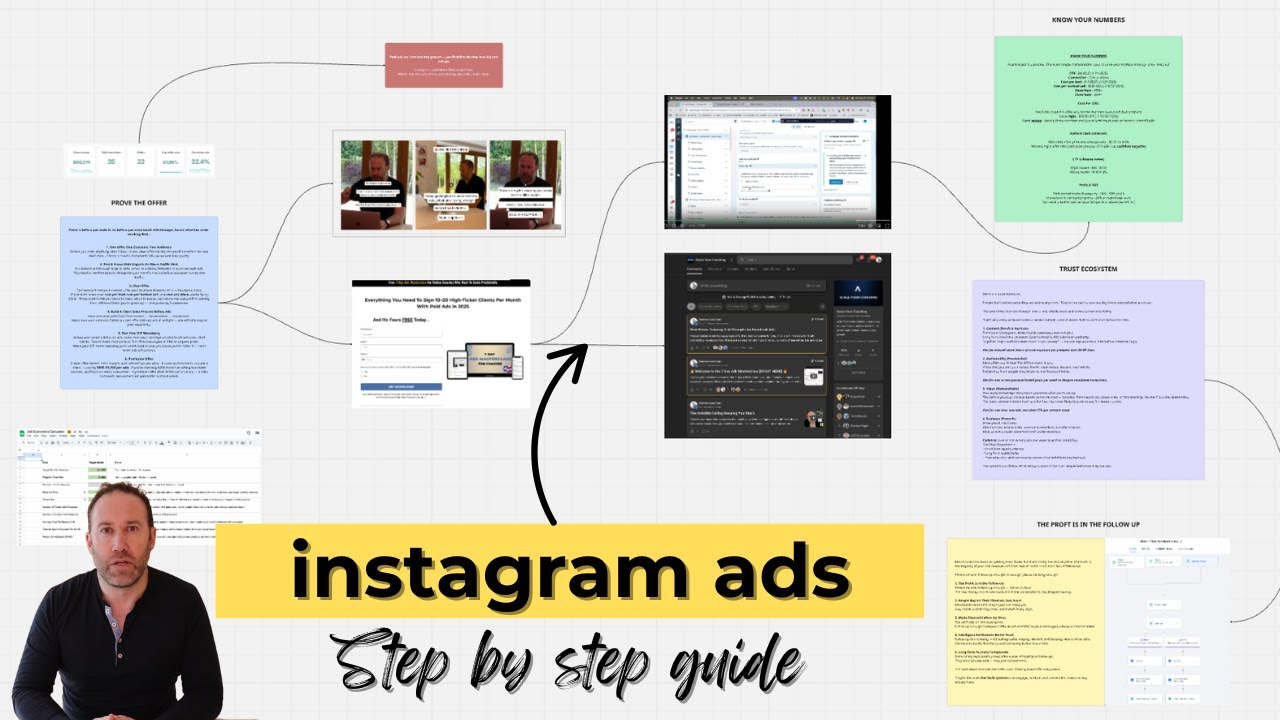
Andrew Leedham breaks down a five-step Instagram ad system for coaches: build unit economics backward from revenue goals, use simple B-roll with a qualifying question to filter leads, monitor KPIs like cost per booked call and close rate, layer in short-form content for awareness and long-form for authority, then follow up relentlessly across email, SMS, and calls.
Chapters
Last month, my Instagram ads brought in $64,000 of coaching sales. No fancy funnels, no agencies, no hidden tricks, just a simple system that works. You could set it up today. But most coaches think that either ads don't work or that their ads are broken. They either blame Meta, the algorithm, their audience, but ads don't create success. All they do is multiply what's already there, and most coaches are trying to scale a broken system rather than a profitable one. So in this video, I'm going to share with you the exact 5-step system that I used to bring in consistent $50K to $60K months, and I'll also show you the one mistake that's quietly killing profits for 90% of coaches, because until you fix this, Meta's algorithm will happily spend your money teaching itself to find you the wrong people. So let's get really clear on why we run ads in the first place. So remember that ads are simply a way of acquiring clients. Now, when you use ads as opposed to organic, you have the ability to control that. It's a lever, it's a tap that you can turn on or off on demand. So when you run paid ads, you can control how many customers you get and be in control of how much money that you make. So think of it like this, you use paid ads to buy growth, acquire new customers, but how profitable your system is defines how far you can scale because obviously as you make money, you can return that back into the system. So scaling in simple terms is just controlled profitable client acquisition. To do that, you've got to master the system and what we call your unit economics. I'll share with you a little bit about what that means. And then when you do that, scaling just becomes a simple set of mathematical rules. So the real issue isn't your ads or your funnel, it's that you're trying to scale something that hasn't yet been proven. So let's have a look at what that actually looks like, how that displays inside your business, because the problem that most people experience are really the symptoms, not the root cause. To solve this, you've got to deal with the root cause. So typically what that looks like in my clients' businesses that I— when I first start working with them is that they will have, you know, some level of leads, often pretty cheap, but their calendar won't be filled with, uh, the right people booking calls. So they'll have $5 leads, but their calendar will be empty because the pixel's learning from bad data and your ad spend is being used to find the wrong people. I'm going to show you how to fix that in this video. Often they have their number of followers going up, all the kind of what we call the vanity metrics looking great— more followers, more likes, more engagement. Nothing wrong with that, but if it doesn't turn into real business metrics— your number of sales, your number of new clients, cash collected, your return on your investment— then it really is just a pure vanity play. It's literally to say, look at how well I'm doing, but that doesn't pay your bills or put food on the table. So in response, what they'll do is they'll have endless tweaks to their ad copy, their hooks, their headlines, their ad sets, over and over. But the problem isn't their ad, which is why it's not ultimately solving the problem. It's the underlying foundations, the offer and the system that you're scaling. And when you do finally get people on calls, they're either unqualified or they're hesitant, or they, you'll often hear that I simply have to think about it. And whilst that in certain cases might be a sales issue, overwhelmingly it's the fact that it's the targeting, the system, and the underlying positioning. And so as a result, you're doing all of this work and you just feel like you're not getting any further forward. You're kind of working harder, doing lots of posting, but your profit either flatlines and stays the same or at worst kind of ultimately dips. So that's the real bottleneck. It's not necessarily your ads. It's not the targeting. It's not even Facebook. You've got to make sure that you've got the underlying foundations in place. This is the problem far more often than it's not. So you've got to prove it before you scale it. Before you get anywhere near the ads manager, you've got to make sure some fundamentals are working first. The first one is You've got to make sure your offer is right. Is your messaging clear? What problem are you solving? You've got to have one offer, one outcome, one audience. Okay, strip it back to one painful problem for one ideal client. Clarity is what helps your ads, your messaging cut through and convert. Complexity just will create confusion, slow people down, get people into the having to think about it mode. Which ultimately is what kills the conversion. Now, really importantly, and I say this over and over to people, there is very little point— you're almost certainly wasting money if you try and run ads before you've tested and proven that your offer converts with organic or warm traffic first. We always share this with our clients. You want to try and make sales through organic DMs, through your existing followers, through email, because if you can't do it there all you're really gonna be doing is spending a lot more money to find out that it doesn't work with ads either. You've gotta be in a place where you can confirm that people are gonna pay for your offer, pay for your transformation before you start spending money on ads. You gotta make sure you've got a clean sales process, okay? Do you have a clear and straightforward converting proven path from first contact to conversation to conversion? Make sure that your calendar, your follow-up, and all your offer delivery are really well dialed in and tight, because otherwise, again, all ads are going to do are going to just expose any problems, any weak links, any issues. Make sure that you've actually tested and know that your messaging lands. People buy in different ways. Some people are much more emotional buyers, some people more logical buyers, but you've got to make sure whatever the kind of headlines and the core messages that you're using to sell your offer actually work? Again, before you spend money on ads, you want to be testing that out. Talk to people who might be your ideal client, post content, test different angles creatively on your Instagram, in your social media, anywhere. When your ICP, your ideal client profile, says those same words back to you, when they say things to you where they're going, it's almost like you're reading my mind, then you know you've nailed it, and that's when you know your ads are gonna convert. Here's a really simple test, right? I found this to work over and over really well. When you're thinking about the way that your ideal client is thinking, imagine what they're getting up and worrying about at 3 in the morning. If you can speak to that challenge, go, this is what they're kind of trying to worry about, what they're trying to solve at 3 o'clock in the morning, almost certainly you're gonna have something that's high converting. Whereas if it's a kind of much more nice to have, that's gonna be a much bigger challenge. You've also, whenever you're on paid ads, again, I say this to my clients over and over, you've gotta have a high ticket offer. I think low ticket for coaching is a real challenge. It's very, very easy to get wrong. It's very easy to lose money on because you don't need too many bad days before you're quite significantly underwater. Your high ticket offer, buys you the margin, the profit to not only have a good business in and of itself, but to deal with any ups and downs from anything that Meta might do with the algorithm, to deal with any bad weeks, and then you've got the money to reinvest in the ads and truly scale. So if you're doing low ticket, it's very, very easy to lose on every transaction. So a premium offer is no longer really optional in my view, it's a must-have. It's the minimum requirement for paid traffic to really make sense. And then lastly, I'm gonna show you this in a second. You've gotta know what we call your unit economics, okay? You've gotta understand the numbers that you're trying to hit because if you don't understand those numbers, you are flying blind and it's really hard to figure out whether I should carry on with this ad, whether this ad makes sense, whether I should switch it off, okay? You've gotta know what you've gotta hit to hit your target, whether you're hitting the numbers that mean that you can hit that target at a sensible level of spend with the right level of profit, okay? Without any of that, you end up guessing, and with ads, guessing is an incredibly expensive game to play, okay? So this is our unit economics calculator, one of the most important things we go through with our clients in our program. So I strongly recommend you take a look at this. If you want a copy of this sheet, Just comment calculator below and I'll send you through a copy of it that you can download and use yourself. Now what we're trying to figure out here is how much we have to spend on ads in order to get to the outcomes that we want with our Instagram ads. So let's just say for example you want to achieve $85,000 a month in, in revenue and that your program price point is $7,500. So what that means working back from that is that you've got to sell 11.3 units of your That's why we talk about unit economics in order to achieve that $85,000. Now, now we've got that top level, that top line number, we need to figure out what that means and what are the inputs necessary to create that output. Okay, so let's assume that we have a 75% show-up rate on our calls. So we book in 100 calls and 75 people turn up. And then let's just say of those 75, we can close 30% of those, so 25, right? So that means that in order to achieve that $85,000 of revenue, we need to actually have calls, direct strategy discovery sales calls with 38 people. But in order to do that, we need to book 50 calls. Now, if we assume as a historical average that our cost per booked call from our ads is $250, then in order to generate that 50 calls, we need to spend $12,500. And if we do that, and if these numbers hold, then our ROAS is gonna be about 6.75. So ROAS, for those, anyone that doesn't know, is return on ad spend. It means that if I spend $1,000, I'm getting $6,750 back. But here's why knowing your numbers is really important. and why I'm such a big advocate of high-ticket pricing. So let's just say you take this price from $7,500 to $2,000, right? Suddenly, to get that same level of revenue, you've gotta go from $12,500 of ad spend to $47,000, okay? You can see it makes a massive, massive difference in why it's so much harder to get there. Let's just say that your show-up rate is 50% instead of 75%. Suddenly you need to spend nearly $19,000 on ads instead of $12,000 on ads. And you can work that through for each of these numbers. If your cost per booked call goes up to say being $350 instead of $250, again, you can see that it makes a significant difference. It's another $5,000 roughly on ads that you've got to spend. Okay, so knowing these numbers is really important because then you can figure out which ads are getting me there. And which ads are not. So with that in place, with a proven offer that you've run to your existing organic or warm traffic, whether that's your existing followers, people in your network, people on your email list, and you know that the messaging lands, the offer converts, and you understand your unit economics so you can figure out what the good numbers look like and what the bad numbers look like, now you're ready to run ads. So the funnel and the system is really simple. You want it to be really straight line. We want to run ads, really simple ads, and the best ones I see working right now are these what we call B-roll style ads with text over the top. These are way better performing than almost any other ads I'm looking at right now. So these are just simple videos of me, as you can see, sitting at my desk, sitting in my kitchen, writing things, tapping things on my computer, and what I'm doing is just offering a really simple structure with a benefit-driven headline and a call to action. Okay, so I'm calling out my ICP, which is online coaches. I'm doing the kind of headline that grabs their attention and appeals to what they're looking for. So you can see the first one on the left is, are you tired of not knowing where your next client is coming from? And then you can grab my free 7-day ads masterclass. Second one is you're talking about people keep getting broke leads on their ads. What am I doing wrong? Here's how to fix it. And there's 4 myths keeping you broke as an online coach. Here's how to fix it. Read the caption. So all it is is just simple, simple video of me sitting there doing something, calling out my avatar with that headline, with that call to action. Uh, there's no sound on it. It's just very, very simple. It converts the best I see with any ads right now. Okay, and then what we're doing is we're running that to a really simple conversion-based funnel. Now, the, the key way— the key thing around this is people make these funnels way too complicated, right? Way too busy. The simple, more basic landing pages will convert way better than anything fancy, anything with lots of graphics on it, anything really busy. This is the page that I use. It varies from month to month, but it converts at a minimum of 20%, and it's been as high as kind of 42-43% at its absolute peak. So I want you to see here the kind of key building blocks. We've got what we call the eyebrow, the top kind of top-level headline, which is my free 7-day ads masterclass for online coaches who want to scale predictably. Then I've got the kind of key headline, everything you need to sign 10 to 20 high-ticket clients per month with paid ads in 2025. Literally adding in the words in 2025 added another few percent to the conversion. and it's yours free today. So you can see I'm getting the first name, the email, the phone number, and really critically here, this question, are you an online coach with 5 to 10 clients and $1,000 a month to invest in ads? Now this is key and I'm gonna explain why. What I'm doing here is I'm qualifying the leads that I'm getting in. So some people are gonna answer yes to that question, some people are gonna answer no before they click on get access now. The reason why that's important is that by clicking on yes, I know that you are at least nominally a qualified lead, someone that is aligned with my ICP. And if you click no, I know you're not. Okay, because what we do with the flow from there is really important. This is how we train the pixel. So in simple terms, what happens is we have a conditional logic on the funnel, okay, which feeds back into Meta. If people say yes to that question, that they've got $1,000 a month available in ad spend, and they've got 5 to 10 clients, they are taken directly to a page where they can book in a call directly with us. And we pixel that page. So if they land on that page through that logic, that is sent back to the pixel, back to Meta to say, this is a lead. If they say no to that question, they're taken directly to our school community, both go to our school community, but the people who say no are taken directly to it. And that isn't pixeled. So the only data that Meta is getting back are the people that we're saying yes to, right? Sorry, excuse me, the people that are answering yes to that question. So over time, the only data that Meta is getting back is the relevant percentage of the people who are saying, yes to that question. Now what that's led to in really simple terms is we started off when we were first running ads to this funnel with about a, uh, about 17 or 18% of people saying yes to that question. Uh, I checked it yesterday, it's currently at about 49-50%. So we've, you know, we're pretty much at half our leads are truly qualified and it's going up by a percent or 2 every week. So that's the simple funnel. We're doing simple B-roll ads to a simple opt-in page, and then they're going to a book a call page if they say yes, and then into our school community. And then they're, they're going direct to the school community, non-pixelled, if they say no. So we're only feeding back the relevant data. So step 1 is prove the offer. Step 2 is that simple conversion-based funnel. Step 3 is to feed the algorithm only the qualified data back so it trains and gets gets the right data to learn better and get smarter. You're training the algorithm right to find you qualified people. Now next, as you're running your ads, you have to know your numbers. You've got your inputs from your unit economics calculator, and now you've got to start to monitor how the ads are doing. This is a really simple mathematical process. Use simple mathematical rules to drive your decision-making. You've got to be data-led, not emotion-led, right? There are so many times where an ad that you think is not gonna do well will absolutely knock it out the park, and equally ads that you think you're gonna do amazingly just completely flop. Data is what counts. It's never about anything other than that when you're making your decision. So simple track, simple metrics to track your click-through rate. It needs to be 2% on your ad if it's a B2C offer, 1% B2B. Your conversion should be a minimum of 15% or above. Your cost per lead should be, uh, $15, uh, target if it's a business-to-consumer, so health, relationship, mindset, etc., or $250— excuse me, or $20 if it's B2B. Book call is $200 for B2C, $250 for B2B. Your show rate should be a minimum of 65%. There's something wrong if that's not the case. And your close rate should be a minimum of 20%. So you've gotta get all of those dialed in, done right. Your cost per sale, your cost to acquire, get a new customer on board should be a target of around $1,000 for B2C. High ticket pricing really is important. And $2,000 for B2B. Done wrong, you can double those numbers and you can easily fall into being unprofitable. Okay, get the offer right. Your upfront cash to feed your ads machine to help you scale profitably and cash flow positively. You wanna be getting $2.5K to $10K upfront. If you don't have those things dialed in, you can easily be in a cash flow negative state. Also be aware of your lifetime value. Again, the right model, that should be $5K to $25K. Wrong model, $1K to $5K. Again, the system starts to come under pressure. Okay. Build everything right. Your profit margin, we want a minimum of 50%, but you do it right, you should be kind of heading more towards 80% profit. And if your structure isn't right, I know plenty of people that wipe out their profit every month or just break even. Your KPI should be a minimum of 3 times ROI cash on your ad spend, okay? And we really target 5, but 3 is the minimum. So now we've got everything set up, we've got the ads running, we know the numbers to monitor, we've got to make sure that we've got a conversion mechanism in place to turn people from a lead to a true prospect to a true client, okay? Now think of ads as being just simply the entry point to the system. Too many coaches think of ads as the system, not as the entry point to an overall conversion mechanism that takes people through to the point where they're ready to buy. So you need to have a trust ecosystem that takes people from a place where they've just got to know you to they, uh, they've got— they've built that know, like, and trust, and they're ready to work with Okay, we are in a trust recession right now. No one believes a word that anyone says online, and they've learned to tune out all the big claims and the, I'm going to get you loads of clients in, you know, 10 minutes flat and you're going to make loads of money, right? No one believes any of that. The only thing that cuts through now is real visible proof and content trust building. So you need to have strategic content assets to earn trust before the sale. That means in really simple terms, you've got to have short-form content assets, which are things on Instagram to build the awareness and curiosity. Think of that as the entry point along with your ads. And then you've got to have the long-form content, that's YouTube, podcasts, school, free training that builds belief and authority. And together they create the kind of trust runway, which covers the average exposure time that people need before someone buys. So there's a Google study that said people need to consume 7 hours of content from you before they are ready to buy. So if you think of my system, I've got the 7-Day Ads Masterclass that I think is something like 8 or 9 hours of content. I've got my YouTube channel, I've got my Instagram, uh, Instagram page with all of the different reels, videos, trust-building content, strategic assets that get people from that place where they've just met me to the point where they're ready to buy as soon as possible. So you wanna get that 7 hours of total exposure over 30 to 60 days. The more you can compress that, content volume matters, the more you're gonna shorten that time, okay? It doesn't have to take 60 days, it's just about getting it done as soon as possible. Now, it's not a matter of just doing any content, the kind of content really matters. There's a really simple framework for you to follow, which is all about making sure that you cover Uh, your authenticity. It's not— systems are the same with lots of people. They've got to get to know you. Most offers are similar. You're the thing that stands out. Show who you are. Bring your personality. Share about your background, your experiences, your lessons, the good stuff and the bad stuff, and how you build back up. People buy from people, not faceless brands, okay? It's no longer good about being a company. You've got to be a personal brand. It's It's not even negotiable anymore, it's just a must-have. So you want 1 to 2 personal brand posts per week to deepen that emotional connection, okay? You wanna make sure you're delivering value. Demonstrate the knowledge that proves that you know what you're doing. Think of this as very much a try before you buy, but at scale. So my school community, and I think school is fantastic for this, has that free training that I offer. It's delivering at scale the try before you buy rather than me having to do one-on-one calls. That content builds huge trust. When I'm talking to people, often when they've gone through that, when they've watched my other YouTubes and binge-watched it, they will come on just ready to buy, okay? It's just a very, very powerful authority content trust-driven way of doing things. The more someone learns from you for free, the more likely they are to pay for deeper access, okay? So keep it really simple, just aim for one idea, one win, One call to action per content asset, and I really encourage you to think about your your content as assets, strategic assets that drag people in, get people ready to buy from you. And then the the last bit is evidence. Prove it. Show proof, not claims. The more you can show client results, testimonials, revenue screenshots, transformations, when you back it up with visible evidence, it really helps. Okay? So you want to just have all of that to build that credibility. Short form creates the interest, long form builds the belief and trust, and the free education and community in something like Skool turns that belief into buying-level trust. Okay, so all these systems are similar. What sets you apart is how people feel when they trust you. Now here's the final part of this system that is so important and is in many ways the most often overlooked, and that is the power of follow-up. Okay, most businesses focus on the top of the funnel, getting more leads in, but it's rarely the real problem. The key area to focus for most businesses is, again, once we've got all the basics set up, is how do we nurture and keep coming back to those leads as many times as we need to in order to convert those leads that we've paid for into clients? Okay, so the majority of your lost revenue isn't from a lack of traffic, it's from a lack of follow-up. If there's one area of your business to make sure you get right, it's making sure you follow up effectively. Almost no one that I've worked with follows up enough, in enough places for long enough. Okay, so it's not about new leads, it's about the conversations that you let go of. Okay, gotta remember, people buy on their timeline, not yours. When they first start to interact with your content, with your funnel, they may or may not be quite ready to buy. Maybe they're moving house, maybe they're going through a divorce. Maybe times are just a bit tougher, but they really like what you're talking about. They know they need it, but they're not quite ready yet. If you let it go at that one point in time, you're missing out on the fact that down the line, they could be an absolute paying customer that's gonna be right. I've had people come back to me after a year and pay me $10,000 simply because I followed up repeatedly. Okay, so you wanna stay visible until the timing, trust, and belief is there take away this idea of leads just simply being cold and more like they're not ready yet. Okay, and that's why we don't simply just want to have a funnel, but we want to have an ecosystem that people stay in for a long period of time. It's the really key, key point. Multi-channel follow-up wins a lot. So I have multiple touch points. I'm going to show you in a second what I have in my school for the follow-up when people opt in. We have emails, SMS, For some people, we will follow up and call them. We have the school follow-up and how we connect with people in there. Don't just rely on one touchpoint of an email, but make sure you've got the Instagram DMs so you're always front of mind. And then intelligently be persistent. It's not a matter of just harassing people. It's at the right time with the right cadence in a way that feels kind of normal and natural. You wanna keep following up. It's about adding value. It's about staying relevant and keeping that relationship alive, just like you'd follow up with a good friend. That consistency builds the familiarity, and it's the familiarity that builds the conversion. Okay. Think of all this together as a long-term compounding asset, and this is why personal brands are so important. Like any relationship, relationships where you have the ongoing interaction deepen over time. And so when you've got people coming in, the more this happens, the deeper that trust builds, and more and more people are going to be ready to work with you and buy from you. Okay, so, um, the more you do this, the more you follow that intelligent follow-up, the more you'll get people ready, because they weren't just— they were already sold, but they just needed time to get ready. Okay, the businesses that win aren't the ones chasing just new leads. They're the ones that build those systems to re-engage, to nurture and to convert the audience that they already have. When you fix this, you stop relying on luck. Your ads start working because, as I said, it's— the ads aren't the system, they're the entry point to the system. When you've got the foundations right, when you've got the follow-up and nurture right, that's when the ads start to make sense. So if this is when you can predict and control your leads, your calls, your clients, and your income, and you stop being in that place where you're kind of just wondering where your next client's going to come from. Our clients who apply this go from those feast and famine months to engineering their own growth, from chasing clients to having a solid pipeline of predictable clients coming through ready to work with them so that they can choose the best clients to work with and make sure they get the best results and create that positive flywheel. So that's how you make ads work. A lot of it isn't to do with the ads itself, it's about what you do before and after the ads run Remembering that ads are just the entry point to the system, not the system itself. You've got to prove your offer, you've got to build a simple, high-converting funnel, you've got to have authentic natural ads that get people ready to buy and call them out directly, and you've got to have both a trust ecosystem that warms people up and a follow-up system that makes sure you connect with the right people who've built enough buy-ready trust to start working with you. Keep it simple, get the basics right first, and then your ads will work wonderfully. If it's something I can help with, there's a link in the description below. We'd love to talk to you and see how we can help you scale. I'll see you in the next video.